REVIEW 4 major objections 202 references
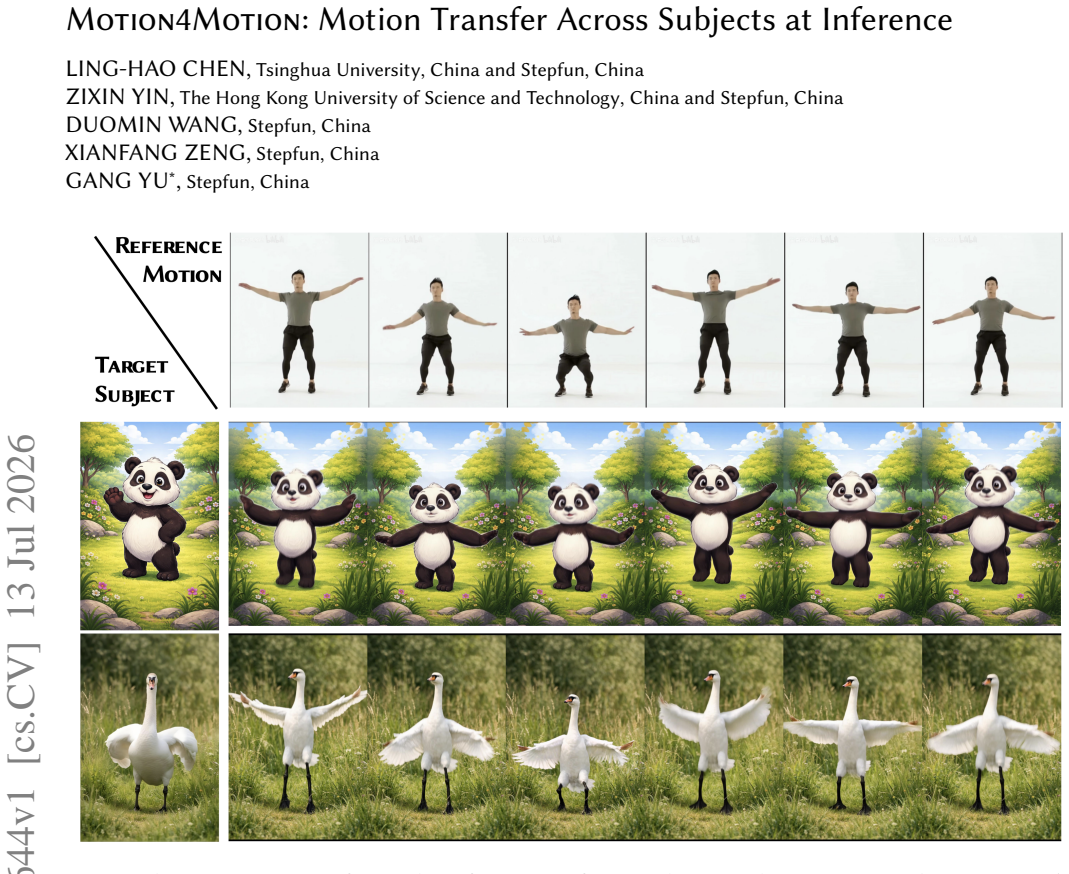
Motion can be transferred across subjects of any shape at inference by injecting pixel motion flows into a video diffusion model, without skeletons or training.
Reviewed by Pith at T0; open to challenge. T0 means a machine referee read the full paper against a public rubric. the ladder, T0–T4 →
Training-free motion transfer across species works by extracting source motion flows, matching semantic points, and injecting them into DiT self-attention via TransPE positional padding.
T0 review reviewed 2026-07-14 challenge →
load-bearing objection Clean training-free TransPE recipe that actually moves the needle on cross-species video motion transfer; the matching step is the real soft underbelly. the 4 major comments →
Motion4Motion: Motion Transfer Across Subjects at Inference
The pith
A machine-rendered reading of the paper's core claim, the machinery that carries it, and where it could break.
The reading
Core claim
Motion4Motion is a training-free framework that achieves high-fidelity motion transfer across general subjects, including different species and non-human morphologies, by representing motion as dense pixel-level flows rather than skeletons and injecting those flows into a diffusion transformer’s self-attention via Transferring Positional Encoding (TransPE), with no model fine-tuning required.
What carries the argument
TransPE (Transferring Positional Encoding): during denoising the query stays unchanged while key and value tensors are concatenated with the target subject’s appearance features, re-embedded by rotary positional encoding along the source motion trajectories; this places the target’s look at the coordinates dictated by the source flow.
Load-bearing premise
The method assumes automatic point matching and tracking reliably link corresponding body parts across very different shapes, so the injected trajectories land on the right places of the target.
What would settle it
On a held-out set of cross-species pairs with ground-truth part labels (e.g., dog legs to giraffe legs), if matched points systematically land on wrong parts and the generated videos show limbs moving out of semantic correspondence while skeleton-based methods do not, the claim that skeleton-free flow injection is sufficient would fail.
If this is right
- Creators can animate non-human or non-animal subjects from ordinary reference videos without building new skeletons.
- Cross-morphology concept composition (for example a desk that walks) becomes practical by binding semantic parts with masks.
- Existing video diffusion models can be used for motion control without collecting topology-specific paired data.
- Per-video optimization and skeleton detectors are unnecessary for many retargeting tasks.
Where Pith is reading between the lines
- If point matching remains the bottleneck, combining sparse learned correspondences with TransPE could bridge larger morphological gaps.
- The same attention-padding pattern could move other attributes (style, lighting) by choosing which features are re-positioned.
- Systematic failure cases on heavy occlusion or extreme articulation would map the practical limits of training-free diffusion control more clearly than current animal/human benchmarks.
Editorial analysis
A structured set of objections, weighed in public.
Referee Report
Summary. The paper proposes Motion4Motion, a training-free inference-time method for transferring motion from a source video to a target subject (including cross-species and non-human morphologies) without skeletal priors. It extracts dense motion flows via SAM-2 anchors, DIFT-based cross-image matching, and point tracking, then injects the resulting target trajectories into a WAN DiT’s self-attention through a TransPE module that concatenates RoPE-repositioned appearance keys/values (Eqs. 2–3, Alg. 1). Experiments on human/animal splits, a new 50-pair pose-similarity set, a 10-rater user study, and a table-walking application report gains over FlexiAct, MotionClone, RoPECraft, and MotionDirector on TS/MF/TC/AC/PS.
Significance. Removing the shared-skeleton assumption for video motion transfer is a practically important step for animation and digital creation with diverse characters. A training-free DiT attention intervention that can retarget motion across species and, with care, to inanimate objects would be a useful tool for the community. Strengths include a clear algorithmic pipeline (Alg. 1), quantitative tables plus a blind pairwise user study, and an explicit novel-composition application. The contribution is primarily engineering and empirical rather than theoretical; its lasting value hinges on whether the correspondence stage is reliable enough to support the “general subjects” claim.
major comments (4)
- Sec. 3.2–3.3 and the composite mapping M = I ∘ C⁻¹: the central claim of morphology-agnostic transfer rests on DIFT semantic matching of SAM-2 anchors plus DIFT tracking. The manuscript never reports matching precision, failure rate, or correspondence error as a function of morphological distance (dog↔lion, fox↔giraffe, human legs↔table). Without this, the large PS gain in Table 1 (0.543) and the “general subjects” claim cannot be attributed cleanly to TransPE rather than to favorable matches on the chosen pairs.
- Sec. 5 (table-walking application): the paper explicitly resorts to manual SAM-2 “bone binding” masks to make the human→table case tractable, stating that pure matching is insufficient under large structural disparity. This is a load-bearing admission: the flagship cross-morphology result is not fully automatic. The abstract and contribution bullets should state the degree of manual correspondence required, and automatic vs. bound results should be separated in evaluation.
- Sec. 4.1.2 vs. Table 1: the text claims comparison with training-required trajectory methods Diffusion-As-Shader and WAN-Move, yet Table 1 reports only MotionDirector, RoPECraft, MotionClone, and FlexiAct. Either add those numbers under a fair protocol (or explain why they are inapplicable) or remove the claim of outperforming them; otherwise the “outperform baselines impressively” statement is incomplete.
- Sec. 4.1.1 free parameters (manipulation step range [0,35], layer range [0,40], number of anchors N): Fig. 7 ablates only the step cutoff. There is no sensitivity analysis for N or layer range, nor any failure-mode analysis when matching is noisy. Because these knobs directly control where appearance is injected (Eqs. 2–3), a short ablation or default-robustness check is needed to support reproducibility of the Table 1 gains.
Circularity Check
No circularity: training-free attention construction evaluated on external benchmarks, not a self-referential derivation.
full rationale
Motion4Motion presents an engineering pipeline (DIFT/SAM-2 correspondence + motion-flow extraction + TransPE key/value padding inside WAN DiT self-attention, Eqs. 2–3 and Alg. 1) that is applied at inference and scored against external video pairs, Co-tracker trajectories, CLIP metrics, a pose detector, and human raters (Table 1, Sec. 4). No parameter is fitted to a subset of the evaluation data and then re-presented as a prediction; no uniqueness theorem or ansatz is imported from the authors’ prior work to force the numerical scores; the composite mapping M = I ∘ C⁻¹ is an operational definition of the control signal, not a claimed first-principles derivation that reduces to its own inputs. Self-citations (e.g., Motion2Motion, HumanMAC) appear only as background related work and do not underwrite the central empirical claims. The method is therefore self-contained against external benchmarks and exhibits zero circularity of the kinds enumerated.
Axiom & Free-Parameter Ledger
free parameters (3)
- attention-manipulation step range =
steps 0–35
- attention-manipulation layer range =
layers 0–40
- number of anchor points N
axioms (3)
- domain assumption 3D RoPE makes self-attention locally position-sensitive, so re-encoding keys with new trajectories relocates appearance features.
- domain assumption Diffusion features (DIFT) plus SAM-2 yield sufficiently accurate semantic correspondences across species.
- domain assumption Deterministic inversion of a generated or I2V video recovers a usable noise latent for subsequent editing.
invented entities (1)
-
TransPE (Transferring Positional Encoding)
no independent evidence
Cite this review
Pith. "Pith review of Motion4Motion: Motion Transfer Across Subjects at Inference." pith.science (2026). https://pith.science/paper/6UFDSBR2
@misc{pith2026260711644,
  author       = {Pith},
  title        = {Pith review of: Motion4Motion: Motion Transfer Across Subjects at Inference},
  year         = {2026},
  howpublished = {\url{https://pith.science/paper/6UFDSBR2}},
  note         = {Machine review of arXiv:2607.11644}
}
read the original abstract
This work explores the motion transfer from one video to another, which is crucial in animation for diverse characters. Previously, video motion transfer has been largely explored between human and human-like characters, enabling a lot of applications in digital creation. However, these approaches encounter a main limitation. Specifically, related technical pipelines heavily rely on a predefined human skeleton structure and accordingly require skeleton-conditional model training. On the one hand, these methods are difficult to generalize to diverse characters, such as animals from different species, while preserving their unique motion styles. On the other hand, labeled data in diverse skeletons is limited, which additionally restricts the large-scale training for the task. In this paper, we jump out of the skeleton-based motion transfer framework and propose a training-free motion transfer framework, named Motion4Motion. Motion4Motionmodels the motion flow of the character in a video instead of skeletons, which makes motion transfer across species easier. Extensive experimental results and novel applications show our methods outperform baselines impressively. Project page is available at https://lhchen.top/Motion4Motion.
Figures


Reference graph
Works this paper leans on
-
[1]
Patricia S. Abril and Robert Plant. The patent holder's dilemma: Buy, sell, or troll?. Communications of the ACM. doi:10.1145/1188913.1188915
-
[2]
Deciding equivalances among conjunctive aggregate queries
Sarah Cohen and Werner Nutt and Yehoshua Sagic. Deciding equivalances among conjunctive aggregate queries. doi:10.1145/1219092.1219093
-
[3]
Special issue: Digital Libraries. 1996
1996
-
[4]
Understanding Policy-Based Networking
David Kosiur. Understanding Policy-Based Networking
-
[7]
The title of book two. doi:10.1007/3-540-09237-4
-
[8]
Asad Z. Spector. Achieving application requirements. Distributed Systems. doi:10.1145/90417.90738
-
[9]
Douglass and David Harel and Mark B
Bruce P. Douglass and David Harel and Mark B. Trakhtenbrot. Statecarts in use: structured analysis and object-orientation. Lectures on Embedded Systems. doi:10.1007/3-540-65193-4_29
-
[10]
Donald E. Knuth. The Art of Computer Programming, Vol. 1: Fundamental Algorithms (3rd. ed.)
-
[11]
Donald E. Knuth. The Art of Computer Programming
-
[12]
Structured Variational Inference Procedures and their Realizations (as incol)
Dan Geiger and Christopher Meek. Structured Variational Inference Procedures and their Realizations (as incol). Proceedings of Tenth International Workshop on Artificial Intelligence and Statistics, The Barbados
-
[13]
Stan W. Smith. An experiment in bibliographic mark-up: Parsing metadata for XML export. Proceedings of the 3rd. annual workshop on Librarians and Computers
-
[14]
Catch me, if you can: Evading network signatures with web-based polymorphic worms
Matthew Van Gundy and Davide Balzarotti and Giovanni Vigna. Catch me, if you can: Evading network signatures with web-based polymorphic worms. Proceedings of the first USENIX workshop on Offensive Technologies
-
[15]
Sten Andler. Predicate Path expressions. Proceedings of the 6th. ACM SIGACT-SIGPLAN symposium on Principles of Programming Languages. doi:10.1145/567752.567774
-
[16]
LOGICS of Programs: AXIOMATICS and DESCRIPTIVE POWER
David Harel. LOGICS of Programs: AXIOMATICS and DESCRIPTIVE POWER
-
[17]
Anisi , title =
David A. Anisi , title =
-
[18]
Clarkson
Kenneth L. Clarkson. Algorithms for Closest-Point Problems (Computational Geometry)
-
[19]
Introduction to Bayesian Statistics
Harry Thornburg. Introduction to Bayesian Statistics. 2001
2001
-
[20]
CLIFFORD: a Maple 11 Package for Clifford Algebra Computations, version 11
Rafal Ablamowicz and Bertfried Fauser. CLIFFORD: a Maple 11 Package for Clifford Algebra Computations, version 11. 2007
2007
-
[21]
Stats and Analysis
Poker-Edge.Com. Stats and Analysis. 2006
2006
-
[22]
A more perfect union
Barack Obama. A more perfect union
-
[23]
The fountain of youth
Joseph Scientist. The fountain of youth
-
[24]
Solder man
Dave Novak. Solder man. ACM SIGGRAPH 2003 Video Review on Animation theater Program: Part I - Vol. 145 (July 27--27, 2003). doi:10.945/woot07-S422
2003
-
[25]
Interview with Bill Kinder: January 13, 2005
Newton Lee. Interview with Bill Kinder: January 13, 2005. Comput. Entertain. doi:10.1145/1057270.1057278
-
[26]
The Enabling of Digital Libraries
Bernard Rous. The Enabling of Digital Libraries. Digital Libraries
-
[28]
(new) Finding minimum congestion spanning trees , journal =
Werneck, Renato and Setubal, Jo\. (new) Finding minimum congestion spanning trees , journal =. doi:10.1145/351827.384253 , acmid = 384253, publisher =
-
[30]
Conti, Mauro and Di Pietro, Roberto and Mancini, Luigi V. and Mei, Alessandro , title =. Inf. Fusion , volume =. 2009 , issn =. doi:10.1016/j.inffus.2009.01.002 , acmid =
-
[31]
Li, Cheng-Lun and Buyuktur, Ayse G. and Hutchful, David K. and Sant, Natasha B. and Nainwal, Satyendra K. , title =. CHI '08 extended abstracts on Human factors in computing systems , year =. doi:10.1145/1358628.1358946 , acmid =
-
[32]
, title =
Hollis, Billy S. , title =. 1999 , isbn =
1999
-
[33]
Goossens, Michel and Rahtz, S. P. and Moore, Ross and Sutor, Robert S. , title =. 1999 , isbn =
1999
-
[34]
and Rosenberg, Arnold L
Buss, Jonathan F. and Rosenberg, Arnold L. and Knott, Judson D. , title =. 1987 , source =
1987
-
[35]
CHI '08: CHI '08 extended abstracts on Human factors in computing systems , year =
, note =. CHI '08: CHI '08 extended abstracts on Human factors in computing systems , year =
-
[36]
Algorithms for Closest-Point Problems (Computational Geometry) , year =
Clarkson, Kenneth Lee , advisor =. Algorithms for Closest-Point Problems (Computational Geometry) , year =
-
[37]
SIGCOMM Comput. Commun. Rev. , year =
-
[38]
IEEE TCSC Executive Committee , booktitle =. 2004 , isbn =. doi:http://dx.doi.org/10.1109/ICWS.2004.64 , acmid =
-
[39]
Distributed systems (2nd Ed.) , year =
-
[40]
, title =
Petrie, Charles J. , title =. 1986 , source =
1986
-
[41]
Donald E. Knuth. Seminumerical Algorithms. 1981
1981
-
[42]
E-commerce and cultural values , year =
Kong, Wei-Chang , Title =. E-commerce and cultural values , year =
-
[43]
E-commerce and cultural values , year =
Kong, Wei-Chang , type =. E-commerce and cultural values , year =
-
[44]
Chapter 9 , booktitle =
Kong, Wei-Chang , editor =. Chapter 9 , booktitle =
-
[45]
E-commerce and cultural values , editor =
Kong, Wei-Chang , title =. E-commerce and cultural values , editor =. 2003 , isbn =
2003
-
[46]
E-commerce and cultural values - (InBook-num-in-chap) , chapter =
Kong, Wei-Chang , editor =. E-commerce and cultural values - (InBook-num-in-chap) , chapter =. 2004 , address =
2004
-
[47]
E-commerce and cultural values (Inbook-text-in-chap) , chapter =
Kong, Wei-Chang , editor =. E-commerce and cultural values (Inbook-text-in-chap) , chapter =. 2005 , address =
2005
-
[48]
E-commerce and cultural values (Inbook-num chap) , chapter =
Kong, Wei-Chang , editor =. E-commerce and cultural values (Inbook-num chap) , chapter =. 2006 , address =
2006
-
[49]
Microelectron
Mehdi Saeedi and Morteza Saheb Zamani and Mehdi Sedighi , title =. Microelectron. J. , volume =. 2010 , pages =
2010
-
[50]
Mehdi Saeedi and Morteza Saheb Zamani and Mehdi Sedighi and Zahra Sasanian , title =. J. Emerg. Technol. Comput. Syst. , volume =
-
[51]
Kirschmer, Markus and Voight, John , title =. SIAM J. Comput. , issue_date =. 2010 , issn =. doi:https://doi.org/10.1137/080734467 , acmid =
-
[52]
Hoare, C. A. R. , title =. Structured programming (incoll) , editor =. 1972 , isbn =
1972
-
[53]
History of programming languages I (incoll) , editor =
Lee, Jan , title =. History of programming languages I (incoll) , editor =. 1981 , isbn =. doi:http://doi.acm.org/10.1145/800025.1198348 , acmid =
-
[54]
, title =
Dijkstra, E. , title =. Classics in software engineering (incoll) , year =
-
[55]
Wenzel, Elizabeth M. , title =. Multimedia interface design (incoll) , year =. doi:10.1145/146022.146089 , acmid =
-
[56]
, title =
Mumford, E. , title =. Critical issues in information systems research (incoll) , year =
-
[57]
and Golden, Donald G
McCracken, Daniel D. and Golden, Donald G. , title =. 1990 , isbn =
1990
-
[58]
The analysis of linear partial differential operators
H. The analysis of linear partial differential operators. 1985 , PAGES =
1985
-
[59]
IEEE", address =
A. Adya and P. Bahl and J. Padhye and A.Wolman and L. Zhou , title =. Proceedings of the IEEE 1st International Conference on Broadnets Networks (BroadNets'04) , publisher = "IEEE", address = "Los Alamitos, CA", year =
-
[60]
I. F. Akyildiz and W. Su and Y. Sankarasubramaniam and E. Cayirci , title =. Comm. ACM , volume = 38, number = "4", year =
-
[61]
I. F. Akyildiz and T. Melodia and K. R. Chowdhury , title =. Computer Netw. , volume = 51, number = "4", year =
-
[62]
ACM", address =
P. Bahl and R. Chancre and J. Dungeon , title =. Proceeding of the 10th International Conference on Mobile Computing and Networking (MobiCom'04) , publisher = "ACM", address = "New York, NY", year =
-
[63]
8 (Special Issue on Sensor Networks)
D. Culler and D. Estrin and M. Srivastava , title =. IEEE Comput. , volume = 37, number = "8 (Special Issue on Sensor Networks)", publisher = "IEEE", address = "Los Alamitos, CA", year =
-
[64]
Natarajan and M
A. Natarajan and M. Motani and B. de Silva and K. Yap and K. C. Chua , title =. Network Architectures , editor =. 960935712
-
[65]
Tzamaloukas and J
A. Tzamaloukas and J. J. Garcia-Luna-Aceves , title =
-
[66]
Zhou and J
G. Zhou and J. Lu and C.-Y. Wan and M. D. Yarvis and J. A. Stankovic , title =
-
[67]
Mapping Powerlists onto Hypercubes
Jacob Kornerup. Mapping Powerlists onto Hypercubes. 1994
1994
-
[68]
Automatic Parallelization for Distributed-Memory Multiprocessing Systems
Michael Gerndt. Automatic Parallelization for Distributed-Memory Multiprocessing Systems
-
[69]
J. E. Archer, Jr. and R. Conway and F. B. Schneider. User recovery and reversal in interactive systems. ACM Trans. Program. Lang. Syst
-
[70]
D. D. Dunlop and V. R. Basili. Generalizing specifications for uniformly implemented loops. ACM Trans. Program. Lang. Syst
-
[71]
Heering and P
J. Heering and P. Klint. Towards monolingual programming environments. ACM Trans. Program. Lang. Syst
-
[72]
Donald E. Knuth. The book
-
[73]
Korach and D
E. Korach and D. Rotem and N. Santoro. Distributed algorithms for finding centers and medians in networks. ACM Trans. Program. Lang. Syst
-
[74]
: A Document Preparation System
Leslie Lamport. : A Document Preparation System
-
[75]
F. Nielson. Program transformations in a denotational setting. ACM Trans. Program. Lang. Syst
-
[76]
Brian K. Reid. A high-level approach to computer document formatting. Proceedings of the 7th Annual Symposium on Principles of Programming Languages
-
[77]
Zhou, Gang and Wu, Yafeng and Yan, Ting and He, Tian and Huang, Chengdu and Stankovic, John A. and Abdelzaher, Tarek F. , title =. ACM Trans. Embed. Comput. Syst. , issue_date =. doi:10.1145/1721695.1721705 , acmid = 1721705, publisher =
-
[78]
Institutional members of the Users Group
-
[79]
Boris Veytsman , title =
-
[80]
Robin Schneider , title =
-
[81]
and Peterson, Larry L
Bowman, Mic and Debray, Saumya K. and Peterson, Larry L. , title =. ACM Trans. Program. Lang. Syst. , volume =. 1993 , doi =
1993
-
[82]
TUGboat , volume =
Braams, Johannes , title =. TUGboat , volume =
-
[83]
Post Congress Tristesse
Malcolm Clark. Post Congress Tristesse. TeX90 Conference Proceedings
-
[84]
ACM Trans
Herlihy, Maurice , title =. ACM Trans. Program. Lang. Syst. , volume =. 1993 , doi =
1993
This paper was first reviewed by grok-4.5 on July 14, 2026.
discussion (0)
Sign in with ORCID, Apple, or X to comment. Anyone can read and Pith papers without signing in.