Probing the neutrino chemical potential with cosmological observations
Pith reviewed 2026-06-29 03:30 UTC · model grok-4.3
The pith
BBN data prefer a positive electron neutrino degeneracy parameter at 95% confidence in non-degenerate models.
A machine-rendered reading of the paper's core claim, the machinery that carries it, and where it could break.
Core claim
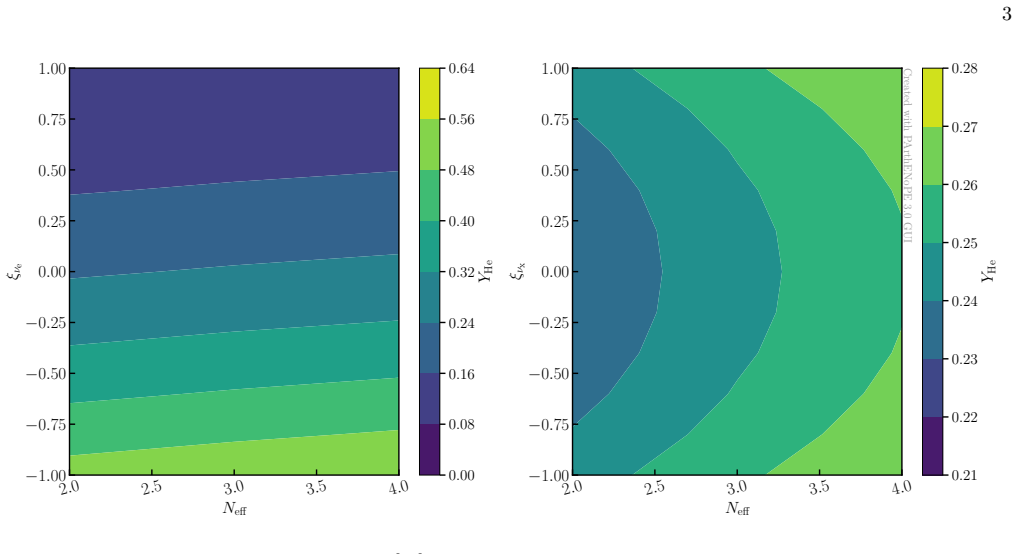
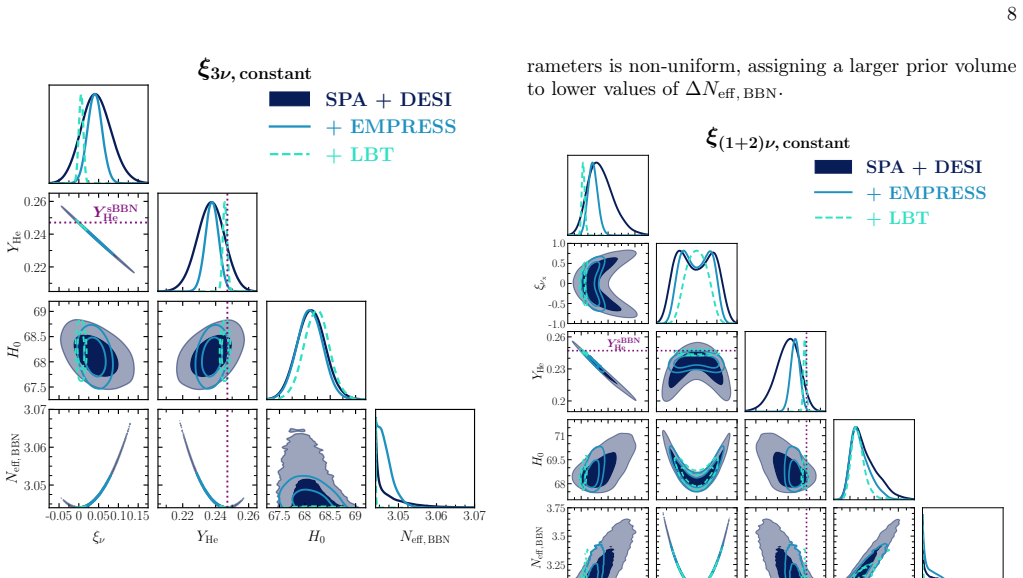
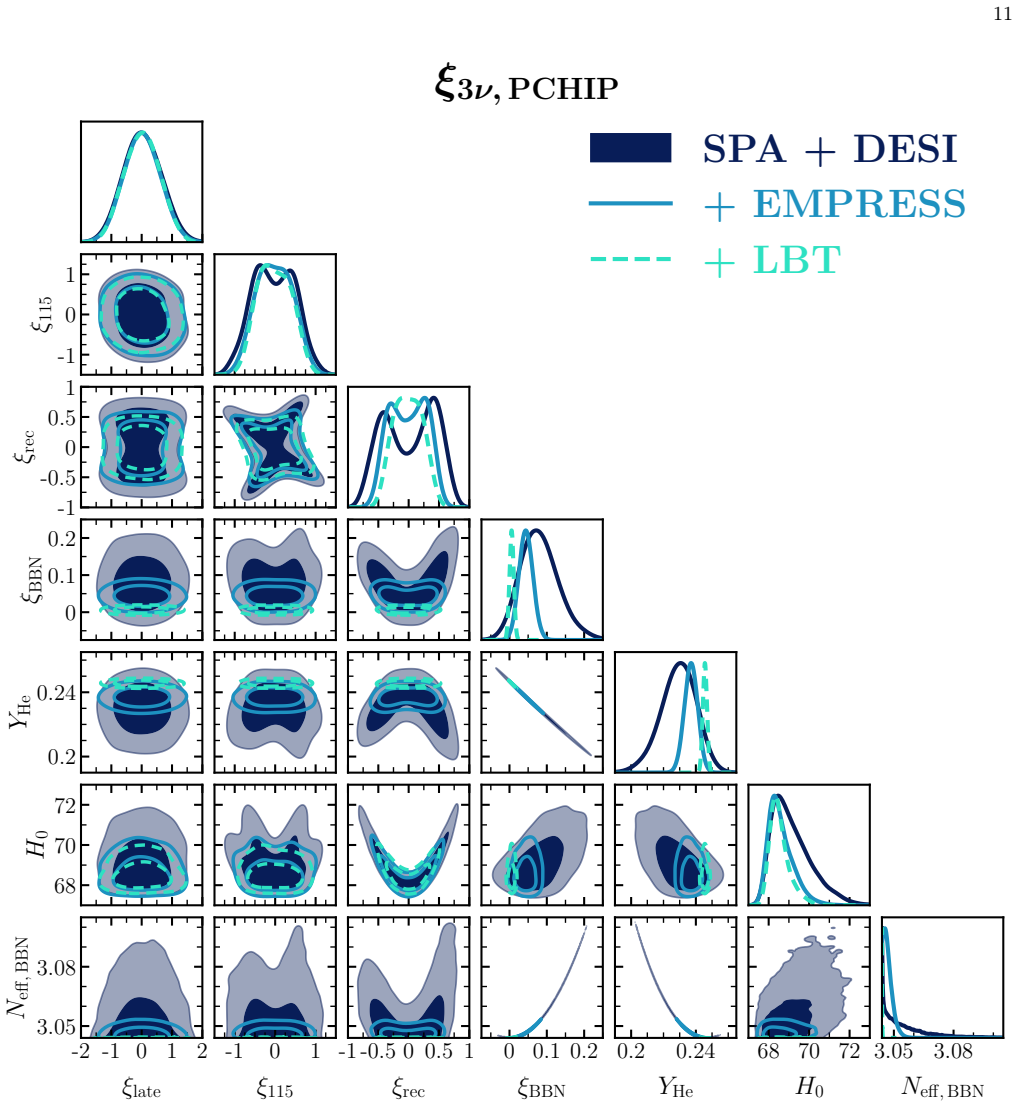
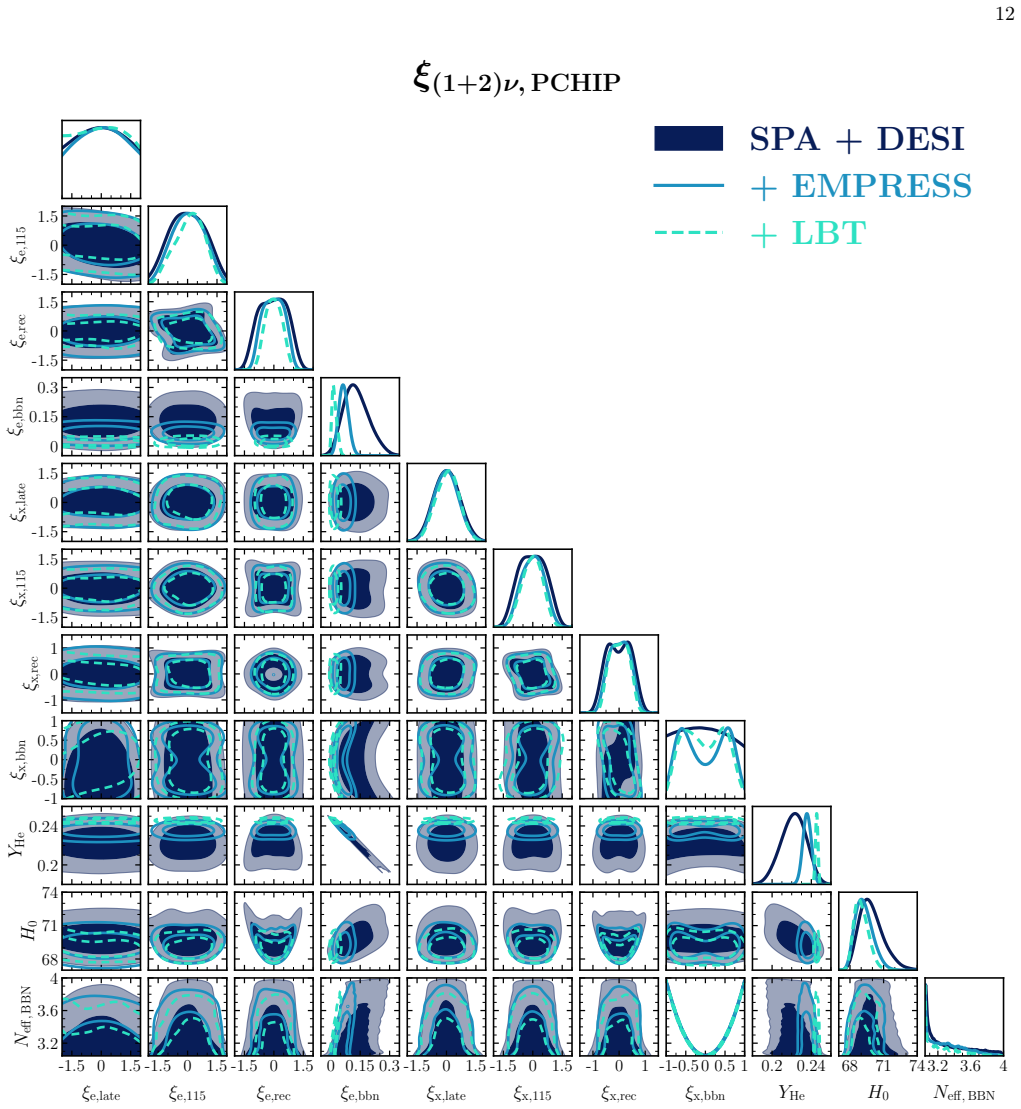
The BBN data, via the change in neutron-to-proton interconversion rates, mostly constrain ξ_νe, parameter for which we observe a preferred non-zero positive value at 95% C.L. in the non-degenerate neutrino case at the BBN period. The analysis distinguishes the constant and redshift-dependent cases as well as the three-degenerate versus differentiated neutrino scenarios and shows the impact of using EMPRESS BBN results that allow non-zero chemical potential versus LBT results compatible with zero.
What carries the argument
The modification of neutron-to-proton interconversion rates by the electron neutrino degeneracy parameter ξ_νe during Big Bang Nucleosynthesis.
If this is right
- BBN observations constrain ξ_νe more strongly than ξ_νx in the differentiated-neutrino case.
- A positive ξ_νe at BBN permits larger values of the Hubble constant through its correlation with N_eff.
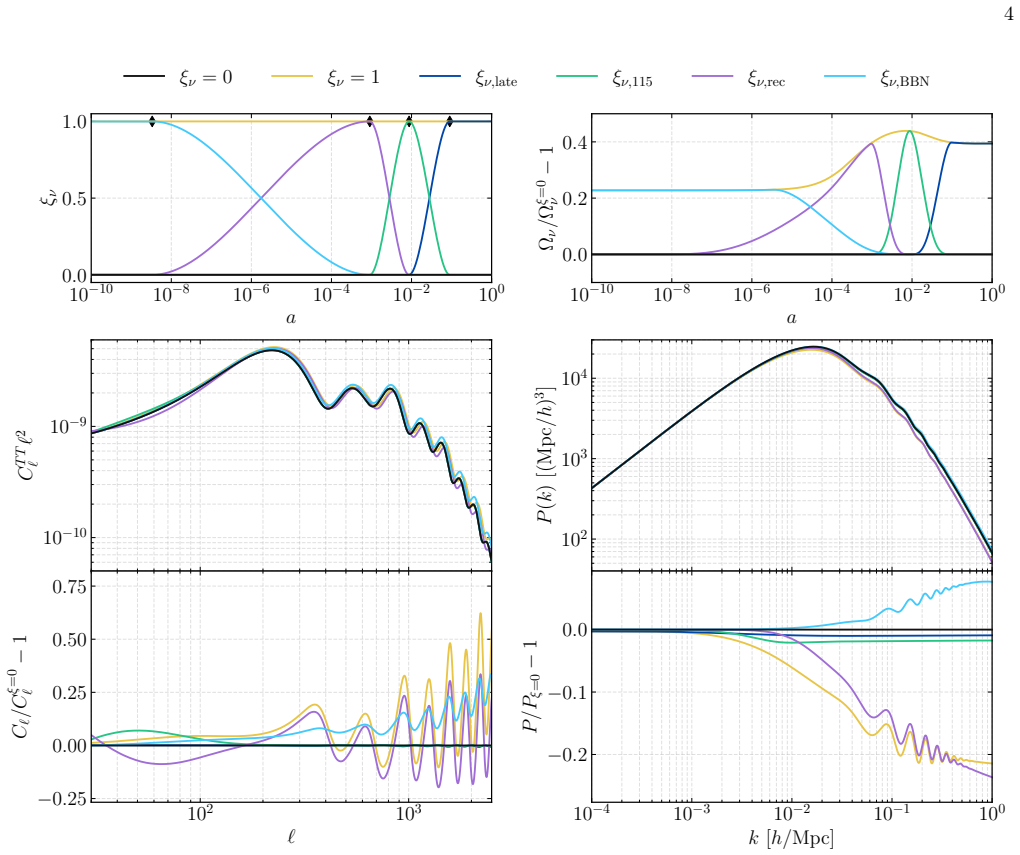
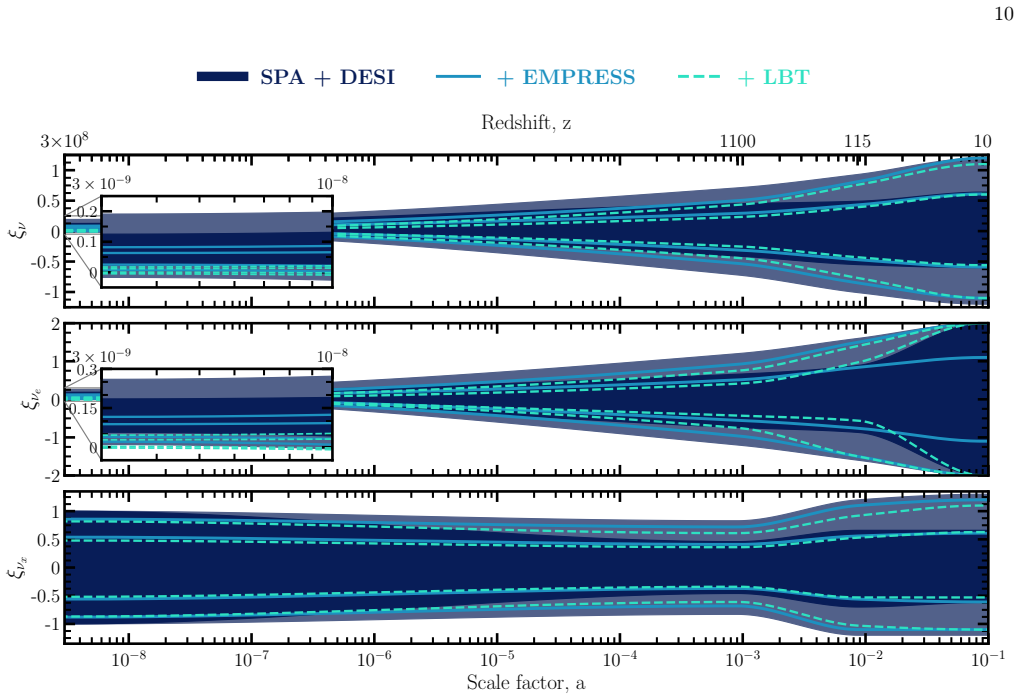
- The preference for non-zero ξ_νe appears primarily at the BBN epoch even when redshift dependence is allowed via PCHIP.
- The three-degenerate-neutrinos scenario produces different bounds on the common ξ value compared with the case that separates ξ_νe from ξ_νx.
Where Pith is reading between the lines
- A confirmed non-zero electron-neutrino chemical potential at BBN could motivate searches for flavor-asymmetric new physics in the early universe.
- Future high-precision BBN measurements independent of EMPRESS could test whether the positive preference persists.
- The allowed increase in H0 within these models suggests they remain viable for addressing the Hubble tension without additional extensions.
Load-bearing premise
BBN data from EMPRESS or LBT accurately reflect the neutron-to-proton interconversion rates modified by ξ_νe without dominant unaccounted systematics, and the four-node PCHIP reconstruction captures any redshift dependence without introducing artifacts.
What would settle it
A future BBN measurement that finds ξ_νe consistent with zero at greater than 95% confidence would remove the reported preference.
Figures
read the original abstract
The electron neutrino degeneracy parameter, $\xi_{\nu_\mathrm{e}} = \mu_{\nu_\mathrm{e}} / T$, is tightly constrained by Big Bang Nucleosynthesis (BBN), while the degeneracy parameters of the other neutrino species, $\xi_{\nu_\mathrm{x}}$, remain weakly constrained by cosmological observations alone. In this manuscript we shall compute up-to-date bounds on $\xi_{\nu_\mathrm{e}}$ and $\xi_{\nu_\mathrm{x}}$ assuming that either they are constant free-parameters along the cosmic history or that they are redshift dependent quantities. In the latter case we employ a model-independent reconstruction approach based on the Piecewise Cubic Hermite Interpolating Polynomial (PCHIP) formalism with four nodes, located at $z\simeq$ 10, 100, 1000 and $10^8$. We shall also consider two scenarios for neutrinos, specifically three degenerate neutrinos ($\xi_{\nu_\mathrm{e}}$ = $\xi_{\nu_\mathrm{x}}$) and the case in which we actually differentiate between $\xi_{\nu_\mathrm{e}}$ and $\xi_{\nu_\mathrm{x}}$. We perform a cosmological analysis combining CMB data from Planck, SPT, and ACT with BAO measurements from DESI, showing the impact of including BBN observables from either EMPRESS results, which allow for a non-zero chemical potential, or from LBT observations, compatible with the standard $\xi_\nu$ = 0 prediction. We explicitly show that the BBN data, via the change in neutron-to-proton interconversion rates, mostly constrain $\xi_{\nu_\mathrm{e}}$, parameter for which we observe a preferred non-zero positive value at $95\%$ C.L. in the non-degenerate neutrino case at the BBN period. Since the Hubble constant is correlated with $\xi_{\nu}$, through $N_{\rm eff}$, a larger value of $H_0$ is allowed within these models, making them really interesting scenarios where to test non-standard physics models.
Editorial analysis
A structured set of objections, weighed in public.
Referee Report
Summary. The manuscript derives updated cosmological constraints on the neutrino degeneracy parameters ξ_νe and ξ_νx, treating them either as constant parameters or as redshift-dependent functions reconstructed via four-node PCHIP interpolation at z ≈ 10, 100, 1000 and 10^8. It combines Planck/SPT/ACT CMB data with DESI BAO and BBN observables (EMPRESS allowing non-zero chemical potential, or LBT assuming ξ_ν = 0), finding that BBN data via modified n↔p rates drive a 95% CL preference for positive ξ_νe in the non-degenerate case at the BBN epoch, while also noting a correlation with Neff that permits larger H0 values.
Significance. If the central BBN-driven preference survives scrutiny, the work supplies a model-independent reconstruction of possible redshift evolution in neutrino chemical potentials and quantifies how BBN tightens ξ_νe relative to CMB+BAO alone, offering a concrete testbed for non-standard neutrino scenarios that could alleviate the Hubble tension through Neff.
major comments (2)
- [Abstract] Abstract (PCHIP nodes): the four nodes terminate at z = 10^8 while BBN occurs at z ≈ 4 × 10^9; the manuscript does not specify the extrapolation rule applied for z > 10^8 when evaluating ξ_νe at the BBN epoch. Because the reported 95% CL preference for positive ξ_νe is driven by the BBN-era value through the n↔p rates, any choice of continuation (constant, log-linear, etc.) directly shifts the posterior and must be stated and varied to confirm robustness.
- [BBN analysis] BBN analysis section: the claim that EMPRESS data yield a non-zero ξ_νe preference at 95% CL assumes that the neutron-to-proton interconversion rates are modified solely by ξ_νe with no dominant unaccounted systematics; the manuscript should quantify the impact of possible rate uncertainties on the posterior to establish that the preference is not an artifact of the chosen BBN likelihood.
minor comments (1)
- [Abstract] Abstract: the phrasing 'we shall compute' and 'we shall also consider' is unnecessarily future-oriented for a completed analysis; replace with present tense for standard journal style.
Simulated Author's Rebuttal
We thank the referee for the careful review and constructive comments. We address each major point below and will revise the manuscript to improve clarity and robustness.
read point-by-point responses
-
Referee: [Abstract] Abstract (PCHIP nodes): the four nodes terminate at z = 10^8 while BBN occurs at z ≈ 4 × 10^9; the manuscript does not specify the extrapolation rule applied for z > 10^8 when evaluating ξ_νe at the BBN epoch. Because the reported 95% CL preference for positive ξ_νe is driven by the BBN-era value through the n↔p rates, any choice of continuation (constant, log-linear, etc.) directly shifts the posterior and must be stated and varied to confirm robustness.
Authors: We agree that the extrapolation beyond the final node at z=10^8 must be explicitly stated. In the analysis the value of ξ_νe at z=10^8 is held constant for all higher redshifts when evaluating the BBN rates. We will add this clarification to the methods section and, to test robustness, include a brief comparison with an alternative log-linear extrapolation in the revised manuscript; the 95% CL preference for positive ξ_νe at BBN is found to persist under both choices. revision: yes
-
Referee: [BBN analysis] BBN analysis section: the claim that EMPRESS data yield a non-zero ξ_νe preference at 95% CL assumes that the neutron-to-proton interconversion rates are modified solely by ξ_νe with no dominant unaccounted systematics; the manuscript should quantify the impact of possible rate uncertainties on the posterior to establish that the preference is not an artifact of the chosen BBN likelihood.
Authors: The reported preference arises directly from the ξ_νe-dependent modification of the n↔p rates within the EMPRESS likelihood. While the rates follow the standard implementation used in the literature, we acknowledge that additional rate uncertainties could influence the posterior. In the revised manuscript we will add a sensitivity test in which the relevant rate coefficients are varied within their quoted uncertainties and the resulting shifts in the ξ_νe posterior are quantified. revision: yes
Circularity Check
No significant circularity; derivation self-contained via external data fits
full rationale
The paper reconstructs redshift-dependent neutrino degeneracy parameters using a four-node PCHIP interpolation with nodes at specified redshifts, treating the node values as free parameters fitted jointly with other cosmological parameters to external datasets (Planck, SPT, ACT, DESI, EMPRESS/LBT BBN). The reported 95% CL preference for positive ξ_νe arises directly from the BBN likelihood constraining neutron-to-proton rates through the model; this does not reduce by construction to a quantity defined in terms of itself, a fitted input renamed as prediction, or a self-citation chain. The derivation remains independent of the target result and relies on standard external benchmarks without load-bearing internal definitions.
Axiom & Free-Parameter Ledger
free parameters (2)
- ξ_νe, ξ_νx (constant or at PCHIP nodes)
- PCHIP node redshifts
axioms (2)
- domain assumption Standard ΛCDM background with neutrino degeneracy extensions governs BBN and CMB observables
- domain assumption EMPRESS or LBT BBN measurements directly probe the ξ_νe-modified neutron-to-proton conversion rates
Reference graph
Works this paper leans on
-
[1]
N. Aghanimet al.(Planck), Astron. Astrophys.641, A6 (2020), [Erratum: Astron.Astrophys. 652, C4 (2021)], arXiv:1807.06209 [astro-ph.CO]
Pith/arXiv arXiv 2020
-
[2]
F. Iocco, G. Mangano, G. Miele, O. Pisanti, and P. D. Serpico, Phys. Rept.472, 1 (2009), arXiv:0809.0631 [astro-ph]
Pith/arXiv arXiv 2009
-
[3]
P. F. de Salas, S. Gariazzo, M. Laveder, S. Pas- tor, O. Pisanti, and N. Truong, JCAP03, 050, arXiv:1802.04639 [astro-ph.CO]
-
[4]
G. Barenboim, J. Froustey, C. Pitrou, and H. Sanchis, Phys. Rev. D111, 123549 (2025), arXiv:2504.07178 [hep- ph]
arXiv 2025
- [5]
- [6]
-
[7]
I. M. Oldengott and D. J. Schwarz, EPL119, 29001 (2017), arXiv:1706.01705 [astro-ph.CO]
Pith/arXiv arXiv 2017
-
[8]
G. Barenboim, W. H. Kinney, and W.-I. Park, Eur. Phys. J. C77, 590 (2017), arXiv:1609.03200 [astro-ph.CO]
Pith/arXiv arXiv 2017
-
[9]
R. C. Nunes and A. Bonilla, Mon. Not. Roy. Astron. Soc. 473, 4404 (2018), arXiv:1710.10264 [astro-ph.CO]
Pith/arXiv arXiv 2018
-
[10]
A. Bonilla, R. C. Nunes, and E. M. C. Abreu, Mon. Not. Roy. Astron. Soc.485, 2486 (2019), arXiv:1810.06356 [astro-ph.CO]
Pith/arXiv arXiv 2019
- [11]
- [12]
-
[13]
Y.-Z. Li and J.-H. Yu, JHEP06, 213, arXiv:2409.08280 15 ξ(1+2)ν,constant SPA + DESI + EMPRESS + LBT 100θs 1.04129+0.00080 −0.00092 1.04148+0.00058 −0.00061 1.04167+0.00049 −0.00055 τreio 0.065+0.012 −0.011 0.066+0.012 −0.011 0.067+0.012 −0.011 log(1010As)3.067 +0.023 −0.021 3.067+0.022 −0.021 3.069+0.021 −0.020 ns 0.971±0.010 0.9725 +0.0089 −0.0082 0.9752...
- [14]
-
[15]
O. Seto and Y. Toda, Phys. Rev. D104, 063019 (2021), arXiv:2104.04381 [astro-ph.CO]
arXiv 2021
-
[16]
E. Aver, E. D. Skillman, R. W. Pogge, N. S. J. Rogers, M. K. Weller, K. A. Olive, D. A. Berg, J. J. Salzer, J. H. Miller, and J. E. Méndez-Delgado, (2026), arXiv:2601.22238 [astro-ph.CO]
arXiv 2026
-
[17]
A. Matsumotoet al., Astrophys. J.941, 167 (2022), arXiv:2203.09617 [astro-ph.CO]
arXiv 2022
-
[18]
M. Escudero, A. Ibarra, and V. Maura, Phys. Rev. D 107, 035024 (2023), arXiv:2208.03201 [hep-ph]
arXiv 2023
-
[19]
G. Steigman, Adv. High Energy Phys.2012, 268321 (2012), arXiv:1208.0032 [hep-ph]
Pith/arXiv arXiv 2012
-
[20]
Pitrou, A
C. Pitrou, A. Coc, J.-P. Uzan, and E. Vangioni, Physics Reports754, 1–66 (2018)
2018
- [21]
-
[22]
S. Gariazzo, P. F. de Salas, O. Pisanti, and R. Con- siglio, Comput. Phys. Commun.271, 108205 (2022), arXiv:2103.05027 [astro-ph.IM]
arXiv 2022
-
[23]
Navaset al.(Particle Data Group), Phys
S. Navaset al.(Particle Data Group), Phys. Rev. D110, 030001 (2024)
2024
-
[24]
F. N. Fritsch and J. Butland, SIAM Journal on Scientific and Statistical Computing5, 300 (1984), https://doi.org/10.1137/0905021
-
[25]
F. N. Fritsch and R. E. Carlson, SIAM Jour- nal on Numerical Analysis17, 238 (1980), https://doi.org/10.1137/0717021. 16
-
[26]
S. Gariazzo, C. Giunti, and M. Laveder, JCAP04, 023, arXiv:1412.7405 [astro-ph.CO]
- [27]
-
[28]
I. Esteban, M. C. Gonzalez-Garcia, M. Maltoni, I. Martinez-Soler, J. P. Pinheiro, and T. Schwetz, JHEP 12, 216, arXiv:2410.05380 [hep-ph]
-
[29]
P. F. de Salas, D. V. Forero, S. Gariazzo, P. Martínez- Miravé, O. Mena, C. A. Ternes, M. Tórtola, and J. W. F. Valle, JHEP02, 071, arXiv:2006.11237 [hep-ph]
Pith/arXiv arXiv 2006
-
[30]
F. Capozzi, E. Di Valentino, E. Lisi, A. Marrone, A. Mel- chiorri,andA.Palazzo,Phys.Rev.D104,083031(2021), arXiv:2107.00532 [hep-ph]
arXiv 2021
- [31]
-
[32]
Lesgourgues, (2011), arXiv:1104.2932 [astro-ph.IM]
J. Lesgourgues, (2011), arXiv:1104.2932 [astro-ph.IM]
Pith/arXiv arXiv 2011
-
[33]
D. Blas, J. Lesgourgues, and T. Tram, JCAP07, 034, arXiv:1104.2933 [astro-ph.CO]
-
[34]
O. Pisanti, A. Cirillo, S. Esposito, F. Iocco, G. Mangano, G. Miele, and P. D. Serpico, Comput. Phys. Commun. 178, 956 (2008), arXiv:0705.0290 [astro-ph]
Pith/arXiv arXiv 2008
-
[35]
R. Consiglio, P. F. de Salas, G. Mangano, G. Miele, S. Pastor, and O. Pisanti, Comput. Phys. Commun.233, 237 (2018), arXiv:1712.04378 [astro-ph.CO]
Pith/arXiv arXiv 2018
-
[36]
J. Torrado and A. Lewis, JCAP05, 057, arXiv:2005.05290 [astro-ph.IM]
Pith/arXiv arXiv 2005
-
[37]
Torrado and A
J. Torrado and A. Lewis, Cobaya: Bayesian analysis in cosmology, Astrophysics Source Code Library, record ascl:1910.019 (2019)
1910
-
[38]
Gelman and D
A. Gelman and D. B. Rubin, Statist. Sci.7, 457 (1992)
1992
-
[39]
Lewis, JCAP08, 025, arXiv:1910.13970 [astro-ph.IM]
A. Lewis, JCAP08, 025, arXiv:1910.13970 [astro-ph.IM]
Pith/arXiv arXiv 1910
-
[40]
A. Heavens, Y. Fantaye, A. Mootoovaloo, H. Eg- gers, Z. Hosenie, S. Kroon, and E. Sellentin, (2017), arXiv:1704.03472 [stat.CO]
Pith/arXiv arXiv 2017
-
[41]
A. Heavens, Y. Fantaye, E. Sellentin, H. Eggers, Z. Ho- senie, S. Kroon, and A. Mootoovaloo, Phys. Rev. Lett. 119, 101301 (2017), arXiv:1704.03467 [astro-ph.CO]
Pith/arXiv arXiv 2017
-
[42]
R. E. Kass and A. E. Raftery, J. Am. Statist. Assoc.90, 773 (1995)
1995
-
[43]
N. Aghanimet al.(Planck), Astron. Astrophys.641, A5 (2020), arXiv:1907.12875 [astro-ph.CO]
Pith/arXiv arXiv 2020
- [44]
-
[45]
J. M. Delouis, L. Pagano, S. Mottet, J. L. Puget, and L. Vibert, Astron. Astrophys.629, A38 (2019), arXiv:1901.11386 [astro-ph.CO]
arXiv 2019
-
[46]
Louiset al.(Atacama Cosmology Telescope), JCAP 11, 062, arXiv:2503.14452 [astro-ph.CO]
T. Louiset al.(Atacama Cosmology Telescope), JCAP 11, 062, arXiv:2503.14452 [astro-ph.CO]
-
[47]
Camphuiset al.(SPT-3G), (2025), arXiv:2506.20707 [astro-ph.CO]
E. Camphuiset al.(SPT-3G), (2025), arXiv:2506.20707 [astro-ph.CO]
Pith/arXiv arXiv 2025
-
[48]
L. Balkenhol, C. Trendafilova, K. Benabed, and S. Galli, Astron. Astrophys.686, A10 (2024), arXiv:2401.13433 [astro-ph.CO]
arXiv 2024
-
[49]
M. S. Madhavacherilet al.(ACT), Astrophys. J.962, 113 (2024), arXiv:2304.05203 [astro-ph.CO]
Pith/arXiv arXiv 2024
-
[50]
F. J. Quet al.(ACT), Astrophys. J.962, 112 (2024), arXiv:2304.05202 [astro-ph.CO]
Pith/arXiv arXiv 2024
-
[51]
MacCrannet al.(ACT), Astrophys
N. MacCrannet al.(ACT), Astrophys. J.966, 138 (2024), arXiv:2304.05196 [astro-ph.CO]
arXiv 2024
-
[52]
J. Carron, M. Mirmelstein, and A. Lewis, JCAP09, 039, arXiv:2206.07773 [astro-ph.CO]
-
[53]
F. Geet al.(SPT-3G), Phys. Rev. D111, 083534 (2025), arXiv:2411.06000 [astro-ph.CO]
arXiv 2025
-
[54]
M. Abdul Karimet al.(DESI), Phys. Rev. D112, 083515 (2025), arXiv:2503.14738 [astro-ph.CO]
Pith/arXiv arXiv 2025
-
[55]
E. D. Skillmanet al., (2026), arXiv:2601.22232 [astro- ph.CO]
arXiv 2026
-
[56]
T.-H. Yeh, K. A. Olive, B. D. Fields, E. Aver, R. W. Pogge, N. S. J. Rogers, E. D. Skillman, and M. K. Weller, (2026), arXiv:2601.22239 [astro-ph.CO]
arXiv 2026
-
[57]
A. G. Riesset al., Astrophys. J. Lett.934, L7 (2022), arXiv:2112.04510 [astro-ph.CO]
Pith/arXiv arXiv 2022
-
[58]
D. Wang, O. Mena, E. Di Valentino, and S. Gariazzo, Physical Review D112, 10.1103/6m5f-xn8r (2025)
discussion (0)
Sign in with ORCID, Apple, or X to comment. Anyone can read and Pith papers without signing in.