REVIEW 4 major objections 4 minor 89 references
Any-Resolution AI-Generated Image Detection by Spectral Learning
T0 review · 4 major / 4 minor · reviewed 2026-08-12 · deepseek-v4-flash
Pith's one-line read SPAI learns the frequency spectrum of real images and flags AI-generated pictures as out-of-distribution samples, averaging 91.0% AUC across 13 generators.
desk verdict Solid detector with a misleading self-supervised framing and a test-set-tuned headline number; deserves peer review but needs an honest rewrite. read the letter →
The pith
A machine-rendered reading of the paper's core claim, the machinery that carries it, and where it could break.
The reading
What carries the argument
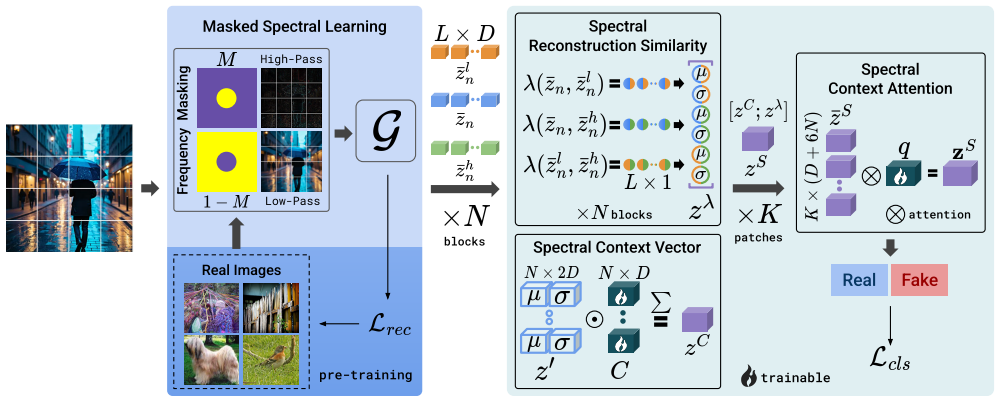
The load-bearing objects are: (1) a frequency mask M defined by a fixed radius r=16 around the spectrum center, splitting an image into low- and high-frequency components via the 2D DFT; (2) the frozen ViT-B/16 backbone G pretrained with masked frequency modeling, which acts as the learned spectral model of real images; (3) Spectral Reconstruction Similarity (SRS), the cosine similarity lambda(z_A,z_B)=z_A·z_B/(||z_A||||z_B||) between projected token representations of original, low-pass, and high-pass versions, aggregated into per-block means and standard deviations; (4) Spectral Context Vector (SCV), which summarizes spectral context by attending over block statistics with a learnable spectral map; and (5) Spectral Context Attention (SCA), which attends over image patches with a learned importance vector and fuses their spectral vectors in O(K) time. Together they convert the question 'does this image's spectrum look real?' into a scalar score trained end-to-end with binary cross-entropy.
What would settle it
Run SPAI on a curated set of real photographs from a camera or computational-photography pipeline whose spectral fingerprint was not among the five training sources; if a substantial fraction of these genuine images are flagged as synthetic, the claim that real-image spectra form a universal invariant fails, because the learned 'invariant' would instead be dataset-specific.
Extended reading notes
Core claim
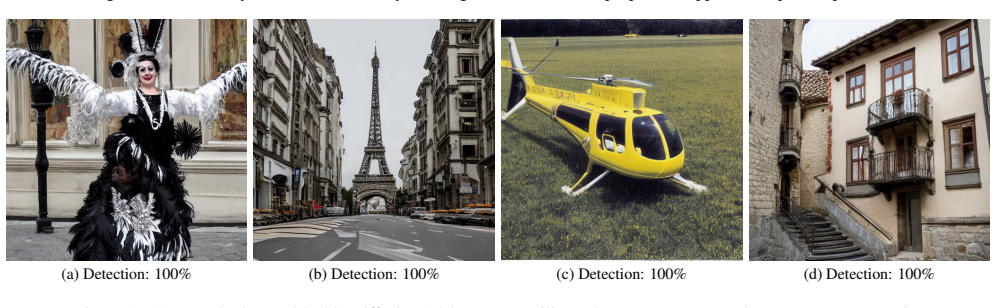
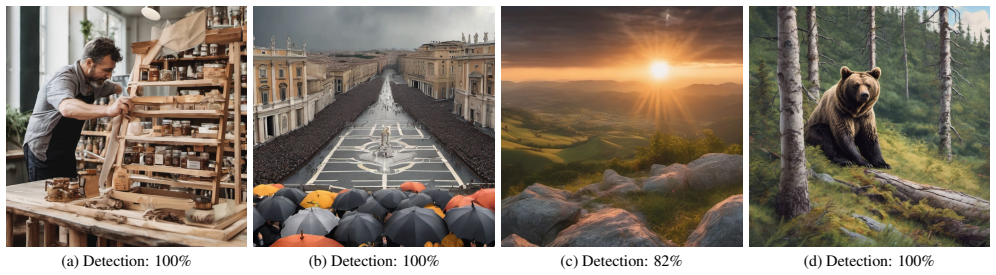
The paper's central claim is that the spectral distribution of real images is both invariant and highly discriminative, so AI-generated images can be treated as out-of-distribution samples of a learned spectral model of reality. The model G is a frozen ViT-B/16 transformer pretrained with masked frequency modeling on ImageNet; only a reconstruction head is trained, on 180k real images, using a frequency-distance loss. At inference, Spectral Reconstruction Similarity computes the cosine similarity between representations of the original, low-pass, and high-pass versions of an image across all transformer blocks, and the paper reports that this score reliably separates real from generated content across generators never seen during training. Spectral Context Attention then pools the most discriminative patch-level similarity values using a learned context vector, allowing images of any resolution to be scored at native size. On 13 generative models and five real-image sources, the method reports 91.0% average AUC, a 5.5-point absolute gain over the best prior detector, with higher accuracy under common perturbations.
Load-bearing premise
The entire method rests on the premise that one frozen transformer, pretrained on ImageNet with a fixed masking radius, captures the true spectrum of all real photographs, so any generated image can be spotted simply by being an outlier in that learned spectrum.
Editorial extensions
If this is right
- A detector can be built from real images alone, without any labeled examples from a specific generator, and the same trained model transfers across the 13-generator benchmark.
- Average detection AUC improves by 5.5 absolute points over the previous best detector (85.5 to 91.0) on the same test set.
- Because SCA processes patches at native resolution, images of many megapixels can be checked without downsampling; the supplementary material shows roughly linear scaling up to gigapixel inputs.
- Stability under JPEG/WebP compression, Gaussian blur, noise, and resizing is consistently above the compared methods, meaning recompressed online copies remain detectable.
- The paper's own failure analysis shows that derivative copies such as screenshots or printed photos can destroy spectral cues, so those cases remain a limitation.
Reading between the lines
- The invariance claim could be tested by training or fine-tuning the spectral model on real images from a disjoint camera era and checking whether SRS still separates current generators; if performance decays, the 'real-spectrum invariance' is partly history-dependent.
- The same SRS and SCA machinery could be applied to other open-set out-of-distribution tasks, such as manipulated video frames, since the method learns only the positive distribution.
- An adversarial generator engineered to match real amplitude spectra, for example by adding camera-ISP-style post-processing, may collapse SRS; testing that scenario would clarify whether the invariant is genuinely spectral or partly generator-dependent.
- Nothing in the method uses generator labels, so the classifier head could in principle be replaced by a calibrated one-class rule on SRS alone, making the approach fully self-supervised at decision time.
Editorial analysis
A structured set of objections, weighed in public.
Referee Report
Summary. The paper proposes SPAI, an AI-generated-image detector built around the idea that the spectral distribution of real images is an invariant, discriminative pattern. The method computes Spectral Reconstruction Similarity (SRS) from the features of a frozen ViT backbone, aggregates patch-level scores with a Spectral Context Vector (SCV) and a linear-complexity Spectral Context Attention (SCA), and trains a small classifier with binary cross-entropy on 180k real and 180k single-generator fake images. The authors report average AUC 91.0 over 13 generators and 5 real-image sources, a 5.5% absolute improvement over RINE, plus robustness experiments and a runtime/memory analysis showing linear scaling to gigapixel inputs.
Significance. If the reported numbers withstand scrutiny, SPAI would be a useful, generalizing detector with a genuinely practical any-resolution mechanism: SCA is O(K) rather than quadratic, and the supplementary contains a serious runtime and memory evaluation, including gigapixel processing. The paper also ships code, data, and trained models, and the benchmark spans 13 recent generators and 5 real sources, which is a valuable public resource. However, two load-bearing claims are currently not supported: that the method performs self-supervised spectral learning on real images, and that the 5.5% average AUC gain is a reliable, consistent improvement over the state of the art.
major comments (4)
- [Sec. 3.1 and Sec. 3.5] The central methodological claim is contradicted by the implementation. Section 3.1 describes training a model G under the pretext task of frequency reconstruction on real images, and the abstract and contributions repeatedly state that SPAI is self-supervised and models the spectral distribution of real images. However, Sec. 3.5 states: 'As our spectral model of real images G we use a ViT-B/16 transformer pre-trained on ImageNet by Xie et al., using a masking radius r = 16. We keep its weights frozen.' Consequently, the paper does not train G on its 180k real images at all; the 'masked spectral learning' is borrowed from a pretrained Masked Frequency Modeling checkpoint. The ablation labeled 'w/o spectral pretraining' in Table 3 therefore tests the value of using MFM pretrained weights versus random initialization, not the value of the proposed frequency-reconstruction pretext task. This does not support the contribution 'we show that the pretext task of frequency reconstruction is an effective approach for modeling the spectral distribution of real images.' The authors should either retrain G on their real-image data under the frequency-reconstruction objective and compare, or substantially reframe the paper as using a fixed pretrained spectral feature extractor.
- [Sec. 4.3, Table 4] The headline hyperparameters appear to be selected on the same test set used for the final AUC. Table 4 reports average AUC over the 13-generator/5-real-source test set for the masking radius r, latent dimensionality D, and learning rate, and the values r=16, D=1024, lr=5e-4 are chosen as 'optimal' from this table. The supplementary describes a validation split, but explicitly only for selecting the best epoch, not for selecting hyperparameters. Thus the reported 91.0 average AUC and the 5.5% margin over RINE include test-set selection bias. The authors should state whether any hold-out protocol was used for hyperparameter selection; if not, they should rerun the selection on a validation split and report the corresponding test numbers, or use nested cross-validation. Without this, the central quantitative claim is not yet established.
- [Table 1] The claim that SPAI exhibits 'consistently high detection performance across all generative models' is not supported by the per-generator results. Compared with RINE, SPAI is worse on 10 of 13 generators, e.g., Glide 90.2 vs. 95.6, Flux 83.0 vs. 93.0, and GigaGAN 85.4 vs. 92.9. The entire positive average margin comes from three generators, most dramatically SD3 (75.9 vs. 39.1), DALLE3 (90.2 vs. 41.8), and Firefly (96.0 vs. 82.9). The aggregate 5.5% improvement is therefore fragile to the composition of the generator set. The authors should report per-generator comparisons and confidence intervals or significance tests, and soften the 'consistent across all generators' claim unless the per-generator profile can be justified.
- [Sec. 3.2 and Sec. 3.5] The out-of-distribution interpretation of SRS is not directly evidenced. The SRS features are computed from a frozen backbone, but the projection operators Pn, the SCV, SCA, and the final classifier are all trained end-to-end with binary cross-entropy on labeled real and fake images (Sec. 3.5). The paper does not show that SRS values, by themselves and without supervised training, separate unseen generators from real images. The conceptual claim that generated images are out-of-distribution samples of a spectral model of real images would be much stronger if the authors reported an unsupervised analysis, e.g., thresholding SRS statistics alone or comparing SRS distributions on held-out generators before any classifier training. As written, SRS may simply be a supervised feature whose usefulness is learned from the specific training generator.
minor comments (4)
- [Sec. 3.2] There are several typographical issues in the notation, including 'L = H ·W/p2' where p2 should be p^2, and 'Each token is embedded to a space of sized' which should read 'a space of size d'. These should be corrected.
- [Supplementary Sec. 6.1] The description of the projection operators P1 and P2 contains a typo: 'using the projection operators P1(·) : R2D → RD and P1(·) : RD → RD that share the same architecture' should refer to P2 for the second operator.
- [Table 4] The hyperparameter tuning table would be more informative if it reported per-generator or per-source breakdowns, or at least the standard deviation across the 13 generators, because the average AUC alone cannot reveal whether a hyperparameter choice is uniformly good or dominated by a few generators.
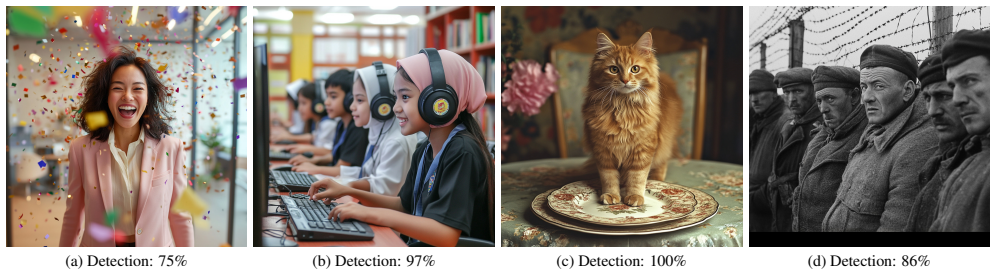
- [Sec. 4.5] The failure-case discussion is honest and useful, but the statement 'Our method successfully detects their early-shared copies' would benefit from reporting the actual confidence scores or detection margins for the shown examples, so the reader can calibrate how close these cases are to the decision boundary.
Circularity Check
No significant circularity: SPAI's spectral reconstruction similarity is a feature computed from an externally pretrained frozen backbone, and the reported AUC is measured on generators unseen during training; the self-citations are comparative or contextual, not load-bearing.
full rationale
The derivation chain is self-contained. SPAI uses a frozen ViT-B/16 pretrained externally by Xie et al. [74] with masked frequency modeling on ImageNet as its spectral model G (Sec. 3.5); the SRS score is defined as cosine similarity between G's token representations of original, low-pass, and high-pass versions of an image (Eq. 5), and SRS/SCV/SCA outputs are combined by a three-layer MLP trained with binary cross-entropy on 180k real and 180k synthetic images from Corvi et al. [7] (Sec. 3.5). The headline AUC of 91.0 is then evaluated on 13 generators and 5 real-image sources not used for training (Sec. 4.1, Table 1). No fitted parameter is renamed as a prediction, and no result is defined in terms of the target it is supposed to explain. The self-citations (RINE [40] as a baseline, SIDBench [63] as an evaluation framework, and [37] as context on online synthetic imagery) are not load-bearing for the validity of the method. The main caveats -- hyperparameters r, D, and lr selected using the same 13-generator test set (Table 4) and the fact that SPAI trails RINE on 10 of 13 generators -- are threats to the strength and statistical interpretation of the 5.5% claim, but they are correctness/overfitting concerns rather than circularity, because the reported test AUC is not algebraically forced by the hyperparameter choice.
Assumptions & free parameters
free parameters (5)
- Masking radius r =
16
- Latent dimensionality D =
1024
- Learning rate =
5e-4
- SCA hidden dim Dh =
1536
- Number of patches Ktraining =
4
assumptions (5)
- domain assumption The spectral distribution of real images is invariant across acquisition devices, content and processing, changing only with long-term technology.
- domain assumption A frequency reconstruction model trained on real images reconstructs real-image frequencies more accurately than AI-generated ones.
- domain assumption A frozen ViT pretrained with masked frequency modeling on ImageNet is a sufficient spectral model of real images.
- domain assumption Resizing or cropping images discards high-frequency information essential for detecting AI-generated content.
- standard math 2D DFT, inverse DFT and masking operations are mathematically standard.
invented entities (3)
-
Spectral Reconstruction Similarity (SRS)
-
Spectral Context Vector (SCV)
-
Spectral Context Attention (SCA)
Cite this review
Pith. "Pith review of Any-Resolution AI-Generated Image Detection by Spectral Learning." pith.science (2026). https://pith.science/paper/6UYEN253
@misc{pith2026241119417,
  author       = {Pith},
  title        = {Pith review of: Any-Resolution AI-Generated Image Detection by Spectral Learning},
  year         = {2026},
  howpublished = {\url{https://pith.science/paper/6UYEN253}},
  note         = {Machine review of arXiv:2411.19417}
}
read the original abstract
Recent works have established that AI models introduce spectral artifacts into generated images and propose approaches for learning to capture them using labeled data. However, the significant differences in such artifacts among different generative models hinder these approaches from generalizing to generators not seen during training. In this work, we build upon the key idea that the spectral distribution of real images constitutes both an invariant and highly discriminative pattern for AI-generated image detection. To model this under a self-supervised setup, we employ masked spectral learning using the pretext task of frequency reconstruction. Since generated images constitute out-of-distribution samples for this model, we propose spectral reconstruction similarity to capture this divergence. Moreover, we introduce spectral context attention, which enables our approach to efficiently capture subtle spectral inconsistencies in images of any resolution. Our spectral AI-generated image detection approach (SPAI) achieves a 5.5% absolute improvement in AUC over the previous state-of-the-art across 13 recent generative approaches, while exhibiting robustness against common online perturbations. Code is available on https://mever-team.github.io/spai.
Figures


Figures from the paper (22 more)










Reference graph
Works this paper leans on
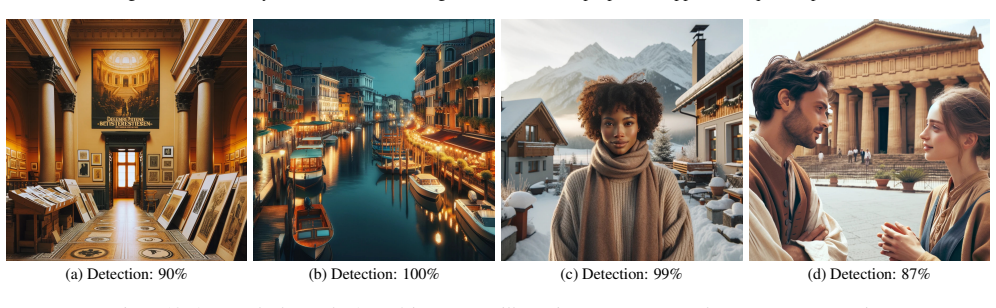
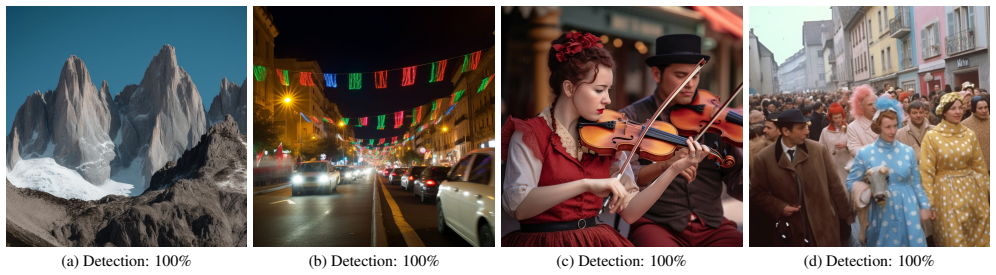
-
[1]
Synthbuster: Towards detection of diffu- sion model generated images
Quentin Bammey. Synthbuster: Towards detection of diffu- sion model generated images. IEEE Open Journal of Signal Processing, 2023. 1, 2, 3, 5, 6
2023
-
[2]
Improving image generation with better captions
James Betker, Gabriel Goh, Li Jing, Tim Brooks, Jianfeng Wang, Linjie Li, Long Ouyang, Juntang Zhuang, Joyce Lee, Yufei Guo, et al. Improving image generation with better captions. Computer Science. https://cdn. openai. com/papers/dall-e-3. pdf, 2(3):8, 2023. 2, 6
2023
-
[3]
A geometric and photo- metric exploration of gan and diffusion synthesized faces
Matyáš Bohá ˇcek and Hany Farid. A geometric and photo- metric exploration of gan and diffusion synthesized faces. In Proceedings of the IEEE/CVF Conference on Computer Vi- sion and Pattern Recognition, pages 874–883, 2023. 2
2023
-
[4]
Controllable generation with text-to-image diffusion models: A survey
Pu Cao, Feng Zhou, Qing Song, and Lu Yang. Controllable generation with text-to-image diffusion models: A survey. arXiv preprint arXiv:2403.04279, 2024. 1
arXiv 2024
-
[5]
Fakeinversion: Learning to detect images from un- seen text-to-image models by inverting stable diffusion
George Cazenavette, Avneesh Sud, Thomas Leung, and Ben Usman. Fakeinversion: Learning to detect images from un- seen text-to-image models by inverting stable diffusion. In Proceedings of the IEEE/CVF Conference on Computer Vi- sion and Pattern Recognition, pages 10759–10769, 2024. 3
2024
-
[6]
Stargan: Unified genera- tive adversarial networks for multi-domain image-to-image translation
Yunjey Choi, Minje Choi, Munyoung Kim, Jung-Woo Ha, Sunghun Kim, and Jaegul Choo. Stargan: Unified genera- tive adversarial networks for multi-domain image-to-image translation. In Proceedings of the IEEE conference on computer vision and pattern recognition, pages 8789–8797,
-
[7]
On the detection of synthetic images generated by diffusion mod- els
Riccardo Corvi, Davide Cozzolino, Giada Zingarini, Gio- vanni Poggi, Koki Nagano, and Luisa Verdoliva. On the detection of synthetic images generated by diffusion mod- els. In ICASSP 2023-2023 IEEE International Conference on Acoustics, Speech and Signal Processing (ICASSP), pages 1–5. IEEE, 2023. 2, 3, 5, 6, 1
2023
-
[8]
Raising the bar of ai-generated image detection with clip
Davide Cozzolino, Giovanni Poggi, Riccardo Corvi, Matthias Nießner, and Luisa Verdoliva. Raising the bar of ai-generated image detection with clip. In Proceedings of the IEEE/CVF Conference on Computer Vision and Pattern Recognition, pages 4356–4366, 2024. 3
2024
Show all 89 references
-
[9]
Zero-shot detection of ai-generated images
Davide Cozzolino, Giovanni Poggi, Matthias Nießner, and Luisa Verdoliva. Zero-shot detection of ai-generated images. In European Conference on Computer Vision, pages 54–72. Springer, 2025. 1, 2, 3
2025
-
[10]
Diffusion models in vision: A survey
Florinel-Alin Croitoru, Vlad Hondru, Radu Tudor Ionescu, and Mubarak Shah. Diffusion models in vision: A survey. IEEE Transactions on Pattern Analysis and Machine Intelli- gence, 45(9):10850–10869, 2023. 1
2023
-
[11]
Raise: A raw images dataset for digital image forensics
Duc-Tien Dang-Nguyen, Cecilia Pasquini, Valentina Conot- ter, and Giulia Boato. Raise: A raw images dataset for digital image forensics. In Proceedings of the 6th ACM multimedia systems conference, pages 219–224, 2015. 6, 1
2015
-
[12]
Flashattention: Fast and memory-efficient exact at- tention with io-awareness
Tri Dao, Dan Fu, Stefano Ermon, Atri Rudra, and Christo- pher Ré. Flashattention: Fast and memory-efficient exact at- tention with io-awareness. Advances in Neural Information Processing Systems, 35:16344–16359, 2022. 2
2022
-
[13]
A re- view on generative adversarial networks for image genera- tion
Vinicius Luis Trevisan De Souza, Bruno Augusto Dorta Mar- ques, Harlen Costa Batagelo, and João Paulo Gois. A re- view on generative adversarial networks for image genera- tion. Computers & Graphics, 114:13–25, 2023. 1
2023
-
[14]
Imagenet: A large-scale hierarchical image database
Jia Deng, Wei Dong, Richard Socher, Li-Jia Li, Kai Li, and Li Fei-Fei. Imagenet: A large-scale hierarchical image database. In 2009 IEEE conference on computer vision and pattern recognition, pages 248–255. Ieee, 2009. 5, 6, 1
2009
-
[15]
Fre- quency masking for universal deepfake detection
Chandler Timm Doloriel and Ngai-Man Cheung. Fre- quency masking for universal deepfake detection. InICASSP 2024-2024 IEEE International Conference on Acoustics, Speech and Signal Processing (ICASSP) , pages 13466– 13470. IEEE, 2024. 2
2024
-
[16]
An image is worth 16x16 words: Transformers for image recognition at scale
Alexey Dosovitskiy. An image is worth 16x16 words: Transformers for image recognition at scale. arXiv preprint arXiv:2010.11929, 2020. 4, 5, 1, 2
2010 arXiv
-
[17]
Ammeba: A large-scale survey and dataset of media-based misinformation in-the-wild
Nicholas Dufour, Arkanath Pathak, Pouya Samangouei, Nikki Hariri, Shashi Deshetti, Andrew Dudfield, Christo- pher Guess, Pablo Hernández Escayola, Bobby Tran, Mevan Babakar, et al. Ammeba: A large-scale survey and dataset of media-based misinformation in-the-wild. arXiv prepri...
2024 arXiv
-
[18]
Watch your up-convolution: Cnn based generative deep neural net- works are failing to reproduce spectral distributions
Ricard Durall, Margret Keuper, and Janis Keuper. Watch your up-convolution: Cnn based generative deep neural net- works are failing to reproduce spectral distributions. In Pro- ceedings of the IEEE/CVF conference on computer vision and pattern recognition, pages 7890–7899, 2020. 2
2020
-
[19]
Image generation: A review
Mohamed Elasri, Omar Elharrouss, Somaya Al-Maadeed, and Hamid Tairi. Image generation: A review. Neural Pro- cessing Letters, 54(5):4609–4646, 2022. 1
2022
-
[20]
Scaling recti- fied flow transformers for high-resolution image synthesis
Patrick Esser, Sumith Kulal, Andreas Blattmann, Rahim Entezari, Jonas Müller, Harry Saini, Yam Levi, Dominik Lorenz, Axel Sauer, Frederic Boesel, et al. Scaling recti- fied flow transformers for high-resolution image synthesis. In Forty-first International Conference on Machin...
2024
-
[21]
Lighting (in) consistency of paint by text
Hany Farid. Lighting (in) consistency of paint by text. arXiv preprint arXiv:2207.13744, 2022. 2
2022 arXiv
-
[22]
Perspective (in) consistency of paint by text
Hany Farid. Perspective (in) consistency of paint by text. arXiv preprint arXiv:2206.14617, 2022. 2
2022 arXiv
-
[23]
Computer vision: a mod- ern approach
David A Forsyth and Jean Ponce. Computer vision: a mod- ern approach. prentice hall professional technical reference,
-
[24]
Leveraging fre- quency analysis for deep fake image recognition
Joel Frank, Thorsten Eisenhofer, Lea Schönherr, Asja Fis- cher, Dorothea Kolossa, and Thorsten Holz. Leveraging fre- quency analysis for deep fake image recognition. In Inter- national conference on machine learning, pages 3247–3258. PMLR, 2020. 6, 3
2020
-
[25]
Huggingface: Geroldmeisinger / laion2b- en-a65 cogvlm2-4bit captions, 2024
GeroldMeisinger. Huggingface: Geroldmeisinger / laion2b- en-a65 cogvlm2-4bit captions, 2024. accessed 11th Nov
2024
-
[26]
Generative adversarial nets
Ian Goodfellow, Jean Pouget-Abadie, Mehdi Mirza, Bing Xu, David Warde-Farley, Sherjil Ozair, Aaron Courville, and 9 Yoshua Bengio. Generative adversarial nets. Advances in neural information processing systems, 27, 2014. 2
2014
-
[27]
Generative adversarial networks
Ian Goodfellow, Jean Pouget-Abadie, Mehdi Mirza, Bing Xu, David Warde-Farley, Sherjil Ozair, Aaron Courville, and Yoshua Bengio. Generative adversarial networks. Commu- nications of the ACM, 63(11):139–144, 2020. 2
2020
-
[28]
Draw: A recurrent neural network for image generation
Karol Gregor, Ivo Danihelka, Alex Graves, Danilo Rezende, and Daan Wierstra. Draw: A recurrent neural network for image generation. In International conference on machine learning, pages 1462–1471. PMLR, 2015. 2
2015
-
[29]
Mix-of-show: Decentralized low- rank adaptation for multi-concept customization of diffusion models
Yuchao Gu, Xintao Wang, Jay Zhangjie Wu, Yujun Shi, Yun- peng Chen, Zihan Fan, Wuyou Xiao, Rui Zhao, Shuning Chang, Weijia Wu, et al. Mix-of-show: Decentralized low- rank adaptation for multi-concept customization of diffusion models. Advances in Neural Information Processing ...
2024
-
[30]
The forchheim im- age database for camera identification in the wild
Benjamin Hadwiger and Christian Riess. The forchheim im- age database for camera identification in the wild. In Pat- tern Recognition. ICPR International Workshops and Chal- lenges: Virtual Event, January 10–15, 2021, Proceedings, Part VI, pages 500–515. Springer, 2021. 6, 1
2021
-
[31]
Rigid: A training-free and model-agnostic framework for ro- bust ai-generated image detection
Zhiyuan He, Pin-Yu Chen, and Tsung-Yi Ho. Rigid: A training-free and model-agnostic framework for ro- bust ai-generated image detection. arXiv preprint arXiv:2405.20112, 2024. 2, 3
2024 arXiv
-
[32]
Gaussian error linear units (gelus)
Dan Hendrycks and Kevin Gimpel. Gaussian error linear units (gelus). arXiv preprint arXiv:1606.08415, 2016. 4, 1
2016 arXiv
-
[33]
Denoising dif- fusion probabilistic models
Jonathan Ho, Ajay Jain, and Pieter Abbeel. Denoising dif- fusion probabilistic models. Advances in neural information processing systems, 33:6840–6851, 2020. 2
2020
-
[34]
Lora: Low-rank adaptation of large language models
Edward J Hu, Yelong Shen, Phillip Wallis, Zeyuan Allen- Zhu, Yuanzhi Li, Shean Wang, Lu Wang, and Weizhu Chen. Lora: Low-rank adaptation of large language models. arXiv preprint arXiv:2106.09685, 2021. 1, 2
2021 arXiv
-
[35]
Fusing global and local features for gen- eralized ai-synthesized image detection
Yan Ju, Shan Jia, Lipeng Ke, Hongfei Xue, Koki Nagano, and Siwei Lyu. Fusing global and local features for gen- eralized ai-synthesized image detection. In 2022 IEEE In- ternational Conference on Image Processing (ICIP) , pages 3465–3469. IEEE, 2022. 2, 6, 3
2022
-
[36]
Scal- ing up gans for text-to-image synthesis
Minguk Kang, Jun-Yan Zhu, Richard Zhang, Jaesik Park, Eli Shechtman, Sylvain Paris, and Taesung Park. Scal- ing up gans for text-to-image synthesis. In Proceedings of the IEEE/CVF Conference on Computer Vision and Pattern Recognition, pages 10124–10134, 2023. 2, 6, 1
2023
-
[37]
Evolution of detection performance through- out the online lifespan of synthetic images
Dimitrios Karageorgiou, Quentin Bammey, Valentin Por- cellini, Bertrand Goupil, Denis Teyssou, and Symeon Pa- padopoulos. Evolution of detection performance through- out the online lifespan of synthetic images. arXiv preprint arXiv:2408.11541, 2024. 1
2024 arXiv
-
[38]
Autolora: Autoguid- ance meets low-rank adaptation for diffusion models
Artur Kasymov, Marcin Sendera, Michał Stypułkowski, Ma- ciej Zi˛ eba, and Przemysław Spurek. Autolora: Autoguid- ance meets low-rank adaptation for diffusion models. arXiv preprint arXiv:2410.03941, 2024. 1
2024 arXiv
-
[39]
Texturecrop: Enhancing synthetic image de- tection through texture-based cropping
Despina Konstantinidou, Christos Koutlis, and Symeon Pa- padopoulos. Texturecrop: Enhancing synthetic image de- tection through texture-based cropping. arXiv preprint arXiv:2407.15500, 2024. 2
2024 arXiv
-
[40]
Leveraging rep- resentations from intermediate encoder-blocks for synthetic image detection
Christos Koutlis and Symeon Papadopoulos. Leveraging rep- resentations from intermediate encoder-blocks for synthetic image detection. In Computer Vision – ECCV 2024 , pages 394–411, Cham, 2025. Springer Nature Switzerland. 3, 5, 6
2024
-
[41]
Towards explain- ing image-based distribution shifts
Sean Kulinski and David I Inouye. Towards explain- ing image-based distribution shifts. In Proceedings of the IEEE/CVF Conference on Computer Vision and Pattern Recognition, pages 4788–4792, 2022. 3
2022
-
[42]
The open images dataset v4: Unified image classification, object detection, and visual relationship detection at scale
Alina Kuznetsova, Hassan Rom, Neil Alldrin, Jasper Ui- jlings, Ivan Krasin, Jordi Pont-Tuset, Shahab Kamali, Stefan Popov, Matteo Malloci, Alexander Kolesnikov, et al. The open images dataset v4: Unified image classification, object detection, and visual relationship detection...
1956
-
[43]
Civitai: Dataset with 6000+ flux.1 dev images,
LatentSpacer. Civitai: Dataset with 6000+ flux.1 dev images,
-
[44]
Layer normalization
Jimmy Lei Ba, Jamie Ryan Kiros, and Geoffrey E Hinton. Layer normalization. ArXiv e-prints , pages arXiv–1607,
-
[45]
Art: Automatic red-teaming for text- to-image models to protect benign users
Guanlin Li, Kangjie Chen, Shudong Zhang, Jie Zhang, and Tianwei Zhang. Art: Automatic red-teaming for text- to-image models to protect benign users. arXiv preprint arXiv:2405.19360, 2024. 1
2024 arXiv
-
[46]
Masksim: Detection of syn- thetic images by masked spectrum similarity analysis
Yanhao Li, Quentin Bammey, Marina Gardella, Tina Nikoukhah, Jean-Michel Morel, Miguel Colom, and Rafael Grompone V on Gioi. Masksim: Detection of syn- thetic images by masked spectrum similarity analysis. In Proceedings of the IEEE/CVF Conference on Computer Vi- sion and Patte...
2024
-
[47]
Detecting multimedia generated by large ai models: A survey
Li Lin, Neeraj Gupta, Yue Zhang, Hainan Ren, Chun-Hao Liu, Feng Ding, Xin Wang, Xin Li, Luisa Verdoliva, and Shu Hu. Detecting multimedia generated by large ai models: A survey. arXiv preprint arXiv:2402.00045, 2024. 1
2024 arXiv
-
[48]
Microsoft coco: Common objects in context
Tsung-Yi Lin, Michael Maire, Serge Belongie, James Hays, Pietro Perona, Deva Ramanan, Piotr Dollár, and C Lawrence Zitnick. Microsoft coco: Common objects in context. In Computer Vision–ECCV 2014: 13th European Conference, Zurich, Switzerland, September 6-12, 2014, Proceedings...
2014
-
[49]
Global tex- ture enhancement for fake face detection in the wild
Zhengzhe Liu, Xiaojuan Qi, and Philip HS Torr. Global tex- ture enhancement for fake face detection in the wild. In Pro- ceedings of the IEEE/CVF conference on computer vision and pattern recognition, pages 8060–8069, 2020. 2, 6, 3
2020
-
[50]
Decoupled weight decay regularization
I Loshchilov. Decoupled weight decay regularization. arXiv preprint arXiv:1711.05101, 2017. 5, 1
2017 arXiv
-
[51]
Misalignment-robust frequency distribution loss for image transformation
Zhangkai Ni, Juncheng Wu, Zian Wang, Wenhan Yang, Hanli Wang, and Lin Ma. Misalignment-robust frequency distribution loss for image transformation. In Proceedings of the IEEE/CVF Conference on Computer Vision and Pattern Recognition, pages 2910–2919, 2024. 3
2024
-
[52]
Glide: Towards photorealistic image generation and editing with text-guided diffusion models.arXiv preprint arXiv:2112.10741, 2021
Alex Nichol, Prafulla Dhariwal, Aditya Ramesh, Pranav Shyam, Pamela Mishkin, Bob McGrew, Ilya Sutskever, and Mark Chen. Glide: Towards photorealistic image generation and editing with text-guided diffusion models.arXiv preprint arXiv:2112.10741, 2021. 5 10
2021 arXiv
-
[53]
Towards uni- versal fake image detectors that generalize across genera- tive models
Utkarsh Ojha, Yuheng Li, and Yong Jae Lee. Towards uni- versal fake image detectors that generalize across genera- tive models. In Proceedings of the IEEE/CVF Conference on Computer Vision and Pattern Recognition, pages 24480– 24489, 2023. 3, 6
2023
-
[54]
Dinov2: Learning robust visual features without supervision
Maxime Oquab, Timothée Darcet, Théo Moutakanni, Huy V o, Marc Szafraniec, Vasil Khalidov, Pierre Fernandez, Daniel Haziza, Francisco Massa, Alaaeldin El-Nouby, et al. Dinov2: Learning robust visual features without supervision. arXiv preprint arXiv:2304.07193, 2023. 6, 7
2023 arXiv
-
[55]
Semantic image synthesis with spatially-adaptive nor- malization
Taesung Park, Ming-Yu Liu, Ting-Chun Wang, and Jun-Yan Zhu. Semantic image synthesis with spatially-adaptive nor- malization. In Proceedings of the IEEE/CVF conference on computer vision and pattern recognition, pages 2337–2346,
-
[56]
Sdxl: Improving latent diffusion mod- els for high-resolution image synthesis
Dustin Podell, Zion English, Kyle Lacey, Andreas Blattmann, Tim Dockhorn, Jonas Müller, Joe Penna, and Robin Rombach. Sdxl: Improving latent diffusion mod- els for high-resolution image synthesis. arXiv preprint arXiv:2307.01952, 2023. 2, 5
2023 arXiv
-
[57]
Learning transferable visual models from natural language supervi- sion
Alec Radford, Jong Wook Kim, Chris Hallacy, Aditya Ramesh, Gabriel Goh, Sandhini Agarwal, Girish Sastry, Amanda Askell, Pamela Mishkin, Jack Clark, et al. Learning transferable visual models from natural language supervi- sion. In International conference on machine learning, ...
2021
-
[58]
Hierarchical text-conditional image gener- ation with clip latents
Aditya Ramesh, Prafulla Dhariwal, Alex Nichol, Casey Chu, and Mark Chen. Hierarchical text-conditional image gener- ation with clip latents. arXiv preprint arXiv:2204.06125, 1 (2):3, 2022. 5
2022 arXiv
-
[59]
Aer- oblade: Training-free detection of latent diffusion images using autoencoder reconstruction error
Jonas Ricker, Denis Lukovnikov, and Asja Fischer. Aer- oblade: Training-free detection of latent diffusion images using autoencoder reconstruction error. In Proceedings of the IEEE/CVF Conference on Computer Vision and Pattern Recognition, pages 9130–9140, 2024. 3
2024
-
[60]
High-resolution image synthesis with latent diffusion models
Robin Rombach, Andreas Blattmann, Dominik Lorenz, Patrick Esser, and Björn Ommer. High-resolution image synthesis with latent diffusion models. In Proceedings of the IEEE/CVF conference on computer vision and pattern recognition, pages 10684–10695, 2022. 2, 5
2022
-
[61]
Huggingface: saq1b/midjourney-v6.1, 2024
saq1b. Huggingface: saq1b/midjourney-v6.1, 2024. ac- cessed 11th Nov. 2024. 6, 1
2024
-
[62]
Shad- ows don’t lie and lines can’t bend! generative models don’t know projective geometry
Ayush Sarkar, Hanlin Mai, Amitabh Mahapatra, Svetlana Lazebnik, David A Forsyth, and Anand Bhattad. Shad- ows don’t lie and lines can’t bend! generative models don’t know projective geometry... for now. In Proceedings of the IEEE/CVF Conference on Computer Vision and Pattern R...
2024
-
[63]
Sidbench: A python framework for reliably assessing synthetic image de- tection methods
Manos Schinas and Symeon Papadopoulos. Sidbench: A python framework for reliably assessing synthetic image de- tection methods. arXiv preprint arXiv:2404.18552, 2024. 6
2024 arXiv
-
[64]
De-fake: Detection and attribution of fake images generated by text- to-image generation models
Zeyang Sha, Zheng Li, Ning Yu, and Yang Zhang. De-fake: Detection and attribution of fake images generated by text- to-image generation models. In Proceedings of the 2023 ACM SIGSAC Conference on Computer and Communica- tions Security, pages 3418–3432, 2023. 3, 6
2023
-
[65]
Deep unsupervised learning using nonequilibrium thermodynamics
Jascha Sohl-Dickstein, Eric Weiss, Niru Maheswaranathan, and Surya Ganguli. Deep unsupervised learning using nonequilibrium thermodynamics. In International confer- ence on machine learning, pages 2256–2265. PMLR, 2015. 2
2015
-
[66]
Learning on gradients: Generalized arti- facts representation for gan-generated images detection
Chuangchuang Tan, Yao Zhao, Shikui Wei, Guanghua Gu, and Yunchao Wei. Learning on gradients: Generalized arti- facts representation for gan-generated images detection. In Proceedings of the IEEE/CVF Conference on Computer Vi- sion and Pattern Recognition, pages 12105–12114, 20...
2023
-
[67]
Rethinking the up-sampling op- erations in cnn-based generative network for generalizable deepfake detection
Chuangchuang Tan, Yao Zhao, Shikui Wei, Guanghua Gu, Ping Liu, and Yunchao Wei. Rethinking the up-sampling op- erations in cnn-based generative network for generalizable deepfake detection. In Proceedings of the IEEE/CVF Con- ference on Computer Vision and Pattern Recognition,...
2024
-
[68]
Df-gan: Deep fusion gener- ative adversarial networks for text-to-image synthesis
Ming Tao, Hao Tang, Songsong Wu, Nicu Sebe, Xiao-Yuan Jing, Fei Wu, and Bingkun Bao. Df-gan: Deep fusion gener- ative adversarial networks for text-to-image synthesis. arXiv preprint arXiv:2008.05865, 2(6), 2020. 2
2008 arXiv
-
[69]
Synthetic image verification in the era of generative ai: What works and what isn’t there yet
Diangarti Tariang, Riccardo Corvi, Davide Cozzolino, Gio- vanni Poggi, Koki Nagano, and Luisa Verdoliva. Synthetic image verification in the era of generative ai: What works and what isn’t there yet. arXiv preprint arXiv:2405.00196,
-
[70]
Visualizing data using t-sne
Laurens Van der Maaten and Geoffrey Hinton. Visualizing data using t-sne. Journal of machine learning research , 9 (11), 2008. 2
2008
-
[71]
Attention is all you need
A Vaswani. Attention is all you need. Advances in Neural Information Processing Systems, 2017. 4, 5, 1
2017
-
[72]
Cnn-generated images are surprisingly easy to spot
Sheng-Yu Wang, Oliver Wang, Richard Zhang, Andrew Owens, and Alexei A Efros. Cnn-generated images are surprisingly easy to spot... for now. In Proceedings of the IEEE/CVF conference on computer vision and pattern recognition, pages 8695–8704, 2020. 1, 2, 6, 3
2020
-
[73]
Dire for diffusion-generated image detection
Zhendong Wang, Jianmin Bao, Wengang Zhou, Weilun Wang, Hezhen Hu, Hong Chen, and Houqiang Li. Dire for diffusion-generated image detection. In Proceedings of the IEEE/CVF International Conference on Computer Vision , pages 22445–22455, 2023. 3, 6
2023
-
[74]
Masked frequency model- ing for self-supervised visual pre-training
Jiahao Xie, Wei Li, Xiaohang Zhan, Ziwei Liu, Yew Soon Ong, and Chen Change Loy. Masked frequency model- ing for self-supervised visual pre-training. arXiv preprint arXiv:2206.07706, 2022. 3, 4, 5, 6
2022 arXiv
-
[75]
Attngan: Fine- grained text to image generation with attentional generative adversarial networks
Tao Xu, Pengchuan Zhang, Qiuyuan Huang, Han Zhang, Zhe Gan, Xiaolei Huang, and Xiaodong He. Attngan: Fine- grained text to image generation with attentional generative adversarial networks. In Proceedings of the IEEE conference on computer vision and pattern recognition , page...
2018
-
[76]
A sanity check for ai-generated image detection
Shilin Yan, Ouxiang Li, Jiayin Cai, Yanbin Hao, Xi- aolong Jiang, Yao Hu, and Weidi Xie. A sanity check for ai-generated image detection. arXiv preprint arXiv:2406.19435, 2024. 3
2024 arXiv
-
[77]
Hiri-vit: Scaling vision transformer with high resolution inputs.IEEE Transactions on Pattern Analysis and Machine Intelligence,
Ting Yao, Yehao Li, Yingwei Pan, and Tao Mei. Hiri-vit: Scaling vision transformer with high resolution inputs.IEEE Transactions on Pattern Analysis and Machine Intelligence,
-
[78]
Text-to-image diffusion models in gener- ative ai: A survey
Chenshuang Zhang, Chaoning Zhang, Mengchun Zhang, and In So Kweon. Text-to-image diffusion models in gener- ative ai: A survey. arXiv preprint arXiv:2303.07909, 2023. 2
2023 arXiv
-
[79]
Patchcraft: Exploring texture patch for efficient ai-generated image detection
Nan Zhong, Yiran Xu, Sheng Li, Zhenxing Qian, and Xinpeng Zhang. Patchcraft: Exploring texture patch for efficient ai-generated image detection. arXiv preprint arXiv:2311.12397, pages 1–18, 2024. 2, 6, 3
2024 arXiv
-
[80]
Unpaired image-to-image translation using cycle- consistent adversarial networks
Jun-Yan Zhu, Taesung Park, Phillip Isola, and Alexei A Efros. Unpaired image-to-image translation using cycle- consistent adversarial networks. In Proceedings of the IEEE international conference on computer vision , pages 2223– 2232, 2017. 2
2017
-
[81]
Dm-gan: Dynamic memory generative adversarial networks for text- to-image synthesis
Minfeng Zhu, Pingbo Pan, Wei Chen, and Yi Yang. Dm-gan: Dynamic memory generative adversarial networks for text- to-image synthesis. In Proceedings of the IEEE/CVF con- ference on computer vision and pattern recognition , pages 5802–5810, 2019. 2 12 Any-Resolution AI-Generated...
2019
-
[83]
Evaluation Setup in Details To better facilitate the reproducibility of our results, in this paragraph, we provide a more extensive description of the implementation of our evaluation setup. 6.1. Projection Operators Pn: In our architecture we employed N projection opera- tors...
-
[84]
Runtime comparison between vision transformer’s self- attention and spectral context attention for different image resolu- tions
Runtime Analysis To evaluate the computational performance of our approach we analyze its runtime using the proposed spectral con- text attention as well as by solely relying on the scaled dot 1 Figure 6. Runtime comparison between vision transformer’s self- attention and spec...
-
[85]
Feature Space Analysis To study the effect of our key architectural components in the feature space we embed the spectral context vector (SCV) zC, the spectral reconstruction similarity (SRS) val- ues zλ and the image-level spectral vector zS generated by spectral context atte...
-
[86]
We report the results across our test set of 5 sources of real images and 13 generative models in Tab
Additional Metrics To study the calibration of our approach with respect to the state-of-the-art detectors as well as to facilitate comparison across popular metrics in the field, we expand the analy- sis of the main paper by computing the balanced accuracy on the 0.5 threshol...
-
[87]
Ethical Considerations Introducing an approach for distinguishing AI-generated content from real one intends to prevent the malicious ex- ploitation of generative AI. However, any detection method, will inevitably fail to correctly predict some cases, allowing malicious actors...
-
[88]
8 to 20 as well as for the 5 sources of real images in Figs
Qualitative Evaluation We perform a qualitative evaluation of our approach across all the considered datasets and present samples for the 13 generative models in Figs. 8 to 20 as well as for the 5 sources of real images in Figs. 21 to 25. As we see, our ap- proach accurately d...
-
[89]
3 Stable Diffusion 1.4 (a) SCV (b) SRS (c) SCA Stable Diffusion XL (a) SCV (b) SRS (c) SCA MidJourney-v5 (a) SCV (b) SRS (c) SCA Figure 7
Source Code To facilitate the reproduction of our results as well as fur- ther research in the field we make publicly available our source code, data and trained models on https://mever- team.github.io/spai. 3 Stable Diffusion 1.4 (a) SCV (b) SRS (c) SCA Stable Diffusion XL (a...
-
[2024]
accessed 11th Nov. 2024. 5, 1
2024
Reviewed August 12, 2026 · model on record in the stance chip above.
Discussion (0). Continue with ORCID to comment.