REVIEW 4 major objections 4 minor 1 cited by
Heat current in a dissipative quantum Hall edge
T0 review · 4 major / 4 minor · reviewed 2026-08-14 · deepseek-v4-flash
Pith's one-line read Dissipative neutral modes carry a fixed fraction of the quantum Hall heat flux quantum.
desk verdict Plausible but unverified: the dissipative AG mode's heat fraction is a real idea, but both key equations are asserted and cutoff-sensitive. read the letter →
The pith
A machine-rendered reading of the paper's core claim, the machinery that carries it, and where it could break.
The reading
What carries the argument
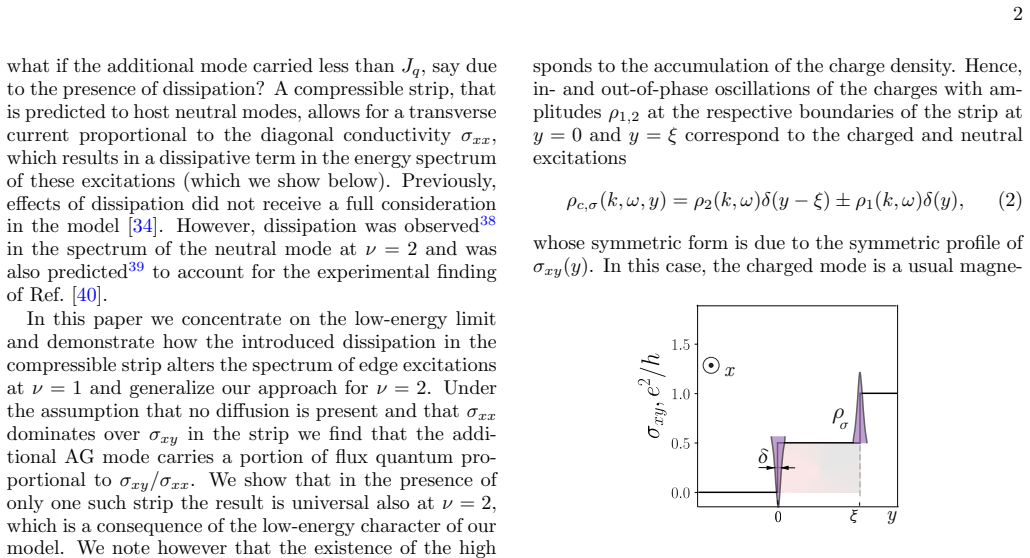
The load-bearing object is a simplified electrostatic model of the dissipative compressible strip: the Hall-conductivity profile $\sigma_{xy}(y)$ has a half-jump of width $\xi$, and the strip carries a constant diagonal conductivity $\sigma_{xx}$. Charged and neutral charge amplitudes live on the two boundaries of the strip; the neutral mode acquires a dominant dissipative part $-2i(\sigma_{xx}/\sigma_{xy})\varepsilon_0$ with $\varepsilon_0=2v_\sigma/\xi$ acting as the high-energy cutoff. The heat current is computed as an integral of density-density correlation functions obtained from the equations of motion through the fluctuation-dissipation theorem; the same machinery is repeated for the three amplitudes at $\nu=2$, where the overdamped mode mixes with the two underdamped ones and contributes the same fractional heat current.
What would settle it
Measure the total heat current of a clean integer quantum Hall edge at $\nu=1$ or $\nu=2$ while tuning the compressible strip, for example by gate voltage or magnetic field to move the local $\sigma_{xx}$ peak. If the heat current remains exactly $J_q$ (at $\nu=1$) or $2J_q$ (at $\nu=2$) even when a dissipative strip is present, or if the deficit does not scale with $\sigma_{xy}/\sigma_{xx}$ as predicted, the dissipative-neutral-mode explanation is ruled out. A $\nu=1$ measurement is the cleanest test, since the model predicts only a single fractional correction $(\sigma_{xy}/2\pi\sigma_{xx})J_q$ on top of the quantized charged mode.
Extended reading notes
Core claim
The paper's central claim is that dissipation inside the compressible edge strip removes the exact quantization of heat current at integer quantum Hall fillings. Modeling the strip as a symmetric jump in the Hall-conductivity profile with a large diagonal conductivity $\sigma_{xx}$, the authors find two modes: a charged edge mode that is insensitive to dissipation and carries exactly one heat flux quantum, and a hydrodynamic neutral mode with spectrum $\omega_\sigma = k v_\sigma - 2i(\sigma_{xx}/\sigma_{xy})\varepsilon_0$, i.e. an overdamped mode. Its contribution to the heat current, calculated from fluctuation-dissipation correlations, equals $(\sigma_{xy}/2\pi\sigma_{xx})J_q$ at $\nu=1$; repeating the calculation for $\nu=2$, where the overdamped mode couples to the two underdamped modes, gives the same fractional contribution on top of the two quanta carried by those modes. All auxiliary parameters—velocities, interaction details, and the cutoff—drop out of the leading-order answer, leaving only the conductivity ratio $\sigma_{xy}/\sigma_{xx}$.
Load-bearing premise
The central result collapses if the compressible strip does not satisfy $\sigma_{xx}\gg\sigma_{xy}$, and the non-quantized value also requires the finite high-energy cutoff $1/\xi$; if the wave-vector integral is extended to infinity, quantization is restored.
Editorial extensions
If this is right
- At $\nu=1$ the total heat current is predicted to be $(1+\sigma_{xy}/2\pi\sigma_{xx})J_q$ rather than exactly $J_q$.
- At $\nu=2$ the total becomes $(2+\sigma_{xy}/2\pi\sigma_{xx})J_q$, reproducing the qualitative 13% deficit seen in the experiment reported in Ref. [13].
- The fractional correction is universal in the model: velocities, interaction details, and the cutoff scale $1/\xi$ all cancel, so the same ratio $\sigma_{xy}/(2\pi\sigma_{xx})$ controls both fillings.
- The overdamped neutral mode is invisible to charge transport but contributes to heat transport, so heat measurements become a direct probe of the strip's diagonal conductivity.
- For large $\sigma_{xx}/\sigma_{xy}$ the correction is small and quantization is approximately restored; the exact value of the measured deficit sets the conductivity ratio.
Reading between the lines
- If a microscopic derivation supplied $\sigma_{xx}/\sigma_{xy}$ as a function of gate voltage and magnetic field, the heat-deficit measurement would become a quantitative estimator of that ratio; the model itself does not predict the ratio.
- The same dissipative-strip mechanism could in principle affect heat transport at other integer fillings where a compressible strip forms, with the fractional correction set by the local conductivity ratio; the paper only works out $\nu=1$ and $\nu=2$.
- Because the correction comes from wavevectors all the way up to the cutoff, a fully microscopic treatment that changes the high-energy behaviour could alter the numerical prefactor; the paper explicitly leaves this open.
- A clean $\nu=1$ heat-current measurement would give the sharpest test: there the prediction is a single fractional contribution on top of the quantized charged mode, with no other modes to disentangle.
Signed reviews
Editorial analysis
A structured set of objections, weighed in public.
Referee Report
Summary. The paper proposes a low-energy effective model of a dissipative compressible strip at the edge of an integer quantum Hall system. Dissipation is modeled through a finite diagonal conductivity sigma_xx in the strip, and the lowest hydrodynamic (Aleiner-Glazman) neutral mode acquires an overdamped spectrum. The authors compute the heat current carried by this mode using response functions and the fluctuation-dissipation theorem. At nu=1 they claim the dissipative mode carries J_sigma = (sigma_xy/(2 pi sigma_xx)) J_q, and at nu=2 they claim the total heat current is J_E = [2 + sigma_xy/(2 pi sigma_xx)] J_q. The paper suggests these dissipative modes explain the missing heat current observed by le Sueur et al. (PRL 105, 056803 (2010)).
Significance. If the central claim is correct, the paper provides a concrete mechanism for the observed breakdown of heat-current quantization in integer quantum Hall edges and offers a potential explanation for the elusiveness of hydrodynamic neutral modes. The model is explicit, the FDT-based response-function formalism is appropriate, and the authors honestly flag the need for a microscopic model of dissipation. However, the significance is conditional: the claimed correction is dominated by the high-energy cutoff region rather than being a protected low-energy property, and the paper's own discussion concedes that the exact numerical prefactor depends on interaction details. The experimental consistency check is also not a parameter-free test, since the ratio sigma_xy/sigma_xx is an input parameter. These issues must be resolved before the universality claim can be accepted.
major comments (4)
- [Eq. (18)-(19), Sec. IV] The evaluation leading to Eq. (19) is not shown in sufficient detail, and the claim that all auxiliary parameters cancel is not demonstrated. A straightforward evaluation under the stated wide-Lorentzian approximation and a sharp cutoff at |k|=1/xi gives a prefactor of order 3/(2 pi^2), not exactly 1/(2 pi), so the exact coefficient depends on how the cutoff and the Lorentzian tails are treated. This is not a purely cosmetic issue, because the discussion section states that "the exact numerical prefactor depends on the interaction details," which appears to contradict the universality claimed in Eq. (19). The authors should provide the full step-by-step evaluation of the integral and clarify the range of validity of the stated cancellation.
- [Appendix A, Eq. (27)] The nu=2 heat current result is asserted rather than derived. After writing the response functions and the determinant, the appendix ends with "Following this strategy one can discover the correction sigma_xy/(2 pi sigma_xx) J_q." This is the key result used for the experimental comparison, and the relevant algebra is not shown. The authors should either display the full computation, including how the cross-correlators combine to produce exactly the same correction as at nu=1, or provide a reproducible symbolic calculation.
- [Introduction and Sec. VI] The claimed consistency with the 13% heat deficit in Ref. [13] appears numerically inconsistent with the central expansion assumption. If the deficit is interpreted as sigma_xy/(2 pi sigma_xx) = 0.13, then sigma_xy/sigma_xx is about 0.8, which violates the assumption sigma_xx >> sigma_xy used throughout to expand in sigma_xy/sigma_xx and to treat the neutral mode as overdamped. The authors should state explicitly how the measured 13% is normalized and clarify whether the inferred ratio lies within the regime where their leading-order result is controlled; otherwise the comparison to experiment is not a meaningful consistency check.
- [Sec. IV, renormalization of quantization] The paper correctly notes that extending the k integral in Eq. (18) to infinity restores full quantization, which means the non-quantized correction is dominated by the boundary of the hydrodynamic regime. Since the coefficient is set by physics at k ~ 1/xi, the prediction is not protected from microscopic details above the cutoff. This limitation is acknowledged in the discussion, but it directly affects the headline claim of universality; the paper should quantify the sensitivity of Eq. (19) to the cutoff profile and state explicitly that the result is not a universal low-energy prediction in the usual sense.
minor comments (4)
- [General] There are several typos, e.g., "seams reasonable" near Eqs. (3)-(7) should read "seems reasonable."
- [Sec. II, Fig. 2] The parameter delta is introduced as the effective width of the charge density in the edge channels, but its precise definition and relation to the strip width xi are not clear; a short clarifying sentence would help.
- [Eq. (18)] The upper limit of the frequency integral is written as T, but the integrand does not show the Bose factor or the vacuum subtraction that appears in Eq. (17); the authors should align the notation with the FDT formula in Eq. (15).
- [Sec. VI] The phrase "the exact numerical prefactor depends on the interaction details" should be reconciled with Eq. (19) and with the abstract's claim that the carried portion is the same at nu=1 and nu=2; as written, the two statements require qualification.
Circularity Check
No circular reduction: the heat-current result is a nontrivial computed function of the model's conductivity ratio, and the self-citations are methodological rather than load-bearing.
full rationale
The paper's central claim J_σσ = (σxy/2πσxx)J_q is obtained by evaluating the FDT correlator (16) in the integral (18) and then taking the σxx ≫ σxy limit. This is not a self-definitional reduction: the heat current is not the input dissipative rate or the input conductivity ratio by construction; it is a computed spectral integral whose value happens to depend only on the ratio after velocities and cutoff cancel. Equation (19) is not a renaming of Eq. (8), and no parameter is fitted to the 13% deficit: the text explicitly states that a microscopic model of dissipation is needed to confirm the prediction (abstract and Sec. VI), so the experimental consistency is conditional rather than a fitted prediction. The self-citations (Refs. 39 and 42) provide a hydrodynamics/FDT evaluation technique and an energy-flux identity, but the FDT itself is cited to Callen and Welton and to Kubo; these citations do not supply the target result or forbid alternatives. The ν=2 result Eq. (27) is supported by the response-function calculation in Appendix A, although the final integration is summarized as 'following this strategy one can discover the correction'; this is an omitted verification step, not circularity. The admitted sensitivity to the UV cutoff (Sec. IV) is a model limitation explicitly acknowledged by the authors, and it concerns correctness risk rather than circularity. No load-bearing step reduces by construction to its own inputs, so the appropriate score is 0.
Assumptions & free parameters
free parameters (3)
- σxx/σxy ratio in the compressible strip
- High-energy cut-off 1/ξ (or ε0 = 2vσ/ξ)
- Velocities v_c, v_σ and interaction parameters U(δ/D), U(ξ/D)
assumptions (7)
- standard math Fluctuation-dissipation theorem relates density correlators to linear response functions.
- domain assumption The compressible strip can be modeled as a symmetric half-jump in σxy with a uniform σxx inside the strip.
- domain assumption σxx ≫ σxy in the compressible strip, with expansion in σxy/σxx.
- domain assumption Constant electric field inside the strip: U'(|ky|)|_{y=δ} = U'(|ky|)|_{y=ξ}.
- domain assumption Neglect of the k^2 (diffusion) term in the continuity equation.
- domain assumption Coulomb interaction is screened at distance D much larger than the strip width, making velocities dispersionless.
- domain assumption The existence of a high-energy cut-off 1/ξ for the hydrodynamic description.
Cite this review
Pith. "Pith review of Heat current in a dissipative quantum Hall edge." pith.science (2026). https://pith.science/paper/6VI5VT6B
@misc{pith2026190801213,
  author       = {Pith},
  title        = {Pith review of: Heat current in a dissipative quantum Hall edge},
  year         = {2026},
  howpublished = {\url{https://pith.science/paper/6VI5VT6B}},
  note         = {Machine review of arXiv:1908.01213}
}
abstract
We explore the heat current in the quantum Hall edge at filling factors $\nu = 1$ and $\nu = 2$ in the presence of dissipation. Dissipation arises in the compressible strip forming at the edge in presence of a smooth confining potential. Such strip was predicted to host an infinite number of hydrodynamic neutral modes, which however were never observed. A possible explanation may be in their dissipative nature, which was not fully considered before. Heat transport measurements are capable of detecting neutral modes and experiment [H. le Sueur et al., Phys. Rev. Lett. 105, 056803 (2010)] at $\nu = 2$ captured additional degrees of freedom transferring heat at the edge. Surprisingly, the breakdown of heat current quantization has been found. We conjecture that the aforementioned dissipative modes might be responsible for this behavior. We build a low-energy effective model and show that the lowest hydrodynamic mode carries a portion of the heat flux quantum which is the same both at $\nu = 1$ and $\nu = 2$. Although our results are consistent with the experiment, a microscopic model of dissipation is needed to confirm the prediction of the low-energy approximation.
Figures


Forward citations
Cited by 1 Pith paper
-
Giant Heat Flux Effect in Non-Chiral Transmission Lines
An open chain of Ohmic contacts on quantum Hall edges carries chiral heat-current fluctuations up to a factor of order N above the quantum of heat flux.
Reference graph
Works this paper leans on
-
[13]
author author H. le Sueur , author C. Altimiras , author U. Gennser , author A. Cavanna , author D. Mailly , \ and\ author F. Pierre ,\ 10.1103/PhysRevLett.105.056803 journal journal Phys. Rev. Lett. \ volume 105 ,\ pages 056803 ( year 2010 ) NoStop
-
[1]
author author M. Banerjee , author M. Heiblum , author A. Rosenblatt , author Y. Oreg , author D. E. \ Feldman , author A. Stern , \ and\ author V. Umansky ,\ https://doi.org/10.1038/nature22052 journal journal Nature \ volume 545 ,\ pages 75 EP ( year 2017 ) NoStop
-
[2]
author author C. L. \ Kane \ and\ author M. P. A. \ Fisher ,\ 10.1103/PhysRevB.55.15832 journal journal Phys. Rev. B \ volume 55 ,\ pages 15832 ( year 1997 ) NoStop
-
[3]
author author S. Jezouin , author F. D. \ Parmentier , author A. Anthore , author U. Gennser , author A. Cavanna , author Y. Jin , \ and\ author F. Pierre ,\ 10.1126/science.1241912 journal journal Science \ volume 342 ,\ pages 601 ( year 2013 ) NoStop
-
[4]
author author O. Chiatti , author J. T. \ Nicholls , author Y. Y. \ Proskuryakov , author N. Lumpkin , author I. Farrer , \ and\ author D. A. \ Ritchie ,\ 10.1103/PhysRevLett.97.056601 journal journal Phys. Rev. Lett. \ volume 97 ,\ pages 056601 ( year 2006 ) NoStop
-
[5]
author author L. W. \ Molenkamp , author T. Gravier , author H. van Houten , author O. J. A. \ Buijk , author M. A. A. \ Mabesoone , \ and\ author C. T. \ Foxon ,\ 10.1103/PhysRevLett.68.3765 journal journal Phys. Rev. Lett. \ volume 68 ,\ pages 3765 ( year 1992 ) NoStop
-
[6]
author author K. Schwab , author E. A. \ Henriksen , author J. M. \ Worlock , \ and\ author M. L. \ Roukes ,\ 10.1038/35010065 journal journal Nature \ volume 404 ,\ pages 974 ( year 2000 ) NoStop
-
[7]
author author D. B. \ Gutman , author I. V. \ Protopopov , author A. L. \ Burin , author I. V. \ Gornyi , author R. A. \ Santos , \ and\ author A. D. \ Mirlin ,\ 10.1103/PhysRevB.93.245427 journal journal Phys. Rev. B \ volume 93 ,\ pages 245427 ( year 2016 ) NoStop
Show all 48 references
-
[8]
Gurman , author R
author author I. Gurman , author R. Sabo , author M. Heiblum , author V. Umansky , \ and\ author D. Mahalu ,\ https://doi.org/10.1038/ncomms2305 journal journal Nature Communications \ volume 3 ,\ pages 1289 EP ( year 2012 ) NoStop
2012 doi
-
[9]
Granger , author J
author author G. Granger , author J. P. \ Eisenstein , \ and\ author J. L. \ Reno ,\ 10.1103/PhysRevLett.102.086803 journal journal Phys. Rev. Lett. \ volume 102 ,\ pages 086803 ( year 2009 ) NoStop
2009 doi
-
[10]
Venkatachalam , author S
author author V. Venkatachalam , author S. Hart , author L. Pfeiffer , author K. West , \ and\ author A. Yacoby ,\ https://doi.org/10.1038/nphys2384 journal journal Nature Physics \ volume 8 ,\ pages 676 EP ( year 2012 ) NoStop
2012 doi
-
[11]
Banerjee , author M
author author M. Banerjee , author M. Heiblum , author V. Umansky , author D. E. \ Feldman , author Y. Oreg , \ and\ author A. Stern ,\ 10.1038/s41586-018-0184-1 journal journal Nature \ volume 559 ,\ pages 205 ( year 2018 ) NoStop
2018 doi
-
[12]
author author D. F. \ Mross , author Y. Oreg , author A. Stern , author G. Margalit , \ and\ author M. Heiblum ,\ 10.1103/PhysRevLett.121.026801 journal journal Phys. Rev. Lett. \ volume 121 ,\ pages 026801 ( year 2018 ) NoStop
2018 doi
-
[14]
author author A. H. \ MacDonald ,\ 10.1103/PhysRevLett.64.220 journal journal Phys. Rev. Lett. \ volume 64 ,\ pages 220 ( year 1990 ) NoStop
1990 doi
-
[15]
author author M. D. \ Johnson \ and\ author A. H. \ MacDonald ,\ 10.1103/PhysRevLett.67.2060 journal journal Phys. Rev. Lett. \ volume 67 ,\ pages 2060 ( year 1991 ) NoStop
1991 doi
-
[16]
author author X. G. \ Wen ,\ 10.1103/PhysRevB.43.11025 journal journal Phys. Rev. B \ volume 43 ,\ pages 11025 ( year 1991 ) NoStop
1991 doi
-
[17]
Meir ,\ 10.1103/PhysRevLett.72.2624 journal journal Phys
author author Y. Meir ,\ 10.1103/PhysRevLett.72.2624 journal journal Phys. Rev. Lett. \ volume 72 ,\ pages 2624 ( year 1994 ) NoStop
1994 doi
-
[18]
Wang , author Y
author author J. Wang , author Y. Meir , \ and\ author Y. Gefen ,\ 10.1103/PhysRevLett.111.246803 journal journal Phys. Rev. Lett. \ volume 111 ,\ pages 246803 ( year 2013 ) NoStop
2013 doi
-
[19]
Yang ,\ 10.1103/PhysRevLett.91.036802 journal journal Phys
author author K. Yang ,\ 10.1103/PhysRevLett.91.036802 journal journal Phys. Rev. Lett. \ volume 91 ,\ pages 036802 ( year 2003 ) NoStop
2003 doi
-
[20]
author author Y. N. \ Joglekar , author H. K. \ Nguyen , \ and\ author G. Murthy ,\ 10.1103/PhysRevB.68.035332 journal journal Phys. Rev. B \ volume 68 ,\ pages 035332 ( year 2003 ) NoStop
2003 doi
-
[21]
Zhang , author Y.-H
author author Y. Zhang , author Y.-H. \ Wu , author J. A. \ Hutasoit , \ and\ author J. K. \ Jain ,\ 10.1103/PhysRevB.90.165104 journal journal Phys. Rev. B \ volume 90 ,\ pages 165104 ( year 2014 ) NoStop
2014 doi
-
[22]
Protopopov , author Y
author author I. Protopopov , author Y. Gefen , \ and\ author A. Mirlin ,\ https://doi.org/10.1016/j.aop.2017.07.015 journal journal Annals of Physics \ volume 385 ,\ pages 287 ( year 2017 ) NoStop
2017 doi
-
[23]
Park , author Y
author author J. Park , author Y. Gefen , \ and\ author H.-S. \ Sim ,\ 10.1103/PhysRevB.92.245437 journal journal Phys. Rev. B \ volume 92 ,\ pages 245437 ( year 2015 ) NoStop
2015 doi
-
[24]
Wan , author K
author author X. Wan , author K. Yang , \ and\ author E. H. \ Rezayi ,\ 10.1103/PhysRevLett.88.056802 journal journal Phys. Rev. Lett. \ volume 88 ,\ pages 056802 ( year 2002 ) NoStop
2002 doi
-
[25]
Ferconi , author M
author author M. Ferconi , author M. R. \ Geller , \ and\ author G. Vignale ,\ 10.1103/PhysRevB.52.16357 journal journal Phys. Rev. B \ volume 52 ,\ pages 16357 ( year 1995 ) NoStop
1995 doi
-
[26]
Bid , author N
author author A. Bid , author N. Ofek , author H. Inoue , author M. Heiblum , author C. L. \ Kane , author V. Umansky , \ and\ author D. Mahalu ,\ https://doi.org/10.1038/nature09277 journal journal Nature \ volume 466 ,\ pages 585 EP ( year 2010 ) NoStop
-
[27]
Grivnin , author H
author author A. Grivnin , author H. Inoue , author Y. Ronen , author Y. Baum , author M. Heiblum , author V. Umansky , \ and\ author D. Mahalu ,\ 10.1103/PhysRevLett.113.266803 journal journal Phys. Rev. Lett. \ volume 113 ,\ pages 266803 ( year 2014 ) NoStop
-
[28]
Gross , author M
author author Y. Gross , author M. Dolev , author M. Heiblum , author V. Umansky , \ and\ author D. Mahalu ,\ 10.1103/PhysRevLett.108.226801 journal journal Phys. Rev. Lett. \ volume 108 ,\ pages 226801 ( year 2012 ) NoStop
2012 doi
-
[29]
Dolev , author Y
author author M. Dolev , author Y. Gross , author R. Sabo , author I. Gurman , author M. Heiblum , author V. Umansky , \ and\ author D. Mahalu ,\ 10.1103/PhysRevLett.107.036805 journal journal Phys. Rev. Lett. \ volume 107 ,\ pages 036805 ( year 2011 ) NoStop
-
[30]
Moore \ and\ author N
author author G. Moore \ and\ author N. Read ,\ https://doi.org/10.1016/0550-3213(91)90407-O journal journal Nuclear Physics B \ volume 360 ,\ pages 362 ( year 1991 ) NoStop
1991 doi
-
[31]
Willett , author J
author author R. Willett , author J. P. \ Eisenstein , author H. L. \ St\"ormer , author D. C. \ Tsui , author A. C. \ Gossard , \ and\ author J. H. \ English ,\ 10.1103/PhysRevLett.59.1776 journal journal Phys. Rev. Lett. \ volume 59 ,\ pages 1776 ( year 1987 ) NoStop
-
[32]
Goldstein \ and\ author Y
author author M. Goldstein \ and\ author Y. Gefen ,\ 10.1103/PhysRevLett.117.276804 journal journal Phys. Rev. Lett. \ volume 117 ,\ pages 276804 ( year 2016 ) NoStop
2016 doi
-
[33]
Bhattacharyya , author M
author author R. Bhattacharyya , author M. Banerjee , author M. Heiblum , author D. Mahalu , \ and\ author V. Umansky ,\ 10.1103/PhysRevLett.122.246801 journal journal Phys. Rev. Lett. \ volume 122 ,\ pages 246801 ( year 2019 ) NoStop
-
[34]
author author I. L. \ Aleiner \ and\ author L. I. \ Glazman ,\ 10.1103/PhysRevLett.72.2935 journal journal Phys. Rev. Lett. \ volume 72 ,\ pages 2935 ( year 1994 ) NoStop
1994 doi
-
[35]
author author D. B. \ Chklovskii , author B. I. \ Shklovskii , \ and\ author L. I. \ Glazman ,\ 10.1103/PhysRevB.46.4026 journal journal Phys. Rev. B \ volume 46 ,\ pages 4026 ( year 1992 ) NoStop
1992 doi
-
[36]
author author C. d. C. \ Chamon \ and\ author X. G. \ Wen ,\ 10.1103/PhysRevB.49.8227 journal journal Phys. Rev. B \ volume 49 ,\ pages 8227 ( year 1994 ) NoStop
1994 doi
-
[37]
Pascher , author C
author author N. Pascher , author C. R\"ossler , author T. Ihn , author K. Ensslin , author C. Reichl , \ and\ author W. Wegscheider ,\ 10.1103/PhysRevX.4.011014 journal journal Phys. Rev. X \ volume 4 ,\ pages 011014 ( year 2014 ) NoStop
-
[38]
Bocquillon , author V
author author E. Bocquillon , author V. Freulon , author J.-. M. \ Berroir , author P. Degiovanni , author B. Pla c ais , author A. Cavanna , author Y. Jin , \ and\ author G. F \`e ve ,\ http://dx.doi.org/10.1038/ncomms2788 journal journal Nature Communications \ volume 4 ,\ p...
-
[39]
author author A. S. \ Goremykina \ and\ author E. V. \ Sukhorukov ,\ 10.1103/PhysRevB.97.115418 journal journal Phys. Rev. B \ volume 97 ,\ pages 115418 ( year 2018 ) NoStop
2018 doi
-
[40]
Tewari , author P
author author S. Tewari , author P. Roulleau , author C. Grenier , author F. Portier , author A. Cavanna , author U. Gennser , author D. Mailly , \ and\ author P. Roche ,\ 10.1103/PhysRevB.93.035420 journal journal Phys. Rev. B \ volume 93 ,\ pages 035420 ( year 2016 ) NoStop
-
[42]
author author I. P. \ Levkivskyi \ and\ author E. V. \ Sukhorukov ,\ 10.1103/PhysRevB.85.075309 journal journal Phys. Rev. B \ volume 85 ,\ pages 075309 ( year 2012 ) NoStop
2012 doi
-
[43]
author author H. B. \ Callen \ and\ author T. A. \ Welton ,\ 10.1103/PhysRev.83.34 journal journal Phys. Rev. \ volume 83 ,\ pages 34 ( year 1951 ) NoStop
1951 doi
-
[44]
Kubo ,\ 10.1143/JPSJ.12.570 journal journal Journal of the Physical Society of Japan \ volume 12 ,\ pages 570 ( year 1957 ) NoStop
author author R. Kubo ,\ 10.1143/JPSJ.12.570 journal journal Journal of the Physical Society of Japan \ volume 12 ,\ pages 570 ( year 1957 ) NoStop
1957 doi
-
[45]
note The perturbation can be very general, but we have already chosen to project our system on the two lowest modes and thus we concentrate only on them. Stop
-
[46]
note In fact, when v_2 = v_4 , the ratio of the dissipative term to the linear one is the same both for the neutral and charged modes and equals to k _ xy /8 _ xx . Stop
-
[47]
author author K. v. \ Klitzing , author G. Dorda , \ and\ author M. Pepper ,\ 10.1103/PhysRevLett.45.494 journal journal Phys. Rev. Lett. \ volume 45 ,\ pages 494 ( year 1980 ) NoStop
1980 doi
-
[48]
Suddards , author A
author author M. Suddards , author A. Baumgartner , author M. Henini , \ and\ author C. Mellor ,\ 10.1088/1367-2630/14/8/083015 journal journal New Journal of Physics \ volume 14 ,\ pages 083015 ( year 2012 ) NoStop
2012 doi
-
[49]
Weis \ and\ author K
author author J. Weis \ and\ author K. Klitzing ,\ 10.1098/rsta.2011.0198 journal journal Philosophical Transactions of the Royal Society A: Mathematical, Physical and Engineering Sciences \ volume 369 ,\ pages 3954 ( year 2011 ) NoStop
2011
Reviewed August 14, 2026 · model on record in the stance chip above.
Discussion (0). Continue with ORCID to comment.