Connection between the GKSL master equation and the Landauer formula
Pith reviewed 2026-06-26 03:23 UTC · model grok-4.3
The pith
GKSL master equation yields a current formula that reduces to the Landauer formula for non-interacting systems under specific conditions.
A machine-rendered reading of the paper's core claim, the machinery that carries it, and where it could break.
Core claim
Within the GKSL master equation formalism applied to a non-interacting system, a current formula is obtained that coincides exactly with the Landauer formula once the system satisfies the stated conditions on the reservoir couplings and steady-state populations.
What carries the argument
Derivation of the current formula directly from the GKSL master equation for a non-interacting system, which permits term-by-term comparison with the Landauer expression.
If this is right
- The Landauer formula can be recovered as a limiting case inside the GKSL framework without additional assumptions.
- Currents in non-interacting open systems can be computed equivalently by either method when the stated conditions hold.
- The equivalence supplies a consistency check for numerical implementations of the GKSL equation in transport problems.
Where Pith is reading between the lines
- The identified conditions may serve as a benchmark when extending the GKSL approach to weakly interacting systems where Landauer is not directly available.
- The connection suggests that master-equation methods could be used for device geometries that are awkward for scattering theory.
- It opens the possibility of systematic comparison between the two formalisms in exactly solvable models.
Load-bearing premise
The system must be non-interacting so that the master-equation current can be compared directly to the Landauer formula.
What would settle it
A concrete calculation or measurement in which the GKSL-derived current differs from the Landauer result for a demonstrably non-interacting system under the identified conditions would falsify the claimed reduction.
Figures
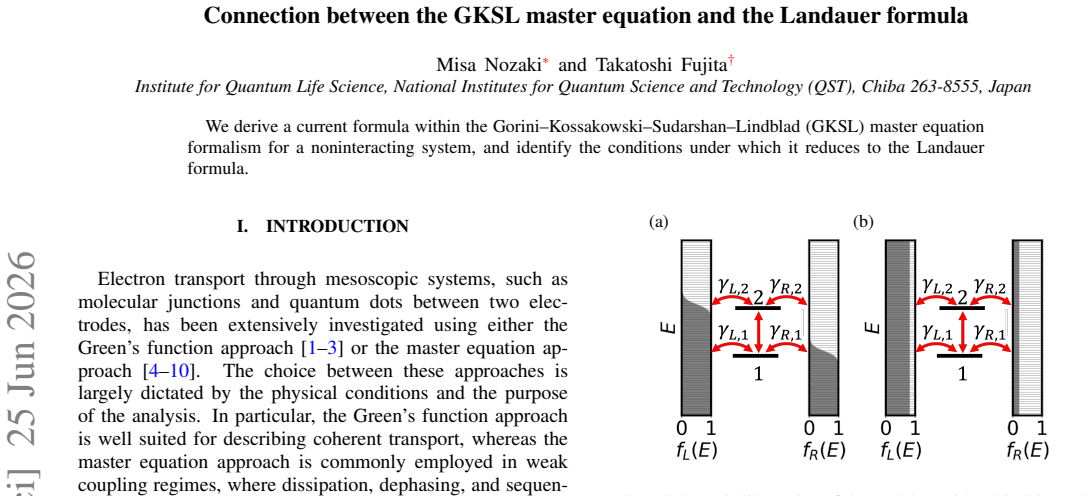
read the original abstract
We derive a current formula within the Gorini-Kossakowski-Sudarshan-Lindblad (GKSL) master equation formalism for a non-interacting system, and identify the conditions under which it reduces to the Landauer formula.
Editorial analysis
A structured set of objections, weighed in public.
Referee Report
Summary. The manuscript derives a current formula within the Gorini-Kossakowski-Sudarshan-Lindblad (GKSL) master equation formalism applied to a non-interacting system and identifies the conditions under which the derived expression reduces to the Landauer formula.
Significance. If the derivation holds, the work supplies an explicit mapping between the GKSL open-system approach and the Landauer scattering formula in the non-interacting regime. This is a useful clarification for quantum transport theory, as both formalisms are known to apply there; the paper's contribution lies in exhibiting the precise limits and the resulting current expression rather than in new physics.
minor comments (1)
- The abstract is terse; a brief statement of the system Hamiltonian or the form of the GKSL dissipator in the main text would help readers immediately locate the non-interacting assumption.
Simulated Author's Rebuttal
We thank the referee for their positive assessment of the manuscript and for recommending acceptance. The report contains no major comments requiring a point-by-point response.
Circularity Check
No significant circularity identified
full rationale
The paper states it derives a current formula inside the GKSL master equation for an explicitly non-interacting system and identifies the conditions for reduction to the Landauer formula. Both formalisms are independently known to apply in the non-interacting regime, so the task reduces to exhibiting an explicit mapping under stated limits. No self-citations, fitted parameters renamed as predictions, self-definitional steps, or ansatz smuggling are described in the provided abstract or reader summary. The derivation chain is therefore self-contained against external benchmarks and receives the default non-finding.
Axiom & Free-Parameter Ledger
Reference graph
Works this paper leans on
-
[1]
Stefanucci and R
G. Stefanucci and R. van Leeuwen,Nonequilibrium Many-Body Theory of Quantum Systems: A Modern Introduction, 2nd ed. (Cambridge University Press, 2025)
2025
-
[2]
Datta,Electronic Transport in Mesoscopic Systems(Cam- bridge University Press, 1995)
S. Datta,Electronic Transport in Mesoscopic Systems(Cam- bridge University Press, 1995)
1995
-
[3]
Meir and N
Y . Meir and N. S. Wingreen, Landauer formula for the current through an interacting electron region, Phys. Rev. Lett.68, 2512 (1992)
1992
-
[4]
Harbola, M
U. Harbola, M. Esposito, and S. Mukamel, Quantum master equation for electron transport through quantum dots and single molecules, Phys. Rev. B74, 235309 (2006)
2006
-
[5]
Timm, Tunneling through molecules and quantum dots: Master-equation approaches, Phys
C. Timm, Tunneling through molecules and quantum dots: Master-equation approaches, Phys. Rev. B77, 195416 (2008)
2008
-
[6]
J. E. Subotnik, T. Hansen, M. A. Ratner, and A. Nitzan, Nonequilibrium steady state transport via the reduced density matrix operator, The Journal of Chemical Physics130, 144105 (2009)
2009
-
[7]
Timm, Time-convolutionless master equation for quantum dots: Perturbative expansion to arbitrary order, Phys
C. Timm, Time-convolutionless master equation for quantum dots: Perturbative expansion to arbitrary order, Phys. Rev. B 83, 115416 (2011)
2011
-
[8]
O. Hod, C. A. Rodr ´ıguez-Rosario, T. Zelovich, and T. Frauen- heim, Driven liouville von neumann equation in lindblad form, The Journal of Physical Chemistry A120, 3278 (2016), pMID: 26807992
2016
-
[9]
P. H. Guimar ˜aes, G. T. Landi, and M. J. de Oliveira, Nonequi- librium quantum chains under multisite lindblad baths, Phys. Rev. E94, 032139 (2016)
2016
-
[10]
A. R. Kolovsky, Deriving landauer’s formula by using the mas- ter equation approach, Europhysics Letters146, 61001 (2024)
2024
-
[11]
Gorini, A
V . Gorini, A. Kossakowski, and E. C. G. Sudarshan, Completely positive dynamical semigroups of n-level systems, Journal of Mathematical Physics17, 821 (1976)
1976
-
[12]
Lindblad, On the generators of quantum dynamical semi- groups, Communications in Mathematical Physics48, 119 (1976)
G. Lindblad, On the generators of quantum dynamical semi- groups, Communications in Mathematical Physics48, 119 (1976)
1976
-
[13]
T. Jin, M. Filippone, and T. Giamarchi, Generic transport for- mula for a system driven by Markovian reservoirs, Phys. Rev. B102, 205131 (2020)
2020
-
[14]
Bhatia,Matrix Analysis, Graduate Texts in Mathematics, V ol
R. Bhatia,Matrix Analysis, Graduate Texts in Mathematics, V ol. 169 (Springer-Verlag, New York, 1997)
1997
discussion (0)
Sign in with ORCID, Apple, or X to comment. Anyone can read and Pith papers without signing in.