REVIEW 3 major objections 5 minor 8 cited by
String breaking mechanism in a lattice Schwinger model simulator
T0 review · 3 major / 5 minor · reviewed 2026-08-12 · deepseek-v4-flash
Pith's one-line read This paper reports direct site-resolved observation of string breaking in a one-dimensional U(1) lattice gauge theory realized with ultracold atoms in an optical superlattice, including a quantitative resonance condition for when a flux…
desk verdict A strong microscopic demonstration of string breaking in an optical lattice gauge-theory simulator, but the quantitative resonance-condition claim rests on a fitting procedure that needs benchmarking before it can be trusted. read the letter →
The pith
A machine-rendered reading of the paper's core claim, the machinery that carries it, and where it could break.
The reading
What carries the argument
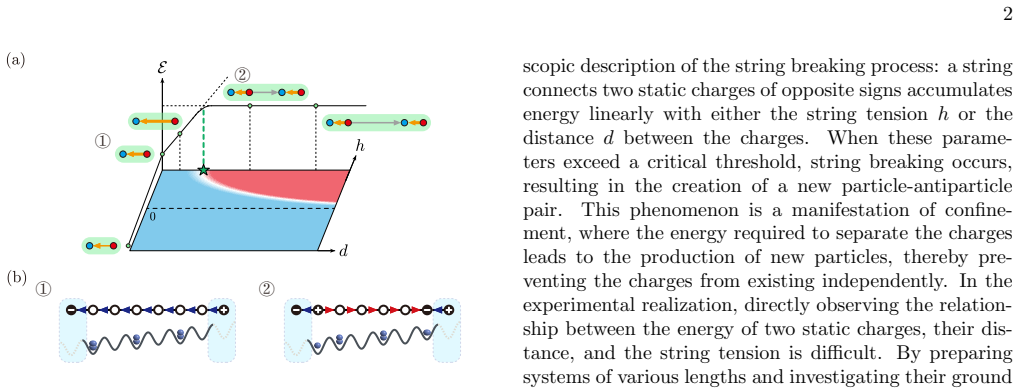
The load-bearing object is the mapping between the spin-1/2 U(1) quantum link model and a one-dimensional Bose-Hubbard model in a tilted optical superlattice, in the regime $U \approx \Delta \gg J$. Link occupations encode the gauge field: $|2\rangle|0\rangle$ is one spin state of the link and the singly or doubly occupied configurations $|1\rangle|1\rangle$, $|1\rangle|2\rangle$, $|0\rangle|2\rangle$, $|0\rangle|1\rangle$ encode the other, so the bosonic dimer dynamics reproduces gauge-invariant fermion hopping under Gauss's law. The order parameter that carries the argument is the spatially averaged electric field $\bar{E}$ over the $L-1$ bulk gauge sites: a negative value marks the string state and a positive value marks the broken-string state, and the peak of $|\bar{E}|$ as a function of $h$ locates the critical tension $h_c$. The quantitative mechanism is energy balance: breaking a string of $L$ flipped gauge sites costs $h L$, while producing the pair costs $2m$, so the transition occurs where $2m \approx h_c L$.
What would settle it
Run a round-trip ramp at the measured critical tension for $L=6$, $8$, and $10$ at each mass: return the system to its starting parameters and measure the fraction of atoms back in the initial Fock state. A return fidelity well below the roughly 90 percent observed for the single tested point ($L=9$, $m/\tilde{t}=8$, $h/\tilde{t}=4$) would show that the ramps excite states above the ground state, so the extracted $h_c$ is not the ground-state string-breaking threshold and the resonance condition $2m \approx h_c L$ is not supported.
Extended reading notes
Core claim
Working in the spin-1/2 quantum link formulation of the lattice Schwinger model, the paper claims that the ground state of two opposite static charges separated by a string of gauge flux is not always the confined string: as the string tension $h$ is raised at fixed mass $m$, the string breaks by nucleating a particle-antiparticle pair, leaving two neutral bound states and a sign-flipped electric field in the bulk. The authors identify the breaking threshold by preparing chains of length $L=6,8,10$ atoms, ramping $m$ and $h$ adiabatically, and reading out the spatially averaged electric field. The critical tension grows linearly with mass with slope $2/(L-1)$, which they interpret as the resonance condition $2m \approx h_c L$: the energy stored in the flipped gauge sites equals the rest-energy of the produced pair. In odd-length chains ($L=5,7,9$), where Gauss's law forces the endpoint charges to have the same sign, the bulk field inverts near $h \approx 0$ as a dynamical charge moves from one end to the other; the inversion threshold is nearly mass-independent. The paper presents these observations as direct microscopic evidence for the string-breaking mechanism and as a demonstration that optical-lattice simulators can access this non-perturbative physics.
Load-bearing premise
The load-bearing assumption is that the slow parameter ramps keep the system in the instantaneous ground state for every mass, length, and tension used to extract $h_c$; adiabaticity was verified for only one setting ($L=9$, $m/\tilde{t}=8$, $h/\tilde{t}=4$).
Editorial extensions
If this is right
- String breaking, normally inferred from hadron decays or numerical analytic continuation, can be watched in real space in a cold-atom simulator, with the broken string appearing as a sign flip of the bulk electric field.
- The resonance condition $2m \approx h_c L$ makes a quantitative prediction: at fixed mass, a longer string breaks at a smaller critical tension; the experiment confirms this for $L=6$, $8$, and $10$.
- Odd-length systems provide a clean, mass-independent marker, string inversion at $h \approx 0$, that follows directly from Gauss's law and same-sign boundary charges.
- The same adiabatic preparation and site-resolved readout can be reused to study other non-perturbative effects in lattice gauge theories, such as meson scattering or false-vacuum decay, on the same platform.
Reading between the lines
- One could test the resonance condition dynamically by quenching $h$ across $h_c$ and checking whether the time scale for forming the particle pair follows the ground-state threshold; the paper's adiabatic protocol does not address real-time breaking rates.
- Because $h_c$ is extracted from a fit to the electric-field magnitude, an independent check would be to measure the two-point charge correlator at the transition and confirm that a single particle-antiparticle pair appears in the bulk rather than multiply excited states.
- The odd-length inversion threshold at $h \approx 0$ could serve as an in situ calibration of the topological $\theta$-angle or string tension, giving a zero-crossing reference that does not depend on the rest mass.
- The same resonance condition implies that at fixed $h$ the critical length grows as $2m/h$; extending the ramp to larger $L$ would test whether the linear scaling in $L$, not just the slope, holds when finite-size corrections weaken.
Signed reviews
Editorial analysis
A structured set of objections, weighed in public.
Referee Report
Summary. The manuscript reports an experimental study of string breaking in a one-dimensional U(1) lattice Schwinger model realized with ultracold atoms in an optical superlattice. The authors prepare deterministic chains of length L with static charges at the ends, adiabatically ramp the mass and string tension, and image site-resolved charge and electric-field distributions. For even-length systems they observe a transition from a string state to a broken-string state as the string tension increases, and for odd-length systems they observe a 'string inversion' phenomenon. From fits to the absolute spatially averaged electric field, they extract a critical string tension h_c and claim the resonance condition 2m ≈ h_c L, where L is the number of flipped gauge sites. Exact-diagonalization phase diagrams are presented in support of the qualitative interpretation.
Significance. If the quantitative claims are correct, this would be a valuable experimental demonstration of a non-perturbative gauge-theory phenomenon in an analog quantum simulator, with direct microscopic readout of charges and electric fields. The site-resolved data in Fig. 2(c,d) provide genuine evidence for string-like and broken-string-like configurations, and the string-inversion observation for odd-length chains is an interesting additional result. However, the central quantitative claim, the resonance condition 2m ≈ h_c L, is not yet supported because the h_c extraction uses a fitting form that is inconsistent with the ground-state order parameter, and the adiabaticity verification covers only a single parameter point that is not representative of the even-length critical region. These issues are load-bearing but appear addressable by reanalysis and additional checks.
major comments (3)
- [Fig. 3 and 'Microscopic observation of string breaking' section] The asymmetric Gaussian fit to |Ebar| is internally inconsistent with the ground-state behavior shown in Fig. 2(a) and Extended Data Fig. 2(b): for even L, the spatially averaged electric field Ebar changes sign continuously at h_c, so |Ebar| has a V-shaped minimum at the transition, not a peak. Fitting a positive-amplitude asymmetric Gaussian to such a curve cannot yield the sign-change point as the 'peak' position, and the extracted h_c values are therefore systematically biased. These h_c values feed directly into the linear fits in Fig. 5(a) and the slopes in Fig. 5(b) that underlie the resonance condition 2m ≈ h_c L, so the central quantitative claim is not established by the current analysis. Please re-extract h_c by locating the sign change of Ebar or by fitting a function with a V-minimum, and validate the extraction against exact-diagonalization data for the same (L, m, h) parameter points.
- [Supplemental 'Adiabaticity verification through round-trip ramps' / Extended Data Fig. 1] The only adiabaticity check is a round-trip ramp for an odd-length system with L = 9 at m/t = 8 and h/t = 4. This parameter point lies far from the h_c ≈ 0 string-inversion transition, and it does not probe the even-length string-breaking regime where the gap is expected to be smallest near h_c. Since every h_c value in Fig. 3 assumes that the final state is the ground state, non-adiabatic excitations at other masses, lengths, or tensions would shift the measured |Ebar| and invalidate the extracted h_c. Please provide adiabaticity tests (e.g., ramp-rate dependence or round-trip fidelity) for representative even-length parameters near the transition, or quantitatively show that finite ramp speed does not shift the extracted h_c.
- [Extended Data Fig. 3 vs. Fig. 3] The numerical h_c values in Extended Data Fig. 3 are defined as the sign-change point of Ebar, while the experimental h_c values in Fig. 3 are defined as the peak of an asymmetric Gaussian fit to |Ebar|. These two estimators are not equivalent, so the comparison between the experimental slopes and the ED prediction 2/L is not apples-to-apples. The same estimator should be used for both, and the experimental estimator must be benchmarked against ED for the identical quantity before the resonance-condition claim can be assessed.
minor comments (5)
- ['Resonance condition for string breaking dynamics' section] The phrase 'the ratio of the rest mass to the string tension at the point of string breaking is inversely proportional to the number of flipped gauge sites' is reversed; the equation 2m ≈ h_c L implies h_c/m ∝ 1/L, so it is the ratio h_c/m (not m/h_c) that is inversely proportional to L.
- [Notation throughout] The symbol L is used both for the BHM system size and for the number of flipped gauge sites L = L − 1; the calligraphic distinction is easy to miss in plain text and should be defined explicitly at first use and rendered distinctly in figure labels.
- [Abstract] The abstract contains the typo 'stringbrokenstring states'; this should read 'string/broken-string states'.
- [Fig. 3 fitting function] The asymmetric Gaussian form A exp[-(x-h_c)^2/(2(σ+b(x-h_c))^2)] + y0 can have a vanishing or negative denominator for some parameter values; if this form is retained, the fit must constrain σ + b(x-h_c) to be positive over the entire fit range.
- [Figures 3 and Extended Data Fig. 1] The axis tick labels in Fig. 3 and Extended Data Fig. 1 are not fully legible in the preprint; the final figures should be high-resolution with clearly readable axes.
Circularity Check
No significant circularity: the central claims are direct experimental observations checked against independent exact-diagonalization calculations, and the resonance condition is a measured slope compared with an energy-balance prediction rather than an identity imposed by construction.
full rationale
The paper's central claims—observation of string and broken-string states, string inversion, and the resonance condition 2m≈hcL—are not circular. The mapping between the Bose-Hubbard simulator and the U(1) quantum link model is explicitly constructed in the supplementary material through operator identifications (Eqs. S4–S7), not merely asserted by citation. The experimental hc values in Fig. 3 are extracted from fits to measured |Ebar| curves; the subsequent linear fits of hc versus m and comparison of their slopes to 2/L constitute a genuine test of the energy-balance relation rather than a consequence of how hc was defined. The exact-diagonalization phase diagrams (Extended Data Figs. 2 and 3) provide an independent numerical determination of hc from the sign change of Ebar, using the same Hamiltonian but not the experimental data, so the resonance condition is corroborated rather than assumed. The overlap of the initial Fock state with the QLM ground state (>98%) is cited to the authors' concurrent preprint [67]; although this is a self-citation, it is a parameter-free numerical calculation that is externally checkable and is not the target result of this paper, so it does not constitute load-bearing circularity. One may worry that fitting a positive asymmetric Gaussian to |Ebar| is a poor estimator of the true sign-change point, since |Ebar| should have a minimum there, but that is a potential experimental bias or correctness risk, not a circularity: the hc values are not forced to equal 2m/L by the fitting procedure, and the agreement with ED is an empirical outcome. Overall, the derivation chain is self-contained against independent numerical benchmarks, and no predicted quantity reduces by definition to a fitted input or to an unverified self-citation chain.
Assumptions & free parameters
free parameters (4)
- Asymmetric Gaussian fit parameters (A, h_c, sigma, b, y_0) =
varies per curve; h_c is the reported critical tension
- Linear fit slope and intercept for h_c versus m =
slope values in Fig. 5(a), compared to 2/L
- Ramp durations (75 ms and 150 ms) =
75 ms, 150 ms
- Initial mass m/t = -4 =
-4
assumptions (5)
- domain assumption The BHM with U approximately Delta much greater than J maps to the target U(1) QLM within the constrained Hilbert space
- domain assumption The initial Fock state |1111...> at m/t = -4, h = 0 has over 98% overlap with the QLM ground state
- domain assumption The ramp is slow enough for the adiabatic theorem to hold for all parameter paths used
- standard math Gauss's law constraint (Eq. S2) defines the physical sector and the static charge configuration at the boundaries
- domain assumption The spatially averaged electric field Ebar is a valid order parameter for the string/broken-string transition
Cite this review
Pith. "Pith review of String breaking mechanism in a lattice Schwinger model simulator." pith.science (2026). https://pith.science/paper/6W3B3KUE
@misc{pith2026241115443,
  author       = {Pith},
  title        = {Pith review of: String breaking mechanism in a lattice Schwinger model simulator},
  year         = {2026},
  howpublished = {\url{https://pith.science/paper/6W3B3KUE}},
  note         = {Machine review of arXiv:2411.15443}
}
read the original abstract
String breaking is a fundamental concept in gauge theories, describing the decay of a flux string connecting two charges through the production of particle-antiparticle pairs. This phenomenon is particularly important in particle physics, notably in Quantum Chromodynamics, and plays a crucial role in condensed matter physics. However, achieving a theoretical understanding of this non-perturbative effect is challenging, as conventional numerical approaches often fall short and require substantial computational resources. On the experimental side, studying these effects necessitates advanced setups, such as high-energy colliders, which makes direct observation difficult. Here, we report an experimental investigation of the string breaking mechanism in a one-dimensional U(1) lattice gauge theory using an optical lattice quantum simulator. By deterministically preparing initial states of varying lengths with fixed charges at each end, and adiabatically tuning the mass and string tension, we observed in situ microscopic confined phases that exhibit either string or brokenstring states. Further analysis reveals that string breaking occurs under a resonance condition, leading to the creation of new particle-antiparticle pairs. These findings offer compelling evidence of string breaking and provide valuable insights into the intricate dynamics of lattice gauge theories. Our work underscores the potential of optical lattices as controllable quantum simulators, enabling the exploration of complex gauge theories and their associated phenomena.
Figures


Figures from the paper (2 more)


Forward citations
Cited by 8 Pith papers
-
Nonlocal Nonstabilizerness from Holographic Schwinger Pair Production
In holographic Schwinger pair production, the excess capacity of entanglement is √λ(d−2)/(d−1)³ — positive for d>2, zero for d=2 — so the produced pair carries nonlocal magic for d>2.
-
Symmetry-protected topology and deconfined solitons in a multi-link $\mathbb{Z}_2$ gauge theory
In a multi-link Z2 lattice gauge theory with three bonds per site pair, gauge fluxes order in a Peierls-like pattern that coexists with topological order, and doping produces deconfined half-charge solitons.
-
String Breaking Dynamics and Glueball Formation in a $2+1$D Lattice Gauge Theory
In a 2+1D Z2 lattice gauge theory, string breaking happens only at specific resonances set by field strength and matter mass, while long strings can dynamically form closed electric loops analogous to glueballs.
-
Quantum computation of hadron scattering in a lattice gauge theory
On a trapped-ion quantum computer, the authors prepared multiple meson wave packets and simulated their early-time collisions in a 1+1D Z2 lattice gauge theory.
-
Observation of hadron scattering in a lattice gauge theory on a quantum computer
The authors observe elastic and confined scattering, plus mass-quench-induced inelastic dynamics, in a 1+1D U(1) lattice gauge theory on IBM quantum hardware.
-
String Breaking in a $2+1$D $\mathbb{Z}_2$ Lattice Gauge Theory
In a 2+1D Z2 lattice gauge theory, strings between static charges in the confined phase map to free fermions on an open chain, and magnetic fluctuations stabilize the strings against breaking.
-
Tensor-network toolbox for probing dynamics of non-Abelian gauge theories
A matrix-product-state ansatz in the loop-string-hadron basis is used to compute ground-state energies, static potentials, and string-breaking dynamics of (1+1)D SU(2) lattice gauge theory, reproducing known qualitati...
-
String breaking dynamics in Ising chain with local vibrations
In the Ising-Holstein model with local vibrations, weak spin-phonon coupling slows string breaking in shallow wells, while strong coupling promotes string contraction over breaking.
Reference graph
Works this paper leans on
-
[1]
Kenneth G Wilson, “Confinement of quarks,” Physical Review D 10, 2445 (1974)
work page 1974
-
[2]
Observation of string breaking in QCD,
Gunnar S Bali, Hartmut Neff, Thomas Duessel, Thomas Lippert, Klaus Schilling, and (SESAM Collaboration), “Observation of string breaking in QCD,” Physical Re- view D 71, 114513 (2005)
work page 2005
-
[3]
Confinement and string breaking for QED 2 in the Hamiltonian picture,
Boye Buyens, Jutho Haegeman, Henri Verschelde, Frank Verstraete, and Karel Van Acoleyen, “Confinement and string breaking for QED 2 in the Hamiltonian picture,” Physical Review X 6, 041040 (2016)
work page 2016
-
[4]
Real-time dynamics of string breaking,
Florian Hebenstreit, J¨ urgen Berges, and Daniil Gelfand, “Real-time dynamics of string breaking,” Physical Re- view Letters 111, 201601 (2013)
work page 2013
-
[5]
Real-time dynamics of string breaking in quantum spin chains,
Roberto Verdel, Fangli Liu, Seth Whitsitt, Alexey V Gor- shkov, and Markus Heyl, “Real-time dynamics of string breaking in quantum spin chains,” Physical Review B 102, 014308 (2020)
work page 2020
-
[6]
Non-Abelian string breaking phenomena with matrix product states,
Stefan K¨ uhn, Erez Zohar, J Ignacio Cirac, and Mari Car- men Ba˜ nuls, “Non-Abelian string breaking phenomena with matrix product states,” Journal of High Energy Physics 2015, 1–26 (2015)
work page 2015
-
[7]
Approaches to the sign problem in lattice field theory,
Christof Gattringer and Kurt Langfeld, “Approaches to the sign problem in lattice field theory,” International Journal of Modern Physics A 31, 1643007 (2016)
work page 2016
-
[8]
Real Time Dynamics and Confinement in the Zn Schwinger-Weyl lattice model for 1+1 QED,
Giuseppe Magnifico, Marcello Dalmonte, Paolo Facchi, Saverio Pascazio, Francesco V. Pepe, and Elisa Erco- lessi, “Real Time Dynamics and Confinement in the Zn Schwinger-Weyl lattice model for 1+1 QED,” Quantum 4, 281 (2020)
work page 2020
Show all 79 references
-
[9]
Dy- namical localization transition of string breaking in quan- tum spin chains,
Roberto Verdel, Guo-Yi Zhu, and Markus Heyl, “Dy- namical localization transition of string breaking in quan- tum spin chains,” Physical Review Letters 131, 230402 (2023)
2023
-
[10]
Quantum simulation,
Iulia M Georgescu, Sahel Ashhab, and Franco Nori, “Quantum simulation,” Reviews of Modern Physics 86, 153–185 (2014)
2014
-
[11]
Practical quantum advantage in quantum simulation,
Andrew J Daley, Immanuel Bloch, Christian Kokail, Stu- art Flannigan, Natalie Pearson, Matthias Troyer, and Peter Zoller, “Practical quantum advantage in quantum simulation,” Nature 607, 667–676 (2022)
2022
-
[12]
Quantum simula- tion for high-energy physics,
Christian W Bauer, Zohreh Davoudi, A Baha Bal- antekin, Tanmoy Bhattacharya, Marcela Carena, Wibe A De Jong, Patrick Draper, Aida El-Khadra, Nate Gemelke, Masanori Hanada, et al., “Quantum simula- tion for high-energy physics,” PRX quantum 4, 027001 (2023)
2023
-
[13]
Realization of three-qubit quan- tum error correction with superconducting circuits,
Matthew D Reed, Leonardo DiCarlo, Simon E Nigg, Luyan Sun, Luigi Frunzio, Steven M Girvin, and Robert J Schoelkopf, “Realization of three-qubit quan- tum error correction with superconducting circuits,” Na- ture 482, 382–385 (2012)
2012
-
[14]
Quantum supremacy using a programmable supercon- ducting processor,
Frank Arute, Kunal Arya, Ryan Babbush, Dave Bacon, Joseph C Bardin, Rami Barends, Rupak Biswas, Sergio Boixo, Fernando GSL Brandao, David A Buell, et al., “Quantum supremacy using a programmable supercon- ducting processor,” Nature 574, 505–510 (2019)
2019
-
[15]
Strong quantum computa- tional advantage using a superconducting quantum pro- cessor,
Yulin Wu, Wan-Su Bao, Sirui Cao, Fusheng Chen, Ming- Cheng Chen, Xiawei Chen, Tung-Hsun Chung, Hui Deng, Yajie Du, Daojin Fan, et al., “Strong quantum computa- tional advantage using a superconducting quantum pro- cessor,” Physical Review Letters 127, 180501 (2021)
2021
-
[16]
Domain-wall confinement and dynamics in a quantum simulator,
Wen Lin Tan, Patrick Becker, F Liu, G Pagano, KS Collins, A De, L Feng, HB Kaplan, A Kypriani- dis, R Lundgren, et al., “Domain-wall confinement and dynamics in a quantum simulator,” Nature Physics 17, 742–747 (2021)
2021
-
[17]
Continuous symmetry breaking in a trapped-ion spin chain,
Lei Feng, Or Katz, Casey Haack, Mohammad Maghrebi, Alexey V Gorshkov, Zhexuan Gong, Marko Cetina, and 7 Christopher Monroe, “Continuous symmetry breaking in a trapped-ion spin chain,” Nature 623, 713–717 (2023)
2023
-
[18]
A site- resolved two-dimensional quantum simulator with hun- dreds of trapped ions,
S-A Guo, Y-K Wu, J Ye, L Zhang, W-Q Lian, R Yao, Y Wang, R-Y Yan, Y-J Yi, Y-L Xu, et al., “A site- resolved two-dimensional quantum simulator with hun- dreds of trapped ions,” Nature , 1–6 (2024)
2024
-
[19]
Quantum phases of matter on a 256-atom pro- grammable quantum simulator,
Sepehr Ebadi, Tout T Wang, Harry Levine, Alexander Keesling, Giulia Semeghini, Ahmed Omran, Dolev Blu- vstein, Rhine Samajdar, Hannes Pichler, Wen Wei Ho, et al., “Quantum phases of matter on a 256-atom pro- grammable quantum simulator,” Nature 595, 227–232 (2021)
2021
-
[20]
Quantum simulation of 2D antiferromagnets with hundreds of Rydberg atoms,
Pascal Scholl, Michael Schuler, Hannah J Williams, Alexander A Eberharter, Daniel Barredo, Kai- Niklas Schymik, Vincent Lienhard, Louis-Paul Henry, Thomas C Lang, Thierry Lahaye, et al., “Quantum simulation of 2D antiferromagnets with hundreds of Rydberg atoms,” Nature 595, 23...
2021
-
[21]
A quantum processor based on coher- ent transport of entangled atom arrays,
Dolev Bluvstein, Harry Levine, Giulia Semeghini, Tout T Wang, Sepehr Ebadi, Marcin Kalinowski, Alexander Keesling, Nishad Maskara, Hannes Pichler, Markus Greiner, et al., “A quantum processor based on coher- ent transport of entangled atom arrays,” Nature 604, 451–456 (2022)
2022
-
[22]
Multi-qubit entanglement and algorithms on a neutral-atom quantum computer,
TM Graham, Y Song, J Scott, C Poole, L Phuttitarn, K Jooya, P Eichler, X Jiang, A Marra, B Grinkemeyer, et al., “Multi-qubit entanglement and algorithms on a neutral-atom quantum computer,” Nature 604, 457–462 (2022)
2022
-
[23]
Scalable multipar- tite entanglement created by spin exchange in an optical lattice,
Wei-Yong Zhang, Ming-Gen He, Hui Sun, Yong-Guang Zheng, Ying Liu, An Luo, Han-Yi Wang, Zi-Hang Zhu, Pei-Yue Qiu, Ying-Chao Shen, et al., “Scalable multipar- tite entanglement created by spin exchange in an optical lattice,” Physical Review Letters 131, 073401 (2023)
2023
-
[24]
Efficiently ex- tracting multi-point correlations of a floquet thermalized system,
Yong-Guang Zheng, Wei-Yong Zhang, Ying-Chao Shen, An Luo, Ying Liu, Ming-Gen He, Hao-Ran Zhang, Wan Lin, Han-Yi Wang, Zi-Hang Zhu, et al., “Efficiently ex- tracting multi-point correlations of a floquet thermalized system,” arXiv:2210.08556 (2022)
2022 arXiv
-
[25]
Emergence of fluctuating hydrodynam- ics in chaotic quantum systems,
Julian F Wienand, Simon Karch, Alexander Impertro, Christian Schweizer, Ewan McCulloch, Romain Vasseur, Sarang Gopalakrishnan, Monika Aidelsburger, and Im- manuel Bloch, “Emergence of fluctuating hydrodynam- ics in chaotic quantum systems,” Nature Physics 20, 1732–1737 (2024)
2024
-
[26]
An atomic boson sampler,
Aaron W Young, Shawn Geller, William J Eckner, Nathan Schine, Scott Glancy, Emanuel Knill, and Adam M Kaufman, “An atomic boson sampler,” Nature 629, 311–316 (2024)
2024
-
[27]
Realization of quantum error correction,
John Chiaverini, Dietrich Leibfried, Tobias Schaetz, Mur- ray D Barrett, RB Blakestad, Joseph Britton, Wayne M Itano, John D Jost, Emanuel Knill, Christopher Langer, et al., “Realization of quantum error correction,” Nature 432, 602–605 (2004)
2004
-
[28]
Quan- tum simulations of lattice gauge theories using ultracold atoms in optical lattices,
Erez Zohar, J Ignacio Cirac, and Benni Reznik, “Quan- tum simulations of lattice gauge theories using ultracold atoms in optical lattices,” Reports on Progress in Physics 79, 014401 (2015)
2015
-
[29]
Real-time dynamics in U(1) lattice gauge theories with tensor networks,
Thomas Pichler, Marcello Dalmonte, Enrique Rico, Peter Zoller, and Simone Montangero, “Real-time dynamics in U(1) lattice gauge theories with tensor networks,” Phys- ical Review X 6, 011023 (2016)
2016
-
[30]
Digital quantum simulation of Z2 lattice gauge theories with dynamical fermionic matter,
Erez Zohar, Alessandro Farace, Benni Reznik, and J Ig- nacio Cirac, “Digital quantum simulation of Z2 lattice gauge theories with dynamical fermionic matter,” Phys- ical Review Letters 118, 070501 (2017)
2017
-
[31]
Lattice gauge theories and string dynamics in Rydberg atom quantum simulators,
Federica M Surace, Paolo P Mazza, Giuliano Giudici, Alessio Lerose, Andrea Gambassi, and Marcello Dal- monte, “Lattice gauge theories and string dynamics in Rydberg atom quantum simulators,” Physical Review X 10, 021041 (2020)
2020
-
[32]
Cold atoms meet lattice gauge theory,
Monika Aidelsburger, Luca Barbiero, Alejandro Bermudez, Titas Chanda, Alexandre Dauphin, Daniel Gonz´ alez-Cuadra, Przemys law R Grzybowski, Simon Hands, Fred Jendrzejewski, Johannes J¨ unemann,et al., “Cold atoms meet lattice gauge theory,” Philosophical Transactions of the R...
2022
-
[33]
Real-time dynamics of lattice gauge the- ories with a few-qubit quantum computer,
Esteban A Martinez, Christine A Muschik, Philipp Schindler, Daniel Nigg, Alexander Erhard, Markus Heyl, Philipp Hauke, Marcello Dalmonte, Thomas Monz, Peter Zoller, et al., “Real-time dynamics of lattice gauge the- ories with a few-qubit quantum computer,” Nature 534, 516–519 (2016)
2016
-
[34]
Probing many-body dynamics on a 51- atom quantum simulator,
Hannes Bernien, Sylvain Schwartz, Alexander Keesling, Harry Levine, Ahmed Omran, Hannes Pichler, Soon- won Choi, Alexander S Zibrov, Manuel Endres, Markus Greiner, et al., “Probing many-body dynamics on a 51- atom quantum simulator,” Nature 551, 579–584 (2017)
2017
-
[35]
Floquet ap- proach to Z2 lattice gauge theories with ultracold atoms in optical lattices,
Christian Schweizer, Fabian Grusdt, Moritz Berngruber, Luca Barbiero, Eugene Demler, Nathan Goldman, Im- manuel Bloch, and Monika Aidelsburger, “Floquet ap- proach to Z2 lattice gauge theories with ultracold atoms in optical lattices,” Nature Physics15, 1168–1173 (2019)
2019
-
[36]
Realization of density-dependent peierls phases to engineer quantized gauge fields coupled to ul- tracold matter,
Frederik G¨ org, Kilian Sandholzer, Joaqu ´ ın Minguzzi, R´ emi Desbuquois, Michael Messer, and Tilman Esslinger, “Realization of density-dependent peierls phases to engineer quantized gauge fields coupled to ul- tracold matter,” Nature Physics 15, 1161–1167 (2019)
2019
-
[37]
A scal- able realization of local u (1) gauge invariance in cold atomic mixtures,
Alexander Mil, Torsten V Zache, Apoorva Hegde, Andy Xia, Rohit P Bhatt, Markus K Oberthaler, Philipp Hauke, J¨ urgen Berges, and Fred Jendrzejewski, “A scal- able realization of local u (1) gauge invariance in cold atomic mixtures,” Science 367, 1128–1130 (2020)
2020
-
[38]
Observation of gauge invariance in a 71-site Bose–Hubbard quantum simula- tor,
Bing Yang, Hui Sun, Robert Ott, Han-Yi Wang, Torsten V Zache, Jad C Halimeh, Zhen-Sheng Yuan, Philipp Hauke, and Jian-Wei Pan, “Observation of gauge invariance in a 71-site Bose–Hubbard quantum simula- tor,” Nature 587, 392–396 (2020)
2020
-
[39]
Thermaliza- tion dynamics of a gauge theory on a quantum simula- tor,
Zhao-Yu Zhou, Guo-Xian Su, Jad C Halimeh, Robert Ott, Hui Sun, Philipp Hauke, Bing Yang, Zhen-Sheng Yuan, J¨ urgen Berges, and Jian-Wei Pan, “Thermaliza- tion dynamics of a gauge theory on a quantum simula- tor,” Science 377, 311–314 (2022)
2022
-
[40]
Ob- servation of microscopic confinement dynamics by a tun- able topological θ-angle,
Wei-Yong Zhang, Ying Liu, Yanting Cheng, Ming-Gen He, Han-Yi Wang, Tian-Yi Wang, Zi-Hang Zhu, Guo- Xian Su, Zhao-Yu Zhou, Yong-Guang Zheng, et al., “Ob- servation of microscopic confinement dynamics by a tun- able topological θ-angle,” arXiv:2306.11794 (2023)
2023 arXiv
-
[41]
“See the Supplemental Material for a detailed description of the mapping between the 1D target U(1) quantum link model and the Bose-Hubbard model, as well as related numerical simulations.”
-
[42]
Quantum link models: A discrete approach to gauge theories,
Shailesh Chandrasekharan and U-J Wiese, “Quantum link models: A discrete approach to gauge theories,” Nu- clear Physics B 492, 455–471 (1997)
1997
-
[43]
Tuning the topological θ-angle in cold- 8 atom quantum simulators of gauge theories,
Jad C Halimeh, Ian P McCulloch, Bing Yang, and Philipp Hauke, “Tuning the topological θ-angle in cold- 8 atom quantum simulators of gauge theories,” PRX Quan- tum 3, 040316 (2022)
2022
-
[44]
Tunable confinement-deconfinement tran- sition in an ultracold-atom quantum simulator,
Yanting Cheng, Shang Liu, Wei Zheng, Pengfei Zhang, and Hui Zhai, “Tunable confinement-deconfinement tran- sition in an ultracold-atom quantum simulator,” PRX Quantum 3, 040317 (2022)
2022
-
[45]
Emergent U (1) lattice gauge theory in Rydberg atom arrays,
Yanting Cheng and Hui Zhai, “Emergent U (1) lattice gauge theory in Rydberg atom arrays,” Nature Reviews Physics , 1–11 (2024)
2024
-
[46]
Cold bosonic atoms in optical lattices,
Dieter Jaksch, Christoph Bruder, Juan Ignacio Cirac, Crispin W Gardiner, and Peter Zoller, “Cold bosonic atoms in optical lattices,” Physical Review Letters 81, 3108 (1998)
1998
-
[47]
Quantum phase transition from a superfluid to a Mott insulator in a gas of ultracold atoms,
Markus Greiner, Olaf Mandel, Tilman Esslinger, Theodor W H¨ ansch, and Immanuel Bloch, “Quantum phase transition from a superfluid to a Mott insulator in a gas of ultracold atoms,” Nature 415, 39–44 (2002)
2002
-
[48]
Mott in- sulators in strong electric fields,
Subir Sachdev, K Sengupta, and SM Girvin, “Mott in- sulators in strong electric fields,” Physical Review B 66, 075128 (2002)
2002
-
[49]
Quantum simulation of antiferromagnetic spin chains in an optical lattice,
Jonathan Simon, Waseem S Bakr, Ruichao Ma, M Eric Tai, Philipp M Preiss, and Markus Greiner, “Quantum simulation of antiferromagnetic spin chains in an optical lattice,” Nature 472, 307–312 (2011)
2011
-
[50]
Observa- tion of many-body scarring in a Bose-Hubbard quantum simulator,
Guo-Xian Su, Hui Sun, Ana Hudomal, Jean-Yves De- saules, Zhao-Yu Zhou, Bing Yang, Jad C Halimeh, Zhen- Sheng Yuan, Zlatko Papi´ c, and Jian-Wei Pan, “Observa- tion of many-body scarring in a Bose-Hubbard quantum simulator,” Physical Review Research 5, 023010 (2023)
2023
-
[51]
Interrelated thermalization and quantum criticality in a lattice gauge simulator,
Han-Yi Wang, Wei-Yong Zhang, Zhiyuan Yao, Ying Liu, Zi-Hang Zhu, Yong-Guang Zheng, Xuan-Kai Wang, Hui Zhai, Zhen-Sheng Yuan, and Jian-Wei Pan, “Interrelated thermalization and quantum criticality in a lattice gauge simulator,” Physical Review Letters 131, 050401 (2023)
2023
-
[52]
and systems with higher spatial dimensions [53–55]. Future research could extend these findings to investi- gate particle collisions[56–58], quantum criticality [51], localization-delocalization transition [9, 59], and topo- logical phases [60, 61]. Moreover, this work offers ...
-
[53]
Spin-S U (1) Quantum Link Models with Dynamical Matter on a Quantum Sim- ulator,
Jesse Osborne, Bing Yang, Ian P McCulloch, Philipp Hauke, and Jad C Halimeh, “Spin-S U (1) Quantum Link Models with Dynamical Matter on a Quantum Sim- ulator,” arXiv:2305.06368 (2023)
2023 arXiv
-
[54]
Large-Scale 2+1 D U(1) Gauge Theory with Dynamical Matter in a Cold-Atom Quantum Simulator,
Jesse Osborne, Ian P McCulloch, Bing Yang, Philipp Hauke, and Jad C Halimeh, “Large-Scale 2+1 D U(1) Gauge Theory with Dynamical Matter in a Cold-Atom Quantum Simulator,” arXiv:2211.01380 (2022)
2022 arXiv
-
[55]
Two-dimensional quantum-link lat- tice quantum electrodynamics at finite density,
Timo Felser, Pietro Silvi, Mario Collura, and Si- mone Montangero, “Two-dimensional quantum-link lat- tice quantum electrodynamics at finite density,” Physical Review X 10, 041040 (2020)
2020
-
[56]
Lattice quantum electrodynamics in (3+1)-dimensions at finite density with tensor networks,
Giuseppe Magnifico, Timo Felser, Pietro Silvi, and Si- mone Montangero, “Lattice quantum electrodynamics in (3+1)-dimensions at finite density with tensor networks,” Nature Communications 12, 3600 (2021)
2021
-
[57]
Scattering of mesons in quantum simulators,
Federica Maria Surace and Alessio Lerose, “Scattering of mesons in quantum simulators,” New Journal of Physics 23, 062001 (2021)
2021
-
[58]
Entanglement gener- ation in (1+1) D QED scattering processes,
Marco Rigobello, Simone Notarnicola, Giuseppe Mag- nifico, and Simone Montangero, “Entanglement gener- ation in (1+1) D QED scattering processes,” Physical Review D 104, 114501 (2021)
2021
-
[59]
Spatiotemporal dynamics of particle collisions in quan- tum spin chains,
PI Karpov, G-Y Zhu, Michal P Heller, and Markus Heyl, “Spatiotemporal dynamics of particle collisions in quan- tum spin chains,” Physical Review Research 4, L032001 (2022)
2022
-
[60]
Disorder-free localization in an inter- acting 2D lattice gauge theory,
Petr Karpov, Roberto Verdel, Y-P Huang, M Schmitt, and Markus Heyl, “Disorder-free localization in an inter- acting 2D lattice gauge theory,” Physical Review Letters 126, 130401 (2021)
2021
-
[61]
Topological invariants for gauge theories and symmetry-protected topological phases,
Chenjie Wang and Michael Levin, “Topological invariants for gauge theories and symmetry-protected topological phases,” Physical Review B 91, 165119 (2015)
2015
-
[62]
Symmetry-protected topo- logical phases in lattice gauge theories: Topological qed 2,
G Magnifico, Davide Vodola, E Ercolessi, SP Kumar, M M¨ uller, and A Bermudez, “Symmetry-protected topo- logical phases in lattice gauge theories: Topological qed 2,” Physical Review D 99, 014503 (2019)
2019
-
[63]
Quantum error thresholds for gauge- redundant digitizations of lattice field theories,
Marcela Carena, Henry Lamm, Ying-Ying Li, and Wanqiang Liu, “Quantum error thresholds for gauge- redundant digitizations of lattice field theories,” Physical Review D 110, 054516 (2024)
2024
-
[64]
Visualizing Dynamics of Charges and Strings in (2+1)D Lattice Gauge Theories,
Tyler A Cochran, Bernhard Jobst, Eliott Rosen- berg, Yuri D Lensky, Gaurav Gyawali, Norhan Eassa, Melissa Will, Dmitry Abanin, Rajeev Acharya, Laleh Aghababaie Beni, et al., “Visualizing Dynamics of Charges and Strings in (2+1)D Lattice Gauge Theories,” arXiv:2409.17142 (2024)
2024 arXiv
-
[65]
Observation of string-breaking dynamics in a quantum simulator,
Arinjoy De, Alessio Lerose, De Luo, Federica M Surace, Alexander Schuckert, Elizabeth R Bennewitz, Brayden Ware, William Morong, Kate S Collins, Zohreh Davoudi, et al., “Observation of string-breaking dynamics in a quantum simulator,” arXiv:2410.13815 (2024)
2024 arXiv
-
[66]
Observation of string breaking on a (2+1) D Rydberg quantum simulator,
Daniel Gonzalez-Cuadra, Majd Hamdan, Torsten V Zache, Boris Braverman, Milan Kornjaca, Alexan- der Lukin, Sergio H Cantu, Fangli Liu, Sheng-Tao Wang, Alexander Keesling, et al., “Observation of string breaking on a (2+1) D Rydberg quantum simulator,” arXiv:2410.16558 (2024)
2024 arXiv
-
[67]
Cooling and entangling ultracold atoms in optical lattices,
Bing Yang, Hui Sun, Chun-Jiong Huang, Han-Yi Wang, Youjin Deng, Han-Ning Dai, Zhen-Sheng Yuan, and Jian-Wei Pan, “Cooling and entangling ultracold atoms in optical lattices,” Science 369, 550–553 (2020)
2020
-
[68]
Probing false vacuum decay on a cold-atom gauge- theory quantum simulator,
Zi-Hang Zhu, Ying Liu, Gianluca Lagnese, Feder- ica Maria Surace, Wei-Yong Zhang, Ming-Gen He, Jad C. Halimeh, Marcello Dalmonte, Siddhardh C. Morampudi, Frank Wilczek, Zhen-Sheng Yuan, and Jian-Wei Pan, “Probing false vacuum decay on a cold-atom gauge- theory quantum simulato...
2024 arXiv
-
[69]
QuSpin: a Python package for dynamics and exact diagonalisation of quan- tum many body systems. Part II: bosons, fermions and higher spins,
Phillip Weinberg and Marin Bukov, “QuSpin: a Python package for dynamics and exact diagonalisation of quan- tum many body systems. Part II: bosons, fermions and higher spins,” SciPost Physics 7, 020 (2019). 9 METHODS AND SUPPLEMENT AR Y MA TERIALS CONTENTS A. Mapping between 1...
2019
-
[70]
The U(1) Quantum Link Model 9
-
[71]
The Bose-Hubbard model in a 1D optical superlattice 9
-
[72]
Experimental procedure 10
Mapping procedure 9 B. Experimental procedure 10
-
[73]
Initial state preparation 10
-
[74]
Adiabatic ramp protocol 10 C. Numerical results 11 Appendix A: Mapping between 1D U(1) lattice gauge theory and Bose-Hubbard model In this section, we provide a brief overview of the map- ping between the (1+1)-dimensional U(1) Quantum Link Model (QLM) with spin-1/2 truncation...
-
[75]
The U(1) Quantum Link Model The U(1) QLM Hamiltonian considered in this work is [42]: ˆHQLM = − ˜t 2 X ℓ ˆψ† ℓ ˆS− ℓ,ℓ+1 ˆψℓ+1 + H.c. + m X ℓ (−1)ℓ ˆψ† ℓ ˆψℓ + h X ℓ (−1)ℓ+1 ˆSz ℓ,ℓ+1, (S1) where, ˆψ(†) ℓ are fermionic annihilation (creation) opera- tors representing matter fi...
-
[76]
+ U 2 X ℓ ˆnℓ(ˆnℓ − 1) + X ℓ ℓ∆ + (−1)ℓ δ 2 ˆnℓ
The Bose-Hubbard model in a 1D optical superlattice The BHM used to simulate the QLM is given by: ˆHBHM = − J X ℓ ˆb† ℓ ˆbℓ+1 + H.c. + U 2 X ℓ ˆnℓ(ˆnℓ − 1) + X ℓ ℓ∆ + (−1)ℓ δ 2 ˆnℓ. (S3) In this Hamiltonian, ˆb(†) ℓ are bosonic annihilation (cre- ation) operators at site ℓ, an...
-
[77]
Since we are focusing on the near-resonant condition U ≈ ∆ ≫ J, the primary hopping process allowed is |1⟩ℓ |1⟩ℓ+1 ↔ |2⟩ℓ |0⟩ℓ+1 between adjacent sites ℓ and ℓ + 1
Mapping procedure The mapping between the QLM and the BHM involves identifying the correspondence between the degrees of freedom and ensuring that the dynamics of the BHM reproduce the gauge-invariant dynamics of the QLM. Since we are focusing on the near-resonant condition U ...
-
[78]
Staggered- immersion cooling [66] is then applied to produce a series of one-dimensional (1D) near-unity Mott insulators with a filling factor of 99 .2(2)%
Initial state preparation Our experiments start with a two-dimensional (2D) Bose-Einstein condensate (BEC) of 87Rb atoms in the 5S1/2|F = 1 , mF = −1⟩ state, confined to a single plane as described in our previous work [23]. Staggered- immersion cooling [66] is then applied to...
-
[79]
round-trip
Adiabatic ramp protocol In our experiment, the ramp process is carefully de- signed to ensure the system evolves adiabatically, en- abling a controlled study of the string breaking mech- anism in the U(1) lattice gauge theory. The detailed ramping procedure and adiabaticity ve...
Reviewed August 12, 2026 · model on record in the stance chip above.
Discussion (0). Continue with ORCID to comment.