REVIEW 2 major objections 5 minor 44 references
Mapping and Measuring the Behavioral Evolution of Large Language Models
T0 review · 2 major / 5 minor · reviewed 2026-08-12 · deepseek-v4-flash
Pith's one-line read This paper maps and measures the behavioral evolution of large language models from their outputs alone, finding lineage-based clusters, a gpt-2 outlier, and decreasing cross-family distances over time.
desk verdict A careful behavioral map of 32 LLMs, but the headline convergence trend is confounded by single-sample responses and shrinking response spread; deserves refereeing, not rejection. read the letter →
The pith
A machine-rendered reading of the paper's core claim, the machinery that carries it, and where it could break.
The reading
What carries the argument
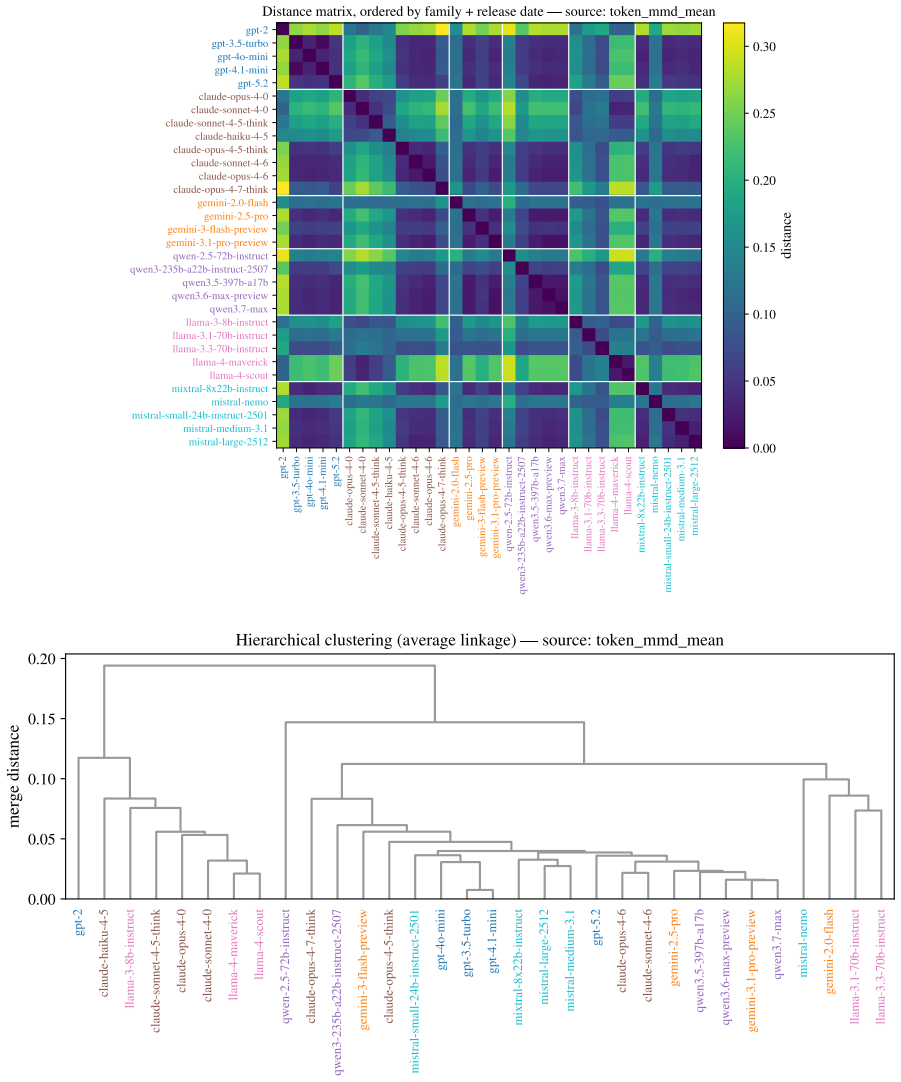
The load-bearing machinery is a set of pairwise dissimilarities computed from a shared, row-aligned prompt bank. The first, the aligned mean per-prompt distance $D^{\mathrm{mean}}_{m,m'}=N^{-1}\sum_i \|E_m[i]-E_{m'}[i]\|_2$, averages Euclidean distances between embeddings of the same prompt and is a pseudometric on observed response matrices, becoming a metric after quotienting out models with identical encoded responses. The second is a PCA-compressed score: each model pair's vector of prompt-wise distances is projected onto its leading principal direction, summarizing how pairs disagree across prompts. The third is the Gromov–Wasserstein discrepancy $D^{\mathrm{gw}}_{m,m'}$, which compares each model's internal response geometry (the matrix of cosine dissimilarities among its own responses) under an optimized coupling, so it discards prompt alignment and is invariant to orthogonal transformations and positive rescaling of embedding vectors. The token-level cross-check replaces each response by the empirical measure of its token embeddings and computes the squared maximum mean discrepancy with an RBF kernel prompt by prompt. These constructions vary deliberately along representation, aggregation, and alignment, so their high rank agreement (Spearman 0.98 between the mean distance and token MMD) is the paper's main stability argument. The theoretical engine is Theorem 1, which bounds the expected total variation between two deployed models by a triangle inequality through their effective target distributions, with learning-error terms transferred from training prompts to inference prompts via a density-ratio coverage condition and Pinsker's inequality: $$\mathbb{E}_{x\sim\xi}\,\mathrm{TV}(q_m(\cdot|x),q_{m'}(\cdot|x)) \;\le\; \$eta^{{\mathrm{txt}}$}_{m,m'} + \sqrt{\kappa_m\varepsilon_m/2} + \sqrt{\kappa_{m'}\varepsilon_{m'}/2}.$$ Here $\eta^{\mathrm{txt}}_{m,m'}$ is the expected total variation between the two effective target distributions on the inference prompts, $\varepsilon_j$ is each model's excess population log-loss, and $\kappa_j$ bounds the inference-to-training density ratio. The bound is architecture-agnostic: conditional on these quantities it does not depend on initialization, optimizer, or architecture.
What would settle it
Generate K independent responses per model-prompt pair (say K=10) on a subset of the prompt bank, recompute the mean per-prompt distance and token MMD for each replicate, and check whether the same-family nearest-neighbor fraction, the gpt-2 outlier status, and the negative cross-family release-date slope survive. If distances between two independent responses from the same model rival distances between different models, the reported geometry is a single-sample artifact.
Extended reading notes
Core claim
The central discovery is that an unlabeled, output-only geometry over models reproduces what leaderboard scores hide: LLMs are organized by lineage, and that lineage structure partially dissolves among recent releases. Under the mean per-prompt distance, 21 of 32 models have a nearest neighbor from their own family, and gpt-2 has the largest average distance to all other models (about 88.5), making it the global outlier; qwen-2.5-72b-instruct separates second. Mean distance from each model to models of other families decreases with release date, giving a negative fitted trend (cross-family slope $-1.37\times10^{-2}$ per day under the sentence-level construction), which the paper reads as descriptive evidence of behavioral homogenization rather than a causal mechanism. Several recent reasoning-oriented models, including claude-opus-4-7-think and gpt-5.2, show lower response-cloud dispersion under the chosen encoder. The token-level MMD matrix correlates with the sentence-level mean at Spearman $\rho=0.98$, recovers the same two outliers and the same decreasing trend, and the rank geometry is preserved when every response is re-encoded with three further encoders, down to one 73 times smaller. The authors frame these as stable empirical patterns, not as claims about capability or about the training causes of drift.
Load-bearing premise
Every distance in the main analysis is computed from exactly one generated response per model and prompt, so the entire behavioral map assumes that generation-to-generation variation is small relative to differences between models.
Editorial extensions
If this is right
- Closed frontier models can be placed in the same behavioral geometry as open models using only their generated text, since every distance is computed from outputs rather than weights or activations.
- The observed decrease in cross-family distance means models from different vendors are becoming harder to distinguish by their outputs; monitoring this trend could serve as an early signal of behavioral homogenization.
- The compact response clouds of several recent reasoning-oriented models indicate that those models concentrate their outputs in a smaller embedding region for the same prompt bank, which is consistent with more deterministic decoding but is not itself a capability claim.
- The low-rank structure of prompt-wise disagreement (leading component explains 63% of variance) implies that a small set of high-leverage prompts could reproduce much of the model geometry, enabling cheaper drift monitoring without running the full 10,000-prompt bank.
- Because Theorem 1 is a sufficient condition, the empirical convergence could arise from other causes; conversely, models can be behaviorally close in the measured geometry without satisfying the training-side assumptions.
Reading between the lines
- If the single-sample distances were recomputed with repeated generation, the family clusters could prove either more stable or largely sampling noise; the paper's cross-encoder agreement does not bound this generation variability, so a direct variance study is the natural next check.
- The cross-vendor Gromov–Wasserstein pairings of recent models (for example, gemini-3.1-pro-preview with qwen3.7-max and an opus-class Claude model with gpt-5.2) suggest that internal response-cloud geometry is converging even where prompt-aligned distances still separate families; testing whether these pairs share error patterns on benchmark categories would sharpen the convergence claim.
- A practical extension would turn the convergence trend into a rolling monitoring statistic: recompute mean cross-family distance in sliding release-date windows; if the negative slope flattens or reverses, that would indicate a shift in training objectives or decoding policies. The paper does not propose such a monitor.
- The theory's coverage condition points to a concrete diagnostic: if training-prompt distributions were available for each model, one could test whether models with smaller density-ratio bounds $\kappa$ converge faster, as Theorem 1 predicts; this would convert the sufficient condition into a falsifiable prediction about training data.
Editorial analysis
A structured set of objections, weighed in public.
Referee Report
Summary. The paper proposes a label-free framework for comparing LLM behavior directly from generated text. Using 32 models from six families responding to a shared bank of 10,000 prompts, it constructs three sentence-level dissimilarities (a mean per-prompt distance, a PCA-compressed summary of prompt-wise disagreement, and a Gromov–Wasserstein discrepancy) plus a token-level per-prompt MMD cross-check. These are used to build behavioral maps, study family-wise drift, hierarchical clustering, cross-family convergence, and response-cloud dispersion. The paper claims that model families form coherent clusters, that gpt-2 is a global outlier, that cross-family distances decrease over time, and that several recent reasoning-oriented models have comparatively compact response clouds. It also proves a sufficient condition linking behavioral similarity to effective target-distribution similarity, small excess population log-loss, and inference-prompt coverage, while explicitly stating that the training-side quantities are unobserved. The main empirical results are robust across four response encoders, three projection methods, and token-level versus sentence-level representations, but all of these reuse exactly one generated response per model–prompt pair.
Significance. If the empirical findings survive additional sampling scrutiny, the paper would make a useful contribution: a label-free, closed-model-compatible way to measure behavioral lineage and temporal homogenization would complement benchmark leaderboards and be of broad interest to the LLM evaluation community. The robustness checks across encoders, projections, and the token-level MMD are genuine strengths, and the measure-theoretic framing and the sufficient-condition theory in Section 6 are correct and carefully scoped. The paper is also unusually transparent about its limitations. The central caveat is that the headline convergence claim rests on single-sample distances with no uncertainty quantification, and the paper's own Appendix A.4 shows that those distances carry within-prompt generation variability; until that variability is quantified or controlled, the decreasing cross-family distance is not fully separated from a dispersion artifact. This is an addressable issue rather than a fatal flaw, so the result warrants major revision rather than rejection.
major comments (2)
- [Section 4 and Appendix A.4, Eq. (16)] The headline convergence claim ("cross-family distances decrease over time") rests entirely on distances computed from exactly one generated response per model–prompt pair. As the paper itself shows in Eq. (16), the expected single-sample per-prompt distance is controlled not only by the mean-embedding discrepancy eta_sem but also by within-prompt spread terms omega_m + omega_m'. Because Fig. 5 (bottom) documents that within-model response-cloud dispersion changes across releases, with several recent reasoning-oriented models markedly more compact, the decreasing cross-family distance in Fig. 5 (top) is not yet distinguished from a decreasing-dispersion artifact. The token-level MMD cross-check and the alternative-encoder checks re-encode exactly the same single responses, so they inherit the same dependence on generation variability and cannot separate it from genuine behavioral convergence. I request either an explicit dispersion control (e.g., estimating omega_m per model from repeated sampling), a repeated-sampling experiment for at least a subset of models, or a variance-decomposition analysis showing that the observed trend survives after conditioning on within-model dispersion.
- [Section 4 and Section 5, Fig. 5 and Table 7] The central statistics—nearest-neighbor counts, Spearman correlations, fitted convergence slopes, and the identity of the two outliers—are reported as point estimates with no uncertainty quantification. In particular, Fig. 5 (top) shows a fitted slope of -1.37e-02/day with no confidence interval, and Table 7 reports trend correlations without intervals. Because the 32 models are not independent draws, many release dates in Table 3 are approximate, and each distance uses a single response per prompt, a bootstrap over prompts, a sensitivity analysis over approximate release dates, and repeated sampling for at least a subset of models are needed before the decreasing trend can be treated as established. This is load-bearing for the paper's central empirical claim, not a presentation detail.
minor comments (5)
- [Section 3, Eq. (2)] The phrase "sign orientation, symmetrization, and rescaling" is not a precise definition; please spell out the exact operation used to obtain the displayed D_pca matrix, since this is a key construction.
- [Figure 5 (bottom)] The response-cloud dispersion panel has no fitted trend or uncertainty; consider adding a slope estimate and a caption stating whether the apparent decline is statistically significant.
- [Appendix A.1] The sentence "The proof is given in Appendix A.1" appears immediately before the proof that is already in Appendix A.1; please delete the redundant sentence.
- [Section 5] The statement that the plug-in MMD estimator's finite-sample bias "does not materially alter" rankings is based on high empirical agreement; please report the distribution of response lengths per model so that readers can assess length-induced bias across families.
- [Section 3, Eq. (2)] The notation for the PCA construction defines x_bar but not the operator S; please define all symbols used in the equation.
Circularity Check
No significant circularity: the empirical geometry, encoder robustness checks, and sufficient-condition theory are self-contained and transparently qualified.
full rationale
The paper's central empirical claim is an observational geometry computed directly from a shared 10,000-prompt bank and response embeddings; no fitted parameter is relabeled as a prediction. Dmean (Eq. 1) averages per-prompt embedding distances, and Dpca (Eq. 2) is explicitly described as a rank-one compression of the same prompt-wise disagreement profiles, so its high correlation with Dmean is acknowledged as partly by construction and used as a descriptive consistency check, not as an independent validation. The token-level MMD cross-check re-encodes responses under the same encoder but uses a genuinely different representation, empirical token measures under an RBF kernel; its Spearman 0.98 agreement is an empirical finding, and the paper explicitly flags that single-sample distances carry generation variability in Section 8 and in Appendix A.4 (Eq. 16 with the omega_m terms). This is a stated limitation, not a concealed fit. Theorem 1 and its corollaries are mathematical sufficient conditions derived from explicitly stated assumptions—coverage, finite excess risk, and target-distribution discrepancy—rather than quantities fit to the observed trends; the paper also explicitly says the training-side quantities are unobserved and that the theory supplies a sufficient scenario, not an empirical explanation. The encoder and projection robustness checks are external substitutions that do not reduce to the construction under test. There are no load-bearing self-citations: related work such as LLM DNA and Qwen3-Embedding is external, and no uniqueness claim is imported from the authors' prior work. The main reviewer concern—that decreasing cross-family distance could be confounded with decreasing within-model response-cloud dispersion—is a validity threat that the paper itself acknowledges (Section 8 and Eq. 16), and it does not amount to a circular derivation. Overall, the derivation chain is self-contained; the paper's own equations and explicit limitations prevent any claim from reducing to its inputs by construction.
Assumptions & free parameters
free parameters (3)
- PCA principal direction u1 =
leading eigenvector of the covariance of 496 pair profiles
- RBF kernel bandwidth sigma for token MMD =
global median of pairwise distances from a sample of responses
- GW subsample size =
256 prompts, seed 0
assumptions (5)
- domain assumption Effective target distribution P_m exists for each post-trained model, and the deployed model has small excess log-loss relative to it.
- domain assumption Inference-prompt distribution xi is absolutely continuous with respect to each training marginal with bounded density ratio kappa_j (Eq. 7).
- domain assumption Bounded embedding diameter: supports of encoded response distributions lie in a set S_phi with finite diameter B_phi.
- domain assumption Responses are sampled from the model distribution q_m, not deterministically decoded.
- standard math Standard inequalities: Pinsker, Jensen, triangle inequality for total variation and Wasserstein, variational characterization of total variation.
invented entities (1)
-
Effective target distribution P_m
Cite this review
Pith. "Pith review of Mapping and Measuring the Behavioral Evolution of Large Language Models." pith.science (2026). https://pith.science/paper/6X2GLUL2
@misc{pith2026260811027,
  author       = {Pith},
  title        = {Pith review of: Mapping and Measuring the Behavioral Evolution of Large Language Models},
  year         = {2026},
  howpublished = {\url{https://pith.science/paper/6X2GLUL2}},
  note         = {Machine review of arXiv:2608.11027}
}
abstract
Benchmark leaderboards summarize how well a language model performs, but not how its behavior relates to that of other models or changes across generations. We characterize the output behavior of 32 models from six families using their responses to a shared bank of 10{,}000 prompts. After embedding each response, we construct three complementary sentence-level dissimilarities: an aligned mean per-prompt distance, which is a pseudometric on observed model responses; a PCA-compressed summary of prompt-wise disagreement; and an alignment-free Gromov--Wasserstein discrepancy between models' internal response geometries. We use these constructions to study static organization and temporal change on a release-date axis through behavioral maps, family-wise drift, hierarchical clustering, cross-family convergence, and response-cloud dispersion. Across the three constructions, model families form coherent clusters, with \texttt{gpt-2} as a global outlier; cross-family distances decrease over time; and several recent reasoning-oriented models have comparatively compact response clouds. A token-level cross-check based on per-prompt Maximum Mean Discrepancy closely agrees with the sentence-level mean distance (Spearman $\rho=0.98$) and recovers the same qualitative findings. We organize these comparisons through a measure-theoretic lens making their alignment and invariance assumptions explicit. We also establish an architecture-agnostic sufficient condition linking behavioral similarity to inference-prompt coverage, small excess population log-loss, and similar effective target distributions---a possible training-side account rather than an empirical explanation of the observed trends. Our pipeline is label-free, and re-encoding every response with three further encoders---down to one $73\times$ smaller---preserves the rank geometry, the outliers, and the sign of the time trend.
Figures


Figures from the paper (11 more)



Reference graph
Works this paper leans on
-
[1]
arXiv preprint arXiv:2211.09110 , year=
Holistic evaluation of language models , author=. arXiv preprint arXiv:2211.09110 , year=
-
[2]
Spectral Signatures of Large Language Models
Spectral Signatures of Large Language Models , author=. arXiv preprint arXiv:2607.03377 , year=
-
[3]
arXiv preprint arXiv:2509.04504 , year=
Behavioral Fingerprinting of Large Language Models , author=. arXiv preprint arXiv:2509.04504 , year=
-
[4]
34th USENIX Security Symposium (USENIX Security 25) , pages=
\ LLMmap \ : Fingerprinting for large language models , author=. 34th USENIX Security Symposium (USENIX Security 25) , pages=
-
[5]
Proceedings of the 58th annual meeting of the association for computational linguistics , pages=
Beyond accuracy: Behavioral testing of NLP models with CheckList , author=. Proceedings of the 58th annual meeting of the association for computational linguistics , pages=
-
[6]
Computational Linguistics , volume=
Language model behavior: A comprehensive survey , author=. Computational Linguistics , volume=
-
[7]
arXiv preprint arXiv:2312.00752 , year=
Mamba: Linear-time sequence modeling with selective state spaces , author=. arXiv preprint arXiv:2312.00752 , year=
-
[8]
Advances in neural information processing systems , volume=
Attention is all you need , author=. Advances in neural information processing systems , volume=
Show all 44 references
-
[9]
Transactions on machine learning research , year=
Beyond the imitation game: Quantifying and extrapolating the capabilities of language models , author=. Transactions on machine learning research , year=
-
[10]
Great Models Think Alike and this Undermines
Shashwat Goel and Joschka Str. Great Models Think Alike and this Undermines. Forty-second International Conference on Machine Learning , year=
-
[11]
Nicolas Yax and Pierre-Yves Oudeyer and Stefano Palminteri , booktitle=. Phylo. 2025 , url=
2025
-
[12]
Journal of Machine Learning Research , volume =
Laurens van der Maaten and Geoffrey Hinton , title =. Journal of Machine Learning Research , volume =
-
[13]
arXiv preprint arXiv:1802.03426 , year =
Leland McInnes and John Healy and James Melville , title =. arXiv preprint arXiv:1802.03426 , year =
-
[14]
Gromov--Wasserstein Distances and the Metric Approach to Object Matching , journal =
Facundo M. Gromov--Wasserstein Distances and the Metric Approach to Object Matching , journal =
-
[15]
Computational Optimal Transport , journal =
Gabriel Peyr. Computational Optimal Transport , journal =
-
[16]
Journal of Machine Learning Research , volume =
R. Journal of Machine Learning Research , volume =
-
[17]
International Conference on Learning Representations (ICLR) , year =
Dan Hendrycks and Collin Burns and Steven Basart and Andy Zou and Mantas Mazeika and Dawn Song and Jacob Steinhardt , title =. International Conference on Learning Representations (ICLR) , year =
-
[18]
Conference on Empirical Methods in Natural Language Processing (EMNLP) , year =
Nils Reimers and Iryna Gurevych , title =. Conference on Empirical Methods in Natural Language Processing (EMNLP) , year =
-
[19]
International Conference on Machine Learning (ICML) , year =
Simon Kornblith and Mohammad Norouzi and Honglak Lee and Geoffrey Hinton , title =. International Conference on Machine Learning (ICML) , year =
-
[20]
Borgwardt and Malte J
Arthur Gretton and Karsten M. Borgwardt and Malte J. Rasch and Bernhard Sch. A Kernel Two-Sample Test , journal =
-
[21]
Kruskal , title =
Joseph B. Kruskal , title =. Psychometrika , volume =
-
[22]
Proceedings of the 41st International Conference on Machine Learning (ICML) , volume =
Minyoung Huh and Brian Cheung and Tongzhou Wang and Phillip Isola , title =. Proceedings of the 41st International Conference on Machine Learning (ICML) , volume =
-
[23]
Revisiting the Platonic Representation Hypothesis: An Aristotelian View , booktitle =
Fabian Gr. Revisiting the Platonic Representation Hypothesis: An Aristotelian View , booktitle =
-
[24]
Sophia Koepke and Daniil Zverev and Shiry Ginosar and Alexei A
A. Sophia Koepke and Daniil Zverev and Shiry Ginosar and Alexei A. Efros , title =. arXiv preprint arXiv:2604.18572 , year =
-
[25]
International Conference on Learning Representations (ICLR) , year =
Junxuan Wang and Xuyang Ge and Wentao Shu and Qiong Tang and Yunhua Zhou and Zhengfu He and Xipeng Qiu , title =. International Conference on Learning Representations (ICLR) , year =
-
[26]
arXiv preprint arXiv:2410.06981 , year =
Michael Lan and Philip Torr and Austin Meek and Ashkan Khakzar and David Krueger and Fazl Barez , title =. arXiv preprint arXiv:2410.06981 , year =
-
[27]
International Conference on Learning Representations (ICLR) , year =
Zhaomin Wu and Haodong Zhao and Ziyang Wang and Jizhou Guo and Qian Wang and Bingsheng He , title =. International Conference on Learning Representations (ICLR) , year =
-
[28]
Alec Radford and Jeffrey Wu and Rewon Child and David Luan and Dario Amodei and Ilya Sutskever , title =
-
[29]
Gemini: A Family of Highly Capable Multimodal Models , journal =
-
[30]
Qwen2.5 Technical Report , journal =
-
[31]
arXiv preprint arXiv:2407.21783 , year =
Aaron Grattafiori and others , title =. arXiv preprint arXiv:2407.21783 , year =
-
[32]
Jiang and Alexandre Sablayrolles and Arthur Mensch and Chris Bamford and Devendra Singh Chaplot and Diego de las Casas and others , title =
Albert Q. Jiang and Alexandre Sablayrolles and Arthur Mensch and Chris Bamford and Devendra Singh Chaplot and Diego de las Casas and others , title =. arXiv preprint arXiv:2310.06825 , year =
-
[33]
arXiv preprint arXiv:2506.05176 , year =
Yanzhao Zhang and Mingxin Li and Dingkun Long and Xin Zhang and Huan Lin and Baosong Yang and Pengjun Xie and An Yang and Dayiheng Liu and Junyang Lin and Fei Huang and Jingren Zhou , title =. arXiv preprint arXiv:2506.05176 , year =
-
[34]
arXiv preprint arXiv:1803.05457 , year =
Peter Clark and Isaac Cowhey and Oren Etzioni and Tushar Khot and Ashish Sabharwal and Carissa Schoenick and Oyvind Tafjord , title =. arXiv preprint arXiv:1803.05457 , year =
-
[35]
Annual Meeting of the Association for Computational Linguistics (ACL) , year =
Rowan Zellers and Ari Holtzman and Yonatan Bisk and Ali Farhadi and Yejin Choi , title =. Annual Meeting of the Association for Computational Linguistics (ACL) , year =
-
[36]
AAAI Conference on Artificial Intelligence , year =
Keisuke Sakaguchi and Ronan Le Bras and Chandra Bhagavatula and Yejin Choi , title =. AAAI Conference on Artificial Intelligence , year =
-
[37]
arXiv preprint arXiv:2110.14168 , year =
Karl Cobbe and Vineet Kosaraju and Mohammad Bavarian and Mark Chen and Heewoo Jun and Lukasz Kaiser and others , title =. arXiv preprint arXiv:2110.14168 , year =
-
[38]
NeurIPS Datasets and Benchmarks Track , year =
Dan Hendrycks and Collin Burns and Saurav Kadavath and Akul Arora and Steven Basart and Eric Tang and Dawn Song and Jacob Steinhardt , title =. NeurIPS Datasets and Benchmarks Track , year =
-
[39]
Annual Meeting of the Association for Computational Linguistics (ACL) , year =
Stephanie Lin and Jacob Hilton and Owain Evans , title =. Annual Meeting of the Association for Computational Linguistics (ACL) , year =
-
[40]
Annual Meeting of the Association for Computational Linguistics (ACL) , year =
Pranav Rajpurkar and Robin Jia and Percy Liang , title =. Annual Meeting of the Association for Computational Linguistics (ACL) , year =
-
[41]
Weld and Luke Zettlemoyer , title =
Mandar Joshi and Eunsol Choi and Daniel S. Weld and Luke Zettlemoyer , title =. Annual Meeting of the Association for Computational Linguistics (ACL) , year =
-
[42]
Transactions of the Association for Computational Linguistics , volume =
Tom Kwiatkowski and Jennimaria Palomaki and Olivia Redfield and Michael Collins and Ankur Parikh and others , title =. Transactions of the Association for Computational Linguistics , volume =
-
[43]
arXiv preprint arXiv:2107.03374 , year =
Mark Chen and Jerry Tworek and Heewoo Jun and Qiming Yuan and Henrique Ponde de Oliveira Pinto and others , title =. arXiv preprint arXiv:2107.03374 , year =
-
[44]
arXiv preprint arXiv:2108.07732 , year =
Jacob Austin and Augustus Odena and Maxwell Nye and Maarten Bosma and Henryk Michalewski and others , title =. arXiv preprint arXiv:2108.07732 , year =
Reviewed August 12, 2026 · model on record in the stance chip above.
Discussion (0). Continue with ORCID to comment.