REVIEW 3 major objections 5 minor 1 cited by
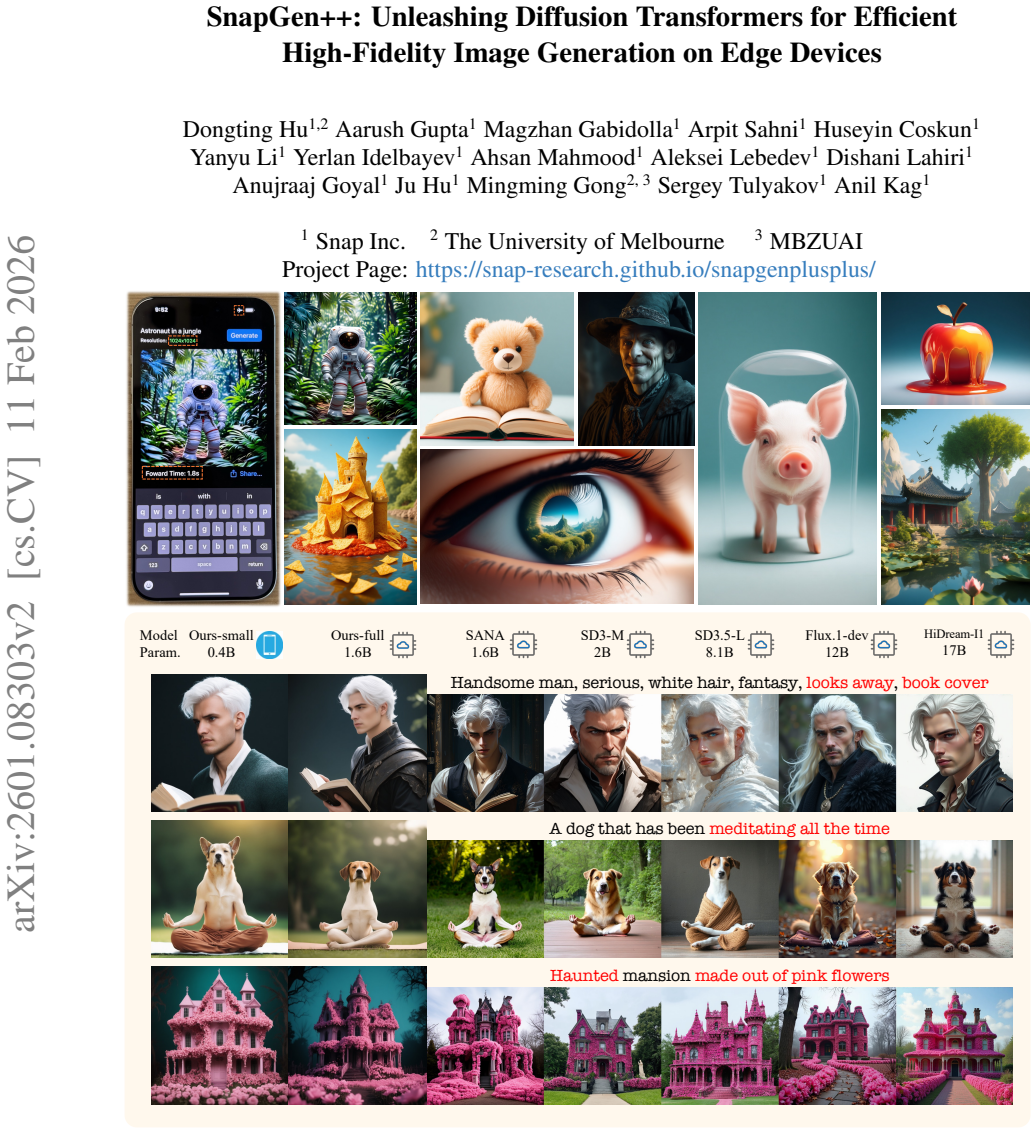
A 0.4B diffusion transformer matches 20x larger models and runs on a phone
Reviewed by Pith at T0; open to challenge. T0 means a machine referee read the full paper against a public rubric. the ladder, T0–T4 →
T0 review · deepseek-v4-flash
2026-08-03 10:51 UTC pith:6YZX535J
load-bearing objection Solid on-device DiT systems paper; the 'surpasses 20×' claim overstates its own Table 2. the 3 major comments →
SnapGen++: Unleashing Diffusion Transformers for Efficient High-Fidelity Image Generation on Edge Devices
The pith
A machine-rendered reading of the paper's core claim, the machinery that carries it, and where it could break.
Core claim
The paper's central claim is that a 0.4B-parameter diffusion transformer, running entirely on a mobile device, can match the generation quality of server-scale models with up to 20× more parameters. This is achieved by combining three components: an architecture that replaces full self-attention with an adaptive mix of compressed global attention and blockwise neighborhood attention; an elastic training framework that shares weights across sub-networks of different widths; and a knowledge-guided distribution matching distillation that compresses the sampling process to four steps. The authors support this with benchmark scores (DPG-Bench, GenEval, T2I-CompBench, CLIP), a user study, and on-d
What carries the argument
The load-bearing object is the Adaptive Sparse Self-Attention (ASSA) layer, which splits attention into a coarse global branch (key/value features compressed by a strided 2×2 convolution) and a fine local branch (blockwise neighborhood attention with a small number of blocks and radius), adaptively interpolating between the two per head. Around it sits a three-stage transformer (down/middle/up) with token downsampling in the middle, elastic width-sliced supernetwork training, and K-DMD, a distillation objective that adds output-level and feature-level supervision from a few-step teacher to the standard DMD loss.
Load-bearing premise
The architecture is tuned against ImageNet validation loss at 256 resolution as a proxy for perceptual quality and human preference, and the authors assume this proxy is reliable and that the conclusions transfer to 1024-resolution text-to-image generation.
What would settle it
Run a controlled user study with the same prompts used in the paper, pitting the 0.4B on-device model against a server-scale model (e.g., 12B) and check whether the claimed win in realism, fidelity, or alignment holds; alternatively, evaluate the 4-step distilled 0.4B model on a larger, more diverse prompt set and see whether its GenEval and DPG scores collapse.
If this is right
- On-device generation at this quality and latency would make text-to-image features practical in consumer apps without cloud round-trips.
- The elastic training result implies one trained model can serve phones, tablets, and servers, replacing per-device fine-tuning.
- The 4-step K-DMD result suggests few-step distillation can be applied successfully to small models, not just large ones.
- The architectural ablations indicate that sparse attention with global and local branches can recover most of the quality of full attention while cutting latency and memory.
Where Pith is reading between the lines
- If the validation-loss proxy transfers to human preference, the ablation-driven design choices (ASSA, layer distribution, FFN expansion) likely survive scale-up to larger datasets and resolutions; however, that transfer is not demonstrated here.
- The comparison to server models relies on benchmarks at 1024 resolution; a direct side-by-side human study with more prompts and diverse devices would show how far the quality claim generalizes.
- The elastic framework could be extended to also slice depth and attention heads, not just width, potentially yielding even finer cost-quality trade-offs.
- Because the K-DMD teacher is already a few-step model, the method may extend to future one-step or few-step models, possibly enabling real-time generation with fewer than four steps.
Editorial analysis
A structured set of objections, weighed in public.
Referee Report
Summary. The paper proposes SnapGen++, a family of efficient diffusion transformers for mobile/edge deployment. Three contributions are claimed: (i) a three-stage DiT architecture with Adaptive Sparse Self-Attention (ASSA), combining compressed global attention and blockwise neighborhood attention; (ii) an elastic training framework that jointly optimizes subnetworks of different widths from one supernetwork; and (iii) Knowledge-guided Distribution Matching Distillation (K-DMD), a step-distillation pipeline that adds a few-step teacher to the DMD objective. The headline claim is that a 0.4B, 4-step variant 'surpasses models up to 20× larger' while running in about 1.8 s on an iPhone 16 Pro Max, and that a 1.6B full variant approaches server-level T2I quality. Experiments include ImageNet-1K validation-loss ablations, T2I benchmarks (DPG-Bench, GenEval, T2I-CompBench, CLIP-Score), latency measurements, a human preference study, and qualitative comparisons.
Significance. The paper addresses a practically important problem — high-fidelity image generation on edge devices — and the proposed components are well-motivated and plausible. The architectural ablations are quantified, and the reported on-device latencies are concrete and specific. If the central comparative claim is correct, the work would be a meaningful step toward making DiT-based T2I generation practical on phones. The elastic training framework and the few-step distillation pipeline also offer useful recipes beyond the specific model. However, the headline comparison is currently undermined by an evaluation-protocol inconsistency in Table 2, and the architecture ablations rest on a single proxy metric whose correlation with perceptual quality is asserted rather than demonstrated. The paper does not release code or evaluation scripts, which would substantially increase confidence in the numerical claims.
major comments (3)
- [Table 2 and Sec. 4.2] The footnote to Table 2 states that '† indicates out-of-memory (OOM) at 1024×1024 resolution,' yet most baseline rows carrying that mark (PixArt-Σ, SANA, SD3-Medium, SD3.5-Large, Flux.1-dev, etc.) report DPG-Bench, GenEval, T2I-CompBench, and CLIP scores. If those models cannot run at 1024×1024 in the stated measurement setup, the numbers must come from a different evaluation protocol (e.g., lower resolution, different sampling steps/CFG, or original papers). T2I benchmarks are resolution-sensitive, so mixing protocols makes the comparison uncontrolled. This matters directly for the central claim 'surpasses models up to 20× larger': the margin over SD3.5-Large is 0.4 DPG points, 0.01 GenEval, and 0.001 T2I-CompBench, so a small protocol mismatch could flip the result. Please specify exactly how each OOM row was evaluated, or separate the 'as-measured-by-us' scores from literature scores
- [Sec. 3.1, Fig. 3] Every architecture decision — ASSA, three-stage layout, FFN expansion, layer redistribution, GQA — is selected using ImageNet-1K validation loss at 256×256 plus iPhone latency. The paper asserts that validation loss 'shows stronger correlation with perceptual quality and human preference than conventional image metrics such as FID,' but no evidence is provided for this correlation in the context of architecture ablations, and the cited finding [18] does not directly validate this proxy for the architectural variants under consideration. If the proxy is unreliable, the claimed support for the architectural choices collapses. Please provide either (a) FID or human-preference measurements for the ablated variants, or (b) a defensible citation or analysis that validation-loss differences of the observed magnitude (e.g., 0.5130 vs. 0.5090) are perceptually meaningful.
- [Table 2 vs. supplementary Tables 2–4] The main paper's headline table omits Qwen-Image (20B) and HiDream-I1 (17B), even though both appear in the supplementary detailed tables. Since Qwen-Image is the actual KD teacher and is itself a '20× larger' model, the claim that the 0.4B variant 'surpasses models up to 20× larger' is not tested against the model that defines the teacher quality ceiling. The supplementary numbers show the 0.4B model is far below Qwen-Image on DPG (85.2 vs. 88.3), so the current wording overstates the result relative to the largest relevant baseline. Please include Qwen-Image (and ideally HiDream-I1) in the main comparison table, or qualify the claim to the specific baselines listed.
minor comments (5)
- [Sec. 3.3, Eqs. (9)–(10)] The K-DMD objective is not fully specified. In Eq. (9), the mapping F and the sampling distribution of τ are not defined; Eq. (10) reintroduces ξ' but the definitions of L^{ξ'}_out and L^{ξ'}_feat are only inferred from Eqs. (6)–(7); and the timestep-aware scaling operator S in Eq. (8) is never given explicitly. Please complete the notation so the method is reproducible.
- [Table 1] The caption says 'Comparison between Standalone and Elastic training for 0.4B and 2B models,' but the table columns are '0.4B' and '1.6B'. Please align the text and the table.
- [Sec. 4.1 and supplementary Sec. A] The main paper says the total on-device runtime is 'around 1.7 s' (Sec. 4.1), while Figure 1 and the supplementary latency table report 1.8 s for the 0.4B model. This inconsistency should be resolved.
- [Fig. 7] The human preference study reports percentages but no error bars, number of participants, or statistical significance tests. Given that some reported differences are small, please add confidence intervals or at least the number of ratings.
- [General] The paper does not state whether evaluation code or model weights will be released. Given that the main comparison depends on exact evaluation protocols (and the OOM issue above), releasing the evaluation harness would greatly improve trust in the numbers.
Circularity Check
No circularity: the system is empirically trained and benchmarked; self-citations are pipeline reuse, not load-bearing reductions.
full rationale
The paper makes no derivation-from-first-principles claim that reduces to its own inputs. Architectural choices (Sec. 3.1) are selected by ImageNet-1K validation loss and iPhone latency; validation loss is used as a training/ablation signal, not fitted to the T2I benchmark numbers reported in Table 2. The headline claim that the small variant (0.4B) surpasses models up to 20x larger is an empirical comparison on DPG-Bench, GenEval, T2I-CompBench, and CLIP, not a consequence of the equations. K-DMD (Eq. 10) combines DMD with knowledge distillation from an external few-step teacher [51] and external DMD references [78, 79]; the elastic framework is a standard Once-for-All/Slimmable slicing idea applied to a DiT and is acknowledged as such. Self-citations to SnapGen [28] describe a training pipeline and baseline, but the central results are not proved by citing [28]; no uniqueness theorem or ansatz is imported via self-citation. The Table 2 footnote ('† indicates out-of-memory (OOM) at 1024×1024 resolution') combined with reported benchmark scores for those rows is an internal-consistency/measurement-protocol concern, not a circularity: it does not show that any number was produced by fitting the paper's equations. No step qualifies under any circularity pattern.
Axiom & Free-Parameter Ledger
free parameters (5)
- BNA block count B and neighborhood radius r =
B=16, r=1
- Elastic width multipliers for subnetworks =
0.375x, 0.5x, 1.0x
- K-DMD LoRA rank and alpha =
rank=64, alpha=128
- DMD teacher guidance scale and time shift =
cfg=4, time shift=3
- Distillation loss weighting / timestep-aware scaling S
axioms (3)
- domain assumption Validation loss on ImageNet correlates with perceptual quality and human preference.
- domain assumption A width-sliced super-network trained with uniform sampling, gradient scaling, and self-distillation remains stable and transfers across subnetworks.
- domain assumption Distillation from Qwen-Image and Qwen-Image-Lightning transfers enough generative ability to 0.3B/0.4B students.
read the original abstract
Recent advances in diffusion transformers (DiTs) have set new standards in image generation, yet remain impractical for on-device deployment due to their high computational and memory costs. In this work, we present an efficient DiT framework tailored for mobile and edge devices that achieves transformer-level generation quality under strict resource constraints. Our design combines three key components. First, we propose a compact DiT architecture with an adaptive global-local sparse attention mechanism that balances global context modeling and local detail preservation. Second, we propose an elastic training framework that jointly optimizes sub-DiTs of varying capacities within a unified supernetwork, allowing a single model to dynamically adjust for efficient inference across different hardware. Finally, we develop Knowledge-Guided Distribution Matching Distillation, a step-distillation pipeline that integrates the DMD objective with knowledge transfer from few-step teacher models, producing high-fidelity and low-latency generation (e.g., 4-step) suitable for real-time on-device use. Together, these contributions enable scalable, efficient, and high-quality diffusion models for deployment on diverse hardware.
Figures


Forward citations
Cited by 1 Pith paper
-
Cross-Space Distillation: Teaching One-Step Students with Modern Diffusion Teachers
Introduces a Bridge latent interface that maps mismatched student latents into teacher space, enabling distillation from modern diffusion teachers to compact one-step students and raising SD 1.5 HPSv3 from 5.4 to 9.4 ...
Reference graph
Works this paper leans on
-
[1]
Stable diffusion 3.5
Stability AI. Stable diffusion 3.5. https://github.com/Stability-AI/sd3.5, 2024. 7, 8, 15, 16
2024
-
[2]
GQA: Training generalized multi-query transformer models from multi-head checkpoints
Joshua Ainslie, James Lee-Thorp, Michiel de Jong, Yury Zemlyanskiy, Federico Lebron, and Sumit Sanghai. GQA: Training generalized multi-query transformer models from multi-head checkpoints. InProceedings of the 2023 Confer- ence on Empirical Methods in Natural Language Processing, pages 4895–4901, Singapore, 2023. Association for Compu- tational Linguistics. 5
2023
-
[3]
Sd3.5- flash: Distribution-guided distillation of generative flows,
Hmrishav Bandyopadhyay, Rahim Entezari, Jim Scott, Reshinth Adithyan, Yi-Zhe Song, and Varun Jampani. Sd3.5- flash: Distribution-guided distillation of generative flows,
-
[4]
All are worth words: A vit backbone for diffusion models
Fan Bao, Shen Nie, Kaiwen Xue, Yue Cao, Chongxuan Li, Hang Su, and Jun Zhu. All are worth words: A vit backbone for diffusion models. InCVPR, 2023. 3
2023
-
[5]
All are worth words: A vit backbone for diffusion models
Fan Bao, Shen Nie, Kaiwen Xue, Yue Cao, Chongxuan Li, Hang Su, and Jun Zhu. All are worth words: A vit backbone for diffusion models. InCVPR, 2023. 5
2023
-
[6]
Large scale gan training for high fidelity natural image synthe- sis
Andrew Brock, Jeff Donahue, and Karen Simonyan. Large scale gan training for high fidelity natural image synthe- sis. InInternational Conference on Learning Representa- tions (ICLR), 2019. 3
2019
-
[7]
Once-for-all: Train one network and specialize it for efficient deployment
Han Cai, Chuang Gan, Tianzhe Wang, Zhekai Zhang, and Song Han. Once-for-all: Train one network and specialize it for efficient deployment. InInternational Conference on Learning Representations (ICLR), 2020. 3
2020
-
[8]
Qi Cai, Jingwen Chen, Yang Chen, Yehao Li, Fuchen Long, Yingwei Pan, Zhaofan Qiu, Yiheng Zhang, Feng- bin Gao, Peihan Xu, Yimeng Wang, Kai Yu, Wenxuan Chen, Ziwei Feng, Zijian Gong, Jianzhuang Pan, Yi Peng, Rui Tian, Siyu Wang, Bo Zhao, Ting Yao, and Tao Mei. Hidream-i1: A high-efficient image generative foundation model with sparse diffusion transformer....
Pith/arXiv arXiv 2025
-
[9]
EdgeFusion: On-Device Text-to-Image Generation.arXiv preprint arXiv:2404.11925, 2024
Thibault Castells, Hyoung-Kyu Song, Tairen Piao, Shinkook Choi, Bo-Kyeong Kim, Hanyoung Yim, Changgwun Lee, Jae Gon Kim, and Tae-Ho Kim. EdgeFusion: On-Device Text-to-Image Generation.arXiv preprint arXiv:2404.11925, 2024. 3
Pith/arXiv arXiv 2024
-
[10]
Junsong Chen, Chongjian Ge, Enze Xie, Yue Wu, Lewei Yao, Xiaozhe Ren, Zhongdao Wang, Ping Luo, Huchuan Lu, and Zhenguo Li. Pixart-σ: Weak-to-strong training of dif- fusion transformer for 4k text-to-image generation.arXiv preprint arXiv:2403.04692, 2024. 3, 8, 15, 16
Pith/arXiv arXiv 2024
-
[11]
Pixart-α: Fast training of dif- fusion transformer for photorealistic text-to-image synthesis
Junsong Chen, Jincheng YU, Chongjian GE, Lewei Yao, Enze Xie, Zhongdao Wang, James Kwok, Ping Luo, Huchuan Lu, and Zhenguo Li. Pixart-α: Fast training of dif- fusion transformer for photorealistic text-to-image synthesis. InThe Twelfth International Conference on Learning Repre- sentations, 2024. 2, 3, 8, 15, 16
2024
-
[12]
Sana-sprint: One-step diffusion with continuous-time con- sistency distillation, 2025
Junsong Chen, Shuchen Xue, Yuyang Zhao, Jincheng Yu, Sayak Paul, Junyu Chen, Han Cai, Song Han, and Enze Xie. Sana-sprint: One-step diffusion with continuous-time con- sistency distillation, 2025. 3
2025
-
[13]
Scalable high-resolution pixel-space image syn- thesis with hourglass diffusion transformers
Katherine Crowson, Stefan Andreas Baumann, Alex Birch, Tanishq Mathew Abraham, Daniel Z Kaplan, and Enrico Shippole. Scalable high-resolution pixel-space image syn- thesis with hourglass diffusion transformers. InProceedings of the 41st International Conference on Machine Learning, pages 9550–9575. PMLR, 2024. 3, 4
2024
-
[14]
Transformers are SSMs: Gen- eralized models and efficient algorithms through structured state space duality
Tri Dao and Albert Gu. Transformers are SSMs: Gen- eralized models and efficient algorithms through structured state space duality. InInternational Conference on Machine Learning (ICML), 2024. 3
2024
-
[15]
Deepfloyd.https://github.com/deep-floyd/IF,
DeepFloyd. Deepfloyd.https://github.com/deep-floyd/IF,
-
[16]
Imagenet: A large-scale hierarchical image database
Jia Deng, Wei Dong, Richard Socher, Li-Jia Li, Kai Li, and Li Fei-Fei. Imagenet: A large-scale hierarchical image database. In2009 IEEE conference on computer vision and pattern recognition, pages 248–255. Ieee, 2009. 3
2009
-
[17]
Kakade, Ali Farhadi, and Prateek Jain
Khatri Devvrit, Sneha Kudugunta, Aditya Kusupati, Tim Dettmers, Kaifeng Chen, Inderjit S Dhillon, Yulia Tsvetkov, Hannaneh Hajishirzi, Sham M. Kakade, Ali Farhadi, and Prateek Jain. Matformer: Nested transformer for elastic in- ference. InThe Thirty-eighth Annual Conference on Neural Information Processing Systems, 2024. 3, 5
2024
-
[18]
Scaling rectified flow trans- formers for high-resolution image synthesis, 2024
Patrick Esser, Sumith Kulal, Andreas Blattmann, Rahim Entezari, Jonas M ¨uller, Harry Saini, Yam Levi, Dominik Lorenz, Axel Sauer, Frederic Boesel, Dustin Podell, Tim Dockhorn, Zion English, Kyle Lacey, Alex Goodwin, Yan- nik Marek, and Robin Rombach. Scaling rectified flow trans- formers for high-resolution image synthesis, 2024. 2, 3, 7, 8, 15, 16
2024
-
[19]
Geneval: An object-focused framework for evaluating text- to-image alignment.Advances in Neural Information Pro- cessing Systems, 36, 2024
Dhruba Ghosh, Hannaneh Hajishirzi, and Ludwig Schmidt. Geneval: An object-focused framework for evaluating text- to-image alignment.Advances in Neural Information Pro- cessing Systems, 36, 2024. 7
2024
-
[20]
Generative adversarial nets
Ian Goodfellow, Jean Pouget-Abadie, Mehdi Mirza, Bing Xu, David Warde-Farley, Sherjil Ozair, Aaron Courville, and Yoshua Bengio. Generative adversarial nets. InAdvances in Neural Information Processing Systems (NeurIPS), 2014. 3
2014
-
[21]
Albert Gu and Tri Dao. Mamba: Linear-time sequence modeling with selective state spaces.arXiv preprint arXiv:2312.00752, 2023. 3
Pith/arXiv arXiv 2023
-
[22]
Ali Hassani, Steven Walton, Humphrey Shi, et al. Generalized neighborhood attention: Multi-dimensional sparse attention at the speed of light.arXiv preprint arXiv:2504.16922, 2025. 3
Pith/arXiv arXiv 2025
-
[23]
Gans trained by a two time-scale update rule converge to a local nash equilib- rium.Advances in neural information processing systems, 30, 2017
Martin Heusel, Hubert Ramsauer, Thomas Unterthiner, Bernhard Nessler, and Sepp Hochreiter. Gans trained by a two time-scale update rule converge to a local nash equilib- rium.Advances in neural information processing systems, 30, 2017. 3
2017
-
[24]
Denoising diffu- sion probabilistic models.Advances in Neural Information Processing Systems (NeurIPS), 2020
Jonathan Ho, Ajay Jain, and Pieter Abbeel. Denoising diffu- sion probabilistic models.Advances in Neural Information Processing Systems (NeurIPS), 2020. 3
2020
-
[25]
sim- ple diffusion: End-to-end diffusion for high resolution im- ages
Emiel Hoogeboom, Jonathan Heek, and Tim Salimans. sim- ple diffusion: End-to-end diffusion for high resolution im- ages. InProceedings of the 40th International Conference on Machine Learning, pages 13213–13232. PMLR, 2023. 3 9
2023
-
[26]
Simpler diffu- sion: 1.5 fid on imagenet512 with pixel-space diffusion
Emiel Hoogeboom, Thomas Mensink, Jonathan Heek, Kay Lamerigts, Ruiqi Gao, and Tim Salimans. Simpler diffu- sion: 1.5 fid on imagenet512 with pixel-space diffusion. In Proceedings of the Computer Vision and Pattern Recognition Conference, pages 18062–18071, 2025. 3, 4
2025
-
[27]
Dynabert: Dynamic bert with adaptive width and depth
Lu Hou, Zhiqi Huang, Lifeng Shang, Xin Jiang, Xiao Chen, and Qun Liu. Dynabert: Dynamic bert with adaptive width and depth. InAdvances in Neural Information Processing Systems, pages 9782–9793. Curran Associates, Inc., 2020. 3
2020
-
[28]
Chan, Mingming Gong, Sergey Tulyakov, Anil Kag, Yanwu Xu, and Jian Ren
Dongting Hu, Jierun Chen, Xijie Huang, Huseyin Coskun, Arpit Sahni, Aarush Gupta, Anujraaj Goyal, Dishani Lahiri, Rajesh Singh, Yerlan Idelbayev, Junli Cao, Yanyu Li, Kwang-Ting Cheng, S.-H. Chan, Mingming Gong, Sergey Tulyakov, Anil Kag, Yanwu Xu, and Jian Ren. Snap- gen: Taming high-resolution text-to-image models for mobile devices with efficient archi...
Pith/arXiv arXiv 2024
-
[29]
LoRA: Low-rank adaptation of large language models
Edward J Hu, yelong shen, Phillip Wallis, Zeyuan Allen- Zhu, Yuanzhi Li, Shean Wang, Lu Wang, and Weizhu Chen. LoRA: Low-rank adaptation of large language models. InIn- ternational Conference on Learning Representations, 2022. 7
2022
-
[30]
Xiwei Hu, Rui Wang, Yixiao Fang, Bin Fu, Pei Cheng, and Gang Yu. Ella: Equip diffusion models with llm for enhanced semantic alignment.arXiv preprint arXiv:2403.05135, 2024. 7
Pith/arXiv arXiv 2024
-
[31]
T2I-CompBench++: An Enhanced and Comprehensive Benchmark for Compositional Text-to- Image Generation .IEEE Transactions on Pattern Analysis Machine Intelligence, (01):1–17, 5555
Kaiyi Huang, Chengqi Duan, Kaiyue Sun, Enze Xie, Zhen- guo Li, and Xihui Liu. T2I-CompBench++: An Enhanced and Comprehensive Benchmark for Compositional Text-to- Image Generation .IEEE Transactions on Pattern Analysis Machine Intelligence, (01):1–17, 5555. 7
-
[32]
Xun Huang, Zhengqi Li, Guande He, Mingyuan Zhou, and Eli Shechtman. Self forcing: Bridging the train- test gap in autoregressive video diffusion.arXiv preprint arXiv:2506.08009, 2025. 7
Pith/arXiv arXiv 2025
-
[33]
TP-blend: Textual-prompt attention pairing for precise object-style blending in diffusion models.Transactions on Machine Learning Research, 2025
Xin Jin, Yichuan Zhong, and Yapeng Tian. TP-blend: Textual-prompt attention pairing for precise object-style blending in diffusion models.Transactions on Machine Learning Research, 2025. 3
2025
-
[34]
Anil Kag, Huseyin Coskun, Jierun Chen, Junli Cao, Willi Menapace, Aliaksandr Siarohin, Sergey Tulyakov, and Jian Ren. Ascan: Asymmetric convolution-attention networks for efficient recognition and generation.arXiv preprint arXiv:2411.04967, 2024. 3
Pith/arXiv arXiv 2024
-
[35]
Bk-sdm: Architecturally Compressed Sta- ble Diffusion for Efficient Text-to-Image Generation
Bo-Kyeong Kim, Hyoung-Kyu Song, Thibault Castells, and Shinkook Choi. Bk-sdm: Architecturally Compressed Sta- ble Diffusion for Efficient Text-to-Image Generation. In Workshop on Efficient Systems for Foundation Models@ ICML2023, 2023. 3
2023
-
[36]
Flux: A generative model by black for- est labs.https://github.com/black- forest- labs/flux, 2024
Black Forest Labs. Flux: A generative model by black for- est labs.https://github.com/black- forest- labs/flux, 2024. Accessed: 2025-05-14. 2, 3, 7, 8, 15, 16
2024
-
[37]
Playground v1,
Daiqing Li, Aleks Kamko, Ali Sabet, Ehsan Akhgari, Lin- miao Xu, and Suhail Doshi. Playground v1, . 3
-
[38]
Playground v2,
Daiqing Li, Aleks Kamko, Ali Sabet, Ehsan Akhgari, Lin- miao Xu, and Suhail Doshi. Playground v2,
-
[39]
Daiqing Li, Aleks Kamko, Ehsan Akhgari, Ali Sabet, Lin- miao Xu, and Suhail Doshi. Playground V2. 5: Three Insights towards Enhancing Aesthetic Quality in Text-to- Image Generation.arXiv preprint arXiv:2402.17245, 2024. 3, 8, 15, 16
Pith/arXiv arXiv 2024
-
[40]
Svdquant: Absorbing outliers by low-rank components for 4-bit diffusion models
Muyang Li*, Yujun Lin*, Zhekai Zhang*, Tianle Cai, Xiuyu Li, Junxian Guo, Enze Xie, Chenlin Meng, Jun-Yan Zhu, and Song Han. Svdquant: Absorbing outliers by low-rank components for 4-bit diffusion models. InThe Thirteenth In- ternational Conference on Learning Representations, 2025. 2, 3
2025
-
[41]
Snap- fusion: Text-to-Image Diffusion Model on Mobile Devices within Two Seconds.Advances in Neural Information Pro- cessing Systems, 36, 2024
Yanyu Li, Huan Wang, Qing Jin, Ju Hu, Pavlo Chemerys, Yun Fu, Yanzhi Wang, Sergey Tulyakov, and Jian Ren. Snap- fusion: Text-to-Image Diffusion Model on Mobile Devices within Two Seconds.Advances in Neural Information Pro- cessing Systems, 36, 2024. 2, 3, 13
2024
-
[42]
SDXL- Lightning: Progressive Adversarial Diffusion Distillation,
Shanchuan Lin, Anran Wang, and Xiao Yang. SDXL- Lightning: Progressive Adversarial Diffusion Distillation,
-
[43]
Microsoft coco: Common objects in context
Tsung-Yi Lin, Michael Maire, Serge Belongie, James Hays, Pietro Perona, Deva Ramanan, Piotr Doll´ar, and C Lawrence Zitnick. Microsoft coco: Common objects in context. In Computer Vision–ECCV 2014: 13th European Conference, Zurich, Switzerland, September 6-12, 2014, Proceedings, Part V 13, pages 740–755. Springer, 2014. 7
2014
-
[44]
Flow matching for generative mod- eling.arXiv preprint arXiv:2210.02747, 2022
Yaron Lipman, Ricky TQ Chen, Heli Ben-Hamu, Maximil- ian Nickel, and Matt Le. Flow matching for generative mod- eling.arXiv preprint arXiv:2210.02747, 2022. 3
Pith/arXiv arXiv 2022
-
[45]
Playground v3: Improving text-to- image alignment with deep-fusion large language models
Bingchen Liu, Ehsan Akhgari, Alexander Visheratin, Aleks Kamko, Linmiao Xu, Shivam Shrirao, Joao Souza, Suhail Doshi, and Daiqing Li. Playground v3: Improving text-to- image alignment with deep-fusion large language models. arXiv preprint arXiv:2409.10695, 2024. 3
Pith/arXiv arXiv 2024
-
[46]
Renjing Liu, Jiatao Li, William Peebles, and Saining Xie. Magicedit: High-fidelity and temporally coherent video edit- ing.arXiv preprint arXiv:2303.08354, 2023. 3
Pith/arXiv arXiv 2023
-
[47]
Linfusion: 1 gpu, 1 minute, 16k image.arXiv preprint arXiv:2409.02097, 2024
Songhua Liu, Weihao Yu, Zhenxiong Tan, and Xinchao Wang. Linfusion: 1 gpu, 1 minute, 16k image.arXiv preprint arXiv:2409.02097, 2024. 3
Pith/arXiv arXiv 2024
-
[48]
Xingchao Liu, Chengyue Gong, and Qiang Liu. Flow straight and fast: Learning to generate and transfer data with rectified flow.arXiv preprint arXiv:2209.03003, 2022. 3, 7
Pith/arXiv arXiv 2022
-
[49]
On distillation of guided diffusion models
Chenlin Meng, Ruiqi Gao, Diederik P Kingma, Stefano Er- mon, Jonathan Ho, and Tim Salimans. On distillation of guided diffusion models. InNeurIPS 2022 Workshop on Score-Based Methods, 2022. 3
2022
-
[50]
SDEdit: Guided image synthesis and editing with stochastic differential equa- tions
Chenlin Meng, Yutong He, Yang Song, Jiaming Song, Jia- jun Wu, Jun-Yan Zhu, and Stefano Ermon. SDEdit: Guided image synthesis and editing with stochastic differential equa- tions. InInternational Conference on Learning Representa- tions, 2022. 3
2022
-
[51]
Qwen-image-lightning: Distilled qwen-image models for fast, high-fidelity text-to-image generation
ModelTC. Qwen-image-lightning: Distilled qwen-image models for fast, high-fidelity text-to-image generation. https://github.com/ModelTC/Qwen- Image- Lightning, 2025. Version V1.x/ V2.x available; Apache- 2.0 license. 7, 15
2025
-
[52]
Kim, Aliaksandr Siarohin, 10 and Anil Kag
Dogyun Park, Moayed Haji-Ali, Yanyu Li, Willi Menapace, Sergey Tulyakov, Hyunwoo J. Kim, Aliaksandr Siarohin, 10 and Anil Kag. Sprint: Sparse-dense residual fusion for ef- ficient diffusion transformers, 2025. 3
2025
-
[53]
Scalable diffusion models with transformers.arXiv preprint arXiv:2212.09748, 2023
William Peebles and Saining Xie. Scalable diffusion models with transformers.arXiv preprint arXiv:2212.09748, 2023. 2, 3
Pith/arXiv arXiv 2023
-
[54]
Dustin Podell, Zion English, Kyle Lacey, Andreas Blattmann, Tim Dockhorn, Jonas M ¨uller, Joe Penna, and Robin Rombach. Sdxl: Improving latent diffusion mod- els for high-resolution image synthesis.arXiv preprint arXiv:2307.01952, 2023. 2, 3, 8, 15, 16
Pith/arXiv arXiv 2023
-
[55]
Learning transferable visual models from natural language supervi- sion
Alec Radford, Jong Wook Kim, Chris Hallacy, Aditya Ramesh, Gabriel Goh, Sandhini Agarwal, Girish Sastry, Amanda Askell, Pamela Mishkin, Jack Clark, et al. Learning transferable visual models from natural language supervi- sion. InInternational conference on machine learning, pages 8748–8763. PMLR, 2021. 3, 7
2021
-
[56]
High-resolution image syn- thesis with latent diffusion models
Robin Rombach, Andreas Blattmann, Dominik Lorenz, Patrick Esser, and Bj¨orn Ommer. High-resolution image syn- thesis with latent diffusion models. InIEEE Conference on Computer Vision and Pattern Recognition (CVPR), 2022. 2, 3
2022
-
[57]
Photorealistic text-to-image diffusion models with deep lan- guage understanding
Chitwan Saharia, William Chan, Saurabh Saxena, Lala Li, Jay Whang, Emily L Denton, Kamyar Ghasemipour, Raphael Gontijo Lopes, Burcu Karagol Ayan, Tim Sali- mans, Jonathan Ho, David J Fleet, and Mohammad Norouzi. Photorealistic text-to-image diffusion models with deep lan- guage understanding. InAdvances in Neural Information Processing Systems, pages 3647...
2022
-
[58]
Progressive distillation for fast sampling of diffusion models
Tim Salimans and Jonathan Ho. Progressive distillation for fast sampling of diffusion models. InInternational Confer- ence on Learning Representations, 2022. 3
2022
-
[59]
Fast transformer decoding: One write-head is all you need.arXiv preprint arXiv:1911.02150, 2019
Noam Shazeer. Fast transformer decoding: One write-head is all you need.arXiv preprint arXiv:1911.02150, 2019. 3
Pith/arXiv arXiv 1911
-
[60]
Score-based generative modeling through stochastic differential equa- tions.International Conference on Learning Representations (ICLR), 2021
Yang Song, Jascha Sohl-Dickstein, Durk P Kingma, Ab- hishek Kumar, Stefano Ermon, and Ben Poole. Score-based generative modeling through stochastic differential equa- tions.International Conference on Learning Representations (ICLR), 2021. 3
2021
-
[61]
Consis- tency models.International Conference on Machine Learn- ing (ICML), 2023
Yang Song, Chenlin Meng, and Stefano Ermon. Consis- tency models.International Conference on Machine Learn- ing (ICML), 2023. 3
2023
-
[62]
Bitsfusion: 1.99 bits weight quantization of diffusion model
Yang Sui, Yanyu Li, Anil Kag, Yerlan Idelbayev, Junli Cao, Ju Hu, Dhritiman Sagar, Bo Yuan, Sergey Tulyakov, and Jian Ren. Bitsfusion: 1.99 bits weight quantization of diffusion model. InAdvances in Neural Information Processing Sys- tems, pages 76775–76818. Curran Associates, Inc., 2024. 3
2024
-
[63]
Gemma 3n
Gemma Team. Gemma 3n. 2025. 5
2025
-
[64]
Gemma Team, Aishwarya Kamath, Johan Ferret, Shreya Pathak, Nino Vieillard, Ramona Merhej, Sarah Perrin, Ta- tiana Matejovicova, Alexandre Ram ´e, Morgane Rivi `ere, Louis Rouillard, Thomas Mesnard, Geoffrey Cideron, Jean bastien Grill, Sabela Ramos, Edouard Yvinec, Michelle Cas- bon, Etienne Pot, Ivo Penchev, Ga ¨el Liu, Francesco Visin, Kathleen Kenealy,...
2025
-
[65]
U-dits: Downsample tokens in u-shaped diffusion transformers, 2024
Yuchuan Tian, Zhijun Tu, Hanting Chen, Jie Hu, Chao Xu, and Yunhe Wang. U-dits: Downsample tokens in u-shaped diffusion transformers, 2024. 3, 4
2024
-
[66]
Sortednet: A scalable and generalized framework for training modular deep neural networks, 2024
Mojtaba Valipour, Mehdi Rezagholizadeh, Hossein Ra- jabzadeh, Parsa Kavehzadeh, Marzieh Tahaei, Boxing Chen, and Ali Ghodsi. Sortednet: A scalable and generalized framework for training modular deep neural networks, 2024. 11 3
2024
-
[67]
Wan: Open and advanced large-scale video generative models.arXiv preprint arXiv:2503.20314, 2025
Team Wan, Ang Wang, Baole Ai, Bin Wen, Chaojie Mao, Chen-Wei Xie, Di Chen, Feiwu Yu, Haiming Zhao, Jianx- iao Yang, Jianyuan Zeng, Jiayu Wang, Jingfeng Zhang, Jin- gren Zhou, Jinkai Wang, Jixuan Chen, Kai Zhu, Kang Zhao, Keyu Yan, Lianghua Huang, Mengyang Feng, Ningyi Zhang, Pandeng Li, Pingyu Wu, Ruihang Chu, Ruili Feng, Shiwei Zhang, Siyang Sun, Tao Fan...
Pith/arXiv arXiv 2025
-
[68]
Phased consistency model.arXiv preprint arXiv:2405.18407, 2024
Fu-Yun Wang, Zhaoyang Huang, Alexander William Bergman, Dazhong Shen, Peng Gao, Michael Lingel- bach, Keqiang Sun, Weikang Bian, Guanglu Song, Yu Liu, et al. Phased consistency model.arXiv preprint arXiv:2405.18407, 2024. 3
Pith/arXiv arXiv 2024
-
[69]
Hat: Hardware-aware transformers for efficient natural language processing
Hanrui Wang, Zhanghao Wu, Zhijian Liu, Han Cai, Ligeng Zhu, Chuang Gan, and Song Han. Hat: Hardware-aware transformers for efficient natural language processing. InAn- nual Conference of the Association for Computational Lin- guistics, 2020. 3
2020
-
[70]
Qwen-image technical report,
Chenfei Wu, Jiahao Li, Jingren Zhou, Junyang Lin, Kaiyuan Gao, Kun Yan, Sheng ming Yin, Shuai Bai, Xiao Xu, Yilei Chen, Yuxiang Chen, Zecheng Tang, Zekai Zhang, Zhengyi Wang, An Yang, Bowen Yu, Chen Cheng, Dayiheng Liu, De- qing Li, Hang Zhang, Hao Meng, Hu Wei, Jingyuan Ni, Kai Chen, Kuan Cao, Liang Peng, Lin Qu, Minggang Wu, Peng Wang, Shuting Yu, Tingk...
-
[71]
Tinyclip: Clip distillation via affinity mimicking and weight inheritance
Kan Wu, Houwen Peng, Zhenghong Zhou, Bin Xiao, Mengchen Liu, Lu Yuan, Hong Xuan, Michael Valenzuela, Xi (Stephen) Chen, Xinggang Wang, Hongyang Chao, and Han Hu. Tinyclip: Clip distillation via affinity mimicking and weight inheritance. InProceedings of the IEEE/CVF In- ternational Conference on Computer Vision (ICCV), pages 21970–21980, 2023. 7
2023
-
[72]
Taming diffusion transformer for efficient mobile video gen- eration in seconds, 2025
Yushu Wu, Yanyu Li, Anil Kag, Ivan Skorokhodov, Willi Menapace, Ke Ma, Arpit Sahni, Ju Hu, Aliaksandr Siaro- hin, Dhritiman Sagar, Yanzhi Wang, and Sergey Tulyakov. Taming diffusion transformer for efficient mobile video gen- eration in seconds, 2025. 3
2025
-
[73]
Metaxas, Yanzhi Wang, Sergey Tulyakov, and Jian Ren
Yushu Wu, Zhixing Zhang, Yanyu Li, Yanwu Xu, Anil Kag, Yang Sui, Huseyin Coskun, Ke Ma, Aleksei Lebedev, Ju Hu, Dimitris N. Metaxas, Yanzhi Wang, Sergey Tulyakov, and Jian Ren. Snapgen-v: Generating a five-second video within five seconds on a mobile device. InProceedings of the Com- puter Vision and Pattern Recognition Conference (CVPR), pages 2479–2490, 2025. 3
2025
-
[74]
Ruijie Xi, Qingxiong Zhang, Hongyu Gao, et al. Sparse videogen: Accelerating video diffusion transformers with spatial-temporal sparsity.arXiv preprint arXiv:2502.01776,
-
[75]
Yifei Xia, Suhan Ling, Fangcheng Fu, Yujie Wang, Huixia Li, Xuefeng Xiao, and Bin Cui. Training-free and adaptive sparse attention for efficient long video generation.arXiv preprint arXiv:2502.21079, 2025. 3
Pith/arXiv arXiv 2025
-
[76]
SANA: Efficient high-resolution text-to-image synthesis with linear diffusion transformers
Enze Xie, Junsong Chen, Junyu Chen, Han Cai, Haotian Tang, Yujun Lin, Zhekai Zhang, Muyang Li, Ligeng Zhu, Yao Lu, and Song Han. SANA: Efficient high-resolution text-to-image synthesis with linear diffusion transformers. In The Thirteenth International Conference on Learning Repre- sentations, 2025. 3, 8, 15, 16
2025
-
[77]
Ufogen: You forward once large scale text-to-image gener- ation via diffusion gans
Yanwu Xu, Yang Zhao, Zhisheng Xiao, and Tingbo Hou. Ufogen: You forward once large scale text-to-image gener- ation via diffusion gans. InProceedings of the IEEE/CVF Conference on Computer Vision and Pattern Recognition, pages 8196–8206, 2024. 3
2024
-
[78]
Tianwei Yin, Micha ¨el Gharbi, Taesung Park, Richard Zhang, Eli Shechtman, Fredo Durand, and William T Freeman. Im- proved distribution matching distillation for fast image syn- thesis.arXiv preprint arXiv:2405.14867, 2024. 2, 3, 7
Pith/arXiv arXiv 2024
-
[79]
One-step diffusion with distribution matching distillation
Tianwei Yin, Micha ¨el Gharbi, Richard Zhang, Eli Shecht- man, Fr´edo Durand, William T Freeman, and Taesung Park. One-step diffusion with distribution matching distillation. In CVPR, 2024. 2, 3, 7
2024
-
[80]
From slow bidirectional to fast autoregressive video diffusion mod- els
Tianwei Yin, Qiang Zhang, Richard Zhang, William T Free- man, Fredo Durand, Eli Shechtman, and Xun Huang. From slow bidirectional to fast autoregressive video diffusion mod- els. InCVPR, 2025. 7
2025
discussion (0)
Sign in with ORCID, Apple, or X to comment. Anyone can read and Pith papers without signing in.