REVIEW 3 major objections 4 minor 51 references
String-of-Pauli measurements can certify high-dimensional entanglement, and a photonic experiment reaches maximal Schmidt number 8 in 8×8 and Schmidt number 13 in 16×16.
Reviewed by Pith at T0; open to challenge. T0 means a machine referee read the full paper against a public rubric. the ladder, T0–T4 →
T0 review · deepseek-v4-flash
2026-08-04 07:16 UTC pith:6Z3HKH37
load-bearing objection Genuinely new low-depth Schmidt-number witness with two proven bounds; the d=8 maximal certification rests on a clearly-flagged but unproven numerical bound. the 3 major comments →
Detecting high-dimensional entanglement with simple measurements
The pith
A machine-rendered reading of the paper's core claim, the machinery that carries it, and where it could break.
Core claim
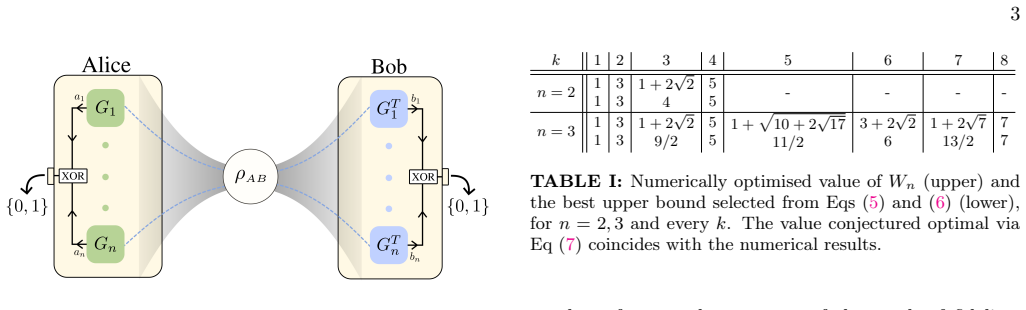
For local dimension d=2^n, Alice and Bob each treat their share as n qubits. For each of 2n+1 pairwise anticommuting Pauli strings S_{n,j}, Alice measures S_{n,j}, Bob measures its transpose, and the witness is W_n(ρ)=Σ_j ⟨S_{n,j}⊗(S_{n,j})^T⟩. The paper proves that every state with Schmidt number at most k satisfies W_n ≤ 2n−3 + k/2^{n−2} by fidelity estimation, and W_n ≤ 2k−1 by anticommutation, the latter being stronger when k<n. It then proves that for pure states supported on the computational basis the optimum is exactly 1+2μ(n,k), where μ(n,k) is the largest adjacency eigenvalue of a k-vertex subgraph of the n-dimensional hypercube, and conjectures this is the true optimal bound, tabu
What carries the argument
The central object is the set of Pauli-string observables {S_{n,j}}_{j=1}^{2n+1}, built recursively from Z, X, Y so that any two strings anticommute; no larger anticommuting set of Pauli strings exists. Each string is a tensor product of n single-qubit Paulis, so each high-dimensional measurement can be performed as n parallel qubit measurements whose binary outcomes are combined classically. The witness W_n(ρ)=Σ_j ⟨S_{n,j}⊗(S_{n,j})^T⟩ is the linear figure of merit. The analytical core is two-fold: an induction showing the fidelity-estimation bound W_n≤2n−3+k/2^{n−2}, and a trace argument using S(t)^2=‖t‖²𝟙 to obtain W_n≤2k−1. For the sharper values, the maximisation over Schmidt-rank-k pur
Load-bearing premise
The d=8 maximal-Schmidt-number certification rests on the numerically optimised bound for (n,k)=(3,7) in Table I, 1+2√7≈6.29, whose global optimality is only conjectured from an alternating-search heuristic in Appendix C; if some Schmidt-7 state in dimension 8 exceeds 6.29, the measured W=6.52±0.07 does not rigorously certify k=8.
What would settle it
Compute α(3,7), the true maximum of W_3 over all Schmidt-number-7 states in dimension 8, using an exhaustive SDP hierarchy or a full alternating optimisation; any value above 1+2√7≈6.29 breaks the claimed k=8 certification. For the general formula, finding any k-vertex subgraph of Q_n whose adjacency largest eigenvalue exceeds the tabulated 1+2μ(n,k) for n≤5 would refute the conjecture for that case; the paper itself notes such gaps occur for larger n (e.g., n=24,k=32), so the conjecture is sharply testable.
If this is right
- The same witness scales to larger d=2^n with only n mode-pairing configurations, removing the need for a fully connected d-dimensional optical circuit in Schmidt-number certification.
- The measured value of W also yields a certified fidelity lower bound, so a single data set gives both a Schmidt-number witness and a maximally-entangled-state fidelity estimate.
- Because the anticommutation bound can be violated by bound entanglement, the method detects entanglement that fidelity-based witnesses miss, not just highly entangled pure states.
- The tabulated thresholds up to n=5 provide explicit witnesses for every Schmidt number in dimensions 4, 8, 16, and 32; a value above the relevant entry certifies Schmidt number at least k+1.
Where Pith is reading between the lines
- The paper leaves implicit that if the conjectured formula W_n=1+2μ(n,k) holds for all n,k, optimal Schmidt-number witnessing becomes a spectral graph problem on the hypercube; the n=24,k=32 counterexample shows the simple pattern μ(n,2^m)=m fails at larger n, so the tables cannot be extrapolated without a genuine subgraph search.
- A natural testable extension is to apply the same Pauli-string decomposition to path-encoded integrated photonics, where circuit depth is the dominant bottleneck, and to multipartite entanglement dimensionality, where the same block-diagonalisation idea may simplify current witnesses.
- One could also push the experiment to d=32 using the n=5 table and compare the measured W with a full MUB-based witness on the same state; that comparison would quantify how much detection power is traded for the lower circuit depth.
Editorial analysis
A structured set of objections, weighed in public.
Referee Report
Summary. The paper proposes Schmidt-number witnesses for bipartite states of local dimension d=2^n, based on expectation values of Pauli-string observables. The witness W_n is shown to obey a fidelity-based bound (Eq. 5) and an anticommutation-based bound (Eq. 6). The authors also compute exact maxima over the subfamily of computational-basis-diagonal states, relating the problem to the largest eigenvalue of subgraphs of the n-dimensional hypercube (Eq. 7), and conjecture that these values are globally optimal. They report an experiment using multi-plane light converters to certify Schmidt numbers in d=4, d=8, and d=16, claiming maximal k=8 in d=8 and k=13 in d=16 with low-depth circuits.
Significance. The witness construction is elegant and practically motivated: the measurements factor into single-qubit Pauli observables, reducing optical circuit depth considerably. The appendices contain several nontrivial analytical proofs (anticommutation, the fidelity bound, the 2k-1 bound, and the diagonal-state reduction), and the authors provide code for the numerical searches. The d=4 and d=16 experimental results are supported by the proven bound in Eq. (5), and the method appears scalable in principle. However, the headline d=8 maximal-Schmidt-number certification depends on an explicitly conjectured bound, and the experimental analysis relies on fair-sampling assumptions without a reported efficiency calibration. If the (3,7) bound can be proven or the claim appropriately downgraded, the paper would be a solid contribution; in its current form, the strongest experimental conclusion is not rigorously established.
major comments (3)
- [Results (d=8), Eq. (7), Table I] The claim that the measured W=6.52±0.07 certifies the maximal Schmidt number k=8 in d=8 requires an upper bound on W for all states with Schmidt number at most 7. The paper uses the value 1+2√7≈6.29 from Table I. However, Appendix D proves this value only for the subfamily T_k of states diagonal in the computational basis; the main text explicitly conjectures that Eq. (7) is globally optimal. The only proven analytical bound for (n,k)=(3,7) is Eq. (5), giving 6.5. The measured value exceeds 6.5 by only 0.02, which is far below the reported 3σ uncertainty (0.07). Thus the d=8 maximal-Schmidt-number certification is not rigorous as stated. The authors must either prove the (3,7) bound or clearly rephrase the claim as conditional on Conjecture (7).
- [Appendix C and Table I] The numerical search in Appendix C is an alternating maximization heuristic: it produces feasible states and therefore lower bounds on α(n,k), not certificates of an upper bound. The 'numerically optimised value' in Table I cannot by itself justify the d=8 conclusion. To use the value 1+2√7 as a witness threshold, the authors need a rigorous upper bound for all states of Schmidt number at most 7, for example via an SDP certificate or an exhaustive proof for the specific case (n,k)=(3,7). Without such a certificate, the d=8 experiment demonstrates only that the measured data violate the known bound for k=7 by 0.02, which is not statistically significant.
- [Appendix F (experimental methods)] The experimental estimate of W assumes fair sampling: the MPLC outputs are redirected sequentially to a fiber, and no detection-efficiency or mode-dependent-loss calibration is reported. Since the witness is a linear function of the measured correlations, an outcome-dependent efficiency pattern can bias W upward and inflate the certified Schmidt number. This concern is particularly acute for d=8, where the claimed violation over the proven bound is only 0.02, and for d=16, where the 3σ lower edge (8.01) is only slightly above the Eq. (5) bound for k=12 (8). The authors should provide per-outcome efficiency data, a robustness analysis, or at minimum a clear statement of the fair-sampling assumption and its consequences for the certificates.
minor comments (4)
- [Main text after Eq. (6)] The sentence 'Bound entanglement can violate this inequality' is asserted without proof or citation. Since the paper is about detecting Schmidt numbers, this claim should either be substantiated with an example or reference, or removed.
- [Appendix B2, Eq. (B16)] The step leading from Eq. (B15) to Eq. (B17) is terse; the use of Cauchy-Schwarz and the assumption that one can choose the PSD representative without loss of generality would benefit from a more explicit derivation.
- [Table I and Table II] Several entries are given as numerical decimals or radicals without a consistent key. For example, the value 1+√(10+2√17) appears in Table I but is not labeled. A note explaining which entries are proven, which are exhaustive subgraph evaluations, and which are conjectural would help the reader.
- [Eq. (3)] The recursion defines S_{n+1,2n+2}=11^{⊗n}⊗X and S_{n+1,2n+3}=11^{⊗n}⊗Y; the notation is understandable but could be clarified by explicitly noting that the first factor acts on the first n qubits and the Pauli operator on the (n+1)-th qubit.
Circularity Check
No circularity: witness bounds are derived analytically; the conjectural numerical bound is a rigor risk, not a fitted input.
full rationale
The central derivation is self-contained. Equation (5) is obtained in Appendix B1 from an induction proof of the operator inequality ~B_n ⪯ (2n−3)1 combined with the known fidelity bound F(ρ) ≤ k/d. Equation (6) is obtained in Appendix B2 from the anticommutation of the Pauli strings and the rank constraint, giving W_n ≤ 2k−1. These are genuine derivations, not definitions of the witness in terms of the target Schmidt number. The experimental values W=6.52±0.07 and W=8.12±0.11 are not used as inputs to any bound; Table I is computed from the witness operator and Schmidt-rank constraints, not fitted to the measured data. The d=8 maximal-Schmidt-number certification does rely on the numerical value 1+2√7 for (n,k)=(3,7), and the paper itself flags the global optimality as conjectural: 'We conjecture that Eq (7) is the optimal bound for the Schmidt number witness.' That is an unproven-conjecture/numerical-rigour concern, not circularity: the bound is not defined in terms of the measured W, nor is the data used to tune the bound. The self-citations are minor: [28] supplies a circuit-depth convention and [40] is a code link; neither substitutes for the proof of (5)–(6). No fitted parameter is renamed as a prediction, and the uniqueness of the anticommuting set is cited to an external source [23]. Therefore no load-bearing step reduces to its own input.
Axiom & Free-Parameter Ledger
axioms (4)
- standard math For any state with Schmidt number at most k, fidelity with the maximally entangled state satisfies F(ρ) ≤ k/d (Terhal–Horodecki bound).
- standard math The 2n+1 Pauli strings S_{n,j} pairwise anticommute and no larger set exists.
- domain assumption The MPLC devices faithfully implement the designed block-diagonal Pauli-string measurements, and fair sampling holds.
- ad hoc to paper The numerically optimized values in Table I are true upper bounds on W_n for all states of Schmidt number at most k.
Cite this review
Pith. "Pith review of Detecting high-dimensional entanglement with simple measurements." pith.science (2026). https://pith.science/paper/6Z3HKH37
@misc{pith2026260802439,
  author       = {Pith},
  title        = {Pith review of: Detecting high-dimensional entanglement with simple measurements},
  year         = {2026},
  howpublished = {\url{https://pith.science/paper/6Z3HKH37}},
  note         = {Machine review of arXiv:2608.02439}
}
read the original abstract
The standard benchmark for high-dimensional entanglement is the number of dimensions in which entanglement must be present in order to generate the state. This is called the Schmidt number and its detection is usually based on implementing an appropriate set of local basis measurements. However, as quantum technology brings increasingly large physical dimensions within reach, the implementation of such measurements typically becomes more costly. Here, we develop a scheme for detecting Schmidt numbers based only on sequences of single-qubit observables. These measurements are simpler to implement as they require only low-depth quantum circuits. Using up to sixteen-dimensional photonic spatial mode entanglement and multi-plane light conversion technology, we demonstrate how it simplifies setup complexity and successfully detects the maximal (or close-to-maximal) Schmidt number. Our results reveal that simple and more scalable measurements are sufficient to detect high-dimensional entanglement properties.
Figures



Reference graph
Works this paper leans on
-
[1]
M. Malik, M. Kues, T. Ikuta, H. Takesue, D. Bajoni, D. J. Moss, R. Morandotti, A. Forbes, S. Walborn, E. Karimi,et al., High-dimensional quantum photonics: Roadmap, arXiv preprint arXiv:2604.06528 (2026)
Pith/arXiv arXiv 2026
-
[2]
B. M. Terhal and P. Horodecki, Schmidt number for density matrices, Phys. Rev. A61, 040301 (2000), arXiv:quant-ph/9911117
Pith/arXiv arXiv 2000
-
[3]
Gharibian, Strong np-hardness of the quantum sepa- rability problem, Quantum Inf
S. Gharibian, Strong np-hardness of the quantum sepa- rability problem, Quantum Inf. Comput.10, 343 (2010), arXiv:0810.4507v5
Pith/arXiv arXiv 2010
-
[4]
M. Weilenmann, B. Dive, D. Trillo, E. A. Aguilar, and M. Navascués, Entanglement detection beyond mea- suring fidelities, Phys. Rev. Lett.124, 200502 (2020), arXiv:1912.10056
Pith/arXiv arXiv 2020
-
[5]
A. Tavakoli and S. Morelli, Enhanced schmidt-number criteria based on correlation trace norms, Phys. Rev. A 110, 062417 (2024), arXiv:2402.09972
Pith/arXiv arXiv 2024
-
[6]
S. Liu, M. Fadel, Q. He, M. Huber, and G. Vitagliano, Bounding entanglement dimensionality from the covari- ance matrix, Quantum8, 1236 (2024), arXiv:2208.04909
Pith/arXiv arXiv 2024
-
[7]
N. Wyderka and A. Ketterer, Probing the geometry of correlation matrices with randomized measurements, PRX Quantum4, 020325 (2023), arXiv:2211.09610
Pith/arXiv arXiv 2023
-
[8]
S. Liu, Q. He, M. Huber, O. Gühne, and G. Vitagliano, Characterizing entanglement dimensionality from ran- domizedmeasurements,PRXQuantum4,020324(2023), arXiv:2211.09614
Pith/arXiv arXiv 2023
-
[9]
N. Wyderka, G. Chesi, H. Kampermann, C. Macchi- avello, and D. Bruß, Construction of efficient schmidt- number witnesses for high-dimensional quantum states, Phys. Rev. A107, 022431 (2023), arXiv:2210.05272
Pith/arXiv arXiv 2023
-
[10]
G.CobucciandA.Tavakoli,Detectingthedimensionality of genuine multiparticle entanglement, Science Advances 10, eadq4467 (2024), arXiv:2402.06234
Pith/arXiv arXiv 2024
-
[11]
S. Morelli, M. Huber, and A. Tavakoli, Resource-efficient high-dimensional entanglement detection via symmet- ric projections, Phys. Rev. Lett.131, 170201 (2023), arXiv:2304.04274
Pith/arXiv arXiv 2023
-
[12]
J. Bavaresco, N. Herrera Valencia, C. Klöckl, M. Pivo- luska, P. Erker, N. Friis, M. Malik, and M. Huber, Measurements in two bases are sufficient for certifying high-dimensional entanglement, Nature Physics14, 1032 (2018), arXiv:1709.07344
Pith/arXiv arXiv 2018
-
[13]
R. Fickler, R. Lapkiewicz, M. Huber, M. P. Lavery, M. J. Padgett, and A. Zeilinger, Interface between path and orbital angular momentum entanglement for high-dimensional photonic quantum information, Nature Communications5, 4502 (2014), arXiv:1402.2423
Pith/arXiv arXiv 2014
-
[14]
M. Malik, M. Erhard, M. Huber, M. Krenn, R. Fick- ler, and A. Zeilinger, Multi-photon entanglement in high dimensions, Nature Photonics10, 248 (2016), arXiv:1509.02561
Pith/arXiv arXiv 2016
-
[15]
N. Herrera Valencia, V. Srivastav, M. Pivoluska, M. Huber, N. Friis, W. McCutcheon, and M. Ma- lik, High-Dimensional Pixel Entanglement: Efficient Generation and Certification, Quantum4, 376 (2020), arXiv:2004.04994
Pith/arXiv arXiv 2020
-
[16]
X.-M. Hu, W.-B. Xing, B.-H. Liu, Y.-F. Huang, C.-F. Li, G.-C. Guo, P. Erker, and M. Huber, Efficient gen- eration of high-dimensional entanglement through mul- tipath down-conversion, Phys. Rev. Lett.125, 090503 (2020), arXiv:2004.09964
Pith/arXiv arXiv 2020
-
[17]
X.-M. Hu, C.-X. Huang, N. d’Alessandro, G. Cobucci, C. Zhang, Y. Guo, Y.-F. Huang, C.-F. Li, G.-C. Guo, X. Gao, M. Huber, A. Tavakoli, and B.-H. Liu, Ob- servation of genuine high-dimensional multi-partite non- locality in entangled photon states, Nature Communica- tions16, 5017 (2025), arXiv:2505.10035
Pith/arXiv arXiv 2025
-
[18]
J. Moreno, E. Svegborn, S. Morelli, M. Hiekkamäaki, L. Kopf, R. Fickler, and A. Tavakoli, Faking entangle- ment with imperceptible measurement deviations (2026), arXiv:2606.20396 [quant-ph]
Pith/arXiv arXiv 2026
-
[19]
W. R. Clements, P. C. Humphreys, B. J. Metcalf, W. S. Kolthammer, and I. A. Walmsley, Optimal design for uni- 7 versal multiport interferometers, Optica3, 1460 (2016), arXiv:1603.08788
Pith/arXiv arXiv 2016
-
[20]
R. Burgwal, W. R. Clements, D. H. Smith, J. C. Gates, W. S. Kolthammer, J. J. Renema, and I. A. Walm- sley, Using an imperfect photonic network to imple- ment random unitaries, Optics Express25, 28236 (2017), arXiv:1704.01945
Pith/arXiv arXiv 2017
-
[21]
A. Barzaghi, M. Bénéfice, F. Ceccarelli, G. Corrielli, V. Galli, M. Gardina, V. Grimaldi, J. Kaczorowski, F. Malaspina, R. Osellame,et al., A 24-mode laser- written universal photonic processor in a glass-based platform, inQuantum Computing, Communication, and Simulation V, Vol. 13391 (SPIE, 2025) pp. 258–263, arXiv:2505.01609
Pith/arXiv arXiv 2025
-
[22]
S. Goel, B. Ghosh, and M. Malik, Quantum informa- tion processing with spatially structured light, Advanced Photonics8, 014005 (2025), arXiv:2510.11154
arXiv 2025
-
[23]
R.SarkarandE.vandenBerg,Onsetsofcommutingand anticommuting paulis (2019), arXiv:1909.08123 [quant- ph]
Pith/arXiv arXiv 2019
-
[24]
G. Tóth and O. Gühne, Entanglement detection in the stabilizer formalism, Phys. Rev. A72, 022340 (2005), arXiv:quant-ph/0501020
Pith/arXiv arXiv 2005
-
[25]
R. M. Karp, Reducibility among combinatorial prob- lems, inComplexity of Computer Computations: Pro- ceedings of a symposium on the Complexity of Com- puter Computations, held March 20–22, 1972, at the IBM Thomas J. Watson Research Center, Yorktown Heights, New York, and sponsored by the Office of Naval Research, Mathematics Program, IBM World Trade Corpo...
1972
-
[26]
M. Magdon-Ismail, NP-hardness and inapproximability of sparse PCA, Information Processing Letters126, 35 (2017), arXiv:1502.05675
Pith/arXiv arXiv 2017
-
[27]
B. Bollobás, J. Lee, and S. Letzter, Eigenvalues of sub- graphs of the cube, European Journal of Combinatorics 70, 125 (2018), arXiv:1605.06360
Pith/arXiv arXiv 2018
-
[28]
S. Goel, S. Leedumrongwatthanakun, N. H. Valencia, W. McCutcheon, A. Tavakoli, C. Conti, P. W. H. Pinkse, and M. Malik, Inverse design of high-dimensional quantum optical circuits in a complex medium, Nature Physics20, 232 (2024), arXiv:2204.00578
Pith/arXiv arXiv 2024
-
[29]
O. Lib, K. Sulimany, M. Araújo, M. Ben-Or, and Y. Bromberg, High-dimensional quantum key distribu- tion using a multi-plane light converter, Optica Quantum 3, 182 (2025), arXiv:2403.04210
Pith/arXiv arXiv 2025
-
[30]
H.Kupianskyi, S.A.R.Horsley,andD.B.Phillips,High- dimensional spatial mode sorting and optical circuit de- sign using multi-plane light conversion, APL Photonics 8, 026101 (2023), arXiv:2209.11081
Pith/arXiv arXiv 2023
-
[31]
F. Brandt, M. Hiekkamäki, F. Bouchard, M. Huber, and R. Fickler, High-dimensional quantum gates using full-field spatial modes of photons, Optica7, 98 (2020), arXiv:1907.13002
Pith/arXiv arXiv 2020
-
[32]
S. Goel, M. Tyler, F. Zhu, S. Leedumrongwatthanakun, M. Malik, and J. Leach, Simultaneously sorting overlap- ping quantum states of light, Physical Review Letters 130, 143602 (2023), arXiv:2207.03986
Pith/arXiv arXiv 2023
-
[33]
M. Mothsara, S. Goel, B. Ghosh, V. Srivastav, W. Mc- Cutcheon, M. Malik, and G. Murta, Robust one-sided device-independent quantum key distribution via high- dimensional steering, arXiv preprint arXiv:2607.08709 (2026)
Pith/arXiv arXiv 2026
-
[34]
O. Lib and Y. Bromberg, Resource-efficient photonic quantum computation with high-dimensional cluster states, Nature Photonics18, 1218, arXiv:2309.10464
-
[35]
N. K. Fontaine, R. Ryf, H. Chen, D. T. Neilson, K. Kim, and J. Carpenter, Laguerre-gaussian mode sorter, Nature communications10, 1865 (2019), arXiv:1803.04126
Pith/arXiv arXiv 2019
-
[36]
O. Lib, R. Shekel, and Y. Bromberg, Building and align- ing a 10-plane light converter, Journal of Physics: Pho- tonics7, 033001 (2025), arXiv:2409.20039
Pith/arXiv arXiv 2025
-
[37]
Hjørungnes,Complex-Valued Matrix Derivatives: With Applications in Signal Processing and Communi- cations(Cambridge University Press, 2011)
A. Hjørungnes,Complex-Valued Matrix Derivatives: With Applications in Signal Processing and Communi- cations(Cambridge University Press, 2011)
2011
- [38]
-
[39]
A. Tavakoli, A. Pozas-Kerstjens, P. Brown, and M. Araújo, Semidefinite programming relaxations for quantum correlations, Rev. Mod. Phys.96, 045006 (2024), arXiv:2307.02551
Pith/arXiv arXiv 2024
-
[40]
Code for upper bounds on schmidt number wit- ness using pauli strings (2025),https://github.com/ GabrieleCobucci/PauliStringsWitness
2025
-
[41]
Brouwer and W
A. Brouwer and W. Haemers,Spectra of graphs, Univer- sitext (Springer, Germany, 2012)
2012
-
[42]
V. Srivastav, N. H. Valencia, S. Leedumrong- watthanakun, W. McCutcheon, and M. Malik, Charac- terizing and tailoring spatial correlations in multimode parametric down-conversion, Physical Review Applied 18, 054006 (2022), arXiv:2110.03462
Pith/arXiv arXiv 2022
-
[43]
Hashimoto, T
T. Hashimoto, T. Saida, I. Ogawa, M. Kohtoku, T. Shi- bata, and H. Takahashi, Optical circuit design based on a wavefront-matching method, Optics Letters30, 2620 (2005)
2005
-
[44]
Sakamaki, T
Y. Sakamaki, T. Saida, T. Hashimoto, and H. Taka- hashi, New Optical Waveguide Design Based on Wave- front Matching Method, Journal of Lightwave Technol- ogy25, 3511 (2007). Appendix A: Anticommutation of Pauli strings We show that all distinct pairs of Pauli strings anti- commute. We prove this through induction. Forn= 1 the set of Pauli strings reduces ...
2007
-
[45]
Since we are aiming at inferring the Schmidt number via fidelity es- timation, we relax the Schmidt number constraint to a fidelityconstraint
Fidelity-estimation bound In this section we prove the bound (5). Since we are aiming at inferring the Schmidt number via fidelity es- timation, we relax the Schmidt number constraint to a fidelityconstraint. Specifically, foranyρ∈SN(k)itholds that [2] ⟨ϕd|ρ|ϕd⟩ ≤k d .(B3) Let us denote the set of all states satisfying this con- straint byF(k). In the mai...
-
[46]
Element-wise bound In this section we prove the bound (6). First, notice thatα(n, k)can be restated as the following maximiza- tion over matrices α(n, k) = max ψ∈SR(k) 2n+1X j=1 ⟨ψ|Sn,j ⊗(S n,j)T|ψ⟩ = max rank(M)≤k 2n+1X j=1 tr M Sn,jM †Sn,j , (B14) where in the last step we have used Lemma 2.14 of [37]. In particular,Mis any matrix whose vectorization gi...
-
[47]
(Bn)AB ⊗ 1 k kX p,q=1 |pp⟩ ⟨qq|A′B′ # |albm⟩AB ⊗ |lm⟩A′B′ =k 2 kX i=1 λ∗ i ⟨aii|AA′ ⊗ 1√ k kX j=1 ⟨bjj|BB ′
Let us recall the varia- tional definition of the 2-norm of a vector: ∥⃗ w∥2 = sup ∥⃗t∥2=1 2n+1X j=1 t∗ j wj = sup ∥⃗t∥2=1 ⟨ua| 2n+1X j=1 t∗ j Sn,j|ub⟩ . (B22) Now, let us distinguish the aforementioned cases over (a, b). Ifa=b, the vector⃗ wis a real vector and ⃗tin (B22) can also be chosen to be real. Hence, ∥⃗ w∥2 = sup ∥⃗t∥2=1 ⟨ua| 2n+1X j=1 tjSn,j|ua...
-
[48]
Then, the following optimisation max {φ} k2 Tr (Bn)AB ⊗ ϕ+ k ϕ+ k A′B′ φAA′ ⊗χ BB ′ s.t.φ AA′ ⪰0,Tr(φ AA′) = 1
Select a random stateχ BB ′. Then, the following optimisation max {φ} k2 Tr (Bn)AB ⊗ ϕ+ k ϕ+ k A′B′ φAA′ ⊗χ BB ′ s.t.φ AA′ ⪰0,Tr(φ AA′) = 1. (C4) can be performed by selectingφ AA′ to be the eigenvector which corresponds to the largest eigenvalue of the operatork 2 trBB ′((Bn)AB ⊗ ϕ+ k ϕ+ k A′B′)(11AA′ ⊗χ BB ′))
-
[49]
Use the optimal stateφ AA′ obtained in the previ- ous step and optimise overχBB ′ using semidefinite programming relaxation (SDP) [39] max {χ} k2 Tr (Bn)AB ⊗ ϕ+ k ϕ+ k A′B′ φAA′ ⊗χ BB ′ s.t.χ BB ′ ⪰0,Tr(χ BB ′) = 1,Tr B(χBB ′) = 1 k11. (C5)
-
[50]
The procedure can be repeated until desired conver- gence is reached
Return to step 1 and use the optimalχ BB ′ from the previous step as an input for the optimization (C4). The procedure can be repeated until desired conver- gence is reached. Our implementation can be found at [40]. 11 Appendix D: Subfamily maximization and eigenvalue-of-subgraph relation Let us proof the maximization solution in (7). To this end, we agai...
-
[51]
Therefore, µ(n, k)≥λ maxAdj(Qn[S])≥ p 16 + 2 √ 23>5. Appendix E: Block-diagonalisability of Pauli strings We prove that for a fixed dimensiond= 2n, the set of Pauli strings{S n,j}j and their eigenvectors can always be recast as a permutation acting over a block-diagonal 12 k n= 2 n= 3 n= 4 n= 5 k n= 5 1 1∗ 1∗ 1∗ 1∗ 17 9.0333 2 3∗ 3∗ 3∗ 3∗ 18 1 + p 38 + 2 ...
discussion (0)
Sign in with ORCID, Apple, or X to comment. Anyone can read and Pith papers without signing in.