Strain induced magnetic phase transitions in Fe3GeTe2 monolayer
Pith reviewed 2026-06-26 13:50 UTC · model grok-4.3
The pith
Compressive strain in Fe3GeTe2 monolayer decreases Curie temperature and switches ground state to conical spin spiral.
A machine-rendered reading of the paper's core claim, the machinery that carries it, and where it could break.
Core claim
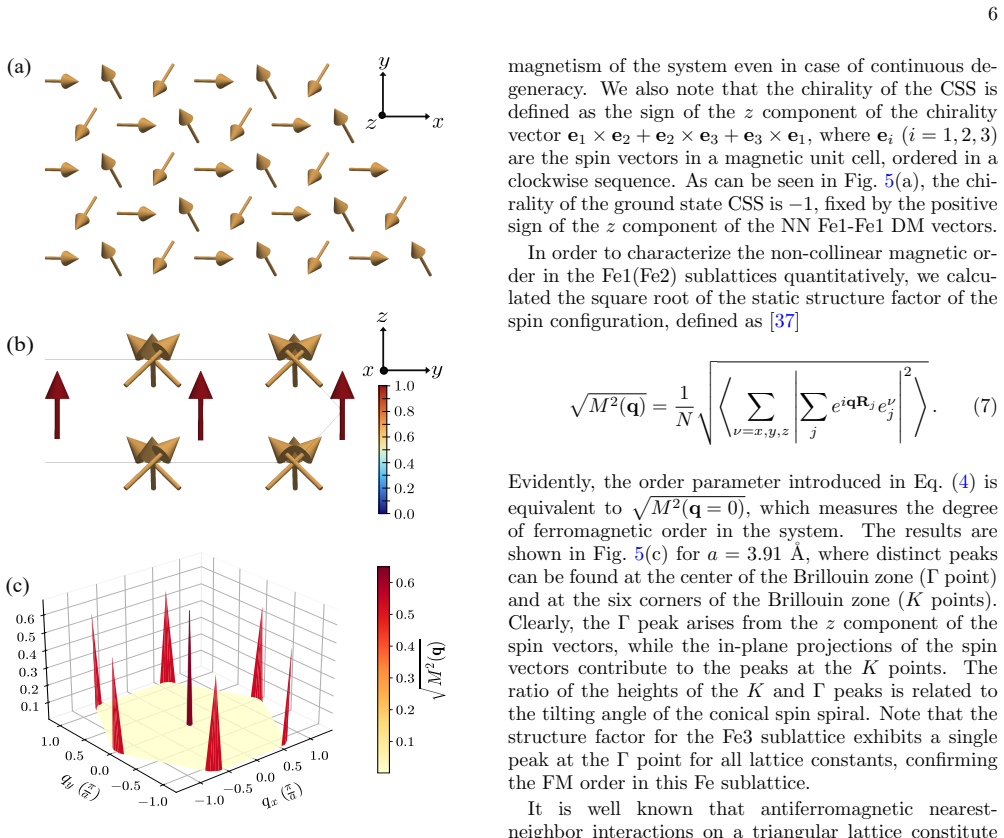
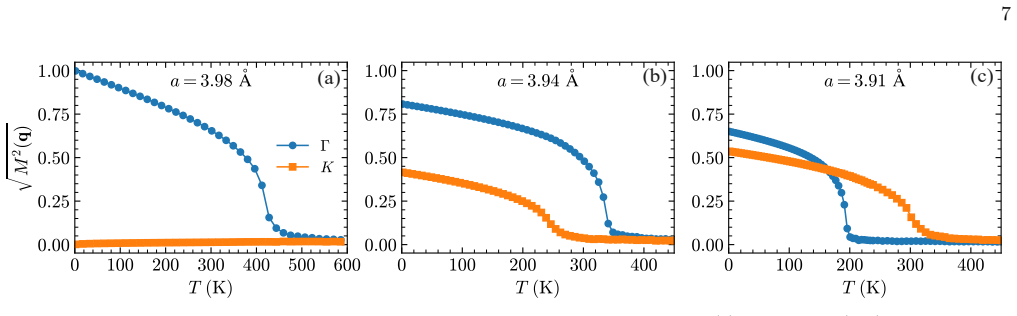
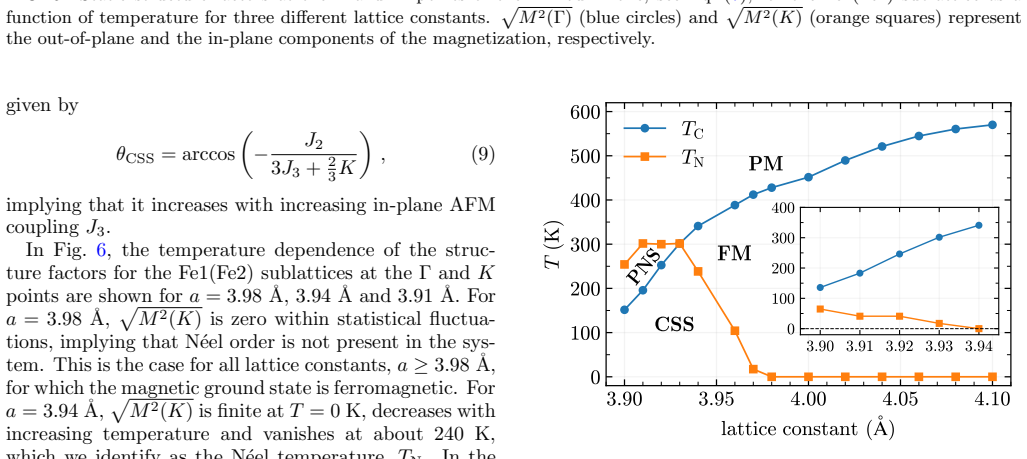
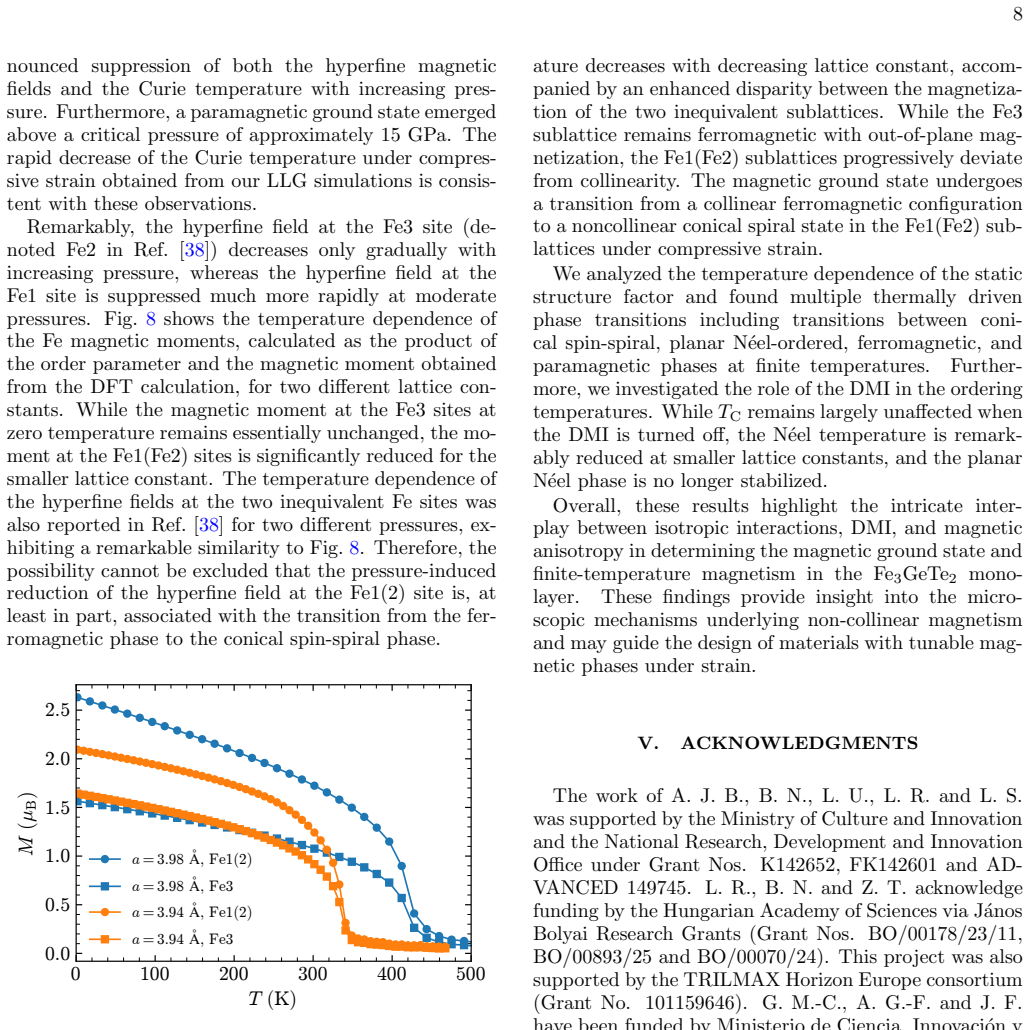
Decreasing the lattice constant strengthens antiferromagnetic exchange interactions relative to ferromagnetic ones, driving a transition of the magnetic ground state from ferromagnetic to conical spin-spiral together with a marked reduction in Curie temperature. Stochastic Landau-Lifshitz-Gilbert simulations of the atomistic model identify additional crossings into planar Néel order at specific strains and temperatures. A simple spin model based solely on competing isotropic exchanges explains the stabilization of the spiral phase, and the explicit removal of Dzyaloshinskii-Moriya terms lowers the Néel temperature without appreciably affecting the Curie temperature.
What carries the argument
Atomistic spin model populated with first-principles exchange interactions and evolved with stochastic Landau-Lifshitz-Gilbert dynamics to determine strain- and temperature-dependent phases.
If this is right
- Curie temperature falls substantially with decreasing lattice constant.
- Magnetic ground state changes from ferromagnetic to conical spin-spiral under sufficient compression.
- Phase diagram contains multiple boundaries separating ferromagnetic, conical spin-spiral, and planar Néel states as functions of lattice constant and temperature.
- Absence of Dzyaloshinskii-Moriya interactions reduces the Néel temperature while leaving the Curie temperature largely unaffected.
Where Pith is reading between the lines
- Controlled compressive strain on Fe3GeTe2 monolayers could be used to switch between distinct magnetic phases in devices.
- Competing-exchange mechanisms identified here may govern strain responses in other two-dimensional van der Waals magnets.
- The minimal spin model supplies a low-parameter starting point for predicting temperature-driven transitions under lattice distortion.
- Neutron scattering or magneto-optical Kerr measurements on compressed samples could directly detect the conical spiral order.
Load-bearing premise
Exchange interactions extracted from density-functional theory remain accurate enough to determine both the zero-temperature ground state and the finite-temperature phase diagram inside the classical atomistic spin model.
What would settle it
Experimental observation that the Curie temperature stays nearly constant or that ferromagnetic order persists down to the smallest accessible lattice constants in strained Fe3GeTe2 monolayers.
Figures
read the original abstract
We investigate the magnetic properties of a monolayer of Fe3GeTe2 as a function of the lattice constant by combining first-principles calculations with atomistic spin dynamics simulations. The calculated magnetic exchange interactions reveal a competition between ferromagnetic and antiferromagnetic couplings, with the latter being significantly strengthened under compressive strain. Stochastic Landau-Lifshitz-Gilbert simulations reveal a substantial decrease in the Curie temperature with decreasing lattice constant, and predict a transition of the magnetic ground state from a ferromagnetic configuration to a conical spin-spiral state. We introduce a simple spin-model which explains the stabilization of the spiral phase due to competing exchange interactions. We found multiple magnetic phase transitions involving ferromagnetic, conical spin-spiral, and planar Neel states, depending on both the lattice constant and the temperature. The absence of Dzyaloshinskii-Moriya interactions is found to significantly reduce the Neel temperature, while leaving the Curie temperature largely unaffected. Our findings reveal the importance of lattice distortions in controlling complex magnetic phases and their evolution with temperature.
Editorial analysis
A structured set of objections, weighed in public.
Referee Report
Summary. The paper combines DFT calculations of strain-dependent magnetic exchange interactions Jij in Fe3GeTe2 monolayer with stochastic Landau-Lifshitz-Gilbert atomistic spin dynamics simulations. It reports that compressive strain strengthens antiferromagnetic couplings relative to ferromagnetic ones, driving a zero-temperature transition from ferromagnetic to conical spin-spiral ground state, a substantial drop in Curie temperature, and multiple temperature-driven phase transitions (FM, conical spiral, planar Néel). A minimal competing-exchange spin model is introduced to rationalize the spiral stabilization, and the absence of Dzyaloshinskii-Moriya interaction is shown to suppress the Néel temperature while leaving Tc largely unchanged.
Significance. If the strain-dependent Jij are robust, the work provides a concrete example of how lattice distortions can be used to engineer competing interactions and stabilize non-collinear phases in a 2D van der Waals magnet. The explicit mapping from ab-initio Jij to both analytic model and LLG phase diagram, together with the reported DMI sensitivity, supplies falsifiable predictions that could be tested by strain-tuned experiments or further calculations.
major comments (2)
- [Methods / DFT exchange section] The central claim (transition to conical spiral below a critical lattice constant) is carried by the strain evolution of the DFT Jij. No convergence data with respect to k-point density, supercell size, Hubbard U on Fe, or choice of exchange-correlation functional are provided for the extracted Jij; given that the FM-AFM competition is delicate, even modest systematic shifts in the ratio of nearest-neighbor FM to next-nearest AFM terms can move or eliminate the spiral phase boundary. This must be addressed before the finite-temperature LLG results can be considered reliable.
- [Results / LLG simulations] The stochastic LLG simulations report a monotonic decrease in Tc and the appearance of multiple phases, yet no statistical uncertainties, number of independent runs, or finite-size scaling checks are shown for the extracted transition temperatures or the location of the FM-spiral boundary. Because the phase diagram is obtained from the same Jij set, any uncertainty in the zero-temperature inputs propagates directly into the reported Tc values and phase boundaries.
minor comments (2)
- [Discussion] The simple analytic spin model is introduced after the DFT step; a quantitative comparison of its predicted critical lattice constant or spiral wave-vector with the LLG results would strengthen the mechanistic interpretation.
- [Introduction] Standard references to prior experimental and theoretical work on bulk and monolayer Fe3GeTe2 (e.g., measured Tc, known exchange parameters) are needed to place the strain-induced changes in context.
Simulated Author's Rebuttal
We thank the referee for the constructive comments, which help strengthen the methodological transparency of our work. We address each major point below and will incorporate the requested checks into the revised manuscript.
read point-by-point responses
-
Referee: [Methods / DFT exchange section] The central claim (transition to conical spiral below a critical lattice constant) is carried by the strain evolution of the DFT Jij. No convergence data with respect to k-point density, supercell size, Hubbard U on Fe, or choice of exchange-correlation functional are provided for the extracted Jij; given that the FM-AFM competition is delicate, even modest systematic shifts in the ratio of nearest-neighbor FM to next-nearest AFM terms can move or eliminate the spiral phase boundary. This must be addressed before the finite-temperature LLG results can be considered reliable.
Authors: We agree that explicit convergence tests are necessary to substantiate the robustness of the Jij values and the resulting phase boundary. In the revised manuscript we will add a dedicated subsection (and supplementary figures) showing the variation of the key exchange parameters with k-point density (up to 12×12×1), supercell size (up to 4×4), Hubbard U (0–4 eV), and two additional functionals (PBE+U and SCAN). These tests confirm that the sign change in the next-nearest-neighbor coupling under compression and the location of the FM-to-spiral transition remain stable within the tested ranges. revision: yes
-
Referee: [Results / LLG simulations] The stochastic LLG simulations report a monotonic decrease in Tc and the appearance of multiple phases, yet no statistical uncertainties, number of independent runs, or finite-size scaling checks are shown for the extracted transition temperatures or the location of the FM-spiral boundary. Because the phase diagram is obtained from the same Jij set, any uncertainty in the zero-temperature inputs propagates directly into the reported Tc values and phase boundaries.
Authors: We acknowledge that quantitative error estimates and finite-size analysis were omitted. In the revision we will include (i) results from at least five independent runs per lattice constant with different random seeds, reporting standard deviations on Tc and the spiral transition temperature, and (ii) a brief finite-size study (32×32, 48×48, and 64×64 supercells) demonstrating that the reported phase boundaries shift by less than 5 K between the two largest sizes. These additions will be placed in the main text and supplementary material. revision: yes
Circularity Check
No circularity: DFT Jij are independent first-principles inputs to spin dynamics; simple model is post-hoc explanation
full rationale
The derivation chain begins with first-principles DFT computation of exchange interactions Jij as a function of lattice constant. These Jij are then fed as fixed inputs into stochastic LLG simulations and a simple analytic spin model. The reported predictions (Tc drop, FM-to-conical-spiral transition, multiple phase boundaries) are simulation outputs, not re-derivations or fits of the same quantities. No equation equates a fitted parameter to a 'prediction' of a related observable, and no self-citation supplies a uniqueness theorem or ansatz that the present work merely renames. The central claim therefore remains non-tautological; any concerns lie in the accuracy of the DFT protocol rather than circular construction.
Axiom & Free-Parameter Ledger
axioms (2)
- domain assumption Density-functional theory with chosen exchange-correlation functional yields exchange parameters accurate enough for qualitative phase prediction
- domain assumption Classical atomistic spin dynamics with Landau-Lifshitz-Gilbert equation captures the finite-temperature magnetic phases
Reference graph
Works this paper leans on
-
[1]
We consider a uniform out-of-plane on-site anisotropyK <0 for all sublattices. The energy per unit cell of the ferromagnetic state with a magnetization along thezaxis can easily be derived as, EFM =J 1 + 6J2 + 6J3 + 3K .(A4) A conical spin-spiral state, in which the spins are ro- tating around thezaxis with an opening angle ofθ, is described as ex 1,R = s...
-
[2]
Huang, G
B. Huang, G. Clark, E. Navarro-Moratalla, D. R. Klein, R. Cheng, K. L. Seyler, D. Zhong, E. Schmidgall, M. A. McGuire, D. H. Cobden, W. Yao, D. Xiao, P. Jarillo- Herrero, and X. Xu, Layer-dependent ferromagnetism in a van der Waals crystal down to the monolayer limit, Nature546, 270 (2017)
2017
-
[3]
C. Gong, L. Li, Z. Li, H. Ji, A. Stern, Y. Xia, T. Cao, W. Bao, C. Wang, Y. Wang, Z. Q. Qiu, R. J. Cava, S. G. Louie, J. Xia, and X. Zhang, Discovery of intrinsic fer- romagnetism in two-dimensional van der Waals crystals, Nature546, 265 (2017)
2017
-
[4]
N. D. Mermin and H. Wagner, Absence of ferromag- netism or antiferromagnetism in one-or two-dimensional isotropic Heisenberg models, Physical Review Letters17, 1133 (1966)
1966
-
[5]
C. Xu, J. Feng, H. Xiang, and L. Bellaiche, Interplay between Kitaev interaction and single ion anisotropy in ferromagnetic CrI 3 and CrGeTe3 monolayers, npj Com- putational Materials4, 57 (2018)
2018
-
[6]
H. Yang, S. O. Valenzuela, M. Chshiev, S. Couet, B. Di- eny, B. Dlubak, A. Fert, K. Garello, M. Jamet, D.- E. Jeong, K. Lee, T. Lee, M.-B. Martin, G. S. Kar, P. S´ en´ eor, H.-J. Shin, and S. Roche, Two-dimensional materials prospects for non-volatile spintronic memories, Nature606, 663 (2022)
2022
-
[7]
A. Fert, R. Ramesh, V. Garcia, F. Casanova, and M. Bibes, Electrical control of magnetism by electric field and current-induced torques, Reviews of Modern Physics 96, 015005 (2024)
2024
-
[8]
Z. Fei, B. Huang, P. Malinowski, W. Wang, T. Song, J. Sanchez, W. Yao, D. Xiao, X. Zhu, A. F. May, W. Wu, D. H. Cobden, J.-H. Chu, and X. Xu, Two-dimensional itinerant ferromagnetism in atomically thin Fe 3GeTe2, Nature Materials17, 778 (2018)
2018
-
[9]
H. Wang, R. Xu, C. Liu, L. Wang, Z. Zhang, H. Su, S. Wang, Y. Zhao, Z. Liu, D. Yu, J.-W. Mei, X. Zou, and J.-F. Dai, Pressure-Dependent Intermediate Mag- netic Phase in Thin Fe 3GeTe2 Flakes, The Journal of Physical Chemistry Letters11, 7313 (2020)
2020
-
[10]
X. Wang, Z. Li, M. Zhang, T. Hou, J. Zhao, L. Li, A. Rahman, Z. Xu, J. Gong, Z. Chi, R. Dai, Z. Wang, Z. Qiao, and Z. Zhang, Pressure-induced modification of the anomalous Hall effect in layered Fe 3GeTe2, Physical Review B100, 014407 (2019)
2019
-
[11]
Fujita, G
R. Fujita, G. Gurung, M.-A. Mawass, A. Smekhova, F. Kronast, A. K.-J. Toh, A. Soumyanarayanan, P. Ho, A. Singh, E. Heppell, D. Backes, F. Maccherozzi, K. Watanabe, T. Taniguchi, D. A. Mayoh, G. Balakrish- nan, G. van der Laan, and T. Hesjedal, Strain-Modulated Ferromagnetism at an Intrinsic van der Waals Hetero- junction, Advanced Functional Materials34, ...
2024
-
[12]
B. Ding, X. Li, Z. Li, X. Xi, Y. Yao, and W. Wang, Tun- ing the density of zero-field skyrmions and imaging the spin configuration in a two-dimensional Fe 3GeTe2 mag- net, NPG Asia Materials14, 74 (2022)
2022
-
[13]
D. Kim, S. Park, J. Lee, J. Yoon, S. Joo, T. Kim, K.-j. Min, S.-Y. Park, C. Kim, K.-W. Moon, C. Lee, J. Hong, and C. Hwang, Antiferromagnetic coupling of van der Waals ferromagnetic Fe3GeTe2, Nanotechnology 30, 245701 (2019)
2019
-
[14]
J. Yi, H. Zhuang, Q. Zou, Z. Wu, G. Cao, S. Tang, S. A. Calder, P. R. C. Kent, D. Mandrus, and Z. Gai, Com- peting antiferromagnetism in a quasi-2D itinerant ferro- magnet: Fe 3GeTe2, 2D Materials4, 011005 (2016)
2016
-
[15]
Z.-X. Shen, X. Bo, K. Cao, X. Wan, and L. He, Mag- netic ground state and electron-doping tuning of Curie temperature in Fe3GeTe2: First-principles studies, Phys- ical Review B103, 085102 (2021)
2021
-
[16]
Ghosh, S
S. Ghosh, S. Ershadrad, V. Borisov, and B. Sanyal, Un- raveling effects of electron correlation in two-dimensional FenGeTe2 (n= 3, 4, 5) by dynamical mean field theory, npj Computational Materials9, 86 (2023)
2023
-
[17]
G. V. Pushkarev, D. I. Badrtdinov, I. A. Iakovlev, V. V. Mazurenko, and A. N. Rudenko, An effective spin model on the honeycomb lattice for the description of magnetic properties in two-dimensional Fe3GeTe2, Journal of Mag- netism and Magnetic Materials588, 171456 (2023)
2023
-
[18]
H. L. Zhuang, P. R. C. Kent, and R. G. Hennig, Strong anisotropy and magnetostriction in the two-dimensional Stoner ferromagnet Fe 3GeTe2, Physical Review B93, 134407 (2016)
2016
-
[19]
J. M. Soler, E. Artacho, J. D. Gale, A. Garc´ ıa, J. Jun- quera, P. Ordej´ on, and D. S´ anchez-Portal, The SIESTA method forab initioorder-N materials simulation, Jour- nal of Physics: Condensed Matter14, 2745 (2002)
2002
-
[20]
J. P. Perdew, K. Burke, and M. Ernzerhof, Generalized Gradient Approximation Made Simple, Physical Review Letters77, 3865 (1996)
1996
-
[21]
Troullier and J
N. Troullier and J. L. Martins, Efficient pseudopotentials for plane-wave calculations, Physical Review B43, 1993 (1991)
1993
-
[22]
Cuadrado and J
R. Cuadrado and J. I. Cerd´ a, Fully relativistic pseu- dopotential formalism under an atomic orbital basis: spin–orbit splittings and magnetic anisotropies, Journal of Physics: Condensed Matter24, 086005 (2012). 11
2012
-
[23]
Liechtenstein, M
A. Liechtenstein, M. Katsnelson, V. Antropov, and V. Gubanov, Local spin density functional approach to the theory of exchange interactions in ferromagnetic met- als and alloys, Journal of Magnetism and Magnetic Ma- terials67, 65 (1987)
1987
-
[24]
Udvardi, L
L. Udvardi, L. Szunyogh, K. Palot´ as, and P. Weinberger, First-principles relativistic study of spin waves in thin magnetic films, Physical Review B68, 104436 (2003)
2003
-
[25]
Oroszl´ any, J
L. Oroszl´ any, J. Ferrer, A. De´ ak, L. Udvardi, and L. Szunyogh, Exchange interactions from a nonorthogo- nal basis set: From bulk ferromagnets to the magnetism in low-dimensional graphene systems, Physical Review B 99, 224412 (2019)
2019
-
[26]
Mart´ ınez-Carracedo, L
G. Mart´ ınez-Carracedo, L. Oroszl´ any, A. Garc´ ıa-Fuente, B. Ny´ ari, L. Udvardi, L. Szunyogh, and J. Ferrer, Rel- ativistic magnetic interactions from nonorthogonal basis sets, Physical Review B108, 214418 (2023)
2023
-
[27]
D. T. Pozs´ ar, G. Mart´ ınez-Carracedo, A. Garc´ ıa-Fuente, L. Udvardi, L. Szunyogh, J. Ferrer, and L. Oroszl´ any, grogupy: v0.4.0 (2025)
2025
-
[28]
L. D. Landau and E. Lifshitz, On the theory of the dis- persion of magnetic permeability in ferromagnetic bodies, Reprinted from Physikalische Zeitschrift der Sowjetunion 8, 153 (1935)
1935
-
[29]
Nowak, Classical spin models, inHandbook of Mag- netism and Advanced Magnetic Materials(John Wiley & Sons, Ltd, 2007)
U. Nowak, Classical spin models, inHandbook of Mag- netism and Advanced Magnetic Materials(John Wiley & Sons, Ltd, 2007)
2007
-
[30]
R´ ozsa, L
L. R´ ozsa, L. Udvardi, and L. Szunyogh, Langevin spin dynamics based onab initiocalculations: numerical schemes and applications, Journal of Physics: Condensed Matter26, 216003 (2014)
2014
-
[31]
Jenkins, L
S. Jenkins, L. R´ ozsa, U. Atxitia, R. F. Evans, K. S. Novoselov, and E. J. Santos, Breaking through the Mermin-Wagner limit in 2D van der Waals magnets, Na- ture Communications13, 6917 (2022)
2022
-
[32]
L´ aszl´ offy, L
A. L´ aszl´ offy, L. R´ ozsa, K. Palot´ as, L. Udvardi, and L. Szunyogh, Magnetic structure of monatomic Fe chains on Re(0001): Emergence of chiral multispin interactions, Physical Review B99, 184430 (2019)
2019
-
[33]
Nagyfalusi, L
B. Nagyfalusi, L. Udvardi, and L. Szunyogh, Magnetic ground state of supported monatomic Fe chains from first principles, Journal of Physics: Condensed Matter 34, 395803 (2022)
2022
-
[34]
Polak and G
E. Polak and G. Ribiere, Note sur la convergence de m´ ethodes de directions conjugu´ ees, Revue fran¸ caise d’informatique et de recherche op´ erationnelle. S´ erie rouge 3, 35 (1969)
1969
-
[35]
Roemer, C
R. Roemer, C. Liu, and K. Zou, Robust ferromagnetism in wafer-scale monolayer and multilayer Fe 3GeTe2, npj 2D Materials and Applications4, 33 (2020)
2020
-
[36]
A. F. May, S. Calder, C. Cantoni, H. Cao, and M. A. McGuire, Magnetic structure and phase stability of the van der Waals bonded ferromagnet Fe3−xGeTe2, Physical Review B93, 014411 (2016)
2016
-
[37]
Moriya, Anisotropic Superexchange Interaction and Weak Ferromagnetism, Physical Review120, 91 (1960)
T. Moriya, Anisotropic Superexchange Interaction and Weak Ferromagnetism, Physical Review120, 91 (1960)
1960
-
[38]
R´ ozsa, L
L. R´ ozsa, L. Udvardi, L. Szunyogh, and I. A. Szab´ o, Mag- netic phase diagram of an Fe monolayer on W(110) and Ta(110) surfaces based onab initiocalculations, Physical Review B91, 144424 (2015)
2015
-
[39]
N.-T. Dang, D. P. Kozlenko, O. N. Lis, S. E. Kichanov, Y. V. Lukin, N. O. Golosova, B. N. Savenko, D.- L. Duong, T.-L. Phan, T.-A. Tran, and M.-H. Phan, High Pressure-Driven Magnetic Disorder and Structural Transformation in Fe3GeTe2: Emergence of a Magnetic Quantum Critical Point, Advanced Science10, 2206842 (2023)
2023
-
[40]
A. Jyothi Bhasu and L. Szunyogh, Dataset for ”Strain induced magnetic phase transitions in Fe 3GeTe2 mono- layer” , 10.5281/zenodo.20737279 (2026)
discussion (0)
Sign in with ORCID, Apple, or X to comment. Anyone can read and Pith papers without signing in.