REVIEW 2 major objections 45 references
Size Effects in the Strong-Field Ionization and Dissociation Dynamics of (H$_2$O)$_n$ (n=1-4)
T0 review · 2 major / 0 minor · reviewed 2026-06-30 · grok-4.3
Pith's one-line read Water cluster size reshapes strong-field response mainly through proton dynamics rather than net ionization changes.
desk verdict The size trends in proton ejection and H-transfer are the main new angle, but the post-hoc trajectory filters are the part that needs checking. read the letter →
The pith
A machine-rendered reading of the paper's core claim, the machinery that carries it, and where it could break.
The reading
What carries the argument
RT-TDDFT coupled to Ehrenfest molecular dynamics tracking net ionization, proton timing, H-transfer classification, and endpoint oxygen statistics across identical laser pulses on clusters of size 1-4.
What would settle it
Measuring net ionization yield per molecule together with H-ejection counts and dissociation fractions for water dimers versus tetramers under identical few-cycle near-infrared pulses would directly test whether net ionization remains nearly constant while proton activity and dissociation rise.
Extended reading notes
Core claim
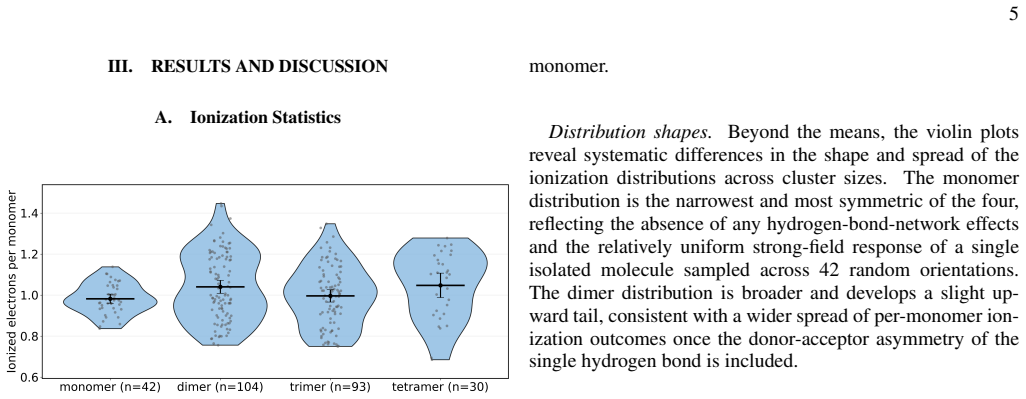
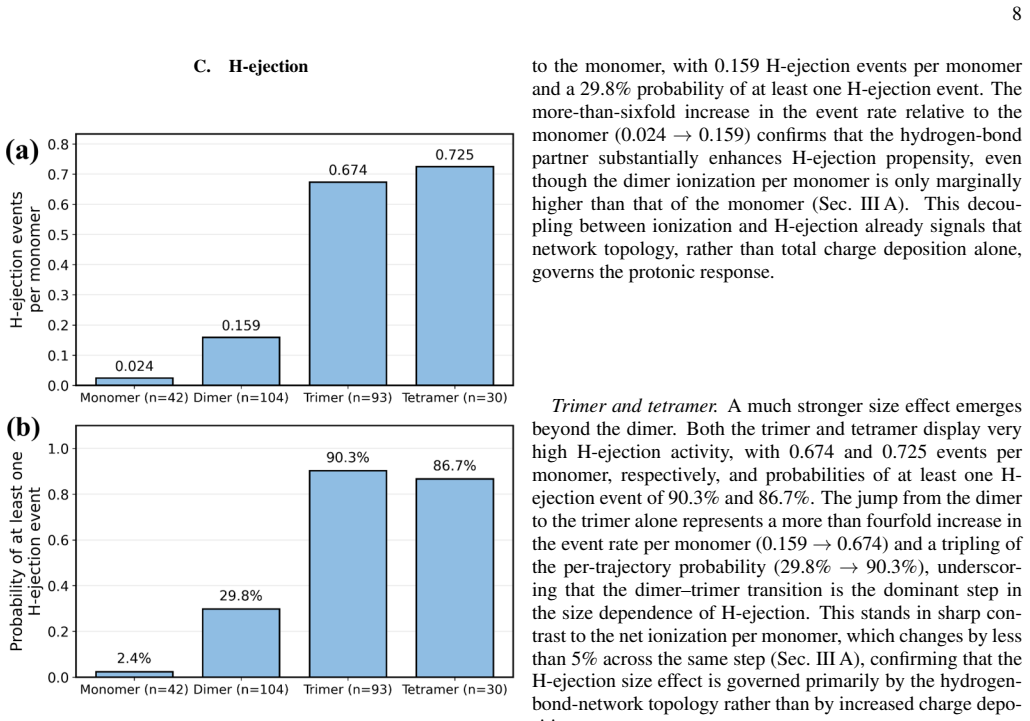
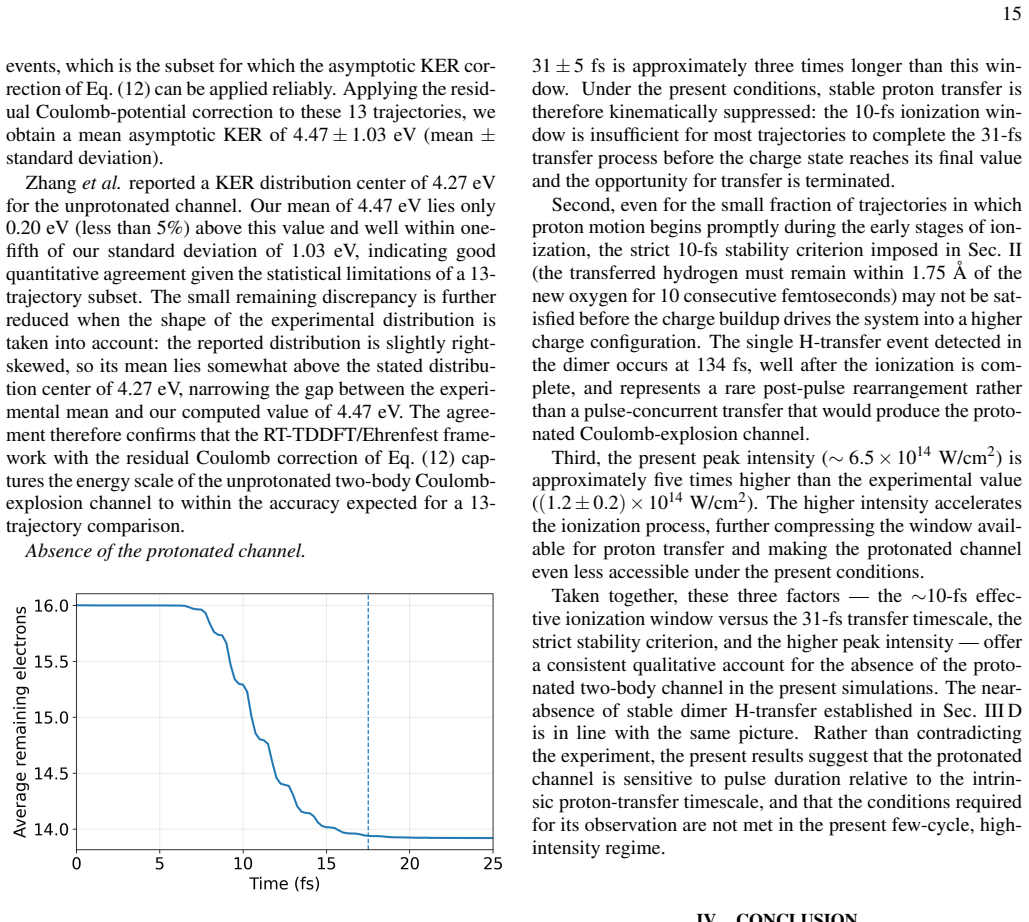
Real-time TDDFT-Ehrenfest simulations under a common few-cycle NIR pulse find net ionization per monomer varies only weakly with size n=1-4, while protonic and oxygen responses strengthen markedly beyond the dimer: H-ejection rises sharply, stable H-transfer is absent in the dimer but substantial in the trimer and amplified in the tetramer, early-time proton response concentrates during and right after the pulse in larger clusters, dissociation propensity increases systematically with size, and a clean subset of direct two-body dimer breakups yields asymptotic kinetic energy release of 4.47 ± 1.03 eV matching the experimental unprotonated Coulomb-explosion channel.
Load-bearing premise
The post-hoc rules for labeling stable H-transfer trajectories and for picking the clean subset of direct two-body dimer breakup trajectories introduce no selection bias that changes the reported size trends or the 4.47 eV kinetic energy release value.
Editorial extensions
If this is right
- H-ejection activity increases sharply once cluster size reaches the trimer and tetramer.
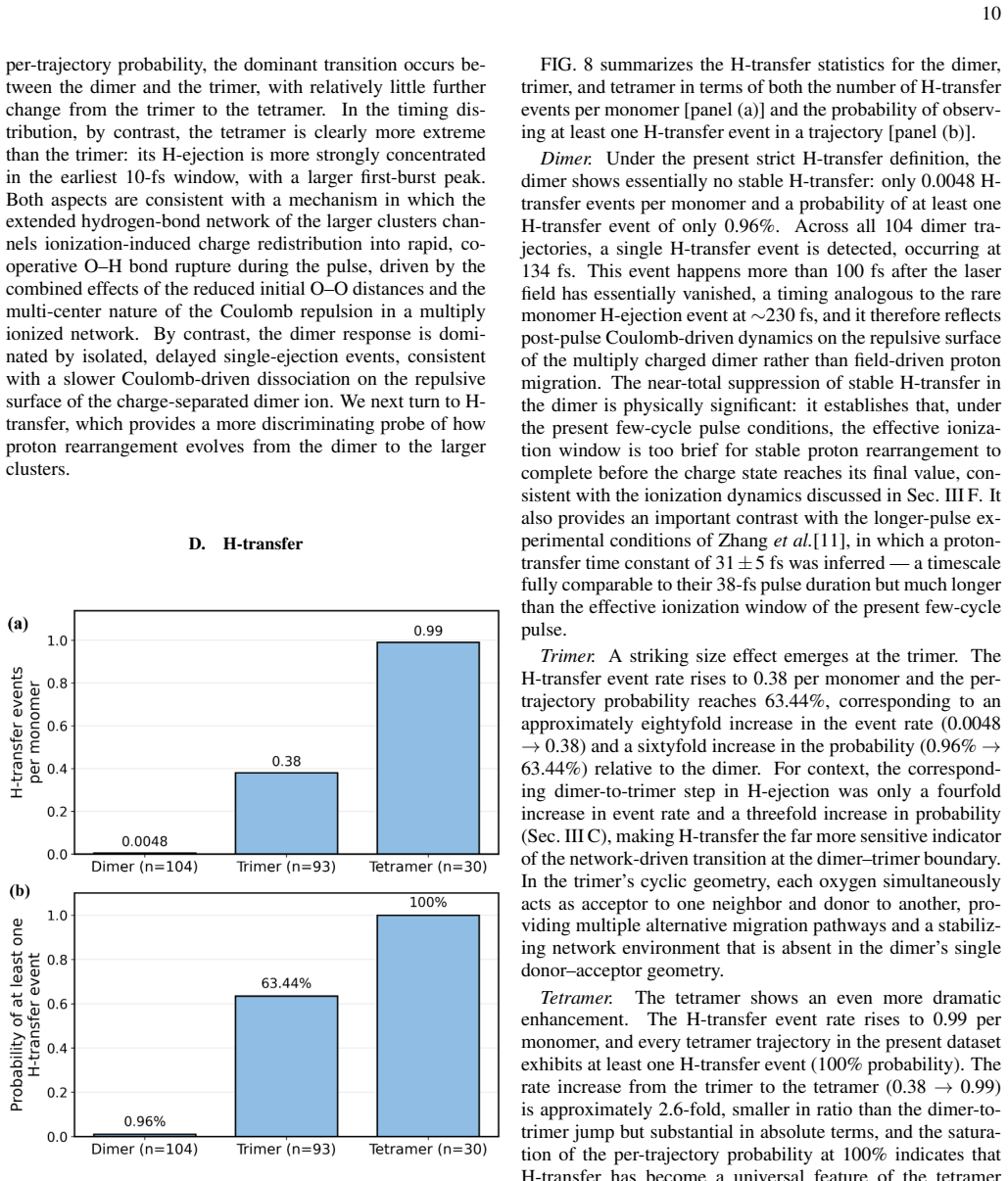
- Stable H-transfer between molecules is negligible in the dimer but becomes substantial and grows further in larger clusters.
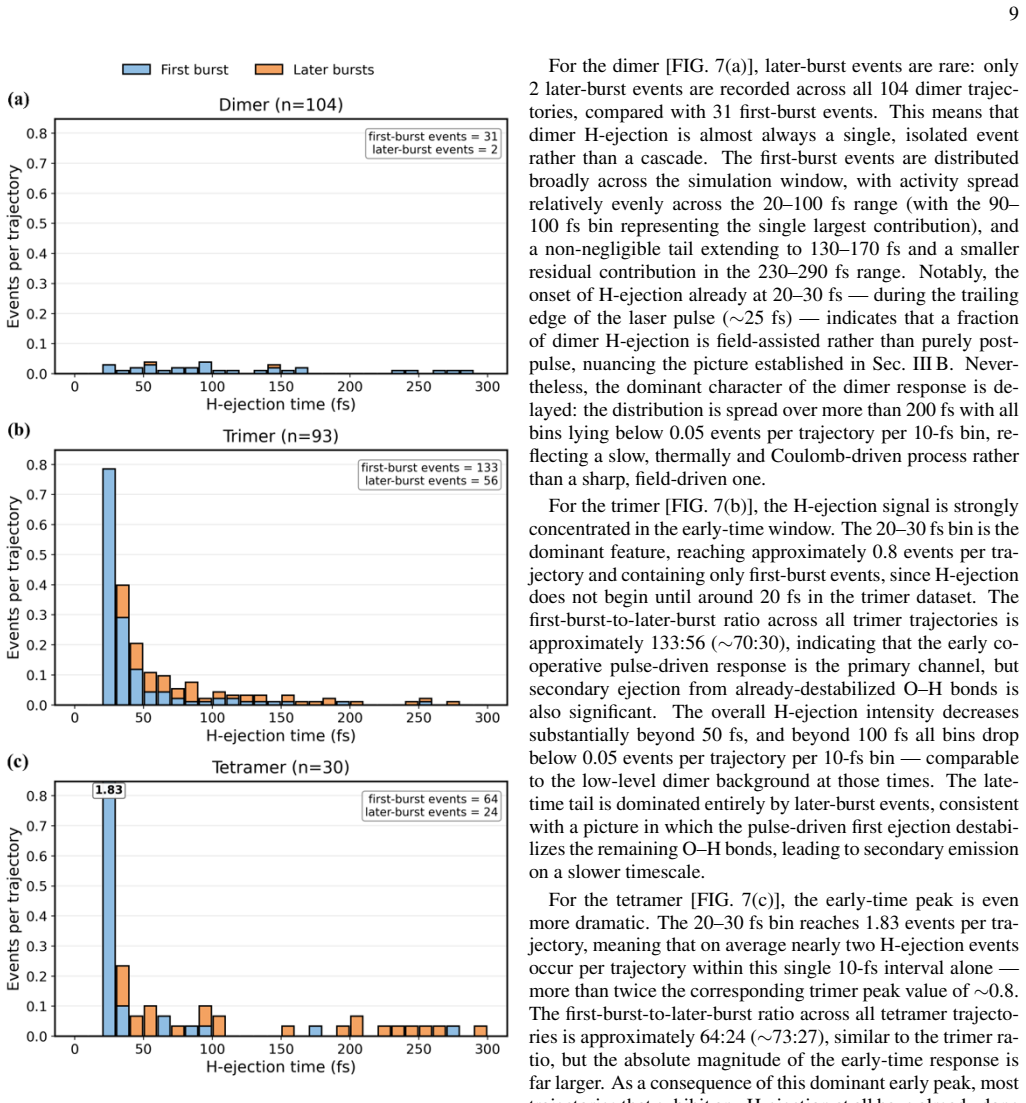
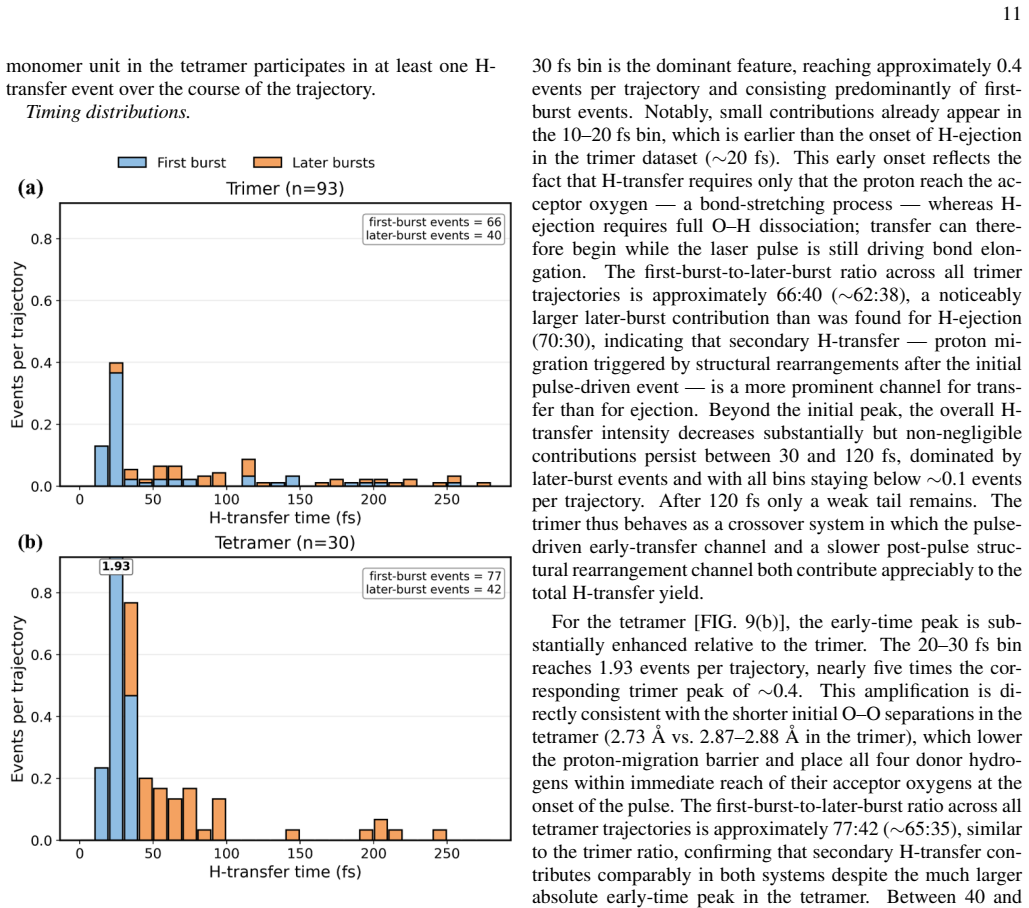
- Early-time protonic response is weak and spread out in the dimer but strong and concentrated within the laser pulse window for trimers and tetramers.
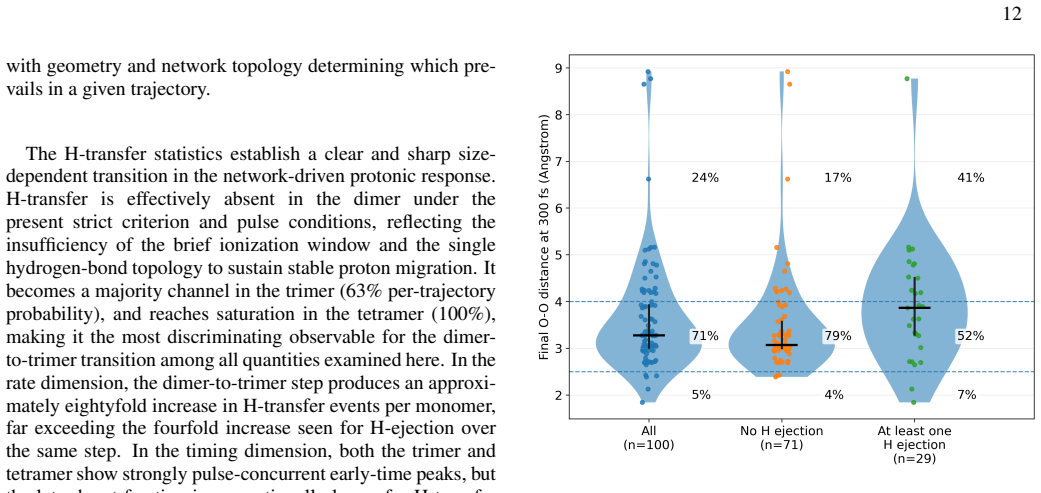
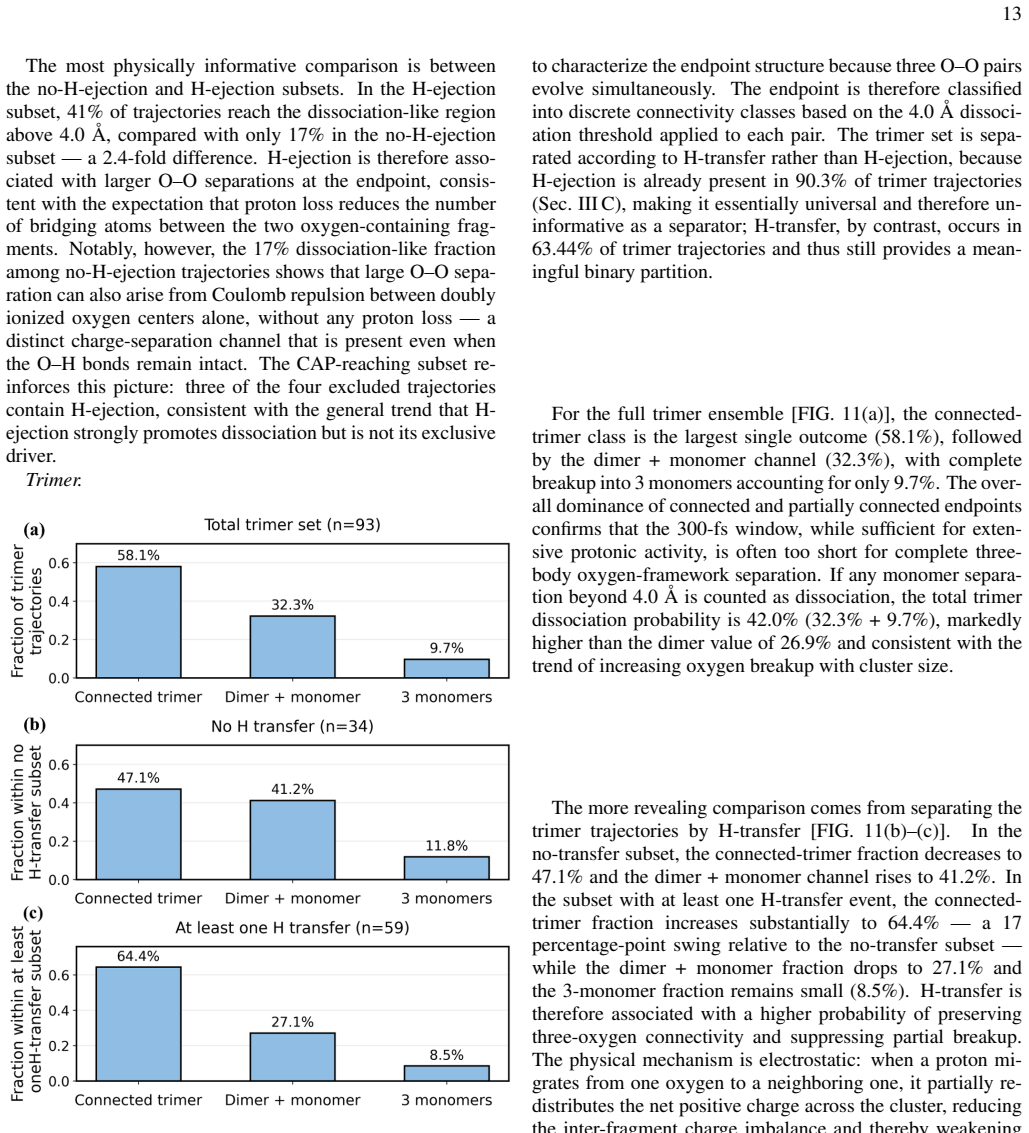
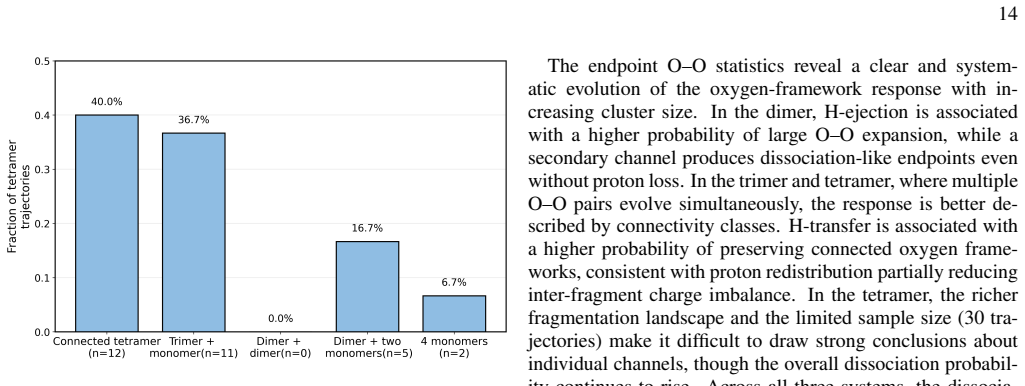
- Dissociation propensity rises systematically with cluster size according to endpoint oxygen statistics.
- Direct two-body dimer breakup channels release 4.47 ± 1.03 eV kinetic energy in the asymptotic limit.
Reading between the lines
- The dominance of proton-mediated effects suggests that models of larger water aggregates or liquid water under strong fields should prioritize nuclear topology over simple charge counting.
- The timing difference implies that laser-pulse duration could be tuned to control whether proton transfer activates in small clusters.
- The reported KER agreement with one experimental channel indicates the clean-trajectory selection isolates a physically relevant breakup pathway.
- Extending the same pulse and analysis to n=5-8 clusters would test whether the proton-response amplification saturates or continues to grow.
Signed reviews
Editorial analysis
A structured set of objections, weighed in public.
Referee Report
Summary. The manuscript uses RT-TDDFT coupled to Ehrenfest MD to simulate strong-field ionization and dissociation of (H₂O)ₙ clusters (n=1–4) under a common few-cycle NIR pulse. It reports that net ionization per monomer changes only weakly with size, while protonic responses (H-ejection activity, stable H-transfer, early-time timing, and dissociation propensity) change strongly beyond the dimer; a clean subset of direct two-body dimer trajectories yields KER = 4.47 ± 1.03 eV, stated to agree with experiment for the unprotonated Coulomb-explosion channel. The central conclusion is that size effects act primarily through proton-mediated and topology-level nuclear dynamics rather than net ionization.
Significance. If the trajectory classifications hold under scrutiny, the separation between weak ionization-size dependence and strong proton-response dependence would usefully highlight many-body nuclear effects in strong-field cluster physics. The consistent protocol across sizes and the reported experimental KER match are strengths. However, the current lack of parameter validation and sensitivity testing on post-selection criteria reduces the immediate impact.
major comments (2)
- [Abstract / trajectory post-selection protocol] Abstract and trajectory-classification description: the claims that 'stable H-transfer is essentially absent in the dimer under the present criterion but becomes substantial in the trimer' and that a 'clean subset' yields the 4.47 eV KER rest on post-hoc filters whose exact thresholds, timing windows, and cleanliness definitions are not specified. No sensitivity analysis on these criteria is described, which directly affects whether the reported size trends in H-transfer and dissociation are robust or selection-dependent.
- [Abstract / computational details] Abstract and methods: quantitative results (weak net-ionization variation, KER agreement, timing of protonic response) are presented without reported validation or convergence tests for the density functional, basis set, laser-pulse parameters, or Ehrenfest integrator. This is load-bearing for the central claim that ionization changes only weakly while nuclear dynamics change strongly.
Simulated Author's Rebuttal
We thank the referee for the constructive comments, which help clarify the presentation of our results. We agree that explicit documentation of post-selection criteria and convergence tests will improve the manuscript and will revise accordingly to address both major points.
read point-by-point responses
-
Referee: [Abstract / trajectory post-selection protocol] Abstract and trajectory-classification description: the claims that 'stable H-transfer is essentially absent in the dimer under the present criterion but becomes substantial in the trimer' and that a 'clean subset' yields the 4.47 eV KER rest on post-hoc filters whose exact thresholds, timing windows, and cleanliness definitions are not specified. No sensitivity analysis on these criteria is described, which directly affects whether the reported size trends in H-transfer and dissociation are robust or selection-dependent.
Authors: We acknowledge that the manuscript does not provide the exact numerical thresholds, timing windows, or full definition of 'clean subset' used for the H-transfer classification and KER analysis. The 'present criterion' is referenced but not quantified in detail. In the revised manuscript we will add an explicit description of these criteria (including distance cutoffs for stable transfer, time windows relative to the pulse, and exclusion rules for the clean two-body subset) in the Methods section. We will also include a sensitivity analysis varying the key thresholds within physically reasonable ranges and demonstrate that the reported size trends in H-transfer activity and dissociation propensity remain robust. This addition directly addresses the concern about selection dependence. revision: yes
-
Referee: [Abstract / computational details] Abstract and methods: quantitative results (weak net-ionization variation, KER agreement, timing of protonic response) are presented without reported validation or convergence tests for the density functional, basis set, laser-pulse parameters, or Ehrenfest integrator. This is load-bearing for the central claim that ionization changes only weakly while nuclear dynamics change strongly.
Authors: We agree that the absence of explicit convergence and validation tests weakens the presentation of the quantitative claims. While the computational parameters were chosen following standard protocols for RT-TDDFT on water systems, the manuscript does not report dedicated tests. In the revision we will add a dedicated subsection (or supplementary material) presenting convergence checks with respect to basis-set size, Ehrenfest time step, and limited variations in laser parameters. We will also reference available literature benchmarks for the functional on related water-cluster properties. These additions will support the reliability of the reported weak size dependence of net ionization versus the stronger changes in proton dynamics. revision: yes
Circularity Check
No significant circularity; results are direct simulation outputs
full rationale
The paper reports outcomes from RT-TDDFT+Ehrenfest trajectory runs under a fixed laser pulse, followed by post-simulation classification of H-ejection, H-transfer, and dissociation channels. No equations, fitted parameters, or self-citations are shown that reduce any reported size trend or KER value to an input by construction. Net ionization and protonic response quantities are computed quantities, not redefined or predicted from themselves. The classification criteria, while post-hoc, do not create a self-definitional loop or rename a fitted result as a prediction. The derivation chain is therefore self-contained against the simulation protocol.
Assumptions & free parameters
assumptions (3)
- domain assumption RT-TDDFT with the chosen functional and basis accurately models strong-field ionization in water clusters
- domain assumption Ehrenfest dynamics sufficiently describes nuclear motion on the time scale of the laser pulse and subsequent dissociation
- ad hoc to paper The operational definitions of 'H-ejection activity', 'stable H-transfer', and 'direct two-body breakup' correctly identify the physical channels of interest
Cite this review
Pith. "Pith review of Size Effects in the Strong-Field Ionization and Dissociation Dynamics of (H$_2$O)$_n$ (n=1-4)." pith.science (2026). https://pith.science/paper/6ZCKOXN3
@misc{pith2026260630331,
  author       = {Pith},
  title        = {Pith review of: Size Effects in the Strong-Field Ionization and Dissociation Dynamics of (H$_2$O)$_n$ (n=1-4)},
  year         = {2026},
  howpublished = {\url{https://pith.science/paper/6ZCKOXN3}},
  note         = {Machine review of arXiv:2606.30331}
}
abstract
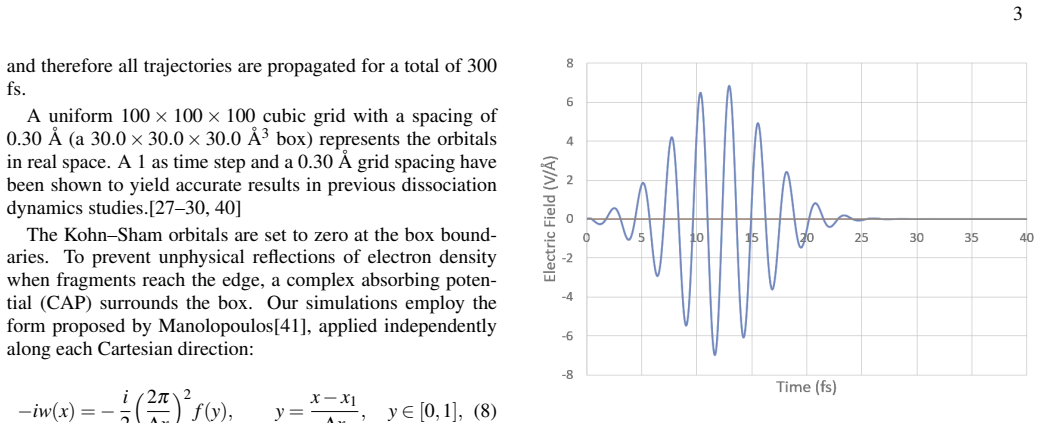
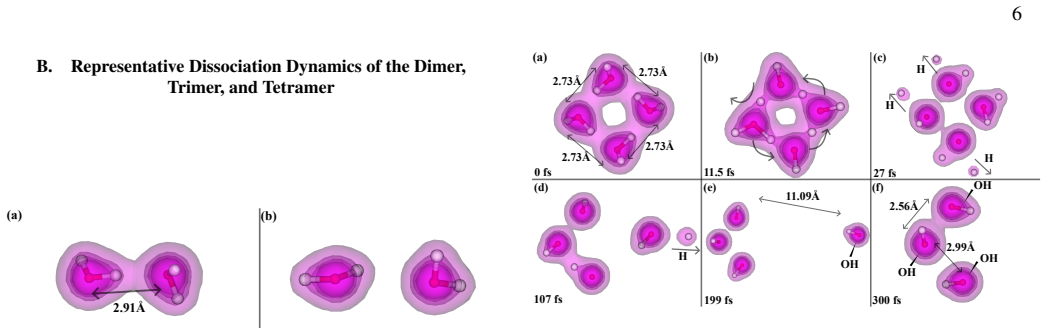
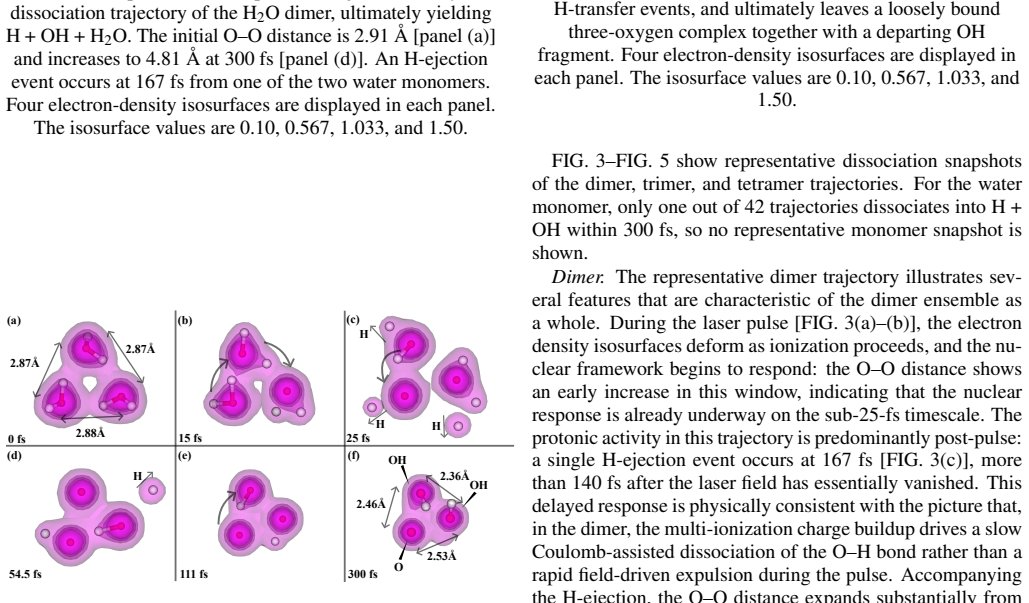
The size-dependent strong-field ionization and dissociation dynamics of (H$_2$O)$_n$ (n=1-4) are investigated using real-time time-dependent density functional theory (RT-TDDFT) coupled to Ehrenfest molecular dynamics under a common few-cycle near-infrared laser pulse. It is found that the net ionization per monomer varies only weakly on cluster size, whereas the protonic and oxygen response is changed much more strongly once the cluster size grows beyond the dimer. In particular, H-ejection activity is observed to rise sharply from the dimer to the trimer/tetramer regime, while stable H-transfer is essentially absent in the dimer under the present criterion but becomes substantial in the trimer and is further amplified in the tetramer. Through timing analyses, it is shown that the dimer exhibits a weak and temporally broad response, whereas the larger clusters display a much stronger early-time protonic response concentrated within and immediately after the laser pulse window. By endpoint oxygen statistics, a systematic increase in dissociation propensity with cluster size is likewise shown. For a clean subset of direct two-body dimer breakup trajectories, the asymptotic kinetic energy release is estimated to be 4.47 $\pm$ 1.03 eV, in reasonably good agreement with the experimental value for the unprotonated two-body Coulomb-explosion channel. Overall, it is shown by the results that increasing water-cluster size primarily reshapes the strong-field response through proton-mediated and topology-level nuclear dynamics rather than through a large change in net ionization alone.
Figures
Figures from the paper (10 more)

Reference graph
Works this paper leans on
-
[1]
M. B. Hahn, P. M. Dietrich, and J. Radnik, In situ monitoring of the influence of water on dna radiation damage by near-ambient pressure x-ray photoelectron spectroscopy, Commun. Chem.4, 50 (2021)
2021
-
[2]
J. A. Reisz, N. Bansal, J. Qian, W. Zhao, and C. M. Fur- dui, Effects of ionizing radiation on biological molecules— mechanisms of damage and emerging methods of detection, Ra- diat. Res.180, 189 (2013)
2013
-
[3]
H. T. Kratochvil, L. C. Watkins, M. Mravic, J. L. Thomaston, J. M. Nicoludis, N. H. Somberg, L. Liu, M. Hong, G. A. V oth, and W. F. DeGrado, Transient water wires mediate selective proton transport in designed channel proteins, Nat. Chem.15, 1012 (2023)
2023
-
[4]
Mücke, M
M. Mücke, M. Braune, S. Barth, M. Förstel, T. Lischke, V . Ul- rich, T. Arion, U. Becker, A. Bradshaw, and U. Hergenhahn, A hitherto unrecognized source of low-energy electrons in water, Nat. Phys.6, 143 (2010)
2010
-
[5]
Jahnkeet al., Ultrafast energy transfer between water molecules, Nat
T. Jahnkeet al., Ultrafast energy transfer between water molecules, Nat. Phys.11, 308 (2015)
2015
-
[6]
L. S. Cederbaum, J. Zobeley, and F. Tarantelli, Giant inter- molecular decay and fragmentation of clusters, Phys. Rev. Lett. 79, 4778 (1997)
1997
-
[7]
Thurmer, M
S. Thurmer, M. Oncák, N. Ottosson, R. Seidel, U. Hergenhahn, S. E. Bradforth, P. Slaví ˇcek, and B. Winter, On the nature and origin of dicationic, charge-separated species formed in liquid water on x-ray irradiation, Nat. Chem.5, 590 (2013)
2013
-
[8]
Kazandjian, J
S. Kazandjian, J. Rist, M. Weller, F. Wiegandt, D. Asliturk, S. Grundmann, M. Kircher, G. Nalin, D. Pitters, I. Vela Pérez, M. Waitz, G. Schiwietz, B. Griffin, J. B. Williams, R. Dörner, M. Schöffler, T. Miteva, F. Trinter, T. Jahnke, and N. Sisourat, Frustrated coulomb explosion of small helium clusters, Phys. Rev. A98, 050701(R) (2018)
2018
Show all 45 references
-
[9]
Zhang, J
P. Zhang, J. Trester, J. Dubský, P. Koloren ˇc, P. Slaví ˇcek, and H. J. Worner, Intermolecular coulombic decay in liquid water competes with proton transfer and non-adiabatic relaxation, Na- ture Communications16, 6732 (2025)
2025
-
[10]
Zhang, C
P. Zhang, C. Perry, T. T. Luu, D. Matselyukh, and H. J. Worner, Intermolecular coulombic decay in liquid water, Phys. Rev. Lett.128, 133001 (2022)
2022
-
[11]
Zhang, J
C. Zhang, J. Lu, T. Feng, and H. Rottke, Proton transfer dynam- ics following strong-field ionization of the water dimer, Phys. Rev. A99, 053408 (2019)
2019
-
[12]
Tachikawa, Ionization dynamics of a water dimer: spe- cific reaction selectivity, Phys
H. Tachikawa, Ionization dynamics of a water dimer: spe- cific reaction selectivity, Phys. Chem. Chem. Phys.13, 11206 (2011)
2011
-
[13]
Schnorr, M
K. Schnorr, M. Belina, S. Augustin, H. Lindenblatt, Y . Liu, S. Meister, T. Pfeifer, G. Schmid, R. Treusch, F. Trost, P. Slavíˇcek, and R. Moshammer, Direct tracking of ultrafast proton transfer in water dimers, Sci. Adv.9, eadg7864 (2023)
2023
-
[14]
K. Wang, C. L. Covington, and K. Varga, Time-dependent density-functional study of intermolecular coulombic decay for 2a1 ionized water dimer, J. Chem. Phys.163, 074106 (2025)
2025
-
[15]
R. N. Barnett and U. Landman, Pathways and dynamics of dis- sociation of ionized (h2o)2, J. Phys. Chem.99, 17305 (1995)
1995
-
[16]
P. P. Radi, P. Beaud, D. Franzke, H.-M. Frey, T. Gerber, B. Mischler, and A.-P. Tzannis, Femtosecond photoionization of (H2O)n and (D2O)n clusters, J. Chem. Phys.111, 512 (1999)
1999
-
[17]
Svoboda, D
O. Svoboda, D. Hollas, M. On ˇcák, and P. Slaví ˇcek, Reaction selectivity in an ionized water dimer: nonadiabatic ab initio dynamics simulations, Phys. Chem. Chem. Phys.15, 11531 (2013)
2013
-
[18]
Chalabala, F
J. Chalabala, F. Uhlig, and P. Slavíˇcek, Assessment of real-time time-dependent density functional theory (rt-tddft) in radiation chemistry: Ionized water dimer, J. Phys. Chem. A122, 3227 (2018)
2018
-
[19]
Tachikawa and T
H. Tachikawa and T. Takada, Proton transfer rates in ionized water clusters (h2o)n (n = 2–4), RSC Adv.5, 6945 (2015)
2015
-
[20]
Z. P. Wang, P. M. Dinh, P.-G. Reinhard, and E. Suraud, Ultrafast nonadiabatic dynamics of a water dimer in femtosecond laser pulses, Laser Phys.24, 106004 (2014)
2014
-
[21]
Zhang, X
X. Zhang, X. Zhao, H. Liu, Z. Yin, X. Zhao, P. Ma, X. Li, C. Wang, Q. Wang, S. Luo, and D. Ding, Ultrafast coulomb explosion of the nh3 dimer, trimer, and tetramer in strong laser fields, Phys. Rev. A109, 023112 (2024)
2024
-
[22]
J. Ma, M. Zhu, Z. Hu, H. Ni, H. Sun, Y . Yang, and Z. Sun, Ul- trafast proton transfer in femtosecond-laser-induced double ion- ization of HCOOH−h2O complexes, Phys. Rev. A112, 023114 (2025)
2025
-
[23]
Runge and E
E. Runge and E. K. U. Gross, Density-functional theory for time-dependent systems, Phys. Rev. Lett.52, 997 (1984)
1984
-
[24]
C. A. Ullrich,Time-Dependent Density-Functional Theory: Concepts and Applications, Oxford Graduate Texts (Oxford University Press, Oxford, United Kingdom, 2011)
2011
-
[25]
Varga and J
K. Varga and J. A. Driscoll,Computational Nanoscience: Ap- 18 plications for Molecules, Clusters, and Solids(Cambridge Uni- versity Press, 2011)
2011
-
[26]
Bruner, S
A. Bruner, S. Hernandez, F. Mauger, P. M. Abanador, D. J. LaMaster, M. B. Gaarde, K. J. Schafer, and K. Lopata, At- tosecond charge migration with tddft: Accurate dynamics from a well-defined initial state, J. Phys. Chem. Lett.8, 3991 (2017)
2017
-
[27]
Jiang, C
C. Jiang, C. L. Covington, and K. Varga, Time-dependent density-functional-theory study of strong-field laser-induced coulomb explosion of the hcl dimer, Phys. Rev. A113, 043101 (2026)
2026
-
[28]
S. S. Taylor, K. Varga, K. Mogyorósi, V . Chikán, and C. Cov- ington, Fragmentation in coulomb explosion of hydrocarbon molecules, Phys. Rev. A111, 013109 (2025)
2025
-
[29]
S. S. Taylor, C. Covington, and K. Varga, Quantum effects of coulomb explosion simulations revealed by time-dependent density-functional theory, Phys. Rev. A111, 033109 (2025)
2025
-
[30]
Jiang, S
C. Jiang, S. S. Taylor, K. Wang, C. L. Covington, and K. Varga, H+ 3 formation in alkanes is governed by competing fragmen- tation pathways revealed by time-dependent density-functional theory, J. Chem. Phys.163, 214101 (2025)
2025
-
[31]
Russakoff and K
A. Russakoff and K. Varga, Time-dependent density-functional study of the ionization and fragmentation of c 2h2 and h 2 by strong circularly polarized laser pulses, Phys. Rev. A92, 053413 (2015)
2015
-
[32]
Russakoff, S
A. Russakoff, S. Bubin, X. Xie, S. Erattupuzha, M. Kitzler, and K. Varga, Time-dependent density-functional study of the alignment-dependent ionization of acetylene and ethylene by strong laser pulses, Phys. Rev. A91, 023422 (2015)
2015
-
[33]
Bubin and K
S. Bubin and K. Varga, First-principles time-dependent simu- lation of laser assisted desorption of hydrogen atoms from h– si(111) surface, Appl. Phys. Lett.98, 154101 (2011)
2011
-
[34]
Bubin and K
S. Bubin and K. Varga, Electron and ion dynamics in graphene and graphane fragments subjected to high-intensity laser pulses, Phys. Rev. B85, 205441 (2012)
2012
-
[35]
S. S. Taylor, N. Skoufis, H. Du, C. Covington, and K. Varga, Hydrogen adsorption and scattering on graphene with electron dynamics: Effects of incident point and kinetic energy, Phys. Rev. A112, 032812 (2025)
2025
-
[36]
Troullier and J
N. Troullier and J. L. Martins, Efficient pseudopotentials for plane-wave calculations, Phys. Rev. B43, 1993 (1991)
1993
-
[37]
J. P. Perdew, Density-functional approximation for the correla- tion energy of the inhomogeneous electron gas, Phys. Rev. B 33, 8822 (1986)
1986
-
[38]
A. D. Becke, Density-functional exchange-energy approxima- tion with correct asymptotic behavior, Phys. Rev. A38, 3098 (1988)
1988
-
[39]
Legrand, E
C. Legrand, E. Suraud, and P.-G. Reinhard, Comparison of self- interaction-corrections for metal clusters, Journal of Physics B: Atomic, Molecular and Optical Physics35, 1115 (2002)
2002
-
[40]
Viveiros, S
M. Viveiros, S. S. Taylor, C. Covington, and K. Varga, Ab initio study of highly-charged-ion-induced coulomb-explosion imag- ing, Phys. Rev. A113, 042805 (2026)
2026
-
[41]
D. E. Manolopoulos, Derivation and reflection properties of a transmission-free absorbing potential, J. Chem. Phys.117, 9552 (2002)
2002
-
[42]
A. R. Hoy and P. R. Bunker, A precise solution of the rotation- bending schrödinger equation for a triatomic molecule with ap- plication to the water molecule, J. Mol. Spectrosc.74, 1 (1979)
1979
-
[43]
Jure ˇcka, J
P. Jure ˇcka, J. Šponer, J. ˇCerný, and P. Hobza, Benchmark database of accurate (mp2 and ccsd(t) complete basis set limit) interaction energies of small model complexes, dna base pairs, and amino acid pairs, Phys. Chem. Chem. Phys.8, 1985 (2006)
1985
-
[44]
Maheshwary, N
S. Maheshwary, N. Patel, N. Sathyamurthy, A. D. Kulkarni, and S. R. Gadre, Structure and stability of water clusters (h2o)n,n= 8–20: An ab initio investigation, J. Phys. Chem. A105, 10525 (2001)
2001
-
[45]
Rakshit, P
A. Rakshit, P. Bandyopadhyay, J. P. Heindel, and S. S. Xanth- eas, Atlas of putative minima and low-lying energy networks of water clustersn=3–25, J. Chem. Phys.151, 214307 (2019)
2019
Reviewed June 30, 2026 · model on record in the stance chip above.
Discussion (0). Continue with ORCID to comment.