REVIEW 3 major objections 5 minor 1 cited by
Safe and Agile Transportation of Cable-Suspended Payload via Multiple Aerial Robots
T0 review · 3 major / 5 minor · reviewed 2026-08-10 · deepseek-v4-flash
Pith's one-line read A three-robot team can transport a cable-suspended payload through cluttered environments with agile, near-thrust-limit maneuvers, planning each trajectory in real time and tracking it without any measurement or closed-loop control of the…
desk verdict A genuine integrated planner+controller for multi-drone cable transport with impressive real flights, but the headline claims outrun the evidence because payload trajectory and cable tautness are never measured and safety is soft-penalty, not certified. read the letter →
The pith
A machine-rendered reading of the paper's core claim, the machinery that carries it, and where it could break.
The reading
What carries the argument
The load-bearing object is the extended flat-output variable $Z = (p^T, \xi_1^T, \psi_1, \dots, \xi_N^T, \psi_N)^T$, with $\xi_n = (\theta_n, \phi_n, F_n)$, where $p$ is the payload position, $\theta_n$ and $\phi_n$ are the pitch and azimuth angles of the $n$-th cable, and $F_n$ is the cable tension. Flatness maps derived from this variable convert the flat output into each robot's mass-normalized thrust vector, tilt angle, and body rate, so that trajectory optimization can be performed entirely on the flat-output space. The surrounding machinery is the representation of each robot's position as $p_n = p + l \rho_n$ (which eliminates the taut-cable kinematic constraint), the piecewise-polynomial trajectory class with sparse spatio-temporal parameters, the diffeomorphisms that remove cable vectorial and temporal constraints, and the trapezoidal-rule transcription that turns infinite continuous-time constraints into finite penalty terms.
What would settle it
Take one optimized trajectory from the paper's planner and evaluate every imposed constraint—obstacle distance (via the ESDF), inter-robot distance, thrust magnitude, tilt angle, and body rate—at dense random time instants between the quadrature nodes and with more than $K=7$ cable samples; any violation means the penalty-based transcription does not enforce the claimed safety and feasibility.
Extended reading notes
Core claim
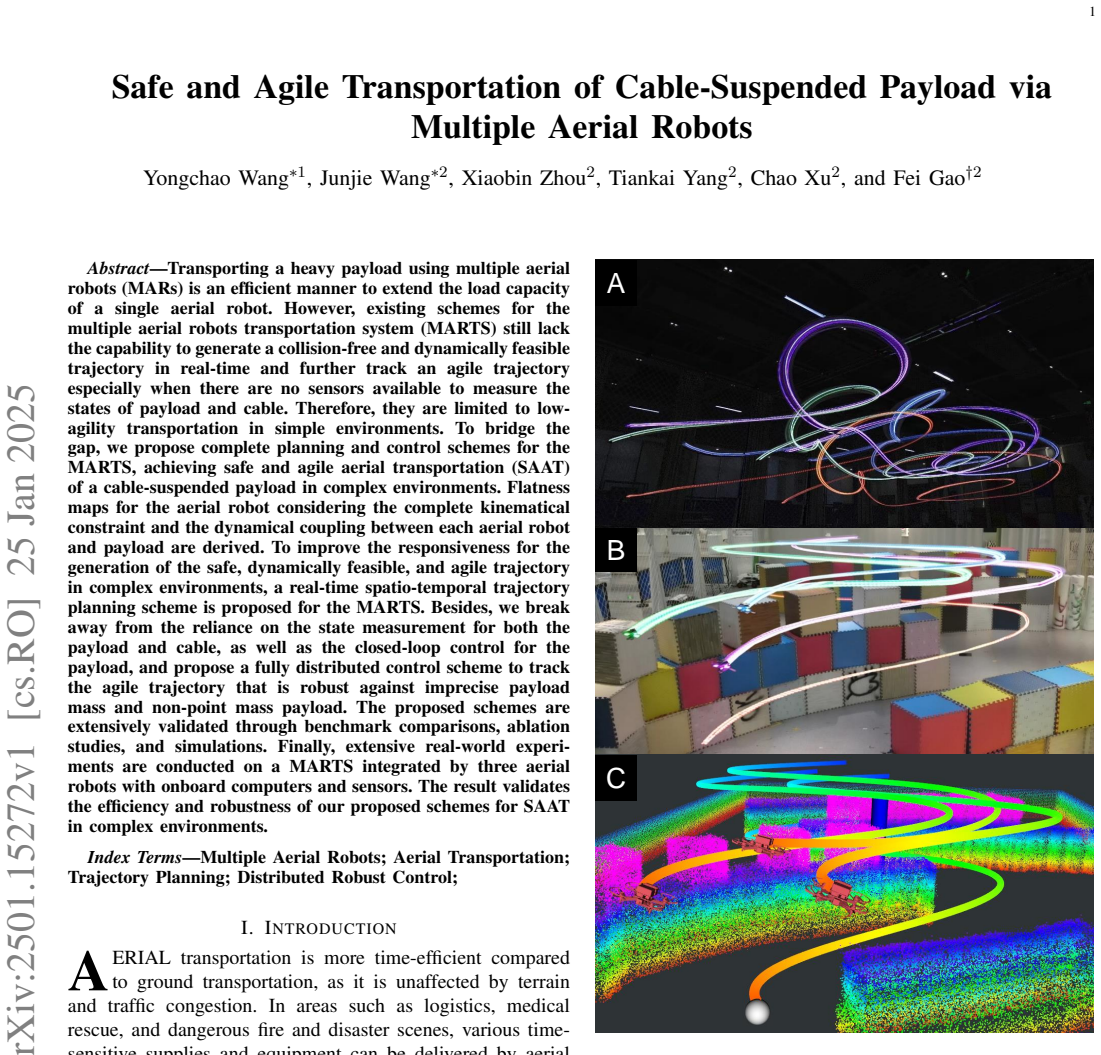
The central discovery is that the multiple-aerial-robot transportation problem has a structure that permits real-time safe and agile planning: represent each robot's position indirectly as the payload position plus the cable direction times the cable length, so the kinematic constraint is automatically satisfied; then use flatness maps to read off each robot's thrust, tilt, and body rate from an extended flat-output variable made of the payload position, per-cable pitch and yaw angles, tension, and yaw angle. With these maps, the paper converts trajectory planning into an unconstrained optimization over sparse spatio-temporal parameters, eliminating cable direction and tension constraints by diffeomorphisms and approximating infinite-time safety and feasibility constraints by trapezoidal-rule penalties. For tracking, it replaces payload and cable feedback with an incremental nonlinear dynamic inversion controller that estimates the actual cable force from motor speeds and estimates payload mass during hover, making the system robust to mass error and non-point-mass payloads. The experimental evidence—up to 9.18 m/s² accelerations, narrow-gap traversal, and 72 ms emergency replanning—supports the claim that this is the first complete scheme to achieve such agile transportation in complex environments without payload sensing.
Load-bearing premise
The planner's safety and dynamic-feasibility guarantees rest on the assumption that checking constraints at discrete sample times, with cable direction and tension ranges enforced as soft penalties of chosen weights, is enough to keep the trajectory safe and executable at all times in between.
Editorial extensions
If this is right
- Emergency retargeting becomes practical: the reported replanning time is about 72 ms, so the system can switch targets mid-flight while keeping a safe distance from obstacles.
- The formation can actively deform—contracting or reorienting the cables—to pass through gaps narrower than the formation's nominal width, as demonstrated with a 1 m gap.
- Payload and cable feedback can be removed entirely; cable force is reconstructed from motor speeds, and payload mass is estimated during a hover phase, so no sensors need to be attached to the payload or cables.
- Tracking error remains bounded under payload mass errors up to ±30% and for non-point-mass payloads such as a carton or water bottle, with RMSE increases of at most about 25% in the reported tests.
Reading between the lines
- The soft-penalty formulation suggests that for agile multi-robot manipulation, planning with approximate constraints plus a disturbance-rejecting controller may be a more practical route than hard-constrained optimization, at the price of provable safety guarantees.
- The same flatness-based pipeline could extend to other underactuated cooperative systems with taut connections (rigid rods, winches) by changing the connection model while keeping the flat-output and penalty-transcription structure.
- Because the obstacle constraints are sampled on the cable at $K=7$ points, a thin obstacle passing between two samples could go undetected; a testable extension is to adapt $K$ locally based on obstacle proximity or cable length.
- The mass estimation performed at hover could be run continuously during flight, enabling adaptation to payloads that gain or lose mass mid-mission.
Signed reviews
Editorial analysis
A structured set of objections, weighed in public.
Referee Report
Summary. The paper proposes a complete planning-and-control framework for multiple aerial robots transporting a cable-suspended payload. The planner uses a differentially flat formulation based on an extended flat output (payload position, cable angles, cable force, yaw), a CMINCO-based sparse spatio-temporal trajectory representation, and an unconstrained optimization with penalty terms for obstacle avoidance, reciprocal avoidance, dynamic feasibility, and payload-coupling dynamics. The controller is a fully distributed two-loop INDI scheme that does not measure payload or cable states and instead estimates cable forces online. The claims are validated in benchmark comparisons against a state-of-the-art kinodynamic planner, in ablation studies, and in real experiments with three 320 g aerial robots carrying payloads up to 200 g at accelerations up to 9.18 m/s^2. The paper positions itself as the first scheme to achieve real-time, safe, agile transportation of a cable-suspended payload in complex environments without any payload or cable state feedback.
Significance. If the claims are fully supported, this would be a substantial contribution to multi-robot aerial transportation: the system is end-to-end, runs in real time, and the hardware experiments demonstrate aggressive maneuvers with a practical three-robot platform. The flatness derivation, the use of INDI for cable-force compensation, and the open-source code are concrete strengths. The reported replanning times (50-162 ms) and the narrow-gap and S-turn experiments are compelling evidence of practical utility. However, the central claims of 'collision-free and dynamically feasible trajectories' and of 'agile transportation of the payload' are stronger than what the current optimization formulation and the reported experimental metrics actually establish. The paper is therefore valuable but needs additional verification or claim softening before the headline results can be accepted at face value.
major comments (3)
- [§V-C3, Eq. (57)-(59), Table II] The claim in the Abstract and §I that the planner produces a 'collision-free and dynamically feasible' trajectory is not supported by the optimization formulation as written. The hard constraints in Eq. (52f) are replaced by a finite trapezoidal-rule penalty (Eqs. 58-59), and the cable-clearance cost uses only K=7 sampled points per cable (Table II). Consequently, constraint violation between quadrature nodes or between cable samples is neither prevented nor detected. In §VII-A, 'success' is defined as generating a dynamically feasible trajectory, but no feasibility check is described. Please report, for the benchmark and experimental trajectories, the maximum violation of Eqs. (20)-(22), (34), (37), (40), and (43) on a fine evaluation grid, or use a formulation with a certified feasibility guarantee.
- [§IV-E, Eq. (47)-(48)] The equality constraint that makes the extended flat output Z dynamically consistent with the payload is enforced only through the soft penalty Jd with a finite weight λd. The flatness maps in §IV-A are derived under the exact equation Eq. (47); if the optimized Z has residual Jd > 0, the robot states and inputs computed by these maps are not the actual states and inputs of a feasible MARTS trajectory. The paper does not report the residual value of Jd for any benchmark or experiment. Please report Jd after optimization and either impose Eq. (47) as a hard constraint or provide a bound on the feasibility error induced by the finite penalty weight.
- [§VI, Tables IV-VI, Fig. 9] All reported tracking errors are for the aerial robots (Fig. 9C shows robot 2's states), not for the payload position, cable direction, or cable tension. The paper's central experimental claims—agile transportation of the payload, maintenance of the taut mode (F_n ≥ F_min, Eq. 51), and robustness to non-point-mass payloads—are therefore not directly validated. Since the controller has no payload feedback, the observed robot tracking could in principle coexist with substantial payload deviation or cable slack, and the paper itself notes in §III-B that slack transitions are dangerous to control. Please add payload motion-capture or a high-fidelity estimate of the payload trajectory from the measured robot states, and report payload trajectory error and estimated cable forces along the trajectory, or explicitly weaken the claims to robot-formation tracking.
minor comments (5)
- [Eq. (8), Eq. (16b)] The symbol m in the cable-force term of Eq. (8) and Eq. (16b) should be m_n (the robot mass) to match Eq. (2b) and Table I; as written, m is undefined in that context.
- [Table II, Eq. (61)] The penalty weights λτ and λς in Table II are not defined in Eq. (61), and the thrust-penalty weight λf appearing in Eq. (61a) has no matching entry in Table II; the notation λT/λZ in Eq. (52a) also differs from the lowercase forms in the table.
- [§VII-A] The statement that 'the bounds of the constraints considered in both methods are set to be the same as listed in Tab II' is imprecise, since Table II also lists many non-constraint parameters such as control gains and filter settings.
- [Fig. 9 caption] The caption contains the typo '2th aerial robot'; it should read '2nd aerial robot'.
- [§VI-C, Eq. (74)] Please clarify how the hover condition preceding the mass estimation is determined and how W=1000 (Table II) is used in the averaging, since Eq. (74) does not explicitly define the window over which the sequence is collected.
Circularity Check
No circularity found: the planning and control derivations are model-based and self-contained, and the self-citations used are external computational tools rather than load-bearing definitions.
full rationale
The paper's central derivations are the flatness maps (Sec. IV-A), the trajectory optimization (Sec. V), and the INDI-based distributed control (Sec. VI). Each step is derived from the stated dynamics (Eqs. 1-2) rather than fitted to the experimental outcomes. The kinematic constraint (Eq. 3) is eliminated by the change of variables pn = p + lρn (Eq. 4), which is a coordinate transformation that satisfies the constraint by construction rather than a result being smuggled from data. The flatness maps (Eqs. 8-16) algebraically express the robot state and control input in terms of the extended flat output Z; they do not depend on measured payload states or on fitted parameters. The planner enforces safety, dynamical feasibility, and cable-tension constraints through penalty functions (Eqs. 24-51) whose gradients are derived explicitly (Eqs. 27-49); this is model-based constraint transcription, not a fitted predictor. The most notable self-citation is CMINCO (Ref. [41]) as the polynomial trajectory class used to map sparse parameters to coefficients (Eq. 18). This is a published, independently usable computational tool; the paper's real-time planning claim relies on its linear-complexity linear solves, which are external algorithmic results, not on a uniqueness theorem or on an ansatz adopted only via self-citation. The control scheme estimates cable force by inverting the robot dynamics with INDI (Eq. 66) and estimates payload mass from measured cable-force components at hover (Eq. 74); neither quantity is defined in terms of the tracking error it is later used to explain. The experimental validation is external to the derivation chain. Concerns about soft-penalty constraint enforcement (Eqs. 57-59) and about whether payload states, rather than only robot states, were measured in experiments are correctness and validation risks, not circularity. Therefore no load-bearing step reduces to its own inputs.
Assumptions & free parameters
free parameters (6)
- Optimization penalty weights (lambda_oa, lambda_ra, lambda_v, lambda_f, lambda_theta, lambda_omega) =
10000, 10000, 1000, 1000, 1000, 1000
- Time regularization weight lambda_T =
2000.0
- Smoothness weight lambda_Z =
0.3
- Cable sample count K =
7
- Outer-loop PD gains Kp, Kv =
diag(12,12,3), diag(4,4,2)
- Attitude gains K_Theta, K_omega, K_I =
diag(70,100,19), diag(10,12,3), diag(0,0,0.3)
assumptions (5)
- standard math The MARTS is differentially flat with flat output Z\{xi_N} (from Ref. 22).
- domain assumption Cables are massless, always taut, and the payload is a point mass; the planner keeps cables taut by enforcing F_min.
- ad hoc to paper The redundant extended flat output Z includes xi_N with extra DOF, and payload dynamics Eq. 1b is enforced only as a soft penalty Jd.
- domain assumption ESDF map and odometry (motion capture plus IMU, or FAST-LIO2 for mapping) are available; no payload or cable measurement is used.
- domain assumption INDI low-pass filters and force estimation capture the cable tension plus disturbances, and the thrust model uses a fixed thrust coefficient.
Cite this review
Pith. "Pith review of Safe and Agile Transportation of Cable-Suspended Payload via Multiple Aerial Robots." pith.science (2026). https://pith.science/paper/6ZEPMZ2V
@misc{pith2026250115272,
  author       = {Pith},
  title        = {Pith review of: Safe and Agile Transportation of Cable-Suspended Payload via Multiple Aerial Robots},
  year         = {2026},
  howpublished = {\url{https://pith.science/paper/6ZEPMZ2V}},
  note         = {Machine review of arXiv:2501.15272}
}
read the original abstract
Transporting a heavy payload using multiple aerial robots (MARs) is an efficient manner to extend the load capacity of a single aerial robot. However, existing schemes for the multiple aerial robots transportation system (MARTS) still lack the capability to generate a collision-free and dynamically feasible trajectory in real-time and further track an agile trajectory especially when there are no sensors available to measure the states of payload and cable. Therefore, they are limited to low-agility transportation in simple environments. To bridge the gap, we propose complete planning and control schemes for the MARTS, achieving safe and agile aerial transportation (SAAT) of a cable-suspended payload in complex environments. Flatness maps for the aerial robot considering the complete kinematical constraint and the dynamical coupling between each aerial robot and payload are derived. To improve the responsiveness for the generation of the safe, dynamically feasible, and agile trajectory in complex environments, a real-time spatio-temporal trajectory planning scheme is proposed for the MARTS. Besides, we break away from the reliance on the state measurement for both the payload and cable, as well as the closed-loop control for the payload, and propose a fully distributed control scheme to track the agile trajectory that is robust against imprecise payload mass and non-point mass payload. The proposed schemes are extensively validated through benchmark comparisons, ablation studies, and simulations. Finally, extensive real-world experiments are conducted on a MARTS integrated by three aerial robots with onboard computers and sensors. The result validates the efficiency and robustness of our proposed schemes for SAAT in complex environments.
Figures


Figures from the paper (9 more)


Forward citations
Cited by 1 Pith paper
-
CrazyMARL: Decentralized Direct Motor Control Policies for Cooperative Aerial Transport of Cable-Suspended Payloads
A decentralized reinforcement learning controller with direct motor commands lets teams of drones carry cable-suspended payloads, recover from harsh disturbances, and transfer from simulation to real Crazyflie hardware.
Reference graph
Works this paper leans on
-
[1]
Geometric control and differential flatness of a quadrotor uav with a cable-suspended load,
K. Sreenath, T. Lee, and V . Kumar, “Geometric control and differential flatness of a quadrotor uav with a cable-suspended load,” in 52nd IEEE conference on decision and control . IEEE, 2013, pp. 2269–2274
work page 2013
-
[2]
Fast trajectory optimization for agile quadrotor maneuvers with a cable- suspended payload,
P. Foehn, D. Falanga, N. Kuppuswamy, R. Tedrake, and D. Scaramuzza, “Fast trajectory optimization for agile quadrotor maneuvers with a cable- suspended payload,” July 2017
work page 2017
-
[3]
Aggressive flight with suspended payloads using vision-based control,
S. Tang, V . W ¨uest, and V . Kumar, “Aggressive flight with suspended payloads using vision-based control,” IEEE Robotics and Automation Letters, vol. 3, no. 2, pp. 1152–1159, 2018
work page 2018
-
[4]
C. Y . Son, H. Seo, D. Jang, and H. J. Kim, “Real-time optimal trajectory generation and control of a multi-rotor with a suspended load for obstacle avoidance,” IEEE Robotics and Automation Letters , vol. 5, no. 2, pp. 1915–1922, 2020. 18 B A ① ② ① ② O A D B C D E F D C Fig. 13. Illustration of an emergent replanning for the MARTS towards a new target. (A...
work page 1915
-
[5]
Differential flatness based path planning with direct collocation on hybrid modes for a quadrotor with a cable-suspended payload,
J. Zeng, P. Kotaru, M. W. Mueller, and K. Sreenath, “Differential flatness based path planning with direct collocation on hybrid modes for a quadrotor with a cable-suspended payload,” IEEE Robotics and Automation Letters, vol. 5, no. 2, pp. 3074–3081, 2020
2020
-
[6]
Model-based meta-reinforcement learning for flight with suspended payloads,
S. Belkhale, R. Li, G. Kahn, R. McAllister, R. Calandra, and S. Levine, “Model-based meta-reinforcement learning for flight with suspended payloads,” IEEE Robotics and Automation Letters , vol. 6, no. 2, pp. 1471–1478, 2021
work page 2021
-
[7]
G. Yu, D. Cabecinhas, R. Cunha, and C. Silvestre, “Aggressive maneu- vers for a quadrotor-slung-load system through fast trajectory generation and tracking,” Autonomous Robots, vol. 46, no. 4, pp. 499–513, 2022
work page 2022
-
[8]
Autotrans: A complete planning and control framework for autonomous uav payload transportation,
H. Li, H. Wang, C. Feng, F. Gao, B. Zhou, and S. Shen, “Autotrans: A complete planning and control framework for autonomous uav payload transportation,” IEEE Robotics and Automation Letters , vol. 8, no. 10, pp. 6859–6866, 2023
2023
Show all 46 references
-
[9]
Impact-aware planning and control for aerial robots with suspended payloads,
H. Wang, H. Li, B. Zhou, F. Gao, and S. Shen, “Impact-aware planning and control for aerial robots with suspended payloads,” IEEE Transac- tions on Robotics , vol. 40, pp. 2478–2497, 2024
2024
-
[10]
Coopera- tive grasping and transport using multiple quadrotors,
D. Mellinger, M. Shomin, N. Michael, and V . Kumar, “Coopera- tive grasping and transport using multiple quadrotors,” in Distributed Autonomous Robotic Systems: The 10th International Symposium . Springer, 2013, pp. 545–558
2013
-
[11]
Cooperative transportation using small quadrotors using monocular vision and inertial sensing,
G. Loianno and V . Kumar, “Cooperative transportation using small quadrotors using monocular vision and inertial sensing,” IEEE Robotics and Automation Letters , vol. 3, no. 2, pp. 680–687, 2017
2017
-
[12]
Cooperative object transport in 3d with multiple quadrotors using no peer communication,
Z. Wang, S. Singh, M. Pavone, and M. Schwager, “Cooperative object transport in 3d with multiple quadrotors using no peer communication,” in 2018 IEEE International Conference on Robotics and Automation (ICRA). IEEE, 2018, pp. 1064–1071
2018
-
[13]
Autonomous trans- portation and deployment with aerial robots for search and rescue missions,
M. Bernard, K. Kondak, I. Maza, and A. Ollero, “Autonomous trans- portation and deployment with aerial robots for search and rescue missions,” Journal of Field Robotics, vol. 28, no. 6, pp. 914–931, 2011
2011
-
[14]
Cooperative transportation of a payload using quadrotors: A reconfigurable cable-driven parallel robot,
C. Masone, H. H. B ¨ulthoff, and P. Stegagno, “Cooperative transportation of a payload using quadrotors: A reconfigurable cable-driven parallel robot,” in 2016 IEEE/RSJ International Conference on Intelligent Robots and Systems (IROS) . IEEE, 2016, pp. 1623–1630
2016
-
[15]
On the human control of a multiple quadcopters with a cable-suspended payload system,
P. Prajapati, S. Parekh, and V . Vashista, “On the human control of a multiple quadcopters with a cable-suspended payload system,” in 2020 IEEE international conference on robotics and automation (ICRA). IEEE, 2020, pp. 2253–2258
2020
-
[16]
Rotortm: A flexible simulator for aerial transportation and manipulation,
G. Li, X. Liu, and G. Loianno, “Rotortm: A flexible simulator for aerial transportation and manipulation,” IEEE Transactions on Robotics, vol. 40, pp. 831–850, 2024
2024
-
[17]
Champion-level drone racing using deep reinforcement learning,
E. Kaufmann, L. Bauersfeld, A. Loquercio, M. M ¨uller, V . Koltun, and D. Scaramuzza, “Champion-level drone racing using deep reinforcement learning,” Nature, vol. 620, no. 7976, pp. 982–987, 2023
2023
-
[18]
Cooperative manipulation and transportation with aerial robots,
N. Michael, J. Fink, and V . Kumar, “Cooperative manipulation and transportation with aerial robots,” Autonomous Robots, vol. 30, pp. 73– 86, 2011
2011
-
[19]
Planning and control for cooperative manipulation and transportation with aerial robots,
J. Fink, N. Michael, S. Kim, and V . Kumar, “Planning and control for cooperative manipulation and transportation with aerial robots,” The International Journal of Robotics Research, vol. 30, no. 3, pp. 324–334, 2011
2011
-
[20]
The inverse kinematics of cooperative transport with multiple aerial robots,
Q. Jiang and V . Kumar, “The inverse kinematics of cooperative transport with multiple aerial robots,” IEEE Transactions on Robotics , vol. 29, no. 1, pp. 136–145, 2012
2012
-
[21]
Motion planning for 6-d manipulation with aerial towed-cable systems,
M. Manubens, D. Devaurs, L. Ros, and J. Cort ´es, “Motion planning for 6-d manipulation with aerial towed-cable systems,” in Proceedings of Robotics: Science and Systems , Berlin, Germany, June 2013, p. 8p
2013
-
[22]
Dynamics, control and planning for co- operative manipulation of payloads suspended by cables from multiple quadrotor robots,
K. Sreenath and V . Kumar, “Dynamics, control and planning for co- operative manipulation of payloads suspended by cables from multiple quadrotor robots,” June 2013
2013
-
[23]
Minimum snap trajectory generation and control for quadrotors,
D. Mellinger and V . Kumar, “Minimum snap trajectory generation and control for quadrotors,” in 2011 IEEE international conference on robotics and automation . IEEE, 2011, pp. 2520–2525
2011
-
[24]
Scalable cooperative transport of cable-suspended loads with uavs using distributed trajectory optimization,
B. E. Jackson, T. A. Howell, K. Shah, M. Schwager, and Z. Manchester, “Scalable cooperative transport of cable-suspended loads with uavs using distributed trajectory optimization,” IEEE Robotics and Automation Letters, vol. 5, no. 2, pp. 3368–3374, 2020
2020
-
[25]
Nonlinear mpc for full-pose manipulation of a cable-suspended load using multiple uavs,
S. Sun and A. Franchi, “Nonlinear mpc for full-pose manipulation of a cable-suspended load using multiple uavs,” in 2023 International Conference on Unmanned Aircraft Systems (ICUAS) . IEEE, 2023, pp. 969–975
2023
-
[26]
Kinodynamic motion planning for a team of multirotors transporting a cable-suspended payload in cluttered environments,
K. Wahba, J. Ortiz-Haro, M. Toussaint, and W. H ¨onig, “Kinodynamic motion planning for a team of multirotors transporting a cable-suspended payload in cluttered environments,” arXiv preprint arXiv:2310.03394 , 2023. 19 O 𝐀𝐀′ A C B 𝐂𝐂′ 𝐁𝐁′ D ① ① ② ① ② ① ② ③ ② ③ ③ ④ ③ ④ BA C D ...
2023 arXiv
-
[27]
Geometric control of cooperating multiple quadrotor uavs with a suspended payload,
T. Lee, K. Sreenath, and V . Kumar, “Geometric control of cooperating multiple quadrotor uavs with a suspended payload,” in 52nd IEEE conference on decision and control . IEEE, 2013, pp. 5510–5515
2013
-
[28]
Geometric control of quadrotor uavs transporting a cable- suspended rigid body,
T. Lee, “Geometric control of quadrotor uavs transporting a cable- suspended rigid body,” IEEE Transactions on Control Systems Tech- nology, vol. 26, no. 1, pp. 255–264, 2017
2017
-
[29]
Cooperative transportation of cable suspended payloads with mavs using monocular vision and inertial sensing,
G. Li, R. Ge, and G. Loianno, “Cooperative transportation of cable suspended payloads with mavs using monocular vision and inertial sensing,” IEEE Robotics and Automation Letters, vol. 6, no. 3, pp. 5316– 5323, 2021
2021
-
[30]
Cooperative transport of a slung load us- ing load-leading control,
J. Geng and J. W. Langelaan, “Cooperative transport of a slung load us- ing load-leading control,” Journal of Guidance, Control, and Dynamics , vol. 43, no. 7, pp. 1313–1331, 2020
2020
-
[31]
Nonlinear model predictive control for cooper- ative transportation and manipulation of cable suspended payloads with multiple quadrotors,
G. Li and G. Loianno, “Nonlinear model predictive control for cooper- ative transportation and manipulation of cable suspended payloads with multiple quadrotors,” in 2023 IEEE/RSJ International Conference on Intelligent Robots and Systems (IROS) . IEEE, 2023, pp. 5034–5041
2023
-
[32]
Efficient optimization-based cable force allocation for geometric control of a multirotor team transporting a payload,
K. Wahba and W. H ¨onig, “Efficient optimization-based cable force allocation for geometric control of a multirotor team transporting a payload,” IEEE Robotics and Automation Letters , vol. 9, no. 4, pp. 3688–3695, 2024
2024
-
[33]
Cooperative control for multirotors transporting an unknown suspended load under environmental disturbances,
K. Klausen, C. Meissen, T. I. Fossen, M. Arcak, and T. A. Johansen, “Cooperative control for multirotors transporting an unknown suspended load under environmental disturbances,” IEEE Transactions on Control Systems Technology, vol. 28, no. 2, pp. 653–660, 2018
2018
-
[34]
Flexible collaborative transportation by a team of rotorcraft,
H. G. De Marina and E. Smeur, “Flexible collaborative transportation by a team of rotorcraft,” in 2019 International Conference on Robotics and Automation (ICRA) . IEEE, 2019, pp. 1074–1080
2019
-
[35]
Dynamic collaboration without communication: Vision-based cable-suspended load transport with two quadrotors,
M. Gassner, T. Cieslewski, and D. Scaramuzza, “Dynamic collaboration without communication: Vision-based cable-suspended load transport with two quadrotors,” in 2017 IEEE International Conference on Robotics and Automation (ICRA) . IEEE, 2017, pp. 5196–5202
2017
-
[36]
Aerial co- manipulation with cables: The role of internal force for equilibria, stability, and passivity,
M. Tognon, C. Gabellieri, L. Pallottino, and A. Franchi, “Aerial co- manipulation with cables: The role of internal force for equilibria, stability, and passivity,” IEEE Robotics and Automation Letters , vol. 3, no. 3, pp. 2577–2583, 2018
2018
-
[37]
Robust collaborative object transportation using multiple mavs,
A. Tagliabue, M. Kamel, R. Siegwart, and J. Nieto, “Robust collaborative object transportation using multiple mavs,” The International Journal of Robotics Research, vol. 38, no. 9, pp. 1020–1044, 2019
2019
-
[38]
Fast-lio2: Fast direct lidar- inertial odometry,
W. Xu, Y . Cai, D. He, J. Lin, and F. Zhang, “Fast-lio2: Fast direct lidar- inertial odometry,” IEEE Transactions on Robotics , vol. 38, no. 4, pp. 2053–2073, 2022
2022
-
[39]
Accurate tracking of aggressive quadrotor tra- jectories using incremental nonlinear dynamic inversion and differential flatness,
E. Tal and S. Karaman, “Accurate tracking of aggressive quadrotor tra- jectories using incremental nonlinear dynamic inversion and differential flatness,” IEEE Transactions on Control Systems Technology , vol. 29, no. 3, pp. 1203–1218, 2021
2021
-
[40]
Control of quadrotors using the hopf fibration on so (3),
M. Watterson and V . Kumar, “Control of quadrotors using the hopf fibration on so (3),” in Robotics Research: The 18th International Symposium ISRR. Springer, 2019, pp. 199–215
2019
-
[41]
Geometrically constrained tra- jectory optimization for multicopters,
Z. Wang, X. Zhou, C. Xu, and F. Gao, “Geometrically constrained tra- jectory optimization for multicopters,” IEEE Transactions on Robotics , vol. 38, no. 5, pp. 3259–3278, 2022
2022
-
[42]
A computational algorithm for functional inequality constrained optimization problems,
L. S. Jennings and K. L. Teo, “A computational algorithm for functional inequality constrained optimization problems,” Automatica, vol. 26, no. 2, pp. 371–375, 1990
1990
-
[43]
W. H. Press, S. A. Teukolsky, W. T. Vetterling, and B. P. Flannery, Numerical Recipes 3rd Edition: The Art of Scientific Computing , 3rd ed. USA: Cambridge University Press, 2007
2007
-
[44]
Fcl: A general purpose library for collision and proximity queries,
J. Pan, S. Chitta, and D. Manocha, “Fcl: A general purpose library for collision and proximity queries,” in 2012 IEEE International Conference on Robotics and Automation . IEEE, 2012, pp. 3859–3866
2012
-
[45]
idb- a*: Iterative search and optimization for optimal kinodynamic motion planning,
J. Ortiz-Haro, W. H ¨onig, V . N. Hartmann, and M. Toussaint, “idb- a*: Iterative search and optimization for optimal kinodynamic motion planning,” IEEE Transactions on Robotics , pp. 1–19, 2024. 20
2024
-
[46]
Crocoddyl: An efficient and versatile framework for multi-contact optimal control,
C. Mastalli, R. Budhiraja, W. Merkt, G. Saurel, B. Hammoud, M. Naveau, J. Carpentier, L. Righetti, S. Vijayakumar, and N. Mansard, “Crocoddyl: An efficient and versatile framework for multi-contact optimal control,” in 2020 IEEE International Conference on Robotics and Automat...
2020
Reviewed August 10, 2026 · model on record in the stance chip above.
Discussion (0). Continue with ORCID to comment.