Beyond Bilingual Transfer: Multilingual Code-Switching in Instruction Tuning
Pith reviewed 2026-06-29 08:03 UTC · model grok-4.3
The pith
Multilingual code-switching in instruction tuning raises average performance across English, Japanese, Korean, and Chinese on Belebele.
A machine-rendered reading of the paper's core claim, the machinery that carries it, and where it could break.
Core claim
The paper establishes that applying multilingual code-switching data during instruction tuning, where sentences from English, Japanese, Korean, and Chinese are mixed within the same contexts, leads to consistent improvements in average performance on the Belebele multilingual understanding benchmark across all four languages. This extends prior work on bilingual code-switching by demonstrating effectiveness in settings with more than two languages.
What carries the argument
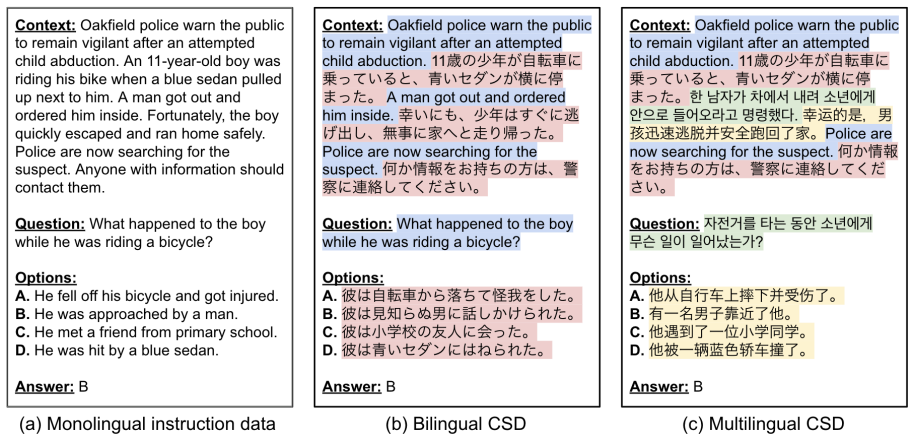
Sentence-level multilingual code-switching data (CSD) used in instruction tuning across four languages.
Load-bearing premise
The observed performance gains on Belebele are caused by the multilingual code-switching itself rather than differences in total data volume, instruction quality, or other uncontrolled variables.
What would settle it
A controlled experiment that trains models with multilingual CSD while exactly matching the data volume and instruction quality of the bilingual baselines, then checks whether Belebele scores still improve.
Figures
read the original abstract
Recent studies have shown that code-switching data (CSD), in which multiple languages are mixed within the same context, can improve cross-lingual transfer and multilingual alignment in large language models (LLMs). However, existing studies primarily focus on bilingual transfer between English and a target language, leaving multilingual settings involving three or more languages largely unexplored. In this work, we investigate multilingual code-switching instruction tuning across four languages: English, Japanese, Korean, and Chinese. We evaluate multilingual understanding on Belebele. Our experiments show that simple sentence-level multilingual CSD consistently improves average multilingual performance across all four languages, indicating that multilingual code-switching can be effective beyond bilingual transfer settings.
Editorial analysis
A structured set of objections, weighed in public.
Referee Report
Summary. The paper claims that sentence-level multilingual code-switching data (mixing English, Japanese, Korean, and Chinese within the same instruction examples) during LLM instruction tuning produces consistent gains in average performance on the Belebele multilingual reading-comprehension benchmark across all four languages, thereby extending the utility of CSD beyond the bilingual-transfer regime examined in prior work.
Significance. If the attribution to code-switching structure rather than data volume holds, the result would supply empirical support for a lightweight, language-agnostic augmentation technique that improves multilingual alignment without additional model capacity or architectural changes.
major comments (2)
- [§4 and Table 2] §4 (Experimental Setup) and Table 2 (Main Results): the manuscript does not report whether the multilingual CSD condition was matched to the monolingual or bilingual baselines on total token count, number of instructions, or per-language token balance. Without an explicit same-volume control (or a shuffled-language ablation), the observed lift on Belebele cannot be unambiguously attributed to the code-switching mechanism itself.
- [§4.3] §4.3 (Evaluation): no statistical significance tests, standard deviations across random seeds, or confidence intervals are provided for the reported average improvements, so the claim of 'consistent improvement across all four languages' rests on point estimates alone.
minor comments (1)
- The abstract would be strengthened by including the actual percentage-point deltas on Belebele rather than the qualitative statement 'consistently improves.'
Simulated Author's Rebuttal
We thank the referee for the careful reading and constructive comments. We address each major point below and will revise the manuscript accordingly to strengthen the experimental controls and statistical reporting.
read point-by-point responses
-
Referee: [§4 and Table 2] §4 (Experimental Setup) and Table 2 (Main Results): the manuscript does not report whether the multilingual CSD condition was matched to the monolingual or bilingual baselines on total token count, number of instructions, or per-language token balance. Without an explicit same-volume control (or a shuffled-language ablation), the observed lift on Belebele cannot be unambiguously attributed to the code-switching mechanism itself.
Authors: The number of instructions was held constant across the monolingual, bilingual, and multilingual CSD conditions. However, we did not explicitly match or report total token counts or per-language token balance, nor did we include a shuffled-language ablation. We agree that these controls are necessary to isolate the contribution of the code-switching structure. In the revision we will add (i) a same-volume control by subsampling data to equalize token counts and (ii) a shuffled-language ablation that preserves token statistics while removing coherent code-switching. revision: yes
-
Referee: [§4.3] §4.3 (Evaluation): no statistical significance tests, standard deviations across random seeds, or confidence intervals are provided for the reported average improvements, so the claim of 'consistent improvement across all four languages' rests on point estimates alone.
Authors: We concur that variability measures and significance testing would make the claims more robust. The current results are reported as single-run point estimates. In the revised manuscript we will rerun the instruction-tuning experiments with multiple random seeds, report standard deviations, and include paired statistical significance tests (e.g., t-tests) comparing the multilingual CSD condition against the baselines. revision: yes
Circularity Check
No circularity: purely empirical experimental claims with no derivation chain
full rationale
The paper reports experimental results showing that sentence-level multilingual CSD improves average Belebele performance across EN/JA/KO/ZH. No equations, fitted parameters, or theoretical derivations are present in the provided abstract or described claims. The central result is an observed performance difference that is directly falsifiable by replication with matched data volumes; it does not reduce to any input by construction, self-definition, or self-citation load-bearing step. Self-citations, if present, are not invoked to justify uniqueness theorems or ansatzes that would force the outcome.
Axiom & Free-Parameter Ledger
Reference graph
Works this paper leans on
-
[1]
Qwen3 technical report.arXiv preprint arXiv:2505.09388. An Yang, Baosong Yang, Binyuan Hui, Bo Zheng, Bowen Yu, Chang Zhou, Chengpeng Li, Chengyuan Li, Dayiheng Liu, Fei Huang, Guanting Dong, Hao- ran Wei, Huan Lin, Jialong Tang, Jialin Wang, Jian Yang, Jianhong Tu, Jianwei Zhang, Jianxin Ma, and 43 others. 2024. Qwen2 technical report.arXiv preprint arXi...
work page internal anchor Pith review Pith/arXiv arXiv 2024
-
[2]
context":
text sample. Given a raw text passage, gpt-4o-mini (OpenAI, 2024) generates a context snippet selected from the text, a question, candi- date options, and the corresponding correct answer in a multiple-choice question-answering format. This process enables the automatic construction of instruction-style data from unlabeled text re- sources. A.2 Multilingu...
2024
discussion (0)
Sign in with ORCID, Apple, or X to comment. Anyone can read and Pith papers without signing in.