REVIEW 4 major objections 4 minor 40 references
Decoupling Skeleton and Flesh: Efficient Multimodal Table Reasoning with Disentangled Alignment and Structure-aware Guidance
T0 review · 4 major / 4 minor · reviewed 2026-08-03 · deepseek-v4-flash
Pith's one-line read Separating table structure from cell content lets vision-language models learn layout from 10K images and reason over tables with no external tools, via a three-step guided procedure.
desk verdict Clean disentanglement idea with broad experiments, but the train/eval benchmark overlap keeps the headline 10K data-efficiency claim unproven. read the letter →
The pith
A machine-rendered reading of the paper's core claim, the machinery that carries it, and where it could break.
The reading
What carries the argument
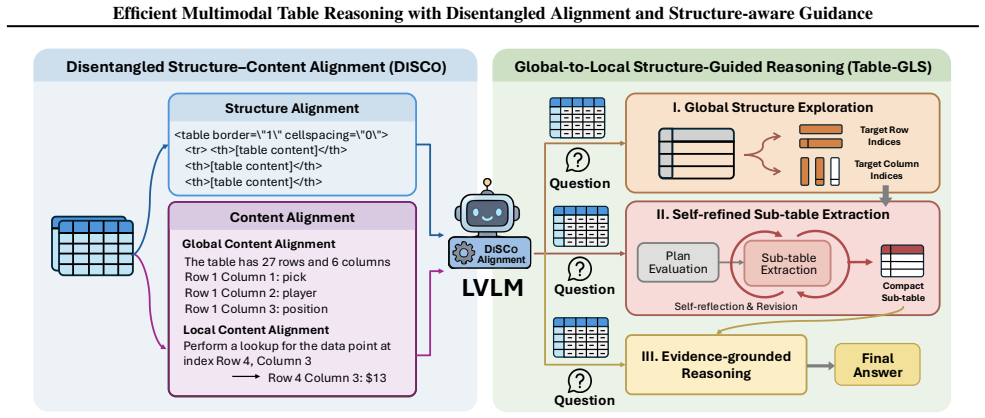
The load-bearing object is DISCO's structure-alignment target T_S = Anonymize(T, t_p): a table serialized in HTML, Markdown, or LaTeX with every cell value replaced by a placeholder token, leaving only row/column delimiters, headers, and span markers. Training the model to predict T_S from the table image isolates layout learning from content. Two content-alignment objectives then ground semantics: global content alignment produces a lightweight description of table dimensions and row/column contents, and local content alignment performs a lookup of Row m Column n. Table-GLS chains three prompts—global structure exploration, self-refined sub-table extraction, and evidence-grounded reasoning—
What would settle it
Train the same LVLM on the same 10K images with only the content-alignment objectives (no structure alignment) and compare on structure-sensitive tasks such as size detection, cell location, and row/column extraction; if the gains disappear or fall within noise, the anonymized-structure objective is not driving the effect. A sharper test: replace the single placeholder token with random distinct strings so layout tokens are unchanged but content varies; if performance collapses, the model was learning content cues rather than pure layout.
Extended reading notes
Core claim
The paper reports that disentangling structure abstraction from semantic grounding during multimodal alignment is what makes LVLM table adaptation data-efficient and transferable. Structure alignment trains the model to predict an anonymized table representation (all cell contents replaced by a placeholder token), so layout is learned without semantics; global and local content alignment then teach the model to attach cell values to structural coordinates. On top of this, a global-to-local reasoning procedure—global structure exploration, self-refined sub-table extraction, and evidence-grounded reasoning—guides the model to answer from a compact sub-table rather than the whole image. The com
Load-bearing premise
The central premise is that replacing every cell value with a single placeholder token in a linear serialization preserves enough of the table's layout that next-token prediction over this anonymized text teaches structure independently of content; if the serialization cannot represent the layout, or the model cannot infer spatial layout from anonymized linear text, the disentanglement fails.
Editorial extensions
If this is right
- With 10K alignment images, DISCO reaches or exceeds full-corpus textual alignment on most table understanding tasks, suggesting alignment design matters more than data quantity.
- Table-GLS improves reasoning over direct answering on nearly every evaluated benchmark without fine-tuning or external tools, showing explicit structure-guided inference elicits latent model capability.
- Combining DISCO with Table-GLS yields the strongest gains on out-of-domain table reasoning benchmarks, indicating better transfer to unseen layouts.
- The framework matches or surpasses heavily optimized table-specialist LVLMs on several benchmarks while using much less task-level supervision.
- DISCO alignment also improves non-table multimodal tasks slightly, whereas standard textual alignment degrades some of them, suggesting the structure-content split avoids over-specialization.
Reading between the lines
- The anonymization trick is a general recipe: to teach any structured visual input, first train on its skeleton with contents blanked, then ground contents to coordinates. Charts, forms, and receipts could be treated the same way.
- If structure learning is genuinely content-free, alignment data could be synthesized by randomizing cell values over fixed layout skeletons, removing the dependence on annotated table corpora.
- Because Table-GLS emits an explicit sub-table before answering, one can audit faithfulness by checking whether the extracted evidence matches the table's true row and column coordinates—an interpretability handle beyond end-task accuracy.
- The paper's own token-efficiency data suggest a practical variant could gate the multi-stage exploration on an initial confidence check and skip it for easy queries.
Editorial analysis
A structured set of objections, weighed in public.
Referee Report
Summary. The paper proposes DISCO, a disentangled structure–content alignment method that trains LVLMs on anonymized table serializations (structure alignment) plus global/local cell-content descriptions (content alignment), and Table-GLS, a training-free three-stage inference pipeline (global structure exploration, self-refined sub-table extraction, evidence-grounded reasoning). The authors claim that this combination adapts LVLMs to table understanding and reasoning using only 10K alignment images, with strong generalization to unseen table structures, and report extensive evaluations across 21 tasks, four base models, and several out-of-domain benchmarks.
Significance. If the central claims hold, this is a genuinely useful contribution: the disentanglement idea is clean, the method requires no external tools or task-level fine-tuning, and the evaluation is unusually broad (21 tasks, 4 backbones, OOD and non-tabular benchmarks). The promise of released data and code, plus the positive non-tabular generalization results, give some independent support. However, the main empirical claim—that 10K alignment images suffice—is currently undercut by the lack of evidence that the alignment sample is disjoint from the in-domain evaluation tables. Several secondary inconsistencies in the full result tables also weaken the paper's stated 'consistent' improvements. The significance is therefore conditional on addressing the overlap question and tightening the claims.
major comments (4)
- [§4.1 and Appendix D, Table 5 vs. Table 3] The 10K DISCO alignment images are sampled from TABMWP, WTQ, FeTaQA, HiTab, TAT-QA, TabFact, InfoTabs, ToTTo, Rotowire, and WikiBIO (Appendix D, Table 5). The in-domain reasoning evaluation in Table 3 uses WTQ, HiTab, TAT-QA, TabFact, and InfoTabs—the same benchmark families. The paper does not state whether the alignment sample is disjoint from the evaluation tables, nor does it report image-level overlap statistics. The Textual(10K) control is drawn from the same mixed corpus, so it controls only data volume, not source overlap. This leaves open the possibility that in-domain gains reflect layout familiarity rather than learned structure abstraction. To support the headline '10K data-efficient' and 'generalization to unseen structures' claims, the authors should release or specify non-overlapping splits, or report overlap statistics and show the gains persist on held-out tables from th
- [§5.1 and Table 11 (LLaVA-v1.6-7B, Qwen3-VL-4B rows)] The main text claims DISCO 'consistently enhances table understanding across all evaluated LVLMs and tasks' and 'yields consistent improvements across models of different scales.' The full results in Table 11 contradict this: for LLaVA-v1.6-7B, RCE Row drops from 10.82 (Textual) to 8.30 (DISCO) and RCE Column from 0.27 to 0.02; for Qwen3-VL-4B, TSD Row drops from 36.60 to 21.70 and OOD TSD Row from 44.40 to 20.00. The main table omits these rows, obscuring the regressions. The consistency claims should be qualified to reflect the actual full-table results, or the regressions should be analyzed and explained.
- [§5.2, Table 2 and Table 3 (HiTab column)] Qwen3-VL-8B-DISCO + Table-GLS achieves 27.35 on HiTab, which is 8.12 points below the base model's direct answering (35.47) and 2.41 points below base Table-GLS without DISCO (29.76). The paper states that 'combining DISCO with Table-GLS achieves the best average score' and emphasizes gains on OOD benchmarks, but it does not discuss this substantial in-domain regression on a core benchmark. The claim is only true on average, and the failure mode on HiTab should be acknowledged and, if possible, explained.
- [§3.1, Eq. (1) and Table 1 ablations] The disentanglement mechanism rests on the assumption that anonymizing all cell contents into a single placeholder token (Eq. 1) preserves task-relevant table structure. The paper's ablation 'DISCO w/o TL' still includes global content alignment, so the unique contribution of the structure-only objective is not isolated. To support the mechanism, an ablation with only structure alignment (no global content) or with global content but without anonymization would be needed. Without such an ablation, the observed improvements could be attributed to the modified instruction formats or the global content descriptions rather than to structure abstraction per se.
minor comments (4)
- [Figure 5] In the Qwen3-VL + Table-GLS panel, the extracted sub-table reads 'Row 5 Column 3: W 17–10', but the reasoning trace says 'the result was W 35–17' and computes 35−17=18. This internal inconsistency makes the case study confusing and should be corrected.
- [Throughout] There are several typos and formatting inconsistencies: 'Description' in Appendix B should be 'Construction'; 'statitiscs' in Appendix D; 'Dection' in §4.1; and the abstract uses 'DiSCo' while the body uses 'DISCO'. Please unify.
- [§5.4, Figure 4] The correlation analysis would be more quantitative if the correlation coefficients (or a fitted line with R²) were reported for each reasoning strategy, rather than relying on visual inspection.
- [Abstract and §1] The paper says '21 tasks and benchmarks' but it is not immediately clear how the count is derived from Tables 1, 3, and 4. A short clarification in the experimental setup would help.
Circularity Check
No significant circularity: the paper's alignment objectives, Table-GLS inference procedure, and OOD evaluations are not equivalent to their inputs by construction.
full rationale
No step in this paper's claimed derivation chain reduces to its own inputs. DISCO's objectives (Eqs. 2–4) are standard next-token prediction losses over constructed labels; structure alignment (Eq. 2) predicts an anonymized serialization whose absence of cell content is a design choice, not an evaluation target, while content alignment (Eqs. 3–4) predicts global/local descriptions and cell lookups that are then used as skills by Table-GLS rather than fitted values. Table-GLS (Eqs. 5–7) is an inference-time prompting procedure, not a fitted model, so there is no parameter estimated from test data. The central comparison is against matched textual alignment on the same 10K images and against the 97K MMTab corpus, plus OOD benchmarks (AIT-QA, TabMCQ, PubHealthTab, LoTNLG) unseen during alignment, so the paper is not self-confirming. The limitations section honestly notes dependence on structure–content decoupled data and the token overhead of multi-stage inference, but it does not assert or admit any circular step. The only concern—that 10K alignment images are sampled partly from the same benchmark families later used for in-domain evaluation—is a potential train/eval overlap risk, not a circularity under the specified definitions, because no reported quantity is constructed from, or defined in terms of, the quantity it is used to predict; it also does not affect the OOD claims that carry the generalization argument.
Assumptions & free parameters
free parameters (6)
- Alignment data size =
10K table images / 30K image-text pairs
- Placeholder token t_p =
[table content]
- LoRA rank and alpha =
rank=8, alpha=16
- Global batch size =
64
- Training epochs =
1
- Per-model learning rate =
1e-4 (Gemma3-12B, LLaVA-7B), 1e-5 (Gemma3n-E4B), 4e-5 (Qwen3-VL-8B)
assumptions (5)
- ad hoc to paper Anonymized HTML/Markdown/LaTeX with a single placeholder preserves task-relevant table structure.
- domain assumption Next-token prediction on structure and content descriptions transfers to zero-shot table reasoning.
- domain assumption 10K images sampled from the MMTab corpus are representative of real-world table layouts.
- domain assumption The 'OOD' benchmarks are unseen by the aligned models.
- domain assumption The LVLM can reliably emit row/column indices and sub-table extractions in the requested JSON-like format.
Cite this review
Pith. "Pith review of Decoupling Skeleton and Flesh: Efficient Multimodal Table Reasoning with Disentangled Alignment and Structure-aware Guidance." pith.science (2026). https://pith.science/paper/7276OSWP
@misc{pith2026260203491,
  author       = {Pith},
  title        = {Pith review of: Decoupling Skeleton and Flesh: Efficient Multimodal Table Reasoning with Disentangled Alignment and Structure-aware Guidance},
  year         = {2026},
  howpublished = {\url{https://pith.science/paper/7276OSWP}},
  note         = {Machine review of arXiv:2602.03491}
}
read the original abstract
Reasoning over table images remains challenging for Large Vision-Language Models (LVLMs) due to complex layouts and tightly coupled structure-content information. Existing solutions often depend on expensive supervised training, reinforcement learning, or external tools, limiting efficiency and scalability. This work addresses a key question: how to adapt LVLMs to table reasoning with minimal annotation and no external tools? Specifically, we first introduce DiSCo, a Disentangled Structure-Content alignment framework that explicitly separates structural abstraction from semantic grounding during multimodal alignment, efficiently adapting LVLMs to tables structures. Building on DiSCo, we further present Table-GLS, a Global-to-Local Structure-guided reasoning framework that performs table reasoning via structured exploration and evidence-grounded inference. Extensive experiments across diverse benchmarks demonstrate that our framework efficiently enhances LVLM's table understanding and reasoning capabilities, particularly generalizing to unseen table structures. Our data and code are available at https://github.com/AAAndy-Zhu/TableVLM.
Figures


Figures from the paper (3 more)


Reference graph
Works this paper leans on
-
[1]
write newline
" write newline "" before.all 'output.state := FUNCTION n.dashify 't := "" t empty not t #1 #1 substring "-" = t #1 #2 substring "--" = not "--" * t #2 global.max substring 't := t #1 #1 substring "-" = "-" * t #2 global.max substring 't := while if t #1 #1 substring * t #2 global.max substring 't := if while FUNCTION format.date year duplicate empty "emp...
-
[2]
P ub H ealth T ab: A public health table-based dataset for evidence-based fact checking
Akhtar, M., Cocarascu, O., and Simperl, E. P ub H ealth T ab: A public health table-based dataset for evidence-based fact checking. In Findings of the Association for Computational Linguistics: NAACL 2022, pp.\ 1--16, 2022
2022
-
[3]
Flamingo: a visual language model for few-shot learning
Alayrac, J.-B., Donahue, J., Luc, P., Miech, A., Barr, I., Hasson, Y., Lenc, K., Mensch, A., Millican, K., Reynolds, M., et al. Flamingo: a visual language model for few-shot learning. Advances in neural information processing systems, 35: 0 23716--23736, 2022
2022
-
[4]
Bai, S., Cai, Y., Chen, R., Chen, K., Chen, X.-H., Cheng, Z., Deng, L., Ding, W., Fang, R., Gao, C., Ge, C., Ge, W., Guo, Z., Huang, Q., Huang, J., Huang, F., Hui, B., Jiang, S., Li, Z., Li, M., Li, M., Li, K., Lin, Z., Lin, J., Liu, X., Liu, J., Liu, C., Liu, Y., Liu, D., Liu, S., Lu, D., Luo, R., Lv, C., Men, R., Meng, L. Y., Ren, X., yi Ren, X., Song, ...
arXiv 2025
-
[5]
Bai, S., Chen, K., Liu, X., Wang, J., Ge, W., Song, S., Dang, K., Wang, P., Wang, S., Tang, J., et al. Qwen2. 5-vl technical report. arXiv preprint arXiv:2502.13923, 2025 b
arXiv 2025
-
[6]
Deep neural networks and tabular data: A survey
Borisov, V., Leemann, T., Se ler, K., Haug, J., Pawelczyk, M., and Kasneci, G. Deep neural networks and tabular data: A survey. IEEE transactions on neural networks and learning systems, 35 0 (6): 0 7499--7519, 2022
2022
-
[7]
Chen, W., Wang, H., Chen, J., Zhang, Y., Wang, H., Li, S., Zhou, X., and Wang, W. Y. Tabfact: A large-scale dataset for table-based fact verification. In International Conference on Learning Representations, 2020
2020
-
[8]
Chen, Z., Chen, W., Smiley, C., Shah, S., Borova, I., Langdon, D., Moussa, R., Beane, M., Huang, T.-H., Routledge, B., and Wang, W. Y. F in QA : A dataset of numerical reasoning over financial data. In Proceedings of the 2021 Conference on Empirical Methods in Natural Language Processing, pp.\ 3697--3711, 2021
2021
Show all 40 references
-
[9]
Vision-language models can self-improve reasoning via reflection
Cheng, K., YanTao, L., Xu, F., Zhang, J., Zhou, H., and Liu, Y. Vision-language models can self-improve reasoning via reflection. In Proceedings of the 2025 Conference of the Nations of the Americas Chapter of the Association for Computational Linguistics: Human Language Techn...
2025
-
[10]
H i T ab: A hierarchical table dataset for question answering and natural language generation
Cheng, Z., Dong, H., Wang, Z., Jia, R., Guo, J., Gao, Y., Han, S., Lou, J.-G., and Zhang, D. H i T ab: A hierarchical table dataset for question answering and natural language generation. In Proceedings of the 60th Annual Meeting of the Association for Computational Linguistic...
2022
-
[11]
R., Lu, Y., Yang, J., Roth, D., Florencio, D., and Zhang, C
Fu, X., Liu, M., Yang, Z., Corring, J. R., Lu, Y., Yang, J., Roth, D., Florencio, D., and Zhang, C. Refocus: Visual editing as a chain of thought for structured image understanding. In Forty-second International Conference on Machine Learning, 2025
2025
-
[12]
Hallusionbench: an advanced diagnostic suite for entangled language hallucination and visual illusion in large vision-language models
Guan, T., Liu, F., Wu, X., Xian, R., Li, Z., Liu, X., Wang, X., Chen, L., Huang, F., Yacoob, Y., et al. Hallusionbench: an advanced diagnostic suite for entangled language hallucination and visual illusion in large vision-language models. In Proceedings of the IEEE/CVF Confere...
2024
-
[13]
INFOTABS : Inference on tables as semi-structured data
Gupta, V., Mehta, M., Nokhiz, P., and Srikumar, V. INFOTABS : Inference on tables as semi-structured data. In Proceedings of the 58th Annual Meeting of the Association for Computational Linguistics, pp.\ 2309--2324, 2020
2020
-
[14]
K., M \"u ller, T., Piccinno, F., and Eisenschlos, J
Herzig, J., Nowak, P. K., M \"u ller, T., Piccinno, F., and Eisenschlos, J. T a P as: Weakly supervised table parsing via pre-training. In Proceedings of the 58th Annual Meeting of the Association for Computational Linguistics, pp.\ 4320--4333, 2020
2020
-
[15]
J., yelong shen, Wallis, P., Allen-Zhu, Z., Li, Y., Wang, S., Wang, L., and Chen, W
Hu, E. J., yelong shen, Wallis, P., Allen-Zhu, Z., Li, Y., Wang, S., Wang, L., and Chen, W. Lo RA : Low-rank adaptation of large language models. In International Conference on Learning Representations, 2022
2022
-
[16]
TABBIE : Pretrained representations of tabular data
Iida, H., Thai, D., Manjunatha, V., and Iyyer, M. TABBIE : Pretrained representations of tabular data. In Proceedings of the 2021 Conference of the North American Chapter of the Association for Computational Linguistics: Human Language Technologies, pp.\ 3446--3456, 2021
2021
-
[17]
K., Turney, P., and Hovy, E
Jauhar, S. K., Turney, P., and Hovy, E. Tabmcq: A dataset of general knowledge tables and multiple-choice questions. arXiv preprint arXiv:1602.03960, 2016
2016 arXiv
-
[18]
Multimodal tabular reasoning with privileged structured information
Jiang, J.-P., Xia, Y., Sun, H.-L., Lu, S., Chen, Q.-G., Luo, W., Zhang, K., Zhan, D.-C., and Ye, H.-J. Multimodal tabular reasoning with privileged structured information. arXiv preprint arXiv:2506.04088, 2025
2025 arXiv
-
[19]
Can GRPO boost complex multimodal table understanding? In Proceedings of the 2025 Conference on Empirical Methods in Natural Language Processing, pp.\ 12642--12655, 2025
Kang, X., Wu, S., Wang, Z., Liu, Y., Jin, X., Huang, K., Wang, W., Yue, Y., Huang, X., and Wang, Q. Can GRPO boost complex multimodal table understanding? In Proceedings of the 2025 Conference on Empirical Methods in Natural Language Processing, pp.\ 12642--12655, 2025
2025
-
[20]
Ait-qa: Question answering dataset over complex tables in the airline industry
Katsis, Y., Chemmengath, S., Kumar, V., Bharadwaj, S., Canim, M., Glass, M., Gliozzo, A., Pan, F., Sen, J., Sankaranarayanan, K., et al. Ait-qa: Question answering dataset over complex tables in the airline industry. In Proceedings of the 2022 Conference of the North American ...
2022
-
[21]
H., Gonzalez, J., Zhang, H., and Stoica, I
Kwon, W., Li, Z., Zhuang, S., Sheng, Y., Zheng, L., Yu, C. H., Gonzalez, J., Zhang, H., and Stoica, I. Efficient memory management for large language model serving with pagedattention. In Proceedings of the 29th Symposium on Operating Systems Principles, pp.\ 611–626, 2023
2023
-
[22]
Multimodal A r X iv: A dataset for improving scientific comprehension of large vision-language models
Li, L., Wang, Y., Xu, R., Wang, P., Feng, X., Kong, L., and Liu, Q. Multimodal A r X iv: A dataset for improving scientific comprehension of large vision-language models. In Proceedings of the 62nd Annual Meeting of the Association for Computational Linguistics (Volume 1: Long...
2024
-
[23]
Liu, H., Li, C., Li, Y., and Lee, Y. J. Improved baselines with visual instruction tuning. In Proceedings of the IEEE/CVF conference on computer vision and pattern recognition, pp.\ 26296--26306, 2024 a
2024
-
[24]
Liu, H., Li, C., Li, Y., Li, B., Zhang, Y., Shen, S., and Lee, Y. J. Llava-next: Improved reasoning, ocr, and world knowledge, January 2024 b . URL https://llava-vl.github.io/blog/2024-01-30-llava-next/
2024
-
[25]
TAPEX : Table pre-training via learning a neural SQL executor
Liu, Q., Chen, B., Guo, J., Ziyadi, M., Lin, Z., Chen, W., and Lou, J.-G. TAPEX : Table pre-training via learning a neural SQL executor. In International Conference on Learning Representations, 2022
2022
-
[26]
Hippo: Enhancing the table understanding capability of large language models through hybrid-modal preference optimization
Liu, Z., Wang, H., Li, X., Xiong, Q., Yang, X., Gu, Y., Yan, Y., Shi, Q., Li, F., Yu, G., et al. Hippo: Enhancing the table understanding capability of large language models through hybrid-modal preference optimization. arXiv preprint arXiv:2502.17315, 2025
2025
-
[27]
Learn to explain: Multimodal reasoning via thought chains for science question answering
Lu, P., Mishra, S., Xia, T., Qiu, L., Chang, K.-W., Zhu, S.-C., Tafjord, O., Clark, P., and Kalyan, A. Learn to explain: Multimodal reasoning via thought chains for science question answering. In Advances in Neural Information Processing Systems, volume 35, pp.\ 2507--2521, 2022
2022
-
[28]
Large language model for table processing: A survey
Lu, W., Zhang, J., Fan, J., Fu, Z., Chen, Y., and Du, X. Large language model for table processing: A survey. Frontiers of Computer Science, 19 0 (2): 0 192350, 2025
2025
-
[29]
and Liang, P
Pasupat, P. and Liang, P. Compositional semantic parsing on semi-structured tables. In Proceedings of the 53rd Annual Meeting of the Association for Computational Linguistics and the 7th International Joint Conference on Natural Language Processing (Volume 1: Long Papers), pp....
2015
-
[30]
Towards vqa models that can read
Singh, A., Natarajan, V., Shah, M., Jiang, Y., Chen, X., Batra, D., Parikh, D., and Rohrbach, M. Towards vqa models that can read. In Proceedings of the IEEE/CVF Conference on Computer Vision and Pattern Recognition (CVPR), June 2019
2019
-
[31]
Table meets llm: Can large language models understand structured table data? a benchmark and empirical study
Sui, Y., Zhou, M., Zhou, M., Han, S., and Zhang, D. Table meets llm: Can large language models understand structured table data? a benchmark and empirical study. In Proceedings of the 17th ACM International Conference on Web Search and Data Mining, pp.\ 645–654, 2024
2024
-
[32]
Gemma 3 technical report
Team, G., Kamath, A., Ferret, J., Pathak, S., Vieillard, N., Merhej, R., Perrin, S., Matejovicova, T., Ram \'e , A., Rivi \`e re, M., et al. Gemma 3 technical report. arXiv preprint arXiv:2503.19786, 2025
2025 arXiv
-
[33]
Y., Trivedi, J., Baral, C., and Gupta, V
Titiya, P. Y., Trivedi, J., Baral, C., and Gupta, V. Mmtbench: A unified benchmark for complex multimodal table reasoning. arXiv preprint arXiv:2505.21771, 2025
2025 arXiv
-
[34]
The all-seeing project v2: Towards general relation comprehension of the open world
Wang, W., Ren, Y., Luo, H., Li, T., Yan, C., Chen, Z., Wang, W., Li, Q., Lu, L., Zhu, X., et al. The all-seeing project v2: Towards general relation comprehension of the open world. In European Conference on Computer Vision, pp.\ 471--490. Springer, 2024
2024
-
[35]
Tuta: Tree-based transformers for generally structured table pre-training
Wang, Z., Dong, H., Jia, R., Li, J., Fu, Z., Han, S., and Zhang, D. Tuta: Tree-based transformers for generally structured table pre-training. In Proceedings of the 27th ACM SIGKDD Conference on Knowledge Discovery & Data Mining, pp.\ 1780–1790, 2021
2021
-
[36]
Tabpedia: Towards comprehensive visual table understanding with concept synergy
Zhao, W., Feng, H., Liu, Q., Tang, J., Wu, B., Liao, L., Wei, S., Ye, Y., Liu, H., Zhou, W., et al. Tabpedia: Towards comprehensive visual table understanding with concept synergy. Advances in Neural Information Processing Systems, 37: 0 7185--7212, 2024
2024
-
[37]
Multimodal table understanding
Zheng, M., Feng, X., Si, Q., She, Q., Lin, Z., Jiang, W., and Wang, W. Multimodal table understanding. In Proceedings of the 62nd Annual Meeting of the Association for Computational Linguistics (Volume 1: Long Papers), pp.\ 9102--9124, 2024
2024
-
[38]
Syntab-llava: Enhancing multimodal table understanding with decoupled synthesis
Zhou, B., Gao, Z., Wang, Z., Zhang, B., Wang, Y., Chen, Z., and Xie, H. Syntab-llava: Enhancing multimodal table understanding with decoupled synthesis. In Proceedings of the IEEE/CVF Conference on Computer Vision and Pattern Recognition (CVPR), pp.\ 24796--24806, June 2025
2025
-
[39]
TAT - QA : A question answering benchmark on a hybrid of tabular and textual content in finance
Zhu, F., Lei, W., Huang, Y., Wang, C., Zhang, S., Lv, J., Feng, F., and Chua, T.-S. TAT - QA : A question answering benchmark on a hybrid of tabular and textual content in finance. In Proceedings of the 59th Annual Meeting of the Association for Computational Linguistics and t...
2021
-
[40]
Benchmarking and improving large vision-language models for fundamental visual graph understanding and reasoning
Zhu, Y., Bai, X., Chen, K., Xiang, Y., Yu, J., and Zhang, M. Benchmarking and improving large vision-language models for fundamental visual graph understanding and reasoning. In Proceedings of the 63rd Annual Meeting of the Association for Computational Linguistics (Volume 1: ...
2025
Reviewed August 3, 2026 · model on record in the stance chip above.
Discussion (0). Continue with ORCID to comment.