REVIEW 5 major objections 6 minor 12 references
Pose Matters: Evaluating Vision Transformers and CNNs for Human Action Recognition on Small COCO Subsets
T0 review · 5 major / 6 minor · reviewed 2026-08-07 · deepseek-v4-flash
Pith's one-line read A binary Vision Transformer reaches 90% accuracy on a 285-image COCO action subset.
desk verdict The paper's central claim is confounded: the 90% ViT result comes from a binary task while every comparator is evaluated on three classes, so the headline gap reflects task difficulty, not architecture. read the letter →
The pith
A machine-rendered reading of the paper's core claim, the machinery that carries it, and where it could break.
The reading
What carries the argument
The load-bearing mechanism is the pretrained Vision Transformer (ViT), fine-tuned on the small COCO subset after resizing images to 224×224, with self-attention as the global-context operation that lets the model bind pose-relevant parts of the image. The argument is carried by comparing this ViT against carefully constructed baselines: an FNN, a three-layer CNN, a regularized CNN_gen, and two fixed-feature CLIP pipelines with a small MLP head, one of which appends cosine-similarity scores against each label's text embedding. A secondary mechanism is the explainability pair SHAP and LeGrad, which the paper uses to show that the ViT's saliency concentrates on the lower limbs for walking_running and on torsos and hips for standing and sitting, whereas simpler models disperse attention or latch onto background textures. The binary formulation matters: removing the intermediate 'standing' class is what isolates the visually separated action pair and produces the 90% result.
What would settle it
Retrain all seven models on an identical three-class sitting/standing/walking_running split with the same folds, or run the binary ViT on each of the three binary class pairs; if the ViT no longer exceeds CLIP by a wide margin under a matched task, the data-efficiency conclusion is not supported.
Extended reading notes
Core claim
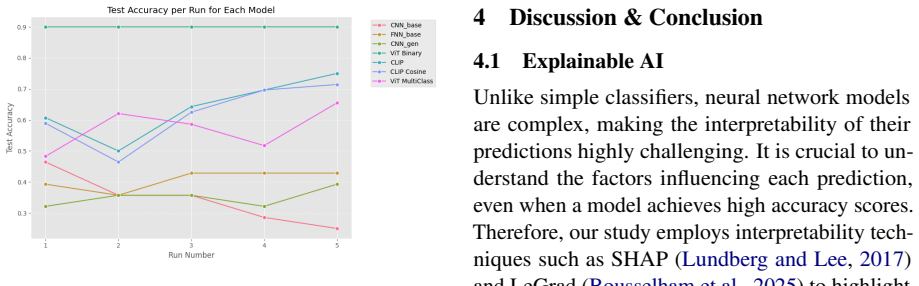
The central discovery is that, on this particular two-class sitting-versus-walking_running task, a fine-tuned binary Vision Transformer attains 90% mean test accuracy across five seeds, with standard deviation zero, clearly beating both convolutional baselines (≈34–35%) and CLIP-based pipelines (≈62–64%). The paper also reports that extending the same ViT to a three-class problem drops accuracy to 57.2%, below the CLIP embeddings' 63.9%, which the authors attribute to 'standing' sharing visual features with both sitting and walking_running. Using LeGrad attribution maps, the paper argues that the ViT's success comes from concentrating on semantically relevant body regions—lower limbs for gait actions, torsos for standing, hips and bench structures for sitting—rather than on background elements. The broader claim is that transformer representations are data-efficient on small, balanced action subsets, and that binary action discrimination is where that efficiency is most visible.
Load-bearing premise
The load-bearing assumption is that a 90% accuracy on a two-class task is directly comparable to a 34–64% accuracy on a three-class task; if binary and multiclass accuracies are not commensurable, the headline gap does not by itself show that transformers are more data-efficient.
Editorial extensions
If this is right
- If the binary ViT result holds, coarse two-way action discrimination, such as stationary sitting versus active gait, can be done very accurately from a few hundred labeled images with a pretrained transformer.
- Saliency methods like LeGrad can be used before deployment to check whether a small-data action model is reasoning from pose regions or from background confounds.
- The multiclass ViT result implies that introducing a visually intermediate class such as standing is the main remaining bottleneck, so future gains are more likely from resolving posture ambiguity than from architecture choice alone.
- A fixed CLIP encoder with a lightweight head is a competitive alternative on the multiclass task and may be preferable when a binary formulation is not available.
- Accuracy numbers on this subset should be read as task-specific rather than as evidence that one architecture family generally dominates.
Reading between the lines
- I infer that much of the reported 90% versus 64% gap reflects task difficulty, with a 50% chance baseline for the binary task and a 33% chance baseline for the three-class task, rather than a general architectural advantage; the multiclass ViT's 57.2% being below CLIP's 63.9% is consistent with that reading.
- A natural testable extension is to train every model on every binary pair from the same three classes; if the ViT wins all pairs, the data-efficiency story is stronger, and if it only wins the sitting-versus-walking_running pair, the story is about that specific discrimination.
- The paper's label-auditing step suggests that annotation noise can silently change which model looks best; applying the same audit to the validation split and reporting per-class confusion would let readers separate architecture effects from label effects.
- I infer that adding temporal context, or using a pose-estimation backbone rather than raw pixels, may close the multiclass gap faster than adding more transformer capacity.
Editorial analysis
A structured set of objections, weighed in public.
Referee Report
Summary. The manuscript curates a 285-image three-class COCO subset (sitting, standing, walking_running), trains or fine-tunes FNN, CNN, CNN_gen, CLIP, CLIP Cosine, a binary ViT, and a multiclass ViT, and reports mean test accuracy, precision, recall, and F1 over five seeds (42-46). It reports that the binary ViT reaches 90.0% accuracy with zero standard deviation, whereas multiclass models reach roughly 35% (CNNs), 62-64% (CLIP), and 57.2% (multiclass ViT). A one-way ANOVA is reported as F=61.37, p<0.001, and SHAP/LeGrad visualizations are used to argue that the binary ViT focuses on pose-specific regions such as lower limbs for walking_running. The paper concludes that transformer representations are data-efficient for human action recognition on small COCO subsets.
Significance. The paper has some strengths: it fixes an explicit stratified split, reports five-seed statistics, and provides qualitative error and explanation analyses that could inform future small-data action recognition studies. However, the central comparison is confounded because the headline ViT result is obtained on a binary task while every other model is evaluated on a three-class task. As a result, the 90% versus 35-64% gap does not support the paper's data-efficiency conclusion, and the reported ANOVA tests a global hypothesis rather than the specific pairwise claims in the abstract. The useful contribution is therefore a preliminary benchmark description and an explainability case study, not a valid architecture comparison. If the authors rerun all models on the same task or restrict the conclusions to within-task comparisons, the work could become a worthwhile empirical note.
major comments (5)
- [§3.1, Table 2; §2.2.3] The central comparison is confounded by task type. ViT Binary is trained on two classes (sitting versus walking_running, chance 50%), while FNN, CNN, CNN_gen, CLIP, CLIP Cosine, and ViT MultiClass are trained on three classes (chance 33%). Listing all seven models in one table and directly comparing mean accuracies in §3.1 and the abstract therefore conflates architecture quality with task difficulty. Section 4.2 itself states that 'standing' shares visual features with both other classes and causes the multiclass ViT accuracy to drop to 57.2%, which confirms that the label space drives much of the gap. The data-efficiency claim in the abstract does not follow from these experiments; the authors should either evaluate all models on the same binary task, evaluate a binary version of every baseline, or report chance-normalized metrics and restrict all claims to within-task comparisons.
- [§3.4] The one-way ANOVA compares the five accuracy values of seven models and only establishes that at least one group mean differs; it does not test the specific pairwise differences claimed in the abstract, such as ViT Binary significantly exceeding CLIP or CNN. Because model identity is fully confounded with task type (binary versus multiclass), F=61.37 cannot be attributed to architecture. A proper analysis would require post-hoc pairwise comparisons with correction, or a model that includes task type as a factor, and it should also address the zero-variance ViT Binary group.
- [§2.2.4 versus §2.3] The evaluation protocol for CLIP contradicts the protocol for all other models. Section 2.2.4 states that CLIP uses an 80/20 train/test split, while Section 2.3 states that every architecture uses a fixed 80/10/10 stratified train/validation/test split. This inconsistency means the CLIP results in Table 2 were obtained under a different data-split and validation procedure, further undermining comparability across models. The authors should use the identical split and validation protocol for every model.
- [Table 2, §3.3] ViT Binary is reported as 0.900 ± 0.000 over five independent trials with seeds 42-46. With stochastic training, early stopping, and five different seeds, an exactly zero standard deviation is surprising and needs an explanation. The authors should report the per-run test accuracies, the test-set size, and a confusion matrix, or explain why the results are deterministic. Without this, readers cannot assess whether the 90% figure is a stable finding or an artifact of a very small test set.
- [§2.1] The manual dataset audit is described only qualitatively: the authors say that 'all such noise samples were removed prior to model training,' but they do not state how many images were removed, what criteria were used, or whether the removal was independently verified. Since the dataset contains only 285 images, this manual editing can materially change every reported accuracy and is not reproducible. The authors should provide the filtered image IDs, a detailed audit protocol, and a discussion of how the removals affect class balance and the comparison across models.
minor comments (6)
- [§1] The introduction contains a typo: 'walking_unning' should be 'walking_running'.
- [§2.3, §3.4] The text contains spacing errors in 'ANOV A' and 'one -way ANOV A'; these should be corrected to 'ANOVA' and 'one-way ANOVA'.
- [Table 2] The table formatting runs the row label into the value ('CNN_base0.343'); ensure proper spacing so the model name and accuracy are visually separated.
- [§2.2.5] The text says concatenating the 3-dimensional cosine-similarity vector to the 512-dimensional CLIP embedding 'doubles' the feature size; 512+3 does not double it. Clarify the intended feature dimension.
- [§3.1] The sentence says 'The two binary vision transformer based models' but only one binary ViT is reported; correct the plural or describe the second model.
- [§2.1, §4.2] The paper does not state whether code and the curated dataset will be released. Given the manual audit step, a data-release or reproducibility statement is important.
Circularity Check
No circularity: all headline numbers are measured accuracies; the binary-vs-multiclass comparison is confounded by task difficulty, but no result reduces to its input by construction.
full rationale
The paper contains no formal derivation whose conclusion is equivalent to its assumptions. The central quantitative claims are empirical test accuracies from held-out splits (Table 2), not predictions derived from fitted parameters renamed as outputs. The headline 90% versus 63.9% gap is computed across different classification tasks (binary vs. three-class), which is a serious internal-validity concern, but it is not circularity: the accuracies are not defined to equal each other or to force the architecture comparison. The interpretability analysis (LeGrad and SHAP) describes the same models it is used to explain, which is standard post-hoc explanation rather than a claim that the maps were independently predicted from pose annotations; no equation or construction collapses here. There are no load-bearing self-citations: the cited works (COCO, CLIP, LeGrad, SHAP, the ViT checkpoint) are independent external resources or methodological tools, and the authors do not invoke their own prior work to justify any premise. The paper's own error analysis in Section 4.2 explicitly states that the binary-versus-multiclass gap arises because standing shares visual features with both sitting and walking_running, confirming that the reported difference is task-compositional rather than a circular derivation. Overall, no identified step satisfies the hard requirement of exhibiting a specific reduction to its own input.
Assumptions & free parameters
free parameters (3)
- Fixed 80/10/10 stratified split and seeds 42-46 =
80/10/10, seeds 42-46
- Early stopping patience =
5 epochs
- CNN_gen augmentation and regularization settings =
rotation +/-25 degrees, shift +/-20 percent, brightness 0.8-1.2x, L2 1e-4, dropout 0.2
assumptions (4)
- domain assumption Pretrained ViT and CLIP checkpoints provide transferable representations for human pose classification.
- domain assumption SHAP and LeGrad attribution maps faithfully reflect the features the models actually use.
- ad hoc to paper The manual audit removed only genuine noise and did not bias the comparison.
- domain assumption The COCO-derived activity labels are valid ground truth for sitting, standing, and walking_running.
Cite this review
Pith. "Pith review of Pose Matters: Evaluating Vision Transformers and CNNs for Human Action Recognition on Small COCO Subsets." pith.science (2026). https://pith.science/paper/72GGEVK4
@misc{pith2026250611678,
  author       = {Pith},
  title        = {Pith review of: Pose Matters: Evaluating Vision Transformers and CNNs for Human Action Recognition on Small COCO Subsets},
  year         = {2026},
  howpublished = {\url{https://pith.science/paper/72GGEVK4}},
  note         = {Machine review of arXiv:2506.11678}
}
read the original abstract
This study explores human action recognition using a three-class subset of the COCO image corpus, benchmarking models from simple fully connected networks to transformer architectures. The binary Vision Transformer (ViT) achieved 90% mean test accuracy, significantly exceeding multiclass classifiers such as convolutional networks (approximately 35%) and CLIP-based models (approximately 62-64%). A one-way ANOVA (F = 61.37, p < 0.001) confirmed these differences are statistically significant. Qualitative analysis with SHAP explainer and LeGrad heatmaps indicated that the ViT localizes pose-specific regions (e.g., lower limbs for walking or running), while simpler feed-forward models often focus on background textures, explaining their errors. These findings emphasize the data efficiency of transformer representations and the importance of explainability techniques in diagnosing class-specific failures.
Figures


Figures from the paper (6 more)



Reference graph
Works this paper leans on
-
[1]
URL: " 'urlintro :=
ENTRY address author booktitle chapter edition editor howpublished institution journal key month note number organization pages publisher school series title type volume year eprint doi pubmed url lastchecked label extra.label sort.label short.list INTEGERS output.state before.all mid.sentence after.sentence after.block STRINGS urlintro eprinturl eprintpr...
-
[2]
write newline
" write newline "" before.all 'output.state := FUNCTION n.dashify 't := "" t empty not t #1 #1 substring "-" = t #1 #2 substring "--" = not "--" * t #2 global.max substring 't := t #1 #1 substring "-" = "-" * t #2 global.max substring 't := while if t #1 #1 substring * t #2 global.max substring 't := if while FUNCTION word.in bbl.in capitalize " " * FUNCT...
-
[3]
Walid Bousselham, Angie Boggust, Sofian Chaybouti, Hendrik Strobelt, and Hilde Kuehne. 2025. http://arxiv.org/abs/2404.03214 Legrad: An explainability method for vision transformers via feature formation sensitivity
arXiv 2025
-
[4]
Jason Brownlee. 2022. https://machinelearningmastery.com/when-to-use-mlp-cnn-and-rnn-neural-networks/ When to use mlp, cnn, and rnn neural networks
work page 2022
-
[5]
Muqing Li, Ziyi Zhu, Ruilin Xu, Yinqiu Feng, and Lingxi Xiao. 2024. https://doi.org/10.54097/qg7hakzu Research on image classification and semantic segmentation model based on convolutional neural network . Journal of Computing and Electronic Information Management, 12:94--100
-
[6]
Lawrence Zitnick, and Piotr Dollár
Tsung-Yi Lin, Michael Maire, Serge Belongie, Lubomir Bourdev, Ross Girshick, James Hays, Pietro Perona, Deva Ramanan, C. Lawrence Zitnick, and Piotr Dollár. 2015. http://arxiv.org/abs/1405.0312 Microsoft coco: Common objects in context
arXiv 2015
-
[7]
Scott Lundberg and Su-In Lee. 2017. http://arxiv.org/abs/1705.07874 A unified approach to interpreting model predictions
arXiv 2017
-
[8]
Bala Priya. 2023. https://www.pinecone.io/learn/softmax-activation/ Softmax activation function: Everything you need to know
work page 2023
Show all 12 references
-
[9]
Alec Radford, Jong Wook Kim, Chris Hallacy, Aditya Ramesh, Gabriel Goh, Sandhini Agarwal, Girish Sastry, Amanda Askell, Pamela Mishkin, Jack Clark, Gretchen Krueger, and Ilya Sutskever. 2021. http://arxiv.org/abs/2103.00020 Learning transferable visual models from natural lang...
2021 arXiv
-
[10]
Sreekanth. 2024. https://huggingface.co/Sreekanth3096/vit-coco-image-classification Sreekanth3096/vit-coco-image-classification · hugging face . Sreekanth3096/vit-coco-image-classification · Hugging Face
2024
-
[11]
Andreas Steiner, Alexander Kolesnikov, Xiaohua Zhai, Ross Wightman, Jakob Uszkoreit, and Lucas Beyer. 2022. http://arxiv.org/abs/2106.10270 How to train your vit? data, augmentation, and regularization in vision transformers
2022 arXiv
-
[12]
Rikiya Yamashita, Mizuho Nishio, Richard Kinh Gian Do, and Kaori Togashi. 2018. https://doi.org/10.1007/s13244-018-0639-9 Convolutional neural networks: an overview and application in radiology . Insights Imaging, 9:611--629
2018 doi
Reviewed August 7, 2026 · model on record in the stance chip above.
Discussion (0). Sign in to comment.