REVIEW 2 major objections 5 minor 32 references
Decentralized Multi-Floor Exploration by a Swarm of Miniature Robots Teaming with Wall-Climbing Units
T0 review · 2 major / 5 minor · reviewed 2026-08-14 · deepseek-v4-flash
Pith's one-line read A decentralized swarm of miniature robots, supported by wall-climbing relay units, can map unknown and dynamic multi-floor indoor environments without a central command.
desk verdict Solid one-floor quantitative swarm mapping data with a genuinely new multi-floor relay concept, but the headline multi-floor claim outruns the qualitative evidence. read the letter →
The pith
A machine-rendered reading of the paper's core claim, the machinery that carries it, and where it could break.
The reading
What carries the argument
The central mechanism is decentralized frontier-based exploration carried by a distributed occupancy-grid map. Each mapping robot keeps a grid of cells, updated with a Bayesian rule from its own laser range readings and from the laser readings of whatever neighbors it is currently connected to, so no unit ever holds the full map. For choosing the next waypoint, each robot maximizes a preference potential $V(\mathbf{r}) = V_F(\mathbf{r}) \times \frac{1}{\min(\|\mathbf{r}-\mathbf{r}_i\|, R_0)} \times \prod_{j\sim i} \|\mathbf{r}-\mathbf{r}_j\|^2$, which favors points near the frontier of explored space, near the robot, and far from other robots. The wall-climbing variant O-climb does not map; its job is to climb a wall and carry the same low-power wireless module upward, acting as a mobile relay node that bridges the robots' mesh network between floors, keeping the distributed communication channel alive where concrete floors would otherwise block it.
What would settle it
Run the same multi-floor ORION mission while an external motion-capture or survey system tracks every robot's true pose, then compare each robot's shared pose estimate and the resulting occupancy grid with ground truth. If any unit's estimated position drifts by more than the 1/15 m grid-cell size during a typical 3–4 minute run, or if the same physical area appears inconsistent in the map, the localization assumption is violated and longer missions would degrade.
Extended reading notes
Core claim
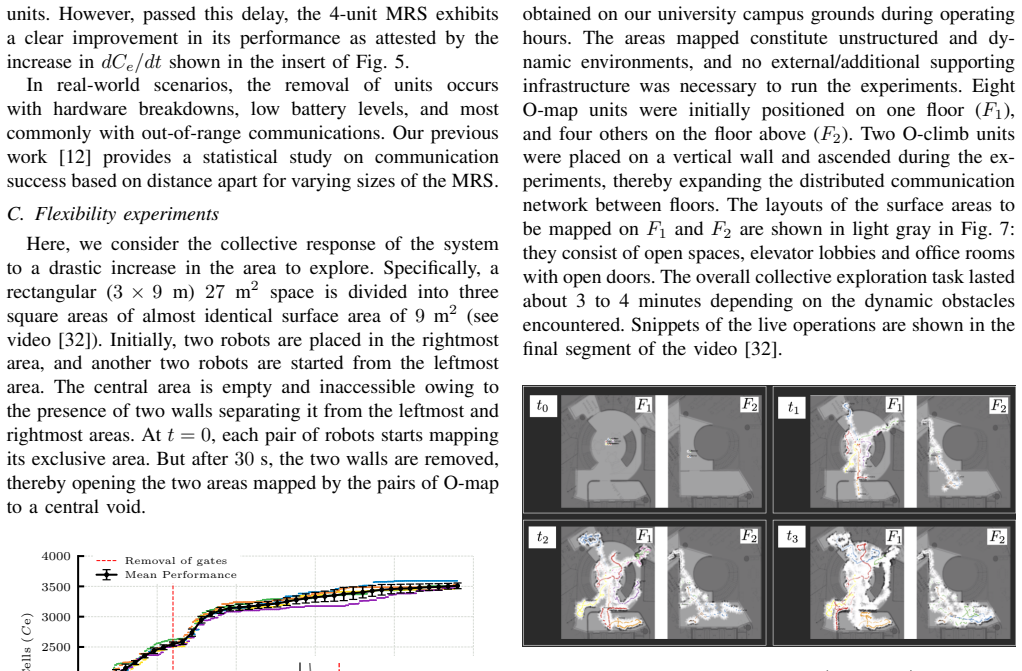
The paper's central claim is that a heterogeneous swarm of miniature robots can carry out fully decentralized exploration and mapping of unknown, dynamic, multi-floor indoor spaces, without any central command, external positioning infrastructure, or a single global map. The system combines wheeled O-map units that build local Bayesian occupancy-grid maps from their laser range sensors with wall-climbing O-climb units that extend the wireless mesh across floors. Repeated trials show that the number of explored cells rises faster with more robots up to a saturation set by the workspace, that removing two of four robots only slows the exploration and injecting two new robots restores the exploration rate after a delay, and that the group adapts when the explorable area abruptly grows by half. A two-floor live test with twelve ground units and two wall climbers, run during normal operating hours with people moving through the space, demonstrates simultaneous multi-floor mapping in a realistic unstructured setting. The authors conclude that the system is scalable, robust, flexible, and capable of fault-tolerant exploration of unknown multi-floor environments.
Load-bearing premise
The load-bearing premise is that every robot starts knowing its position in one shared coordinate system and that its on-board wheel and inertial sensors stay accurate enough for the whole mission, since the system never corrects robot poses against each other or against an external reference.
Editorial extensions
If this is right
- Multi-floor reconnaissance can run with no installed communication infrastructure: wall-climbing units create the inter-floor link themselves as they climb.
- The swarm tolerates unit loss: killing two of four units slows the mapping rate but does not stop the task, and adding fresh units restores the exploration rate after a short coordination delay.
- The coordination scheme stays local: robots exchange only current sensor readings and their own states with nearby neighbors, so no unit needs the global map and the communication load does not grow with the size of the mapped area.
- Dynamic environments are within reach: the occupancy-grid representation accepts moving features, and the robots re-plan when the free space changes, as shown in the area-expansion experiment.
- Performance scales with swarm size within the tested range: characteristic exploration time falls roughly as a power of $N$ as the number of units rises from 1 to 8, then saturates when the workspace becomes crowded.
Reading between the lines
- The paper's two-floor demonstration uses exactly one vertical link; a natural untested extension is a chain of multiple wall-climbing relays to carry the mesh across three or more floors, where relay spacing and battery life would become the limiting factors.
- Because the weakest premise is dead-reckoning accuracy, an obvious next experiment is a long-duration mission with external ground-truth tracking; that would reveal how many minutes or meters of travel the shared occupancy grid tolerates before map disagreement appears.
- The same local-information architecture could transfer to other small ground robots, but only if the common-initial-pose assumption is replaced by a distributed localization scheme; otherwise each new environment requires manual pose initialization.
Signed reviews
Editorial analysis
A structured set of objections, weighed in public.
Referee Report
Summary. The paper presents ORION, a decentralized heterogeneous multi-robot system composed of wheeled ground-mapping units (O-map) and wall-climbing units (O-climb). The ground robots collectively build occupancy-grid maps using frontier-based exploration, sharing LiDAR data and poses through a distributed XBee mesh network without any central command or external infrastructure. The authors report quantitative experiments characterizing scalability (N = 1, 2, 4, 6, 8), robustness (removal and injection of units), and flexibility (expansion of the explorable area), each with five repeated trials. They also report a qualitative multi-floor exploration experiment in which two O-climb units climb a wall to bridge the communication link between twelve O-map units mapping two floors. The abstract and conclusions claim that ORION is capable of scalable and fault-tolerant exploration of unknown multi-floor environments.
Significance. If fully substantiated, the multi-floor exploration capability would be a valuable contribution: the use of wall-climbing robots as mobile communication relays for a decentralized swarm is an original idea, and the absence of external infrastructure is a practically relevant feature. The strength of the paper lies in its systematic quantitative evaluation of scalability, robustness, and flexibility with repeated trials and standard deviations, which is still uncommon in swarm-robotics papers. However, the headline multi-floor claim is currently supported only by a qualitative demonstration, and the localization assumption underpinning the map-fusion pipeline is not validated for the multi-floor scenario. Thus the significance is conditional on additional evidence or a more modest claim.
major comments (2)
- [Section IV-D] The multi-floor experiment is presented as qualitative only, with no repeat count, no map-accuracy metric, and no quantitative measurement of the communication link maintained by the O-climb units. Since the abstract and the conclusions state that ORION is 'capable of performing scalable and fault-tolerant explorations of unknown multi-floor indoor environments,' this central claim is not supported by the reported evidence. Please provide at least one of the following: repeated multi-floor trials, a comparison of the resulting occupancy grid against a ground-truth floor plan, or a log of packet delivery/link quality between the two floors during the climb.
- [Section III (Collective Mapping Approach)] The assumption that all units know their initial poses in a common, global reference frame and that IMU/wheel-encoder localization remains sufficiently accurate for the whole task is load-bearing for the map-fusion in Eq. (1). For robots starting on different floors, establishing a common reference frame is nontrivial, and any inter-floor misalignment or odometric drift will directly corrupt the shared occupancy grid. The manuscript reports no ground-truth drift test, no map-consistency metric, and no sensitivity analysis for this assumption. Without such validation, the reliability of the multi-floor mapping pipeline is unknown; please add a quantitative assessment of localization error over the duration of the experiments.
minor comments (5)
- [Section I] The phrase 'unknown indoor entity' in the Introduction should be 'unknown indoor environment'.
- [Section III] The acronym 'IMU' is expanded as 'Inertia Measurement Unit'; the correct term is 'Inertial Measurement Unit'.
- [Section IV-C] There is a typo in the text: 'after ther removal of the walls' should be 'after the removal of the walls'.
- [Figure 7] The snapshots of the multi-floor mapping would be more informative if they included a scale bar or coordinate axes, and if the ground-truth floor layouts were overlaid for a direct visual comparison.
- [Equation (2)] The cutoff distance R0 is described as arbitrary; please clarify whether the reported results are sensitive to its value, since it enters the preference potential and thus the exploration behavior.
Circularity Check
No circularity: ORION's claims rest on new experiments; self-citations supply hardware and prior-art context, not derivational load.
full rationale
This is an experimental systems paper rather than a derivation. The collective-mapping equations (1)-(2) and Algorithm 1 define the algorithm from LiDAR inputs and neighbor data; they do not encode the measured performance metrics (explored cells Ce, time-scales, recovery delays). The scalability time-scales in Section IV-A are post-hoc exponential fits to the measured Ce curves (Methods 1 and 2), used as descriptive characterizations rather than predictions generated from a fitted parameter, so no fitted input is later relabeled as a result. Robustness and flexibility claims rest on repeated trials (five experiments each) with means and standard deviations, not on a self-referential model. The multi-floor experiment in Section IV-D is admittedly qualitative ('we present some qualitative results'), so it may under-support the strength of the concluding claim from an evidence standpoint, but a qualitative demonstration is not circular reasoning. The numerous self-citations ([8], [12], [24]-[29]) describe the miniature robots, O-climb units, and swarm-enabling communication hardware; these are separate artifacts with their own reported characterizations, and the present experiments measure system-level behavior independently. No uniqueness theorem, no fitted ansatz, and no definitional identity is invoked, so there is no circular step to exhibit.
Assumptions & free parameters
free parameters (1)
- R0, arbitrary cut-off distance in preference potential
assumptions (4)
- domain assumption All robots know their initial poses in a common global frame, and IMU/encoder localization remains accurate for the whole mapping task.
- domain assumption The XBee mesh network reliably delivers 5 Hz state and LiDAR broadcasts over short-range, intermittent, multi-hop links inside buildings.
- standard math Occupancy-grid Bayesian updates with a 0.5 prior correctly represent dynamic obstacles from noisy LiDAR.
- domain assumption The frontier-based preference potential in Eq. (2) yields effective decentralized exploration when each robot maximizes V.
Cite this review
Pith. "Pith review of Decentralized Multi-Floor Exploration by a Swarm of Miniature Robots Teaming with Wall-Climbing Units." pith.science (2026). https://pith.science/paper/73P2OLC4
@misc{pith2026190805822,
  author       = {Pith},
  title        = {Pith review of: Decentralized Multi-Floor Exploration by a Swarm of Miniature Robots Teaming with Wall-Climbing Units},
  year         = {2026},
  howpublished = {\url{https://pith.science/paper/73P2OLC4}},
  note         = {Machine review of arXiv:1908.05822}
}
read the original abstract
In this paper, we consider the problem of collectively exploring unknown and dynamic environments with a decentralized heterogeneous multi-robot system consisting of multiple units of two variants of a miniature robot. The first variant-a wheeled ground unit-is at the core of a swarm of floor-mapping robots exhibiting scalability, robustness and flexibility. These properties are systematically tested and quantitatively evaluated in unstructured and dynamic environments, in the absence of any supporting infrastructure. The results of repeated sets of experiments show a consistent performance for all three features, as well as the possibility to inject units into the system while it is operating. Several units of the second variant-a wheg-based wall-climbing unit-are used to support the swarm of mapping robots when simultaneously exploring multiple floors by expanding the distributed communication channel necessary for the coordinated behavior among platforms. Although the occupancy-grid maps obtained can be large, they are fully distributed. Not a single robotic unit possesses the overall map, which is not required by our cooperative path-planning strategy.
Figures


Figures from the paper (4 more)



Reference graph
Works this paper leans on
-
[1]
Coordinated multi-robot exploration,
W. Burgard, M. Moors, C. Stachniss, and F. E. Schneider, “Coordinated multi-robot exploration,” IEEE Trans. Robot., vol. 21, no. 3, pp. 376– 386, 2005
work page 2005
-
[2]
Bouffanais, Design and Control of Swarm Dynamics , ser
R. Bouffanais, Design and Control of Swarm Dynamics , ser. Springer- Briefs in Complexity. Heidelberg: Springer, 2016
work page 2016
-
[3]
Mapping, localization and motion planning in mobile multi-robotic systems,
W. Rone and P. Ben-Tzvi, “Mapping, localization and motion planning in mobile multi-robotic systems,” Robotica, vol. 31, no. 1, pp. 1–23, 2013
work page 2013
-
[4]
Interplay between signaling network design and swarm dynamics,
A. Sekunda, M. Komareji, and R. Bouffanais, “Interplay between signaling network design and swarm dynamics,” Network Sci., vol. 4, no. 2, pp. 244–265, 2016
work page 2016
-
[5]
Optimal network topology for responsive collective behavior,
D. Mateo, N. Horsevad, V . Hassani, M. Chamanbaz, and R. Bouffanais, “Optimal network topology for responsive collective behavior,”Science Advances, vol. 5, p. eaau0999, Apr 2019
work page 2019
-
[6]
A decentralized mobile computing network for multi-robot systems operations,
J. L. Kit, D. Mateo, and R. Bouffanais, “A decentralized mobile computing network for multi-robot systems operations,” in 2018 9th IEEE UEMCON International Conference . New York City, N.Y .: IEEE, 2019, in Press
work page 2018
-
[7]
Merging occupancy grid maps from multiple robots,
A. Birk and S. Carpin, “Merging occupancy grid maps from multiple robots,” Proc. IEEE, vol. 94, no. 7, pp. 1384–1397, 2006
work page 2006
-
[8]
Development of a miniature robot for multi-robot occupancy grid mapping,
J. Sundram, V . D. Nguyen, G. S. Soh, R. Bouffanais, and K. L. Wood, “Development of a miniature robot for multi-robot occupancy grid mapping,” in 3rd IEEE Int. Conf. Adv. Rob. Mechatron. (ICARM) , Jul 2018, pp. 414–419
work page 2018
Show all 32 references
-
[9]
Decentralized mapping of robot-aided sensor networks,
J. Djugash, S. Singh, and B. Grocholsky, “Decentralized mapping of robot-aided sensor networks,” in Proc. IEEE Int. Conf. Robot. Autom. (ICRA), 2008, pp. 583–589
2008
-
[10]
Cooperative chemical concentration map building using decentralized asynchronous particle swarm optimization based search by mobile robots,
M. Turduev, Y . Atas ¸, P. Sousa, V . Gazi, and L. Marques, “Cooperative chemical concentration map building using decentralized asynchronous particle swarm optimization based search by mobile robots,” in Proc. IEEE/RSJ Int. Conf. Intell. Robots Syst. , 2010, pp. 4175–4180
2010
-
[11]
Application of swarm robotics systems to marine environmental monitoring,
M. Duarte, J. Gomes, V . Costa, T. Rodrigues, F. Silva, V . Lobo, M. M. Marques, S. M. Oliveira, and A. L. Christensen, “Application of swarm robotics systems to marine environmental monitoring,” in Proc. OCEANS 2016-Shanghai , 2016, pp. 1–8
2016
-
[12]
Distributed system of autonomous buoys for scalable deployment and monitoring of large waterbodies,
B. M. Zoss, D. Mateo, Y . K. Kuan, G. Toki ´c, M. Chamanbaz, L. Goh, F. Vallegra, R. Bouffanais, and D. K. P. Yue, “Distributed system of autonomous buoys for scalable deployment and monitoring of large waterbodies,” Autonomous Robots, vol. 42, pp. 1669–1689, Feb 2018
2018
-
[13]
Gradual collective upgrade of a swarm of autonomous buoys for dynamic ocean monitoring,
F. Vallegra, D. Mateo, G. Toki ´c, R. Bouffanais, and D. K. P. Yue, “Gradual collective upgrade of a swarm of autonomous buoys for dynamic ocean monitoring,” in 2018 MTS/IEEE OCEANS, Charleston. Charleston, S.C.: IEEE, Oct 2018, pp. 1–7
2018
-
[14]
Multi- uav exploration with limited communication and battery,
K. Cesare, R. Skeele, S.-H. Yoo, Y . Zhang, and G. Hollinger, “Multi- uav exploration with limited communication and battery,” in Proc. IEEE Int. Conf. Robotics Autom. (ICRA) , 2015, pp. 2230–2235
2015
-
[15]
A comprehensive survey on decentralized modular swarm robotic systems and deployment envi- ronments,
T. Abukhalil, M. Patil, and T. Sobh, “A comprehensive survey on decentralized modular swarm robotic systems and deployment envi- ronments,” Int. J. Eng. , vol. 7, no. 2, p. 44, 2013
2013
-
[16]
Multiple-robot simulta- neous localization and mapping: A review,
S. Saeedi, M. Trentini, M. Seto, and H. Li, “Multiple-robot simulta- neous localization and mapping: A review,” J. Field Robotics, vol. 33, no. 1, pp. 3–46, 2016
2016
-
[17]
Mapping of multi-floor buildings: A barometric approach,
A. G. Ozkil, Z. Fan, J. Xiao, S. Dawids, J. K. Kristensen, and K. H. Christensen, “Mapping of multi-floor buildings: A barometric approach,” in Proc. IEEE/RSJ Int. Conf. Intell. Robots Syst. , 2011, pp. 847–852
2011
-
[18]
Consistent mapping of multistory buildings by introducing global constraints to graph-based slam,
M. Karg, K. M. Wurm, C. Stachniss, K. Dietmayer, and W. Burgard, “Consistent mapping of multistory buildings by introducing global constraints to graph-based slam,” in Proc. IEEE Int. Conf. Robotics Automat. (ICRA), 2010, pp. 5383–5388
2010
-
[19]
Toward autonomous multi-floor exploration: Ascending stairway localization and modeling,
J. A. Delmerico, J. J. Corso, D. Baran, and P. David, “Toward autonomous multi-floor exploration: Ascending stairway localization and modeling,” Army Research Lab Adelphi MD, Computational And Information Sciences Directorate, Tech. Rep., 2013
2013
-
[20]
Ascending stairway modeling: A first step toward autonomous multi- floor exploration,
J. A. Delmerico, J. J. Corso, D. Baran, P. David, and J. Ryde, “Ascending stairway modeling: A first step toward autonomous multi- floor exploration,” in 2012 IEEE/RSJ Int. Conf. Intell. Robots Sys. (IROS). IEEE, 2012, pp. 4806–4807
2012
-
[21]
Semi-autonomous exploration of multi-floor buildings with a legged robot,
G. J. Wenger, A. M. Johnson, C. J. Taylor, and D. E. Koditschek, “Semi-autonomous exploration of multi-floor buildings with a legged robot,” in Unmanned Systems Technology XVII , vol. 9468, 2015, p. 94680B
2015
-
[22]
Navigation strategy for the service robot in the elevator environment,
J.-G. Kang, S.-Y . An, and S.-Y . Oh, “Navigation strategy for the service robot in the elevator environment,” in 2007 Int. Conf. Control Automat. Sys. (ICCAS). IEEE, 2007, pp. 1092–1097
2007
-
[23]
Autonomous multi-floor indoor navigation with a computationally constrained mav,
S. Shen, N. Michael, and V . Kumar, “Autonomous multi-floor indoor navigation with a computationally constrained mav,” in 2011 IEEE Int. Conf. Robotics Automat. (ICRA) . IEEE, 2011, pp. 20–25
2011
-
[24]
ORION-II: A miniature climbing robot with bilayer compliant tape for autonomous intelligent surveillance and reconnaissance,
H. H. Hariri, D. C. Y . Koh, H. C. Lim, A. G. Dharmawan, V . D. Nguyen, G. S. Soh, S. Foong, R. Bouffanais, H. Y . Low, and K. L. Wood, “ORION-II: A miniature climbing robot with bilayer compliant tape for autonomous intelligent surveillance and reconnaissance,” in 15th IEEE I...
2018
-
[25]
A bio-inspired miniature climbing robot with bilayer dry adhesives: Design, modeling, and experimentation,
A. G. Dharmawan, P. Xavier, D. Anderson, K. B. Perez, H. H. Hariri, G. S. Soh, A. Baji, R. Bouffanais, S. Foong, H. Y . Low, and K. L. Wood, “A bio-inspired miniature climbing robot with bilayer dry adhesives: Design, modeling, and experimentation,” in ASME Int. Design Eng. Te...
2018
-
[26]
Design and analysis of a miniature two-wheg climbing robot with robust internal and external transitioning capabilities,
D. C. Y . Koh, A. G. Dharmawan, H. H. Hariri, G. S. Soh, S. Foong, R. Bouffanais, H. Y . Low, and K. L. Wood, “Design and analysis of a miniature two-wheg climbing robot with robust internal and external transitioning capabilities,” in IEEE Int. Conf. Rob. Automat. (ICRA) . IE...
2019
-
[27]
Design, modeling and experimentation of a bio-inspired miniature climbing robot with bilayer dry adhesives,
A. G. Dharmawan, P. Xavier, H. H. Hariri, G. S. Soh, A. Baji, R. Bouffanais, S. Foong, H. Y . Low, and K. L. Wood, “Design, modeling and experimentation of a bio-inspired miniature climbing robot with bilayer dry adhesives,” J. Mech. Rob. , vol. 11, p. 020902, Feb 2019
2019
-
[28]
Tail design of a miniature two-wheg climbing robot for external transitioning,
A. G. Dharmawan, D. C. Y . Koh, G. S. Soh, S. Foong, R. Bouffanais, and K. L. Wood, “Tail design of a miniature two-wheg climbing robot for external transitioning,” in Advances in Mechanism and Machine Science, T. Uhl, Ed. Cham: Springer International Publishing, 2019, pp. 2139–2148
2019
-
[29]
Swarm-enabling technology for multi-robot systems,
M. Chamanbaz, D. Mateo, B. M. Zoss, G. Toki ´c, E. Wilhelm, R. Bouf- fanais, and D. K. P. Yue, “Swarm-enabling technology for multi-robot systems,” Front. Robot. AI , vol. 4, p. 12, 2017
2017
-
[30]
Learning occupancy grid maps with forward sensor mod- els,
S. Thrun, “Learning occupancy grid maps with forward sensor mod- els,” Autonomous Robots, vol. 15, no. 2, pp. 111–127, 2003
2003
-
[31]
Frontier-based exploration using multiple robots,
B. Yamauchi, “Frontier-based exploration using multiple robots,” in Proc. 2nd Int. Conf. Auton. Agents , vol. 98, 1998, pp. 47–53
1998
-
[32]
YouTube video – Multi-Robot System ORION: Col- lective Exploration of Unknown and Dynamic Environments,
R. Bouffanais, “YouTube video – Multi-Robot System ORION: Col- lective Exploration of Unknown and Dynamic Environments,” https: //youtu.be/GUvKQzOO48Y, 2019, [Online; accessed 08-April-2019]
2019
Reviewed August 14, 2026 · model on record in the stance chip above.
Discussion (0). Continue with ORCID to comment.