REVIEW 4 major objections 5 minor 1 cited by
Causal Information Prioritization for Efficient Reinforcement Learning
T0 review · 4 major / 5 minor · reviewed 2026-08-07 · deepseek-v4-flash
Pith's one-line read The paper claims that a reinforcement-learning agent becomes dramatically more sample-efficient when it first learns which state and action dimensions causally drive reward, then swaps unrelated state variables across trajectories to…
desk verdict Strong empirical package, but the causal mechanism at the core is not justified, so the paper as written overclaims. read the letter →
The pith
A machine-rendered reading of the paper's core claim, the machinery that carries it, and where it could break.
The reading
What carries the argument
The central object is the reward-guided causal mask pair $(M^{s\to r}, M^{a\to r})$ learned from a factored MDP, together with the uncontrollable set $U_s = \{s_i \mid M^{s\to r}\cdot(s_i^t, r_t) < \theta\}$. The uncontrollable set drives counterfactual data augmentation: variables in $U_s$ are assumed to be exchangeable across transitions, and swapping them generates synthetic training data that emphasize causally relevant state dimensions. The action mask $M^{a\to r}$ then reweights actions, and the causality-aware empowerment objective $E^{\pi_c}(s) = \max_a I(a_t; s_{t+1}\mid s_t; M)$, computed as the entropy difference between the policy and an inverse dynamics model (each weighted by $M^{a\to r}$), is added to the Bellman target $T^{\pi_c}Q = r(s_t, a_t) + \gamma E[Q(s_{t+1}, a_{t+1}) + \alpha E^{\pi_c}(s)]$. The mutual-information objective is what converts the passive causal masks into an exploration bonus that prefers actions with predictable, causally relevant consequences.
What would settle it
Construct a factored MDP where $s_1 \to s_2 \to r$ and $s_1$ has no direct edge to $r$. Since DirectLiNGAM estimates linear direct effects, $s_1$ could fall into the uncontrollable set; if CIP then swaps $s_1$ across trajectories, the synthetic transitions mix inconsistent $s_1$–$s_2$ pairs and the learned policy should degrade relative to CIP with augmentation disabled, or relative to a variant that masks $s_1$ entirely. Running that comparison would settle whether the counterfactual swap assumption holds.
Extended reading notes
Core claim
CIP treats the environment as a factored MDP whose reward is $r_t = R(M^{s\to r}\odot s_t, M^{a\to r}\odot a_t, \epsilon_{r,t})$, where the binary/weight matrices $M^{s\to r}$ and $M^{a\to r}$ encode which state and action dimensions causally influence reward. It learns these masks with DirectLiNGAM from collected trajectories. State dimensions with no edge to the reward form the 'uncontrollable set' $U_s$; pairs of transitions sharing uncontrollable variables are counterfactually augmented by swapping those variables, producing synthetic tuples $(\tilde s_t, \tilde a_t, \tilde s_{t+1}, \tilde r_t)$ without additional environment interaction. Separately, the learned action-reward weights $\omega$ reweight actions, and a causality-aware empowerment objective $E^{\pi_c}(s) = H(\pi_c(a_t|s_t)) - H(\pi_c(a_t|s_t, s_{t+1}))$ (with each entropy term masked by $M^{a\to r}$) is added to the Bellman update. The paper's central claim is that this combination, counterfactual state-swapping plus causally reweighted empowerment, is what makes policies learn faster and reach near-perfect success on tasks like Adroit door opening where baseline SAC, ACE, and BAC barely progress.
Load-bearing premise
The load-bearing premise is that any state variable with no direct causal edge to the reward can be swapped across transitions without changing the dynamics or reward: the paper assumes such variables have no indirect influence through other state dimensions, and it neither proves nor tests this.
Editorial extensions
If this is right
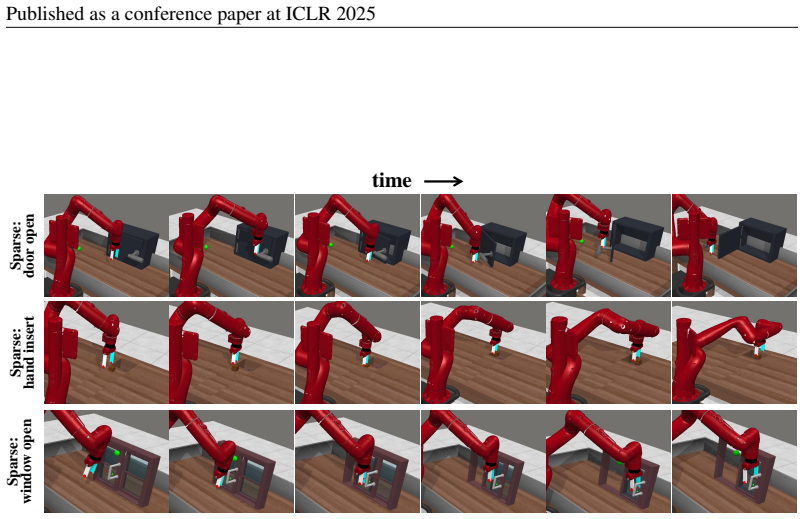
- On the 17 Meta-World robot-arm tasks, CIP reaches a near-perfect normalized score of 100, and it achieves a near-100% success rate on the 28-dimensional Adroit door task where SAC, BAC, and ACE make little progress.
- Ablations show that removing the empowerment term hurts performance the most, and removing counterfactual data augmentation reduces sample efficiency, so both components carry the reported gains.
- CIP's state-swapping augmentation works without extra environment interaction, which is what makes its sample-efficiency gains not an artifact of more data.
- In pixel-based DMControl tasks, CIP combined with IFactor's latent states outperforms IFactor alone, indicating the causal prioritization transfers to high-dimensional observations.
Reading between the lines
- A testable extension: on environments where a state variable has no direct edge to reward but acts indirectly through another state variable, CIP's swap creates invalid transitions; a variant that masks such variables instead of swapping them should reveal whether the augmentation's validity assumption is doing the work.
- If the causal masks are accurate, the empowerment objective is essentially a controllability bonus over causally relevant action dimensions; one could drop the causal discovery step and use learned action importance to see how much of the gain is causal versus merely dimensional attention.
- The paper's own future-work list joins CIP with object-centric world models; a concrete next step would reuse $M^{s\to r}$ as a sparsification prior on object attributes in a 3D manipulation context.
Editorial analysis
A structured set of objections, weighed in public.
Referee Report
Summary. This paper proposes Causal Information Prioritization (CIP), a reinforcement learning method that uses causal discovery (DirectLiNGAM) on collected transitions to estimate state-to-reward and action-to-reward causal matrices, then uses the state-to-reward matrix to perform counterfactual data augmentation by swapping state variables that have no direct edge to the reward, reweights actions by the action-to-reward matrix, and adds a causality-aware empowerment term to the policy objective. The method is evaluated on 36 (or 39, the text is inconsistent) continuous control tasks, including locomotion, manipulation, sparse-reward, and pixel-based settings, and is reported to outperform SAC, ACE, BAC, and IFactor in most tasks. The paper also includes ablations, hyperparameter sensitivity analyses, and a generalization study on MT1/MT10.
Significance. The paper addresses an important problem—sample efficiency in reinforcement learning—and the idea of using causal structure to guide data augmentation and exploration is timely. The experimental scope is unusually broad: 5 environments, pixel-based and sparse-reward variants, 4 random seeds, and statistical analyses (pairwise t-tests, IQM, optimality gap). The authors provide code in the supplementary material and report computation costs. If the causal mechanism were sound, the near-100% success rates on Meta-World and Adroit Hand would be a substantial contribution. However, the theoretical foundation is not established: the counterfactual augmentation relies on an exchangeability assumption that is neither proved nor tested and is generally false in factored MDPs with cross-variable dependencies; the identifiability theorem is asserted without proof and is incompatible with the nonlinear reward functions in Eq. (2); and the empowerment objective in Eqs. (5)-(9) is not internally consistent. These gaps undermine the causal interpretation of the empirical gains.
major comments (4)
- [Section 4.1, Eq. (4)] The counterfactual augmentation step is valid only if the swapped variables are causally isolated, i.e., they have no influence on the reward or on any other state variable at any time. The uncontrollable set U_s in Eq. (4) is defined by the absence of a direct edge s_i^t → r_t, but a variable without a direct edge can still influence the reward through indirect paths, e.g., s_i^t → s_j^t → r_t or s_i^t → s_j^{t+1} → r_{t+1}, and the transition dynamics couple the swapped components to the unswapped ones. Swapping (s_i^t, s_i^{t+1}) across trajectories while leaving the other coordinates unchanged therefore produces tuples (s̃_t, a_t, s̃_{t+1}, r_t) that are not realizable transitions of the MDP. Assumption 4 (self-loop edges) and Propositions 1-2 (direct edges to reward) do not rule out such couplings. The paper neither proves the required exchangeability nor tests whether the augmented transitions are dynamically consistent; this is the central mechanism of the claimed improvement.
- [Appendix B, Theorem 1] Theorem 1 asserts that the causal matrices M^{s→r} and M^{a→r} are identifiable from the factored-MDP reward model, but the proof is omitted; Proposition 2's proof is also deferred with 'a similar line of reasoning.' More importantly, the identifiability statement is incompatible with the unrestricted reward function R in Eq. (2): DirectLiNGAM assumes a linear non-Gaussian structural equation model, while continuous-control reward functions are generally nonlinear (e.g., quadratic penalties, contact terms). No identifiability result for the nonlinear case is provided, and Appendix D.3.7 compares DirectLiNGAM only with GES and PC, not against known ground-truth graphs. Because the causal matrices are the sole basis for both the augmentation and the action reweighting, this gap is load-bearing.
- [Section 4.2 and Algorithm 1] The action-reward causal matrix M^{a→r} is learned from a local buffer that already contains the synthetic transitions generated by the state-reward model in Step 1 (Algorithm 1: augmented transitions are added to D_c, and Step 2 samples D_a from D_c). This creates a feedback loop in which errors in the state-reward mask and in the swap operation propagate into the action-reward weights, which then reweight actions, influence the policy, and affect future data collection. The paper provides no analysis of how this self-training loop affects the reliability of the causal estimates; in particular, invalid augmentations can reinforce initial errors rather than be corrected. This concern is material because the action reweighting and empowerment objective depend on M^{a→r}.
- [Section 4.2, Eqs. (5)-(9)] The derivation of the causality-aware empowerment objective is internally inconsistent. Eq. (5) defines the objective as a mutual information, but Eqs. (6)-(7) insert the causal weights M^{a_i→r} as multiplicative factors inside the entropy summands, and Eq. (8) drops the weights entirely when writing the log-ratio form. Eq. (9) adds αE^{φ_c}(s) inside the expectation over a_t, although the empowerment term as defined is a function of the policy and state, not of the sampled action. If the objective is a heuristic reward-shaping term, this should be stated explicitly; as written, the learning objective in Eq. (8) cannot be derived from Eqs. (6)-(7), and the causal action reweighting ('reweight them as (ω_1 a_1, ...)') is never specified in the algorithm or the implementation details.
minor comments (5)
- [Abstract, Section 5.1, Figure 3, Figure 4] Inconsistent task counts: the Abstract and Conclusion state 39 tasks, while Section 5.1, Figure 3, and Figure 4 state 36 tasks; the pixel-based section mentions 3 DMControl tasks but Figure 6 includes 4 tasks (including Cartpole). Please reconcile these numbers.
- [Algorithm 1] In Algorithm 1, Step 1's comment says 'Learn causal mask matrix M^{a→r}' but the context requires M^{s→r}; this is a typo that obscures the pipeline.
- [Appendix D.3.7 and Figure 15] The causal discovery comparison refers to 'DirectLiNAM' (twice) instead of DirectLiNGAM; also 'ReacherEeasy' appears in Figure 15. These typos should be fixed.
- [Section 5.3, Figure 8] The reliability evaluation excludes the Adroit Hand door task 'due to CIP's exceptional performance there'; excluding a task on this basis can bias the optimality-gap comparison and should be justified or documented as a sensitivity analysis.
- [Section 5.2, Table 1] The claim that CIP 'consistently outperforms' is stronger than the evidence in Table 1: pairwise t-tests show significant superiority in only 5 of 8 locomotion tasks, and BAC has a higher mean return on Ant. The text should be qualified accordingly.
Circularity Check
No significant circularity: the benchmark gains are externally evaluated, and the fitted causal masks are an algorithmic design rather than a prediction derived from themselves.
full rationale
The paper's central claim is an empirical one: CIP improves sample efficiency on external continuous-control benchmarks. The causal matrices M^{s->r} and M^{a->r} are learned from the replay buffer and then used to construct augmented transitions and action weights, so the pipeline is self-referential in the sense that fitted quantities shape the training data and objective. However, the reported success rates and returns are measured on the real environments, not on quantities that are equal to the fitted matrices by construction. The augmentation validity rests on the unproven assumption that state variables with no direct edge to the reward have no indirect influence through other variables or dynamics; this is a correctness and generalizability concern, not a circular reduction of the paper's own equations. Similarly, DirectLiNGAM's linear non-Gaussian assumption is not established for the nonlinear reward in Eq. 2, which is again a modeling-validity issue rather than circularity. The self-citations (Cao et al., 2023; Cao et al., 2024) are positional or contrastive and are not load-bearing for the main derivation. Hyperparameters such as alpha are tuned on the reported tasks, but this is ordinary experimental tuning and does not make the empirical comparison circular. Overall, no derivation step reduces to its own inputs by definition or by a fitted-parameter-as-prediction construction.
Assumptions & free parameters
free parameters (6)
- causal threshold theta =
not specified
- empowerment temperature alpha =
0.2
- causal update interval I =
2
- causal sample size =
10,000
- batch size / hidden size =
512/1024 (manipulation), 256/256 (locomotion)
- causal weight matrices from DirectLiNGAM =
per-task matrices M s->r and M a->r
assumptions (6)
- domain assumption Global Markov condition and faithfulness
- domain assumption Full observability and Markovian dynamics
- domain assumption Edge s_i,t -> s_i,t+1 exists for all state variables
- domain assumption No simultaneous or backward edges in time
- ad hoc to paper Reward/state/action relations are linear with non-Gaussian noise
- ad hoc to paper Exchangeability of uncontrollable state variables across transitions
Cite this review
Pith. "Pith review of Causal Information Prioritization for Efficient Reinforcement Learning." pith.science (2026). https://pith.science/paper/742HC3TB
@misc{pith2026250210097,
  author       = {Pith},
  title        = {Pith review of: Causal Information Prioritization for Efficient Reinforcement Learning},
  year         = {2026},
  howpublished = {\url{https://pith.science/paper/742HC3TB}},
  note         = {Machine review of arXiv:2502.10097}
}
read the original abstract
Current Reinforcement Learning (RL) methods often suffer from sample-inefficiency, resulting from blind exploration strategies that neglect causal relationships among states, actions, and rewards. Although recent causal approaches aim to address this problem, they lack grounded modeling of reward-guided causal understanding of states and actions for goal-orientation, thus impairing learning efficiency. To tackle this issue, we propose a novel method named Causal Information Prioritization (CIP) that improves sample efficiency by leveraging factored MDPs to infer causal relationships between different dimensions of states and actions with respect to rewards, enabling the prioritization of causal information. Specifically, CIP identifies and leverages causal relationships between states and rewards to execute counterfactual data augmentation to prioritize high-impact state features under the causal understanding of the environments. Moreover, CIP integrates a causality-aware empowerment learning objective, which significantly enhances the agent's execution of reward-guided actions for more efficient exploration in complex environments. To fully assess the effectiveness of CIP, we conduct extensive experiments across 39 tasks in 5 diverse continuous control environments, encompassing both locomotion and manipulation skills learning with pixel-based and sparse reward settings. Experimental results demonstrate that CIP consistently outperforms existing RL methods across a wide range of scenarios.
Figures


Figures from the paper (29 more)




Forward citations
Cited by 1 Pith paper
-
Causality-informed Anomaly Detection in Partially Observable Sensor Networks: Moving beyond Correlations
A deep Q-network that mixes causal statistics and a causality-weighted entropy term is proposed for placing sensors in partially observable anomaly detection.
Reference graph
Works this paper leans on
-
[2]
Towards em- powerment gain through causal structure learning in model-based rl
Hongye Cao, Fan Feng, Meng Fang, Shaokang Dong, Jing Huo, and Yang Gao. Towards em- powerment gain through causal structure learning in model-based rl. In ICML 2024 Workshop: Foundations of Reinforcement Learning and Control–Connections and Perspectives,
work page 2024
-
[3]
D.3.4 C OMPUTATION COST ANALYSIS We analyze the computational cost of the proposed framework
29 Published as a conference paper at ICLR 2025 0 500 1000 Environment steps 0.00 0.25 0.50 0.75 1.00Success rate basketball 0 500 1000 Environment steps 0.00 0.25 0.50 0.75 1.00 coffee push 0 500 1000 Environment steps 0.00 0.25 0.50 0.75 1.00 disassemble 0 500 1000 Environment steps 0.00 0.25 0.50 0.75 1.00 door open 0 500 1000 Environment steps 0.00 0....
work page 2025
-
[5]
Entity-centric reinforcement learning for object manip- ulation from pixels
Dan Haramati, Tal Daniel, and Aviv Tamar. Entity-centric reinforcement learning for object manip- ulation from pixels. In NeurIPS 2023 Workshop on Goal-Conditioned Reinforcement Learning,
work page 2023
-
[7]
Jindong Jiang, Fei Deng, Gautam Singh, Minseung Lee, and Sungjin Ahn. Slot state space models. arXiv preprint arXiv:2406.12272,
-
[10]
Towards practical multi-object manipu- lation using relational reinforcement learning
Richard Li, Allan Jabri, Trevor Darrell, and Pulkit Agrawal. Towards practical multi-object manipu- lation using relational reinforcement learning. In 2020 ieee international conference on robotics and automation (icra), pp. 4051–4058. IEEE,
work page 2020
-
[12]
Object- aware regularization for addressing causal confusion in imitation learning
13 Published as a conference paper at ICLR 2025 Jongjin Park, Younggyo Seo, Chang Liu, Li Zhao, Tao Qin, Jinwoo Shin, and Tie-Yan Liu. Object- aware regularization for addressing causal confusion in imitation learning. Advances in Neural Information Processing Systems, 34:3029–3042,
work page 2025
-
[14]
Yuval Tassa, Yotam Doron, Alistair Muldal, Tom Erez, Yazhe Li, Diego de Las Casas, David Budden, Abbas Abdolmaleki, Josh Merel, Andrew Lefrancq, et al. Deepmind control suite. arXiv preprint arXiv:1801.00690,
-
[15]
Octo: An open-source generalist robot policy
14 Published as a conference paper at ICLR 2025 Octo Model Team, Dibya Ghosh, Homer Walke, Karl Pertsch, Kevin Black, Oier Mees, Sudeep Dasari, Joey Hejna, Tobias Kreiman, Charles Xu, et al. Octo: An open-source generalist robot policy. arXiv preprint arXiv:2405.12213,
arXiv 2025
Show all 34 references
-
[16]
Mujoco: A physics engine for model-based control
Emanuel Todorov, Tom Erez, and Yuval Tassa. Mujoco: A physics engine for model-based control. In 2012 IEEE/RSJ international conference on intelligent robots and systems , pp. 5026–5033. IEEE,
2012
-
[17]
Plannable approximations to mdp homomorphisms: Equivariance under actions
Elise Van der Pol, Thomas Kipf, Frans A Oliehoek, and Max Welling. Plannable approximations to mdp homomorphisms: Equivariance under actions. arXiv preprint arXiv:2002.11963,
2002 arXiv
-
[19]
Rise: 3d perception makes real-world robot imitation simple and effective
Chenxi Wang, Hongjie Fang, Hao-Shu Fang, and Cewu Lu. Rise: 3d perception makes real-world robot imitation simple and effective. arXiv preprint arXiv:2404.12281, 2024a. Zizhao Wang, Xuesu Xiao, Yuke Zhu, and Peter Stone. Task-independent causal state abstraction. In Proceeding...
-
[20]
Skild: Unsupervised skill discovery guided by factor interactions
Zizhao Wang, Jiaheng Hu, Caleb Chuck, Stephen Chen, Roberto Mart´ın-Mart´ın, Amy Zhang, Scott Niekum, and Peter Stone. Skild: Unsupervised skill discovery guided by factor interactions. In The Thirty-eighth Annual Conference on Neural Information Processing Systems, 2024b. Ziz...
1905 arXiv
-
[21]
Neural assets: 3d-aware multi-object scene synthesis with image diffusion models
Ziyi Wu, Yulia Rubanova, Rishabh Kabra, Drew A Hudson, Igor Gilitschenski, Yusuf Aytar, Sjoerd van Steenkiste, Kelsey R Allen, and Thomas Kipf. Neural assets: 3d-aware multi-object scene synthesis with image diffusion models. arXiv preprint arXiv:2406.09292,
-
[22]
Sornet: Spatial object-centric representations for sequential manipulation
15 Published as a conference paper at ICLR 2025 Wentao Yuan, Chris Paxton, Karthik Desingh, and Dieter Fox. Sornet: Spatial object-centric representations for sequential manipulation. In Conference on Robot Learning , pp. 148–157. PMLR,
2025
-
[23]
Object-centric learning for real- world videos by predicting temporal feature similarities
Andrii Zadaianchuk, Maximilian Seitzer, and Georg Martius. Object-centric learning for real- world videos by predicting temporal feature similarities. In Thirty-seventh Conference on Neural Information Processing Systems (NeurIPS 2023),
2023
-
[24]
A survey on causal reinforcement learning
Yan Zeng, Ruichu Cai, Fuchun Sun, Libo Huang, and Zhifeng Hao. A survey on causal reinforcement learning. arXiv preprint arXiv:2302.05209,
-
[25]
3 2.2 Empowerment in RL
16 Published as a conference paper at ICLR 2025 CONTENTS 1 Introduction 1 2 Related Work 3 2.1 Causal RL . . . . . . . . . . . . . . . . . . . . . . . . . . . . . . . . . . . . . . . 3 2.2 Empowerment in RL . . . . . . . . . . . . . . . . . . . . . . . . . . . . . . . . . 3 2....
2025
-
[26]
However, both approaches are limited by focusing on a single reward-guided causal relationship
have shown success in learning policies for manipulation and locomotion tasks. However, both approaches are limited by focusing on a single reward-guided causal relationship. Regarding generalization, AdaRL (Huang et al., 2022a) effectively leverages both state-reward and acti...
2024
-
[27]
In summary, current research on reward-guided causal discovery remains incomplete and lacks validation across a broader spectrum of tasks
have not yet explored the inference and utilization of both causal relationships. In summary, current research on reward-guided causal discovery remains incomplete and lacks validation across a broader spectrum of tasks. This gap underscores the need for more comprehensive inv...
1999
-
[28]
For pixel-based DMControl environments, we employ IFactor (Liu et al.,
For fair comparison, the hyperparameters of the baseline methods (SAC (Haarnoja et al., 2018), BAC (Ji et al., 2024b), ACE (Ji et al., 2024a)) follow the same settings in the experiments. For pixel-based DMControl environments, we employ IFactor (Liu et al.,
2018
-
[29]
We utilize the s¯r t state features in IFactor as uncontrollable states unrelated to rewards to execute counterfactual data augmentation
to encode latent states and integrate the CIP framework for policy learning. We utilize the s¯r t state features in IFactor as uncontrollable states unrelated to rewards to execute counterfactual data augmentation. Furthermore, for simplicity, we maximize the mutual informatio...
2025
-
[30]
The findings indicate that CIP without counterfactual data augmentation exhibits reduced learning efficiency and is unable to successfully complete tasks such as pick-and-place. This underscores the importance of incorporating counterfactual data augmentation, which prioritize...
2025
-
[32]
All experiments were conducted on the same computing platform with the same computational resources detailed in Appendix F
Our experimental results demonstrate that CIP achieves its performance improvements with minimal additional computational burden - specifically less than 10% increase compared to SAC, less than 5% increase compared to ACE, and actually requiring less computation time than BAC....
2025
-
[33]
We establish MT1 and MT10 tasks for generalization validation: Multi-Task 1 (MT1): Learning one multi-task policy that generalizes to5 tasks belonging to the same environment
to validate the generalizability. We establish MT1 and MT10 tasks for generalization validation: Multi-Task 1 (MT1): Learning one multi-task policy that generalizes to5 tasks belonging to the same environment. MT1 uses single Meta-World environments, with the training “tasks” ...
2025
-
[34]
The experimental results in Figure 32 across three tasks demonstrate that our chosen DirectLiNAM method exhibits superior performance compared to both alternatives
and constraint-based PC (Spirtes et al., 2001). The experimental results in Figure 32 across three tasks demonstrate that our chosen DirectLiNAM method exhibits superior performance compared to both alternatives. During experimentation, we also observe that both GES and PC met...
2001
-
[1999]
Empowerment: A universal agent-centric measure of control
Alexander S Klyubin, Daniel Polani, and Chrystopher L Nehaniv. Empowerment: A universal agent-centric measure of control. In 2005 ieee congress on evolutionary computation, volume 1, pp. 128–135. IEEE,
2005
-
[2002]
Variational empowerment as representation learning for goal-based reinforcement learning
Jongwook Choi, Archit Sharma, Honglak Lee, Sergey Levine, and Shixiang Shane Gu. Variational empowerment as representation learning for goal-based reinforcement learning. arXiv preprint arXiv:2106.01404,
-
[2005]
Identifiable object-centric representation learning via probabilistic slot attention
12 Published as a conference paper at ICLR 2025 Avinash Kori, Francesco Locatello, Ainkaran Santhirasekaram, Francesca Toni, Ben Glocker, and Fabio De Sousa Ribeiro. Identifiable object-centric representation learning via probabilistic slot attention. arXiv preprint arXiv:2406.07141,
2025 arXiv
-
[2018]
Learning dynamic attribute-factored world models for efficient multi-object reinforcement learning
11 Published as a conference paper at ICLR 2025 Fan Feng and Sara Magliacane. Learning dynamic attribute-factored world models for efficient multi-object reinforcement learning. Advances in Neural Information Processing Systems , 36,
2025
-
[2019]
Object-centric slot diffusion
Jindong Jiang, Fei Deng, Gautam Singh, and Sungjin Ahn. Object-centric slot diffusion. arXiv preprint arXiv:2303.10834,
-
[2020]
Multi-object search using object-oriented pomdps
Arthur Wandzel, Yoonseon Oh, Michael Fishman, Nishanth Kumar, Lawson LS Wong, and Stefanie Tellex. Multi-object search using object-oriented pomdps. In 2019 International Conference on Robotics and Automation (ICRA), pp. 7194–7200. IEEE,
2019
-
[2022]
Robust agents learn causal world models
Jonathan Richens and Tom Everitt. Robust agents learn causal world models. arXiv preprint arXiv:2402.10877,
-
[2023]
Enhancing ood generaliza- tion in offline reinforcement learning with energy-based policy optimization
Hongye Cao, Shangdong Yang, Jing Huo, Xingguo Chen, and Yang Gao. Enhancing ood generaliza- tion in offline reinforcement learning with energy-based policy optimization. In ECAI 2023, pp. 335–342. IOS Press,
2023
-
[2024]
Object-aware gaussian splatting for robotic manipulation
Yulong Li and Deepak Pathak. Object-aware gaussian splatting for robotic manipulation. In ICRA 2024 Workshop on 3D Visual Representations for Robot Manipulation ,
2024
Reviewed August 7, 2026 · model on record in the stance chip above.
Discussion (0). Sign in to comment.