REVIEW 4 major objections 5 minor 2 cited by
HORUS: A Mixed Reality Interface for Managing Teams of Mobile Robots
T0 review · 4 major / 5 minor · reviewed 2026-08-07 · deepseek-v4-flash
Pith's one-line read The paper claims that a mixed-reality mini-map interface lets a single operator manage a team of mobile robots faster and with less frustration than teleoperating them one at a time, and reports a user study supporting this.
desk verdict A working MR multi-robot system with a real user study, but the headline speed advantage is bundled with autonomous navigation and shared mapping, so the interface-specific claim is not yet established. read the letter →
The pith
A machine-rendered reading of the paper's core claim, the machinery that carries it, and where it could break.
The reading
What carries the argument
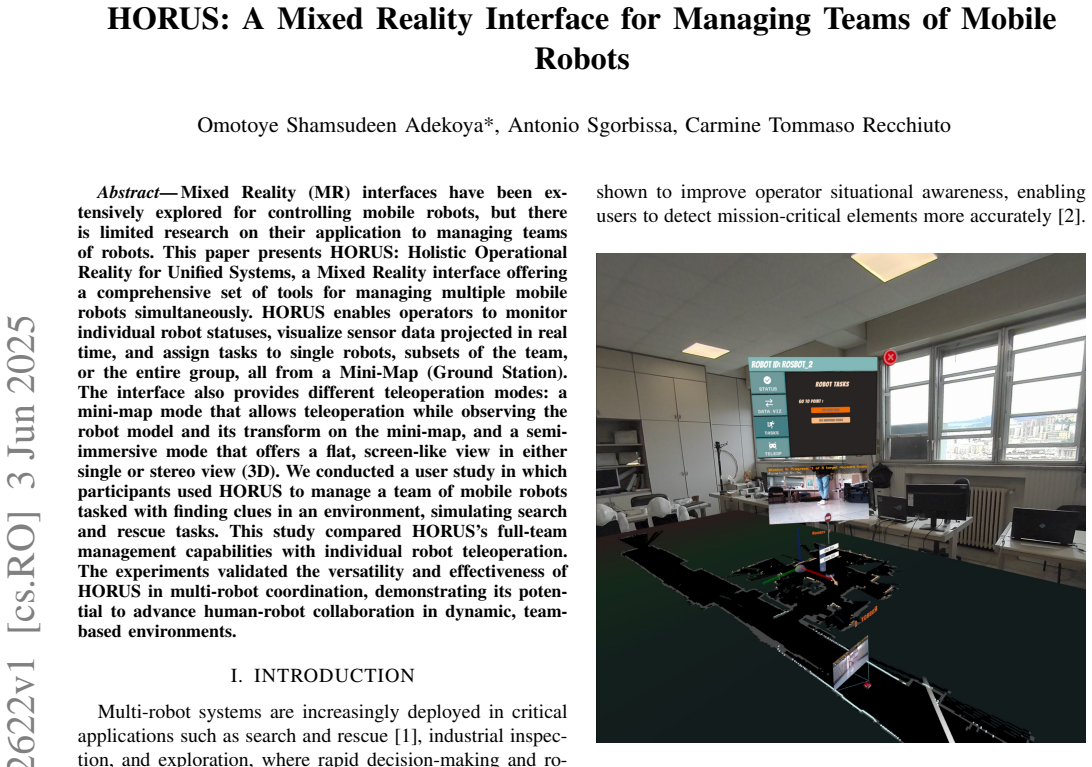
The load-bearing mechanism is the Mini-Map Ground Station, a spatially registered 3D map in the headset where every robot appears as a holographic model with a Robot Manager panel containing Status, Data Viz, Tasks, and Teleoperation tabs. Each robot builds a local occupancy grid, and a custom map-merging step (coarse TF alignment refined by phase correlation) produces one shared map that the operator uses to assign goal poses, waypoints, labels, and drawn navigation plans and to switch to direct teleoperation. The shared map is what lets one operator act on the whole team at once rather than fusing separate camera and sensor feeds mentally.
What would settle it
Repeat the five-marker search with a control group that also has autonomous goal-setting and a shared map, with matched training time, and check whether HORUS still finishes faster and scores higher on usability; if the gap disappears, the claimed benefit comes from the added capabilities rather than the mixed-reality presentation.
Extended reading notes
Core claim
The central claim is that combining goal-based task assignment, a live merged map, and per-robot teleoperation in one mixed-reality view lets a novice operator coordinate a small robot team better than pure first-person teleoperation. On the study's measures, HORUS users were faster (mean 8:42 vs 11:17, $t(18)=4.32$, $p<0.001$, Cohen's $d=1.93$), rated usability higher (SUS 82.3 vs 68.5, $p=0.006$), and reported lower frustration ($p=0.04$), with no significant difference in overall workload or simulator sickness. The paper concludes that HORUS validates mixed-reality interfaces as a practical tool for multi-robot coordination on real hardware.
Load-bearing premise
The load-bearing premise is that the teleoperation-only condition is a fair baseline for individual robot teleoperation, since the two conditions differ in available capabilities, training time, and group assignment, not just in the interface.
Editorial extensions
If this is right
- Operators can search an environment in parallel by assigning different rooms to different robots, which is what made the HORUS group faster in the study.
- A mixed-reality team interface can score as 'excellent' on usability even when its training session is longer, because the interaction model corresponds to how operators think about the mission.
- Keeping a mini-map visible while teleoperating one robot lets the operator preserve awareness of the rest of the team, reducing the need to switch contexts.
- If the per-robot overhead stays flat as robots are added, the same Ground Station pattern could support larger teams and remote operation with minimal extra operator training.
Reading between the lines
- A fairer test of the mixed-reality contribution would give the control condition the same autonomous goal-setting and shared map through a conventional 2D screen; until then, part of the 23% advantage may come from the added capabilities rather than from the headset presentation.
- The study's strategy shift suggests a testable extension: log each robot's path and room coverage to quantify how much of the speedup comes from parallel search assignment rather than from faster control of any single robot.
- If the mini-map merges maps from more than two robots, the same interface could be extended to heterogeneous ground-and-aerial teams, with the operator assigning each platform by its role rather than by its stream.
Signed reviews
Editorial analysis
A structured set of objections, weighed in public.
Referee Report
Summary. The paper presents HORUS, a Unity-based Mixed Reality interface for the Meta Quest 3 that combines a mini-map ground station, per-robot status and sensor panels, task assignment (goal poses, waypoints, labeling, drawn paths), and two teleoperation modes for managing a team of ROSbot 2.0 robots. The authors describe the system architecture (multi-master ROS, map merging, TEB navigation) and report a between-subjects user study (n=10 per group) comparing a HORUS condition with a Teleop-Only condition on an ArUco-tag search-and-rescue inspired task. They report faster task completion (8:42 vs 11:17), higher SUS (82.3 vs 68.5), lower frustration, and no significant SSQ differences, concluding that HORUS is validated as an effective multi-robot coordination interface.
Significance. If the reported results were attributable to the MR interface itself, the study would provide useful evidence for MR-based multi-robot team management on real robots. The system contribution is substantial: it integrates a shared mini-map, multi-robot SLAM, task assignment, and teleoperation in one deployable MR headset, and it is evaluated on physical robots rather than in simulation. The reported effect sizes are large, and the task-time and SUS outcomes are directionally consistent. However, the empirical design as reported does not isolate the MR interface from the autonomy and mapping capabilities included in the HORUS condition, so the paper's central claim needs to be scaled back or supplemented. The absence of raw data and the inconsistent statistical labeling further limit the strength of the quantitative conclusions.
major comments (4)
- [IV.A, Table I] The HORUS condition bundles the MR interface with autonomous goal-setting, shared SLAM map building, and a mini-map, whereas the Teleop-Only condition provides only manual velocity control with camera switching. Consequently, the significant task-time difference (8:42 vs 11:17, d=1.93) cannot be attributed to the MR visualization or interaction design; it could be produced entirely by the autonomous navigation and shared map. A third condition (e.g., autonomous goal-setting with a conventional 2D interface) or an autonomy-only baseline is needed to support the conclusion that HORUS's MR features, rather than the added capabilities, drive the improvement.
- [IV.C.1] The training-time imbalance (18 minutes for HORUS vs 7 minutes for Teleop-Only) is a confound: the HORUS group received more than twice as much hands-on practice, which could inflate its performance independent of interface quality. The manuscript mentions this difference but does not analyze or control for it. At minimum, the authors should report whether task time correlates with training time and discuss the direction of the potential bias.
- [IV.C] The statistical reporting is internally inconsistent: the text states that a 'parametric test (i.e., Mann-Whitney U)' was used, but Mann-Whitney U is nonparametric, and the reported statistics are t-values with df=18, which correspond to an independent-samples t-test. The authors should state exactly which test was used for each outcome, report the corresponding test statistic (e.g., U or t with exact p), and avoid the mislabeling. This is necessary for the quantitative claims to be verifiable.
- [IV.C.4, Table III] The frustration difference (p=0.04) is reported without correction for the fact that six TLX dimensions were tested. Under a Bonferroni correction for six comparisons, p=0.04 would not reach significance. The paper should either apply a multiplicity correction, or explicitly identify frustration as a targeted hypothesis with justification, and adjust the language accordingly.
minor comments (5)
- [References] References [7] and [13] are the same work (Chen et al., 'A 3D mixed reality interface for human-robot teaming') cited twice with different venues, and references [8] and [12] duplicate Kennel-Maushart et al.; consolidate these citations.
- [IV.C] The sentence introducing the statistical analysis says 'parametric test (i.e., Mann-Whitney U)'; this is a factual mischaracterization, as Mann-Whitney U is a nonparametric test.
- [IV.C.5] There is a stray period before 'As qualitative data' at the beginning of the qualitative paragraph.
- [IV.A.1] The HORUS condition is described as 'full HORUS application, excluding the semi-immersive teleoperation feature'; the abstract and conclusions should be precise about which teleoperation modes were evaluated.
- [II] In the sentence about egocentric command inputs, 'fostersegocentric' is missing a space.
Circularity Check
No circularity: HORUS is an empirical user-study comparison with externally defined outcome measures and no fitted parameters or self-citation chain.
full rationale
This paper reports a between-subjects user study comparing the HORUS mixed-reality team-management interface against a Teleop-Only baseline. The outcome measures—task completion time, SUS, NASA TLX, and SSQ—are external, operationally defined metrics, and the statistical comparisons reported are straightforward tests on measured data. There is no derivation chain in which a quantity is defined in terms of another quantity and then presented as a prediction; no parameters are fitted to a subset of the data and then renamed as predictions; and no load-bearing claim is justified by a self-citation. The references cited are prior systems and standard tools, not prior work of the present authors whose results are imported as premises. The main scientific concern—that the HORUS condition bundles autonomous goal-setting and shared mapping with the MR interface, so the observed speed advantage cannot be attributed specifically to the interface modality—is a construct-validity and experimental-design issue, not a circularity. Similarly, the statistical reporting inconsistency (describing Mann-Whitney U as parametric while reporting t-statistics) is a correctness/transparency issue, not a circular step. Therefore the appropriate circularity score is 0.
Assumptions & free parameters
assumptions (5)
- domain assumption Each ROSbot 2.0 runs GMapping to produce a locally accurate 2D occupancy grid map.
- domain assumption The custom map-merging script (coarse TF alignment plus OpenCV phase correlation) yields a sufficiently consistent merged map for multi-robot navigation.
- domain assumption The TEB local planner reliably follows goal poses and waypoints on the merged map without collisions.
- domain assumption ArUco tags are reliably detected by the onboard camera node, and the detection count is accurately synchronized between robots.
- domain assumption Meta Quest 3 tracking and passthrough remain stable in the indoor environment, so the mini-map and 3D views are correctly registered.
Cite this review
Pith. "Pith review of HORUS: A Mixed Reality Interface for Managing Teams of Mobile Robots." pith.science (2026). https://pith.science/paper/74QWFDDN
@misc{pith2026250602622,
  author       = {Pith},
  title        = {Pith review of: HORUS: A Mixed Reality Interface for Managing Teams of Mobile Robots},
  year         = {2026},
  howpublished = {\url{https://pith.science/paper/74QWFDDN}},
  note         = {Machine review of arXiv:2506.02622}
}
read the original abstract
Mixed Reality (MR) interfaces have been extensively explored for controlling mobile robots, but there is limited research on their application to managing teams of robots. This paper presents HORUS: Holistic Operational Reality for Unified Systems, a Mixed Reality interface offering a comprehensive set of tools for managing multiple mobile robots simultaneously. HORUS enables operators to monitor individual robot statuses, visualize sensor data projected in real time, and assign tasks to single robots, subsets of the team, or the entire group, all from a Mini-Map (Ground Station). The interface also provides different teleoperation modes: a mini-map mode that allows teleoperation while observing the robot model and its transform on the mini-map, and a semi-immersive mode that offers a flat, screen-like view in either single or stereo view (3D). We conducted a user study in which participants used HORUS to manage a team of mobile robots tasked with finding clues in an environment, simulating search and rescue tasks. This study compared HORUS's full-team management capabilities with individual robot teleoperation. The experiments validated the versatility and effectiveness of HORUS in multi-robot coordination, demonstrating its potential to advance human-robot collaboration in dynamic, team-based environments.
Figures


Figures from the paper (3 more)


Forward citations
Cited by 2 Pith papers
-
A Multi-Operator Mixed-Reality Interface for Multi-Robot Control and Coordination: Co-Located and Private Workspace Collaboration
Co-located mixed-reality workspaces improve perceived collaboration, shared understanding, and handoff clarity in multi-operator multi-robot control compared to private workspaces, with comparable objective task performance.
-
Interpretable Multimodal Gesture Recognition for Drone and Mobile Robot Teleoperation via Log-Likelihood Ratio Fusion
A sensor-only, log-likelihood-ratio fusion of IMU and capacitive glove signals recognizes 20 teleoperation gestures with accuracy comparable to a vision-based baseline.
Reference graph
Works this paper leans on
-
[1]
CERBERUS in the DARPA subterranean challenge,
M. Tranzatto, T. Miki, M. Dharmadhikari, L. Bernreiter, M. Kulkarni, F. Mascarich, O. Andersson, S. Khattak, M. Hutter, R. Siegwart, and K. Alexis, “CERBERUS in the DARPA subterranean challenge,”Sci. Robot., vol. 7, 2022
work page 2022
-
[2]
J. J. Rold ´an, E. Pe ˜na Tapia, A. Mart ´ın-Barrio, M. A. Olivares- M´endez, J. Del Cerro, and A. Barrientos, “Multi-robot interfaces and operator situational awareness: Study of the impact of immersion and prediction,”Sensors, vol. 17, p. 1720, 2017
work page 2017
-
[3]
ARviz: An augmented reality-enabled visualization platform for ROS applications,
K. C. Hoang, W. P. Chan, S. Lay, A. Cosgun, and E. A. Croft, “ARviz: An augmented reality-enabled visualization platform for ROS applications,”IEEE Robot. Autom. Mag., vol. 29, pp. 58–67, 2022
work page 2022
-
[4]
iviz: A ROS visualization app for mobile devices,
A. Zea and U. D. Hanebeck, “iviz: A ROS visualization app for mobile devices,”Softw. Impacts, vol. 8, p. 100057, 2021
work page 2021
-
[5]
Robot teleoperation with augmented reality virtual surrogates,
M. E. Walker, H. Hedayati, and D. Szafir, “Robot teleoperation with augmented reality virtual surrogates,” inProc. IEEE Int. Conf. Human- Robot Interaction, 2019
work page 2019
-
[6]
M. Allenspach, S. Laasch, N. Lawrance, M. Tognon, and R. Siegwart, “Mixed reality human-robot interface to generate and visualize 6DoF trajectories: Application to omnidirectional aerial vehicles,” inProc. Int. Conf. Unmanned Aircraft Syst., 2023
work page 2023
-
[7]
A 3D mixed reality interface for human-robot teaming,
J. Chen, B. Sun, M. Pollefeys, and H. Blum, “A 3D mixed reality interface for human-robot teaming,” inProc. IEEE Int. Conf. Robot. Autom., 2024, pp. 11 327–11 333
work page 2024
-
[8]
Interacting with multi- robot systems via mixed reality,
F. Kennel-Maushart, R. Poranne, and S. Coros, “Interacting with multi- robot systems via mixed reality,” inProc. IEEE Int. Conf. Robot. Autom., 2023
work page 2023
Show all 20 references
-
[9]
Integrated online trajec- tory planning and optimization in distinctive topologies,
C. R ¨osmann, F. Hoffmann, and T. Bertram, “Integrated online trajec- tory planning and optimization in distinctive topologies,”Robotics and Autonomous Systems, vol. 88, pp. 142–153, 2017
2017
-
[10]
Automatic generation and detection of highly reliable fiducial markers under occlusion,
S. Garrido-Jurado, R. Mu ˜noz-Salinas, F. J. Madrid-Cuevas, and M. J. Mar´ın-Jim´enez, “Automatic generation and detection of highly reliable fiducial markers under occlusion,”Pattern Recognition, vol. 47, no. 6, pp. 2280–2292, 2014
2014
-
[11]
Mann-whitney u test,
P. E. McKnight and J. Najab, “Mann-whitney u test,”The Corsini encyclopedia of psychology, pp. 1–1, 2010
2010
-
[12]
Interacting with multi-robot systems via mixed reality,
F. Kennel-Maushart, R. Poranne, and S. Coros, “Interacting with multi-robot systems via mixed reality,” in2023 IEEE International Conference on Robotics and Automation (ICRA). IEEE, 2023, pp. 11 633–11 639
2023
-
[13]
A 3d mixed reality interface for human-robot teaming,
J. Chen, B. Sun, M. Pollefeys, and H. Blum, “A 3d mixed reality interface for human-robot teaming,”arXiv preprint arXiv:2310.02392, 2023
2023 arXiv
-
[14]
Spatial computing and intu- itive interaction: Bringing mixed reality and robotics together,
J. Delmerico, R. Poranne, F. Bogo, H. Oleynikova, E. V ollenweider, S. Coros, J. Nieto, and M. Pollefeys, “Spatial computing and intu- itive interaction: Bringing mixed reality and robotics together,”IEEE Robotics & Automation Magazine, vol. 29, no. 1, pp. 45–57, 2022
2022
-
[15]
Aug- mented reality and robotics: A survey and taxonomy for ar-enhanced human-robot interaction and robotic interfaces,
R. Suzuki, A. Karim, T. Xia, H. Hedayati, and N. Marquardt, “Aug- mented reality and robotics: A survey and taxonomy for ar-enhanced human-robot interaction and robotic interfaces,” inCHI Conference on Human Factors in Computing Systems. ACM, 2022, pp. 1–33
2022
-
[16]
Overview of multi-robot collaborative slam from the perspective of data fusion,
J. Zhanget al., “Overview of multi-robot collaborative slam from the perspective of data fusion,”Machines, vol. 11, no. 6, p. 653, 2023
2023
-
[17]
V oxblox: Incremental 3d euclidean signed distance fields for on- board mav planning,
H. Oleynikova, Z. Taylor, M. Fehr, R. Siegwart, and J. Nieto, “V oxblox: Incremental 3d euclidean signed distance fields for on- board mav planning,” in2017 IEEE/RSJ International Conference on Intelligent Robots and Systems (IROS). IEEE, 2017, pp. 1366–1373
2017
-
[18]
Communicating via augmented reality for human-robot teaming in field environments,
C. Reardon, K. Lee, J. G. Rogers, and J. Fink, “Communicating via augmented reality for human-robot teaming in field environments,” in 2019 IEEE International Symposium on Safety, Security, and Rescue Robotics (SSRR). IEEE, 2019, pp. 94–101
2019
-
[19]
maplab 2.0 – a modular and multi-modal mapping framework,
A. Cramariuc, L. Bernreiter, F. Tschopp, M. Fehr, V . Reijgwart, J. Nieto, R. Siegwart, and C. Cadena, “maplab 2.0 – a modular and multi-modal mapping framework,” inIEEE Robotics and Automation Letters, vol. 8, no. 2, 2023, pp. 520–527
2023
-
[20]
Come see this! augmented reality to enable human-robot cooperative search,
C. Reardon, K. Lee, and J. Fink, “Come see this! augmented reality to enable human-robot cooperative search,” in2018 IEEE International Symposium on Safety, Security, and Rescue Robotics (SSRR). IEEE, 2018, pp. 1–7
2018
Reviewed August 7, 2026 · model on record in the stance chip above.
Discussion (0). Continue with ORCID to comment.