REVIEW 4 major objections 5 minor 76 references
Variational quantum simulation of a nonadditive relaxation dynamics in a qubit coupled to a finite-temperature bath
T0 review · 4 major / 5 minor · reviewed 2026-08-15 · deepseek-v4-flash
Pith's one-line read The paper shows that a variational quantum simulation can reproduce a qubit's finite-temperature relaxation by encoding the decay probability in the state norm, and that a q-deformed Arrhenius law with smoother drive envelopes reduces…
desk verdict The central α-to-p mapping in Eq. (14) is inconsistent and yields a non-normalized density matrix, so the claimed VQS thermal-bath simulation is not supported as written. read the letter →
The pith
A machine-rendered reading of the paper's core claim, the machinery that carries it, and where it could break.
The reading
What carries the argument
The load-bearing object is the reconstructed density matrix of Eq. (14), built from the VQS pure-state trajectory. The generalized amplitude-damping dissipator (the thermal channel that drives populations toward the bath's equilibrium occupation $f$) supplies the effective nonunitary generator $H_{\mathrm{eff}}$; the VQS variational principle, based on minimizing the difference between exact and ansatz time derivatives, turns this generator into equations of motion for the parameters $\vec{\theta}$ and the norm $\alpha$; and the q-deformed relaxation time $\tau_q = \tau_0[1+(q-1)E_A\beta]^{1/(q-1)}$ sets the damping scale $\lambda = 1/\tau_q$ for the mapping $\alpha^4 \approx 1-e^{-\lambda t}$. The role of this machinery is to let a closed-system circuit carry all dissipative information through the norm parameter, so that thermalization and coherence loss emerge from the assembled $\hat{\rho}(t)$ rather than from explicit bath qubits.
What would settle it
Simulate the protocol with known $\lambda$ and, at each time step, compare $\alpha^4$ from the variational state with $1 - e^{-\lambda t}$ and check whether the assembled $\hat{\rho}(t)$ of Eq. (14) satisfies the generalized amplitude-damping Lindblad equation for the chosen $J$ and $f$; the immediate mismatch at $t=0$ makes the approximate nature of the mapping directly observable, and replacing $\alpha^4$ by an independent decay parameter $p(t)$ with $p(0)=0$ should either reproduce the reported trace distances or reveal where the agreement comes from.
Extended reading notes
Core claim
The central claim is that a closed-system variational circuit, which never explicitly represents the bath, can nonetheless simulate a qubit thermalizing with a finite-temperature bath. The construction uses the norm parameter $\alpha$ of the variational state as the carrier of dissipation: the density matrix is assembled in Eq. (14) from the simulated closed-system parameters $\vec{\theta}$ by setting $\alpha^4 \approx 1 - e^{-\lambda t}$, weighting the excited-state population by $\alpha^4$ and the coherences by $\alpha^2$, and mixing in the bath occupation fraction $f$. On this basis the paper claims that VQS accurately maps the effective nonunitary generator under generalized amplitude damping, that nonadditive parameters produce smoother drive envelopes which suppress high-frequency components and lower simulation errors, and that the variational manifold keeps its mapping fidelity even when the exact solution's sensitivity to $q$ grows.
Load-bearing premise
The entire dissipative content rests on the asserted identification $\alpha^4 \approx 1 - e^{-\lambda t}$ between the variational norm and the excited-state decay probability; at $t=0$ this gives $1$ rather than $0$, so the relation cannot be exact, and if it fails the assembled density matrix no longer describes thermal relaxation.
Editorial extensions
If this is right
- If the mapping holds, a shallow variational circuit without ancilla bath qubits can simulate finite-temperature thermalization and coherence decay on near-term hardware.
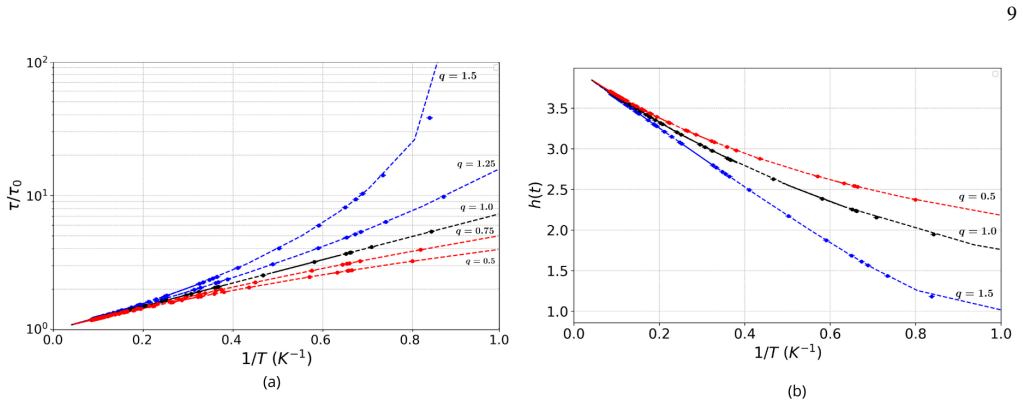
- The q-deformed relaxation law gives a single tunable knob for scanning sub-Arrhenius, Arrhenius, and super-Arrhenius activation regimes in one simulator.
- Smoother drive envelopes produced by nonadditive relaxation laws reduce trace-distance error, so matching the drive bandwidth to the ansatz's low-frequency expressibility improves simulation fidelity.
- The density-matrix reconstruction in Eq. (14) yields coherence terms and average Bloch-sphere coherence, quantities previous VQS open-system implementations did not extract, making the method a diagnostic probe of dissipative regimes.
Reading between the lines
- An implication left implicit in the paper is that the same norm-parameter encoding could be tested against other generalized relaxation laws, for example Vogel-Fulcher-Tammann or d-Arrhenius forms, simply by replacing $\tau_q$; the variational pipeline would then become a general benchmark for relaxation models.
- Because the q-dependence enters mainly through the envelope of the composite field rather than through the Hamiltonian, the method's predictive power for a real bath depends on independently estimating q; a direct measurement of $\lambda$ from population decay would provide that estimate.
- The coherence formula in Eqs. (21)-(23) suggests a concrete experimental probe: rotate the reconstructed state over the Bloch sphere and compare the measured average coherence with the VQS prediction; disagreement localized at particular $q$ values would reveal which relaxation regime the bath realizes.
- If extended to multi-qubit systems, the same alpha-encoding trick would need validation for collective decay channels, since a single norm parameter may not capture correlations between simultaneously decaying qubits.
Signed reviews
Editorial analysis
A structured set of objections, weighed in public.
Referee Report
Summary. The manuscript applies the variational quantum simulation (VQS) framework to a single qubit coupled to a finite-temperature bath, modeling the open dynamics through the generalized amplitude-damping channel. The authors introduce a nonadditive relaxation-time model with a tunable parameter q that generalizes the Arrhenius law, and they compare VQS population dynamics and trace-distance errors against exact qutip solutions for two driving protocols. The central claim is that the norm parameter of the variational state can be used to reconstruct the thermal density matrix, thereby yielding accurate simulation of the dissipative dynamics for both Arrhenius and non-Arrhenius regimes.
Significance. The paper addresses a relevant problem—extending variational quantum simulation to finite-temperature open systems—and the proposed nonadditive relaxation model is an interesting phenomenological extension that recovers Arrhenius behavior as a limit. The numerical experiments cover two qualitatively different drive protocols and use a realistic noise model, which is a strength. However, the central derivation that connects the variational norm to the decay probability is not valid as written: the key relation α^4 ≈ 1 − e^{−λ t} is inconsistent at t = 0, and the resulting density matrix in Eq. (14) does not have unit trace. Because the dissipative content enters exclusively through this mapping, the numerical agreement with qutip does not validate the method as a simulation of the open-system dynamics. If a sound mapping were provided, the idea would be worth revisiting; in its current form, the central claim is unsupported.
major comments (4)
- [Section III, Eq. (14)] The mapping α^4 ≈ 1 − e^{−λ t} in Section III is ad hoc and internally inconsistent. At t = 0, the initial condition α(0) = 1 gives α^4 = 1, whereas 1 − e^0 = 0; the relation cannot hold at the initial time. Moreover, Eq. (14) replaces the factor (1 − p) in Eq. (4) with α^4 and the factor p with (1 − α^2); these two substitutions require α^2 + α^4 = 1, which no decaying norm satisfies. Thus Eq. (14) is not a valid transcription of the thermal density operator, and the claim that VQS "accurately maps the effective nonunitary generator" is not supported.
- [Eq. (14)] The operator in Eq. (14) is not a physical density matrix: its trace is 1 + 2(1 − α^2) f, which is greater than 1 for α^2 < 1 and f > 0. Since the populations extracted from this operator are used in all the comparisons in Section IV, the reported errors and conclusions are not based on valid quantum states.
- [Section IV, qutip comparison] The numerical validation against qutip is circular for the dissipative part. The exact solution is obtained from the Lindblad dissipator with the same damping parameter λ (or τ_q) that is inserted by hand into the mapping α^4 ≈ 1 − e^{−λ t}; the VQS density matrix is then constructed from that same p(t). Consequently, agreement between the two does not demonstrate that the VQS equations of motion reproduce the open-system dynamics. The paper would need to show that the variational equations with the effective Hamiltonian in Eq. (15) independently generate the norm decay and coherences used in Eq. (14).
- [Section II and Section IV] The paper does not specify how the nonadditive relaxation time τ_q of Eq. (6) determines the damping constant λ used in the mapping and in the qutip reference. Without this connection, the dependence of the simulated dynamics on q is imposed through the ad-hoc relation rather than derived from the generalized amplitude-damping generator, so the claim of simulating nonadditive relaxation dynamics is not established.
minor comments (5)
- [Abstract] The abstract contains a duplicated sentence: the results list (i)–(iii) appears twice verbatim.
- [Section III] The phrase "Variation Quantum Algorithms" appears twice and should be "Variational Quantum Algorithms".
- [Section IV A] The text says "nonactive model" where it should say "nonadditive model".
- [Figure 3 and Figure 5 captions] The captions state that the nonadditive dynamics have little influence on the Hamiltonian of the system, but the text shows instead that the driving envelope h(t) is q-independent while the relaxation time changes; the captions should be clarified.
- [Eq. (3)] The stated range f ∈ [0, 0.5] is not the full domain of a Fermi-Dirac occupation factor; if a restriction is intended, it should be justified.
Circularity Check
Section III's α↔p mapping imports the exact decay probability into Eq. (14), so the VQS-vs-qutip comparison partially verifies that mapping by construction.
-
self definitional
[Section III, Eq. (14) and the paragraph preceding it]
"The key idea is to use the norm parameter α to get a description of the probability decay p(t). Since α2 =⟨Ψ|Ψ⟩, we obtain α4 ≈ (1− e−λt), satisfying α(0) = 1 and p(0) = 0. Therefore, since the quantum circuit only simulates the evolution of closed systems, the simulation was made using the parameters ⃗θ to get the evolution {ρ00(⃗θt),ρ 01(⃗θt),ρ 10(⃗θt),ρ 11(⃗θt)}, while the norm parameter α was use to compute the decay probability p(t). Thus, Eq. (4) becomes Eq. (14)."
Equation (4) is the exact generalized-amplitude-damping density matrix with p(t)=1−e^{−λt}, and Equation (14) is obtained by substituting p(t) with a function of the variational norm α. The qutip 'exact' comparison solves the same Lindblad dissipator (Eq. 3) with the same λ (from Eq. 6). Hence the population decay that VQS is claimed to predict is inserted through the α↔p identification; the comparison largely reduces to checking that asserted identity. The substitution is also internally inconsistent as printed: at t=0, α(0)=1 gives α^4=1, whereas 1−e^0=0, and Eq. (14) uses 1−α^2 in the f-terms and a plus sign, so its trace is not 1 for α<1, f>0.
full rationale
The central numerical claim is that VQS 'accurately maps the effective nonunitary generator under generalized amplitude damping'. In the paper, this claim is tested by comparing Eq. (14) against qutip's exact solution. Eq. (14) is not an independent density-matrix output: it is literally Eq. (4) with the channel decay probability p(t) replaced by the norm parameter α. Because Eq. (4) already contains p(t)=1−e^{−λt} and the exact solution uses the same λ and the same Lindblad dissipator, the comparison is partly self-referential. The paper provides no derivation of α^4≈1−e^{−λt}; the relation is asserted, and it is false at t=0 if α(0)=1. The printed Eq. (14) also fails to match Eq. (4) under the stated substitution (plus sign on the f-term, 1−α^2 instead of 1−α^4), which compounds the problem. No load-bearing self-citation chain was found: the nonadditive relaxation formula is presented as a new parametric ansatz, and qutip is an external benchmark. The VQS equations of motion are standard and could in principle provide independent content, but as written the finite-temperature relaxation that is compared is entangled with the constructed α↔p mapping, so the circularity score is moderate.
Assumptions & free parameters
free parameters (5)
- q (nonadditivity parameter) =
0.5, 0.75, 1, 1.25, 1.5
- lambda (damping constant) =
not specified numerically
- tau_0 (Arrhenius prefactor) =
not specified numerically
- alpha(t) norm mapping =
alpha^4 approximately 1 - e^{-lambda t}
- f (bath occupation) =
in [0,0.5], value for 10 K not given
assumptions (6)
- domain assumption Lindblad master equation governs the open-system dynamics
- domain assumption Linear quantum state diffusion averages to the Lindblad equation
- domain assumption The thermal state ansatz in Eq. (4) is the exact solution for the qubit under generalized amplitude damping
- domain assumption The q-exponential relaxation law in Eq. (6) describes nonadditive relaxation dynamics
- ad hoc to paper alpha^4 approximately 1 - e^{-lambda t} maps the norm parameter to the decay probability
- domain assumption The noisy simulator in Appendix A represents near-term device behavior
Cite this review
Pith. "Pith review of Variational quantum simulation of a nonadditive relaxation dynamics in a qubit coupled to a finite-temperature bath." pith.science (2026). https://pith.science/paper/77AOOJ6Q
@misc{pith2026250512013,
  author       = {Pith},
  title        = {Pith review of: Variational quantum simulation of a nonadditive relaxation dynamics in a qubit coupled to a finite-temperature bath},
  year         = {2026},
  howpublished = {\url{https://pith.science/paper/77AOOJ6Q}},
  note         = {Machine review of arXiv:2505.12013}
}
read the original abstract
In this paper, we present an application of the variational quantum simulation (VQS) framework to capture finite-temperature open-system dynamics on near-term quantum hardware. By embedding the generalized amplitude-damping channel into the VQS algorithm, we modeled the energy exchange with a thermal bath through its Lindblad representation and thereby simulated realistic dissipative effects. To explore a wide range of activation behaviors, we introduce a nonadditive relaxation-time model using a generalized form of the Arrhenius law, based on the phenomenological parameter q. We compare our method on a driven qubit subject to both static and composite time-dependent fields, comparing population evolution and trace distance errors against exact solutions. Our results demonstrate that (i) VQS accurately maps the effective nonunitary generator under generalized amplitude damping, (ii) smoother drive envelopes induced by nonaddtive parameters suppress high frequency components and yield lower simulation errors, and (iii) the variational manifold exhibits dynamical selectivity, maintaining mapping fidelity even as the exact solution's sensitivity to q increases. Our results demonstrate that (i) VQS accurately maps the effective nonunitary generator under generalized amplitude damping, (ii) smoother drive envelopes induced by nonaddtive parameters suppress high frequency components and yield lower simulation errors, and (iii) the variational manifold exhibits dynamical selectivity, maintaining mapping fidelity even as the exact solution's sensitivity to q increases.
Figures


Figures from the paper (4 more)



Reference graph
Works this paper leans on
-
[1]
J. P. Dowling and G. J. Milburn, Philosophical Transactions of the Royal Society of London. Series A: Mathematical, Physical and Engineering Sciences 361, 1655 (2003)
work page 2003
- [2]
-
[3]
M. Atzori and R. Sessoli, Journal of the American Chemical Society 141, 11339 (2019), pMID: 31287678, https://doi.org/10.1021/jacs.9b00984
-
[5]
Buluta, S
I. Buluta, S. Ashhab, and F. Nori, Reports on Progress in Physics 74, 104401 (2011)
2011
-
[6]
S. Somaroo, C. H. Tseng, T. F. Havel, R. Laflamme, and D. G. Cory, Phys. Rev. Lett.82, 5381 (1999)
work page 1999
-
[7]
I. Buluta and F. Nori, Science 326, 108 (2009), https://www.science.org/doi/pdf/10.1126/science.1177838
-
[8]
Lloyd, Science 273, 1073 (1996)
S. Lloyd, Science 273, 1073 (1996)
1996
-
[9]
J. T. Barreiro, M. M ¨uller, P. Schindler, D. Nigg, T. Monz, M. Chwalla, M. Hennrich, C. F. Roos, P. Zoller, and R. Blatt, Nature 470, 486 (2011)
work page 2011
Show all 76 references
-
[10]
Breuer and F
H.-P. Breuer and F. Petruccione, The theory of open quantum systems (Oxford University Press, USA, 2002)
2002
-
[11]
R. P. Feynman, in Feynman and computation (cRc Press, 2018) pp. 133–153
2018
-
[12]
Preskill, Quantum 2, 79 (2018)
J. Preskill, Quantum 2, 79 (2018)
2018
-
[13]
Cerezo, A
M. Cerezo, A. Arrasmith, R. Babbush, S. C. Benjamin, S. Endo, K. Fujii, J. R. McClean, K. Mitarai, X. Yuan, L. Cincio, et al., Nature Reviews Physics 3, 625 (2021)
2021
-
[14]
X. Yuan, S. Endo, Q. Zhao, Y . Li, and S. C. Benjamin, Quan- tum 3, 191 (2019)
2019
-
[15]
S. Endo, J. Sun, Y . Li, S. C. Benjamin, and X. Yuan, Physical Review Letters 125, 010501 (2020)
2020
-
[16]
Li and S
Y . Li and S. C. Benjamin, Physical Review X7, 021050 (2017)
2017
-
[17]
J. Luo, K. Lin, and X. Gao, The Journal of Physical Chemistry Letters 15, 3516 (2024)
2024
-
[18]
Jaksic and C
V . Jaksic and C. Pillet, Journal of Mathematical Physics 38, 1757 (1997)
1997
-
[19]
H. Wang, S. Ashhab, and F. Nori, Physical Review A—Atomic, Molecular, and Optical Physics 83, 062317 (2011)
2011
-
[20]
Yamaguchi and Y
F. Yamaguchi and Y . Yamamoto, Applied Physics A 68, 1 (1999)
1999
-
[21]
X. Hu, R. de Sousa, and S. D. Sarma, in F oundations Of Quantum Mechanics In The Light Of New Technology: ISQM—Tokyo’01 (World Scientific, 2002) pp. 3–11
2002
-
[22]
Tolunay, I
M. Tolunay, I. Liepuoniute, M. Vyushkova, and B. A. Jones, Physical Chemistry Chemical Physics 25, 15115 (2023)
2023
-
[23]
Arnold, Communications in Partial Di fferential Equations 21, 473 (1996)
A. Arnold, Communications in Partial Di fferential Equations 21, 473 (1996)
1996
-
[24]
Prester, I
M. Prester, I. ˇZivkovi´c, D. Drobac, V . ˇSurija, D. Paji ´c, and H. Berger, Physical Review B—Condensed Matter and Materi- als Physics 84, 064441 (2011)
2011
-
[25]
Bochenek and P
D. Bochenek and P. B. Niemiec, Archives of Metallurgy and Materials 58 (2013)
2013
-
[26]
Ferbinteanu, H
M. Ferbinteanu, H. Miyasaka, W. Wernsdorfer, K. Nakata, K. Sugiura, M. Yamashita, C. Coulon, and R. Cl ´erac, Journal of the American Chemical Society 127 9, 3090 (2005)
2005
-
[27]
Yan-rong, L
L. Yan-rong, L. Hai-qing, L. Ying, S. Shao-Kui, and W. Yun- Ping, Chinese Physics Letters 26, 077504 (2009)
2009
-
[28]
Sirenko, F
V . Sirenko, F. B. Usieto, and J. Bartolom ´e, Low Temperature Physics (2024), 10.1063 /10.0026056
2024
-
[29]
Demsar, Journal of Low Temperature Physics 201, 676 (2020)
J. Demsar, Journal of Low Temperature Physics 201, 676 (2020)
2020
-
[30]
Erdem and G
R. Erdem and G. G ¨ulpınar, IntechOpen , 255 (2011)
2011
-
[31]
W. J. Blackmore, G. K. Gransbury, P. Evans, J. G. Kragskow, 12 D. P. Mills, and N. F. Chilton, Physical Chemistry Chemical Physics 25, 16735 (2023)
2023
-
[32]
Levit, J
R. Levit, J. C. Martinez-Garcia, D. A. Ochoa, and J. E. Garc ´ıa, Scientific reports 9, 12390 (2019)
2019
-
[33]
G. Liu, J. P. Wu, H. Dong, and H. Zhang, Journal of Non- crystalline Solids 528, 119761 (2020)
2020
-
[34]
Geske, M
J. Geske, M. Harrach, L. Heckmann, R. Horstmann, F. Klameth, N. M ¨uller, E. Pafong, T. Wohlfromm, B. Drossel, and M. V o- gel, Zeitschrift f¨ur Physikalische Chemie 232, 1187 (2018)
2018
-
[35]
Huang and M.-K
I.-S. Huang and M.-K. Tsai, The Journal of Physical Chemistry A 122, 4654 (2018)
2018
-
[36]
Stroka, Food Additives & Contaminants: Part A 28, 259 (2011), https://doi.org/10.1080/19440049.2011.561599
J. Stroka, Food Additives & Contaminants: Part A 28, 259 (2011), https://doi.org/10.1080/19440049.2011.561599
2011
-
[38]
Galamba, Journal of Physics: Condensed Matter 29, 015101 (2016)
N. Galamba, Journal of Physics: Condensed Matter 29, 015101 (2016)
2016
-
[39]
Nishiyama, S
M. Nishiyama, S. Kleijn, V . Aquilanti, and T. Kasai, Chemical Physics Letters 482, 325 (2009)
2009
-
[41]
Rosa Junior, C
A. Rosa Junior, C. Cruz, W. S. Santana, and M. A. Moret, Physical Review E 100, 022139 (2019)
2019
-
[42]
Lindblad, Communications in mathematical physics 48, 119 (1976)
G. Lindblad, Communications in mathematical physics 48, 119 (1976)
1976
-
[43]
Manzano, Aip advances 10 (2020)
D. Manzano, Aip advances 10 (2020)
2020
-
[44]
de Oliveira, R
A. de Oliveira, R. Gomes, V . Brasil, N. R. da Silva, L. C ´eleri, and P. S. Ribeiro, Physics Letters A 384, 126933 (2020)
2020
-
[45]
A. J. Leggett, S. Chakravarty, A. T. Dorsey, M. P. A. Fisher, A. Garg, and W. Zwerger, Rev. Mod. Phys. 59, 1 (1987)
1987
-
[46]
Fujiwara, Physical Review A—Atomic, Molecular, and Op- tical Physics 70, 012317 (2004)
A. Fujiwara, Physical Review A—Atomic, Molecular, and Op- tical Physics 70, 012317 (2004)
2004
-
[47]
N ¨ußeler, I
A. N ¨ußeler, I. Dhand, S. F. Huelga, and M. B. Plenio, Phys. Rev. B 101, 155134 (2020)
2020
-
[48]
Nesbet, Reviews of Modern Physics 33, 28 (1961)
R. Nesbet, Reviews of Modern Physics 33, 28 (1961)
1961
-
[49]
N ¨ußeler, I
A. N ¨ußeler, I. Dhand, S. F. Huelga, and M. B. Plenio, Physical Review B 101, 155134 (2020)
2020
-
[50]
Ghosh, S
A. Ghosh, S. S. Sinha, and D. S. Ray, Physical Review E—Statistical, Nonlinear, and Soft Matter Physics 86, 011138 (2012)
2012
-
[51]
B. d. L. Bernardo, Physical Review E 102, 062152 (2020)
2020
-
[52]
Topping and S
C. Topping and S. Blundell, Journal of Physics: Condensed Matter 31, 013001 (2018)
2018
-
[53]
D. G. Truhlar and A. Kohen, Proceedings of the National Academy of Sciences 98, 848 (2001)
2001
-
[54]
Heitler and E
W. Heitler and E. Teller, Proceedings of the Royal Society of London. Series A 155, 629 (1936)
1936
-
[55]
Korringa, Physica 16, 601 (1950)
J. Korringa, Physica 16, 601 (1950)
1950
-
[56]
Rosa Jr, C
A. Rosa Jr, C. Cruz, W. S. Santana, E. Brito, and M. A. Moret, Physical Review E 101, 042131 (2020)
2020
-
[57]
Rosa Jr, P
A. Rosa Jr, P. Vaveliuk, K. C. Mundim, and M. Moret, Physica A: Statistical Mechanics and its Applications 450, 317 (2016)
2016
-
[58]
R. J. Beerends, F ourier and Laplace transforms (Cambridge University Press, 2003)
2003
-
[59]
Tsallis, Journal of statistical physics 52, 479 (1988)
C. Tsallis, Journal of statistical physics 52, 479 (1988)
1988
-
[60]
V . H. Silva, V . Aquilanti, H. C. de Oliveira, and K. C. Mundim, Chemical Physics Letters 590, 201 (2013)
2013
-
[61]
Park and N
C.-Y . Park and N. Killoran, Quantum8, 1239 (2024)
2024
-
[62]
A. D. McLachlan, Molecular Physics 8, 39 (1964)
1964
-
[63]
Okuma and Y
N. Okuma and Y . O. Nakagawa, Physical Review B 105, 054304 (2022)
2022
-
[64]
D. T. Gillespie, Physical review E 54, 2084 (1996)
1996
-
[65]
I. M. Georgescu, S. Ashhab, and F. Nori, Rev. Mod. Phys. 86, 153 (2014)
2014
-
[66]
Christou, D
G. Christou, D. Gatteschi, D. N. Hendrickson, and R. Sessoli, MRS bulletin 25, 66 (2000)
2000
-
[67]
A. C. Santos, Journal of Physics B: Atomic, Molecular and Op- tical Physics 51, 015501 (2017)
2017
-
[68]
Oshima and K
K. Oshima and K. Azuma, Physical Review A 68, 034304 (2003)
2003
-
[69]
J. R. Johansson, P. D. Nation, and F. Nori, Computer physics communications 183, 1760 (2012)
2012
-
[70]
Meana-Pa ˜neda, D
R. Meana-Pa ˜neda, D. G. Truhlar, and A. Fern ´andez- Ramos, The Journal of Chemical Physics 134, 094302 (2011), https: //pubs.aip.org/aip/jcp/article- pdf/doi/10.1063/1.3555763/13306303/094302 1 online.pdf
2011 doi
-
[71]
Cavalli, V
S. Cavalli, V . Aquilanti, K. C. Mundim, and D. De Fazio, The Journal of Physical Chemistry A 118, 6632 (2014), pMID: 24893210, https://doi.org/10.1021/jp503463w
2014 doi
-
[72]
R. V . Chamberlin, Phys. Rev. B48, 15638 (1993)
1993
-
[73]
S. Roy, P. Schopf, and A. Warshel, The Journal of Physical Chemistry B 121, 6520 (2017), pMID: 28613876, https://doi.org/10.1021/acs.jpcb.7b03698
2017 doi
-
[74]
V . H. Carvalho-Silva, V . Aquilanti, H. C. B. de Oliveira, and K. C. Mundim, Journal of Computational Chemistry 38, 178 (2017), https://onlinelibrary.wiley.com/doi/pdf/10.1002/jcc.24529
2017 doi
-
[75]
Yahata and M
H. Yahata and M. Suzuki, Journal of the Physical Society of Japan 27, 1421 (1969)
1969
-
[76]
D. S. Fisher, Physical review letters 56, 416 (1986)
1986
-
[77]
Djurberg, P
C. Djurberg, P. Svedlindh, P. Nordblad, M. F. Hansen, F. Bødker, and S. Mørup, Physical review letters 79, 5154 (1997)
1997
-
[78]
Yadav, P
K. Yadav, P. Koushik, S. Singh, M. Hagihala, and K. Mukher- jee, New Journal of Physics 25, 123030 (2023)
2023
-
[79]
Kundu, T
S. Kundu, T. Bar, R. K. Nayak, and B. Bansal, Physical Review Letters 124, 095703 (2020)
2020
Reviewed August 15, 2026 · model on record in the stance chip above.
Discussion (0). Continue with ORCID to comment.