Speed and accuracy for long signals: Frequency-domain effective-one-body waveforms for compact binary coalescences
Pith reviewed 2026-06-28 13:16 UTC · model grok-4.3
The pith
A hybrid frequency-domain method for effective-one-body waveforms matches full-model accuracy near merger for binary neutron stars while retaining the speed of the stationary-phase approximation.
A machine-rendered reading of the paper's core claim, the machinery that carries it, and where it could break.
Core claim
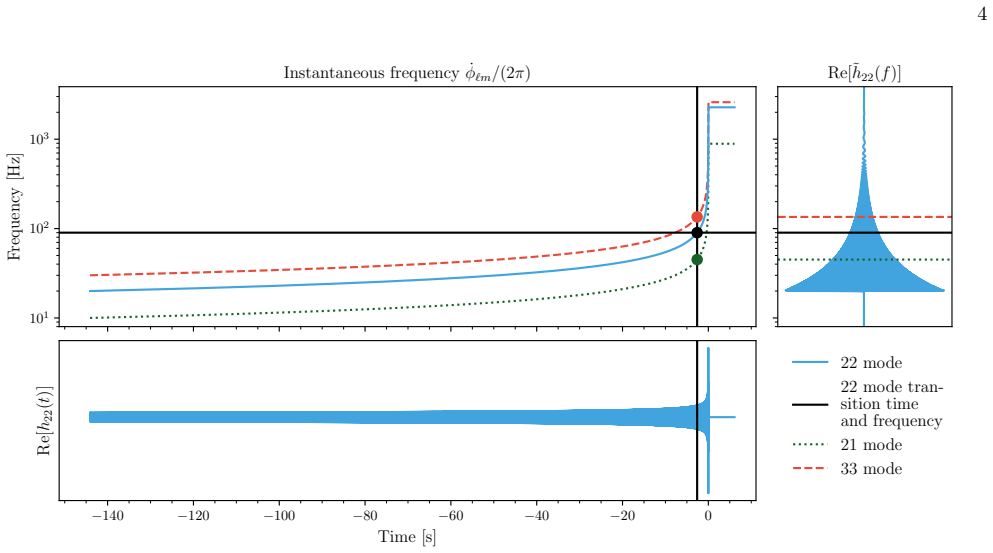
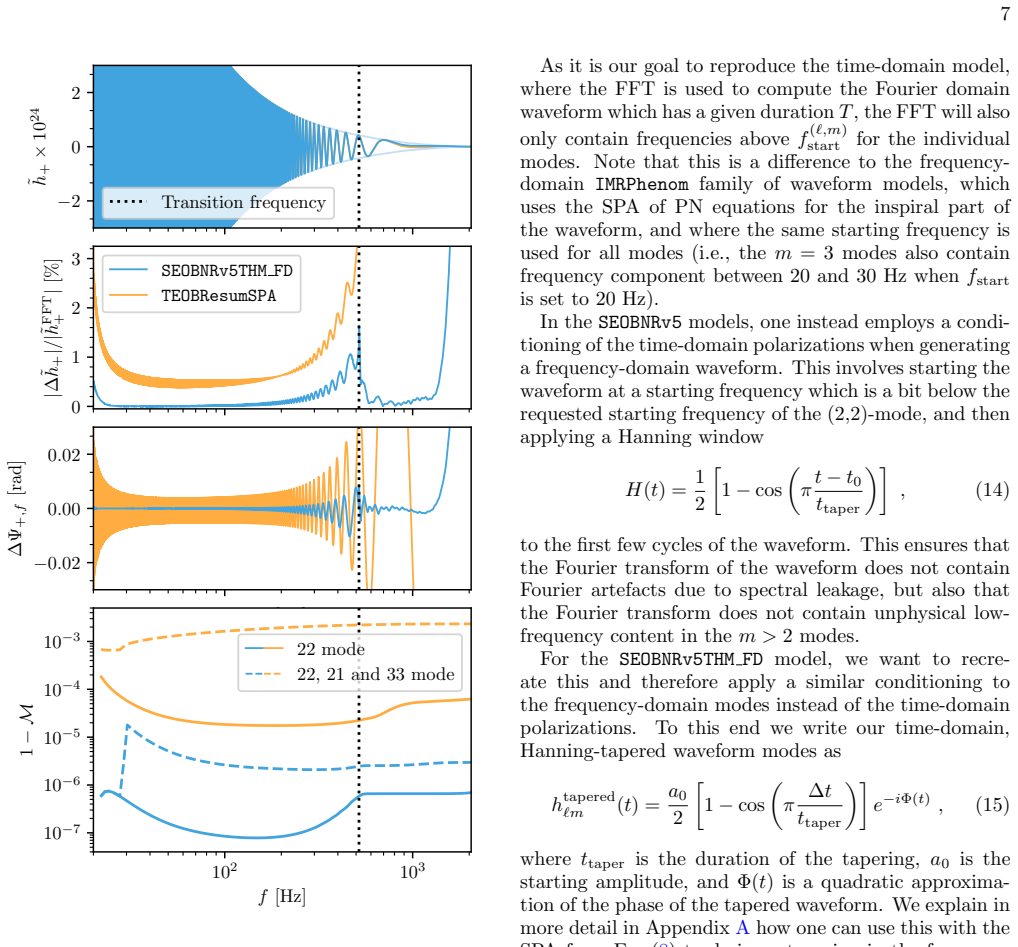
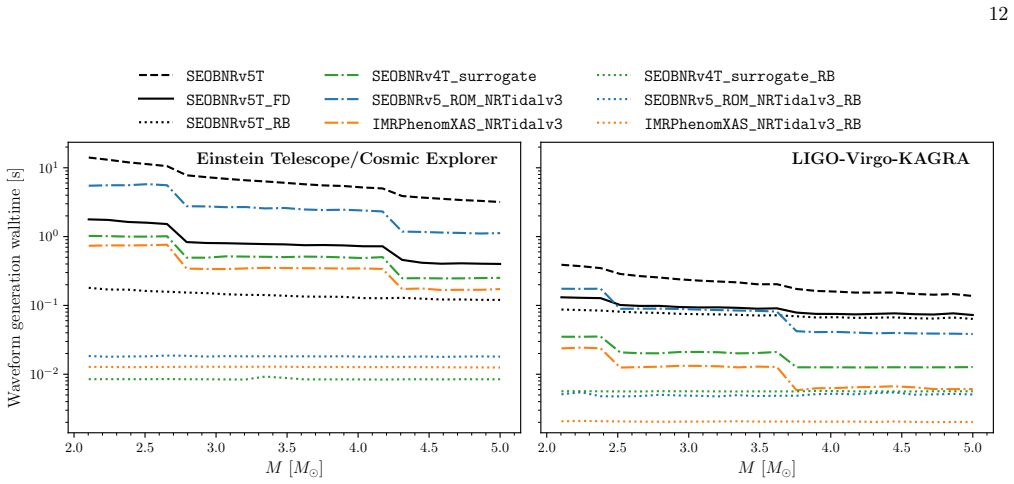
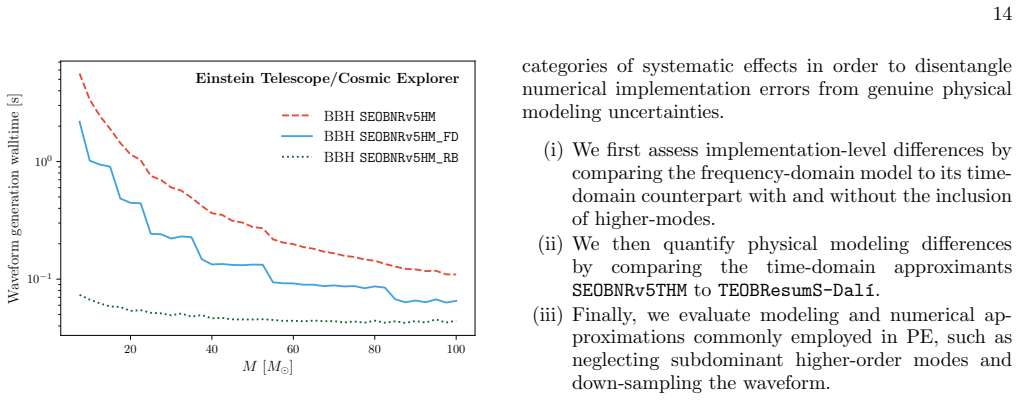
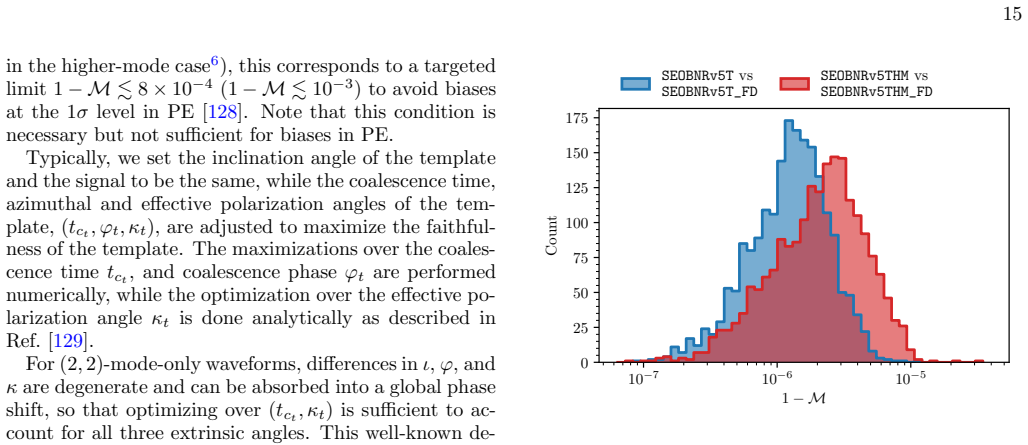
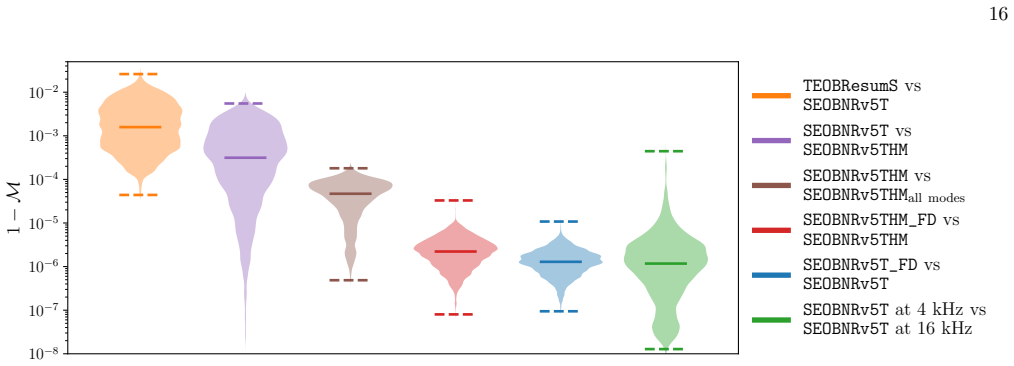
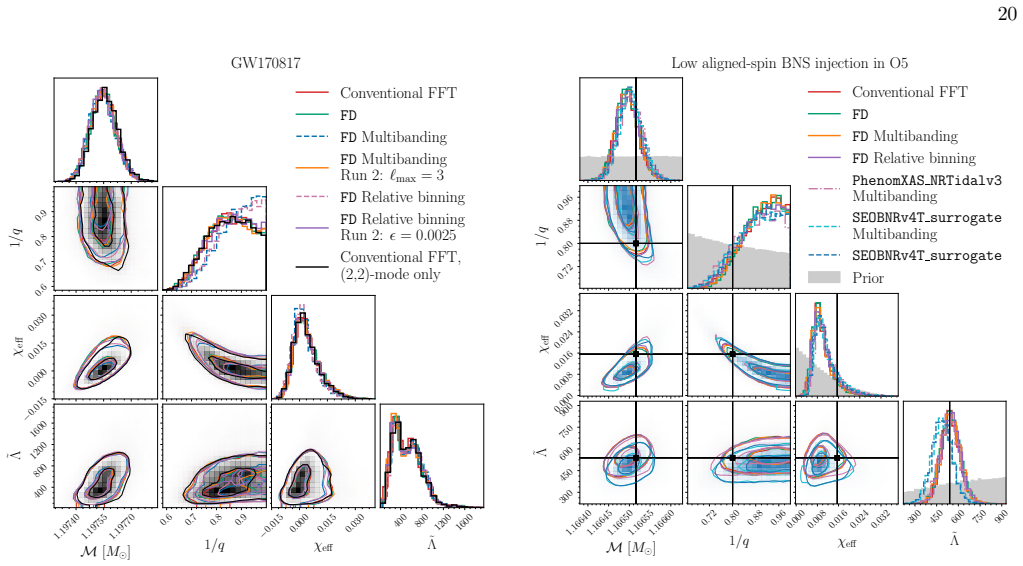
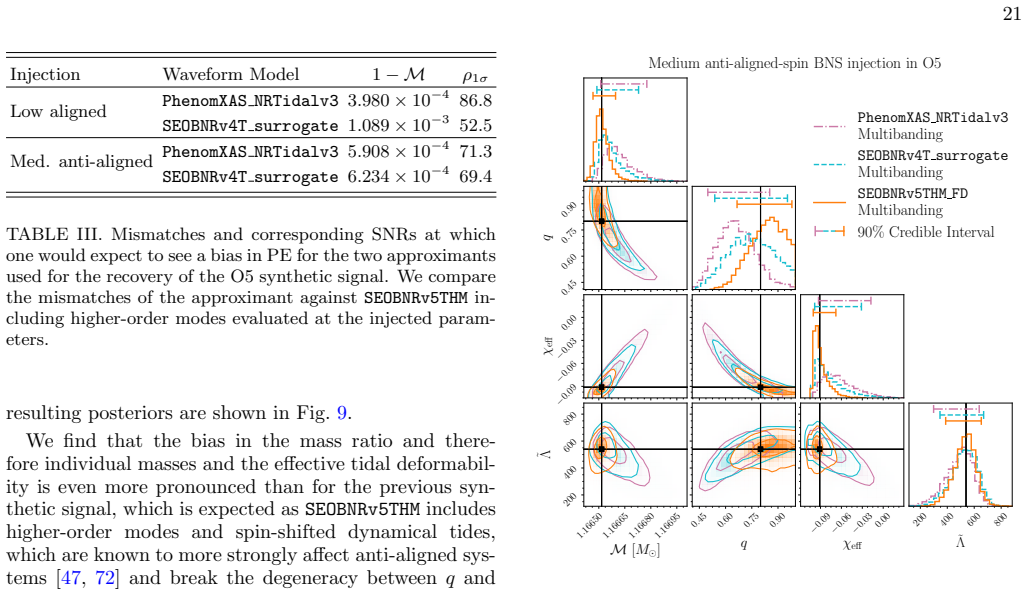
The hybrid approach of using the stationary-phase approximation for the early inspiral combined with a fast Fourier transform treatment of the late- and post-inspiral regime, applied mode-by-mode, retains the efficiency of the SPA without affecting the waveform accuracy close to merger. The resulting waveforms show excellent agreement with the baseline SEOBNRv5THM model in both mismatches and when analyzing real and synthetic data, and the method significantly reduces computational costs to enable faithful parameter estimation for BNS signals within practical runtimes of order days. The procedure can be readily extended to coalescing binary black hole systems.
What carries the argument
The hybrid stationary-phase approximation combined with mode-by-mode fast Fourier transform treatment of the late-inspiral regime within the effective-one-body framework.
If this is right
- The waveform generation speed can be further decreased using multibanding and relative binning techniques.
- Excellent agreement holds with the baseline model both in mismatch calculations and in analyses of real and synthetic data.
- Waveform systematics from the hybrid method could affect BNS detections in upcoming observational runs and new facilities.
- The method enables faithful parameter estimation for BNS signals within practical runtimes of order days.
- The procedure extends directly to coalescing binary black hole systems.
Where Pith is reading between the lines
- Similar hybrid switching could be tested on other time-domain models to accelerate inference for any long-duration compact-binary signals.
- The reduced cost might make it practical to add higher-order physics such as spin precession or eccentricity into routine BNS analyses.
- Days-long runtimes could support population studies that combine many BNS events to tighten constraints on the nuclear equation of state.
- If the switch point can be tuned further, the same logic might apply to signals from third-generation detectors that last even longer.
Load-bearing premise
The stationary-phase approximation remains sufficiently accurate throughout the early inspiral so that switching to FFT only near merger does not introduce errors that affect overall waveform fidelity or parameter recovery for BNS systems.
What would settle it
A side-by-side comparison of the hybrid waveform against the full time-domain SEOBNRv5THM model on the same synthetic BNS signal that shows a mismatch large enough to shift the recovered posterior distributions for tidal deformability parameters.
Figures
read the original abstract
Gravitational-wave inference for long signals, like those from binary neutron-star (BNS) systems, requires waveform models that are both physically faithful and computationally efficient, otherwise, one risks drawing incorrect conclusions about nuclear matter from observations. To address this challenge, we present a frequency-domain implementation of the accurate SEOBNRv5THM waveform model for quasi-circular, spin-aligned BNS systems within the effective-one-body framework. Our approach combines the stationary-phase approximation (SPA) for the early inspiral with a fast Fourier transform treatment of the late- and post-inspiral regime, applied mode-by-mode. Our hybrid approach retains the efficiency of the SPA without affecting the waveform accuracy close to merger, where matter effects are most significant. The resulting waveform's generation speed can be further decreased using modern parameter-estimation techniques, such as multibanding and relative binning. We demonstrate excellent agreement with the baseline SEOBNRv5THM model in both mismatches and when analyzing real and synthetic data, and show how waveform systematics could affect BNS detections in upcoming observational runs and new facilities on the ground. We find that our method significantly reduces computational costs, enabling faithful parameter estimation for BNS signals within practical runtimes of order days. Our procedure can be readily extended to coalescing binary black hole systems.
Editorial analysis
A structured set of objections, weighed in public.
Referee Report
Summary. The manuscript presents a frequency-domain implementation of the SEOBNRv5THM effective-one-body waveform model for quasi-circular, spin-aligned binary neutron star systems. It combines the stationary-phase approximation for the early inspiral with a fast Fourier transform treatment of the late- and post-inspiral regime, applied mode-by-mode, and incorporates multibanding and relative binning for further speedups. The hybrid approach is claimed to retain SPA efficiency without compromising accuracy near merger, with demonstrations of excellent agreement to the baseline SEOBNRv5THM model via mismatches and end-to-end parameter estimation on real and synthetic data, enabling practical BNS analyses in runtimes of order days.
Significance. If the accuracy and efficiency results hold, the work is significant for gravitational-wave data analysis of long-duration BNS signals. It provides a computationally practical yet faithful model needed to extract nuclear equation-of-state constraints from observations, directly supporting analyses in upcoming runs and new ground-based facilities. The explicit validation through mismatches and full parameter-recovery tests on both synthetic and real data, together with the hybrid construction, strengthens its potential utility.
minor comments (1)
- [Abstract] Abstract: the claim of 'excellent agreement' in mismatches and data analysis would be strengthened by including at least one or two representative quantitative mismatch values, runtime comparisons, and a brief statement of the data-exclusion or fitting criteria used.
Simulated Author's Rebuttal
We thank the referee for the positive assessment of our work and the recommendation of minor revision. The referee summary correctly captures the hybrid frequency-domain construction, its validation, and the computational gains for long BNS signals.
Circularity Check
No significant circularity identified
full rationale
The manuscript describes a hybrid SPA+FFT implementation of the existing SEOBNRv5THM model for BNS waveforms. Accuracy claims are supported by direct numerical mismatches against the external baseline SEOBNRv5THM model plus end-to-end parameter recovery on synthetic and real data. These comparisons constitute independent external benchmarks rather than internal fits or self-referential definitions. No load-bearing step reduces to a self-citation chain, an ansatz smuggled via prior work, or a prediction that is definitionally equivalent to its input. The central efficiency/accuracy claim is therefore self-contained against external validation.
Axiom & Free-Parameter Ledger
Forward citations
Cited by 1 Pith paper
-
Joint inference of line-of-sight acceleration and orbital eccentricity in neutron-star--black-hole binaries
All five NSBH events are consistent with zero line-of-sight acceleration; the joint posterior for GW200105_162426 disfavors both zero LOSA and zero eccentricity at 90% credibility.
Reference graph
Works this paper leans on
-
[1]
B. P. Abbottet al.(LIGO Scientific, Virgo), Obser- vation of Gravitational Waves from a Binary Black Hole Merger, Phys. Rev. Lett.116, 061102 (2016), arXiv:1602.03837 [gr-qc]
Pith/arXiv arXiv 2016
-
[2]
B. P. Abbottet al.(LIGO Scientific, Virgo), GW170817: Observation of Gravitational Waves from a Binary Neu- tron Star Inspiral, Phys. Rev. Lett.119, 161101 (2017), arXiv:1710.05832 [gr-qc]
Pith/arXiv arXiv 2017
-
[3]
B. P. Abbottet al.(LIGO Scientific, Virgo), Proper- ties of the binary neutron star merger GW170817, Phys. Rev. X9, 011001 (2019), arXiv:1805.11579 [gr-qc]
Pith/arXiv arXiv 2019
-
[4]
T. Dietrich, M. W. Coughlin, P. T. H. Pang, M. Bulla, J. Heinzel, L. Issa, I. Tews, and S. Antier, Multimes- senger constraints on the neutron-star equation of state and the Hubble constant, Science370, 1450 (2020), arXiv:2002.11355 [astro-ph.HE]
arXiv 2020
-
[5]
B. P. Abbottet al.(LIGO Scientific, Virgo, Fermi- GBM, INTEGRAL), Gravitational Waves and Gamma- rays from a Binary Neutron Star Merger: GW170817 and GRB 170817A, Astrophys. J. Lett.848, L13 (2017), arXiv:1710.05834 [astro-ph.HE]
Pith/arXiv arXiv 2017
-
[6]
B. P. Abbottet al.(LIGO Scientific, Virgo, and oth- ers), Multi-messenger Observations of a Binary Neu- tron Star Merger, Astrophys. J. Lett.848, L12 (2017), arXiv:1710.05833 [astro-ph.HE]
Pith/arXiv arXiv 2017
-
[7]
A. G. Abacet al.(LIGO Scientific, VIRGO, KA- GRA), GWTC-4.0: Updating the Gravitational-Wave Transient Catalog with Observations from the First Part of the Fourth LIGO-Virgo-KAGRA Observing Run (2025), arXiv:2508.18082 [gr-qc]
Pith/arXiv arXiv 2025
-
[8]
R. Abbottet al.(LIGO Scientific Collaboration, Virgo Collaboration, and KAGRA Collaboration), Gwtc-3: Compact binary coalescences observed by ligo and virgo during the second part of the third observing run, Phys. Rev. X13, 041039 (2023)
2023
-
[9]
R. Abbottet al.(The LIGO Scientific Collaboration and the Virgo Collaboration), Gwtc-2.1: Deep extended catalog of compact binary coalescences observed by ligo and virgo during the first half of the third observing run, Phys. Rev. D109, 022001 (2024)
2024
-
[10]
B. P. Abbottet al.(LIGO Scientific, Virgo), GW190425: Observation of a Compact Binary Coalescence with To- tal Mass∼3.4M ⊙, Astrophys. J. Lett.892, L3 (2020), arXiv:2001.01761 [astro-ph.HE]
arXiv 2020
-
[11]
W. Niuet al., GW231109 235456: A Sub-threshold Bi- nary Neutron Star Merger in the LIGO-Virgo-KAGRA O4a Observing Run? (2025), arXiv:2509.09741 [astro- ph.HE]
arXiv 2025
-
[12]
R. Abbottet al.(KAGRA, VIRGO, LIGO Scientific), Population of Merging Compact Binaries Inferred Using Gravitational Waves through GWTC-3, Phys. Rev. X 13, 011048 (2023), arXiv:2111.03634 [astro-ph.HE]
Pith/arXiv arXiv 2023
-
[13]
A. G. Abacet al.(LIGO Scientific, VIRGO, KAGRA), GWTC-4.0: Population Properties of Merging Compact Binaries (2025), arXiv:2508.18083 [astro-ph.HE]. 25
Pith/arXiv arXiv 2025
-
[14]
M. Fishbach, A. P. Ji, W.-f. Fong, T. Y. Wu, J. C. Rastinejad, A. Vijaykumar, and H.-Y. Chen, Implica- tions of low neutron star merger rates for gamma-ray bursts, r-process production and Galactic double neu- tron stars (2026), arXiv:2604.05059 [astro-ph.HE]
Pith/arXiv arXiv 2026
-
[15]
O. S. Salafia, Detection probability of light compact bi- nary mergers in future observing runs of the current ground-based gravitational wave detector network, As- tron. Astrophys.702, A54 (2025), arXiv:2507.00588 [gr- qc]
arXiv 2025
-
[16]
Shoemaker, N
D. Shoemaker, N. Arnaud, and T. Sawada, Observing scenario timeline graphic, post-o3 (2026)
2026
-
[17]
R. W. Kiendrebeogoet al., Updated Observing Sce- narios and Multimessenger Implications for the Inter- national Gravitational-wave Networks O4 and O5, As- trophys. J.958, 158 (2023), arXiv:2306.09234 [astro- ph.HE]
arXiv 2023
-
[18]
Weizmann Kiendrebeogoet al., Refinements of gravitational-wave observation strategies using o4a per- formance (2026), in preparation
R. Weizmann Kiendrebeogoet al., Refinements of gravitational-wave observation strategies using o4a per- formance (2026), in preparation
2026
-
[19]
B. P. Abbottet al., Noise curves used for simulations in the update of the observing scenarios paper (2026)
2026
-
[20]
Iacovelli, M
F. Iacovelli, M. Mancarella, S. Foffa, and M. Mag- giore, Forecasting the detection capabilities of third- generation gravitational-wave detectors using gwfast, The Astrophysical Journal941, 208 (2022)
2022
-
[21]
I. Guptaet al., Characterizing gravitational wave detec- tor networks: from A ♯ to cosmic explorer, Class. Quant. Grav.41, 245001 (2024), arXiv:2307.10421 [gr-qc]
arXiv 2024
-
[22]
V. Kalogeraet al., The Next Generation Global Grav- itational Wave Observatory: The Science Book (2021), arXiv:2111.06990 [gr-qc]
arXiv 2021
-
[23]
Reitzeet al., Cosmic Explorer: The U.S
D. Reitzeet al., Cosmic Explorer: The U.S. Contribu- tion to Gravitational-Wave Astronomy beyond LIGO, Bull. Am. Astron. Soc.51, 035 (2019), arXiv:1907.04833 [astro-ph.IM]
Pith/arXiv arXiv 2019
-
[24]
M. Evanset al., A Horizon Study for Cosmic Ex- plorer: Science, Observatories, and Community, (2021), arXiv:2109.09882 [astro-ph.IM]
Pith/arXiv arXiv 2021
-
[25]
Abacet al.(ET), The Science of the Einstein Tele- scope, JCAP03, 081, arXiv:2503.12263 [gr-qc]
A. Abacet al.(ET), The Science of the Einstein Tele- scope, JCAP03, 081, arXiv:2503.12263 [gr-qc]
-
[26]
J. M. Lattimer, The nuclear equation of state and neu- tron star masses, Ann. Rev. Nucl. Part. Sci.62, 485 (2012), arXiv:1305.3510 [nucl-th]
Pith/arXiv arXiv 2012
-
[27]
F. ¨Ozel and P. Freire, Masses, Radii, and the Equation of State of Neutron Stars, Ann. Rev. Astron. Astrophys. 54, 401 (2016), arXiv:1603.02698 [astro-ph.HE]
Pith/arXiv arXiv 2016
-
[28]
S. A. Chin and J. D. Walecka, An Equation of State for Nuclear and Higher-Density Matter Based on a Rela- tivistic Mean-Field Theory, Phys. Lett. B52, 24 (1974)
1974
-
[29]
B. D. Serot and J. D. Walecka, Recent progress in quan- tum hadrodynamics, Int. J. Mod. Phys. E6, 515 (1997), arXiv:nucl-th/9701058
Pith/arXiv arXiv 1997
-
[30]
S. Huthet al., Constraining Neutron-Star Matter with Microscopic and Macroscopic Collisions, Nature606, 276 (2022), arXiv:2107.06229 [nucl-th]
arXiv 2022
-
[31]
M. G. Alford, L. Brodie, A. Haber, and I. Tews, Rel- ativistic mean-field theories for neutron-star physics based on chiral effective field theory, Phys. Rev. C106, 055804 (2022), arXiv:2205.10283 [nucl-th]
arXiv 2022
-
[32]
J. M. Lattimer, Neutron Stars and the Nuclear Matter Equation of State, Ann. Rev. Nucl. Part. Sci.71, 433 (2021)
2021
-
[33]
G. F. Burgio, H. J. Schulze, I. Vidana, and J. B. Wei, Neutron stars and the nuclear equation of state, Prog. Part. Nucl. Phys.120, 103879 (2021), arXiv:2105.03747 [nucl-th]
arXiv 2021
-
[34]
Z. Zhu, A. Li, J. Hu, and H. Shen, Equation of state of nuclear matter and neutron stars: Quark mean-field model versus relativistic mean-field model, Phys. Rev. C108, 025809 (2023), arXiv:2305.16058 [nucl-th]
arXiv 2023
-
[35]
B. F. Schutz, Determining the Hubble Constant from Gravitational Wave Observations, Nature323, 310 (1986)
1986
-
[36]
B. P. Abbottet al.(LIGO Scientific, Virgo, 1M2H, Dark Energy Camera GW-E, DES, DLT40, Las Cumbres Ob- servatory, VINROUGE, MASTER), A gravitational- wave standard siren measurement of the Hubble con- stant, Nature551, 85 (2017), arXiv:1710.05835 [astro- ph.CO]
Pith/arXiv arXiv 2017
- [37]
-
[38]
E. E. Flanagan and T. Hinderer, Constraining neutron star tidal Love numbers with gravitational wave detec- tors, Phys. Rev. D77, 021502 (2008), arXiv:0709.1915 [astro-ph]
Pith/arXiv arXiv 2008
-
[39]
T. Hinderer, B. D. Lackey, R. N. Lang, and J. S. Read, Tidal deformability of neutron stars with realistic equa- tions of state and their gravitational wave signatures in binary inspiral, Phys. Rev. D81, 123016 (2010), arXiv:0911.3535 [astro-ph.HE]
Pith/arXiv arXiv 2010
-
[40]
Hinderer, Tidal Love numbers of neutron stars, As- trophys
T. Hinderer, Tidal Love numbers of neutron stars, As- trophys. J.677, 1216 (2008), arXiv:0711.2420 [astro- ph]
Pith/arXiv arXiv 2008
-
[41]
Shibata, Effects of Tidal Resonances in Coalesc- ing Compact Binary Systems, Progress of Theoretical Physics91, 871 (1994)
M. Shibata, Effects of Tidal Resonances in Coalesc- ing Compact Binary Systems, Progress of Theoretical Physics91, 871 (1994)
1994
-
[42]
T. Hindereret al., Effects of neutron-star dynamic tides on gravitational waveforms within the effective-one- body approach, Phys. Rev. Lett.116, 181101 (2016), arXiv:1602.00599 [gr-qc]
Pith/arXiv arXiv 2016
-
[43]
J. Steinhoff, T. Hinderer, A. Buonanno, and A. Tarac- chini, Dynamical Tides in General Relativity: Effec- tive Action and Effective-One-Body Hamiltonian, Phys. Rev. D94, 104028 (2016), arXiv:1608.01907 [gr-qc]
Pith/arXiv arXiv 2016
-
[44]
P. Schmidt and T. Hinderer, Frequency domain model of f-mode dynamic tides in gravitational waveforms from compact binary inspirals, Phys. Rev. D100, 021501 (2019), arXiv:1905.00818 [gr-qc]
arXiv 2019
-
[45]
N. Andersson and P. Pnigouras, The phenomenology of dynamical neutron star tides, Mon. Not. Roy. Astron. Soc.503, 533 (2021), arXiv:1905.00012 [gr-qc]
arXiv 2021
-
[46]
P. K. Gupta, J. Steinhoff, and T. Hinderer, Relativistic effective action of dynamical gravitomagnetic tides for slowly rotating neutron stars, Phys. Rev. Res.3, 013147 (2021), arXiv:2011.03508 [gr-qc]
arXiv 2021
-
[47]
J. Steinhoff, T. Hinderer, T. Dietrich, and F. Fou- cart, Spin effects on neutron star fundamental-mode dy- namical tides: Phenomenology and comparison to nu- merical simulations, Phys. Rev. Res.3, 033129 (2021), arXiv:2103.06100 [gr-qc]
arXiv 2021
-
[48]
G. Pratten, P. Schmidt, and N. Williams, Impact of Dynamical Tides on the Reconstruction of the Neutron Star Equation of State, Phys. Rev. Lett.129, 081102 (2022), arXiv:2109.07566 [astro-ph.HE]. 26
arXiv 2022
-
[49]
H.-J. Kuan and K. D. Kokkotas, f-mode imprints on gravitational waves from coalescing binaries involving aligned spinning neutron stars, Phys. Rev. D106, 064052 (2022), arXiv:2205.01705 [gr-qc]
arXiv 2022
-
[50]
P. Pnigouras, F. Gittins, A. Nanda, N. Andersson, and D. I. Jones, The dynamical tides of spinning Newtonian stars, Mon. Not. Roy. Astron. Soc.527, 8409 (2024), arXiv:2205.07577 [gr-qc]
arXiv 2024
-
[51]
M. K. Mandal, P. Mastrolia, H. O. Silva, R. Patil, and J. Steinhoff, Gravitoelectric dynamical tides at second post-Newtonian order, JHEP11, 067, arXiv:2304.02030 [hep-th]
-
[52]
M. K. Mandal, P. Mastrolia, H. O. Silva, R. Patil, and J. Steinhoff, Renormalizing Love: tidal effects at the third post-Newtonian order, JHEP02, 188, arXiv:2308.01865 [hep-th]
- [53]
-
[54]
M. Khalil, A. Buonanno, H. Estelles, D. P. Mihaylov, S. Ossokine, L. Pompili, and A. Ramos-Buades, Theo- retical groundwork supporting the precessing-spin two- body dynamics of the effective-one-body waveform mod- els SEOBNRv5, Phys. Rev. D108, 124036 (2023), arXiv:2303.18143 [gr-qc]
arXiv 2023
-
[55]
Samajdar and T
A. Samajdar and T. Dietrich, Waveform systematics for binary neutron star gravitational wave signals: Ef- fects of the point-particle baseline and tidal descrip- tions, Phys. Rev. D98, 124030 (2018)
2018
-
[56]
Gamba, M
R. Gamba, M. Breschi, S. Bernuzzi, M. Agathos, and A. Nagar, Waveform systematics in the gravitational- wave inference of tidal parameters and equation of state from binary neutron-star signals, Phys. Rev. D103, 124015 (2021)
2021
-
[57]
Kunert, P
N. Kunert, P. T. H. Pang, I. Tews, M. W. Coughlin, and T. Dietrich, Quantifying modeling uncertainties when combining multiple gravitational-wave detections from binary neutron star sources, Phys. Rev. D105, L061301 (2022)
2022
-
[58]
Kunert, J
N. Kunert, J. Gair, P. T. H. Pang, and T. Dietrich, Impact of gravitational waveform model systematics on the measurement of the hubble constant, Phys. Rev. D 110, 043520 (2024)
2024
-
[59]
G. Huez, S. Bernuzzi, M. Breschi, and R. Gamba, Gravitational waves from eccentric binary neutron star mergers: Systematic biases and inadequacy of quasi- circular templates, Phys. Rev. D112, 084054 (2025), arXiv:2504.18622 [gr-qc]
arXiv 2025
-
[60]
A. Buonanno and T. Damour, Effective one-body ap- proach to general relativistic two-body dynamics, Phys. Rev. D59, 084006 (1999), arXiv:gr-qc/9811091
Pith/arXiv arXiv 1999
-
[61]
A. Buonanno and T. Damour, Transition from inspiral to plunge in binary black hole coalescences, Phys. Rev. D62, 064015 (2000), arXiv:gr-qc/0001013
Pith/arXiv arXiv 2000
-
[62]
A. Buonanno, G. B. Cook, and F. Pretorius, Inspiral, merger and ring-down of equal-mass black-hole binaries, Phys. Rev. D75, 124018 (2007), arXiv:gr-qc/0610122
Pith/arXiv arXiv 2007
- [63]
-
[64]
Damour, Coalescence of two spinning black holes: an effective one-body approach, Phys
T. Damour, Coalescence of two spinning black holes: an effective one-body approach, Phys. Rev. D64, 124013 (2001), arXiv:gr-qc/0103018
Pith/arXiv arXiv 2001
-
[65]
A. Buonanno, Y. Chen, and T. Damour, Transition from inspiral to plunge in precessing binaries of spinning black holes, Phys. Rev. D74, 104005 (2006), arXiv:gr- qc/0508067
arXiv 2006
-
[66]
A. Boh´ eet al., Improved effective-one-body model of spinning, nonprecessing binary black holes for the era of gravitational-wave astrophysics with advanced detec- tors, Phys. Rev. D95, 044028 (2017), arXiv:1611.03703 [gr-qc]
Pith/arXiv arXiv 2017
-
[67]
R. Cotesta, A. Buonanno, A. Boh´ e, A. Taracchini, I. Hinder, and S. Ossokine, Enriching the Symphony of Gravitational Waves from Binary Black Holes by Tun- ing Higher Harmonics, Phys. Rev. D98, 084028 (2018), arXiv:1803.10701 [gr-qc]
arXiv 2018
-
[68]
S. Ossokineet al., Multipolar Effective-One-Body Wave- forms for Precessing Binary Black Holes: Construc- tion and Validation, Phys. Rev. D102, 044055 (2020), arXiv:2004.09442 [gr-qc]
arXiv 2020
-
[69]
R. Cotesta, S. Marsat, and M. P¨ urrer, Frequency do- main reduced order model of aligned-spin effective-one- body waveforms with higher-order modes, Phys. Rev. D 101, 124040 (2020), arXiv:2003.12079 [gr-qc]
arXiv 2020
-
[70]
A. Ramos-Buades, A. Buonanno, M. Khalil, and S. Os- sokine, Effective-one-body multipolar waveforms for ec- centric binary black holes with nonprecessing spins, Phys. Rev. D105, 044035 (2022), arXiv:2112.06952 [gr- qc]
arXiv 2022
-
[71]
D. P. Mihaylov, S. Ossokine, A. Buonanno, and A. Ghosh, Fast post-adiabatic waveforms in the time domain: Applications to compact binary coalescences in LIGO and Virgo, Phys. Rev. D104, 124087 (2021), arXiv:2105.06983 [gr-qc]
arXiv 2021
-
[72]
M. Haberland, A. Buonanno, and J. Steinhoff, Mod- eling matter in SEOBNRv5THM: Generating fast and accurate effective-one-body waveforms for spin-aligned binary neutron stars, Phys. Rev. D112, 084024 (2025), arXiv:2503.18934 [gr-qc]
arXiv 2025
-
[73]
A. Nagaret al., Time-domain effective-one-body gravi- tational waveforms for coalescing compact binaries with nonprecessing spins, tides and self-spin effects, Phys. Rev. D98, 104052 (2018), arXiv:1806.01772 [gr-qc]
Pith/arXiv arXiv 2018
-
[74]
S. Bernuzzi, A. Nagar, T. Dietrich, and T. Damour, Modeling the Dynamics of Tidally Interacting Binary Neutron Stars up to the Merger, Phys. Rev. Lett.114, 161103 (2015), arXiv:1412.4553 [gr-qc]
Pith/arXiv arXiv 2015
- [75]
- [76]
- [77]
-
[78]
G. Riemenschneider, P. Rettegno, M. Breschi, A. Al- bertini, R. Gamba, S. Bernuzzi, and A. Nagar, Assess- ment of consistent next-to-quasicircular corrections and postadiabatic approximation in effective-one-body mul- 27 tipolar waveforms for binary black hole coalescences, Phys. Rev. D104, 104045 (2021), arXiv:2104.07533 [gr- qc]
arXiv 2021
-
[79]
D. Chiaramello and A. Nagar, Faithful analytical effective-one-body waveform model for spin-aligned, moderately eccentric, coalescing black hole binaries, Phys. Rev. D101, 101501 (2020), arXiv:2001.11736 [gr- qc]
arXiv 2020
-
[80]
S. Akcay, S. Bernuzzi, F. Messina, A. Nagar, N. Or- tiz, and P. Rettegno, Effective-one-body multipolar waveform for tidally interacting binary neutron stars up to merger, Phys. Rev. D99, 044051 (2019), arXiv:1812.02744 [gr-qc]
Pith/arXiv arXiv 2019
discussion (0)
Sign in with ORCID, Apple, or X to comment. Anyone can read and Pith papers without signing in.