REVIEW 48 references
Retrieval-Corrected Conformal Prediction for Time Series
T0 review · reviewed 2026-08-12 · deepseek-v4-flash
Pith's one-line read RCCP retrieves similar past residuals to set an asymmetric interval shape and calibrates that interval with a scalar conformal correction.
The pith
A machine-rendered reading of the paper's core claim, the machinery that carries it, and where it could break.
The reading
RCCP changes how the past errors are selected. For each new forecast, it finds the K past time steps whose contexts look most similar to the current context, using an embedding of the input window and the point forecast. It then forms an asymmetric interval from the upper residuals and lower residuals of those similar steps. Because this retrieved interval is not guaranteed to cover enough test points, RCCP adds a correction step: on a calibration period, it measures how far the realized error falls outside the retrieved interval, normalizing by the retrieved scale, takes the 1 minus alpha quantile of those normalized deviations, and uses that single number to scale the interval at test time.
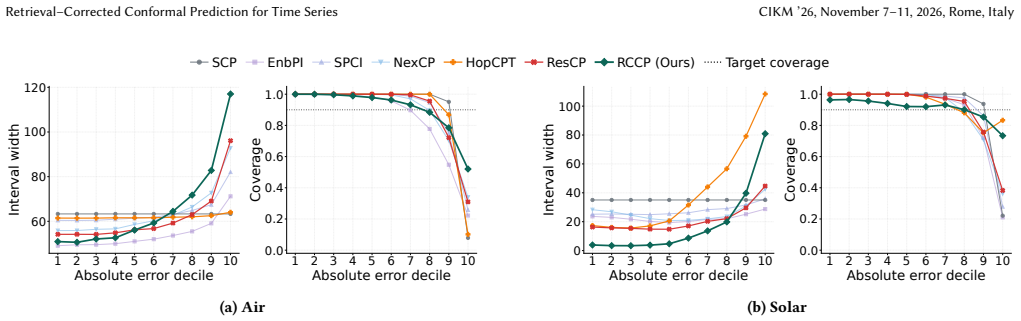
On four benchmark datasets and two forecasters, RCCP keeps empirical coverage near the target level and produces the lowest or tied-lowest Winkler scores, a combined measure of interval width and coverage violations. The width adaptivity analysis shows that RCCP widens intervals most where realized errors are large, so the gains come from better allocation of interval width rather than from uniformly inflating intervals. The main caveat is that the formal coverage guarantee is conditional on a stability assumption about the normalized retrieval error distribution, and the paper does not directly verify that assumption in the experiments.
Extended reading notes
Core claim
The load-bearing claim is that separating residual retrieval from conformal correction yields calibrated, locally adaptive intervals: Theorem 1 states that under Assumptions 1-4, |P_test{Y_t in C_t(hat c)} - q| <= rho_n + (2L/m)(e_n + r_n), and the experiments claim RCCP attains target coverage and the lowest Winkler scores across four benchmarks. If correct, RCCP is a simple, scalable way to obtain locally sharp and coverage-calibrated intervals for fixed time series forecasters.
Load-bearing premise
Assumption 1 in Section 3.4: |F_test(c*) - F_cal(c*)| <= rho_n, where F_cal and F_test are the CDFs of the normalized retrieval error B at the oracle multiplier c*. The entire coverage guarantee collapses to this stability premise. It is especially fragile because during calibration each B_j is computed with a knowledge base containing only earlier calibration points, while at test time the retrieved scale is computed from the full calibration set plus earlier test points, so the B distributions can systematically differ even if the raw residuals are stationary.
Signed reviews
Editorial analysis
A structured set of objections, weighed in public.
Assumptions & free parameters
free parameters (3)
- Neighborhood size K =
64 (default; grid 32, 64, 128)
- Retrieval temperature tau =
not reported per dataset (grid 0.75, 1.0, 1.25)
- Conformal correction scalar hat c =
quantile of {B_j} on calibration data
assumptions (7)
- domain assumption Assumption 1 (Calibration-test score stability): |F_test(c*) - F_cal(c*)| <= rho_n.
- domain assumption Assumption 2 (Local identifiability): F_cal has slope at least m near c*.
- domain assumption Assumption 3 (Local Lipschitzness of F_test).
- domain assumption Assumption 4 (Empirical calibration accuracy): e_n + r_n <= m delta_0 / 2.
- domain assumption Retrieved quantiles are strictly positive (tilde R^+, tilde R^- > 0).
- standard math Forecaster f is fixed after the training period and calibration uses only held-out residuals.
- domain assumption The retrieval key psi_f captures error-relevant similarity between contexts.
Cite this review
Pith. "Pith review of Retrieval-Corrected Conformal Prediction for Time Series." pith.science (2026). https://pith.science/paper/77WRZTSB
@misc{pith2026260810553,
  author       = {Pith},
  title        = {Pith review of: Retrieval-Corrected Conformal Prediction for Time Series},
  year         = {2026},
  howpublished = {\url{https://pith.science/paper/77WRZTSB}},
  note         = {Machine review of arXiv:2608.10553}
}
read the original abstract
Conformal prediction (CP) provides distribution-free prediction intervals for fixed forecasters, but its standard calibration procedure is often inefficient for time series data, where forecast errors are temporally dependent and change across time and operating conditions. Recent time series CP methods improve local calibration using recent, weighted, or localized residuals. Yet local calibration can remain indirect, since broad residual weighting or additional adaptation procedures may dilute the evidence most relevant to the current prediction. This motivates a simple retrieval and correction strategy that selects similar past residuals as local evidence and then corrects the coverage error left by retrieval. In this paper, we propose Retrieval--Corrected Conformal Prediction (RCCP), a retrieval-augmented calibration method for time series prediction intervals. RCCP builds an asymmetric interval from retrieved one-sided residuals and calibrates its normalized retrieval error with a scalar conformal correction. Thus, retrieval provides local residual evidence, while conformal correction determines the final scale needed for coverage. We provide a coverage-gap bound based on the stability of the normalized retrieval error distribution. Across standard benchmarks and backbone forecasters, RCCP attains the target coverage in every setting and achieves the lowest Winkler scores, with fewer severe misses. RCCP also achieves low calibration and inference overhead, showing that retrieval-corrected calibration is an effective and scalable approach to uncertainty quantification in time series forecasting. Code is available at https://github.com/jinsaaang/rccp.
Figures


Figures from the paper (4 more)


Reference graph
Works this paper leans on
-
[1]
Anastasios Angelopoulos, Emmanuel Candes, and Ryan J Tibshirani. 2023. Con- formal pid control for time series prediction.Advances in neural information processing systems36 (2023), 23047–23074
work page 2023
-
[2]
Anastasios N Angelopoulos and Stephen Bates. 2023. Conformal prediction: A gentle introduction.Foundations and Trends in Machine Learning16, 4 (2023), 494–591
work page 2023
-
[3]
Andreas Auer, Martin Gauch, Daniel Klotz, and Sepp Hochreiter. 2023. Conformal prediction for time series with modern hopfield networks.Advances in neural information processing systems36 (2023), 56027–56074
work page 2023
-
[4]
Rina Foygel Barber, Emmanuel J Candes, Aaditya Ramdas, and Ryan J Tibshirani
-
[5]
Konstantinos Benidis, Syama Sundar Rangapuram, Valentin Flunkert, Yuyang Wang, Danielle Maddix, Caner Turkmen, Jan Gasthaus, Michael Bohlke-Schneider, David Salinas, Lorenzo Stella, et al. 2022. Deep learning for time series forecasting: Tutorial and literature survey.Comput. Surveys55, 6 (2022), 1–36
work page 2022
-
[6]
Baiting Chen, Zhimei Ren, and Lu Cheng. 2024. Conformalized time series with semantic features.Advances in Neural Information Processing Systems37 (2024), 121449–121474
work page 2024
-
[7]
Sunil Chopra and Peter Meindl. 2019. Supply chain management. Strategy, plan- ning & operation. InDas Summa Summarum des Management: Die 25 wichtigsten Werke für Strategie, Führung und Veränderung. Springer, 265–275
work page 2019
-
[8]
Andrea Cini, Alexander Jenkins, Danilo Mandic, Cesare Alippi, and Filippo Maria Bianchi. 2025. Relational Conformal Prediction for Correlated Time Series. In International Conference on Machine Learning. PMLR, 10949–10965
work page 2025
Show all 48 references
-
[9]
Wenqi Fan, Yujuan Ding, Liangbo Ning, Shijie Wang, Hengyun Li, Dawei Yin, Tat-Seng Chua, and Qing Li. 2024. A survey on rag meeting llms: Towards retrieval-augmented large language models. InProceedings of the 30th ACM SIGKDD conference on knowledge discovery and data mining. ...
2024
-
[10]
Isaac Gibbs and Emmanuel Candes. 2021. Adaptive conformal inference under distribution shift.Advances in Neural Information Processing Systems34 (2021), 1660–1672
2021
-
[11]
Isaac Gibbs and Emmanuel J Candès. 2024. Conformal inference for online prediction with arbitrary distribution shifts.Journal of Machine Learning Research 25, 162 (2024), 1–36
2024
-
[12]
Sungwon Han, Seungeon Lee, Meeyoung Cha, Sercan O Arik, and Jinsung Yoon
-
[13]
Michael Harries, New South Wales, et al. 1999. Splice-2 comparative evaluation: Electricity pricing. (1999)
1999
-
[14]
Baoyu Jing, Si Zhang, Yada Zhu, Bin Peng, Kaiyu Guan, Andrew Margenot, and Hanghang Tong. 2022. Retrieval based time series forecasting.arXiv preprint arXiv:2209.13525(2022)
2022 arXiv
-
[15]
Jongseon Kim, Hyungjoon Kim, HyunGi Kim, Dongjun Lee, and Sungroh Yoon
-
[16]
Jonghyeok Lee, Chen Xu, and Yao Xie. 2025. Kernel-based optimally weighted conformal time-series prediction. InThe Thirteenth International Conference on Learning Representations
2025
-
[17]
Jing Lei, Max G’Sell, Alessandro Rinaldo, Ryan J Tibshirani, and Larry Wasserman
-
[18]
A comprehensive survey of deep learning for time series forecasting: architectural diversity and open challenges.Artificial Intelligence Review58, 7 (2025), 216
2025
-
[19]
Bryan Lim, Sercan Ö Arık, Nicolas Loeff, and Tomas Pfister. 2021. Temporal fusion transformers for interpretable multi-horizon time series forecasting.International journal of forecasting37, 4 (2021), 1748–1764
2021
-
[20]
Bryan Lim and Stefan Zohren. 2021. Time-series forecasting with deep learning: a survey.Philosophical transactions of the royal society a: mathematical, physical and engineering sciences379, 2194 (2021)
2021
-
[21]
Zhen Lin, Shubhendu Trivedi, and Jimeng Sun. 2022. Conformal prediction with temporal quantile adjustments.Advances in Neural Information Processing Systems35 (2022), 31017–31030
2022
-
[22]
Patrick Lewis, Ethan Perez, Aleksandra Piktus, Fabio Petroni, Vladimir Karpukhin, Naman Goyal, Heinrich Küttler, Mike Lewis, Wen-tau Yih, Tim Rocktäschel, et al. 2020. Retrieval-augmented generation for knowledge-intensive nlp tasks. Advances in neural information processing s...
2020
-
[23]
Bronstein, and Filippo Maria Bianchi
Roberto Neglia, Andrea Cini, Michael M. Bronstein, and Filippo Maria Bianchi
-
[24]
Kanghui Ning, Zijie Pan, Yu Liu, Yushan Jiang, James Zhang, Kashif Rasul, An- derson Schneider, Lintao Ma, Yuriy Nevmyvaka, and Dongjin Song. 2026. Ts-rag: Retrieval-augmented generation based time series foundation models are stronger zero-shot forecaster.Advances in Neural I...
2026
-
[25]
Roberto I Oliveira, Paulo Orenstein, Thiago Ramos, and Joao Vitor Romano
-
[26]
Jingwei Liu, Ling Yang, Hongyan Li, and Shenda Hong. 2024. Retrieval-augmented diffusion models for time series forecasting.Advances in Neural Information Processing Systems37 (2024), 2766–2786
2024
-
[27]
Yaniv Romano, Evan Patterson, and Emmanuel Candes. 2019. Conformalized quantile regression.Advances in neural information processing systems32 (2019)
2019
-
[28]
David Salinas, Valentin Flunkert, Jan Gasthaus, and Tim Januschowski. 2020. DeepAR: Probabilistic forecasting with autoregressive recurrent networks.Inter- national journal of forecasting36, 3 (2020), 1181–1191
2020
-
[29]
Manajit Sengupta, Yu Xie, Anthony Lopez, Aron Habte, Galen Maclaurin, and James Shelby. 2018. The national solar radiation data base (NSRDB).Renewable and sustainable energy reviews89 (2018), 51–60
2018
-
[30]
Matteo Sesia and Emmanuel J Candès. 2020. A comparison of some conformal quantile regression methods.Stat9, 1 (2020), e261
2020
-
[31]
Glenn Shafer and Vladimir Vovk. 2008. A tutorial on conformal prediction. Journal of machine learning research9, 3 (2008)
2008
-
[32]
Ori Ram, Yoav Levine, Itay Dalmedigos, Dor Muhlgay, Amnon Shashua, Kevin Leyton-Brown, and Yoav Shoham. 2023. In-context retrieval-augmented language models.Transactions of the Association for Computational Linguistics11 (2023), 1316–1331
2023
-
[33]
Ryan J Tibshirani, Rina Foygel Barber, Emmanuel Candes, and Aaditya Ramdas
-
[34]
2005.Algorithmic learning in a random world
Vladimir Vovk, Alexander Gammerman, and Glenn Shafer. 2005.Algorithmic learning in a random world. Springer
2005
-
[35]
Sheng Xiang, Dawei Cheng, Chencheng Shang, Ying Zhang, and Yuqi Liang
-
[36]
Chen Xu and Yao Xie. 2021. Conformal prediction interval for dynamic time- series. InInternational Conference on Machine Learning. PMLR, 11559–11569
2021
-
[37]
Chen Xu and Yao Xie. 2023. Sequential predictive conformal inference for time series. InInternational Conference on Machine Learning. PMLR, 38707–38727
2023
-
[38]
Yihong Tang, Ao Qu, Andy HF Chow, William HK Lam, Sze Chun Wong, and Wei Ma. 2022. Domain adversarial spatial-temporal network: A transferable framework for short-term traffic forecasting across cities. InProceedings of the 31st ACM international conference on information & kn...
2022
-
[39]
Margaux Zaffran, Olivier Féron, Yannig Goude, Julie Josse, and Aymeric Dieuleveut. 2022. Adaptive conformal predictions for time series. InInternational conference on machine learning. PMLR, 25834–25866
2022
-
[40]
Shuyi Zhang, Bin Guo, Anlan Dong, Jing He, Ziping Xu, and Song Xi Chen. 2017. Cautionary tales on air-quality improvement in Beijing.Proceedings of the Royal Society A: Mathematical, Physical and Engineering Sciences473, 2205 (2017). CIKM ’26, November 7–11, 2026, Rome, Italy ...
2017
-
[46]
Silin Yang, Dong Wang, Haoqi Zheng, and Ruochun Jin. 2025. Timerag: Boosting llm time series forecasting via retrieval-augmented generation. InICASSP 2025- 2025 IEEE International Conference on Acoustics, Speech and Signal Processing (ICASSP). IEEE, 1–5
2025
-
[2018]
Distribution-free predictive inference for regression.J. Amer. Statist. Assoc. 113, 523 (2018), 1094–1111
2018
-
[2019]
Conformal prediction under covariate shift.Advances in neural information processing systems32 (2019)
2019
-
[2022]
InProceedings of the 31st ACM international conference on information & knowledge management
Temporal and heterogeneous graph neural network for financial time series prediction. InProceedings of the 31st ACM international conference on information & knowledge management. 3584–3593
-
[2023]
Conformal prediction beyond exchangeability.The Annals of Statistics51, 2 (2023), 816–845
2023
-
[2024]
Split conformal prediction and non-exchangeable data.Journal of Machine Learning Research25, 225 (2024), 1–38
2024
-
[2025]
InInternational Conference on Machine Learning
Retrieval Augmented Time Series Forecasting. InInternational Conference on Machine Learning. PMLR, 21774–21797
-
[2026]
In The Fourteenth International Conference on Learning Representations
ResCP: Reservoir Conformal Prediction for Time Series Forecasting. In The Fourteenth International Conference on Learning Representations. https: //openreview.net/forum?id=WGqibe5H3W
Reviewed August 12, 2026 · model on record in the stance chip above.
Discussion (0). Continue with ORCID to comment.