REVIEW 6 major objections 4 minor 83 references
Response of a classical mesoscopic oscillator to a two-level quantum system
T0 review · 6 major / 4 minor · reviewed 2026-08-05 · deepseek-v4-flash
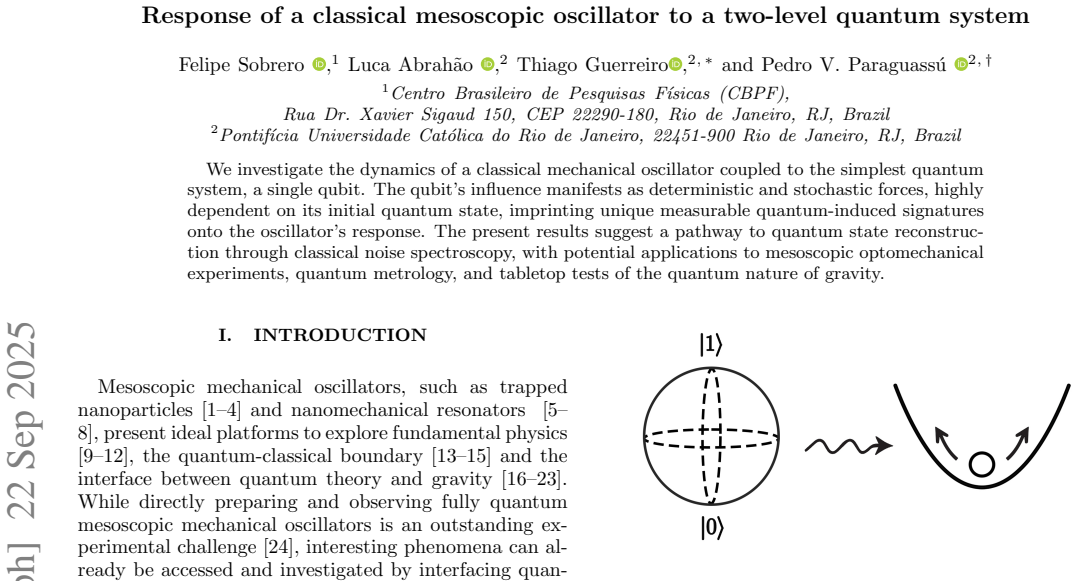
Pith's one-line read The paper establishes that a qubit's initial state leaves deterministic and stochastic force signatures on a classical oscillator's motion, so the oscillator's classical record carries information about the qubit's state.
desk verdict The paper gets the qualitative physics right, but the printed equations have several load-bearing errors—noise kernel, factor of 2, and the Langevin equation—so the quantitative results are not trustworthy as printed. read the letter →
The pith
A machine-rendered reading of the paper's core claim, the machinery that carries it, and where it could break.
The reading
What carries the argument
The central object is the Feynman-Vernon influence functional F[X,X′]=exp(iΦ_fl+iΦ_force), obtained after integrating out the qubit at leading order in the dimensionless coupling g=Ω/(2√2ω_q). The fluctuation phase iΦ_fl, built from a two-time noise kernel matrix M_fl, is converted by a Gaussian-integral trick into an auxiliary noise vector Λ; the force phase iΦ_force yields a deterministic force vector F_force proportional to √(p(1−p)). These enter a super-propagator that gives the oscillator's effective Langevin equations, producing the mean displacement and the noise correlation functions from which the qubit's state parameters are to be read.
What would settle it
Prepare a qubit in an equatorial superposition state (p=1/2) and record the oscillator's position fluctuations over several runs. The theory predicts non-stationary noise correlations proportional to cos(τ+τ′+2φ) and a mean displacement scaling as √(p(1−p)); observing only stationary, φ-independent noise, or a mean response independent of the qubit state, would refute the central claim.
Extended reading notes
Core claim
Central finding: a qubit coupled to a mesoscopic oscillator induces a deterministic force and a stochastic noise source on the oscillator, and both depend on the qubit's initial state (p, φ). The deterministic force is proportional to √(p(1−p)) with phase φ, so it is a coherence signature. The noise has stationary and non-stationary correlations, the latter appearing only for superpositions. The authors derive these from an influence-functional trace over the qubit, estimate the forces at zepto- to atto-newton scales in existing setups, and report a Fisher-information asymmetry between estimating p and φ from the classical record.
Load-bearing premise
The predictions rely on neglecting the qubit's back-action damping of the oscillator, even though that damping is the same order of magnitude in the coupling as the noise the calculation keeps, so the results hold only when observation times are short compared with the damping time.
Editorial extensions
If this is right
- A classical measurement of the oscillator's mean position yields estimates of the qubit's Bloch-vector components √(p(1−p))cosφ and √(p(1−p))sinφ.
- The stationary part of the oscillator noise measures the population p through the intensity factor η_st, while the non-stationary noise correlations carry the phase φ and certify coherence.
- Combining the deterministic and stochastic records allows partial quantum state reconstruction of the qubit without any direct qubit measurement.
- The force magnitudes, estimated between 10⁻²¹ N and 10⁻¹⁸ N, are within the sensitivity of levitated and nanomechanical force sensors, making the predictions experimentally testable.
- Fisher-information analysis implies that the optimal observation time for estimating p differs from that for estimating φ, so population and phase are not equally accessible at all times.
Reading between the lines
- [Editorial inference] Because the noise is Gaussian and the deterministic force is known as a function of p and φ, the same model could be turned into a real-time Bayesian estimator that processes the continuous oscillator trajectory to track the qubit state online.
- [Editorial inference] The non-stationary part of the noise, which depends on φ through τ+τ′+2φ, is the kind of two-time correlation that appears in phase-sensitive noise measurements; isolating it would separate the coherence signature from the stationary background in an experiment.
- [Editorial inference] The reconstruction protocol implicitly requires observation times short enough for the neglected qubit-induced dissipation to remain negligible; longer records would need a modified estimator that includes damping.
- [Editorial inference] The same influence-functional route could be extended to two or more oscillators coupled to a common qubit, where the state-induced force and noise would be shared, potentially giving cross-correlation signatures that amplify the quantum signal.
Editorial analysis
A structured set of objections, weighed in public.
Referee Report
Summary. The paper studies a single-mode classical mechanical oscillator coupled to a two-level system via the Jaynes-Cummings interaction. Using the Feynman-Vernon influence functional, the authors derive an effective action for the oscillator after tracing out the qubit. To leading order in the dimensionless coupling g, they obtain a Gaussian fluctuation kernel and linear deterministic forces depending on the initial qubit state parameters (p, φ). They then pass to a Langevin description, compute noise correlators and the mean oscillator response, and argue that monitoring the oscillator's classical motion provides a route to qubit state reconstruction via noise spectroscopy. The paper also estimates the magnitude of the induced forces for trapped-ion, levitated-nanodiamond, and piezoelectric optomechanical systems. The abstract additionally claims a Fisher Information analysis quantifying estimation of the qubit state, but such an analysis does not appear in the body of the manuscript.
Significance. If the derivation were internally consistent, the paper would be a useful contribution to the hybrid quantum-classical interface: it gives an analytic, parameter-free influence-functional treatment of a spin environment and identifies state-dependent deterministic and stochastic forces that could be observable in mesoscopic optomechanics. The explicit Appendices A and B, the absence of fitted parameters, and the concrete experimental estimates are strengths. However, the printed manuscript contains multiple mutually inconsistent equations in the central derivation, so the quantitative predictions—noise spectra, mean response, and the proposed state-reconstruction protocol—are not established as written. The inconsistencies appear fixable by a careful re-derivation, but they affect the main deliverables rather than mere presentation.
major comments (6)
- [III C, Eq. (33)-(34) vs. Eqs. (49)-(51)] The noise kernel M_fl defined through Eq. (34) is not the quadratic form corresponding to the influence phase (26). The symmetrized representation of W_x W_y has (1,1) entry -sin(τ+τ')/2, not -cosτ sinτ' - (1/2)cos(τ+τ') as printed in Eq. (33). Concretely, evaluating Eq. (34) at p=1/2, φ=π/4 gives ⟨λ_q(τ)λ_q(τ')⟩ = 0.5 cos(τ-τ') + cosτ sinτ' + 0.5 cos(τ+τ'), which disagrees with Eq. (49) (= 0.5 cos(τ-τ') + 0.5 sin(τ+τ')); for τ=0, τ'=π/2 the two expressions give 1 and 0.5, respectively. Thus the Gaussian process used in the Langevin equations is not the process obtained from the influence functional.
- [III D, Eq. (43) vs. Eq. (27)] The deterministic force F_force defined in Eq. (43) is missing the factor 2 that appears in Eq. (27). Starting from iΦ_forces = 2ig√(p(1-p))(W_x cosφ + W_y sinφ) and writing W_x = ∫(-cosτ, sinτ)·J dτ, W_y = ∫(sinτ, cosτ)·J dτ, one obtains F_force(τ) = 2g√(p(1-p))(cos(τ+φ), -sin(τ+φ)). Eq. (43) has no factor 2. Consequently the mean response (52) and any reconstruction formula calibrated on it are off by a factor of two.
- [IV B, Eqs. (46)-(48)] Equation (48) does not follow from Eqs. (46)-(47). Taking the τ-derivative of (46) and using (47) yields q¨+r²q = g[-(1-r)√(p(1-p)) cos(τ+φ) - rλ_p - λ̇_q] (up to the sign convention for λ_p), not the printed g[√(p(1-p))(1-r) cos(τ+φ) + λ̇_p + rλ_q]. As printed, the equations of motion are mutually inconsistent, so the derivation of the mean response (52) is not sound.
- [IV C, Eq. (58)] The state-dependent intensity factor is defined as η_f(p) ≡ √(p(p-1)). For 0<p<1 this is imaginary, whereas the deterministic and non-stationary noise amplitudes in Eqs. (27), (48), (49)-(51), and (55) are proportional to √(p(1-p)). Eq. (58) should read √(p(1-p)). As printed, it invalidates the quantitative expressions (55), (61), and the description of Fig. 2, whose claimed behavior (maximum at the equator) is not encoded by the printed formula.
- [IV C, Eqs. (59)-(61)] The physical force correlators are not consistent with the derived λ correlators (49)-(51). Since ξ_p = (f_0/ω_o)dλ_p/dt = (f_0/r)dλ_p/dτ, its autocorrelation must involve a double derivative: ⟨ξ_p ξ_p⟩ = (f_0²/r²) ∂²/(∂τ∂τ')⟨λ_p(τ)λ_p(τ')⟩, yielding A cos(τ-τ') - B cos(τ+τ'+2φ) with B=2p(1-p); Eq. (60) simply reproduces ⟨λ_pλ_p⟩. Similarly, ⟨ξ_q ξ_p⟩ should be (f_0²/r)[-cos(τ-τ') + B cos(τ+τ'+2φ)], while Eq. (61) has -cos(τ-τ') + η_f² cos(τ+φ)cos(τ'+φ), which is not equal to the correct expression. The noise-spectroscopy predictions based on these correlators are therefore not supported.
- [Abstract and Section V] The abstract claims 'By employing the Fisher Information Matrix, we quantify the efficacy of estimating the initial qubit state from the continuous classical record, revealing a fundamental temporal asymmetry between population and phase estimation.' The manuscript contains no Fisher Information analysis and no such quantification. The conclusion's state-reconstruction claim is not backed by an estimation-theoretic treatment. This is a substantive omission relative to the stated contributions.
minor comments (4)
- [III D] The neglect of the O(g²) dissipation term (41) is stated without a validity condition. Since the fluctuation term kept is also O(g²) before the Feynman trick, the paper should explicitly state the timescale over which the Langevin equations are valid (e.g., τ ≪ 1/[g²(1-2p)]), otherwise the long-time noise spectrum and response acquire O(g²) corrections.
- [Eq. (52)] After correcting the factor 2 in Eq. (43), the derivation of Eq. (52) must be re-checked; the sign of the deterministic contribution in Eq. (48) also appears to depend on the choice of λ_p sign convention, and the text should be consistent.
- [Fig. 2] The caption states η_f is maximal along the equator. This is consistent with √(p(1-p)), but not with the printed Eq. (58). The figure and the formula should be reconciled.
- [General] There are numerous typos and notation slips (e.g., the 'Ha' in Eq. (8) should be H_q, and the abstract's FIM claim is not reflected in the body). A careful pass over all equations is needed.
Circularity Check
No significant circularity: influence functional is derived from the stated JC Hamiltonian with no fitted parameters; self-citations are methodological or peripheral.
full rationale
The central derivation chain is self-contained. Appendix A computes the time-ordered evolution operator via a Dyson series and the Baker-Campbell-Hausdorff formula, giving Eq. (17); Appendix B evaluates the expectation value for the pure state (24), producing the influence phases (26)-(27) with no free parameters beyond the physical coupling g and the declared qubit state parameters p, phi. The noise variables in Eqs. (37)-(39) are introduced by a Stratonovich-type Gaussian representation of the fluctuation phase, so their correlations are the kernel M_fl by construction; Eqs. (49)-(51) are evaluations of that kernel, not fits. The deterministic force (43) and mean response (52) likewise follow from the first-order term (27). No quantity called a prediction is fitted to data or defined in terms of the target. The only self-citations are [31] and [32]: [31] is cited for the general Feynman-Vernon treatment of the linear-coupling analogue and for the standard choice to neglect second-order dissipation; this is a modeling approximation stated in the text ('dissipation appears as a second-order effect, and hence will be neglected'), not an imported theorem that forces the central result. The cited prior work is not machine-checked but is not load-bearing for the qubit-specific derivation, since the qubit case is worked out in Appendices A and B. There are correctness concerns outside circularity: the abstract promises a Fisher Information Matrix quantification that does not appear in the body, and the O(g^2) dissipation term is dropped without a timescale justification while an O(g^2) fluctuation is retained. These affect rigor, not circularity. The skeptical claim of a mismatch between Eq. (34) and Eq. (49) at p=1/2, phi=pi/4 is a potential algebraic error in evaluating M_fl; if true it invalidates the printed noise spectrum, but it does not make the derivation circular. Overall: no significant circularity; score 2 reflects minor self-citations only.
Assumptions & free parameters
assumptions (7)
- domain assumption Jaynes-Cummings interaction with rotating-wave approximation describes the qubit-oscillator coupling (Eqs. (1)-(5))
- domain assumption Initially separable product state rho_0 = rho_o (x) rho_q
- domain assumption Initial qubit state is pure, rho_q = |Psi><Psi| (Eq. (24))
- domain assumption Weak coupling expansion in g = Omega/(2 sqrt(2) omega_q), truncation at O(g^2)
- ad hoc to paper Neglect of the O(g^2) qubit-induced dissipation term ig^2(1-2p)(W_z - W_x W_y)
- domain assumption The fluctuation kernel M_fl is a valid positive covariance so a Gaussian noise Lambda can be introduced (Feynman-Vernon-Stratonovich trick)
- domain assumption The oscillator can be described by classical c-number paths in the influence functional (semiclassical treatment)
Cite this review
Pith. "Pith review of Response of a classical mesoscopic oscillator to a two-level quantum system." pith.science (2026). https://pith.science/paper/7A3ZF42W
@misc{pith2026250904216,
  author       = {Pith},
  title        = {Pith review of: Response of a classical mesoscopic oscillator to a two-level quantum system},
  year         = {2026},
  howpublished = {\url{https://pith.science/paper/7A3ZF42W}},
  note         = {Machine review of arXiv:2509.04216}
}
read the original abstract
We investigate the dynamics of a classical mechanical oscillator coupled to the simplest quantum system, a single qubit. Using the Feynman-Vernon influence functional formalism, we show that the qubit's influence manifests as both deterministic and stochastic forces on the oscillator. These forces are highly dependent on the qubit's initial quantum state, imprinting unique measurable signatures onto the oscillator's response. The present results provide a direct pathway to quantum state reconstruction through classical noise spectroscopy. By employing the Fisher Information Matrix, we quantify the efficacy of estimating the initial qubit state from the continuous classical record, revealing a fundamental temporal asymmetry between population and phase estimation. This framework has potential applications to mesoscopic optomechanical experiments, quantum metrology, and tabletop tests of the quantum nature of gravity.
Figures

Reference graph
Works this paper leans on
-
[1]
(44) where thesuper-propagatoris defined as, 5 J(X f , X′ f |X0, X′
-
[2]
= Z Xf ,X ′ f X0,X ′ 0 DXDX ′ Z DΛ exp − 1 2 Z T 0 dτ dτ′ΛT (τ)M −1 fl (τ, τ′)Λ(τ ′) (45) ×exp i Z T 0 dτ p(τ) ˙q(τ)−p ′(τ) ˙q′(τ)− 1 ℏωq Ho(τ)−H ′ o(τ) + Λ(τ)− Fforce(τ) T J(τ) ! . Here, the first line represents the stochastic density ker- nel, while the terms in the second line represent the os- cillator’s forward and backward free actions written in H...
- [3]
-
[4]
Millen, T
J. Millen, T. S. Monteiro, R. Pettit, and A. N. Vami- vakas, Optomechanics with levitated particles, Reports on Progress in Physics83, 026401 (2020)
2020
-
[5]
Gonzalez-Ballestero, M
C. Gonzalez-Ballestero, M. Aspelmeyer, L. Novotny, R. Quidant, and O. Romero-Isart, Levitodynamics: Lev- itation and control of microscopic objects in vacuum, Sci- ence374, eabg3027 (2021)
2021
-
[6]
J. Chan, T. M. Alegre, A. H. Safavi-Naeini, J. T. Hill, A. Krause, S. Gr¨ oblacher, M. Aspelmeyer, and O. Painter, Laser cooling of a nanomechanical oscillator into its quantum ground state, Nature478, 89 (2011)
work page 2011
-
[7]
Magrini, P
L. Magrini, P. Rosenzweig, C. Bach, A. Deutschmann- Olek, S. G. Hofer, S. Hong, N. Kiesel, A. Kugi, and M. Aspelmeyer, Real-time optimal quantum control of mechanical motion at room temperature, Nature595, 373 (2021)
2021
-
[8]
Aspelmeyer, T
M. Aspelmeyer, T. J. Kippenberg, and F. Marquardt, Cavity optomechanics, Reviews of Modern Physics86, 1391 (2014)
2014
Show all 83 references
-
[9]
H. Ulbricht, Testing fundamental physics by using levi- tated mechanical systems, inMolecular Beams in Physics and Chemistry: From Otto Stern ’s Pioneering Exploits to Present-Day Feats(Springer International Publishing Cham, 2021) pp. 303–332
2021
-
[10]
E. A. Cryer-Jenkins, K. D. Major, J. Clarke, G. En- zian, M. Szczykulska, J. Zhang, A. Gupta, A. C. Leung, H. Rathee, A. Ø. Svela,et al., Enhanced laser cooling of a mechanical resonator via zero-photon detection, Physical Review Letters134, 073601 (2025)
2025
-
[11]
M. Bild, M. Fadel, Y. Yang, U. Von L¨ upke, P. Mar- tin, A. Bruno, and Y. Chu, Schr¨ odinger cat states of a 16-microgram mechanical oscillator, Science380, 274 (2023)
2023
-
[12]
Carney, K
D. Carney, K. G. Leach, and D. C. Moore, Searches for massive neutrinos with mechanical quantum sensors, PRX Quantum4, 010315 (2023)
2023
-
[13]
D. C. Moore and A. A. Geraci, Searching for new physics using optically levitated sensors, Quantum Science and Technology6, 014008 (2021)
2021
-
[14]
Carney, G
D. Carney, G. Krnjaic, D. C. Moore, C. A. Regal, G. Afek, S. Bhave, B. Brubaker, T. Corbitt, J. Cripe, N. Crisosto,et al., Mechanical quantum sensing in the 8 search for dark matter, Quantum Science and Technol- ogy6, 024002 (2021)
2021
-
[15]
Anglin, J
J. Anglin, J. Paz, and W. Zurek, Deconstructing deco- herence, Physical Review A55, 4041 (1997)
1997
-
[16]
W. H. Zurek, Decoherence, einselection, and the quan- tum origins of the classical, Reviews of modern physics 75, 715 (2003)
2003
-
[17]
Schlosshauer, Decoherence, the measurement prob- lem, and interpretations of quantum mechanics, Reviews of Modern physics76, 1267 (2004)
M. Schlosshauer, Decoherence, the measurement prob- lem, and interpretations of quantum mechanics, Reviews of Modern physics76, 1267 (2004)
2004
-
[18]
S. Bose, A. Mazumdar, G. W. Morley, H. Ulbricht, M. Toroˇ s, M. Paternostro, A. A. Geraci, P. F. Barker, M. Kim, and G. Milburn, Spin entanglement witness for quantum gravity, Physical review letters119, 240401 (2017)
2017
-
[19]
R. Y. Chiao, The interface between quantum mechanics and general relativity, Journal of Modern Optics53, 2349 (2006)
2006
-
[20]
R. Y. Chiao, Conceptual tensions between quantum me- chanics and general relativity: Are there experimental consequences, Science and Ultimate Reality: Quantum Theory, Cosmology, and Complexity , 254 (2004)
2004
-
[21]
S. Bose, I. Fuentes, A. A. Geraci, S. M. Khan, S. Qvar- fort, M. Rademacher, M. Rashid, M. Toroˇ s, H. Ulbricht, and C. C. Wanjura, Massive quantum systems as inter- faces of quantum mechanics and gravity, Reviews of Mod- ern Physics97, 015003 (2025)
2025
-
[22]
Marletto and V
C. Marletto and V. Vedral, Gravitationally induced en- tanglement between two massive particles is sufficient evidence of quantum effects in gravity, Physical review letters119, 240402 (2017)
2017
-
[23]
Carney, P
D. Carney, P. C. Stamp, and J. M. Taylor, Tabletop ex- periments for quantum gravity: a user’s manual, Classi- cal and Quantum Gravity36, 034001 (2019)
2019
-
[24]
M. Aspelmeyer, When zeh meets feynman: how to avoid the appearance of a classical world in gravity experi- ments, inFrom Quantum to Classical: Essays in Honour of H.-Dieter Zeh(Springer, 2022) pp. 85–95
2022
-
[25]
Feldman, B
O. Feldman, B. B. Shultz, M. Muretova, O. Dobkowski, Y. Japha, D. Grosswasser, and R. Folman, Trapping and cooling of nanodiamonds in a paul trap under ultra-high vacuum: Towards matter-wave interferometry with mas- sive objects, arXiv preprint arXiv:2508.14687 (2025)
2025 arXiv
-
[26]
Bose and et al., A spin-based pathway to testing the quantum nature of gravity (2025), arXiv:2509.01586 [quant-ph]
S. Bose and et al., A spin-based pathway to testing the quantum nature of gravity (2025), arXiv:2509.01586 [quant-ph]
2025 arXiv
-
[27]
Seifert, Stochastic thermodynamics, fluctuation the- orems and molecular machines, Reports on progress in physics75, 126001 (2012)
U. Seifert, Stochastic thermodynamics, fluctuation the- orems and molecular machines, Reports on progress in physics75, 126001 (2012)
2012
-
[28]
Peliti and S
L. Peliti and S. Pigolotti,Stochastic thermodynamics: an introduction(Princeton University Press, 2021)
2021
-
[29]
Ciliberto, Experiments in stochastic thermodynamics: Short history and perspectives, Physical Review X7, 021051 (2017)
S. Ciliberto, Experiments in stochastic thermodynamics: Short history and perspectives, Physical Review X7, 021051 (2017)
2017
-
[30]
Jarzynski, Equalities and inequalities: Irreversibility and the second law of thermodynamics at the nanoscale, Annual Review of Condensed Matter Physics2, 329 (2011)
C. Jarzynski, Equalities and inequalities: Irreversibility and the second law of thermodynamics at the nanoscale, Annual Review of Condensed Matter Physics2, 329 (2011)
2011
-
[31]
Strasberg,Quantum Stochastic Thermodynamics: Foundations and Selected Applications(Oxford Univer- sity Press, 2022)
P. Strasberg,Quantum Stochastic Thermodynamics: Foundations and Selected Applications(Oxford Univer- sity Press, 2022)
2022
-
[32]
L. P. Bettmann, M. J. Kewming, G. T. Landi, J. Goold, and M. T. Mitchison, Quantum stochastic thermodynam- ics in the mesoscopic-leads formulation, Physical Review E112, 014105 (2025)
2025
-
[33]
Oppenheim, A postquantum theory of classical grav- ity?, Physical Review X13, 041040 (2023)
J. Oppenheim, A postquantum theory of classical grav- ity?, Physical Review X13, 041040 (2023)
2023
-
[34]
P. V. Paraguass´ u, L. Abrah˜ ao, and T. Guerreiro, Quantum-induced stochastic optomechanical dynamics, Journal of the Optical Society of America B41, 2798 (2024)
2024
-
[35]
P. V. Paraguass´ u and T. Guerreiro, Apparent violations of the second law in the quantum-classical dynamics of in- teracting levitated nanoparticles, Physical Review E112, 024134 (2025)
2025
-
[36]
Treutlein, C
P. Treutlein, C. Genes, K. Hammerer, M. Poggio, and P. Rabl, Hybrid mechanical systems, inCavity optome- chanics: nano-and micromechanical resonators interact- ing with light(Springer, 2014) pp. 327–351
2014
-
[37]
Layton and J
I. Layton and J. Oppenheim, The classical-quantum limit, PRX Quantum5, 020331 (2024)
2024
-
[38]
Layton, J
I. Layton, J. Oppenheim, and Z. Weller-Davies, A health- ier semi-classical dynamics., Quantum8, 1565 (2024)
2024
-
[39]
D. S. Bykov, L. Dania, F. Goschin, and T. E. Northup, A nanoparticle stored with an atomic ion in a linear paul trap, arXiv preprint arXiv:2403.02034 (2024)
2024
-
[40]
Armour, M
A. Armour, M. Blencowe, and K. C. Schwab, Entangle- ment and decoherence of a micromechanical resonator via coupling to a cooper-pair box, Physical Review Letters 88, 148301 (2002)
2002
-
[41]
A. D. O’Connell, M. Hofheinz, M. Ansmann, R. C. BIAL- CZAK, M. Lenander, E. Lucero, M. Neeley, D. Sank, H. Wang, M. Weides, J. Wenner, J. M. Martinis, and A. N. Cleland, Quantum ground state and single-phonon control of a mechanical resonator, Nature464, 697 (2010)
2010
-
[42]
E. T. Jaynes and F. W. Cummings, Comparison of quan- tum and semiclassical radiation theories with applica- tion to the beam maser, Proceedings of the IEEE51, 89 (2005)
2005
-
[43]
Deli´ c, M
U. Deli´ c, M. Reisenbauer, K. Dare, D. Grass, V. Vuleti´ c, N. Kiesel, and M. Aspelmeyer, Cooling of a levitated nanoparticle to the motional quantum ground state, Sci- ence367, 892 (2020)
2020
-
[44]
Piotrowski, D
J. Piotrowski, D. Windey, J. Vijayan, C. Gonzalez- Ballestero, A. de los R ´ ıos Sommer, N. Meyer, R. Quidant, O. Romero-Isart, R. Reimann, and L. Novotny, Simulta- neous ground-state cooling of two mechanical modes of a levitated nanoparticle, Nature Physics19, 1009 (2023)
2023
-
[45]
schr¨ odinger cat
M. Brune, S. Haroche, J.-M. Raimond, L. Davidovich, and N. Zagury, Manipulation of photons in a cavity by dispersive atom-field coupling: Quantum-nondemolition measurements and generation of “schr¨ odinger cat”states, Physical Review A45, 5193 (1992)
1992
-
[46]
Haroche, Controlling photons in a box and exploring the quantum to classical boundary, Annalen der Physik 525, 753 (2013)
S. Haroche, Controlling photons in a box and exploring the quantum to classical boundary, Annalen der Physik 525, 753 (2013)
2013
-
[47]
Haroche, M
S. Haroche, M. Brune, and J. Raimond, From cavity to circuit quantum electrodynamics, Nature Physics16, 243 (2020)
2020
-
[48]
R. P. Feynman and F. L. Vernon Jr, The theory of a gen- eral quantum system interacting with a linear dissipative system, Annals of physics24, 118 (1963)
1963
-
[49]
P. L. Knight, C. C. Gerry, R. J. Birrittella, and P. M. Als- ing, Enduring relevance of the jaynes–cummings model: a personal perspective, Journal of the Optical Society of America B41, C91 (2024)
2024
-
[50]
Brune, E
M. Brune, E. Hagley, J. Dreyer, X. Maitre, A. Maali, 9 C. Wunderlich, J.-M. Raimond, and S. Haroche, Ob- serving the progressive decoherence of the “meter” in a quantum measurement, Physical review letters77, 4887 (1996)
1996
-
[51]
A. O. Caldeira and A. J. Leggett, Path integral approach to quantum brownian motion, Physica A: Statistical me- chanics and its Applications121, 587 (1983)
1983
-
[52]
B. L. Hu, J. P. Paz, and Y. Zhang, Quantum brownian motion in a general environment: Exact master equation with nonlocal dissipation and colored noise, Physical Re- view D45, 2843 (1992)
1992
-
[53]
Calzetta and B.-L
E. Calzetta and B.-L. Hu, Nonequilibrium quantum fields: Closed-time-path effective action, wigner function, and boltzmann equation, Physical Review D37, 2878 (1988)
1988
-
[54]
W. G. Unruh, False loss of coherence, inRelativistic Quantum Measurement and Decoherence: Lectures of a Workshop Held at the Istituto Italiano per gli Studi Filosofici Naples, April 9–10, 1999(Springer, 2000) pp. 125–140
1999
-
[55]
Stamp, Dissipation and decoherence in quantum mag- netic systems, Physica B: Condensed Matter197, 133 (1994)
P. Stamp, Dissipation and decoherence in quantum mag- netic systems, Physica B: Condensed Matter197, 133 (1994)
1994
-
[56]
P. C. Stamp, The decoherence puzzle, Studies in History and Philosophy of Science Part B: Studies in History and Philosophy of Modern Physics37, 467 (2006)
2006
-
[57]
Pistolesi, A
F. Pistolesi, A. Cleland, and A. Bachtold, Proposal for a nanomechanical qubit, Physical Review X11, 031027 (2021)
2021
-
[58]
B. L. Hu and E. Verdaguer, Stochastic gravity: The- ory and applications, Living Reviews in Relativity11, 1 (2008)
2008
-
[59]
Parikh, F
M. Parikh, F. Wilczek, and G. Zahariade, Quantum me- chanics of gravitational waves, Physical Review Letters 127, 081602 (2021)
2021
-
[60]
Wang, J.-M
B. Wang, J.-M. Hu, V. Macr ` ı, Z.-L. Xiang, and F. Nori, Coherent resonant coupling between atoms and a me- chanical oscillator mediated by cavity-vacuum fluctua- tions, Physical Review Research5, 013075 (2023)
2023
-
[61]
D. Lee, K. W. Lee, J. V. Cady, P. Ovartchaiyapong, and A. C. B. Jayich, Topical review: spins and mechanics in diamond, Journal of Optics19, 033001 (2017)
2017
-
[62]
Montenegro, G
V. Montenegro, G. d. M. Neto, and S. Bose, Mechanical qubit-light entanglers in hybrid nonlinear qubit optome- chanics, Physical Review A100, 052310 (2019)
2019
-
[63]
M. O. Scully and M. S. Zubairy,Quantum optics(Cam- bridge university press, 1997)
1997
-
[64]
S. Burd, H. Knaack, R. Srinivas, C. Arenz, A. Collopy, L. Stephenson, A. C. Wilson, D. Wineland, D. Leibfried, J. J. Bollinger,et al., Experimental speedup of quantum dynamics through squeezing, PRX Quantum5, 020314 (2024)
2024
-
[65]
Santos, J
J. Santos, J. Li, J. Ilves, C. Ockeloen-Korppi, and M. Sil- lanp¨ a¨ a, Optomechanical measurement of a millimeter- sized mechanical oscillator approaching the quantum ground state, New Journal of Physics19, 103014 (2017)
2017
-
[66]
Chaichian and A
M. Chaichian and A. Demichev,Path integrals in physics: Volume I stochastic processes and quantum mechanics (CRC Press, 2018)
2018
-
[67]
Grynberg, A
G. Grynberg, A. Aspect, and C. Fabre,Introduction to quantum optics: from the semi-classical approach to quantized light(Cambridge university press, 2010)
2010
-
[68]
Feynman and A
R. Feynman and A. Hibbs, The path integral formulation of quantum mechanics, McGraw-Hiill, New York (1965)
1965
-
[69]
Dowker and J
H. Dowker and J. J. Halliwell, Quantum mechanics of his- tory: The decoherence functional in quantum mechanics, Physical Review D46, 1580 (1992)
1992
-
[70]
Parikh, F
M. Parikh, F. Wilczek, and G. Zahariade, Signatures of the quantization of gravity at gravitational wave detec- tors, Physical Review D104, 046021 (2021)
2021
-
[71]
Weiss,Quantum dissipative systems(World Scientific, 2012)
U. Weiss,Quantum dissipative systems(World Scientific, 2012)
2012
-
[72]
Meekhof, C
D. Meekhof, C. Monroe, B. King, W. M. Itano, and D. J. Wineland, Generation of nonclassical motional states of a trapped atom, Physical review letters76, 1796 (1996)
1996
-
[73]
Define the characteristic force, f0 ≡ ℏΩ 4 √ 2q0 ,(53) which governs the order-of-magnitude of forces induced by the interaction with the qubit
and piezoelectric mechanical oscillators coupled to superconducting qubits [8]. Define the characteristic force, f0 ≡ ℏΩ 4 √ 2q0 ,(53) which governs the order-of-magnitude of forces induced by the interaction with the qubit. Restoring dimensions to Eq. (48), we find m d2x dt2 ...
2024
-
[74]
W. H. Zurek, Decoherence and the transition from quan- tum to classical, Physics today44, 36 (1991)
1991
-
[75]
P. V. Paraguass´ u, L. Defaveri, S. M. D. Queir´ os, and W. A. Morgado, Probabilities for informational free lunches in stochastic thermodynamics, Journal of Statis- tical Mechanics: Theory and Experiment2022, 123204 (2022)
2022
-
[76]
Z.-q. Yin, T. Li, X. Zhang, and L. Duan, Large quantum superpositions of a levitated nanodiamond through spin- optomechanical coupling, Physical Review A—Atomic, Molecular, and Optical Physics88, 033614 (2013)
2013
-
[77]
Ranjit, M
G. Ranjit, M. Cunningham, K. Casey, and A. A. Geraci, Zeptonewton force sensing with nanospheres in an optical lattice, Physical Review A93, 053801 (2016)
2016
-
[78]
Monteiro, W
F. Monteiro, W. Li, G. Afek, C.-l. Li, M. Mossman, and D. C. Moore, Force and acceleration sensing with opti- cally levitated nanogram masses at microkelvin temper- atures, Physical Review A101, 053835 (2020)
2020
-
[79]
Ranjit, D
G. Ranjit, D. P. Atherton, J. H. Stutz, M. Cunningham, and A. A. Geraci, Attonewton force detection using mi- crospheres in a dual-beam optical trap in high vacuum, Physical Review A91, 051805 (2015)
2015
-
[80]
Gavartin, P
E. Gavartin, P. Verlot, and T. J. Kippenberg, A hy- brid on-chip optomechanical transducer for ultrasensi- tive force measurements, Nature nanotechnology7, 509 (2012)
2012
-
[81]
Z. F. Yan, B. He, and Q. Lin, Force sensing with an optomechanical system at room temperature, Physical Review A107, 013529 (2023)
2023
-
[82]
Martinetz, K
L. Martinetz, K. Hornberger, J. Millen, M. Kim, and B. A. Stickler, Quantum electromechanics with levitated nanoparticles, npj Quantum Information6, 101 (2020)
2020
-
[83]
Itzykson and J.-B
C. Itzykson and J.-B. Zuber,Quantum field theory (Courier Corporation, 2006). 10 Appendix A: The BCH formula in the product of time ordered evolution operator With the dimensionless quantities, we expand our time ordered evolution operator, Eq. (10), using a Dyson series [80],...
2006
Reviewed August 5, 2026 · model on record in the stance chip above.
Discussion (0). Sign in to comment.