REVIEW 1 major objections 67 references
Amplification and generation bounds of gravity-induced entanglement in pulsed optomechanical systems
T0 review · 1 major / 0 minor · reviewed 2026-06-29 · grok-4.3
Pith's one-line read Gravity-induced entanglement in pulsed optomechanics requires gravitational coupling to exceed twice the thermal decoherence rate, and no input state lowers this threshold.
desk verdict The paper derives a thermal-noise threshold for gravity-induced entanglement that holds for Gaussian and Fock inputs but asserts it for arbitrary states without a general proof. read the letter →
The pith
A machine-rendered reading of the paper's core claim, the machinery that carries it, and where it could break.
The reading
What carries the argument
The beam-splitter state swap performed by the red-detuned optomechanical interaction under rectangular pulses, which transfers the effect of the gravitational coupling from the mechanical modes to the optical outputs.
What would settle it
An experiment that generates detectable entanglement with g_G less than or equal to 2 gamma_m N_th using either Gaussian or Fock inputs would falsify the claimed bound.
Extended reading notes
Core claim
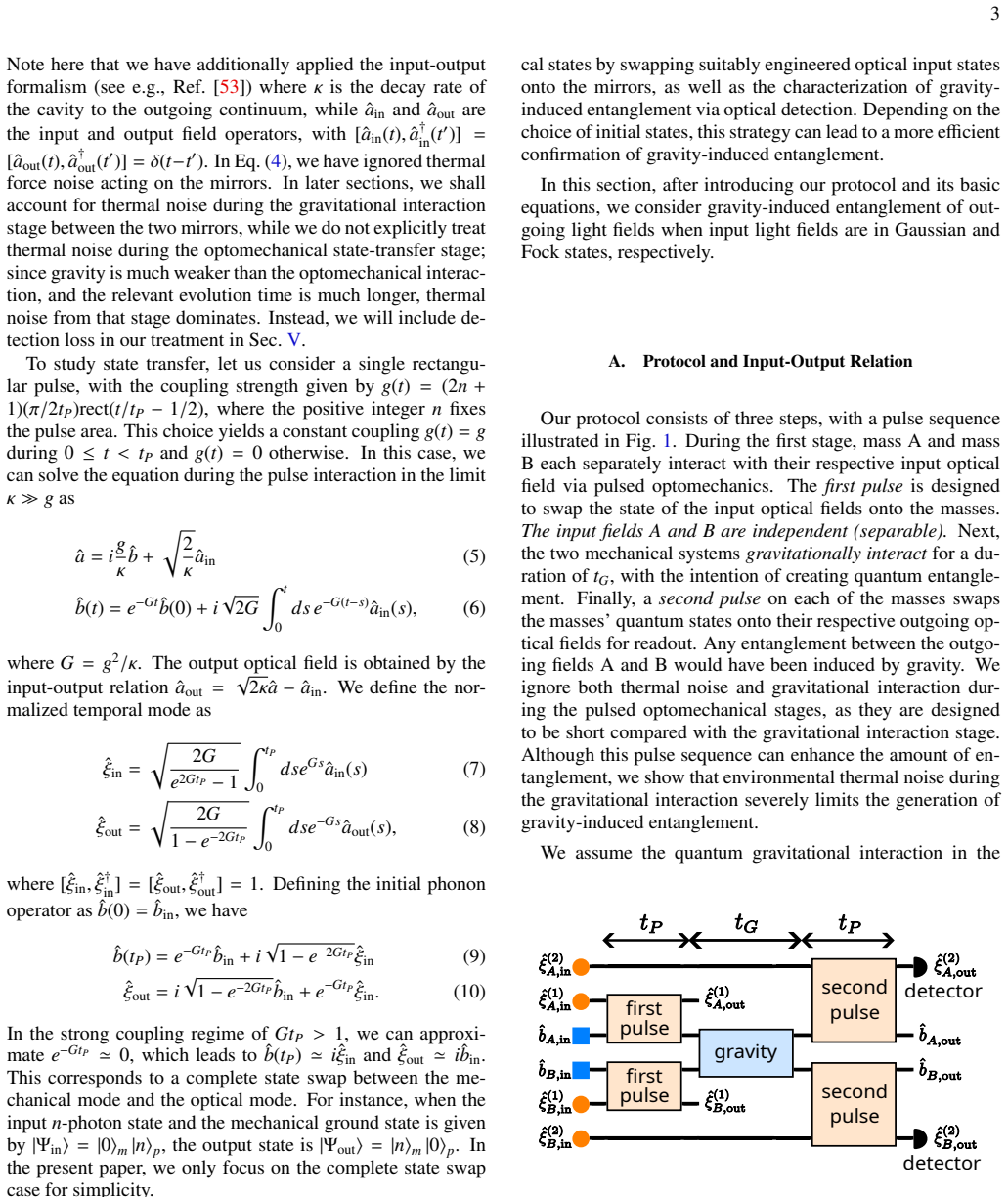
In two red-detuned pulsed optomechanical systems with gravitationally coupled masses, the optomechanical interaction realizes a beam-splitter state swap. Two rectangular pulses per system first imprint a nonclassical state on the mechanics and then read the gravitationally generated entanglement onto the outgoing optical fields. While squeezed or Fock inputs amplify the resulting entanglement, the threshold condition g_G > 2 gamma_m N_th cannot be lowered by any choice of input state; the bound is established for two-mode Gaussian inputs and remains valid for Fock-state inputs. Imperfect detection modifies the accessible regimes, which are ultimately set by thermal decoherence accumulated ov
Load-bearing premise
The optomechanical interaction must realize an ideal beam-splitter swap with rectangular pulses while thermal decoherence in the mechanical modes is the only competing noise.
Signed reviews
Editorial analysis
A structured set of objections, weighed in public.
Referee Report
Summary. The paper investigates gravity-induced entanglement between the output optical fields of two red-detuned pulsed optomechanical systems whose masses interact gravitationally. Using rectangular pulses to realize beam-splitter state swaps, it shows that preparing input states in squeezed or Fock form amplifies the generated entanglement, but derives a threshold g_G > 2 γ_m N_th for entanglement generation that is set by competition with thermal decoherence and cannot be lowered by input-state choice. The bound is proven for two-mode Gaussian inputs and shown to hold for Fock inputs; the work also analyzes imperfect detection and identifies entanglement-annihilating and entanglement-breaking regimes independent of g_G.
Significance. If the central bound holds, the result supplies a concrete, input-state-independent limit on gravity-induced entanglement generation in pulsed optomechanics, together with explicit amplification mechanisms for nonclassical inputs. The explicit proofs for Gaussian and Fock cases, the identification of detection-modified regimes, and the parameter-free character of the threshold (arising directly from g_G versus thermal terms) are strengths that would guide experimental efforts to observe quantum gravity effects.
major comments (1)
- [Abstract] Abstract: the claim that the threshold 'cannot be lowered by any choice of input state' is not supported by the proofs that are explicitly limited to two-mode Gaussian inputs and Fock-state inputs. If the manuscript contains no general argument showing that input-state dependence drops out for arbitrary states (e.g., via properties of the beam-splitter swap or thermal noise that are state-independent), the claim must be qualified to the cases actually proven; otherwise the central assertion about the threshold is over-stated.
Simulated Author's Rebuttal
We thank the referee for their careful reading of the manuscript and for highlighting the need to align the abstract claim with the scope of the proofs. We address the single major comment below and will make the corresponding revision.
read point-by-point responses
-
Referee: [Abstract] Abstract: the claim that the threshold 'cannot be lowered by any choice of input state' is not supported by the proofs that are explicitly limited to two-mode Gaussian inputs and Fock-state inputs. If the manuscript contains no general argument showing that input-state dependence drops out for arbitrary states (e.g., via properties of the beam-splitter swap or thermal noise that are state-independent), the claim must be qualified to the cases actually proven; otherwise the central assertion about the threshold is over-stated.
Authors: We agree that the abstract statement is stronger than the explicit proofs provided. The threshold g_G > 2 γ_m N_th originates from the additive thermal noise contributed by the mechanical baths during the interaction time; because this noise is independent of the input state and the beam-splitter swap merely transfers the gravitational phase accumulation to the optical outputs, the minimal coupling required to overcome the noise is expected to be state-independent. Nevertheless, we have only derived the bound rigorously for two-mode Gaussian states and verified it for Fock states. To correct the overstatement we will (i) revise the abstract to read that the threshold “cannot be lowered by the choice of Gaussian or Fock input states” and (ii) add a short paragraph after the Fock-state section explaining why the same bound is anticipated for general states on the basis of the state-independent thermal channel. These changes will be implemented in the revised manuscript. revision: yes
Circularity Check
No significant circularity; bound derived from model competition
full rationale
The central bound g_G > 2 γ_m N_th arises directly from the competition between gravitational coupling and thermal decoherence terms under the stated optomechanical beam-splitter model and rectangular-pulse assumptions. The paper explicitly proves the bound for two-mode Gaussian inputs and extends it to Fock inputs without reducing the result to a fitted parameter, self-citation chain, or definitional equivalence. No load-bearing self-citations, ansatz smuggling, or renaming of known results are indicated; the derivation remains independent of the target claim and self-contained against the model inputs.
Assumptions & free parameters
assumptions (2)
- domain assumption Optomechanical interaction realizes a beam-splitter state swap between incident optical pulse and mechanical mode
- domain assumption Thermal decoherence is the dominant competing process with gravitational coupling
Cite this review
Pith. "Pith review of Amplification and generation bounds of gravity-induced entanglement in pulsed optomechanical systems." pith.science (2026). https://pith.science/paper/7B5W7AY3
@misc{pith2026260526240,
  author       = {Pith},
  title        = {Pith review of: Amplification and generation bounds of gravity-induced entanglement in pulsed optomechanical systems},
  year         = {2026},
  howpublished = {\url{https://pith.science/paper/7B5W7AY3}},
  note         = {Machine review of arXiv:2605.26240}
}
abstract
We investigate gravity-induced entanglement between the output optical fields of two red-detuned pulsed optomechanical systems with their masses coupled by mutual gravitational interaction. For each individual system, the optomechanical interaction realizes a beam-splitter state swap between an incident optical pulse and its mechanical mode. Using two rectangular pulses for each system -- the first to imprint a nonclassical state on the mechanical modes and the second to read the gravitationally generated entanglement back onto the outgoing light -- we show that the amount of entanglement can be amplified by preparing the input in a squeezed or Fock state. However, the threshold for entanglement generation is set by the competition between the gravitational coupling and thermal decoherence, $g_G>2\gamma_m N_{\rm th}$, and cannot be lowered by any choice of input state. We prove this bound for two-mode Gaussian inputs and show that it continues to hold for Fock-state inputs. We further analyze how imperfect detection modifies the threshold and identify the entanglement-annihilating and entanglement-breaking regimes, which are set by the thermal decoherence accumulated over the interaction time, independent of the gravitational coupling.
Figures


Figures from the paper (3 more)


Reference graph
Works this paper leans on
-
[1]
This proves that Eq
In the regime γmtG ≪g GtG ≪1, this inequality impliesg G ≤2γ mNth. This proves that Eq. (33) is sufficient for separability preservation. Moreover, forΩ 2 ≥0, the conditionΩ≥0 is also neces- sary. We show the details of the proof in Appendix C. In the regimeγ mtG ≪g GtG ≪1, we haveΩ 2 ≥0. Hence, the con- dition 2γmNth ≥g G is necessary and sufficient cond...
-
[2]
ˆD(1) B (αAC∗ 12 −α BC∗ 22) ×e iα∗ An11 A +iαAn11† A eiα∗ An12 B +iαAn12† B e−iα∗ Bn21 A −iαBn21† A e−iα∗ Bn22 B −iαBn22† B .(B7) Hence, the characteristic function is obtained by χout(αA, αB)=exp " −1 2 αAα∗ B(C∗ 11C21 +C ∗ 12C22)+ 1 2 α∗ AαB(C11C∗ 21 +C 12C∗ 22) # ×tr[ρ (1) in ˆD(1) A (−αAC∗ 11 +α BC∗
-
[3]
ˆD(1) B (αAC∗ 12 −α BC∗ 22)] ×tr ρtheiα∗ An11 A +iαAn11† A eiα∗ An12 B +iαAn12† B e−iα∗ Bn21 A −iαBn21† A e−iα∗ Bn22 B −iαBn22† B .(B8) Using Eq. (18), the characteristic function can be decomposed as the product of a pure evolution part and a thermal part as χout(αA, αB)=χ inχth,(B9) where each part is χin =tr[ρ (1) in ˆD(1) A (−αAC∗ 11 +α BC∗
-
[4]
Since the thermal noise is Gaussian, the commutation relation of the thermal fluctuation is a c-number
ˆD(1) B (αAC∗ 12 −α BC∗ 22)] (B10) χth =tr ρtheiα∗ An11 A +iαAn11† A e−iα∗ Bn21 A −iαBn21† A eiα∗ An12 B +iαAn12† B e−iα∗ Bn22 B −iαBn22† B (B11) Let us compute the thermal partχ th. Since the thermal noise is Gaussian, the commutation relation of the thermal fluctuation is a c-number. Using Wick’s theorem, we have χth =e 1 2 [iα∗ An11 A +iαAn11† A ,−iα∗ ...
-
[5]
We first consider the lossless case
Lossless case Here, we derive the separability-preservation condition without expanding in the gravitational interaction angleθ≡g GtG. We first consider the lossless case. As discussed in Sec. IV A, the PPT condition for the output covariance matrix can be written as ˜V=V in +Σ PT +Ω≥0, whereΩis defined in Eq. (37). Since any initially separable two-mode ...
-
[6]
Therefore,Ω≥0 is equivalent toΩ 1 ≥ q Ω2 2 + Ω2
-
[7]
We next discuss when this sufficient condition is also necessary
Expanding only inγ mtG ≪1, we obtain λmin(Ω)≃ −2|sin[g GtG]|+4γ mtGNth.(C1) Thus, to this order, the sufficient condition for separability preservation is 2γmtGNth ≥ |sin(g GtG)|.(C2) This reduces to 2γmNth ≥g G when the additional short-interaction approximationg GtG ≪1 is used. We next discuss when this sufficient condition is also necessary. We do not ...
-
[8]
For finiteg GtG, however,Ω 2 is not necessarily positive
This implies that there exists an initially separable squeezed product state for which ˜V̸≥0 and the conditionΩ≥0 is not only sufficient but also necessary for separability preservation. For finiteg GtG, however,Ω 2 is not necessarily positive. Therefore, outside the regimeΩ 2 ≥0, the conditionΩ≥0 should be regarded as a sufficient condition within the pr...
Show all 67 references
-
[9]
IV A, but now apply the loss channel to the final time evolved covariance matrix
Lossy case We consider the same system as in Sec. IV A, but now apply the loss channel to the final time evolved covariance matrix. The resulting post-loss covariance matrix is Vpost-loss =η MVin MT +V th +(1−η)1,(C6) where we assumeη A =η B ≡ηand ¯n=0. We first evaluate the e...
-
[10]
S. Bose, A. Mazumdar, G. W. Morley, H. Ulbricht, M. Toroš, M. Paternostro, A. A. Geraci, P. F. Barker, M. S. Kim, and G. Milburn, Spin entanglement witness for quantum gravity, Phys. Rev. Lett.119, 240401 (2017)
2017
-
[11]
Marletto and V
C. Marletto and V . Vedral, Gravitationally-induced entangle- ment between two massive particles is sufficient evidence of quantum effects in gravity, Phys. Rev. Lett.119, 240402 (2017), arXiv:1707.06036 [quant-ph]
2017 arXiv
-
[12]
Marletto and V
C. Marletto and V . Vedral, Witnessing nonclassicality beyond quantum theory, Phys. Rev. D102, 086012 (2020)
2020
-
[13]
Marletto and V
C. Marletto and V . Vedral, Quantum-information methods for quantum gravity laboratory-based tests, Rev. Mod. Phys.97, 015006 (2025)
2025
-
[14]
Marletto, J
C. Marletto, J. Oppenheim, V . Vedral, and E. Wilson, Classical gravity cannot mediate entanglement (2025), arXiv:2511.07348 [quant-ph]
2025
-
[15]
A. Mari, D. P. G., and V . Giovannetti, Experiments testing macroscopic quantum superpositions must be slow, Scientific Reports6, 22777 (2016)
2016
-
[16]
Belenchia, R
A. Belenchia, R. M. Wald, F. Giacomini, E. Castro-Ruiz, v. Brukner, and M. Aspelmeyer, Quantum superposition of mas- sive objects and the quantization of gravity, Phys. Rev. D98, 126009 (2018)
2018
-
[17]
D. L. Danielson, G. Satishchandran, and R. M. Wald, Gravita- tionally mediated entanglement: Newtonian field versus gravi- tons, Phys. Rev. D105, 086001 (2022)
2022
-
[18]
Carney, Newton, entanglement, and the graviton, Phys
D. Carney, Newton, entanglement, and the graviton, Phys. Rev. D105, 024029 (2022)
2022
-
[19]
Sugiyama, A
Y . Sugiyama, A. Matsumura, and K. Yamamoto, Quantum un- certainty of gravitational field and entanglement in superposed massive particles, Phys. Rev. D108, 105019 (2023)
2023
-
[20]
Sugiyama, A
Y . Sugiyama, A. Matsumura, and K. Yamamoto, Quantumness of the gravitational field: A perspective on monogamy relation, Phys. Rev. D110, 045016 (2024)
2024
-
[21]
R. J. Marshman, A. Mazumdar, and S. Bose, Locality and en- tanglement in table-top testing of the quantum nature of lin- earized gravity, Phys. Rev. A101, 052110 (2020)
2020
-
[22]
Schut, A
M. Schut, A. Geraci, S. Bose, and A. Mazumdar, Micrometer- size spatial superpositions for the qgem protocol via screening and trapping, Phys. Rev. Res.6, 013199 (2024)
2024
-
[23]
Krisnanda, G
T. Krisnanda, G. Y . Tham, M. Paternostro, and T. Paterek, Ob- servable quantum entanglement due to gravity, npj Quantum In- formation6, 12 (2020)
2020
-
[24]
Qvarfort, S
S. Qvarfort, S. Bose, and A. Serafini, Mesoscopic entangle- ment through central–potential interactions, Journal of Physics B: Atomic, Molecular and Optical Physics53, 235501 (2020). 21
2020
-
[25]
Carney, H
D. Carney, H. Müller, and J. M. Taylor, Using an atom inter- ferometer to infer gravitational entanglement generation, PRX Quantum2, 030330 (2021)
2021
-
[26]
Matsumura, Y
A. Matsumura, Y . Nambu, and K. Yamamoto, Leggett-garg in- equalities for testing quantumness of gravity, Phys. Rev. A106, 012214 (2022)
2022
-
[27]
Al Balushi, W
A. Al Balushi, W. Cong, and R. B. Mann, Optomechani- cal quantum cavendish experiment, Phys. Rev. A98, 043811 (2018)
2018
-
[28]
Matsumura and K
A. Matsumura and K. Yamamoto, Gravity-induced entangle- ment in optomechanical systems, Phys. Rev. D102, 106021 (2020)
2020
-
[29]
D. Miki, A. Matsumura, and K. Yamamoto, Non-gaussian en- tanglement in gravitating masses: The role of cumulants, Phys. Rev. D105, 026011 (2022)
2022
-
[30]
H. Miao, D. Martynov, H. Yang, and A. Datta, Quantum corre- lations of light mediated by gravity, Phys. Rev. A101, 063804 (2020)
2020
-
[31]
Datta and H
A. Datta and H. Miao, Signatures of the quantum nature of grav- ity in the differential motion of two masses, Quantum Science and Technology6, 045014 (2021)
2021
-
[32]
D. Miki, A. Matsumura, and K. Yamamoto, Quantum signature of gravity in optomechanical systems with conditional measure- ment, Phys. Rev. D109, 064090 (2024)
2024
-
[33]
D. Miki, A. Matsumura, and K. Yamamoto, Feasible genera- tion of gravity-induced entanglement by using optomechanical systems, Phys. Rev. D110, 024057 (2024)
2024
-
[34]
A. Mari, S. Zippilli, and D. Vitali, Can gravity mediate the transmission of quantum information?, Phys. Rev. D113, L021905 (2026)
2026
-
[35]
Z. Tang, H. Xue, Z. Han, Z. Kan, Z. Li, and Y . Liu, Optimal form factors for experimental proposals on gravity-induced en- tanglement, Phys. Rev. D112, 042004 (2025)
2025
-
[36]
Matsumoto, K
N. Matsumoto, K. Sakai, K. Hatakeyama, K. Izumi, D. Miki, S. Iso, A. Matsumura, and K. Yamamoto, Space-based cm/kg-scale laser interferometer for quantum gravity (2025), arXiv:2507.12899 [gr-qc]
2025
-
[37]
J. S. Pedernales, K. Streltsov, and M. B. Plenio, Enhancing gravitational interaction between quantum systems by a mas- sive mediator, Phys. Rev. Lett.128, 110401 (2022)
2022
-
[38]
Y . Kaku, T. Fujita, and A. Matsumura, Enhancement of quan- tum gravity signal in an optomechanical experiment, Phys. Rev. D108, 106014 (2023)
2023
-
[39]
Fujita, Y
T. Fujita, Y . Kaku, A. Matsumura, and Y . Michimura, Inverted oscillators for testing gravity-induced quantum entanglement, Classical and Quantum Gravity42, 165003 (2025)
2025
-
[40]
Shiomatsu, Y
Y . Shiomatsu, Y . Kaku, A. Matsumura, and T. Fujita, Boosting gravity-induced entanglement through parametric resonance (2025), arXiv:2511.09169 [gr-qc]
2025
-
[41]
Hatakeyama, D
K. Hatakeyama, D. Miki, and K. Yamamoto, Theoretical study of the squeezed-light-enhanced sensitivity to gravity-induced entanglement via finite-time analysis, Phys. Rev. D113, 024025 (2026)
2026
-
[42]
Fukuzumi, K
R. Fukuzumi, K. Hatakeyama, D. Miki, and K. Yamamoto, Mo- mentum squeezed state realized via optimal filtering in optome- chanics: Implications for gravity-induced entanglement, Phys. Rev. Res.8, 023039 (2026)
2026
-
[43]
Y . Liu, H. Miao, Y . Chen, and Y . Ma, Semiclassical gravity phe- nomenology under the causal-conditional quantum measure- ment prescription, Phys. Rev. D107, 024004 (2023)
2023
-
[44]
Y . Liu, W. Zhong, Y . Chen, and Y . Ma, Semiclassical grav- ity phenomenology under the causal-conditional quantum mea- surement prescription. ii. heisenberg picture and apparent opti- cal entanglement, Phys. Rev. D111, 062004 (2025)
2025
-
[45]
D. Miki, Y . Kaku, Y . Liu, Y . Ma, and Y . Chen, Role of quan- tum measurements when testing the quantum nature of gravity, Phys. Rev. D111, 104084 (2025)
2025
-
[46]
Zhong, Y
W. Zhong, Y . Liu, and Y . Ma, Distinguishing quantum and clas- sical gravity via nonstationary test mass dynamics, Phys. Rev. D112, 044060 (2025)
2025
-
[47]
L. Lami, J. S. Pedernales, and M. B. Plenio, Testing the quan- tumness of gravity without entanglement, Phys. Rev. X14, 021022 (2024)
2024
-
[48]
M. R. Vanner, I. Pikovski, G. D. Cole, M. S. Kim, ˇC. Brukner, K. Hammerer, G. J. Milburn, and M. Aspelmeyer, Pulsed quan- tum optomechanics, Proceedings of the National Academy of Sciences108, 16182 (2011)
2011
-
[49]
S. G. Hofer, W. Wieczorek, M. Aspelmeyer, and K. Hammerer, Quantum entanglement and teleportation in pulsed cavity op- tomechanics, Phys. Rev. A84, 052327 (2011)
2011
-
[50]
B. M. Helou,Testing Alternative Theories of Quantum Mechan- ics with Optomechanics, and Effective Modes for Gaussian Lin- ear Optomechanics, Ph.D. thesis, California Institute of Tech- nology (2019)
2019
-
[51]
Wilson-Gerow, Y
J. Wilson-Gerow, Y . Chen, and P. C. E. Stamp, Testing quan- tum gravity using pulsed optomechanical systems, Phys. Rev. D109, 064078 (2024)
2024
-
[52]
Kafri and J
D. Kafri and J. M. Taylor, A noise inequality for classical forces (2013), arXiv:1311.4558 [quant-ph]
2013 arXiv
-
[53]
Kafri, J
D. Kafri, J. M. Taylor, and G. J. Milburn, A classical channel model for gravitational decoherence, New Journal of Physics 16, 065020 (2014)
2014
-
[54]
A. Li, D. Miki, and Y . Chen, Universal bound for entanglement generation (2026), arXiv:in preparation [quant-ph]
2026
-
[55]
Direkci, K
S. Direkci, K. Winkler, C. Gut, K. Hammerer, M. Aspelmeyer, and Y . Chen, Macroscopic quantum entanglement between an optomechanical cavity and a continuous field in presence of non-markovian noise, Physical Review Research6, 013175 (2024)
2024
-
[56]
Direkci, K
S. Direkci, K. Winkler, C. Gut, M. Aspelmeyer, and Y . Chen, Characterizing stationary optomechanical entanglement in the presence of non-markovian noise, Phys. Rev. A112, 043512 (2025)
2025
-
[57]
Direkci, K
S. Direkci, K. Winkler, C. Gut, M. Aspelmeyer, and Y . Chen, Universality of stationary entanglement in an optomechani- cal system driven by non-markovian noise and squeezed light, Physical Review Letters135, 153601 (2025)
2025
-
[58]
Horodecki, P
M. Horodecki, P. W. Shor, and M. B. Ruskai, Entanglement breaking channels, Reviews in Mathematical Physics15, 629 (2003)
2003
-
[59]
A. S. Holevo, Entanglement-breaking channels in infinite di- mensions, Problems of Information Transmission44, 171 (2008)
2008
-
[60]
Morav ˇcíková and M
L. Morav ˇcíková and M. Ziman, Entanglement-annihilating and entanglement-breaking channels, Journal of Physics A: Mathe- matical and Theoretical43, 275306 (2010)
2010
-
[61]
S. N. Filippov and M. Ziman, Entanglement sensitivity to signal attenuation and amplification, Phys. Rev. A90, 010301 (2014)
2014
-
[62]
Chen, Macroscopic quantum mechanics: theory and ex- perimental concepts of optomechanics, Journal of Physics B: Atomic, Molecular and Optical Physics46, 104001 (2013)
Y . Chen, Macroscopic quantum mechanics: theory and ex- perimental concepts of optomechanics, Journal of Physics B: Atomic, Molecular and Optical Physics46, 104001 (2013)
2013
-
[63]
L.-M. Duan, G. Giedke, J. I. Cirac, and P. Zoller, Inseparability criterion for continuous variable systems, Phys. Rev. Lett.84, 2722 (2000)
2000
-
[64]
Simon, Peres-horodecki separability criterion for continuous variable systems, Phys
R. Simon, Peres-horodecki separability criterion for continuous variable systems, Phys. Rev. Lett.84, 2726 (2000)
2000
-
[65]
A. J. Brady, A. Eickbusch, S. Singh, J. Wu, and Q. Zhuang, Advances in bosonic quantum error correction with gottes- 22 man–kitaev–preskill codes: Theory, engineering and applica- tions, Progress in Quantum Electronics93, 100496 (2024)
2024
-
[66]
T. A. Palomaki, J. D. Teufel, R. W. Simmonds, and K. W. Lehn- ert, Entangling mechanical motion with microwave fields, Sci- ence342, 710 (2013)
2013
-
[67]
J. Chen, M. Rossi, D. Mason, and A. Schliesser, Entanglement of propagating optical modes via a mechanical interface, Nature Communications11, 943 (2020)
2020
Reviewed June 29, 2026 · model on record in the stance chip above.
Discussion (0). Continue with ORCID to comment.