REVIEW 3 major objections 4 minor 44 references
Disorder and Critical Current Variability in Josephson Junctions
T0 review · 3 major / 4 minor · reviewed 2026-08-14 · deepseek-v4-flash
Pith's one-line read The paper argues that vacancies and atomic-scale thickness fluctuations in the oxide layer, rather than pinholes, are the most plausible sources of critical-current variation in Nb/Al–AlOx/Nb Josephson junctions.
desk verdict Honest, useful BdG comparison of three disorder mechanisms in Nb/Al-AlOx/Nb junctions: the qualitative ranking is convincing, but the quantitative P(Ic) match to experiment rests on an unvalidated Gaussian assumption. read the letter →
The pith
A machine-rendered reading of the paper's core claim, the machinery that carries it, and where it could break.
The reading
What carries the argument
The machinery is the self-consistent Bogoliubov–de Gennes (BdG) treatment of a two-dimensional square-lattice SNIS junction, with the superconducting order parameter determined self-consistently from the BdG eigenstates and the Josephson current computed from the resulting wavefunctions for a fixed phase difference $\varphi$ across the junction. Disorder is introduced as strong on-site potentials (vacancies), locally thickened oxide regions, or zero-barrier pinhole sites, and the current-phase relation is obtained by sweeping $\varphi$. The self-consistency lets the order parameter respond locally to disorder, and the resulting shape of the current-phase relation—sinusoidal versus sawtooth—is the diagnostic that distinguishes tunnel-like behavior from pinhole-dominated behavior.
What would settle it
Direct low-temperature measurement of the current-phase relation of many nominally identical junctions, for example by embedding them in SQUID loops, would settle the pinhole question: a sinusoidal CPR with maximum near $\varphi=\pi/2$ rules out pinholes, while a sawtooth CPR with maximum approaching $\pi$ confirms them. Separately, examining non-functioning devices with transmission electron microscopy for pinholes would test the claim that pinholes cause device failures.
Extended reading notes
Core claim
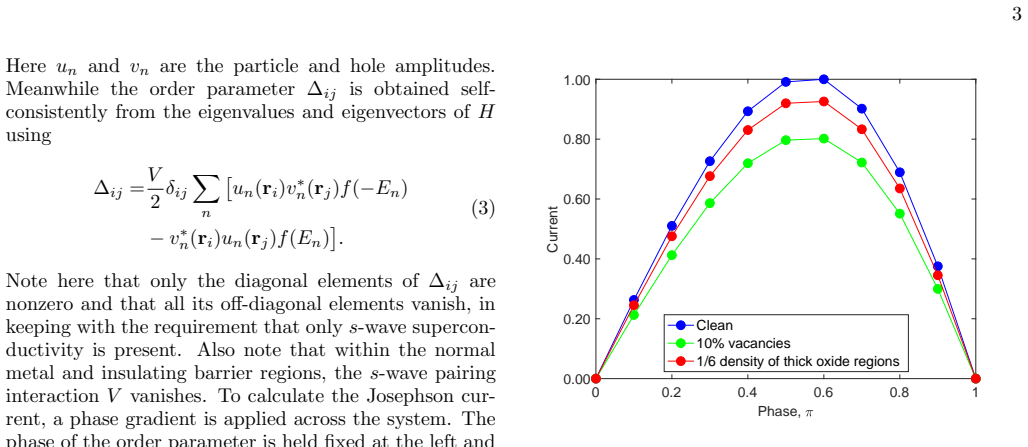
The central claim is that observed critical-current variations in Nb/Al–AlOx/Nb junctions are most plausibly caused by vacancies in the Al layer and by barrier-thickness fluctuations on the scale of one lattice spacing, not by pinholes. In the model, a 10% vacancy concentration suppresses the critical current by about 20%; thick-oxide segments make the critical current fall roughly as $\exp(-L_{\rm avg})$, with $L_{\rm avg}$ the average barrier thickness; and a 10% pinhole density doubles the critical current while changing the current-phase relation from sinusoidal to sawtooth-like, characteristic of superconductor–normal-metal–superconductor junctions. The paper therefore argues that pinholes are an unlikely source of the modest variability seen in working devices but a plausible cause of device failures, since even small pinhole densities produce large currents.
Load-bearing premise
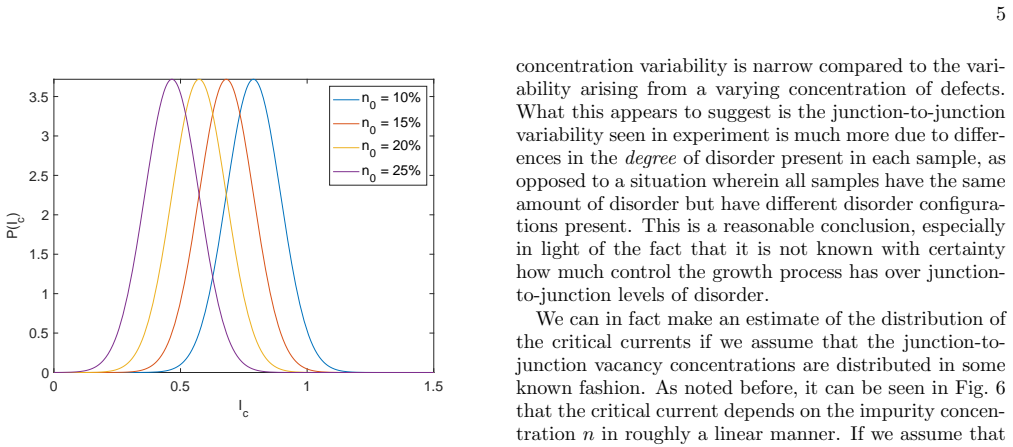
The paper's statistical predictions assume junction-to-junction defect concentrations are normally distributed with a 5% standard deviation; if the real growth process yields a broader, skewed, or correlated distribution, the predicted critical-current spreads and the conclusion that vacancies and thickness variations dominate could be wrong.
Editorial extensions
If this is right
- If vacancies and thickness fluctuations are the dominant variability sources, controlling oxidation and metal-deposition uniformity should narrow the critical-current distribution.
- Pinhole-free fabrication should be prioritized: even a 10% pinhole density roughly doubles the critical current and changes the current-phase relation, so pinholes likely cause device failures rather than gradual variability.
- The linear dependence of $I_c$ on vacancy concentration means a Gaussian spread in vacancy concentration yields a Gaussian spread in $I_c$, whereas the nonlinear dependence on thick-oxide density yields skewed, low-current-tailed distributions.
- Direct measurement of the current-phase relation, for example with a SQUID, can discriminate pinhole-free tunnel junctions (sinusoidal, peak near $\varphi=\pi/2$) from pinhole-dominated junctions (sawtooth, peak approaching $\pi$).
- Junction-to-junction variability is attributed mainly to differences in disorder level between samples, not to different configurations at a fixed disorder concentration.
Reading between the lines
- Beyond the paper: in a three-dimensional barrier, the exponential thickness dependence would likely persist, but the pinhole density at which the CPR turns sawtooth could shift because conduction paths percolate differently in 3D.
- Beyond the paper: the predicted low-side skew from thickness variations and high-side skew from pinholes suggests that the skew direction of measured $P(I_c)$ distributions could serve as a quick diagnostic for which defect class dominates a given fabrication run.
- Beyond the paper: if pinholes are the main device-failure mechanism, then screening non-functional junctions for pinholes, for example by transmission electron microscopy, could directly improve yield modeling and process control; this is a testable consequence the paper does not itself develop.
Signed reviews
Editorial analysis
A structured set of objections, weighed in public.
Referee Report
Summary. The paper uses self-consistent Bogoliubov–de Gennes calculations on a 30×30 lattice model of an Nb/Al-AlOx/Nb SNIS junction to study three disorder mechanisms: vacancies in the Al layer, thickness fluctuations in the AlOx barrier, and pinholes in the barrier. For each mechanism it computes current-phase relations and critical currents, then estimates junction-to-junction critical-current distributions by assuming Gaussian distributions of defect concentrations with a fixed standard deviation of 5%. The authors find that 10% vacancies suppress Ic by about 20%, that thick-oxide-region effects scale roughly as exp(-L_avg), and that even a small pinhole density markedly enhances Ic and changes the CPR to a sawtooth form. They conclude that vacancies and small thickness fluctuations are the most likely explanations for the experimentally observed Ic variability, while pinholes are more likely to cause device failures.
Significance. The paper provides a useful, systematic microscopic comparison of three distinct disorder mechanisms in a technologically relevant junction type, and it makes a concrete, falsifiable prediction: a sawtooth-like current-phase relation is a signature of pinhole-dominated transport. The self-consistent BdG treatment and the side-by-side comparison of mechanisms are strengths, and the authors are appropriately candid about the illustrative nature of their models. However, the central attribution of observed Ic variability to vacancies and thickness fluctuations rests on an unvalidated statistical assumption about junction-to-junction defect-concentration distributions, and the paper's own discussion acknowledges that no quantitative information about disorder levels exists. The qualitative trends and the pinhole scenario are robust, but the quantitative P(Ic) predictions and the resulting attribution claims need either experimental grounding or a sensitivity analysis before they can be considered conclusive.
major comments (3)
- [Secs. III–IV, Figs. 7 and 10] The central comparison with experiment assumes that vacancy concentrations n and thick-oxide-segment concentrations nb are normally distributed across junctions with a standard deviation of 5%. This assumption is introduced without experimental evidence or sensitivity analysis, and the paper explicitly states in Sec. VI that "there is no quantitative information ... about the level of disorder present." If the true distribution is broader, narrower, skewed, or correlated with other defects, the predicted P(Ic) shapes and the conclusion that vacancies and thickness variations dominate the variability could change substantially. For example, the fixed-concentration configuration disorder estimated in Sec. III (6% standard deviation at 10% vacancies) could dominate if the concentration spread is narrower than assumed. The authors should either provide a sensitivity analysis over plausible distribution shapes and widths, or explicitly reframe the P(Ic) results and the attribution as illustrative rather than evidential.
- [Sec. IV, Fig. 10 and Sec. VI] The paper acknowledges in Sec. IV that the thickness-fluctuation P(Ic) is skewed to the low-Ic side, whereas the experimental Nb/Al-AlOx/Nb distributions are skewed to high Ic. It then suggests that pinholes or other defects could produce the high-Ic skew, but it does not present a quantitative combined model of thickness fluctuations plus pinholes or any estimate of the required pinhole concentration. As a result, the claim in Sec. VI that thickness variations are among the "likeliest explanations" for the observed variability is not fully supported by the presented evidence; at most, the paper shows that thickness variations alone cannot reproduce the experimental skew without an additional, unquantified mechanism.
- [Sec. III, Fig. 6] The statement that Ic(n) is proportional to n is only approximate; Fig. 6 shows clear curvature at concentrations above about 10–15%. The derivation of a Gaussian P(Ic) in Sec. III relies on this linearity. The authors should quantify the error introduced by the curvature for the mean concentrations used in Fig. 7, particularly for n0 = 20–25%, or restrict the Gaussian-shape claim to the dilute regime.
minor comments (4)
- [Introduction] The text says "transmission emission microscopy (TEM)"; the correct term is "transmission electron microscopy."
- [Sec. IV, Eq. (5)] There is a typo: "the dependence of of nb on Ic" should read "the dependence of nb on Ic."
- [Secs. III and IV] The standard deviation σ = 5% should be defined precisely: is it 5 percentage points in concentration, or 5% of the mean concentration? The captions of Figs. 7 and 10 should state this explicitly, since the resulting P(Ic) widths depend on the interpretation.
- [Sec. IV, Fig. 10 caption] In the caption, "segement" should be "segment."
Circularity Check
No significant circularity: the quantitative results are forward BdG simulations; auxiliary fitting and Gaussian assumptions are explicitly stated hypotheses, not fitted predictions.
full rationale
I examined the derivation chain for the seven circularity patterns and found none that reduce a central claim to its own inputs. The paper's quantitative results (10% vacancies suppressing Ic by ~20%; Ic scaling with exp(-L_avg) for thickness variations; 10% pinholes doubling Ic) are obtained by self-consistent BdG diagonalization of a microscopic Hamiltonian with stated parameters (V=2, t=1, U=4t, 30x30 lattice). These are forward model outputs, not fits to the experimental critical-current data. The P(Ic) estimates in Sections III and IV do assume Gaussian junction-to-junction defect concentration distributions with sigma=5%, but the paper explicitly labels this as an assumption ('if we assume that the junction-to-junction vacancy concentrations are distributed in some known fashion') and does not claim to have measured or fitted sigma. The curve fit in Eq. 5 is an interpolation of the paper's own numerical Ic(nb) dependence, used only to illustrate possible P(Ic) shapes, and the text explicitly states that 'the precise functional form is not relevant—similar results can be obtained by a quadratic fit.' This is not a fitted parameter renamed as a prediction. The paper is also candid about the limits of its inference: it states 'there is no quantitative information ... about the level of disorder present' and notes that the thickness-variation P(Ic) is skewed opposite to experiment, requiring additional mechanisms. Self-citations (Refs. 10, 11, 13, 15, 20-27) are methodological support for BdG techniques and disorder effects in superconductors; they are not load-bearing uniqueness theorems or ansatz justifications. No self-definitional step, imported uniqueness claim, or renaming of a known empirical pattern was found. The main scientific weakness is underdetermination from unvalidated distributional assumptions, which is a correctness or external-validity concern, not a circularity concern under the stated criteria.
Assumptions & free parameters
free parameters (4)
- pairing interaction V =
2 (in units of t)
- barrier height U =
4t
- Gaussian width sigma for defect concentration =
5%
- curve-fit parameters A, B, p, q (Eq. 5) =
not specified in the paper
assumptions (4)
- domain assumption Bogoliubov-de Gennes mean-field theory adequately describes a single Josephson junction with s-wave pairing at T->0
- domain assumption The junction can be modeled on a 2D square lattice with periodic boundary conditions along the barrier and open boundary conditions across it
- ad hoc to paper Defect concentrations across junctions are normally distributed with sigma=5%
- domain assumption The pairing interaction V=0 in the normal metal and insulator regions
Cite this review
Pith. "Pith review of Disorder and Critical Current Variability in Josephson Junctions." pith.science (2026). https://pith.science/paper/7BGQV3YK
@misc{pith2026190808360,
  author       = {Pith},
  title        = {Pith review of: Disorder and Critical Current Variability in Josephson Junctions},
  year         = {2026},
  howpublished = {\url{https://pith.science/paper/7BGQV3YK}},
  note         = {Machine review of arXiv:1908.08360}
}
abstract
We investigate theoretically the origins of observed variations in the critical currents of Nb/Al-AlO$_x$/Nb Josephson junctions in terms of various types of disorder. We consider the following disorder sources: vacancies within the Al layer; thickness variations in the AlO$_x$ layer; and "pinholes" (i.e., point contacts) within the AlO$_x$ layer. The calculations are all performed by solving the microscopic Bogoliubov-de Gennes Hamiltonian self-consistently. It is found that a small concentration of vacancies within the Al layer is sufficient to suppress the critical current, while the presence of a small number of thick regions of the oxide layer induces a similar effect as well. The pinhole scenario is found to result in anomalous behavior that resembles neither that of a pure tunnel junction nor that of an SNS junction, but a regime that interpolates between these two limits. We comment on the degree to which each of the three scenarios describes the actual situation present in these junctions.
Figures


Figures from the paper (5 more)



Reference graph
Works this paper leans on
-
[1]
author author A. N. \ McCaughan \ and\ author K. K. \ Berggren ,\ 10.1021/nl502629x journal journal Nano Letters \ volume 14 ,\ pages 5748 ( year 2014 ) ,\ note pMID: 25233488 ,\ http://arxiv.org/abs/https://doi.org/10.1021/nl502629x https://doi.org/10.1021/nl502629x NoStop
-
[2]
author author S. K. \ Tolpygo ,\ @noop journal journal Low Temperature Physics \ volume 42 ,\ pages 361 ( year 2016 ) NoStop
work page 2016
-
[3]
author author M. Gurvitch , author M. A. \ Washington , \ and\ author H. A. \ Huggins ,\ @noop journal journal Applied Physics Letters \ volume 42 ,\ pages 472 ( year 1983 ) NoStop
work page 1983
-
[4]
author author S. K. \ Tolpygo , author V. Bolkhovsky , author T. J. \ Weir , author L. M. \ Johnson , author M. A. \ Gouker , \ and\ author W. D. \ Oliver ,\ @noop journal journal IEEE Transactions on Applied Superconductivity \ volume 25 ,\ pages 1 ( year 2014 ) NoStop
work page 2014
-
[5]
author author D. S. \ Holmes \ and\ author J. McHenry ,\ @noop journal journal IEEE Transactions on Applied Superconductivity \ volume 27 ,\ pages 1 ( year 2017 ) NoStop
work page 2017
-
[6]
author author G. E. \ Blonder , author M. Tinkham , \ and\ author T. M. \ Klapwijk ,\ @noop journal journal Phys. Rev. B \ volume 25 ,\ pages 4515 ( year 1982 ) NoStop
work page 1982
-
[7]
author author A. Furusaki ,\ @noop journal journal Physica B: Condensed Matter \ volume 203 ,\ pages 214 ( year 1994 ) NoStop
work page 1994
-
[8]
Asano ,\ @noop journal journal Phys
author author Y. Asano ,\ @noop journal journal Phys. Rev. B \ volume 63 ,\ pages 052512 ( year 2001 ) NoStop
work page 2001
Show all 44 references
-
[9]
author author B. K. \ Nikoli \'c , author J. K. \ Freericks , \ and\ author P. Miller ,\ @noop journal journal Phys. Rev. B \ volume 65 ,\ pages 064529 ( year 2002 ) NoStop
2002
-
[10]
author author B. M. \ Andersen , author I. V. \ Bobkova , author P. J. \ Hirschfeld , \ and\ author Y. S. \ Barash ,\ @noop journal journal Phys. Rev. B \ volume 72 ,\ pages 184510 ( year 2005 ) NoStop
2005
-
[11]
author author B. M. \ Andersen , author I. V. \ Bobkova , author P. J. \ Hirschfeld , \ and\ author Y. S. \ Barash ,\ @noop journal journal Phys. Rev. Lett. \ volume 96 ,\ pages 117005 ( year 2006 ) NoStop
2006
-
[12]
Covaci \ and\ author F
author author L. Covaci \ and\ author F. Marsiglio ,\ @noop journal journal Phys. Rev. B \ volume 73 ,\ pages 014503 ( year 2006 ) NoStop
2006
-
[13]
author author B. M. \ Andersen , author Y. S. \ Barash , author S. Graser , \ and\ author P. J. \ Hirschfeld ,\ @noop journal journal Phys. Rev. B \ volume 77 ,\ pages 054501 ( year 2008 ) NoStop
2008
-
[14]
author author A. M. \ Black-Schaffer \ and\ author S. Doniach ,\ @noop journal journal Phys. Rev. B \ volume 78 ,\ pages 024504 ( year 2008 ) NoStop
2008
-
[15]
Graser , author P
author author S. Graser , author P. J. \ Hirschfeld , author T. Kopp , author R. Gutser , author B. M. \ Andersen , \ and\ author J. Mannhart ,\ @noop journal journal Nature Physics \ volume 6 ,\ pages 609 ( year 2010 ) NoStop
2010
-
[16]
author author F. A. \ Wolf , author S. Graser , author F. Loder , \ and\ author T. Kopp ,\ @noop journal journal Phys. Rev. Lett. \ volume 108 ,\ pages 117002 ( year 2012 ) NoStop
2012
-
[17]
\ Kim , author R
author author Y.-J. \ Kim , author R. Tao , author R. F. \ Klie , \ and\ author D. N. \ Seidman ,\ @noop journal journal ACS Nano \ volume 7 ,\ pages 732 ( year 2012 ) NoStop
2012
-
[18]
author author M. L. \ Grossbeck \ and\ author H. K. \ Birnbaum ,\ @noop journal journal Acta Metallurgica \ volume 25 ,\ pages 135 ( year 1977 ) NoStop
1977
-
[19]
Abrahams \ and\ author C
author author E. Abrahams \ and\ author C. M. \ Varma ,\ @noop journal journal Proceedings of the National Academy of Sciences \ volume 97 ,\ pages 5714 ( year 2000 ) NoStop
2000
-
[20]
Zhu , author P
author author L. Zhu , author P. J. \ Hirschfeld , \ and\ author D. J. \ Scalapino ,\ 10.1103/PhysRevB.70.214503 journal journal Phys. Rev. B \ volume 70 ,\ pages 214503 ( year 2004 ) NoStop
2004 doi
-
[21]
author author T. S. \ Nunner , author B. M. \ Andersen , author A. Melikyan , \ and\ author P. J. \ Hirschfeld ,\ @noop journal journal Phys. Rev. Lett. \ volume 95 ,\ pages 177003 ( year 2005 ) NoStop
2005
-
[22]
author author T. S. \ Nunner \ and\ author P. J. \ Hirschfeld ,\ @noop journal journal Phys. Rev. B \ volume 72 ,\ pages 014514 ( year 2005 ) NoStop
2005
-
[23]
author author T. S. \ Nunner , author W. Chen , author B. M. \ Andersen , author A. Melikyan , \ and\ author P. J. \ Hirschfeld ,\ @noop journal journal Phys. Rev. B \ volume 73 ,\ pages 104511 ( year 2006 ) NoStop
2006
-
[24]
He , author T
author author Y. He , author T. S. \ Nunner , author P. J. \ Hirschfeld , \ and\ author H.-P. \ Cheng ,\ @noop journal journal Phys. Rev. Lett. \ volume 96 ,\ pages 197002 ( year 2006 ) NoStop
2006
-
[25]
author author D. J. \ Scalapino , author T. Nunner , \ and\ author P. J. \ Hirschfeld ,\ @noop journal journal Journal of Physics and Chemistry of Solids \ volume 67 ,\ pages 6 ( year 2006 ) NoStop
2006
-
[26]
author author M. A. \ Sulangi , author M. P. \ Allan , \ and\ author J. Zaanen ,\ @noop journal journal Phys. Rev. B \ volume 96 ,\ pages 134507 ( year 2017 ) NoStop
2017
-
[27]
author author M. A. \ Sulangi \ and\ author J. Zaanen ,\ @noop journal journal Phys. Rev. B \ volume 97 ,\ pages 144512 ( year 2018 ) NoStop
2018
-
[28]
author author S. K. \ Tolpygo , author E. Cimpoiasu , author X. Liu , author N. Simonian , author Y. A. \ Polyakov , author J. E. \ Lukens , \ and\ author K. K. \ Likharev ,\ @noop journal journal IEEE Transactions on Applied Superconductivity \ volume 13 ,\ pages 99 ( year 20...
2003
-
[29]
author author L. J. \ Zeng , author S. Nik , author T. Greibe , author P. Krantz , author C. M. \ Wilson , author P. Delsing , \ and\ author E. Olsson ,\ @noop journal journal Journal of Physics D: Applied Physics \ volume 48 ,\ pages 395308 ( year 2015 ) NoStop
2015
-
[30]
Ishii ,\ @noop journal journal Progress of Theoretical Physics \ volume 44 ,\ pages 1525 ( year 1970 ) NoStop
author author C. Ishii ,\ @noop journal journal Progress of Theoretical Physics \ volume 44 ,\ pages 1525 ( year 1970 ) NoStop
1970
-
[31]
author author A. A. \ Golubov , author M. Y. \ Kupriyanov , \ and\ author E. Il’Ichev ,\ @noop journal journal Rev. Mod. Phys. \ volume 76 ,\ pages 411 ( year 2004 ) NoStop
2004
-
[32]
author author C. W. J. \ Beenakker ,\ @noop journal journal Phys. Rev. Lett. \ volume 67 ,\ pages 3836 ( year 1991 ) NoStop
1991
-
[33]
author author D. S. \ Holmes ,\ @noop howpublished personal communication NoStop
-
[34]
Haberkorn , author H
author author W. Haberkorn , author H. Knauer , \ and\ author J. Richter ,\ @noop journal journal physica status solidi (a) \ volume 47 ,\ pages K161 ( year 1978 ) NoStop
1978
-
[35]
Il'Ichev , author V
author author E. Il'Ichev , author V. Zakosarenko , author R. P. J. \ IJsselsteijn , author V. Schultze , author H.-G. \ Meyer , author H. E. \ Hoenig , author H. Hilgenkamp , \ and\ author J. Mannhart ,\ @noop journal journal Phys. Rev. Lett. \ volume 81 ,\ pages 894 ( year 1...
1998
-
[36]
Il’ichev , author V
author author E. Il’ichev , author V. Zakosarenko , author R. P. J. \ IJsselsteijn , author H. E. \ Hoenig , author V. Schultze , author H.-G. \ Meyer , author M. Grajcar , \ and\ author R. Hlubina ,\ @noop journal journal Phys. Rev. B \ volume 60 ,\ pages 3096 ( year 1999 ) NoStop
1999
-
[37]
Il’ichev , author V
author author E. Il’ichev , author V. Zakosarenko , author V. Schultze , author H. E. \ Hoenig , author H.-G. \ Meyer , author K. O. \ Subke , author H. Burkhardt , \ and\ author M. Schilling ,\ @noop journal journal Applied Physics Letters \ volume 76 ,\ pages 100 ( year 2000...
2000
-
[38]
G \"o tz , author M
author author M. G \"o tz , author M. Grajcar , author E. Il’ichev , author V. V. \ Khanin , author A. B. \ Zorin , author J. Niemeyer , \ and\ author H.-G. \ Meyer ,\ @noop journal journal Phys. Rev. B \ volume 62 ,\ pages R14645 ( year 2000 ) NoStop
2000
-
[39]
Il'Ichev , author M
author author E. Il'Ichev , author M. Grajcar , author R. Hlubina , author R. P. J. \ IJsselsteijn , author H. Hoenig , author H.-G. \ Meyer , author A. Golubov , author M. H. S. \ Amin , author A. M. \ Zagoskin , author A. N. \ Omelyanchouk , \ and\ author M. Y. \ Kupriyanov ...
2001
-
[40]
Il'ichev , author H
author author E. Il'ichev , author H. E. \ Hoenig , author H.-G. \ Meyer , author A. B. \ Zorin , author V. Khanin , author M. G \"o tz , author A. B. \ Pavolotsky , \ and\ author J. Niemeyer ,\ @noop journal journal Physica C: Superconductivity \ volume 352 ,\ pages 141 ( yea...
2001
-
[41]
Il’ichev , author V
author author E. Il’ichev , author V. Zakosarenko , author L. Fritzsch , author R. Stolz , author H. E. \ Hoenig , author H.-G. \ Meyer , author M. G \"o tz , author A. B. \ Zorin , author V. Khanin , author A. B. \ Pavolotsky , \ and\ author J. Niemeyer ,\ @noop journal journ...
2001
-
[42]
Komissinski , author E
author author P. Komissinski , author E. Il'ichev , author G. Ovsyannikov , author S. Kovtonyuk , author M. Grajcar , author R. Hlubina , author Z. Ivanov , author Y. Tanaka , author N. Yoshida , \ and\ author S. Kashiwaya ,\ @noop journal journal EPL (Europhysics Letters) \ v...
2002
-
[43]
Grajcar , author M
author author M. Grajcar , author M. Ebel , author E. Il'ichev , author R. K \"u rsten , author T. Matsuyama , \ and\ author U. Merkt ,\ @noop journal journal Physica C: Superconductivity \ volume 372 ,\ pages 27 ( year 2002 a ) NoStop
2002
-
[44]
Grajcar , author R
author author M. Grajcar , author R. Hlubina , author E. Il'ichev , \ and\ author H.-G. \ Meyer ,\ @noop journal journal Physica C: Superconductivity \ volume 368 ,\ pages 267 ( year 2002 b ) NoStop
2002
Reviewed August 14, 2026 · model on record in the stance chip above.
Discussion (0). Continue with ORCID to comment.