REVIEW 4 major objections 7 minor 39 references
Multi-Task Deep Learning with Dynamic Programming for Embryo Early Development Stage Classification from Time-Lapse Videos
T0 review · 4 major / 7 minor · reviewed 2026-08-14 · deepseek-v4-flash
Pith's one-line read A multi-task ResNet50 with multiplicative-mean ensembling and dynamic-programming post-processing raises embryo early-stage classification accuracy from 83.8% to 86.5% on time-lapse IVF videos.
desk verdict Useful but under-powered empirical study of multi-task learning plus DP for embryo staging; the headline gains are plausible yet not statistically established. read the letter →
The pith
A machine-rendered reading of the paper's core claim, the machinery that carries it, and where it could break.
The reading
What carries the argument
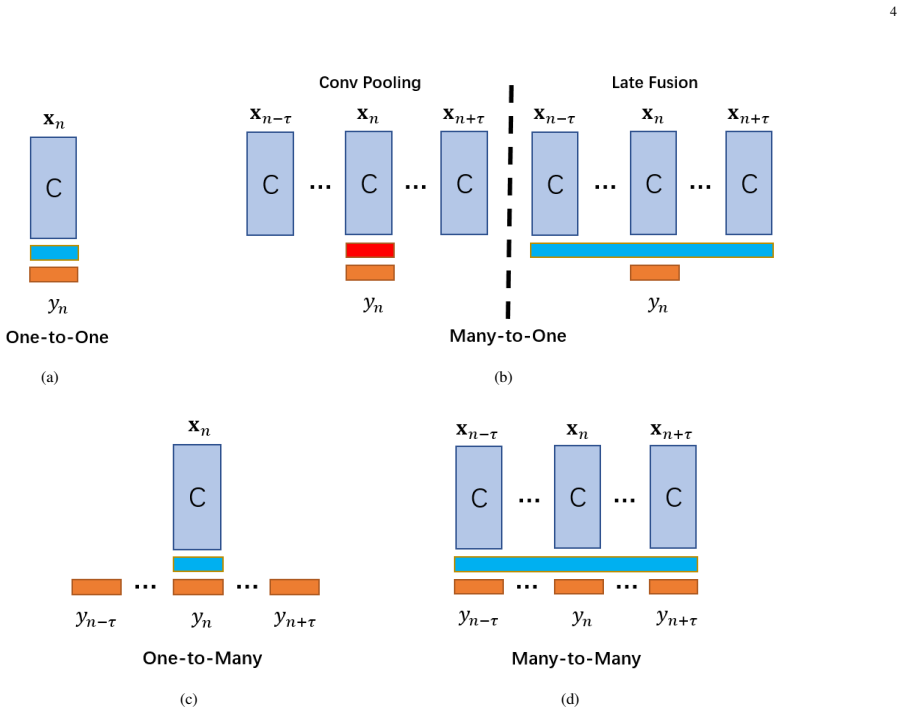
The load-bearing object is the one-to-many multi-task network in hard-parameter-sharing form: convolutional layers are shared, and each of the $2\tau+1$ fully-connected and softmax heads predicts the stage at a different time offset. The multiplicative-mean ensemble (Eq. 7) takes the element-wise product of the probability vectors $\hat{p}_n(x_t)$ from all neighboring frames, turning agreement among frames into a sharper prediction. Dynamic programming then solves Eq. (11) with the per-frame earth-mover loss (Eq. 10), enforcing $\hat{y}_{n+1} \ge \hat{y}_n$; the forward pass accumulates minimal costs and the backtracking pass recovers the optimal monotone sequence. The comparison baselines are the one-to-one ResNet50, many-to-one (conv pooling and late fusion), and many-to-many frameworks.
What would settle it
On a held-out set of embryos with documented reverse-cleavage or t3 events, compare per-stage accuracy with and without the DP step: if forcing monotonicity lowers accuracy on those embryos, or removes most of the overall gain, the improvement is largely an artifact of the constraint rather than better visual recognition.
Extended reading notes
Core claim
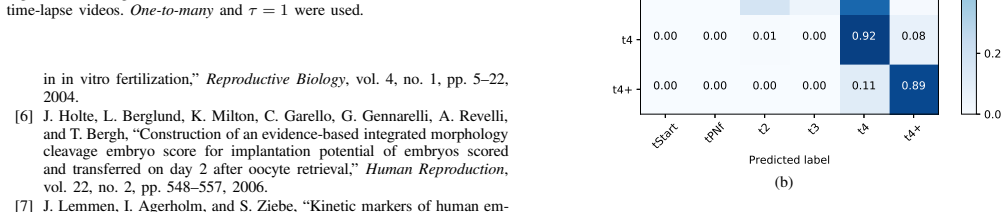
The central claim is that borrowing labels from neighboring frames and enforcing a natural order on stages improves per-frame embryo-stage classification. The one-to-many framework shares convolutional weights across $2\tau+1$ stage-classification heads; the multiplicative-mean ensemble combines the probability vectors assigned to each frame by all frames in its context window; and the DP decoder solves the sequence optimization in Eq. (11) with an earth-mover-distance per-frame loss under the constraint $\hat{y}_{n+1} \ge \hat{y}_n$. At $\tau=1$ this yields 86.5% accuracy and RMSE 0.3964, compared with 83.8% and 0.4840 for the single-frame baseline. Dynamic-programming post-processing improves accuracy for every classifier and every $\tau$ tested, though the gain shrinks as $\tau$ grows. The authors also report that the rare t3 stage (three cells) is classified at only 16% before DP and 5% after DP, which they attribute to few training examples and to multipolar cleavage in roughly 12.2% of human embryos.
Load-bearing premise
The load-bearing premise is that an embryo's developmental stage number almost never decreases over time: the dynamic-programming step forces every frame's predicted stage to be at least the previous frame's, so any real embryo that skips or reverses a stage is guaranteed to be mislabeled.
Editorial extensions
If this is right
- Clinicians using time-lapse incubators can get automated stage labels with per-frame accuracy above 86%, which is high enough to flag embryos for manual review rather than full visual scoring.
- The one-to-many framework gives nearly the accuracy of many-to-many while keeping training time roughly constant as $\tau$ grows, so it is the practical choice for larger video datasets.
- The monotonicity constraint means the method is directly portable to any staged biological process with a known progression order, such as cell division or tissue differentiation.
- If validated on more embryos, the t3 stage remains the weakest link: the model before DP already misses most t3 frames, and DP pushes those errors to adjacent stages.
Reading between the lines
- Editorial inference: The reported DP gains are measured on sequences the constraint mostly agrees with; on embryos with reverse cleavage or multipolar division, forcing monotonicity is likely to mislabel frames that the visual model had classified correctly.
- Editorial inference: A testable extension is to replace the hard monotonic constraint with a learned transition prior, or to allow jumps that skip a stage, which would preserve the smoothing benefit without penalizing genuine reversals.
- Editorial inference: The multiplicative-mean ensemble's success suggests that frame disagreement is best handled by penalizing low-confidence votes; this could generalize to other temporal classification tasks with noisy frame labels.
Signed reviews
Editorial analysis
A structured set of objections, weighed in public.
Referee Report
Summary. This paper proposes MTDL-DP, an automatic pipeline for classifying early embryo development stages from time-lapse videos. A ResNet50 is first extended to multi-task frameworks (one-to-many, many-to-one, many-to-many); the one-to-many variant outputs multiple stage probabilities for a central frame using neighboring frames, aggregated via multiplicative mean (Eq. 7). The resulting per-frame probability vectors are then post-processed by dynamic programming that enforces the stage sequence to be monotonically non-decreasing (Eq. 11, Algorithm 1). Experiments on a private dataset of 170 videos compare five classifiers (one-to-one ResNet50, two many-to-one variants, one-to-many, many-to-many) at tau = 1, 4, 7, reporting classification accuracy, RMSE, and training time. The headline result is that one-to-many MTDL with DP improves accuracy from 83.8% to 86.5% and reduces RMSE from 0.4840 to 0.3964 at tau=1 (Tables II and III); the many-to-many variant reaches 86.6% accuracy. The authors recommend the one-to-many framework as the best accuracy/computation trade-off.
Significance. If the reported results are reliable, the paper would provide a practical and efficient method for automated embryo staging in IVF time-lapse imaging, with a useful analysis of architectural choices. The one-to-many multi-task design is shown to have nearly constant training time across context size, which is a genuine practical advantage. The combination of a simple multiplicative ensemble and DP is straightforward to implement. However, the statistical support is currently weak: only means over five runs are reported, no confidence intervals or tests are given, and the test set is only 34 videos, so the magnitude of the claimed improvements is not established. The DP monotonicity constraint also interacts with the rare t3 stage in a way that is acknowledged but not analyzed. The underlying ideas are sensible, but the empirical claims need substantial strengthening before publication.
major comments (4)
- [Section IV-A, Tables II and III] The paper reports only mean values over five runs (Section IV-A) and no standard deviations, confidence intervals, or hypothesis tests. The test set consists of 34 videos (20% of 170), and frames within a video are highly correlated; the effective sample size for generalization is thus about 34, not 11,900 frames. At tau=1 after DP, one-to-many accuracy is 86.5% versus 86.1% for one-to-one (delta 0.4 percentage points), and before DP the delta is 85.0% versus 83.8% (1.2 points). These differences may be within run-to-run or video-level noise. Please report per-video bootstrap confidence intervals, paired tests (e.g., Wilcoxon signed-rank across videos), and effect sizes, and apply a multiple-comparison correction across the many framework and tau combinations.
- [Section III-B, Eq. (11); Section IV-F, Fig. 10] The non-decreasing constraint in (11) is a hard assumption that conflicts with the paper's own discussion: t3 is rare, and multipolar cleavage occurs in 12.2% of human embryos (cited [39]). The confusion matrix in Fig. 10 shows t3 accuracy dropping from 16% before DP to 5% after DP. This means the DP step actively misclassifies a real stage; the reported overall accuracy and RMSE improvements may be largely an artifact of the constraint suppressing a rare class rather than better visual recognition. Please report results with DP disabled, with a soft or per-video monotonicity constraint, and per-stage metrics for all methods, to separate the effect of the prior from the classifier.
- [Section III-B, Eq. (10)] The EM loss is defined with a negative sign: e_EM(y_hat, p) = -sum_l p_l |y_hat - l|. Since (11) minimizes this loss, the DP would select labels far from the high-probability stages, which is the opposite of the intended behavior and inconsistent with the reported improvements in Tables II and III. Please correct the sign (or explain the convention) and confirm the implementation matches the corrected equation.
- [Algorithm 1] The pseudocode does not initialize the cumulative cost E(l, p_1) for the first frame: the recurrence starts at n=2, so E(l, p_1) remains zero for all l, and the backtracking step will not produce a correct solution to the optimization in (11). The first frame's cost must be set to e(l, p_1) before the recurrence. Please fix Algorithm 1 and specify the tie-breaking rule for argmin.
minor comments (7)
- [Eq. (9)] In Eq. (9), e_LL uses y_n (the true label) in the subscript; it should be y_hat_n, the label being evaluated, since the optimization in (11) does not have access to the true label at inference time.
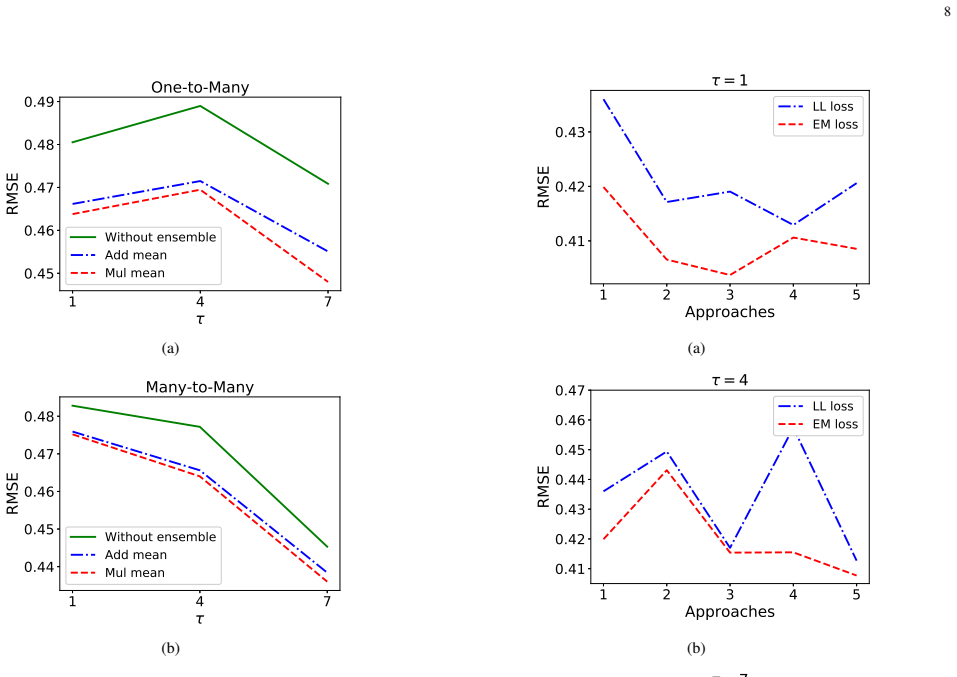
- [Fig. 8 caption] The third panel is labeled '(b) tau = 7'; it should be '(c) tau = 7'.
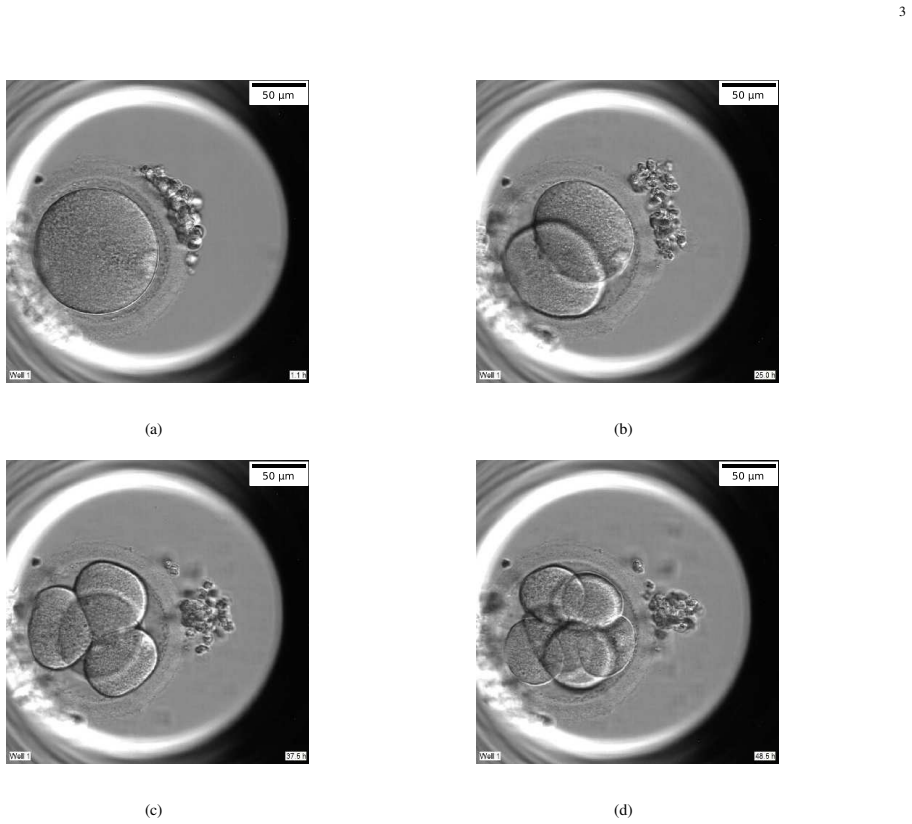
- [Fig. 1] The scale bar labels render as 'uni03BCμ'; should read '50 μm'.
- [Reference [13]] The conference acronym 'ICMICCAI' should be 'MICCAI'.
- [Reference [17]] Reference [17] is an OpenReview preprint; consider citing a peer-reviewed version if available.
- [Abstract and Section I] The novelty claim 'first study that applies MTDL to embryo early development stage classification' should be qualified relative to Ref. [17], which also combines late fusion and DP, so the reader can assess the incremental contribution.
- [Section IV-A] 'Random rotation and flip data augmentation was used' should be 'were used'.
Circularity Check
No significant circularity: the paper's gains are empirical comparisons, with the DP monotonicity prior imported from external embryology literature.
full rationale
This is an empirical benchmarking paper. The claimed improvements of MTDL-DP over one-to-one ResNet50 come from training on labeled frames and testing on held-out videos; no parameter fitted to the test set is renamed as a prediction. The DP post-processing (Eq. 11) enforces a monotonicity constraint taken from the embryology literature [37], an externally motivated prior rather than a self-citation, and the paper measures the improvement on data rather than deriving it by construction. The ensemble choices (Eqs. 6-7) and per-frame losses (Eqs. 9-10) are compared empirically, not derived from the target result. No uniqueness theorem from the authors is invoked, and no ansatz is smuggled in via self-citation. Even if the monotonicity prior is debatable for t3 or multipolar cleavage, the paper acknowledges the issue and cites external work [39], so the concern is about biological validity or statistical significance, not circularity. The absence of error bars and significance tests is a correctness risk, not a circularity risk. No circular step can be identified with the required quote-and-reduction evidence.
Assumptions & free parameters
free parameters (2)
- tau (context window size) =
1, 4, or 7 (chosen, not fitted)
- Equal loss weights w_t =
1 for all t
assumptions (5)
- domain assumption Embryo development stage number is monotonically non-decreasing over time, which the DP post-processor enforces.
- domain assumption Manual labels by embryologists are a reliable ground truth for the six stages.
- domain assumption ResNet50 pretrained on ImageNet provides transferable image features for grayscale embryo frames.
- domain assumption The random 70/10/20 split by video creates independent training and test sets.
- domain assumption The six developmental stages can be treated as equally spaced numeric labels for RMSE computation.
Cite this review
Pith. "Pith review of Multi-Task Deep Learning with Dynamic Programming for Embryo Early Development Stage Classification from Time-Lapse Videos." pith.science (2026). https://pith.science/paper/7BN6PEWM
@misc{pith2026190809637,
  author       = {Pith},
  title        = {Pith review of: Multi-Task Deep Learning with Dynamic Programming for Embryo Early Development Stage Classification from Time-Lapse Videos},
  year         = {2026},
  howpublished = {\url{https://pith.science/paper/7BN6PEWM}},
  note         = {Machine review of arXiv:1908.09637}
}
read the original abstract
Time-lapse is a technology used to record the development of embryos during in-vitro fertilization (IVF). Accurate classification of embryo early development stages can provide embryologists valuable information for assessing the embryo quality, and hence is critical to the success of IVF. This paper proposes a multi-task deep learning with dynamic programming (MTDL-DP) approach for this purpose. It first uses MTDL to pre-classify each frame in the time-lapse video to an embryo development stage, and then DP to optimize the stage sequence so that the stage number is monotonically non-decreasing, which usually holds in practice. Different MTDL frameworks, e.g., one-to-many, many-to-one, and many-to-many, are investigated. It is shown that the one-to-many MTDL framework achieved the best compromise between performance and computational cost. To our knowledge, this is the first study that applies MTDL to embryo early development stage classification from time-lapse videos.
Figures

Figures from the paper (7 more)




Reference graph
Works this paper leans on
-
[39]
Trip olar mitosis in human cells and embryos: occurrence, pathophysiology an d medical implications,
B. Kalatova, R. Jesenska, D. Hlinka, and M. Dudas, “Trip olar mitosis in human cells and embryos: occurrence, pathophysiology an d medical implications,” Acta Histochemica, vol. 117, no. 1, pp. 111–125, 2015
work page 2015
-
[1]
B. Huang, X. Ren, L. Wu, L. Zhu, B. Xu, Y . Li, J. Ai, and L. Jin , “Elevated progesterone levels on the day of oocyte maturati on may affect top quality embryo IVF cycles,” PLoS One, vol. 11, no. 1, p. e0145895, 2016
work page 2016
-
[2]
B. Huang, D. Hu, K. Qian, J. Ai, Y . Li, L. Jin, G. Zhu, and H. Z hang, “Is frozen embryo transfer cycle associated with a significa ntly lower incidence of ectopic pregnancy? an analysis of more than 30, 000 cycles,” Fertility Sterility, vol. 102, no. 5, pp. 1345–1349, 2014
work page 2014
-
[3]
B. Huang, K. Qian, Z. Li, J. Y ue, W. Y ang, G. Zhu, and H. Zhan g, “Neonatal outcomes after early rescue intracytoplasmic sp erm injection: an analysis of a 5-year period,” Fertility Sterility, vol. 103, no. 6, pp. 1432–1437, 2015
work page 2015
-
[4]
The istanbul consensus workshop on embryo assessment: Proceed ings of an expert meeting,
A. S. in Reproductive Medicine and E. S. I. G. of Embryolog y, “The istanbul consensus workshop on embryo assessment: Proceed ings of an expert meeting,” Human Reproduction , vol. 26, no. 6, pp. 1270–1283, 2011
work page 2011
-
[5]
B. Tomasz, K. Rafal, and G. Wojciech, “Methods of embryo s coring 9 0 100 200 300 Video frame tStart tPNf t2 t3 t4 t4+ Cell stage True Before DP After DP (a) 0 100 200 300 Video frame tStart tPNf t2 t3 t4 t4+ Cell stage True Before DP After DP (b) Fig. 9. True stage labels, and classifications before and aft er DP , in two time-lapse videos. One-to-many an...
work page 2004
-
[6]
J. Holte, L. Berglund, K. Milton, C. Garello, G. Gennarel li, A. Revelli, and T. Bergh, “Construction of an evidence-based integrate d morphology cleavage embryo score for implantation potential of embryo s scored and transferred on day 2 after oocyte retrieval,” Human Reproduction, vol. 22, no. 2, pp. 548–557, 2006
work page 2006
-
[7]
J. Lemmen, I. Agerholm, and S. Ziebe, “Kinetic markers of human em- bryo quality using time-lapse recordings of IVF/ICSI-fert ilized oocytes,” Reproductive Biomedicine Online , vol. 17, no. 3, pp. 385–391, 2008
work page 2008
Show all 39 references
-
[8]
Time -lapse moni- toring as a tool for clinical embryo assessment,
K. Kirkegaard, I. E. Agerholm, and H. J. Ingerslev, “Time -lapse moni- toring as a tool for clinical embryo assessment,” Human Reproduction, vol. 27, no. 5, pp. 1277–1285, 2012
2012
-
[9]
Non-invasive imaging of human embryos before embryonic genome activation predicts devel opment to the blastocyst stage,
C. C. Wong, K. E. Loewke, N. L. Bossert, B. Behr, C. J. De Jon ge, T. M. Baer, and R. A. R. Pera, “Non-invasive imaging of human embryos before embryonic genome activation predicts devel opment to the blastocyst stage,” Nature Biotechnology, vol. 28, no. 10, pp. 1115– 1121, 2010
2010
-
[10]
A time to look back: Analysis of morphokine tic characteristics of human embryo development,
J. Herrero, A. Tejera, C. Albert, C. Vidal, M. J. De Los Sa ntos, and M. Meseguer, “A time to look back: Analysis of morphokine tic characteristics of human embryo development,” Fertility Sterility , vol. 100, no. 6, pp. 1602–1609, 2013
2013
-
[11]
Biom arkers identified with time-lapse imaging: Discovery, validation , and practical application,
A. A. Chen, L. Tan, V . Suraj, R. R. Pera, and S. Shen, “Biom arkers identified with time-lapse imaging: Discovery, validation , and practical application,” Fertility Sterility, vol. 99, no. 4, pp. 1035–1043, 2013
2013
-
[12]
The use of morphokinetics as a predictor of em bryo implantation,
M. Meseguer, J. Herrero, A. Tejera, K. M. Hilligsoe, N. B . Ramsing, and J. Remohi, “The use of morphokinetics as a predictor of em bryo implantation,” Human Reproduction , vol. 26, no. 10, pp. 2658–2671, 2011
2011
-
[13]
Automated embry o stage classification in time-lapse microscopy video of early huma n embryo development,
Y . Wang, F. Moussavi, and P . Lorenzen, “Automated embry o stage classification in time-lapse microscopy video of early huma n embryo development,” in Proc. 16th Int’l Conf. on Medical Image Computing and Computer-Assisted Intervention (ICMICCAI) , Nagoya, Japan, Sep. 2013, pp...
2013
-
[14]
Conaghan, A
J. Conaghan, A. A. Chen, S. P . Willman, K. Ivani, P . E. Ch- enette, R. Boostanfar, V . L. Baker, G. D. Adamson, M. E. Abusi ef, M. Gvakharia et al. , “Improving embryo selection using a computer- automated time-lapse image analysis test plus day 3 morphol ogy: results tStart...
-
[15]
Applicati on of numerical intelligence methods for the automatic quality grading of a n embryo development,
D. Jonaitis, V . Raudonis, and A. Lipnickas, “Applicati on of numerical intelligence methods for the automatic quality grading of a n embryo development,” International Journal of Computing , vol. 15, no. 3, pp. 177–183, 2016
2016
-
[16]
Segmentation of dev eloping human embryo in time-lapse microscopy,
A. Khan, S. Gould, and M. Salzmann, “Segmentation of dev eloping human embryo in time-lapse microscopy,” in Proc. 13th Int’l Symposium on Biomedical Imaging (ISBI) , Prague, Czech Republic, April 2016, pp. 930–934
2016
-
[17]
Predicting embryo morphokinetics in videos with l ate fusion nets & dynamic decoders,
N. H. Ng, J. McAuley, J. A. Gingold, N. Desai, and Z. C. Lipton, “Predicting embryo morphokinetics in videos with l ate fusion nets & dynamic decoders,” May 2018. [Online]. Availa ble: https://openreview.net/forum?id=By1QA Ykvz
2018
-
[18]
Deep convolutional neural networks for human embryonic cell counting,
A. Khan, S. Gould, and M. Salzmann, “Deep convolutional neural networks for human embryonic cell counting,” in Proc. 14th European Conf. on Computer Vision (ECCV) , Amsterdam, The Netherlands, Oc- tober 2016, pp. 339–348
2016
-
[19]
Computer-automated time-lapse analysis results correla te with embryo implantation and clinical pregnancy: a blinded, multi-cen tre study,
M. D. V erMilyea, L. Tan, J. T. Anthony, J. Conaghan, K. Iv ani, M. Gvakharia, R. Boostanfar, V . L. Baker, V . Suraj, A. A. Chen et al. , “Computer-automated time-lapse analysis results correla te with embryo implantation and clinical pregnancy: a blinded, multi-cen tre study...
2014
-
[20]
Using the Eeva Test adjunctively to traditional day 3 morph ology is 10 informative for consistent embryo assessment within a pane l of embry- ologists with diverse experience,
M. P . Diamond, V . Suraj, E. J. Behnke, X. Y ang, M. J. Angle , J. C. Lambe-Steinmiller, R. Watterson, K. A. Wirka, A. A. Chen, an d S. Shen, “Using the Eeva Test adjunctively to traditional day 3 morph ology is 10 informative for consistent embryo assessment within a pane l ...
2015
-
[21]
Automatic time-lapse instrument is superior to single- point morphology observation for selecting viable embryos : retrospective study in oocyte donation,
B. Aparicio-Ruiz, N. Basile, S. P . Albal´ a, F. Bronet, J . Remoh´ ı, and M. Meseguer, “Automatic time-lapse instrument is superior to single- point morphology observation for selecting viable embryos : retrospective study in oocyte donation,” Fertility and Sterility , vol. 1...
2016
-
[22]
Embryo selection using time-lapse analysis (Early Em- bryo Viability Assessment) in conjunction with standard mo rphology: a prospective two-center pilot study,
D. C. Kieslinger, S. De Gheselle, C. B. Lambalk, P . De Sut ter, E. H. Kostelijk, J. W. R. Twisk, J. van Rijswijk, E. V an den Abbeel, and C. G. V ergouw, “Embryo selection using time-lapse analysis (Early Em- bryo Viability Assessment) in conjunction with standard mo rphology...
2016
-
[23]
A unified architecture for n atural language processing: Deep neural networks with multitask learning,
R. Collobert and J. Weston, “A unified architecture for n atural language processing: Deep neural networks with multitask learning, ” in Proc. 25th Int’l Conf. on Machine Learning (ICML) , Helsinki, Finland, July 2008, pp. 160–167
2008
-
[24]
New types of deep n eural network learning for speech recognition and related applic ations: an overview,
L. Deng, G. Hinton, and B. Kingsbury, “New types of deep n eural network learning for speech recognition and related applic ations: an overview,” in Proc. 38th Int’l Conf. on Acoustics, Speech, and Signal Processing (ICASSP) , V ancouver, Canada, May 2013, pp. 8599–8603
2013
-
[25]
Fast R-CNN,
R. Girshick, “Fast R-CNN,” in Proc. Int’l Conf. on Computer Vision (ICCV), Santiago, Chile, December 2015
2015
-
[26]
An overview of multi-task learning in deep ne ural networks,
S. Ruder, “An overview of multi-task learning in deep ne ural networks,” CoRR, vol. abs/1706.05098, 2017. [Online]. Available: http://arxiv.org/abs/1706.05098
2017 arXiv
-
[27]
Deep residual learni ng for image recognition,
K. He, X. Zhang, S. Ren, and J. Sun, “Deep residual learni ng for image recognition,” in Proc. IEEE Conf. on Computer Vision and Pattern Recognition (CVPR) , Las V egas, NV , June 2016, pp. 770–778
2016
-
[28]
ImageNet: A large-scale hierarchical image database,
J. Deng, W. Dong, R. Socher, L.-J. Li, K. Li, and L. Fei-Fe i, “ImageNet: A large-scale hierarchical image database,” in Proc. IEEE Conf. on Computer Vision and Pattern Recognition (CVPR) , Miami Beach, FL, June 2009, pp. 248–255
2009
-
[29]
UCF101: A dataset of 101 human actions classes from videos in the wild,
K. Soomro, A. R. Zamir, and M. Shah, “UCF101: A dataset of 101 human actions classes from videos in the wild,” CoRR, vol. abs/1212.0402, 2012. [Online]. Available: http://arxiv.org/abs/1212.0402
2012 arXiv
-
[30]
Large-scale video classification with convolu tional neural networks,
A. Karpathy, G. Toderici, S. Shetty, T. Leung, R. Suktha nkar, and L. Fei-Fei, “Large-scale video classification with convolu tional neural networks,” in Proc. IEEE Conf. on Computer Vision and Pattern Recognition (CVPR) . Columbus, OH: IEEE, June 2014, pp. 1725– 1732
2014
-
[31]
Activitynet: A large-scale video benchmark for human acti vity un- derstanding,
F. Caba Heilbron, V . Escorcia, B. Ghanem, and J. Carlos N iebles, “Activitynet: A large-scale video benchmark for human acti vity un- derstanding,” in Proc. IEEE Conf. on Computer Vision and Pattern Recognition (CVPR) . Boston, MA: IEEE, June 2015, pp. 961–970
2015
-
[32]
Beyond short snippets: Deep networks for v ideo classification,
J. Y .-H. Ng, M. Hausknecht, S. Vijayanarasimhan, O. Vin yals, R. Monga, and G. Toderici, “Beyond short snippets: Deep networks for v ideo classification,” in Proc. IEEE Conf. on Computer Vision and Pattern Recognition (CVPR) . Boston, MA: IEEE, June 2015, pp. 4694–4702
2015
-
[33]
A bayesian hierarchical mode l for learning natural scene categories,
L. Fei-Fei and P . Perona, “A bayesian hierarchical mode l for learning natural scene categories,” in Proc. IEEE Conf. on Computer Vision and Pattern Recognition (CVPR) , vol. 2, San Diego, CA, June 2005, pp. 524–531
2005
-
[34]
ImageNe t classification with deep convolutional neural networks,
A. Krizhevsky, I. Sutskever, and G. E. Hinton, “ImageNe t classification with deep convolutional neural networks,” in Proc. Advances in Neural Information Processing Systems , Lake Tahoe, NV , December 2012, pp. 1097–1105
2012
-
[35]
Multi-tas k neural networks for qsar predictions,
G. E. Dahl, N. Jaitly, and R. Salakhutdinov, “Multi-tas k neural networks for qsar predictions,” arXiv preprint arXiv:1406.1231 , 2014
2014 arXiv
-
[36]
Zhou, Ensemble methods: foundations and algorithms
Z.-H. Zhou, Ensemble methods: foundations and algorithms . Boca Raton, FL: CRC press, 2012
2012
-
[37]
Prevalence, consequence, and significance of reverse cleavage by human embryos viewed with the use of the embryoscope time-lapse video system,
Y . Liu, V . Chapple, P . Roberts, and P . Matson, “Prevalence, consequence, and significance of reverse cleavage by human embryos viewed with the use of the embryoscope time-lapse video system,” Fertility Sterility, vol. 102, no. 5, pp. 1295–1300, 2014
2014
-
[38]
Adam: A method for stochastic optimization,
D. P . Kingma and J. Ba, “Adam: A method for stochastic optimization,” CoRR, vol. abs/1412.6980, 2014. [Online]. Available: https://arxiv.org/abs/1412.6980
2014 arXiv
Reviewed August 14, 2026 · model on record in the stance chip above.
Discussion (0). Continue with ORCID to comment.