REVIEW 3 major objections 6 minor 55 references
Fast charge noise sensing using a spectator valley state in a singlet-triplet qubit
T0 review · 3 major / 6 minor · reviewed 2026-08-06 · deepseek-v4-flash
Pith's one-line read This paper claims that the valley degree of freedom of a silicon singlet-triplet spin qubit can serve as a colocated spectator charge-noise sensor, reaching unity SNR in about 13 microseconds through a resonator while preserving spin…
desk verdict A real extension of the valley-spectator idea to ST qubits, with sound mechanics, but the paper's own valley-lifetime numbers contradict each other and the headline measurement speeds depend on the longer one. read the letter →
The pith
A machine-rendered reading of the paper's core claim, the machinery that carries it, and where it could break.
The reading
What carries the argument
The central object is the spin-dependent hybridized valley (HV) state: a rotation $U_{SV}(\theta)=\exp(-i\theta\,\sigma_z\tau_y/2)$ with $\theta=\tan^{-1}(J_c/\Delta)$ diagonalizes the singly-excited-valley Hamiltonian into decoupled spin ($\sigma$) and valley ($T$) Pauli operators, giving $H_{SV}=(J_s/2)\sigma_z+(\beta/2)T_z$ with $\beta=\sqrt{\Delta^2+J_c^2}$. This HV degree of freedom plays the role of a spectator qubit living on the same two electrons as the singlet-triplet qubit: it couples transversally to a resonator probe field with strength $g=g_0\cos\theta_0$, producing a dispersive shift $\chi=g^2/\Delta_{rv}$ that charge noise modulates through $\delta\chi=\chi(2\delta g/g-\delta\Delta/\Delta_{rv})$. The measurement-speed result rests on the signal-to-noise formula $t_m^{\mathrm{shot}}=(\kappa^2/4+\chi_0^2)/(4\kappa\,\delta\chi_{\min}^2\langle n\rangle)$, which gives 13 microseconds for the parameters of Table I, together with the numerically verified claim that measurement-induced collapse of the HV state leaves the spin pure to order $\theta^2$.
What would settle it
Build the proposed Si/SiGe double-dot resonator setup with Table I parameters, initialize one electron in the excited valley state, and apply a calibrated detuning step of $\delta\epsilon\approx20\,\mu\mathrm{V}$ (corresponding to $\delta\mu\approx4\,\mu\mathrm{eV}$) at a known time; the paper predicts the homodyne current reaches unity SNR within about 13 microseconds with a quantum-limited amplifier. If the detection time is far longer, or if the probe response decays on a sub-millisecond timescale, the valley-coherence assumption or the coupling estimates fail, and measuring the in-situ valley relaxation time under pulsed two-electron operation would settle which.
Extended reading notes
Core claim
At the paper's core is a model Hamiltonian for the singly-excited-valley subspace of a two-electron singlet-triplet qubit. After a Schrieffer-Wolff reduction and a rotation $U_{SV}(\theta)=\exp(-i\theta\,\sigma_z\tau_y/2)$ with $\theta=\tan^{-1}(J_c/\Delta)$, the spin and valley degrees of freedom decouple: $H_{SV}=(J_s/2)\sigma_z+(\beta/2)T_z$ with $\beta=\sqrt{\Delta^2+J_c^2}$, so the excited valley acts as a spectator whose energy responds to the exchange coupling $J$ and the valley-splitting difference $\Delta$. Coupling a resonator to the detuning gate produces a dispersive shift $\chi=g^2/\Delta_{rv}$ that charge noise modulates by $\delta\chi=\chi(2\delta g/g-\delta\Delta/\Delta_{rv})$, so a homodyne measurement of the reflected field gives a continuous, classical readout of exchange fluctuations. For the realistic parameters of Table I (charge noise amplitude $A_0=1.0\,\mu\mathrm{eV}$, resonator at 5 GHz with quality factor 2500, valley splitting difference $\Delta=20\,\mu\mathrm{eV}$), the SNR analysis gives a unity-SNR detection time of 13 microseconds with a quantum-limited amplifier, and 9 ms without one, reduced to about 90 microseconds if stray capacitance is cut tenfold. The protocol preserves spin coherence at the $O(\theta^2)$ level, with $\theta^2=4\times10^{-4}$ for Table I parameters, works in standard Si/SiGe heterostructures without the Ge doping that earlier versions of the idea required, and the valley state can be repumped after decay.
Load-bearing premise
The load-bearing premise is that the excited valley state stays coherent through the full measurement window: the paper imports a valley relaxation rate of roughly 10–100 kHz measured in a single-electron device and assumes it holds in the pulsed two-electron singlet-triplet configuration, so if valley $T_1$ is actually much shorter the probe signal decays and the sensor fails.
Editorial extensions
If this is right
- A charge-noise event that shifts the exchange by about 3 percent (a 13 percent change in the dispersive shift) is detected with unity SNR in roughly 13 microseconds under Table I parameters with a quantum-limited amplifier, fast enough to track slow drift during operation.
- Spin coherence is preserved at the $O(\theta^2)$ level ($\theta^2=4\times10^{-4}$ for Table I), so the probe can run concurrently with qubit logic gates without appreciable disturbance.
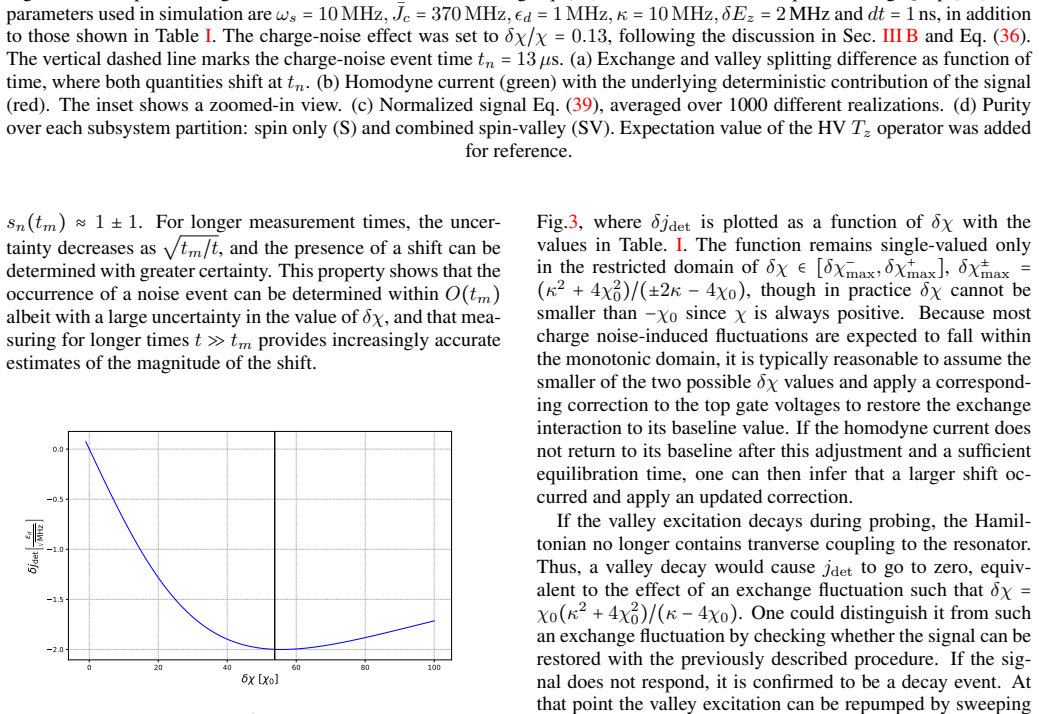
- The probe signal is nonmonotonic in $\delta\chi$, so the readout is single-valued only inside a bounded domain; larger shifts can still be resolved by applying a detuning correction and checking whether the baseline is restored.
- A valley decay event is distinguishable from an exchange fluctuation because the signal drops to zero and does not respond to detuning correction; the valley state can then be repumped through the avoided crossings.
- Without a quantum-limited amplifier the measurement time is about 9 ms, but engineering the resonator (for example, reducing stray capacitance tenfold) brings it to roughly 90 microseconds, so sub-millisecond sensing remains accessible to simpler readout chains.
Reading between the lines
- A natural extension the authors sketch but leave undeveloped is closed-loop exchange stabilization: because the probe supplies a continuous estimate of $\delta J$ whose uncertainty shrinks as $\sqrt{t_m/t}$, the same homodyne signal could drive an integrator that cancels slow drift in real time, effectively turning the sensor into an active noise-cancellation loop for two-qubit gates.
- The hybridized-valley machinery is not tied to Si/SiGe: the derivation carries over to Si-MOS devices (which the paper notes) and, in principle, to any two-electron system with an exchange-tunable spectator doublet, such as an orbital degree of freedom, so the protocol may generalize beyond silicon.
- Because the sensor is colocated with the qubit, the apparatus could double as an exchange-noise spectrometer: recording the time series of $\delta J$ yields the noise power spectral density exactly where it limits gate fidelity, replacing transport-based noise measurements that rely on imperfect spatial correlations.
Signed reviews
Editorial analysis
A structured set of objections, weighed in public.
Referee Report
Summary. The manuscript proposes a charge-noise sensor based on a silicon singlet-triplet (ST) qubit in which one electron is prepared in an excited valley state. The valley excitation acts as a spectator two-level system coupled to a resonator through the exchange interaction, so that charge-noise-induced fluctuations in exchange and valley splitting produce a measurable dispersive shift. The authors derive the effective Hamiltonian, compute the signal-to-noise ratio of a homodyne readout, estimate measurement times from device parameters (13 micro-seconds with a quantum-limited amplifier, 9 ms with a cryogenic amplifier, and sub-ms with optimized resonator parameters), show that the probe perturbs the spin qubit only at O(theta^2), and validate the SNR formula with a stochastic master-equation simulation. The central claim is that sub-millisecond, in-situ, colocated charge-noise detection is feasible while the qubit continues to operate.
Significance. If the underlying assumptions hold, the proposal is a conceptually attractive route to real-time charge-noise monitoring for exchange-based silicon qubits, with the sensor colocated on the same pair of electrons and no additional sensor dot. The paper contains a complete analytic derivation of the probe Hamiltonian, a transparent SNR analysis, and a numerical simulation, which are strengths. The parameter estimates are grounded in experimental references rather than fitted to produce a small measurement time. However, the significance currently depends on two load-bearing points that need clarification: the valley relaxation time in the proposed operating configuration, and the consistency between the simulated and the analytic signal (delta_chi/chi).
major comments (3)
- [Sec. I, Sec. II C, Sec. III B] The manuscript is internally contradictory about the valley relaxation time. Section I states 'valley relaxation times in silicon can exceed 10 ms [24]' and Sec. III B repeats '~10 ms', but Sec. II C states 'valley relaxation rate~10–100kHz [24]', which corresponds to T1 = 10–100 micro-seconds. If the 10–100 kHz rate is the correct one for this system, the 13 micro-second measurement time is invalid because the spectator valley state decays with probability 73% (for T1 = 10 micro-seconds) or 12% (for T1 = 100 micro-seconds) during the integration, and continuous monitoring over 1 micro-second to 1 ms as claimed is impossible without frequent repumping, which would interrupt concurrent operation. The authors must resolve this discrepancy and either justify T1 > 10 ms in the pulsed ST configuration or revise the measurement-time claims to account for valley decay and repumping overhead.
- [Sec. IV A and Fig. 2, with Eq. (36)] The simulation that is presented as numerical confirmation of Eq. (30) uses delta_chi/chi = 0.13, but Eq. (36) with the paper's own inputs (delta_J/J = 3% and delta_Delta/Delta_rv ~ 0.5%) gives delta_chi/chi ~ 6%. The simulated signal is therefore about a factor of 2.2 larger than the realistic estimate, and the simulation does not validate the 13 micro-second measurement time for the parameters of Table I. The authors should either rerun the simulation with delta_chi/chi consistent with Eq. (36), or provide a clear justification for why 0.13 is an appropriate fluctuation amplitude in the simulation.
- [Sec. III B, Eq. (38), and Appendix A, Eq. (A5)] The cryogenic-amplifier measurement time is numerically inconsistent. With Table I (T = 4 K, omega_r = 2*pi*5 GHz), k_B T/(hbar omega_r) ~ 16.7, so Eq. (38) gives t_cryo ~ 7 * 16.7 * t_shot ~ 117 * 13 micro-seconds ~ 1.5 ms, not 9 ms. In addition, the derivation in Eq. (A5) uses an incorrect expression for the variance of integrated white noise: the integral of sinc^2(pi f t_m) over the bandwidth 1/t_m does not equal Si(2*pi)/pi ~ 20/9, and the variance should be S0 t_m rather than (20/9) S0 t_m. This affects the quantitative claims for the non-quantum-limited amplifier path and should be corrected.
minor comments (6)
- [Eq. (29)] The prefactor in the SNR expression appears to be printed as 2 epsilon_d / (sqrt(kappa) (kappa^2/4 + chi^2)); the correct prefactor that yields Eq. (30) is 2 epsilon_d sqrt(kappa) / (kappa^2/4 + chi^2). As written, solving Eq. (29) would give a measurement time proportional to kappa rather than to 1/kappa.
- [Sec. III B, Eq. (35)] The symbol 'd' in delta_Delta ~ delta_epsilon * d/l is undefined, and the numerical estimate delta_Delta ~ 0.1 micro-eV from |nabla_F Delta_1/2| = 0.2 e*nm, delta_epsilon = 20 micro-V, and l = 100 nm appears to give 0.04 micro-eV rather than 0.1 micro-eV. Please clarify the formula and check the arithmetic.
- [Sec. III B] The statement 'partial J / partial epsilon = partial J / partial V ~ 0.5 MHz/micro-eV' uses inconsistent units; if V is a gate voltage, the sensitivity should include the lever arm, and if the quantity is partial J / partial epsilon, the units should be MHz/micro-eV consistently.
- [Fig. 2(d)] The legend label 'S SV Tz' is cryptic; the figure should clearly distinguish the spin purity, the spin-valley purity, and the expectation value of T_z.
- [Sec. III B] Equation (30) is an equality defining t_shot, not an inequality; the text describing 'the inequality (30) is nonlinear in t_m' is inaccurate.
- [Sec. IV A] The expression for delta_chi_max^+/- should be checked for sign conventions; as written, the denominator can vanish, and the text would benefit from an explicit statement of the monotonic domain in terms of chi_0 and kappa.
Circularity Check
No significant circularity: the 13 µs measurement-time claim is an SNR formula fed by externally measured device parameters; self-citations supply standard transformations and one calculated input, not the target result.
full rationale
The central derivation is self-contained. The measurement time in Eq. (30) follows from the SNR integral in Eq. (29); the dispersive-shift fluctuation δχ in Eq. (36) is assembled from experimental charge-noise amplitude A0, lever arm α, exchange sensitivity dJ/dV from Refs. [8,10–13,45], and a valley-splitting gradient of 0.2 e·nm from Ref. [23]. None of these are fitted to make t_m small, and the numerical simulation in Fig. 2 is a Monte Carlo consistency check of the same analytic model, not a fitted reproduction of the headline result. The self-citations ([23], [26], [44]) provide a calculated input value and standard Schrieffer-Wolff/lever-arm relations; they are parameter-free with stated assumptions and do not contain the target result, so per the rubric they are independent evidence and do not raise the score. The manuscript does contain an internal inconsistency about valley relaxation (Sec. I says ~10 ms [24] while Sec. II C quotes a 10–100 kHz rate [24]); this is a correctness risk for the premise that the probe remains coherent, but it is not a circular step because nothing is defined or fitted in terms of the measurement-time claim.
Assumptions & free parameters
free parameters (3)
- Simulation noise event size delta_chi/chi =
0.13 (13%)
- Photon number ratio <n>/n_crit =
0.025
- Valley splitting gradient |grad_F Delta| =
0.2 e*nm
assumptions (5)
- standard math Schrieffer-Wolff perturbative elimination of doubly occupied states requires U_i >> t_c, Delta_i.
- standard math Dispersive approximation requires <n> << n_crit and Delta_rv >> g.
- domain assumption Charge noise is quasi-static over the measurement window, modeled by a 1/f spectrum with cutoff f_cutoff.
- domain assumption Valley relaxation is slower than the measurement time (~10 ms T1).
- ad hoc to paper The resonator-HV coupling g scales proportionally with exchange J, so delta_g/g = delta_J/J.
Cite this review
Pith. "Pith review of Fast charge noise sensing using a spectator valley state in a singlet-triplet qubit." pith.science (2026). https://pith.science/paper/7BTDHOCY
@misc{pith2026250714108,
  author       = {Pith},
  title        = {Pith review of: Fast charge noise sensing using a spectator valley state in a singlet-triplet qubit},
  year         = {2026},
  howpublished = {\url{https://pith.science/paper/7BTDHOCY}},
  note         = {Machine review of arXiv:2507.14108}
}
read the original abstract
Semiconductor spin qubits are a promising platform for quantum computing but remain vulnerable to charge noise. Accurate, in situ measurement of charge noise could enable closed-loop control and improve qubit performance. Here, we propose a method for real-time detection of charge noise using a silicon singlet-triplet qubit with one electron initialized in an excited valley state. This valley excitation acts as a spectator degree of freedom, coupled to a high-quality resonator via the exchange interaction, which is sensitive to charge-noise-induced voltage fluctuations. Dispersive readout of the resonator enables a continuous, classical measurement of exchange fluctuations during qubit operation. Signal-to-noise analysis shows that, under realistic device parameters, sub-millisecond measurement times are possible using a quantum-limited amplifier. Even without such an amplifier, similar performance is achievable with appropriately engineered resonator parameters. This approach allows the probe to monitor slow drift in exchange in real time, opening the door to feedback and feedforward strategies for maintaining high-fidelity quantum operations. Importantly, the protocol preserves spin coherence and can be run concurrently with qubit logic gates.
Figures


Reference graph
Works this paper leans on
-
[23]
D. W. Kanaar, H. E. Ercan, M. F. Gyure, and J. P. Kestner, arXiv.org (2024)
work page 2024
-
[24]
N. E. Penthorn, J. S. Schoenfield, L. F. Edge, and H. Jiang, Phys. Rev. Appl.14, 054015 (2020)
work page 2020
-
[1]
F. A. Zwanenburg, A. S. Dzurak, A. Morello, M. Y . Simmons, L. C. L. Hollenberg, G. Klimeck, S. Rogge, S. N. Coppersmith, and M. A. Eriksson, Rev. Mod. Phys.85, 961 (2013)
work page 2013
-
[2]
R. Maurand, X. Jehl, D. Kotekar-Patil, A. Corna, H. Bo- huslavskyi, R. Lavi ´eville, L. Hutin, S. Barraud, M. Vinet, M. Sanquer, and S. De Franceschi, Nat. Commun.7, 13575 (2016)
work page 2016
-
[3]
M. F. Gonzalez-Zalba, S. de Franceschi, E. Charbon, T. Meu- nier, M. Vinet, and A. S. Dzurak, Nat. Electron.4, 872 (2021)
work page 2021
-
[4]
T. Tanttu, W. H. Lim, J. Y . Huang, N. Dumoulin Stuyck, W. Gilbert, R. Y . Su, M. Feng, J. D. Cifuentes, A. E. Seed- house, S. K. Seritan, C. I. Ostrove, K. M. Rudinger, R. C. C. Leon, W. Huang, C. C. Escott, K. M. Itoh, N. V . Abrosimov, H.-J. Pohl, M. L. W. Thewalt, F. E. Hudson, R. Blume-Kohout, S. D. Bartlett, A. Morello, A. Laucht, C. H. Yang, A. Sar...
work page 2024
- [5]
- [6]
Show all 55 references
-
[7]
Ruskov, M
R. Ruskov, M. Veldhorst, A. S. Dzurak, and C. Tahan, Phys. Rev. B98, 245424 (2018)
2018
-
[8]
B. M. Freeman, J. S. Schoenfield, and H. Jiang, Appl. Phys. Lett.108, 253108 (2016)
2016
-
[9]
Yoneda, K
J. Yoneda, K. Takeda, T. Otsuka, T. Nakajima, M. R. Delbecq, G. Allison, T. Honda, T. Kodera, S. Oda, Y . Hoshi, N. Usami, K. M. Itoh, and S. Tarucha, Nat. Nanotechnol.13, 102 (2018)
2018
-
[10]
E. J. Connors, J. Nelson, H. Qiao, L. F. Edge, and J. M. Nichol, Phys. Rev. B100, 165305 (2019)
2019
-
[11]
Struck, A
T. Struck, A. Hollmann, F. Schauer, O. Fedorets, A. Schmid- bauer, K. Sawano, H. Riemann, N. V . Abrosimov, L. Cyw´nski, D. Bougeard, and L. R. Schreiber, Npj Quantum Inf.6, 1 (2020)
2020
-
[12]
E. J. Connors, J. Nelson, L. F. Edge, and J. M. Nichol, Nat. Commun.13, 940 (2022)
2022
-
[13]
Degli Esposti, L
D. Degli Esposti, L. E. A. Stehouwer, ¨O. G¨ul, N. Samkharadze, C. D ´eprez, M. Meyer, I. N. Meijer, L. Tryputen, S. Karwal, M. Botifoll, J. Arbiol, S. V . Amitonov, L. M. K. Vandersypen, A. Sammak, M. Veldhorst, and G. Scappucci, arXiv e-prints , arXiv:2309.02832 (2023)
2023 arXiv
-
[14]
J. M. Boter, X. Xue, T. Kr ¨ahenmann, T. F. Watson, V . N. Pre- makumar, D. R. Ward, D. E. Savage, M. G. Lagally, M. Friesen, S. N. Coppersmith, M. A. Eriksson, R. Joynt, and L. Vander- sypen, Phys. Rev. B101, 235133 (2020)
2020
-
[15]
F. Ye, A. Ellaboudy, D. Albrecht, R. Vudatha, N. T. Jacobson, and J. M. Nichol, arXiv e-prints , arXiv:2401.14541 (2024)
2024 arXiv
-
[16]
J. S. Rojas-Arias, A. Noiri, J. Yoneda, P. Stano, T. Naka- jima, K. Takeda, T. Kobayashi, G. Scappucci, S. Tarucha, and D. Loss, arXiv e-prints , arXiv:2505.05875 (2025)
2025
-
[17]
Yoneda, J
J. Yoneda, J. S. Rojas-Arias, P. Stano, K. Takeda, A. Noiri, T. Nakajima, D. Loss, and S. Tarucha, Nat. Phys. , 1 (2023)
2023
-
[18]
M. D. Shulman, S. P. Harvey, J. M. Nichol, S. D. Bartlett, A. C. Doherty, V . Umansky, and A. Yacoby, Nat. Commun.5, 5156 (2014)
2014
-
[19]
Huang, C
W. Huang, C. H. Yang, K. W. Chan, T. Tanttu, B. Hensen, R. C. C. Leon, M. A. Fogarty, J. C. C. Hwang, F. E. Hudson, K. M. Itoh, A. Morello, A. Laucht, and A. S. Dzurak, Nature 569, 532 (2019)
2019
-
[20]
Nakajima, A
T. Nakajima, A. Noiri, K. Kawasaki, J. Yoneda, P. Stano, S. Amaha, T. Otsuka, K. Takeda, M. R. Delbecq, G. Allison, A. Ludwig, A. D. Wieck, D. Loss, and S. Tarucha, Phys. Rev. X10, 011060 (2020)
2020
-
[21]
J. Kim, J. Yun, W. Jang, H. Jang, J. Park, Y . Song, M.-K. Cho, S. Sim, H. Sohn, H. Jung, V . Umansky, and D. Kim, Phys. Rev. Lett.129, 040501 (2022)
2022
-
[22]
Veps¨al¨ainen, R
A. Veps¨al¨ainen, R. Winik, A. H. Karamlou, J. Braum¨uller, A. D. Paolo, Y . Sung, B. Kannan, M. Kjaergaard, D. K. Kim, A. J. Melville, B. M. Niedzielski, J. L. Yoder, S. Gustavsson, and W. D. Oliver, Nat. Commun.13, 1932 (2022), publisher: Nature Publishing Group
2022
-
[25]
Tariq and X
B. Tariq and X. Hu, Npj Quantum Inf.8, 1 (2022)
2022
-
[26]
D. W. Kanaar, S. Wolin, U. G ¨ung¨ord¨u, and J. P. Kestner, Phys. Rev. B103, 235314 (2021)
2021
-
[27]
A. J. Weinstein, M. D. Reed, A. M. Jones, R. W. Andrews, D. Barnes, J. Z. Blumoff, L. E. Euliss, K. Eng, B. H. Fong, S. D. Ha, D. R. Hulbert, C. A. C. Jackson, M. Jura, T. E. Keat- ing, J. Kerckhoff, A. A. Kiselev, J. Matten, G. Sabbir, A. Smith, J. Wright, M. T. Rakher, T. D....
2023
-
[28]
Y .-H. Wu, L. C. Camenzind, A. Noiri, K. Takeda, T. Nakajima, T. Kobayashi, C.-Y . Chang, A. Sammak, G. Scappucci, H.-S. Goan, and S. Tarucha, Npj Quantum Inf.10, 1 (2024)
2024
-
[29]
A. J. Sigillito, M. J. Gullans, L. F. Edge, M. Borselli, and J. R. Petta, Npj Quantum Inf.5, 1 (2019)
2019
-
[30]
H. Y . Walelign, X. Cai, B. Li, E. Barnes, and J. M. Nichol, Phys. Rev. Appl.22, 064029 (2024)
2024
-
[31]
Steinacker, T
P. Steinacker, T. Tanttu, W. H. Lim, N. D. Stuyck, M. Feng, S. Serrano, E. Vahapoglu, R. Y . Su, J. Y . Huang, C. Jones, K. M. Itoh, F. E. Hudson, C. C. Escott, A. Morello, A. Saraiva, C. H. Yang, A. S. Dzurak, and A. Laucht, arXiv e-prints , arXiv:2407.15778 (2024)
2024 arXiv
-
[32]
Petit, H
L. Petit, H. G. J. Eenink, M. Russ, W. I. L. Lawrie, N. W. Hen- drickx, S. G. J. Philips, J. S. Clarke, L. M. K. Vandersypen, and M. Veldhorst, Nature580, 355 (2020)
2020
-
[33]
V olmer, T
M. V olmer, T. Struck, A. Sala, B. Chen, M. Oberl¨ander, T. Offer- mann, R. Xue, L. Visser, J.-S. Tu, S. Trellenkamp, L. Cyw´nski, H. Bluhm, and L. R. Schreiber, Npj Quantum Inf.10, 1 (2024)
2024
-
[34]
J. C. Marcks, E. Eagen, E. C. Brann, M. P. Losert, T. Oh, J. Reily, C. S. Wang, D. Keith, F. A. Mohiyaddin, F. Luthi, M. J. Curry, J. Zhang, F. J. Heremans, M. Friesen, and M. A. Eriks- son, arXiv e-prints , arXiv:2504.12455 (2025)
2025
-
[35]
B. M. Maune, M. G. Borselli, B. Huang, T. D. Ladd, P. W. Deel- man, K. S. Holabird, A. A. Kiselev, I. Alvarado-Rodriguez, R. S. Ross, A. E. Schmitz, M. Sokolich, C. A. Watson, M. F. Gyure, and A. T. Hunter, Nature481, 344–347 (2012)
2012
-
[36]
Blais, R.-S
A. Blais, R.-S. Huang, A. Wallraff, S. M. Girvin, and R. J. Schoelkopf, Phys. Rev. A69, 062320 (2004)
2004
-
[37]
S. P. Harvey, C. G. L. Bøttcher, L. A. Orona, S. D. Bartlett, A. C. Doherty, and A. Yacoby, Phys. Rev. B97, 235409 (2018)
2018
-
[38]
Jaynes and F
E. Jaynes and F. Cummings, Proceedings of the IEEE51, 89 (1963)
1963
-
[39]
P. M. Mutter and G. Burkard, Phys. Rev. Lett.128, 236801 (2022)
2022
-
[40]
Blais, A
A. Blais, A. L. Grimsmo, S. Girvin, and A. Wallraff, Rev. Mod. Phys.93(2021)
2021
-
[41]
Frisk Kockum, L
A. Frisk Kockum, L. Tornberg, and G. Johansson, Phys. Rev. A 85, 052318 (2012)
2012
-
[42]
Gambetta, A
J. Gambetta, A. Blais, D. I. Schuster, A. Wallraff, L. Frunzio, J. Majer, M. H. Devoret, S. M. Girvin, and R. J. Schoelkopf, Phys. Rev. A74(2006)
2006
-
[43]
Walter, P
T. Walter, P. Kurpiers, S. Gasparinetti, P. Magnard, A. Potoˇcnik, Y . Salath´e, M. Pechal, M. Mondal, M. Oppliger, C. Eichler, and 11 A. Wallraff, Phys. Rev. Appl.7(2017)
2017
-
[44]
M. Reed, B. Maune, R. Andrews, M. Borselli, K. Eng, M. Jura, A. Kiselev, T. Ladd, S. Merkel, I. Milosavljevic, E. Pritchett, M. Rakher, R. Ross, A. Schmitz, A. Smith, J. Wright, M. Gyure, and A. Hunter, Phys. Rev. Lett.116, 110402 (2016)
2016
-
[45]
X. Cai, E. J. Connors, L. F. Edge, and J. M. Nichol, Nat. Phys. 19, 386 (2023)
2023
-
[46]
M. P. Losert, M. A. Eriksson, R. Joynt, R. Rahman, G. Scap- pucci, S. N. Coppersmith, and M. Friesen, Phys. Rev. B108, 125405 (2023)
2023
-
[47]
Paquelet Wuetz, D
B. Paquelet Wuetz, D. Degli Esposti, A.-M. J. Zwerver, S. V . Amitonov, M. Botifoll, J. Arbiol, L. Vandersypen, M. Russ, and G. Scappucci, Nat. Commun.14, 1385 (2023)
2023
-
[48]
Y . P. Kandel, S. Thapa Magar, A. Iyer, W. H. Renninger, and J. M. Nichol, Phys. Rev. Appl.21(2024)
2024
-
[49]
Koolstra, E
G. Koolstra, E. Glen, N. Beysengulov, H. Byeon, K. Castoria, M. Sammon, B. Dizdar, C. Wang, D. Schuster, S. Lyon, J. Pol- lanen, and D. Rees, Phys. Rev. Appl.23(2025)
2025
-
[50]
Borjans, X
F. Borjans, X. Zhang, X. Mi, G. Cheng, N. Yao, C. Jackson, L. Edge, and J. Petta, PRX Quantum2(2021)
2021
-
[51]
Samkharadze, A
N. Samkharadze, A. Bruno, P. Scarlino, G. Zheng, D. P. DiVin- cenzo, L. DiCarlo, and L. M. K. Vandersypen, Phys. Rev. Appl. 5, 044004 (2016)
2016
-
[52]
Lambert, E
N. Lambert, E. Gigu `ere, P. Menczel, B. Li, P. Hopf, G. Su´arez, M. Gali, J. Lishman, R. Gadhvi, R. Agarwal, A. Galicia, N. Shammah, P. Nation, J. R. Johansson, S. Ahmed, S. Cross, A. Pitchford, and F. Nori, arXiv e-prints , arXiv:2412.04705 (2024)
2024 arXiv
-
[53]
Takeda, A
K. Takeda, A. Noiri, J. Yoneda, T. Nakajima, and S. Tarucha, Phys. Rev. Lett.124, 117701 (2020)
2020
-
[54]
D. C. McKay, C. J. Wood, S. Sheldon, J. M. Chow, and J. M. Gambetta, Phys. Rev. A96, 022330 (2017)
2017
-
[55]
J. B. Johnson, Phys. Rev.32, 97–109 (1928)
1928
Reviewed August 6, 2026 · model on record in the stance chip above.
Discussion (0). Continue with ORCID to comment.