REVIEW 4 major objections 6 minor 43 references
Balancing Privacy and Action Performance: A Penalty-Driven Approach to Image Anonymization
T0 review · 4 major / 6 minor · reviewed 2026-08-16 · deepseek-v4-flash
Pith's one-line read Penalizing an anonymizer when it alters action-relevant pixels too much—while leaving privacy-image anonymization uncapped—keeps action recognition near raw-data accuracy and holds privacy leakage nearly constant across penalty settings.
desk verdict A practical penalty knob for SPACT with strong reported gains, but an inconsistent loss definition and missing code keep it from being reproducible as written. read the letter →
The pith
A machine-rendered reading of the paper's core claim, the machinery that carries it, and where it could break.
The reading
What carries the argument
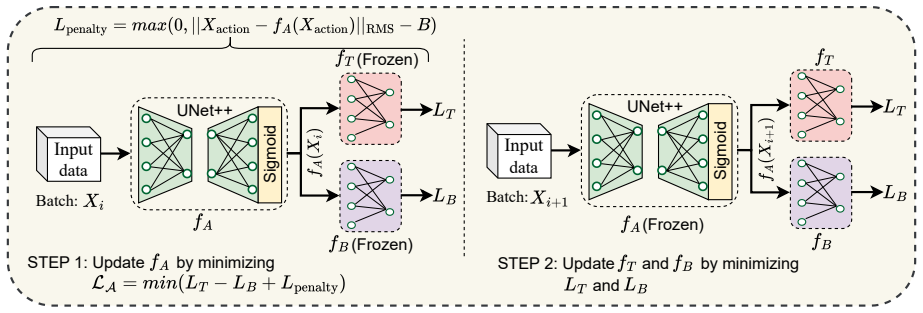
The load-bearing mechanism is the penalty term $L_{\mathrm{penalty}} = \max(0,\|X - f_A(X)\|_{\mathrm{RMS}} - B)$ applied to action frames within a two-step minimax loop. The term is a hinge: as long as the anonymizer keeps the RMS pixel difference below B it is free to do whatever it likes to the image; once the difference exceeds B, the anonymizer is pushed back toward the original. Because it is applied only to action input data, the budget branch's inverted contrastive loss can push for maximal destruction of private attributes without fighting the utility-preserving constraint. This feature-dependent penalty is the component the paper says is new; the surrounding adversarial training and self-supervised budget branch follow prior work.
What would settle it
Apply a post-hoc block shuffle or small affine warp to frames anonymized at B=0.3 so the RMS distance stays below B; if action Top-1 accuracy collapses while privacy leakage stays low, then the penalty is not what protects action cues and the reported gains come from the utility loss rather than the cap.
Extended reading notes
Core claim
On the paper's own terms, the discovery is that a single scalar threshold on how much the anonymizer may change action-related pixels buys most of the privacy–utility trade-off. The anonymizer $f_A$ (a UNet++ initially trained to be the identity) is trained in two alternating steps: it minimizes utility cross-entropy loss minus a self-supervised contrastive budget loss plus $\lambda_{\mathrm{penalty}}\max(0,\|X-f_A(X)\|_{\mathrm{RMS}}-B)$, with the penalty evaluated only on action frames, while the utility classifier and budget classifier are then updated against the frozen anonymizer. Across B = 0.3, 0.5, 0.7, and 0.9, action performance rises as B falls, privacy leakage as measured by class-wise mean average precision and F1 remains almost unchanged, and B = 0.3 gives the best balance, with UCF101 Top-1 accuracy within about a quarter of a point of raw data and PA-HMDB action accuracy far above the prior self-supervised baseline. The same anonymizer transfers to unseen action datasets and to different action classifiers, and it suppresses private attributes in new privacy datasets as well.
Load-bearing premise
The load-bearing premise is that pixel-level similarity between the original and anonymized image faithfully measures whether action cues survive, and that training can cleanly separate action frames from privacy frames so the penalty applies only to action data.
Editorial extensions
If this is right
- At the tightest penalty setting B=0.3, UCF101 action Top-1 accuracy is 78.26% versus 78.88% on raw data, while privacy leakage drops by about 6.5 cMAP points; no prior self-supervised anonymizer reported in the paper achieves this balance.
- Privacy leakage stays nearly flat from B=0.3 to B=0.9 across all tested datasets, so the utility-preserving penalty can be tuned without rebalancing the privacy budget.
- The trained anonymizer generalizes to unseen action and privacy datasets: for instance, on VPHMDB-to-VPUCF it keeps 91.91% Top-1 accuracy at B=0.3 against 92.23% on raw data while cutting privacy leakage by roughly 8.7 cMAP points.
- The anonymizer transfers across different action classifiers (R3D-18, R2plus1D, MViTv2, I3D, C3D), with B=0.3 consistently closest to raw accuracy, supporting the paper's claim that it is model-agnostic.
- Because the privacy branch is self-supervised, the whole pipeline avoids private-attribute labels, which the paper argues makes it more practical under EU AI Act and GDPR-style regulation.
Reading between the lines
- Because privacy leakage barely moves when B changes, the budget branch is likely doing the bulk of the privacy work; the penalty looks like an independent utility-control dial, so the two objectives may be almost fully separable rather than genuinely coupled.
- RMS pixel distance is a weak proxy for semantic preservation: a spatial perturbation such as a block shuffle or small affine warp can keep the penalty below B while destroying action cues. A stricter test would replace the RMS cap with a feature-space distance from the utility encoder.
- The GDPR/EU AI Act alignment is regulatory framing rather than an empirical result; a deployment story would need to measure leakage against stronger or task-specific attackers instead of a fixed ResNet-50 privacy model.
Signed reviews
Editorial analysis
A structured set of objections, weighed in public.
Referee Report
Summary. The manuscript proposes a penalty-driven minimax optimization framework for privacy-preserving action recognition. An anonymizer f_A (UNet++) is trained with a utility loss for action classification (I3D), a self-supervised contrastive privacy loss for the budget branch (ResNet-50/VISPR), and an additional penalty term L_penalty intended to limit over-anonymization of action-relevant features. The penalty is controlled by a threshold B and a weight lambda_penalty. Experiments are conducted on UCF101, HMDB51, PA-HMDB, VISPR1/2, VPUCF, and VPHMDB, with cross-dataset protocols and ablations over B and lambda_penalty. The central claim is that the penalty improves action recognition performance while keeping privacy leakage nearly unchanged across penalty settings.
Significance. If the intended objective can be pinned down, the simple idea of adding a utility-side penalty to a self-supervised anonymizer is attractive, and the empirical scope is broad: the paper evaluates several datasets, multiple target action classifiers, and multiple privacy classifiers. The reported gains over SPACT on UCF101 and PA-HMDB are substantial. The main weaknesses are the internally inconsistent definition of the penalty loss, the lack of uncertainty quantification, and the fact that the 'feature-based penalty' claim in the abstract does not match the pixel-space equation in Eq. (4). These issues are load-bearing because they concern the exact objective being optimized and the reliability of the headline comparisons.
major comments (4)
- [Section 3.2, Eq. (4), Algorithm 1] The penalty loss is defined inconsistently across the paper. Eq. (4) defines L_penalty(X, f_A(X)) = max(0, ||X - f_A(X)||_RMS - B), a pixel-space distance between input and anonymized output, whereas Section 3.2 defines it as max(0, ||X_action - f_T(f_A(X_action))||_RMS - B) and Algorithm 1 line 16 calls it L_P(theta_A, theta_T). The latter form is dimensionally ill-posed because f_T is the I3D action classifier, whose output is a label logit vector, not an image-shaped tensor, so an RMS distance against X_action cannot be computed. The objective actually minimized determines every number in Tables 1-3 and the lambda_penalty ablation, so the paper must fix the definition, provide the exact implemented loss, and rerun or confirm all experiments after the correction. This is not a cosmetic issue.
- [Table 1, Section 5] The claim of 'nearly consistent privacy leakage across different penalty settings' is not supported by the reported numbers. On PA-HMDB, the F1 score varies from 0.253 at B=0.3 to 0.124 at B=0.7, more than a factor of two, and the cMAP values span 65.02 to 65.88. On VISPR1, F1 spans 0.450 to 0.493. These variations are not negligible, and without confidence intervals it is unclear whether they are noise or real trends. Please report error bars over multiple runs or substantially temper the stability claim and discuss the PA-HMDB outliers.
- [Section 4.3, Tables 1 and 2] All comparisons appear to be single-run. The central empirical claim is that Ours at B=0.3 outperforms SPACT by 16.10% on UCF101 and by comparable margins elsewhere, but no standard deviations, seeds, or number of repeats are reported. Given the typical run-to-run variance of deep action recognition and privacy-classifier training, the claimed improvements and the 'nearly constant' privacy differences could be within noise. Please report mean and standard deviation over at least three independent runs for the main tables, state whether baseline numbers are rerun under identical conditions or copied from prior papers, and justify the protocol.
- [Abstract, Eq. (4), Section 3.2.2] The paper describes the method as a 'feature-based penalty scheme' that 'exclusively controls the action features,' but Eq. (4) is a pixel-space RMS constraint. Even if the inconsistency with Section 3.2 is resolved in favor of the pixel-space version, no evidence is provided that pixel RMS distance between X and f_A(X) tracks preservation of action-relevant features. An anonymizer could apply spatial or color transforms that keep pixel RMS under B while destroying action cues, or conversely could remove privacy attributes with large pixel changes while preserving the features the utility branch needs. Please provide a validation analysis, for example an ablation comparing the pixel-RMS penalty against a feature-space penalty, or a correlation study between the penalty value and downstream action accuracy.
minor comments (6)
- [Abstract and Code Availability] The text 'Find code HERE' contains no URL or repository identifier; a link or DOI is needed for reproducibility.
- [Section 3, Eq. (3) text] The sentence 'Lpenalty is the penalty loss used for the anonymizer. is the penalty loss used to penalize the anonymizer...' is broken and duplicated; it should be rewritten.
- [Algorithm 1, line 27] Line 27 updates theta'_B with the gradient of L_T(theta'_B, theta*_A), but the budget/privacy branch should be trained with the privacy loss L_B; this appears to be a typo.
- [Figure 3] The caption says '↓ and ↓' without identifying which curve is the action drop and which is the privacy drop; the axes and curves should be labeled explicitly.
- [Section 3.2.2] The statement that 'Equation 4 is applied exclusively to action-related features' is unclear because Eq. (4) takes only X and f_A(X) as arguments; please specify how X_action is separated from X_privacy in a batch and how the RMS is normalized over pixels and channels.
- [Tables 1-2] The column group headers are confusing because VISPR1 appears to have no action column while PA-HMDB and VPHMDB have both action and privacy columns; please restructure the headers to make the dataset-protocol grouping explicit.
Circularity Check
No significant circularity: the central claim is supported by held-out empirical evaluation, and the method's dependence on prior frameworks is by citation to others, not self-citation.
full rationale
The paper's central claim is that adding a penalty term derived from the utility branch to the anonymizer loss improves action recognition while leaving privacy leakage roughly unchanged. This is not circular: the penalty is a regularizer added to the training objective, and the claimed improvement is measured on held-out test sets of UCF101, HMDB51, PA-HMDB, VPHMDB, and VISPR1/VISPR2 (Tables 1-2, 5-8), rather than being derived from the penalty equation. The method builds on the SPACT self-supervised framework [8] and the adversarial minimax formulation of [8,33], but these are external prior works, not self-citations, and no uniqueness or existence theorem is imported from the authors' own prior work. The only notable issues are not circularity: Eq. 4 defines L_penalty as a pixel-space RMS between X and f_A(X), whereas Section 3.2 and Algorithm 1 define it as an RMS involving f_T(f_A(X_action)), which is dimensionally inconsistent as written and leaves the implemented objective ambiguous; and the statement 'Find code HERE' is not a working URL, so the implemented loss cannot be independently checked. Table 3's monotonic improvement with increasing lambda_penalty is an empirical sanity check that the regularizer behaves as intended, not a prediction forced by construction. Because the evaluation is held-out and self-contained against external benchmarks, the circularity score is 0.
Assumptions & free parameters
free parameters (2)
- B =
swept 0.3, 0.5, 0.7, 0.9
- lambda_penalty =
swept 0.0, 0.1, 0.3, 0.5, 0.7, 1.0
assumptions (4)
- domain assumption Inverted SimCLR contrastive loss (maximizing distance between positive frames) destroys private attribute features while preserving action features.
- domain assumption Cross-dataset training with shared anonymizer weights transfers to novel action and privacy datasets.
- ad hoc to paper Pixel-level RMS difference is a valid proxy for action feature preservation.
- domain assumption Separating input data into action frames (with penalty) and privacy frames (without penalty) is feasible during training.
Cite this review
Pith. "Pith review of Balancing Privacy and Action Performance: A Penalty-Driven Approach to Image Anonymization." pith.science (2026). https://pith.science/paper/7CFO6ISA
@misc{pith2026250414301,
  author       = {Pith},
  title        = {Pith review of: Balancing Privacy and Action Performance: A Penalty-Driven Approach to Image Anonymization},
  year         = {2026},
  howpublished = {\url{https://pith.science/paper/7CFO6ISA}},
  note         = {Machine review of arXiv:2504.14301}
}
read the original abstract
The rapid development of video surveillance systems for object detection, tracking, activity recognition, and anomaly detection has revolutionized our day-to-day lives while setting alarms for privacy concerns. It isn't easy to strike a balance between visual privacy and action recognition performance in most computer vision models. Is it possible to safeguard privacy without sacrificing performance? It poses a formidable challenge, as even minor privacy enhancements can lead to substantial performance degradation. To address this challenge, we propose a privacy-preserving image anonymization technique that optimizes the anonymizer using penalties from the utility branch, ensuring improved action recognition performance while minimally affecting privacy leakage. This approach addresses the trade-off between minimizing privacy leakage and maintaining high action performance. The proposed approach is primarily designed to align with the regulatory standards of the EU AI Act and GDPR, ensuring the protection of personally identifiable information while maintaining action performance. To the best of our knowledge, we are the first to introduce a feature-based penalty scheme that exclusively controls the action features, allowing freedom to anonymize private attributes. Extensive experiments were conducted to validate the effectiveness of the proposed method. The results demonstrate that applying a penalty to anonymizer from utility branch enhances action performance while maintaining nearly consistent privacy leakage across different penalty settings.
Figures


Figures from the paper (5 more)


Reference graph
Works this paper leans on
-
[1]
The privacy-utility tradeoff for remotely teleoper- ated robots
Daniel J Butler, Justin Huang, Franziska Roesner, and Maya Cakmak. The privacy-utility tradeoff for remotely teleoper- ated robots. In Proceedings of the tenth annual ACM/IEEE international conference on human-robot interaction, pages 27–34, 2015
work page 2015
-
[2]
A vision-based system for monitoring elderly people at home
Marco Buzzelli, Alessio Alb ´e, and Gianluigi Ciocca. A vision-based system for monitoring elderly people at home. Applied Sciences, 10(1):374, 2020
work page 2020
-
[3]
Quo vadis, action recognition? a new model and the kinetics dataset
Joao Carreira and Andrew Zisserman. Quo vadis, action recognition? a new model and the kinetics dataset. In pro- ceedings of the IEEE Conference on Computer Vision and Pattern Recognition, pages 6299–6308, 2017
2017
-
[4]
MaSS: Multi-attribute Selective Suppression
Chun-Fu Chen, Shaohan Hu, Zhonghao Shi, Prateek Gulati, Bill Moriarty, Marco Pistoia, Vincenzo Piuri, and Pierangela Samarati. Mass: Multi-attribute selective suppression. arXiv preprint arXiv:2210.09904, 2022
work page Pith review arXiv 2022
-
[5]
A simple framework for contrastive learning of visual representations
Ting Chen, Simon Kornblith, Mohammad Norouzi, and Ge- offrey Hinton. A simple framework for contrastive learning of visual representations. In International conference on ma- chine learning, pages 1597–1607. PMLR, 2020
2020
-
[6]
Privacy- preserving action recognition for smart hospitals using low- resolution depth images
Edward Chou, Matthew Tan, Cherry Zou, Michelle Guo, Albert Haque, Arnold Milstein, and Li Fei-Fei. Privacy- preserving action recognition for smart hospitals using low- resolution depth images. arXiv preprint arXiv:1811.09950, 2018
arXiv 2018
-
[7]
Towards privacy-preserving recognition of human activities
Ji Dai, Behrouz Saghafi, Jonathan Wu, Janusz Konrad, and Prakash Ishwar. Towards privacy-preserving recognition of human activities. In 2015 IEEE international conference on image processing (ICIP), pages 4238–4242. IEEE, 2015
work page 2015
-
[8]
Spact: Self-supervised privacy preservation for action recog- nition
Ishan Rajendrakumar Dave, Chen Chen, and Mubarak Shah. Spact: Self-supervised privacy preservation for action recog- nition. In Proceedings of the IEEE/CVF Conference on Com- puter Vision and Pattern Recognition , pages 20164–20173, 2022
work page 2022
Show all 43 references
-
[9]
Imagenet: A large-scale hierarchical image database
Jia Deng, Wei Dong, Richard Socher, Li-Jia Li, Kai Li, and Li Fei-Fei. Imagenet: A large-scale hierarchical image database. In 2009 IEEE conference on computer vision and pattern recognition, pages 248–255. Ieee, 2009
2009
-
[10]
A large-scale study on unsupervised spatiotemporal representation learning
Christoph Feichtenhofer, Haoqi Fan, Bo Xiong, Ross Gir- shick, and Kaiming He. A large-scale study on unsupervised spatiotemporal representation learning. In Proceedings of the IEEE/CVF conference on computer vision and pattern recognition, pages 3299–3309, 2021
2021
-
[11]
Ted-spad: Temporal distinctiveness for self- supervised privacy-preservation for video anomaly detec- tion
Joseph Fioresi, Ishan Rajendrakumar Dave, and Mubarak Shah. Ted-spad: Temporal distinctiveness for self- supervised privacy-preservation for video anomaly detec- tion. In Proceedings of the IEEE/CVF International Con- ference on Computer Vision, pages 13598–13609, 2023
2023
-
[12]
An introduction to the california consumer privacy act (ccpa)
Eric Goldman. An introduction to the california consumer privacy act (ccpa). Santa Clara Univ. Legal Studies Research Paper, 2020
2020
-
[13]
Deep residual learning for image recognition
Kaiming He, Xiangyu Zhang, Shaoqing Ren, and Jian Sun. Deep residual learning for image recognition. In Proceed- ings of the IEEE conference on computer vision and pattern recognition, pages 770–778, 2016
2016
-
[14]
Learning privacy-preserving optics for human pose estima- tion
Carlos Hinojosa, Juan Carlos Niebles, and Henry Arguello. Learning privacy-preserving optics for human pose estima- tion. In Proceedings of the IEEE/CVF international confer- ence on computer vision, pages 2573–2582, 2021
2021
-
[15]
Using time-of-flight mea- surements for privacy-preserving tracking in a smart room
Li Jia and Richard J Radke. Using time-of-flight mea- surements for privacy-preserving tracking in a smart room. IEEE Transactions on Industrial Informatics , 10(1):689– 696, 2013
2013
-
[16]
Adam: A method for stochastic opti- mization
Diederik P Kingma. Adam: A method for stochastic opti- mization. arXiv preprint arXiv:1412.6980, 2014
2014 arXiv
-
[17]
Hmdb: a large video database for human motion recognition
Hildegard Kuehne, Hueihan Jhuang, Est ´ıbaliz Garrote, Tomaso Poggio, and Thomas Serre. Hmdb: a large video database for human motion recognition. In 2011 Inter- national conference on computer vision , pages 2556–2563. IEEE, 2011
2011
-
[18]
Stprivacy: Spatio-temporal privacy-preserving action recognition
Ming Li, Xiangyu Xu, Hehe Fan, Pan Zhou, Jun Liu, Jia-Wei Liu, Jiahe Li, Jussi Keppo, Mike Zheng Shou, and Shuicheng Yan. Stprivacy: Spatio-temporal privacy-preserving action recognition. In Proceedings of the IEEE/CVF International Conference on Computer Vision, pages 5106–5115, 2023
2023
-
[19]
Privacy-preserving in-home fall detection using vi- sual shielding sensing and private information-embedding
Jixin Liu, Rong Tan, Guang Han, Ning Sun, and Sam Kwong. Privacy-preserving in-home fall detection using vi- sual shielding sensing and private information-embedding. IEEE Transactions on Multimedia, 23:3684–3699, 2020
2020
-
[20]
Indoor privacy-preserving ac- tion recognition via partially coupled convolutional neural network
Jixin Liu and Leilei Zhang. Indoor privacy-preserving ac- tion recognition via partially coupled convolutional neural network. In 2020 International Conference on Artificial In- telligence and Computer Engineering (ICAICE), pages 292–
2020
-
[21]
Argus: Efficient activity detection system for extended video analysis
Wenhe Liu, Guoliang Kang, Po-Yao Huang, Xiaojun Chang, Yijun Qian, Junwei Liang, Liangke Gui, Jing Wen, and Peng Chen. Argus: Efficient activity detection system for extended video analysis. In Proceedings of the IEEE/CVF Winter Conference on Applications of Computer Vision Wo...
2020
-
[22]
To- wards a visual privacy advisor: Understanding and predict- ing privacy risks in images
Tribhuvanesh Orekondy, Bernt Schiele, and Mario Fritz. To- wards a visual privacy advisor: Understanding and predict- ing privacy risks in images. InProceedings of the IEEE inter- national conference on computer vision , pages 3686–3695, 2017
2017
-
[23]
Privacy preserv- ing optics for miniature vision sensors
Francesco Pittaluga and Sanjeev J Koppal. Privacy preserv- ing optics for miniature vision sensors. InProceedings of the IEEE Conference on Computer Vision and Pattern Recogni- tion, pages 314–324, 2015
2015
-
[24]
Pre- capture privacy for small vision sensors
Francesco Pittaluga and Sanjeev Jagannatha Koppal. Pre- capture privacy for small vision sensors. IEEE transactions on pattern analysis and machine intelligence , 39(11):2215– 2226, 2016
2016
-
[25]
Spatiotempo- ral contrastive video representation learning
Rui Qian, Tianjian Meng, Boqing Gong, Ming-Hsuan Yang, Huisheng Wang, Serge Belongie, and Yin Cui. Spatiotempo- ral contrastive video representation learning. In Proceedings of the IEEE/CVF conference on computer vision and pattern recognition, pages 6964–6974, 2021
2021
-
[26]
Learning to anonymize faces for privacy preserving action detection
Zhongzheng Ren, Yong Jae Lee, and Michael S Ryoo. Learning to anonymize faces for privacy preserving action detection. In Proceedings of the european conference on computer vision (ECCV), pages 620–636, 2018
2018
-
[27]
Privacy-preserving human activity recog- nition from extreme low resolution
Michael Ryoo, Brandon Rothrock, Charles Fleming, and Hyun Jong Yang. Privacy-preserving human activity recog- nition from extreme low resolution. In Proceedings of the AAAI conference on artificial intelligence, volume 31, 2017
2017
-
[28]
Ucf101: A dataset of 101 human actions classes from videos in the wild
K Soomro. Ucf101: A dataset of 101 human actions classes from videos in the wild. arXiv preprint arXiv:1212.0402 , 2012
2012 arXiv
-
[29]
Human pose estimation on privacy-preserving low-resolution depth images
Vinkle Srivastav, Afshin Gangi, and Nicolas Padoy. Human pose estimation on privacy-preserving low-resolution depth images. In International conference on medical image com- puting and computer-assisted intervention , pages 583–591. Springer, 2019
2019
-
[30]
Human action recognition from various data modalities: A review
Zehua Sun, Qiuhong Ke, Hossein Rahmani, Mohammed Bennamoun, Gang Wang, and Jun Liu. Human action recognition from various data modalities: A review. IEEE transactions on pattern analysis and machine intelligence , 45(3):3200–3225, 2022
2022
-
[31]
The eu general data protection regulation (gdpr)
Paul V oigt and Axel V on dem Bussche. The eu general data protection regulation (gdpr). A Practical Guide, 1st Ed., Cham: Springer International Publishing, 10(3152676):10– 5555, 2017
2017
-
[32]
Privacy-preserving action recognition using coded aperture videos
Zihao W Wang, Vibhav Vineet, Francesco Pittaluga, Sudipta N Sinha, Oliver Cossairt, and Sing Bing Kang. Privacy-preserving action recognition using coded aperture videos. In Proceedings of the IEEE/CVF Conference on Computer Vision and Pattern Recognition Workshops, 2019
2019
-
[33]
Privacy-preserving deep action recogni- tion: An adversarial learning framework and a new dataset
Zhenyu Wu, Haotao Wang, Zhaowen Wang, Hailin Jin, and Zhangyang Wang. Privacy-preserving deep action recogni- tion: An adversarial learning framework and a new dataset. IEEE Transactions on Pattern Analysis and Machine Intelli- gence, 44(4):2126–2139, 2020
2020
-
[34]
Towards privacy-preserving visual recognition via ad- versarial training: A pilot study
Zhenyu Wu, Zhangyang Wang, Zhaowen Wang, and Hailin Jin. Towards privacy-preserving visual recognition via ad- versarial training: A pilot study. In Proceedings of the Eu- ropean conference on computer vision (ECCV) , pages 606– 624, 2018
2018
-
[35]
Pri- vacy preserving automatic fall detection for elderly using rgbd cameras
Chenyang Zhang, Yingli Tian, and Elizabeth Capezuti. Pri- vacy preserving automatic fall detection for elderly using rgbd cameras. In Computers Helping People with Special Needs: 13th International Conference, ICCHP 2012, Linz, Austria, July 11-13, 2012, Proceedings, Part I 13...
2012
-
[36]
Multi-scale, class-generic, privacy- preserving video
Zhixiang Zhang, Thomas Cilloni, Charles Walter, and Charles Fleming. Multi-scale, class-generic, privacy- preserving video. Electronics, 10(10):1172, 2021
2021
-
[37]
Unet++: A nested u-net ar- chitecture for medical image segmentation
Zongwei Zhou, Md Mahfuzur Rahman Siddiquee, Nima Tajbakhsh, and Jianming Liang. Unet++: A nested u-net ar- chitecture for medical image segmentation. In Deep Learn- ing in Medical Image Analysis and Multimodal Learning for Clinical Decision Support: 4th International Workshop,...
2018
-
[38]
Section A: Dataset details
-
[39]
Section B: Self supervised contrastive loss for privacy removal branchfB
-
[40]
Section C: Additional Results
-
[41]
All the experiments in this paper are conducted on the split- 1, which contains 9,537 training videos and 3,783 testing videos
Dataset UCF101 [28] dataset is a large action annotated dataset with 101 different day-to-day human actions with 13,320 videos. All the experiments in this paper are conducted on the split- 1, which contains 9,537 training videos and 3,783 testing videos. HMDB51 [17] dataset i...
-
[42]
An input videoXp is passed through the anonymizerfA to generate the anonymized videofA(XP )
Self supervised contrastive loss for privacy removal branch fB A schematic diagram of the self-supervised contrastive loss for the privacy removal branch is depicted in Figure 4. An input videoXp is passed through the anonymizerfA to generate the anonymized videofA(XP ). This ...
-
[43]
Training offA,fB andfT The training loss curves of the anonymizer fA, budget task fB, and utility task fT are shown in Figure 5
Additional Results 8.1. Training offA,fB andfT The training loss curves of the anonymizer fA, budget task fB, and utility task fT are shown in Figure 5. The anonymizer is expected to converge by minimizingLA (re- fer eq. 3 of main paper), which is reflected in Figure 5a, where...
Reviewed August 16, 2026 · model on record in the stance chip above.
Discussion (0). Continue with ORCID to comment.