REVIEW 5 major objections 4 minor 5 cited by
Gradient-Free Classifier Guidance for Diffusion Model Sampling
T0 review · 5 major / 4 minor · reviewed 2026-08-12 · deepseek-v4-flash
Pith's one-line read A pretrained classifier used only for inference can guide diffusion sampling toward a target class, and does so without gradient backpropagation.
desk verdict Adaptive reference-class guidance is a real idea, but the Precision headline is circular until an independent classifier scores it. read the letter →
The pith
A machine-rendered reading of the paper's core claim, the machinery that carries it, and where it could break.
The reading
What carries the argument
The load-bearing mechanism is the time-adaptive pair $(\omega, c_{\rm ref})$ that a pretrained classifier derives from a denoised estimate of the image. Equation (5) turns classifier confidence into a continuous guidance scale, and the reference-class rule makes the guidance target not a fixed unconditional model but the class the model is most likely to confuse with the desired one. Algorithm 3 plugs this into the contrast update $bD = \omega D^m(x_t,t,c_{\rm des}) - (\omega-1)D^g(x_t,t,c_{\rm ref})$, with optional multi-step denoising for $\hat{x}_0$ and stochastic reference-class sampling. This lets a single off-the-shelf classifier replace backpropagation while keeping the contrast-based guidance form of classifier-free guidance.
What would settle it
Compare the classifier's top competing class on intermediate denoised estimates with the actual failure mode of the final image as judged by a held-out classifier or human labels; if the intermediate top competitor frequently is not what the final image gets confused with, the steering target is wrong and GFCG should degrade. A direct control is to rerun GFCG with the classifier's softmax replaced by a fixed random reference class: if precision still rises, the classifier signal is not the cause.
Extended reading notes
Core claim
The paper claims that a pretrained classifier, used only in inference mode, can guide diffusion sampling toward a desired class by adaptively choosing a reference class and guidance strength at each time step. For a desired class $c_{\rm des}$ and noisy sample $x_t$, the sampler estimates the clean image $\hat{x}_0$, obtains probabilities $p(c|\hat{x}_0)$, and when $p(c_{\rm des}|\hat{x}_0) < \tau$ it sets $\omega = 1 + \alpha \exp(-\beta(p(c_{\rm des}|\hat{x}_0)-\tau))$ and selects as reference class the highest-probability competing class (or the second-highest when the desired class is already most probable). The denoising update then takes the contrast form $bD = \omega D^m(x_t,t,c_{\rm des}) - (\omega-1)D^g(x_t,t,c_{\rm ref})$, the same linear extrapolation as classifier-free guidance but with a classifier-chosen, time-adaptive reference. The paper reports that this consistently raises classification precision and, combined with Autoguidance on ImageNet 512, achieves a record FD_DINOv2 of 23.09 with 94.3% precision versus Autoguidance's 24.83 and 90.2%; on a 525-species fine-grained bird task it lifts precision from 5.3% (no guidance) to 32.3%.
Load-bearing premise
The method assumes that classifier probabilities computed on an intermediate denoised estimate of the image reliably indicate the final image's class content, so steering away from the top competing class improves the final sample; if those probabilities are noisy or biased, the guidance will optimize the classifier rather than the image.
Editorial extensions
If this is right
- Classifier guidance no longer requires a differentiable classifier or backpropagation, so any off-the-shelf classifier can steer generation at roughly the cost of one extra forward pass per guidance prediction.
- GFCG layers onto existing gradient-free methods: in mixed mode it adds no additional function evaluations, and in additive mode it improves both fidelity and diversity at the cost of doubled evaluations.
- On the paper's ImageNet 512 evaluation, GFCG combined with Autoguidance reaches FD_DINOv2 23.09 and 94.3% precision, beating Autoguidance's 24.83 and 90.2% under identical random seeds.
- The same mechanism transfers to text-to-image models, where a fine-grained 525-species bird classifier lifts precision from 5.3% without guidance and 27.3% with CFG to 32.3% with GFCG.
Reading between the lines
- If intermediate classifier confidence is a reliable signal, the same adaptive reference idea should work for any attribute with a pretrained predictor, not just class labels; one could steer style, sentiment, or even regression targets by defining a 'most confusing' alternative.
- The confidence threshold $\tau$ could double as a stopping rule: guidance is active only while the model is genuinely confused, which may reduce over-correction artifacts that plain CFG exhibits at high scales.
- Because the headline Precision is measured with the same classifier family used for guidance, a stronger test would use a held-out classifier or human labels; the method's true fidelity gain may be smaller or larger than reported.
- A testable scaling prediction is that better classifiers produce better guidance; varying classifier architecture and accuracy should move both FD_DINOv2 and precision monotonically.
Signed reviews
Editorial analysis
A structured set of objections, weighed in public.
Referee Report
Summary. The paper proposes Gradient-free Classifier Guidance (GFCG), a sampling-time method that uses a pretrained classifier in inference mode to adaptively select a reference class cref and a guidance scale omega at each denoising step. When the classifier confidence in the desired class cdes falls below a threshold, the method steers the sample away from the most competing class via the update bD = omega*Dm(x_t,t,cdes) - (omega-1)*Dg(x_t,t,cref). The method is combined with CFG and ATG in mixed or additive modes, and is evaluated on EDM2 ImageNet 512x512 and on Stable Diffusion 1.5 with a fine-grained Bird Species classifier. The main claims are consistent improvements in class prediction accuracy (Precision), complementarity with CFG/ATG, and a record FD_DINOv2 of 23.09 on ImageNet 512 with GFCG+ATG.
Significance. If the results hold, GFCG is a practically valuable contribution: it avoids backpropagation through the diffusion network, makes adaptive use of an off-the-shelf classifier, and can be layered on top of CFG or ATG. The manuscript has real strengths: it builds on a public code base (EDM2), reports extensive ablations over alpha, beta, tau, ts, scp, guidance model choice, and classifier choice, includes a compression-based justification for preferring FD_DINOv2 over FID, and provides a random-seed variation study in the supplement. However, the headline Precision gains are measured with the same classifier that generates the guidance signal, so they are not independent evidence of class-label fidelity; the FD_DINOv2 results are independent and do suggest a real distributional improvement, but the 'record' claim is benchmarked only against a local rerun of ATG, and the 'no additional computational overhead' assertion is contradicted by the supplementary NFE accounting. These issues affect the central empirical claims and need to be addressed.
major comments (5)
- [§3.2 (Eq. 5), §4, Tables 1–2] The Precision metric is circular with respect to the guidance signal. Guidance in Eq. (5) uses the classifier's confidence p(c_des|x0_hat) to set omega and select cref, and Algorithm 3 uses that same classifier during sampling. Precision is then defined in Section 4 as the percentage of generated samples classified correctly by 'the real image classifier', which for ImageNet is the same ResNet-101 described in Section 4.1 and for SD 1.5 is the same Bird Species classifier used for guidance. Consequently, any method that raises this classifier's confidence on the desired class will increase Precision by construction, even if the image is not semantically closer to the class from an independent viewpoint. The paper should re-measure Precision with an independent classifier (different architecture and/or training data) that is not used for guidance, and should report the difference; without this, the Precision gains in Tables 1 and 2 (e.g., 95.4% vs. 90.6% and 32.3% vs. 27.3%) cannot be interpreted as evidence of genuine class-label alignment.
- [Abstract and §5 vs. Supp. §8.4 (Table 6)] The claim of 'without additional computational overhead' is contradicted by the implementation details. Supp. §8.4 states that the multi-step x0_hat estimation with T'=4 'introduces 7 additional NFEs' (63 to 70), and Table 6 confirms that the main-paper configuration uses 70 NFEs versus a 63-NFE baseline. Since the headline ImageNet results in Table 1 are all reported for scp set to its maximum and T'=4, the extra cost is part of the reported configuration, not an optional add-on. Please either remove the 'no additional computational overhead' wording, report runtime and NFE side-by-side for all compared methods, or clearly restrict the claim to configurations with a single-step x0_hat estimate.
- [§4.1, Table 1; Abstract] The 'record FD_DINOv2 of 23.09' is not supported by the reported comparison. The only ATG baseline in Table 1 for EDM2-XXL is the authors' rerun at 24.83, and the text acknowledges that this rerun is 'a little worse than the published value' in the ATG paper. A record claim should be benchmarked directly against the best published number for the same model, dataset, and evaluation protocol; otherwise 23.09 is merely an improvement over a locally rerun baseline. The random-seed study in Supp. §8.1 is a good step, but it is shown for the EDM2-S configuration and does not cover the XXL headline. Please state the published ATG FD_DINOv2 for this setting and demonstrate that 23.09 improves on it.
- [§3.2 (Eq. 6), §5] The resource-requirement narrative is also misleading regarding the need for a second diffusion model. GFCG's update in Eq. (6) requires a forward pass Dg_phi(x_t,t,cref) from a separate guidance network; for the reported ImageNet experiments this is the (XS,T/16) or (M,T/3.5) model, which must be available or trained. The statement in Section 5 that GFCG avoids 'requiring the training of an extra unconditional model, as seen with classifier-free guidance' is technically about an unconditional model, but it obscures that GFCG still requires an auxiliary conditional model for the reference class. Please clarify this second-model requirement, and state explicitly whether GFCG can be run with Dg = Dm when no smaller guidance model is available.
- [§3.2, Eq. (5); Supp. §10.1] The core steering assumption is that classifier probabilities computed on an intermediate denoised estimate x0_hat reliably indicate the final image's class content. The paper does not provide validation of this assumption; the failure cases in Supp. §10.1 (e.g., the TIT MOUSE and TEAL examples) show that GFCG can amplify incorrect features rather than correct them. Please report an empirical check of this assumption, for example by measuring the agreement between the classifier's argmax on x0_hat at intermediate steps and the final classified class of the generated sample, or by analyzing how the reliability of p(c|x0_hat) depends on the denoising schedule and the step budget T'.
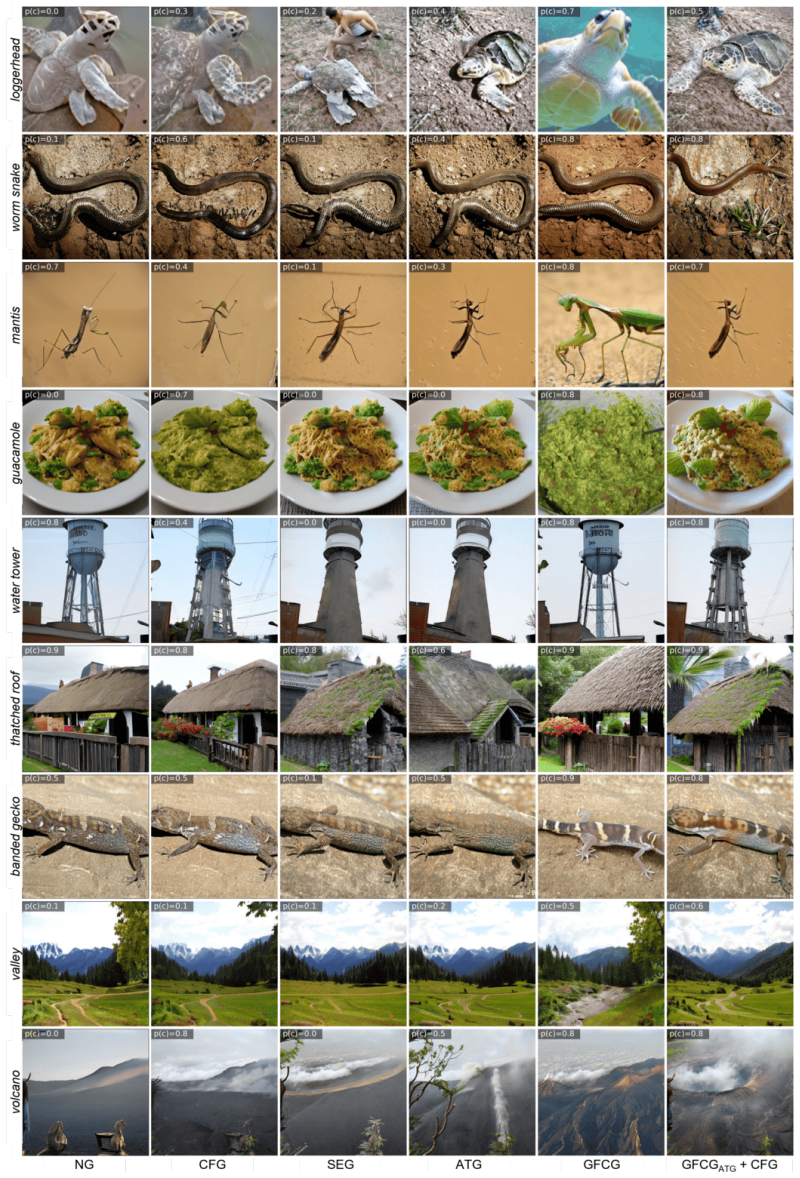
minor comments (4)
- [Abstract] The sentence 'Image generation using diffusion models have demonstrated...' has a subject-verb agreement error; 'have' should agree with 'models' or the sentence should be rephrased to 'Image generation using diffusion models has demonstrated...'.
- [§3.3] There is a typographical error in 'Forscp, it is used to determine...'; it should read 'For scp, it is used to determine...'.
- [§4.1] The sentence 'The best FD DINOv2 of all is achieved when the additive guidance of GFCG and CFG, setting a SOTA performance of 33.39' is grammatically incomplete and also appears to refer to GFCG+ATG+CFG (the configuration with omega_ATG=2.45 and omega_CFG=1.60 in Table 1), not merely GFCG+CFG; please rephrase and make the naming consistent.
- [Equation (7)] The notation 'j∼{1,2,...,N}−{des}' is unclear; it should be written as j ∈ {1,...,N} \ {des} to denote all classes except the desired one.
Circularity Check
Precision gains are self-fulfilling: GFCG steers with the same classifier that later defines Precision, so the headline class-accuracy advantage over ATG is not independent evidence of fidelity.
-
self definitional
[Section 3.2, Eqs. (5)-(6); Section 4, Precision definition; also Supp. Section 7.1 Algorithm 3]
"if p(cdes|bx0) < τ, we identify a reference class cref following two criteria: (1)cref = the class with highest probability if cdes does not have the highest probability; (2) cref = the class with second highest probability if cdes has the highest probability. We then recast the denoising step in Equation 3 as follows: bD = ωDmθ(x, t, cdes) − (ω − 1)Dgϕ(x, t, cref). (6) ... The image fidelity metric Precision is computed as the percentage of generated samples that fall into the data manifold (assessed using the real image classifier)."
Eqs. (5)-(6) use classifier C to pick cref and ω from p(c|x0_hat), then steer bD = ωDm(cdes) − (ω − 1)Dg(cref) away from C's current top or runner-up class. Section 4 then defines Precision as the percentage of generated samples falling into the data manifold 'assessed using the real image classifier'; for ImageNet this is the same ResNet-101 used for guidance, and for SD 1.5 the paper states 'a classifier trained from the Bird Species dataset was used for guided sampling and the samples were evaluated against the same training dataset.' Hence Precision is C's own top-1 accuracy after GFCG has moved the sample in the direction that changes C's decision toward cdes.
full rationale
GFCG's headline Precision advantage is partly circular: the same classifier both selects the reference class and guidance scale (Eqs. 5-6) and defines the Precision metric (Section 4). Because GFCG is triggered whenever the classifier does not already favor cdes and steers away from that classifier's competing class, the reported Precision gain is the classifier rewarding its own steering signal. The FD_DINOv2 numbers are computed from DINOv2 embeddings and are genuinely independent; they support a real distributional-fidelity improvement (23.09 vs 24.83 for ATG on EDM2-XXL). Thus the circularity is partial: the 'improves class prediction accuracy' claim is substantially self-fulfilling, while the FD_DINOv2 and Recall claims retain independent content. No load-bearing self-citation or imported-uniqueness pattern exists. The limitations section concedes GFCG is 'most beneficial to generation of images which are in distribution of the pre-trained classifier,' reinforcing that the metric is tied to the same classifier's biases. Separately, and not a circularity issue, the abstract's 'without additional computational overhead' conflicts with Supp. Section 8.4, which reports 7 additional NFEs from the 4-step x0_hat estimation.
Assumptions & free parameters
free parameters (7)
- alpha (guidance strength) =
0.5 to 2.5 depending on experiment
- beta (confidence sensitivity) =
1.25 (ImageNet), 1.0 (text-to-image birds)
- tau (confidence threshold) =
1.0 for text-to-image; not explicitly reported for ImageNet
- ts (guidance start step) =
17 (ImageNet), 20 or 50 (birds)
- scp (classifier prediction interval) =
max for ImageNet, 1 or 2 for birds
- T-prime (multi-step denoising steps for x0_hat) =
4
- Guidance model choice Mg =
(XS,T/16) for EDM2-S, (M,T/3.5) for EDM2-XXL
assumptions (4)
- standard math Score approximation: D_theta(x,t,c) approximates the conditional score (Eq. 2)
- domain assumption CFG combination formula Eq. 3 is valid for an arbitrary reference condition
- ad hoc to paper Classifier probabilities on x0_hat are reliable indicators of final image class fidelity
- ad hoc to paper Precision measured by the same classifier used for guidance is a valid image fidelity metric
Cite this review
Pith. "Pith review of Gradient-Free Classifier Guidance for Diffusion Model Sampling." pith.science (2026). https://pith.science/paper/7CHFD5PI
@misc{pith2026241115393,
  author       = {Pith},
  title        = {Pith review of: Gradient-Free Classifier Guidance for Diffusion Model Sampling},
  year         = {2026},
  howpublished = {\url{https://pith.science/paper/7CHFD5PI}},
  note         = {Machine review of arXiv:2411.15393}
}
abstract
Image generation using diffusion models have demonstrated outstanding learning capabilities, effectively capturing the full distribution of the training dataset. They are known to generate wide variations in sampled images, albeit with a trade-off in image fidelity. Guided sampling methods, such as classifier guidance (CG) and classifier-free guidance (CFG), focus sampling in well-learned high-probability regions to generate images of high fidelity, but each has its limitations. CG is computationally expensive due to the use of back-propagation for classifier gradient descent, while CFG, being gradient-free, is more efficient but compromises class label alignment compared to CG. In this work, we propose an efficient guidance method that fully utilizes a pre-trained classifier without using gradient descent. By using the classifier solely in inference mode, a time-adaptive reference class label and corresponding guidance scale are determined at each time step for guided sampling. Experiments on both class-conditioned and text-to-image generation diffusion models demonstrate that the proposed Gradient-free Classifier Guidance (GFCG) method consistently improves class prediction accuracy. We also show GFCG to be complementary to other guided sampling methods like CFG. When combined with the state-of-the-art Autoguidance (ATG), without additional computational overhead, it enhances image fidelity while preserving diversity. For ImageNet 512$\times$512, we achieve a record $\text{FD}_{\text{DINOv2}}$ of 23.09, while simultaneously attaining a higher classification Precision (94.3%) compared to ATG (90.2%)
Figures


Figures from the paper (19 more)




Forward citations
Cited by 5 Pith papers
-
Conditional Diffusion Guidance under Hard Constraint: A Stochastic Analysis Approach
By adding drift g(t)^2 ∇log h(t,y) with h estimated via martingale and covariation losses, diffusion samples can be hard-conditioned on an event.
-
UniDB: A Unified Diffusion Bridge Framework via Stochastic Optimal Control
A stochastic optimal control formulation of diffusion bridges, where Doob's h-transform is the infinite-penalty limit and a finite penalty yields a tunable detail-preserving bridge.
-
Visual Generation Without Guidance
GFT trains a single β-conditioned network that reproduces Classifier-Free Guidance's sampling distribution, matching CFG FID scores across five model families with half the inference cost.
-
DiffIER: Optimizing Diffusion Models with Iterative Error Reduction
DiffIER claims that iteratively minimizing the distance between a diffusion model's predicted noise and a random Gaussian sample at each inference step improves generation quality.
-
Contrastive Flow Matching
Contrastive Flow Matching adds a negative flow-target term to the standard flow-matching loss, reporting large empirical gains, but the closed-form solution shows the term only applies a global rescaling and shift, no...
Reference graph
Works this paper leans on
-
[1]
Self-rectifying dif- fusion sampling with perturbed-attention guidance
Donghoon Ahn, Hyoungwon Cho, Jaewon Min, Wooseok Jang, Jungwoo Kim, SeonHwa Kim, Hyun Hee Park, Ky- ong Hwan Jin, and Seungryong Kim. Self-rectifying dif- fusion sampling with perturbed-attention guidance. arXiv preprint arXiv:2403.17377, 2024. 3
arXiv 2024
-
[2]
Universal guidance for diffusion models
Arpit Bansal, Hong-Min Chu, Avi Schwarzschild, Soumyadip Sengupta, Micah Goldblum, Jonas Geip- ing, and Tom Goldstein. Universal guidance for diffusion models. In Proceedings of the IEEE/CVF Conference on Computer Vision and Pattern Recognition , pages 843–852,
-
[3]
Diffusion posterior sam- pling for general noisy inverse problems
Hyungjin Chung, Jeongsol Kim, Michael T Mccann, Marc L Klasky, and Jong Chul Ye. Diffusion posterior sam- pling for general noisy inverse problems. arXiv preprint arXiv:2209.14687, 2022. 3
arXiv 2022
-
[4]
Katherine Crowson, Maxwell Ingham, Adam Letts, and Alex Spirin. Stable diffusion. https : / / github . com / CompVis/stable-diffusion, 2022. 1, 7
work page 2022
-
[5]
ImageNet: A large-scale hierarchical im- age database
Jia Deng, Wei Dong, Richard Socher, Li-Jia Li, Kai Li, and Li Fei-Fei. ImageNet: A large-scale hierarchical im- age database. In 2009 IEEE conference on computer vision and pattern recognition, pages 248–255. Ieee, 2009. 5
work page 2009
-
[6]
Diffusion models beat GANs on image synthesis
Prafulla Dhariwal and Alexander Nichol. Diffusion models beat GANs on image synthesis. Advances in Neural Infor- mation Processing Systems, 34:8780–8794, 2021. 2, 3
work page 2021
-
[7]
A smaller subset of 10 easily classified classes from imagenet, and a little more french
fast.ai. A smaller subset of 10 easily classified classes from imagenet, and a little more french. https://github. com/fastai/imagenette, 2022. 6
work page 2022
-
[8]
Zico Kolter, Ruslan Salakhutdinov, and Ste- fano Ermon
Yutong He, Naoki Murata, Chieh-Hsin Lai, Yuhta Takida, Toshimitsu Uesaka, Dongjun Kim, Wei-Hsiang Liao, Yuki Mitsufuji, J. Zico Kolter, Ruslan Salakhutdinov, and Ste- fano Ermon. Manifold preserving guided diffusion. ArXiv, abs/2311.16424, 2023. 3
arXiv 2023
Show all 41 references
-
[9]
GANs trained by a two time-scale update rule converge to a local nash equi- librium
Martin Heusel, Hubert Ramsauer, Thomas Unterthiner, Bernhard Nessler, and Sepp Hochreiter. GANs trained by a two time-scale update rule converge to a local nash equi- librium. Advances in neural information processing systems, 30, 2017. 2, 5
2017
-
[10]
Classifier-free diffusion guidance
Jonathan Ho and Tim Salimans. Classifier-free diffusion guidance. In NeurIPS 2021 Workshop on Deep Generative Models and Downstream Applications, 2021. 1, 2, 3
2021
-
[11]
Denoising diffu- sion probabilistic models
Jonathan Ho, Ajay Jain, and Pieter Abbeel. Denoising diffu- sion probabilistic models. Advances in Neural Information Processing Systems, 33:6840–6851, 2020. 2, 3, 4
2020
-
[12]
Video diffu- sion models
Jonathan Ho, Tim Salimans, Alexey A Gritsenko, William Chan, Mohammad Norouzi, and David J Fleet. Video diffu- sion models. In ICLR Workshop on Deep Generative Models for Highly Structured Data, 2022. 2
2022
-
[13]
Smoothed energy guidance: Guiding dif- fusion models with reduced energy curvature of attention
Susung Hong. Smoothed energy guidance: Guiding dif- fusion models with reduced energy curvature of attention. arXiv preprint arXiv:2408.00760, 2024. 3
2024 arXiv
-
[14]
Improving sample quality of diffusion models us- ing self-attention guidance
Susung Hong, Gyuseong Lee, Wooseok Jang, and Seungry- ong Kim. Improving sample quality of diffusion models us- ing self-attention guidance. In Proceedings of the IEEE/CVF International Conference on Computer Vision, pages 7462– 7471, 2023. 3
2023
-
[15]
Elucidating the design space of diffusion-based generative models
Tero Karras, Miika Aittala, Timo Aila, and Samuli Laine. Elucidating the design space of diffusion-based generative models. Advances in neural information processing systems, 35:26565–26577, 2022. 6, 1, 2
2022
-
[16]
Guiding a dif- fusion model with a bad version of itself
Tero Karras, Miika Aittala, Tuomas Kynk ¨a¨anniemi, Jaakko Lehtinen, Timo Aila, and Samuli Laine. Guiding a dif- fusion model with a bad version of itself. arXiv preprint arXiv:2406.02507, 2024. 1, 2, 3, 6
2024 arXiv
-
[17]
Analyzing and improving the training dynamics of diffusion models
Tero Karras, Miika Aittala, Jaakko Lehtinen, Janne Hellsten, Timo Aila, and Samuli Laine. Analyzing and improving the training dynamics of diffusion models. In Proceedings of the IEEE/CVF Conference on Computer Vision and Pattern Recognition, pages 24174–24184, 2024. 1, 5, 3
2024
-
[18]
Diffwave: A versatile diffusion model for audio synthesis
Zhifeng Kong, Wei Ping, Jiaji Huang, Kexin Zhao, and Bryan Catanzaro. Diffwave: A versatile diffusion model for audio synthesis. In International Conference on Learning Representations, 2021. 2
2021
-
[19]
Applying guidance in a limited interval improves sample and distribution quality in diffusion models
Tuomas Kynk ¨a¨anniemi, Miika Aittala, Tero Karras, Samuli Laine, Timo Aila, and Jaakko Lehtinen. Applying guidance in a limited interval improves sample and distribution quality in diffusion models. arXiv preprint arXiv:2404.07724, 2024. 4, 6
2024 arXiv
-
[20]
Pseudo numerical methods for diffusion models on manifolds.arXiv preprint arXiv:2202.09778, 2022
Luping Liu, Yi Ren, Zhijie Lin, and Zhou Zhao. Pseudo numerical methods for diffusion models on manifolds.arXiv preprint arXiv:2202.09778, 2022. 7
2022 arXiv
-
[21]
Diffusion probabilistic models for 3d point cloud generation
Shitong Luo and Wei Hu. Diffusion probabilistic models for 3d point cloud generation. In Proceedings of the IEEE/CVF Conference on Computer Vision and Pattern Recognition , pages 2837–2845, 2021. 2
2021
-
[22]
GLIDE: Towards photorealistic image gener- ation and editing with text-guided diffusion models
Alex Nichol, Prafulla Dhariwal, Aditya Ramesh, Pranav Shyam, Pamela Mishkin, Bob McGrew, Ilya Sutskever, and Mark Chen. GLIDE: Towards photorealistic image gener- ation and editing with text-guided diffusion models. arXiv preprint arXiv:2112.10741, 2022. 2
2022 arXiv
-
[23]
Arbitrary style guid- ance for enhanced diffusion-based text-to-image generation
Zhihong Pan, Xin Zhou, and Hao Tian. Arbitrary style guid- ance for enhanced diffusion-based text-to-image generation. In Proceedings of the IEEE/CVF Winter Conference on Ap- plications of Computer Vision, pages 4461–4471, 2023. 2
2023
-
[24]
On aliased resizing and surprising subtleties in gan evaluation
Gaurav Parmar, Richard Zhang, and Jun-Yan Zhu. On aliased resizing and surprising subtleties in gan evaluation. In Proceedings of the IEEE/CVF Conference on Computer Vision and Pattern Recognition, pages 11410–11420, 2022. 5, 1 9
2022
-
[25]
Dif- fusion motion: Generate text-guided 3d human motion by diffusion model
Zhiyuan Ren, Zhihong Pan, Xin Zhou, and Le Kang. Dif- fusion motion: Generate text-guided 3d human motion by diffusion model. In ICASSP 2023-2023 IEEE International Conference on Acoustics, Speech and Signal Processing (ICASSP), pages 1–5. IEEE, 2023. 2
2023
-
[26]
High-resolution image synthesis with latent diffusion models
Robin Rombach, Andreas Blattmann, Dominik Lorenz, Patrick Esser, and Bj ¨orn Ommer. High-resolution image synthesis with latent diffusion models. In Proceedings of the IEEE/CVF Conference on Computer Vision and Pattern Recognition, pages 10684–10695, 2022. 2
2022
-
[27]
Palette: Image-to-image diffusion mod- els
Chitwan Saharia, William Chan, Huiwen Chang, Chris A Lee, Jonathan Ho, Tim Salimans, David J Fleet, and Mo- hammad Norouzi. Palette: Image-to-image diffusion mod- els. In NeurIPS 2021 Workshop on Deep Generative Models and Downstream Applications, 2021. 2
2021
-
[28]
Photorealistic text-to-image diffusion models with deep language understanding
Chitwan Saharia, William Chan, Saurabh Saxena, Lala Li, Jay Whang, Emily L Denton, Kamyar Ghasemipour, Raphael Gontijo Lopes, Burcu Karagol Ayan, Tim Salimans, et al. Photorealistic text-to-image diffusion models with deep language understanding. Advances in neural information...
2022
-
[29]
Denois- ing diffusion implicit models
Jiaming Song, Chenlin Meng, and Stefano Ermon. Denois- ing diffusion implicit models. In International Conference on Learning Representations, 2021. 2, 3, 4
2021
-
[30]
Loss-guided diffusion models for plug-and-play controllable generation
Jiaming Song, Qinsheng Zhang, Hongxu Yin, Morteza Mar- dani, Ming-Yu Liu, Jan Kautz, Yongxin Chen, and Arash Vahdat. Loss-guided diffusion models for plug-and-play controllable generation. In International Conference on Ma- chine Learning, pages 32483–32498. PMLR, 2023. 3
2023
-
[31]
Generative modeling by esti- mating gradients of the data distribution.Advances in Neural Information Processing Systems, 32, 2019
Yang Song and Stefano Ermon. Generative modeling by esti- mating gradients of the data distribution.Advances in Neural Information Processing Systems, 32, 2019. 2
2019
-
[32]
Score-based generative modeling through stochastic differential equa- tions
Yang Song, Jascha Sohl-Dickstein, Diederik P Kingma, Ab- hishek Kumar, Stefano Ermon, and Ben Poole. Score-based generative modeling through stochastic differential equa- tions. In International Conference on Learning Represen- tations, 2020. 2, 3
2020
-
[33]
Exposing flaws of generative model evaluation metrics and their unfair treatment of diffusion models
George Stein, Jesse Cresswell, Rasa Hosseinzadeh, Yi Sui, Brendan Ross, Valentin Villecroze, Zhaoyan Liu, Anthony L Caterini, Eric Taylor, and Gabriel Loaiza-Ganem. Exposing flaws of generative model evaluation metrics and their unfair treatment of diffusion models. Advances i...
2024
-
[34]
Geometric latent diffusion models for 3d molecule generation
Minkai Xu, Alexander S Powers, Ron O Dror, Stefano Er- mon, and Jure Leskovec. Geometric latent diffusion models for 3d molecule generation. In International Conference on Machine Learning, pages 38592–38610. PMLR, 2023. 2
2023
-
[35]
TFG: Unified training-free guidance for diffusion models
Haotian Ye, Haowei Lin, Jiaqi Han, Minkai Xu, Sheng Liu, Yitao Liang, Jianzhu Ma, James Zou, and Stefano Ermon. TFG: Unified training-free guidance for diffusion models. arXiv preprint arXiv:2409.15761, 2024. 2, 3, 7
2024 arXiv
-
[36]
FreeDoM: Training-free energy-guided condi- tional diffusion model
Jiwen Yu, Yinhuai Wang, Chen Zhao, Bernard Ghanem, and Jian Zhang. FreeDoM: Training-free energy-guided condi- tional diffusion model. In Proceedings of the IEEE/CVF In- ternational Conference on Computer Vision , pages 23174– 23184, 2023. 2, 3 10 Gradient-Free Classifier Guid...
2023
-
[37]
To further validate this choice, we also conducted a lossy compression test as in [24] to compare FID and FDDINOv2
Evaluation Metrics We have explained the reasoning for choosing FD DINOv2 over FID as the overall image quality metric in the main paper. To further validate this choice, we also conducted a lossy compression test as in [24] to compare FID and FDDINOv2 . As shown in Table 3, F...
-
[38]
Class-Conditional Generation: Pseudo Code For Algorithm 1, specifics like timestep t, noise schedule and sampling method are illustrated using DDIM as the example
Additional Implementation Details 7.1. Class-Conditional Generation: Pseudo Code For Algorithm 1, specifics like timestep t, noise schedule and sampling method are illustrated using DDIM as the example. In implementations, GFCG is applicable to dif- ferent models and sampling ...
-
[39]
Effects of Random Seed Variation The results presented in Table 1 of the main paper were gen- erated using the same random seed for image generation
More Experimental Results 8.1. Effects of Random Seed Variation The results presented in Table 1 of the main paper were gen- erated using the same random seed for image generation. As the random seeds used in the ATG study [16] were not disclosed, we were unable to exactly rep...
-
[40]
Additionally, we compare GFCG to the additive method GFCGATG+CFG, which achieves state- of-the-art performance in FD DINOv2 for EDM2-S
Class-Conditional Visual Examples Visual examples from class-conditional image generation using existing guidance methods (refer to Table 1) are com- pared with our GFCG method in EDM2-S sampling, as il- lustrated in Figure 11. Additionally, we compare GFCG to the additive met...
-
[41]
Additionally, we also conducted experiments using another popular model, DeepFloyd IF model5 from Stability AI
Text-to-Image Visual Examples For text-to-image generations, the results presented in the main paper were all based on samples from SD 1.5 and more visual examples are included here. Additionally, we also conducted experiments using another popular model, DeepFloyd IF model5 f...
Reviewed August 12, 2026 · model on record in the stance chip above.
Discussion (0). Continue with ORCID to comment.