REVIEW 5 major objections 6 minor 55 references
The paper claims that a future muon-proton collider at √s = 9.16 TeV and 3000 fb⁻¹ can discover singly produced vector-like T quarks up to about 3.5 TeV, with a 3 TeV quark at 21.86σ (hadronic) and 3.75σ (leptonic).
Reviewed by Pith at T0; open to challenge. T0 means a machine referee read the full paper against a public rubric. the ladder, T0–T4 →
A simulated muon-proton collider search claims up to ~3.5 TeV discovery reach for a singly produced vector-like top quark, but its central tables are inconsistent.
T0 review reviewed 2026-08-03 challenge →
load-bearing objection A plausible muon-proton VLQ search idea undermined by inconsistent tables and an unspecified benchmark coupling; the 3.5 TeV claim does not follow from the paper's own numbers. the 5 major comments →
Probing Vector-Like Quarks at a future Muon-Proton Collider
The pith
A machine-rendered reading of the paper's core claim, the machinery that carries it, and where it could break.
The reading
Core claim
The central claim is that single production of a vector-like T quark in muon-proton collisions—via t-channel W exchange followed by T → Wb—is an experimentally viable discovery channel, and that a muon-proton collider at √s = 9.16 TeV with 3000 fb⁻¹ can discover such a quark up to m_T ≈ 3.5 TeV. The quantitative evidence: at m_T = 3 TeV, the hadronic channel gives S/B ≈ 0.32 and S/√B ≈ 21.86, while the leptonic channel gives ≈ 3.75σ; at 1.5 TeV the hadronic significance reaches about 660σ. The authors frame this as extending the multi-TeV reach beyond the pair-production limits of current colliders, where single production becomes the dominant mode. All rates scale as (g*)² with the effectiv
What carries the argument
The central object is an effective Lagrangian for single T production and decay, parameterized by mixing matrices and an overall effective coupling g*. Production proceeds through t-channel W exchange (µp → νµ T b), and the cross-section scales as σ ∝ (g*)². The dominant decay T → Wb defines the search topology; a cut-based selection using high-pT central jets, b-tagging, HT > 800 GeV, missing-energy windows, and angular separations isolates the signal from the νtb, νWj, νZj, and νjj backgrounds. The same kinematic variables feed Boosted Decision Tree and Multi-Layer Perceptron classifiers, compared via S/B and S/√(S+B).
Load-bearing premise
The entire projection rests on the value of the effective coupling g* used to generate the cross-sections; the paper never states that number, and if the true coupling is even a factor of two smaller, the 3 TeV significance drops from 21.86σ to roughly 5.5σ and the 3.5 TeV reach is lost.
What would settle it
Recover the benchmark coupling: compute the leading-order cross-section for µp → νµ T b at √s = 9.16 TeV for m_T = 1.5 TeV from the model Lagrangian using a single explicit g*, and compare with the paper's Table I value of 594.9 fb. If no single g* within CKM bounds reproduces the normalization and mass-dependence of all tabulated cross-sections simultaneously, the significance projections are not reproducible.
If this is right
- If the 3.5 TeV reach holds, a muon-proton collider becomes a direct probe of TeV-scale vector-like quarks, complementing and extending the pair-production limits of current hadron colliders.
- The hadronic channel, not the leptonic one, supplies the primary discovery significance at high mass, so detector design should emphasize high-pT jet reconstruction and b-tagging performance.
- The leptonic channel, though weaker, provides a clean cross-check signal at the same mass points, allowing confirmation across independent final states.
- Because all rates scale as (g*)², the same analysis can be inverted: a null result at 3000 fb⁻¹ would translate into upper limits on the product of the effective coupling and the T → Wb branching fraction as a function of m_T.
- The MLP classifier improves hadronic purity by roughly a factor of 2.6 over the BDT at fixed statistical significance, suggesting that the effective discovery reach could be extended beyond 3.5 TeV with multivariate analysis.
Where Pith is reading between the lines
- The paper's headline reach is conditional on an unstated numerical value of g*; a more informative presentation would show the discovery mass as a function of g*, since the reach roughly scales with the square root of the coupling.
- The analysis uses leading-order event generation and a generic detector simulation; higher-order QCD and electroweak corrections typically soften sharp distributions and could shift both the efficiency tables and the quoted 21.86σ significance.
- The MLP purity gain implies that combining the hadronic and leptonic channels in a profile-likelihood fit to reconstructed mass or HT might extend the reach beyond the 3.5 TeV quoted for the cut-based analysis—an avenue the authors themselves flag as future work.
- If the CKM unitarity deficit or related flavor anomalies are eventually traced to a vector-like quark, this single-production search would be a targeted, low-background way to confirm it, because the same mixing that explains those anomalies controls the production rate.
Editorial analysis
A structured set of objections, weighed in public.
Referee Report
Summary. The paper studies single production of a vector-like top partner T at a future muon-proton collider via the process μp → ν_μ T b, with T → W b. The analysis uses an effective Lagrangian, MadGraph/Pythia/Delphes simulation, and cut-based plus machine-learning selections in hadronic and leptonic final states at sqrt(s) = 5.29, 6.48, and 9.16 TeV. The central claim is that at sqrt(s) = 9.16 TeV and L = 3000 fb^-1, singly produced T quarks can be discovered up to m_T ≈ 3.5 TeV, with a 3 TeV T giving 21.86σ (hadronic) and 3.75σ (leptonic) significance.
Significance. If the quantitative claims were correct, the paper would provide a useful first estimate of the VLQ discovery potential of a future muon-proton collider and would complement existing LHC and FCC studies. The topic is timely, and the inclusion of both hadronic and leptonic channels plus an ML comparison is commendable. However, the headline result is not supported by the manuscript's own tables, and the effective coupling g* used to generate all signal rates is never specified. Because all cross-sections scale as (g*)^2, the mass reach is a function of an unstated input, and the projections are not independently checkable. The internal inconsistencies in the event counts and significance tables further undermine the central claim.
major comments (5)
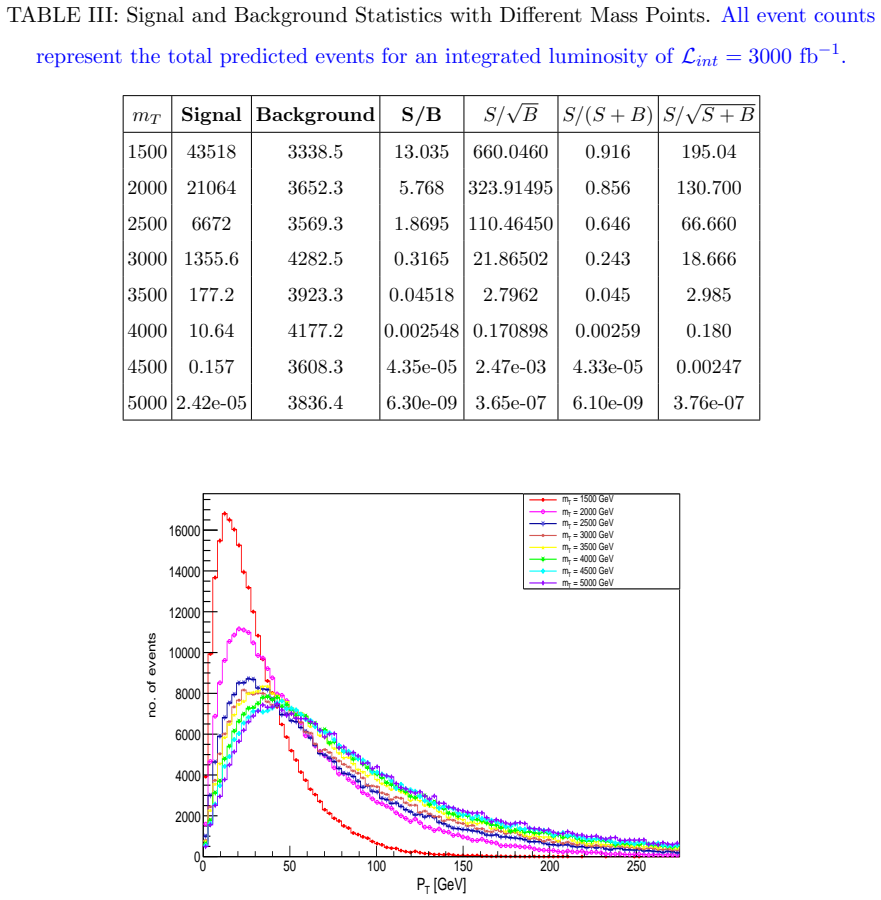
- [Section IX vs. Tables III and VI] The conclusion states that 'the 5σ discovery threshold is maintained for VLQ masses up to approximately 3.5 TeV.' This is contradicted by the paper's own numbers: Table III gives, for m_T = 3500 GeV in the hadronic channel, S/√B = 2.80 and S/√(S+B) = 2.99, and Table VI gives 0.48 in the leptonic channel. Both are far below 5σ. The reach claim therefore cannot be derived from the displayed analysis; either the luminosity, the combination procedure, or the significance definition must be different and should be stated explicitly.
- [Section II, Eq. (1) and Fig. 2(b)] The effective coupling g* is introduced but its numerical value is never given. The text only says it is 'within the perturbative regime and consistent with... |V_Lb| ≲ 0.1.' Since the cross-section is stated to scale as σ ∝ (g*)^2, every event count, significance, and the 3.5 TeV reach depend quadratically on this unreported input. Without the actual g* (and the κ_W,Z,H values) used in the UFO implementation, the quantitative projections are not reproducible or falsifiable. Please state the benchmark values and show the resulting cross-section for at least one mass point.
- [Tables I, II, and III] The central significance table is internally inconsistent. For m_T = 1500 GeV, Table I lists 204,256 hadronic signal events, while Table III lists 43,518. The background events in Table II sum to 88.5 + 370.5 + 20.4 + 6.2 ≈ 485.6, whereas Table III quotes B = 3338.5. Furthermore, the S/√B value in Table III for this row (660.0) is not equal to 43,518/√3338.5 ≈ 753. These discrepancies invalidate the significance columns and the conclusions drawn from them.
- [Table VII and Section IX] Table VII is titled 'Cross sections (in fb),' but its 5.29 TeV hadronic row reproduces exactly the S/√(S+B) significance column of Table III (195.04, 130.70, 66.66, ...). The text then refers to '195.04 fb' as a cross-section. This mislabeling of significance as cross-section makes the energy comparison in Table VII unreliable and the statement in the conclusion about 'production cross-section reaches 594.93 fb in the hadronic channel' ambiguous.
- [Section X, Tables IX–XII] The ML results are incompatible with the cut-based results on the same signal and background samples. For m_T = 3000 GeV at √s = 9.16 TeV, Table III gives S/B = 0.316 and S/√(S+B) = 18.67 at L = 3000 fb^-1. Table IX reports BDT S/B = 15.14 and S/√(S+B) = 270.54 at the same mass and luminosity. A classifier cannot increase S/B by a factor of ~48 on the same dataset; these values imply a different normalization or a different definition of S and B. The ML comparison is therefore not a meaningful extension of the cut-based analysis.
minor comments (6)
- [Figure/table cross-referencing] Several figure references are wrong: Section II refers to 'Figure 1 (Left)' for cross-sections, but Fig. 1 is the Feynman diagram; the σ plot is Fig. 2(a). Section IV refers to 'Figure 2 (Left)' for branching ratios, but the BR plot is Fig. 3(a). Please renumber or fix the in-text references throughout.
- [Table IV] The 'Total Events' row in Table IV contains values around 100,000 for every mass point, which cannot be scaled event counts for L = 3000 fb^-1. This row appears to be a formatting or labeling error; it should be removed or replaced with the actual cumulative efficiency.
- [Table V] The muon efficiency after the PT(l) > 100 GeV cut is 0.0297 while the electron efficiency is 0.348. The text states the channels are 'comparable performance (approx 30-34% for main cuts).' This large discrepancy needs to be explained or corrected.
- [Section II vs. Section IV] The branching-fraction normalization is inconsistent: Section II says with κ_W = κ_Z = κ_H = 1 the T has 50% W, 25% Z, and 25% H decays at high mass, while Section IV and Fig. 3(a) report BR(T→Wb) ≈ 35%. Please clarify which branching fractions are used in the simulation.
- [Abstract and Section II] The phrase 'production cross sections peaking at 9.16 TeV and decreasing above 3 TeV' is confusing: at fixed √s, σ decreases monotonically with m_T (Table I). It should be rephrased to describe the m_T dependence or the √s dependence separately.
- [Typos and notation] There are numerous formatting issues: 'M ET≤ 700 GeV' in the text, inconsistent use of 'S/(S+B)' versus 'S/√(S+B)', and 'Tb' labels in figures. Please proofread carefully.
Circularity Check
The 3.5 TeV discovery claim is set by an unreported coupling g* (σ ∝ (g*)^2) and conflicts with the paper's own significance tables.
specific steps
-
fitted input called prediction
[Section II (THE VLQ MODEL AND SINGLE PRODUCTION), paragraph defining g*; Section IX (CONCLUSION)]
"Specifically, for single production, the cross-section is expected to scale as σ ∝ (g∗)2. We have carefully selected our benchmark coupling values to be within the perturbative regime and consistent with the most recent constraints from electroweak precision observables and CKM unitarity, which typically require |VLb| ≲ 0.1 for heavy vector-like states."
The numerical value of g* is never reported, yet every signal rate and significance in the paper scales as (g*)^2 via the paper's own statement σ ∝ (g*)^2 (also Fig. 2b). The headline quantities — 21.86σ (hadronic) and 3.75σ (leptonic) at 3 TeV, and 'discovery ... up to approximately 3.5 TeV' — are therefore the chosen benchmark normalization expressed as a reach: with g* hidden, the 'prediction' is a free input renamed as a collider capability, not a result derived from fixed external inputs. The quoted σ ≈ 425 fb at 3 TeV is also incompatible with the stated |VLb| ≲ 0.1 bound if g* ≈ V, since σ ∝ (g*)^2 would then be ~100× smaller, so the numbers cannot be checked against the paper's own constraint.
-
other
[Section IX CONCLUSION vs Table III (hadronic significance table)]
"As illustrated in the significance curves of Figure 7 (Right), the 5 σ discovery threshold is maintained for VLQ masses up to approximately 3.5 TeV. (Table III at 3500 GeV: S/sqrt(B) = 2.7962, S/sqrt(S+B) = 2.985)"
The paper's own Table III gives at m_T = 3500 GeV, hadronic S/sqrt(B) = 2.80 and S/sqrt(S+B) = 2.99, and Table VI gives 0.48 in the leptonic channel — all below the 5σ threshold the text says is maintained. The claimed ~3.5 TeV reach is therefore not derivable from the displayed significance calculation; the 5σ crossing of the tabulated points lies near 3.2 TeV at most, so the conclusion's reach value is asserted rather than obtained from the stated analysis.
-
other
[Section VI HADRONIC ANALYSIS, Table I vs Table III (same mass, sqrt(s), luminosity)]
"Table I: 'T otal Events 204256 189445 163674 123806 89550 54805 27065 8081'; Table III: '3000 1355.6 4282.5 0.3165 21.86502'"
For the same point (m_T = 3000 GeV, sqrt(s) = 9.16 TeV, L = 3000 fb^-1), Table I's chain (σ = 425 fb × 3000 fb^-1 × cumulative efficiency 0.0971) yields ~123,806 signal events, whereas Table III lists 1,355.6 signal events — a factor ~91 discrepancy. The quoted significance of 21.86σ is thus not reproducible from the paper's own event-count derivation; the headline 'prediction' is not a well-defined function of the displayed inputs, so the result cannot be independently re-derived from the paper.
full rationale
The paper's quantitative chain is g* -> σ ∝ (g*)^2 -> event rates -> S/sqrt(B) -> reach. The background simulation, detector efficiencies, and cut optimization are genuine, independent computations, so the analysis has real content. However, the absolute normalization is set by g*, whose numerical value is never given: the text defines g*, states the quadratic scaling, gives only the constraint |VLb| ≲ 0.1, and then quotes specific cross-sections, significances, and the 3.5 TeV reach. Because every headline number scales as (g*)^2, the discovery claim is the chosen (undisclosed) benchmark coupling re-expressed as a property of the collider — the 'fitted input called prediction' pattern, with the parameter selected rather than fitted but with the same effect: the prediction is forced by the input normalization. This is compounded by two internal failures of derivability: (a) the conclusion's '5σ up to ~3.5 TeV' contradicts Table III's 2.80σ at 3500 GeV, and (b) Table I and Table III disagree by ~90× on the same signal yield, so the significance cannot even be recovered from the paper's own tables. There is no self-citation chain, imported uniqueness theorem, or ansatz-smuggling; the circularity is of the parameter-normalization kind and is partial — the shape of the reach curve is computed, but the reported reach value reduces to the unreported coupling input. Score 6.
Axiom & Free-Parameter Ledger
free parameters (4)
- g* (effective VLQ-SM coupling) =
not stated
- Benchmark coupling normalizations κW=κZ=κH=1 =
1
- Integrated luminosity L=3000 fb^-1 =
3000 fb^-1
- Hadronic/leptonic selection cuts =
e.g., pT(j)>300 GeV, HT≥800 GeV, ΔR(b1,b2)∈(2.5,4.0); leptonic pT(l)>100 GeV, MET>200 GeV
axioms (5)
- domain assumption The singlet vector-like T quark and its couplings are described by Eq. (1), with mixing matrices V4i and κV=1.
- domain assumption Leading-order matrix elements with the Narrow Width Approximation correctly describe signal and backgrounds.
- domain assumption The Delphes detector card for a generic high-energy lepton-hadron environment approximates the future µp detector, including b-tagging and jet reconstruction.
- domain assumption The listed SM background processes (νtb, νWj, νZj, νjj) with the listed cross-sections are complete and correctly normalized.
- domain assumption The asymptotic formula for significance with no systematic uncertainties applies.
Cite this review
Pith. "Pith review of Probing Vector-Like Quarks at a future Muon-Proton Collider." pith.science (2026). https://pith.science/paper/7CLJQQPR
@misc{pith2026251211471,
  author       = {Pith},
  title        = {Pith review of: Probing Vector-Like Quarks at a future Muon-Proton Collider},
  year         = {2026},
  howpublished = {\url{https://pith.science/paper/7CLJQQPR}},
  note         = {Machine review of arXiv:2512.11471}
}
read the original abstract
This study investigates the discovery potential of a singly produced vector-like top quark ($T$) at a future muon-proton collider with center-of-mass energies of 5.29, 6.48, and 9.16~TeV using a model-independent effective Lagrangian consistent with CKM and electroweak constraints. The $T$ quark predominantly decays into $Wb$, with production cross sections peaking at 9.16~TeV and decreasing above 3~TeV due to parton distribution functions (PDFs) and phase-space suppression. Sensitivity is enhanced through optimized kinematic selections, with the hadronic channel providing higher event rates due to the larger hadronic branching fraction of the $W$ boson, while the leptonic channel offers a cleaner background environment. At an integrated luminosity of 3000~fb$^{-1}$, a 3~TeV $T$ quark can be observed with statistical significances of $21.86\sigma$ and $3.75\sigma$ in the hadronic and leptonic channels, respectively. A machine-learning analysis employing a Boosted Decision Tree (BDT) and a Multi-Layer Perceptron (MLP) is performed at 9.16~TeV for $m_T = 3000$~GeV using $S/B$ and $S/\sqrt{S+B}$ as performance metrics. The MLP consistently outperforms the BDT, achieving a hadronic purity gain of approximately 2.62 while maintaining stable performance across all luminosities. These results demonstrate that a future muon-proton collider can probe vector-like $T$ quark masses up to approximately 3.5~TeV, significantly extending the search for physics beyond the Standard Model.
Figures





Reference graph
Works this paper leans on
-
[1]
Large mass hierarchy from a small extra dimension,
L. Randall and R. Sundrum, “Large mass hierarchy from a small extra dimension,” Phys. Rev. Lett. 83 (1999) 3370
1999
-
[2]
The Littlest Higgs,
N. Arkani-Hamed, A. G. Cohen, E. Katz, and A. E. Nelson, “The Littlest Higgs,” JHEP 07 (2002) 034
2002
-
[3]
The minimal composite Higgs model,
K. Agashe, R. Contino, and A. Pomarol, “The minimal composite Higgs model,” Nucl. Phys. B 719 (2005) 165
2005
-
[4]
SU(2) x U(1) Breaking by Vacuum Misalignment,
D. B. Kaplan and H. Georgi, “SU(2) x U(1) Breaking by Vacuum Misalignment,” Phys. Lett. B 136 (1984) 183
1984
-
[5]
Light custodians in natural composite Higgs models,
R. Contino, L. Da Rold, and A. Pomarol, “Light custodians in natural composite Higgs models,” Phys. Rev. D 75 (2007) 055014. 25
2007
-
[6]
Theory and phenomenology of two-Higgs-doublet models,
G. C. Branco et al., “Theory and phenomenology of two-Higgs-doublet models,” Phys. Rept. 516 (2012) 1
2012
-
[7]
Phenomenology of 2HDM with vectorlike quarks,
A. Arhrib et al., “Phenomenology of 2HDM with vectorlike quarks,” Phys. Rev. D 97 (2018) 095015
2018
-
[8]
Handbook of vectorlike quarks: Mixing and single production,
J. A. Aguilar-Saavedra et al., “Handbook of vectorlike quarks: Mixing and single production,” Phys. Rev. D 88 (2013) 094010
2013
-
[9]
FCC-hh: The Hadron Collider: Future Circular Col- lider Conceptual Design Report Volume 3,
A. Abada et al. (FCC Collaboration), “FCC-hh: The Hadron Collider: Future Circular Col- lider Conceptual Design Report Volume 3,” Eur. Phys. J. Spec. Top. 228, no.4, 755-1107 (2019), doi:10.1140/epjst/e2019-900087-0
-
[10]
Stabilizing electroweak vacuum in a vector-like fermion model,
M. L. Xiao and J. H. Yu, “Stabilizing electroweak vacuum in a vector-like fermion model,” Phys. Rev. D 90 (2014) 014007
2014
-
[11]
Joglekar et al., ”Dark Matter and Enhanced Higgs to Di-photon Rate from Vector-like Leptons,” JHEP 12 (2012) 064
A. Joglekar et al., ”Dark Matter and Enhanced Higgs to Di-photon Rate from Vector-like Leptons,” JHEP 12 (2012) 064
2012
-
[12]
Vacuum stability in the type-II seesaw model with vector-like quarks,
R. Benbrik et al., “Vacuum stability in the type-II seesaw model with vector-like quarks,” Phys. Rev. D 90 (2014) 015009
2014
-
[13]
Review of Particle Physics,
R. L. Workman et al. (Particle Data Group), “Review of Particle Physics,” PTEP 2022 (2022) 083C01
2022
-
[14]
Cabibbo-Kobayashi-Maskawa Unitarity and Vector-like Quarks,
B. Belfatto et al., “Cabibbo-Kobayashi-Maskawa Unitarity and Vector-like Quarks,” JHEP 10 (2021) 079
2021
-
[15]
Vector-like quark interpretation for the CKM unitarity violation,
K. Cheung et al., “Vector-like quark interpretation for the CKM unitarity violation,” JHEP 05 (2020) 117
2020
-
[16]
Crivellin et al., ”Hadronic Vacuum Polarization and CKM Unitarity within the SM and Beyond,” JHEP 12 (2020) 166
A. Crivellin et al., ”Hadronic Vacuum Polarization and CKM Unitarity within the SM and Beyond,” JHEP 12 (2020) 166
2020
-
[17]
Addressing the CKM unitarity problem with a vector-like up quark,
G. C. Branco et al., “Addressing the CKM unitarity problem with a vector-like up quark,” JHEP 07 (2021) 099
2021
-
[18]
High-precision measurement of the W boson mass,
T. Aaltonen et al. (CDF Collaboration), “High-precision measurement of the W boson mass,” Science 376 (2022) 170
2022
-
[19]
Interpreting the W-mass anomaly in vectorlike quark models,
J. Cao et al., “Interpreting the W-mass anomaly in vectorlike quark models,” Phys. Rev. D 106 (2022) 055042
2022
-
[20]
Search for pair production of vector-like quarks,
ATLAS Collaboration, “Search for pair production of vector-like quarks,” Phys. Rev. D 105 (2022) 092012
2022
-
[21]
Search for pair production of vector-like quarks decaying to top quarks,
CMS Collaboration, “Search for pair production of vector-like quarks decaying to top quarks,” JHEP 02 (2025) 119
2025
-
[22]
New W’ signals at the LHC,
N. Vignaroli, “New W’ signals at the LHC,” Phys. Rev. D 89 (2014) 095027
2014
-
[23]
The Large Hadron Electron Collider,
O. Bruening and M. Klein, “The Large Hadron Electron Collider,” J. Phys. G 47 (2020) 060501
2020
-
[24]
The physics potential of a muon-proton collider,
A. Caldwell, “The physics potential of a muon-proton collider,” arXiv:1606.07598 (2016)
Pith/arXiv arXiv 2016
-
[25]
Muon-proton colliders: Luminosity and physics potential,
Y. C. Acar et al., “Muon-proton colliders: Luminosity and physics potential,” Adv. High Energy Phys. 2017 (2017) 8705327
2017
-
[26]
A First Top Partner Hunter’s Guide,
A. De Simone et al., “A First Top Partner Hunter’s Guide,” JHEP 04 (2013) 004. 26
2013
-
[27]
Vector-like Quarks: Theory and Phenomenology,
S. Das et al., “Vector-like Quarks: Theory and Phenomenology,” Phys. Rept. 1004 (2023) 1
2023
-
[28]
Composite Higgs Models in the HL-LHC Era,
G. Cacciapaglia et al., “Composite Higgs Models in the HL-LHC Era,” Front. in Phys. 11 (2023) 112345
2023
-
[29]
New Physics and CKM Unitarity Violations,
M. Abdullah et al., “New Physics and CKM Unitarity Violations,” Phys. Rev. D 108 (2023) 055012
2023
-
[30]
Improved measurement of the W-boson mass,
ATLAS Collaboration, “Improved measurement of the W-boson mass,” Eur. Phys. J. C 84 (2024) 456
2024
-
[31]
Search for vector-like quarks in Run 2 dataset,
CMS Collaboration, “Search for vector-like quarks in Run 2 dataset,” Phys. Rev. D 109 (2024) 032001
2024
-
[32]
Single production of VLQs at high-energy colliders,
J. Hernandez et al., “Single production of VLQs at high-energy colliders,” JHEP 01 (2024) 089
2024
-
[33]
Development of the LHeC,
LHeC Collaboration, “Development of the LHeC,” J. Phys. G 50 (2023) 020501
2023
-
[34]
A Muon Collider for Particle Physics,
IMCC, “A Muon Collider for Particle Physics,” arXiv:2303.08533 (2023)
Pith/arXiv arXiv 2023
-
[35]
Muon Colliders: Opening New Frontiers,
K. Long et al., “Muon Colliders: Opening New Frontiers,” Nature Physics 19 (2023) 155
2023
-
[36]
Boosted topologies in VLQ searches,
B. Song et al., “Boosted topologies in VLQ searches,” Phys. Rev. D 111 (2025) 014022
2025
-
[37]
fat-jets
to generate the Universal FeynRules Output (UFO) model files. Event generation was per- formed at leading order (LO) using MadGraph5 aMC@NLO [38]. Parton showering, hadroniza- tion, and the simulation of the underlying event were handled by PYTHIA 8 [39]. To simulate the response of a generic muon-proton detector, we employed Delphes 3 [40], utilizing a d...
2000
-
[38]
FeynRules 2.0 - A complete toolbox for tree-level and loop-level phenomenology,
A. Alloul et al., “FeynRules 2.0 - A complete toolbox for tree-level and loop-level phenomenology,” Comput. Phys. Commun. 185 (2014) 2250
2014
-
[39]
The automated computation of tree-level and next-to-leading order differential cross sections, and their matching to parton shower simulations,
J. Alwall et al., “The automated computation of tree-level and next-to-leading order differential cross sections, and their matching to parton shower simulations,” JHEP 07 (2014) 079
2014
-
[40]
An introduction to PYTHIA 8.2,
T. Sj¨ ostrand et al., “An introduction to PYTHIA 8.2,” Comput. Phys. Commun. 191 (2015) 159
2015
-
[41]
DELPHES 3, A modular framework for fast simulation of a generic collider experiment,
J. de Favereau et al. (DELPHES 3 Collaboration), “DELPHES 3, A modular framework for fast simulation of a generic collider experiment,” JHEP 02 (2014) 057
2014
-
[42]
FastJet user manual,
M. Cacciari, G. P. Salam, and G. Soyez, “FastJet user manual,” Eur. Phys. J. C 72 (2012) 1896
2012
-
[43]
Delahaye, J. P., et al. “Muon Colliders,” arXiv preprint arXiv:1901.06150 (2019)
Pith/arXiv arXiv 1901
-
[44]
Parton distributions for the LHC Run II,
Ball, R. D., et al. (NNPDF Collaboration). “Parton distributions for the LHC Run II,” JHEP 04, 040 (2015)
2015
-
[45]
The goldstone boson equivalence theorem,
Chanowitz, M. S. and Gaillard, M. K. “The goldstone boson equivalence theorem,” Nuclear Physics B 261, 379-431 (1985)
1985
-
[46]
Boosted objects: A Probe of new physics at the LHC,
Abdesselam, A., et al. “Boosted objects: A Probe of new physics at the LHC,” Eur. Phys. J. C 71, 1661 (2011)
2011
-
[47]
Search for new particles decaying into dijets in proton- antiproton collisions at s=1.96 TeV,
T. Aaltonen et al. (CDF Collaboration), “Search for new particles decaying into dijets in proton- antiproton collisions at s=1.96 TeV,” Phys. Rev. D 79, 112002 (2009)
2009
-
[48]
Asymptotic formulae for likelihood-based tests of new physics,
Cowan, G., Cranmer, K., Gross, E. and Vitells, O. “Asymptotic formulae for likelihood-based tests of new physics,” Eur. Phys. J. C 71, 1554 (2011)
2011
-
[49]
et al., Boosted decision trees as an alternative to artificial neural networks for particle identification, Nucl
Roe, B.P. et al., Boosted decision trees as an alternative to artificial neural networks for particle identification, Nucl. Instrum. Meth. A 543 (2005) 577-584
2005
-
[50]
et al., TMV A - Toolkit for Multivariate Data Analysis, PoS ACAT, 040 (2007)
Hocker, A. et al., TMV A - Toolkit for Multivariate Data Analysis, PoS ACAT, 040 (2007)
2007
-
[51]
et al., Searching for exotic particles in high-energy physics with deep learning, Nature Com- mun., 5 (2014) 4308
Baldi, P. et al., Searching for exotic particles in high-energy physics with deep learning, Nature Com- mun., 5 (2014) 4308
2014
-
[52]
et al., Asymptotic formulae for likelihood-based tests of new physics, Eur
Cowan, G. et al., Asymptotic formulae for likelihood-based tests of new physics, Eur. Phys. J. C, 71 (2011) 1554
2011
-
[53]
et al., Machine learning at the energy and intensity frontiers of particle physics, Nature 27 560 (2018) 41-48
Radovic, A. et al., Machine learning at the energy and intensity frontiers of particle physics, Nature 27 560 (2018) 41-48
2018
-
[54]
Search for the singlet vector-like top quark in T → tZ channel with Z → ν ¯ν at the 14 TeV LHC,
H. Li, J. Chao, and G. Zhang, “Search for the singlet vector-like top quark in T → tZ channel with Z → ν ¯ν at the 14 TeV LHC,” Nuclear Physics B994 (2023) 116310
2023
-
[55]
Jet substructure as a new Higgs search channel at the LHC,
Butterworth, J. M., Davison, A. R., Rubin, M. and Salam, G. P. “Jet substructure as a new Higgs search channel at the LHC,” Phys. Rev. Lett. 100, 242001 (2008). 28
2008
This paper was first reviewed by deepseek-v4-flash on August 3, 2026.
discussion (0)
Sign in with ORCID, Apple, or X to comment. Anyone can read and Pith papers without signing in.