REVIEW 3 major objections 7 minor 67 references
1B Vision Model Beats 7B Rival by Masking Boundaries
Reviewed by Pith at T0; open to challenge. T0 means a machine referee read the full paper against a public rubric. the ladder, T0–T4 →
T0 review · glm-5.2
2026-07-07 21:48 UTC pith:7DFRGZIK
load-bearing objection Boundary-centric masked modeling is a genuinely new pretraining idea with strong empirical results, but the data-seed confound and unproven bootstrapping mechanism need referee attention. the 3 major comments →
Vision Pretraining for Dense Spatial Perception
The pith
A machine-rendered reading of the paper's core claim, the machinery that carries it, and where it could break.
Core claim
The central discovery is that boundary structure — line segments, contours, and shape discontinuities — can serve as a primary self-supervised learning signal for vision pretraining, not merely as a downstream output. The paper shows that a self-distillation loop can bootstrap its own boundary targets from raw images without any human annotations, external edge detectors, or pretrained backbones, by exploiting the redundancy of dense boundary-field representations: many pixels vote on the same segment, so coherent geometry emerges from noisy per-pixel predictions long before the field is pixel-accurate. The categorical reparameterization of boundary fields into discrete bins is the second en
What carries the argument
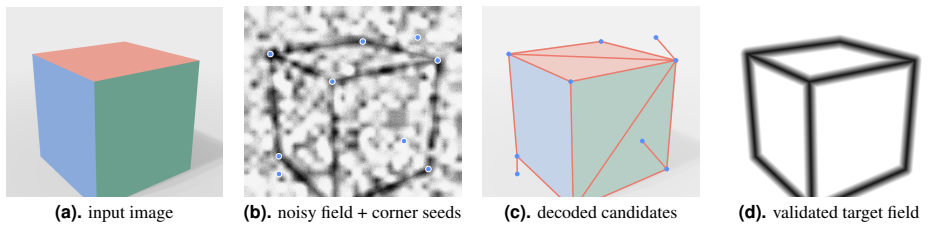
Masked boundary modeling with categorical boundary fields. The teacher predicts a dense boundary field (distance, orientation, and endpoint angles per pixel relative to the nearest line segment), reparameterized as per-pixel categorical distributions over discretized bins. Boundary-bearing tokens — patches through which a predicted boundary passes — are forced into the student's masked set. Masked tokens are routed by geometry: boundary tokens receive the categorical boundary objective, all masked tokens also receive the standard semantic iBOT objective (dual supervision). Boundary targets are generated online by the EMA teacher: a frozen single-block ViT localizes corner points, the field's
Load-bearing premise
The bootstrapping loop depends on the claim that usable boundary fields emerge even from an untrained model, specifically that corner points from a frozen single-block ViT plus parameter-free level-line orientation suffice to anchor coherent line segments from noisy teacher fields. If the frozen corner detector or the level-line guidance fails to produce reliable anchors early in training, the teacher's boundary targets could be noisy or hallucinated, destabilizing the self-d
What would settle it
If the frozen corner-point detector produces unreliable anchors on a class of images (e.g., texture-heavy scenes, low-contrast indoor environments), the a-contrario validation would either reject most candidates (leaving too few boundary tokens to train on) or accept spurious segments (feeding hallucinated structure into the student). Either failure mode would manifest as training instability or degraded dense-prediction performance on scenes where corner detection is weak.
If this is right
- If boundary modeling is a general pretraining principle, then other geometric structures — curvature, junctions, symmetry axes — could serve as additional native learning signals in the same self-distillation framework.
- The 0.3B distilled student matching 7B DINOv3 on NYU-Depth v2 suggests that spatial pretraining efficiency gains are real and transferable, potentially reshaping the compute-versus-quality frontier for embodied AI perception.
- The compounding effect (boundary advantage widens with downstream data) implies that pretraining objective design may matter more than data scale for dense spatial tasks, challenging the assumption that more data washes out initialization differences.
- The a-contrario validation as a built-in hallucination filter for self-distillation targets could generalize to other self-supervised settings where the teacher's own predictions risk feeding noise back into the student.
Where Pith is reading between the lines
- The bootstrapping loop's dependence on a frozen corner-point detector raises the question of whether the detector's quality sets a ceiling on boundary-target quality, and whether replacing it with a learned detector that co-evolves with the backbone would help or destabilize the loop.
- The trade-off — LingBot-Vision trails DINOv3-7B on ImageNet classification by ~1.5 points while leading on dense tasks — suggests that boundary-oriented pretraining reallocates model capacity from image-level invariances to localized structure. Whether this is a fundamental trade-off or an artifact of training duration or data scale remains open.
- If the categorical reparameterization is what makes boundary self-distillation stable, then other continuous geometric targets (surface normals, optical flow fields, depth itself) might benefit from the same discretization-plus-centering treatment in self-supervised settings.
- The finding that boundary tokens are trackable through video by plain cosine similarity, without any temporal supervision, implies that boundary-anchored features may be naturally temporally stable — a property that could reduce the need for video pretraining in robotics perception pipelines.
Editorial analysis
A structured set of objections, weighed in public.
Referee Report
Summary. This paper introduces masked boundary modeling, a self-supervised pretraining paradigm that treats boundary structure as a native learning signal rather than a downstream output. The method extends DINO/iBOT self-distillation by (1) forcing teacher-discovered boundary-bearing tokens into the student's masked set, (2) supervising those tokens with a categorical reparameterization of dense boundary fields, and (3) bootstrapping boundary targets online from the EMA teacher using a frozen corner-point detector and parameter-free a-contrario validation. The authors scale this to LingBot-Vision (1.1B parameters, ViT-g/16) and report strong frozen-feature results on dense prediction tasks (NYUv2, ADE20K, Cityscapes, VOC, DAVIS, YouTube-VOS), including best NYUv2 RMSE among compared models. Distilled ViT-L/B/S students and an application to depth completion (LingBot-Depth 2.0) further demonstrate downstream transfer.
Significance. The paper makes a conceptually clear contribution: it identifies a specific weakness of current self-distillation methods (content-agnostic masking and under-supervision at boundaries) and proposes a principled, self-contained fix. The categorical reparameterization connecting boundary fields to the a-contrario null hypothesis is elegant and yields parameter-free validation. The proof-of-concept ablations (Table 1) cleanly isolate design choices. The downstream evaluation is extensive (Tables 2-8), and the release of checkpoints and code is a strength. The data-scaling experiment (Fig. 8) showing that the pretraining advantage compounds rather than washes out is a valuable empirical finding.
major comments (3)
- Sec. 4.1 explicitly lists ADE20K, NYU-Depth v2, SUN-RGBD, Cityscapes, and VOC among the retrieval seeds used to curate the 161M-image pretraining corpus. These are exactly the downstream benchmarks reported in Tables 2-8. The paper's central claim is that gains come 'from the pretraining objective rather than from a data advantage' (Sec. 4.1), but retrieval from a 2B-image pool using downstream evaluation datasets as queries will populate the pretraining corpus with images visually similar to the evaluation scenes, creating a distributional alignment that DINOv2/v3 may not share. The ImageNet-1K proof of concept (Table 1) does control for data and shows objective-driven gains, but those gains are modest (NYUv2 RMSE 0.474 to 0.440) relative to the scaled margins (Table 2: NYUv2 RMSE 0.296 vs DINOv3's 0.309). The paper does not report whether DINOv2/v3's curation pipelines also included A-
- Sec. 3.2, Finding 1: The bootstrapping loop depends on the claim that 'usable boundary fields emerge even from an untrained model' via corner points from a frozen single-block ViT plus parameter-free level-line orientation. Fig. 3 and Appendix A demonstrate this qualitatively on two images, but no quantitative metric is provided for how reliably corner anchors produce coherent segments across a diverse image set, nor for how this reliability evolves during early training. If the frozen corner detector or level-line guidance fails to produce reliable anchors on a non-trivial fraction of images early in training, the teacher's boundary targets could be noisy, destabilizing the self-distillation loop. A quantitative ablation reporting, e.g., the fraction of training images retaining at least 10 validated segments (the threshold mentioned in Appendix B) over the first 10k iterations would de
- Table 2: LingBot-Vision reports ADE20K mIoU of 53.5, trailing the 7B DINOv3 (55.9) by 2.4 points and the distilled DINOv3 ViT-H+ (54.8) by 1.3 points. The abstract claims the model 'matches or surpasses visual foundation models up to seven times larger,' but on semantic segmentation—a core dense spatial task—the gap to DINOv3 is non-trivial. The paper should clarify whether 'matches' refers specifically to depth and video tasks, and temper the headline claim accordingly, or provide additional analysis of why the boundary-centric objective underperforms on semantic segmentation relative to depth.
minor comments (7)
- Sec. 3.1, Eq. (4): The iBOT loss uses a single temperature τ without subscript, while Eq. (2) distinguishes τ_t and τ_s. Clarify whether τ in Eq. (4) is the student or teacher temperature.
- Sec. 3.3, Eq. (8): The label temperature τ_ℓ is introduced but its value is not specified until Sec. 4.3 ('narrow soft-label temperature'). Report the actual value used.
- Table 5, ViT-S row: LingBot-Vision reports KITTI RMSE of 3.784, substantially worse than DINOv2 (3.568) and DINOv3 (2.851). This is mentioned only obliquely ('falls behind on KITTI and Cityscapes'). A brief analysis of why the smallest model degrades specifically on outdoor driving scenes would be helpful.
- Fig. 6: The PCA visualizations are compelling but qualitative. Consider adding a quantitative boundary-fidelity metric (e.g., F-measure against BSDS500 or NYUv2 boundary maps) to complement the visual comparison.
- Sec. 4.3: The paper states K was reduced from 128 to 32 and 'verified to be quality-neutral.' Report the verification result (e.g., NYUv2 RMSE or ADE20K mIoU at K=128 vs K=32).
- Sec. 6.3: The LingBot evaluation set (1,751 frames, 35 scenes) is self-captured with pseudo-ground-truth from FoundationStereo. Clarify whether this set will be publicly released to enable independent verification.
- Typos: 'aboundary-centriclens' (abstract), 'Re fined Point Cloud' (Fig. 9 caption), 'DA VIS' should be 'DAVIS' throughout (Tables 3, Sec. 5.2.1).
Simulated Author's Rebuttal
We thank the referee for a careful and constructive report. The three major comments raise legitimate concerns about (1) potential data-distribution leakage from using downstream benchmarks as retrieval seeds, (2) the absence of quantitative evidence for early-training stability of the bootstrapping loop, and (3) the precision of the headline claim given the ADE20K gap to DINOv3. We address each below and commit to revisions in all three cases.
read point-by-point responses
-
Referee: Sec. 4.1 lists ADE20K, NYU-Depth v2, SUN-RGBD, Cityscapes, and VOC among retrieval seeds; these are the same downstream benchmarks in Tables 2-8. The claim that gains come from the pretraining objective rather than data advantage is not fully controlled. The ImageNet-1K proof of concept (Table 1) controls for data but shows modest gains relative to scaled margins.
Authors: The referee raises a valid concern. We acknowledge that using downstream evaluation datasets as retrieval seeds creates a distributional alignment that could contribute to the scaled results, and the current manuscript overstates the degree to which the objective alone accounts for the scaled margins. We will revise the manuscript accordingly. revision: yes
-
Referee: Sec. 3.2, Finding 1: No quantitative metric is provided for how reliably corner anchors produce coherent segments across diverse images, nor for how this reliability evolves during early training. A quantitative ablation over the first 10k iterations would address concerns about bootstrapping stability.
Authors: The referee is correct that the current evidence for Finding 1 is qualitative only (Fig. 3, Appendix A) and that quantitative metrics would strengthen the claim. We will add the requested quantitative ablation to the revision. revision: yes
-
Referee: Table 2: LingBot-Vision trails DINOv3 by 2.4 mIoU on ADE20K. The abstract claims 'matches or surpasses' models up to 7x larger, but on semantic segmentation the gap is non-trivial. The paper should clarify or temper the headline claim.
Authors: The referee is right that the headline claim is imprecise as written. On semantic segmentation, LingBot-Vision does not match the 7B DINOv3; the claim is more accurately scoped to depth and video tasks. We will revise the abstract and introduction to clarify this. revision: yes
Circularity Check
No significant circularity: the boundary-centric pretraining derivation is self-contained, with standard self-distillation bootstrapping and external benchmarks
full rationale
The paper's core derivation chain is not circular. The boundary-forcing masked modeling objective (Sec. 3.2, Eq. 6) is defined structurally: boundary tokens B are identified by the teacher's predicted boundary field, forced into the mask, and supervised by a categorical boundary target (Eq. 9). This is a standard self-distillation loop with EMA teacher, not a self-definitional circle. The teacher generates targets online (Sec. 3.4), validated by a parameter-free a-contrario test (Appendix B) whose null hypothesis (uniform orientation distribution) is independently grounded in classical detection theory [14, 47], not defined in terms of the paper's own results. Finding 1 (Sec. 3.2) — that corner points plus level-line orientation produce coherent segments even from random fields — is demonstrated empirically (Fig. 3, Appendix A) as a property of the boundary-field representation, not assumed. The categorical reparameterization (Sec. 3.3, Eq. 8) is a design choice justified by stability arguments, not a fitted parameter renamed as prediction. The ImageNet-1K proof-of-concept (Table 1) controls for data and architecture, isolating the objective's contribution. The scaled results (Table 2) are evaluated against external benchmarks (NYUv2, KITTI, ADE20K, Cityscapes, VOC) with frozen-feature linear probing, an externally falsifiable protocol. The skeptic's concern about downstream datasets appearing as retrieval seeds in the pretraining corpus (Sec. 4.1) is a legitimate data-contamination concern for correctness risk, but it is not circularity: the paper does not define its evaluation metrics in terms of its training data, nor does it fit a parameter to the test set and call it a prediction. The claim that 'gains come from the pretraining objective rather than from a data advantage' (Sec. 4.1) is an inference the paper acknowledges is suggestive ('suggests that...'), not a theorem. Self-citations to prior work on attraction-field representations [57-59] are foundational but not load-bearing for the present paper's claims: the paper re-derives the field properties it needs (Sec. 3.3, Fig. 4) and validates them empirically (Finding 1, Fig. 3). No step in the derivation reduces to its inputs by construction.
Axiom & Free-Parameter Ledger
free parameters (8)
- λ_i (iBOT loss weight) =
1.0
- λ_b (boundary loss weight) =
1.0
- λ_k (KoLeo loss weight) =
0.1
- K (number of bins per field channel) =
32
- τ_ℓ (label temperature)
- τ_d (support threshold) =
5px
- ε (NFA acceptance threshold) =
1
- Alignment tolerance =
π/16
axioms (4)
- domain assumption Boundaries and shape discontinuities offer essential cues for perceiving geometric properties.
- domain assumption The EMA teacher in self-distillation is always slightly better than the student, providing a usable learning signal.
- ad hoc to paper Finding 1: Given corner points, a boundary field with random values decodes into corner-anchored fragments, and coherent segments emerge with level-line guidance.
- domain assumption The a-contrario null hypothesis (uniformly distributed orientations) holds for non-boundary regions.
invented entities (3)
-
Boundary-bearing tokens
independent evidence
-
Categorical boundary field
independent evidence
-
Frozen single-block ViT corner-point detector
no independent evidence
read the original abstract
Dense spatial perception is essential for physical intelligence, where visual systems are expected to recover structured, metric, and actionable representations from pixel observations. Modern visual foundation models tend to prioritize semantic invariance, often at the expense of detailed spatial understanding. In this work, we study vision pretraining through a boundary-centric lens, motivated by the premise that boundaries and shape discontinuities offer essential cues for perceiving geometric properties. Concretely, we propose masked boundary modeling, a self-supervised paradigm that dynamically learns sub-pixel boundary representations and subsequently leverages the discovered boundary-bearing tokens as masked targets to facilitate dense visual token learning. By scaling this framework, we develop LingBot-Vision and demonstrate its efficacy across a diverse set of downstream vision tasks with DINOv3 as a strong baseline. Remarkably, LingBot-Vision drives the progression from LingBot-Depth 1.0 to LingBot-Depth 2.0 for depth completion, and thereby yields enhanced depth estimation, a key pillar for embodied artificial intelligence. Our findings reveal that boundary modeling goes beyond simple line segments and instead serves as a scalable pretraining principle for learning spatially structured visual representations.
Figures




Reference graph
Works this paper leans on
-
[1]
Self-supervised learning from images with a joint-embedding predictive architecture
Mahmoud Assran, Quentin Duval, Ishan Misra, Piotr Bojanowski, Pascal Vincent, Michael Rabbat, Yann LeCun, and Nicolas Ballas. Self-supervised learning from images with a joint-embedding predictive architecture. InIEEE/CVF Conference on Computer Vision and Pattern Recognition (CVPR), 2023
work page 2023
-
[2]
V-JEPA 2: Self-Supervised Video Models Enable Understanding, Prediction and Planning
Mido Assran, Adrien Bardes, David Fan, Quentin Garrido, Russell Howes, Mojtaba Komeili, Matthew Muckley, Ammar Rizvi, Claire Roberts, Koustuv Sinha, Artem Zholus, Sergio Arnaud, Abha Gejji, Ada Martin, Francois Robert Hogan, Daniel Dugas, Piotr Bojanowski, Vasil Khalidov, Patrick Labatut, Francisco Massa, Marc Szafraniec, Kapil Krishnakumar, Yong Li, Xiao...
work page internal anchor Pith review Pith/arXiv arXiv 2025
-
[3]
LeJEPA: Provable and Scalable Self-Supervised Learning Without the Heuristics
Randall Balestriero and Yann LeCun. LeJEPA: Provable and scalable self-supervised learning without the heuristics.arXiv preprint arXiv:2511.08544, 2025
work page internal anchor Pith review Pith/arXiv arXiv 2025
-
[4]
BEiT: BERT pre-training of image transformers
Hangbo Bao, Li Dong, Songhao Piao, and Furu Wei. BEiT: BERT pre-training of image transformers. InInternational Conference on Learning Representations (ICLR), 2022
work page 2022
-
[5]
Adrien Bardes, Quentin Garrido, Jean Ponce, Xinlei Chen, Michael Rabbat, Yann LeCun, Mido Assran, and Nicolas Ballas. Revisiting feature prediction for learning visual representations from video.Transactions on Machine Learning Research, 2024, 2024. 27
work page 2024
-
[6]
Perception encoder: The best visual embeddings are not at the output of the network
Daniel Bolya, Po-Yao Huang, Peize Sun, Jang Hyun Cho, Andrea Madotto, Chen Wei, Tengyu Ma, Jiale Zhi, Jathushan Rajasegaran, Hanoona Rasheed, Junke Wang, Marco Monteiro, Hu Xu, Shiyu Dong, Nikhila Ravi, Daniel Li, Piotr Dollár, and Christoph Feichtenhofer. Perception encoder: The best visual embeddings are not at the output of the network. InAdvances in N...
work page 2025
-
[7]
John Canny. A computational approach to edge detection.IEEE Transactions on Pattern Analysis and Machine Intelligence, 8(6):679–698, 1986
work page 1986
-
[8]
TIPSv2: Advancing vision-language pretraining with enhanced patch-text alignment
Bingyi Cao, Koert Chen, Kevis-Kokitsi Maninis, Kaifeng Chen, Arjun Karpur, Ye Xia, Sahil Dua, Tanmaya Dabral, Guangxing Han, Bohyung Han, Joshua Ainslie, Alex Bewley, Mithun Jacob, René Wagner, Washington Ramos, Krzysztof Choromanski, Mojtaba Seyedhosseini, Howard Zhou, and André Araujo. TIPSv2: Advancing vision-language pretraining with enhanced patch-te...
work page 2026
-
[9]
Emerging properties in self-supervised vision transformers
Mathilde Caron, Hugo Touvron, Ishan Misra, Hervé Jégou, Julien Mairal, Piotr Bojanowski, and Armand Joulin. Emerging properties in self-supervised vision transformers. InIEEE/CVF International Conference on Computer Vision (ICCV), 2021
work page 2021
-
[10]
A simple framework for contrastive learning of visual representations
Ting Chen, Simon Kornblith, Mohammad Norouzi, and Geoffrey Hinton. A simple framework for contrastive learning of visual representations. InInternational Conference on Machine Learning (ICML), 2020
work page 2020
-
[11]
The Cityscapes dataset for semantic urban scene understanding
Marius Cordts, Mohamed Omran, Sebastian Ramos, Timo Rehfeld, Markus Enzweiler, Rodrigo Benenson, Uwe Franke, Stefan Roth, and Bernt Schiele. The Cityscapes dataset for semantic urban scene understanding. InIEEE/CVF Conference on Computer Vision and Pattern Recognition (CVPR), pages 3213–3223, 2016
work page 2016
-
[12]
JAFAR: Jack up any feature at any resolution
Paul Couairon, Loick Chambon, Louis Serrano, Jean-Emmanuel Haugeard, Matthieu Cord, and Nicolas Thome. JAFAR: Jack up any feature at any resolution. InAdvances in Neural Information Processing Systems (NeurIPS), 2025
work page 2025
-
[13]
ImageNet: A large-scale hierarchical image database
Jia Deng, Wei Dong, Richard Socher, Li-Jia Li, Kai Li, and Li Fei-Fei. ImageNet: A large-scale hierarchical image database. In IEEE/CVF Conference on Computer Vision and Pattern Recognition (CVPR), pages 248–255, 2009
work page 2009
-
[14]
Meaningful alignments.International Journal of Computer Vision, 40(1):7–23, 2000
Agnès Desolneux, Lionel Moisan, and Jean-Michel Morel. Meaningful alignments.International Journal of Computer Vision, 40(1):7–23, 2000
work page 2000
-
[15]
Piotr Dollár and C. Lawrence Zitnick. Fast edge detection using structured forests.IEEE Transactions on Pattern Analysis and Machine Intelligence, 37(8):1558–1570, 2015
work page 2015
-
[16]
Mark Everingham, Luc Van Gool, Christopher K. I. Williams, John M. Winn, and Andrew Zisserman. The Pascal visual object classes (VOC) challenge.International Journal of Computer Vision, 88(2):303–338, 2010
work page 2010
-
[17]
Scaling language-free visual representation learning
David Fan, Shengbang Tong, Jiachen Zhu, Koustuv Sinha, Zhuang Liu, Xinlei Chen, Michael Rabbat, Nicolas Ballas, Yann LeCun, Amir Bar, and Saining Xie. Scaling language-free visual representation learning. InIEEE/CVF International Conference on Computer Vision (ICCV), 2025
work page 2025
-
[18]
Are we ready for autonomous driving? The KITTI vision benchmark suite
Andreas Geiger, Philip Lenz, and Raquel Urtasun. Are we ready for autonomous driving? The KITTI vision benchmark suite. InIEEE/CVF Conference on Computer Vision and Pattern Recognition (CVPR), pages 3354–3361, 2012
work page 2012
-
[19]
Masked autoencoders are scalable vision learners
Kaiming He, Xinlei Chen, Saining Xie, Yanghao Li, Piotr Dollár, and Ross Girshick. Masked autoencoders are scalable vision learners. InIEEE/CVF Conference on Computer Vision and Pattern Recognition (CVPR), 2022
work page 2022
-
[20]
Momentum contrast for unsupervised visual representation learning
Kaiming He, Haoqi Fan, Yuxin Wu, Saining Xie, and Ross Girshick. Momentum contrast for unsupervised visual representation learning. InIEEE/CVF Conference on Computer Vision and Pattern Recognition (CVPR), 2020
work page 2020
-
[21]
Learning to parse wireframes in images of man-made environments
Kun Huang, Yifan Wang, Zihan Zhou, Tianjiao Ding, Shenghua Gao, and Yi Ma. Learning to parse wireframes in images of man-made environments. InIEEE/CVF Conference on Computer Vision and Pattern Recognition (CVPR), pages 626–635, 2018
work page 2018
-
[22]
HyunJun Jung, Patrick Ruhkamp, Guangyao Zhai, Nikolas Brasch, Yitong Li, Yannick Verdie, Jifei Song, Yiren Zhou, Anil Armagan, Slobodan Ilic, Ales Leonardis, and Benjamin Busam. Is my depth ground-truth good enough? HAMMER – highly accurate multi-modal dataset for DEnse 3D scene regression.arXiv preprint arXiv:2205.04565, 2022
work page internal anchor Pith review Pith/arXiv arXiv 2022
-
[23]
ScaleLSD: Scalable deep line segment detection streamlined
Zeran Ke, Bin Tan, Xianwei Zheng, Yujun Shen, Tianfu Wu, and Nan Xue. ScaleLSD: Scalable deep line segment detection streamlined. InIEEE/CVF Conference on Computer Vision and Pattern Recognition (CVPR), pages 6327–6336, 2025
work page 2025
-
[24]
Tobias Koch, Lukas Liebel, Marco Körner, and Friedrich Fraundorfer. Comparison of monocular depth estimation methods using geometrically relevant metrics on the IBims-1 dataset.Computer Vision and Image Understanding, 191:102877, 2020
work page 2020
-
[25]
Manipulation as in Simulation: Enabling Accurate Geometry Perception in Robots
Minghuan Liu, Zhengbang Zhu, Xiaoshen Han, Peng Hu, Haotong Lin, Xinyao Li, Jingxiao Chen, Jiafeng Xu, Yichu Yang, Yunfeng Lin, Xinghang Li, Yong Yu, Weinan Zhang, Tao Kong, and Bingyi Kang. Manipulation as in simulation: Enabling accurate geometry perception in robots.arXiv preprint arXiv:2509.02530, 2025. 28
work page internal anchor Pith review Pith/arXiv arXiv 2025
-
[26]
LeWorldModel: Stable End-to-End Joint-Embedding Predictive Architecture from Pixels
Lucas Maes, Quentin Le Lidec, Damien Scieur, Yann LeCun, and Randall Balestriero. LeWorldModel: Stable end-to-end joint-embedding predictive architecture from pixels.arXiv preprint arXiv:2603.19312, 2026
work page internal anchor Pith review Pith/arXiv arXiv 2026
-
[27]
V-JEPA 2.1: Unlocking Dense Features in Video Self-Supervised Learning
Lorenzo Mur-Labadia, Matthew Muckley, Amir Bar, Mido Assran, Koustuv Sinha, Mike Rabbat, Yann LeCun, Nicolas Ballas, and Adrien Bardes. V-JEPA 2.1: Unlocking dense features in video self-supervised learning.arXiv preprint arXiv:2603.14482, 2026
work page internal anchor Pith review Pith/arXiv arXiv 2026
-
[28]
Maxime Oquab, Timothée Darcet, Théo Moutakanni, Huy V . V o, Marc Szafraniec, Vasil Khalidov, Pierre Fernandez, Daniel Haziza, Francisco Massa, Alaaeldin El-Nouby, Mido Assran, Nicolas Ballas, Wojciech Galuba, Russell Howes, Po-Yao Huang, Shang-Wen Li, Ishan Misra, Michael Rabbat, Vasu Sharma, Gabriel Synnaeve, Hu Xu, Hervé Jégou, Julien Mairal, Patrick L...
work page 2024
-
[29]
Rémi Pautrat, Daniel Barath, Viktor Larsson, Martin R. Oswald, and Marc Pollefeys. DeepLSD: Line segment detection and refinement with deep image gradients. InIEEE/CVF Conference on Computer Vision and Pattern Recognition (CVPR), pages 17327–17336, 2023
work page 2023
-
[30]
The 2017 DAVIS Challenge on Video Object Segmentation
Jordi Pont-Tuset, Federico Perazzi, Sergi Caelles, Pablo Arbeláez, Alexander Sorkine-Hornung, and Luc Van Gool. The 2017 DA VIS challenge on video object segmentation.arXiv preprint arXiv:1704.00675, 2017
work page internal anchor Pith review Pith/arXiv arXiv 2017
-
[31]
Qwen3.5: Towards native multimodal agents, February 2026
Qwen Team. Qwen3.5: Towards native multimodal agents, February 2026
work page 2026
-
[32]
Learning transferable visual models from natural language supervision
Alec Radford, Jong Wook Kim, Chris Hallacy, Aditya Ramesh, Gabriel Goh, Sandhini Agarwal, Girish Sastry, Amanda Askell, Pamela Mishkin, Jack Clark, Gretchen Krueger, and Ilya Sutskever. Learning transferable visual models from natural language supervision. InInternational Conference on Machine Learning (ICML), 2021
work page 2021
-
[33]
Vision transformers for dense prediction
René Ranftl, Alexey Bochkovskiy, and Vladlen Koltun. Vision transformers for dense prediction. InIEEE/CVF International Conference on Computer Vision (ICCV), 2021
work page 2021
-
[34]
AM-RADIO: Agglomerative vision foundation model – reduce all domains into one
Mike Ranzinger, Greg Heinrich, Jan Kautz, and Pavlo Molchanov. AM-RADIO: Agglomerative vision foundation model – reduce all domains into one. InIEEE/CVF Conference on Computer Vision and Pattern Recognition (CVPR), 2024
work page 2024
-
[35]
ImageNet-21K pretraining for the masses
Tal Ridnik, Emanuel Ben Baruch, Asaf Noy, and Lihi Zelnik-Manor. ImageNet-21K pretraining for the masses. InAdvances in Neural Information Processing Systems (NeurIPS) Datasets and Benchmarks Track, 2021
work page 2021
-
[36]
Sajjan, Matthew Moore, Mike Pan, Ganesh Nagaraja, Johnny Lee, Andy Zeng, and Shuran Song
Shreeyak S. Sajjan, Matthew Moore, Mike Pan, Ganesh Nagaraja, Johnny Lee, Andy Zeng, and Shuran Song. ClearGrasp: 3D shape estimation of transparent objects for manipulation. InIEEE International Conference on Robotics and Automation (ICRA), pages 3634–3642, 2020
work page 2020
-
[37]
Schönberger, Silvano Galliani, Torsten Sattler, Konrad Schindler, Marc Pollefeys, and Andreas Geiger
Thomas Schöps, Johannes L. Schönberger, Silvano Galliani, Torsten Sattler, Konrad Schindler, Marc Pollefeys, and Andreas Geiger. A multi-view stereo benchmark with high-resolution images and multi-camera videos. InIEEE/CVF Conference on Computer Vision and Pattern Recognition (CVPR), pages 2538–2547, 2017
work page 2017
-
[38]
Indoor segmentation and support inference from RGBD images
Nathan Silberman, Derek Hoiem, Pushmeet Kohli, and Rob Fergus. Indoor segmentation and support inference from RGBD images. InEuropean Conference on Computer Vision (ECCV), pages 746–760, 2012
work page 2012
-
[39]
Oriane Siméoni, Huy V . V o, Maximilian Seitzer, Federico Baldassarre, Maxime Oquab, Cijo Jose, Vasil Khalidov, Marc Szafraniec, Seungeun Yi, Michaël Ramamonjisoa, Francisco Massa, Daniel Haziza, Luca Wehrstedt, Jianyuan Wang, Timothée Darcet, Théo Moutakanni, Leonel Sentana, Claire Roberts, Andrea Vedaldi, Jamie Tolan, John Brandt, Camille Couprie, Julie...
work page 2026
-
[40]
A 3×3 isotropic gradient operator for image processing
Irwin Sobel and Gary Feldman. A 3×3 isotropic gradient operator for image processing. Stanford Artificial Intelligence Project, 1968
work page 1968
-
[41]
Lichtenberg, and Jianxiong Xiao
Shuran Song, Samuel P. Lichtenberg, and Jianxiong Xiao. SUN RGB-D: A RGB-D scene understanding benchmark suite. In IEEE/CVF Conference on Computer Vision and Pattern Recognition (CVPR), pages 567–576, 2015
work page 2015
-
[42]
Masked depth modeling for spatial perception
Bin Tan, Changjiang Sun, Xiage Qin, Hanat Adai, Zelin Fu, Tianxiang Zhou, Han Zhang, Yinghao Xu, Xing Zhu, Yujun Shen, and Nan Xue. Masked depth modeling for spatial perception. InEuropean Conference on Computer Vision (ECCV), 2026
work page 2026
-
[43]
Michael Tschannen, Alexey Gritsenko, Xiao Wang, Muhammad Ferjad Naeem, Ibrahim Alabdulmohsin, Nikhil Parthasarathy, Talfan Evans, Lucas Beyer, Ye Xia, Basil Mustafa, Olivier Hénaff, Jeremiah Harmsen, Andreas Steiner, and Xiaohua Zhai. SigLIP 2: Multilingual vision-language encoders with improved semantic understanding, localization, and dense features.arX...
work page internal anchor Pith review Pith/arXiv arXiv 2025
-
[44]
DIODE: A Dense Indoor and Outdoor DEpth Dataset
Igor Vasiljevic, Nicholas I. Kolkin, Shanyi Zhang, Ruotian Luo, Haochen Wang, Falcon Z. Dai, Andrea F. Daniele, Mohammadreza Mostajabi, Steven Basart, Matthew R. Walter, and Gregory Shakhnarovich. DIODE: A dense indoor and outdoor DEpth dataset.arXiv preprint arXiv:1908.00463, 2019
work page internal anchor Pith review Pith/arXiv arXiv 1908
-
[45]
Shashanka Venkataramanan, Valentinos Pariza, Mohammadreza Salehi, Lukas Knobel, Spyros Gidaris, Elias Ramzi, Andrei Bursuc, and Yuki M. Asano. Franca: Nested Matryoshka clustering for scalable visual representation learning. InIEEE/CVF Conference on Computer Vision and Pattern Recognition (CVPR), 2026
work page 2026
-
[46]
Marigold-DC: Zero-shot monocular depth completion with guided diffusion
Massimiliano Viola, Kevin Qu, Nando Metzger, Bingxin Ke, Alexander Becker, Konrad Schindler, and Anton Obukhov. Marigold-DC: Zero-shot monocular depth completion with guided diffusion. InIEEE/CVF International Conference on Computer Vision (ICCV), pages 5359–5370, 2025
work page 2025
-
[47]
Rafael Grompone von Gioi, Jérémie Jakubowicz, Jean-Michel Morel, and Gregory Randall. LSD: A fast line segment detector with a false detection control.IEEE Transactions on Pattern Analysis and Machine Intelligence, 32(4):722–732, 2010
work page 2010
-
[48]
Ruicheng Wang, Sicheng Xu, Cassie Dai, Jianfeng Xiang, Yu Deng, Xin Tong, and Jiaolong Yang. MoGe: Unlocking accurate monocular geometry estimation for open-domain images with optimal training supervision. InIEEE/CVF Conference on Computer Vision and Pattern Recognition (CVPR), pages 5261–5271, 2025
work page 2025
-
[49]
InternVideo2: Scaling foundation models for multimodal video understanding
Yi Wang, Kunchang Li, Xinhao Li, Jiashuo Yu, Yinan He, Guo Chen, Baoqi Pei, Rongkun Zheng, Zun Wang, Yansong Shi, Tianxiang Jiang, Songze Li, Jilan Xu, Hongjie Zhang, Yifei Huang, Yu Qiao, Yali Wang, and Limin Wang. InternVideo2: Scaling foundation models for multimodal video understanding. InEuropean Conference on Computer Vision (ECCV), 2024
work page 2024
-
[50]
Zehan Wang, Siyu Chen, Lihe Yang, Jialei Wang, Ziang Zhang, Hengshuang Zhao, and Zhou Zhao. Depth Anything with any prior.arXiv preprint arXiv:2505.10565, 2025
work page internal anchor Pith review Pith/arXiv arXiv 2025
-
[51]
Mapillary street-level sequences: A dataset for lifelong place recognition
Frederik Warburg, Søren Hauberg, Manuel López-Antequera, Pau Gargallo, Yubin Kuang, and Javier Civera. Mapillary street-level sequences: A dataset for lifelong place recognition. InIEEE/CVF Conference on Computer Vision and Pattern Recognition (CVPR), pages 2623–2632, 2020
work page 2020
-
[52]
FoundationStereo: Zero-shot stereo matching
Bowen Wen, Matthew Trepte, Joseph Aribido, Jan Kautz, Orazio Gallo, and Stan Birchfield. FoundationStereo: Zero-shot stereo matching. InIEEE/CVF Conference on Computer Vision and Pattern Recognition (CVPR), pages 5249–5260, 2025
work page 2025
-
[53]
Google Landmarks Dataset v2 - a large-scale benchmark for instance-level recognition and retrieval
Tobias Weyand, André Araújo, Bingyi Cao, and Jack Sim. Google Landmarks Dataset v2 - a large-scale benchmark for instance-level recognition and retrieval. InIEEE/CVF Conference on Computer Vision and Pattern Recognition (CVPR), pages 2572–2581, 2020
work page 2020
-
[54]
Unsupervised depth completion from visual inertial odometry
Alex Wong, Xiaohan Fei, Stephanie Tsuei, and Stefano Soatto. Unsupervised depth completion from visual inertial odometry. IEEE Robotics and Automation Letters, 5(2):1899–1906, 2020
work page 1906
-
[55]
Holistically-nested edge detection
Saining Xie and Zhuowen Tu. Holistically-nested edge detection. InIEEE/CVF International Conference on Computer Vision (ICCV), pages 1395–1403, 2015
work page 2015
-
[56]
Ning Xu, Linjie Yang, Yuchen Fan, Dingcheng Yue, Yuchen Liang, Jianchao Yang, and Thomas S. Huang. YouTube-VOS: A large-scale video object segmentation benchmark.arXiv preprint arXiv:1809.03327, 2018
work page internal anchor Pith review Pith/arXiv arXiv 2018
-
[57]
Learning attraction field representation for robust line segment detection
Nan Xue, Song Bai, Fudong Wang, Gui-Song Xia, Tianfu Wu, and Liangpei Zhang. Learning attraction field representation for robust line segment detection. InIEEE/CVF Conference on Computer Vision and Pattern Recognition (CVPR), pages 1595–1603, 2019
work page 2019
-
[58]
Nan Xue, Tianfu Wu, Song Bai, Fu-Dong Wang, Gui-Song Xia, Liangpei Zhang, and Philip H. S. Torr. Holistically-attracted wireframe parsing. InIEEE/CVF Conference on Computer Vision and Pattern Recognition (CVPR), pages 2785–2794, 2020
work page 2020
-
[59]
Nan Xue, Tianfu Wu, Song Bai, Fu-Dong Wang, Gui-Song Xia, Liangpei Zhang, and Philip H. S. Torr. Holistically-attracted wireframe parsing: From supervised to self-supervised learning.IEEE Transactions on Pattern Analysis and Machine Intelligence, 45(12):14727–14744, 2023
work page 2023
-
[60]
In pursuit of pixel supervision for visual pre-training.arXiv preprint arXiv:2512.15715, 2025
Lihe Yang, Shang-Wen Li, Yang Li, Xinjie Lei, Dong Wang, Abdelrahman Mohamed, Hengshuang Zhao, and Hu Xu. In pursuit of pixel supervision for visual pre-training.arXiv preprint arXiv:2512.15715, 2025
-
[61]
Sigmoid loss for language image pre-training
Xiaohua Zhai, Basil Mustafa, Alexander Kolesnikov, and Lucas Beyer. Sigmoid loss for language image pre-training. In IEEE/CVF International Conference on Computer Vision (ICCV), 2023
work page 2023
-
[62]
Scene parsing through ADE20K dataset
Bolei Zhou, Hang Zhao, Xavier Puig, Sanja Fidler, Adela Barriuso, and Antonio Torralba. Scene parsing through ADE20K dataset. InIEEE/CVF Conference on Computer Vision and Pattern Recognition (CVPR), pages 5122–5130, 2017
work page 2017
-
[63]
DINO-WM: World models on pre-trained visual features enable zero-shot planning
Gaoyue Zhou, Hengkai Pan, Yann LeCun, and Lerrel Pinto. DINO-WM: World models on pre-trained visual features enable zero-shot planning. InInternational Conference on Machine Learning (ICML), 2025. 30
work page 2025
-
[64]
iBOT: Image BERT pre-training with online tokenizer
Jinghao Zhou, Chen Wei, Huiyu Wang, Wei Shen, Cihang Xie, Alan Yuille, and Tao Kong. iBOT: Image BERT pre-training with online tokenizer. InInternational Conference on Learning Representations (ICLR), 2022
work page 2022
-
[65]
Yichao Zhou, Haozhi Qi, and Yi Ma. End-to-end wireframe parsing. InIEEE/CVF International Conference on Computer Vision (ICCV), pages 962–971, 2019
work page 2019
-
[66]
Zhiyuan Zhou, Ruofeng Liu, Taichi Liu, Weijian Zuo, Shanshan Wang, Zhiqing Hong, and Desheng Zhang. Any to full: Prompting Depth Anything for depth completion in one stage.arXiv preprint arXiv:2603.05711, 2026
-
[67]
OMNI-DC: Highly robust depth completion with multiresolution depth integration
Yiming Zuo, Willow Yang, Zeyu Ma, and Jia Deng. OMNI-DC: Highly robust depth completion with multiresolution depth integration. InIEEE/CVF International Conference on Computer Vision (ICCV), pages 9287–9297, 2025. 31
work page 2025
discussion (0)
Sign in with ORCID, Apple, or X to comment. Anyone can read and Pith papers without signing in.