REVIEW 5 major objections 5 minor 42 references
A Self-supervised Learning Method for Raman Spectroscopy based on Masked Autoencoders
T0 review · 5 major / 5 minor · reviewed 2026-08-16 · deepseek-v4-flash
Pith's one-line read This paper claims that a masked autoencoder pretrained on unlabeled Raman spectra learns transferable spectral features, reaching 83.90% classification accuracy after limited-label fine-tuning and over 80% unsupervised clustering accuracy…
desk verdict A plausible masked-autoencoder-for-spectra paper whose key transfer claim needs stronger evidence—worth refereeing, but don't trust the headline numbers yet. read the letter →
The pith
A machine-rendered reading of the paper's core claim, the machinery that carries it, and where it could break.
The reading
What carries the argument
The core mechanism is masked spectral reconstruction. The input spectrum is cut into patches; a multi-head self-attention encoder processes only the 50% of patches that remain visible, and a light decoder predicts the intensity of the masked patches from their positional context, with mean-squared error computed only on the masked positions. To complete the hidden portions the network must model global spectral shape and peak relationships rather than interpolate between neighbors, which is what forces it to learn chemically meaningful features. After pretraining, the decoder is discarded and the encoder weights initialize a classifier; the tuned setting, 50% masking with an 8-block encoder and 1-block decoder, gives the best transfer accuracy.
What would settle it
Pretrain SMAE on two unlabeled corpora drawn from Bacteria-ID: the 1-second reference set and a held-out portion of the 2-second test set, then fine-tune both on the same labeled 1-second finetune subset and evaluate on the 2-second test set. If the 2-second pretrained variant does not beat the 1-second variant by a margin comparable to the reported transfer gain, the claim that masked pretraining transfers across acquisition conditions is not supported.
Extended reading notes
Core claim
On its own terms, the paper establishes that masking and reconstructing Raman spectra is a workable pretext task for spectral representation learning. The pretrained encoder alone, followed by K-means, reaches 80.56% clustering accuracy on 30 bacterial species, far above the classical unsupervised pipelines tested (raw K-means 37.86%, PCA 19.97%, t-SNE 33.73%, UMAP 37.05%, SOM 16.08%) and above the best deep-clustering comparison by more than six points. After fine-tuning with 100 labeled spectra per species, SMAE reaches 83.90% on the held-out test set, up from 77.80% without pretraining and comparable to 83.40% for the supervised baseline. The same pretrained reconstruction improves SNR from 5.09 to 10.40 on a separate noisy breast-cancer-cell dataset. The authors conclude that autonomous feature learning from unlabeled spectra offers a route to spectral analysis when annotations are scarce.
Load-bearing premise
The results assume that the 1-second reference spectra, the 1-second fine-tuning spectra, and the 2-second test spectra all describe the same 30 bacterial classes with no hidden batch or culture differences, so that features learned from one measuring condition transfer to another.
Editorial extensions
If this is right
- With no labels at all, SMAE features plus K-means cluster 30 bacterial species at 80.56% accuracy, versus at most 37.86% for the classical unsupervised methods tested.
- On 4-, 6-, 8-, and 10-species clustering benchmarks, SMAE improves accuracy by more than six percentage points over the strongest deep-clustering comparison.
- Fine-tuning with 100 labeled spectra per class reaches 83.90% on the 30-class test set, beating the same architecture fine-tuned without pretraining (77.80%) and matching the supervised baseline (83.40%).
- Reconstruction of low-SNR spectra after pretraining on unlabeled data more than doubles signal-to-noise ratio and lowers MSE, indicating denoising is a side effect of masked pretraining.
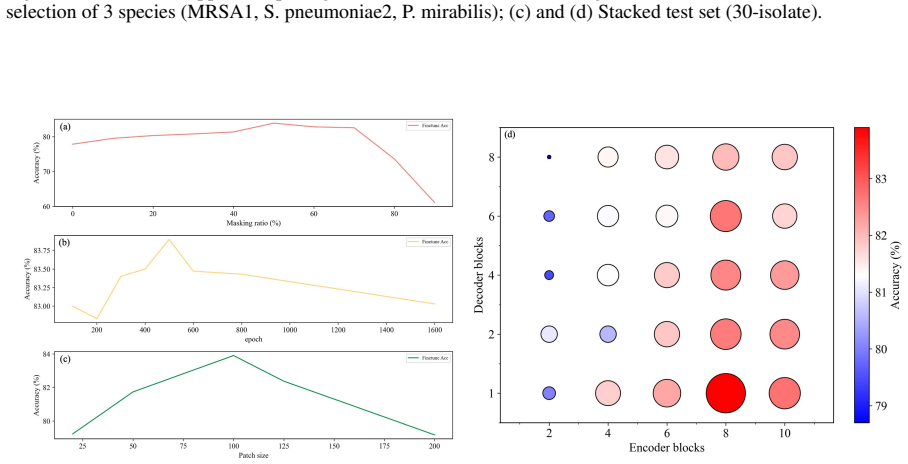
- Design ablations fix the best configuration at a 50% masking ratio, a patch size of 100, and an encoder deeper than the decoder; deviating from these lowers fine-tuned accuracy.
Reading between the lines
- If the transfer result generalizes, the practical win is not accuracy but label cost: the method trades thousands of expert-labeled spectra for a pretraining corpus that needs no labels at all.
- The same masked-reconstruction recipe should transfer to other one-dimensional spectroscopies (near-infrared, NMR), with spectral dimension and patch size rescaled; the paper states this possibility but does not demonstrate it.
- The reported denoising suggests a pretrained SMAE could be used as a preprocessing stage for any downstream classifier, not only for fine-tuning, although such a pipeline is not tested here.
- The 0.5-point accuracy gap between SMAE and supervised training is small enough that the right reading of the result is approximate parity with far lower labeling cost, not superiority.
Signed reviews
Editorial analysis
A structured set of objections, weighed in public.
Referee Report
Summary. The paper proposes SMAE, a masked autoencoder for Raman spectroscopy. In a self-supervised pretraining phase, random spectral patches are masked and the network is trained to reconstruct them with an MSE loss, without using any labels. The pretrained encoder is then either evaluated as a feature extractor for k-means clustering or fine-tuned with a small labeled set for classification. The method is tested on the Bacteria-ID dataset (30 bacterial classes; reference/finetune/test subsets) and on the MDA-MB-231 dataset for denoising. The central claims are that SMAE improves SNR by more than twofold, achieves over 80% clustering accuracy on the 30-class Bacteria-ID reference subset, and reaches 83.90% test accuracy after fine-tuning, compared with 83.40% for a supervised ResNet and 77.80% without pretraining.
Significance. If the quantitative claims are reliable, this is a useful contribution: it demonstrates that masked spectral reconstruction can serve as a label-free pretraining objective for Raman spectroscopy, potentially reducing annotation costs in clinical and material-science applications. The pretext task is external to the downstream labels, so the core comparison is not circular. Strengths include the use of two public datasets, a simple and transferable architecture, and a systematic ablation of masking ratio, patch size, and encoder/decoder depth in Section 3.4. The Grad-CAM analysis also provides interpretability evidence for the learned features. However, the statistical and technical gaps detailed below currently prevent the headline numbers from being taken as established.
major comments (5)
- [§3.3, Table 5] The headline comparison is a single-run point estimate with no uncertainty quantification. With 3,000 test spectra, the standard error of the 83.90% accuracy is roughly 0.7 percentage points, so the 0.50-point margin over the supervised ResNet (83.40%) is within one standard error. The 6.1-point gain over the w/o-pretraining baseline (77.80%) is larger, but without repeated seeds or a paired significance test it is not statistically established. Please report the mean and standard deviation over multiple training runs and a paired test (e.g., McNemar) for the w/ versus w/o pretraining comparison.
- [§3.2, Table 3] The 80.56% clustering accuracy is computed on the reference subset of Bacteria-ID, which is exactly the data used for SMAE pretraining (Section 2.1). This is an in-sample measure: it shows that the pretrained encoder can separate its own training spectra, but it does not demonstrate that the learned features generalize to new acquisitions. The abstract's claim of 'clustering accuracy over 80% for 30 classes' should be re-evaluated on held-out spectra or explicitly qualified as a training-set evaluation.
- [§3.1, Table 2] The row labeled 'Without SMAE pretraining' is undefined. The text only says that SMAE was pretrained on MDA-MB-231 and then reconstructed the low-SNR test spectra; it never describes what baseline the 'Without SMAE pretraining' entry corresponds to. The reported SNR of 1.8218 is also lower than the original SNR of 5.0883, which is surprising for a reconstruction baseline. In addition, the SNR estimation formula is not stated anywhere. Without these details, the claimed twofold SNR improvement cannot be reproduced or properly interpreted.
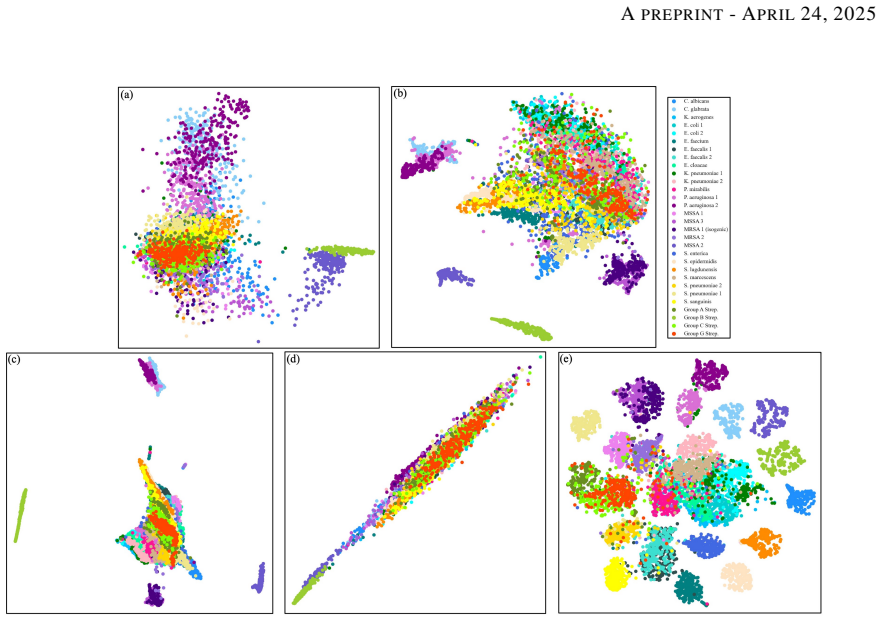
- [§2.1, Table 1] The transfer claim rests on an untested assumption that the reference and finetune subsets (1 s integration) and the test subset (2 s integration) are exchangeable draws from the same 30-class distribution. If acquisition time or batch identity is confounded with class, the encoder could exploit those cues and the 83.90% accuracy would overstate generalization to new samples. Please add a domain-gap analysis, for example a t-SNE or UMAP overlay colored by subset or a simple classifier trained to distinguish reference from test spectra, and report the w/o-pretraining baseline separately for the 1 s and 2 s conditions.
- [§3.4, Figure 10] The hyperparameter analysis selects the masking ratio, training epochs, patch size, and encoder/decoder depth based on fine-tuning classification accuracy. It is not stated which split is used for this selection. If the test set was used to choose these hyperparameters, the reported 83.90% test accuracy would not be a clean held-out estimate. Please clarify the validation procedure, or perform hyperparameter selection on a validation split derived from the finetune subset.
minor comments (5)
- [§3.3] The sentence 'SMAE achieved better classification performance in the reference subset without using any data labels' should read 'test subset'; as written it contradicts the protocol described in Section 2.1 and blurs the distinction between in-sample and held-out results.
- [Table 4] The header 'Mehthods' is a typo. More importantly, the 'dataset partitioning strategy outlined in RamanCluster' is not described in this paper, so the Bacteria-4 and Bacteria-6 comparisons cannot be reproduced from the manuscript alone.
- [Table 5] The 'Supervised learning Accuracy' of 84.80% for SMAE is never discussed in the text; please state how this supervised model was trained (for example, with all reference labels) and why it is not used as the main comparison.
- [§4] The claim that SMAE 'proposed a learning strategy for random masked spectra for the first time' is too strong given the masked autoencoder literature cited in [23,25]; the novelty claim should be limited to one-dimensional Raman spectra.
- [Figures 3 and 4] The spectra plots would benefit from explicit axis labels and wavelength units, and the masking ratio used for the displayed reconstructions should be stated in the captions.
Circularity Check
No circularity: masked-reconstruction pretraining is an external pretext task; labels enter only at fine-tuning and evaluation.
full rationale
None of the load-bearing claims reduces to its own inputs by construction. SMAE's pretraining objective is a masked-spectrum reconstruction task (Section 2.2.3), which is an external pretext task that never sees the 30-class labels; the fine-tuned classifier (Section 2.3) is trained only on the finetune subset and evaluated on the unseen test subset, and the controlled comparison 'w/o pretraining versus w/ pretraining' (Table 5) is the relevant experiment for the transfer claim. The clustering result in Table 3 is computed on the reference subset, the same subset used for pretraining, so it is an in-sample quality measure rather than a transfer test; however, since the pretraining task is label-free reconstruction, this is an evaluation-design caveat, not a definitional equivalence. The hyperparameter study in Section 3.4 (masking ratio, epochs, patch size, encoder/decoder depth) could in principle have used the test set for model selection, and the paper does not describe a separate validation split; that is a potential leakage risk, but the text does not state that the final 83.90% was selected on the test set, so under the no-speculation rule it is a correctness concern rather than demonstrable circularity. No self-citation chain, uniqueness theorem, or imported ansatz is used to force the result, and the central derivation is self-contained relative to the external Bacteria-ID and MDA-MB-231 benchmarks.
Assumptions & free parameters
free parameters (5)
- masking_ratio =
0.5
- patch_size =
100
- encoder_depth =
8 blocks
- decoder_depth =
1 block
- pretraining_epochs =
500
assumptions (4)
- domain assumption Raman spectra of the same bacterial species share learnable spectral features that are recoverable from randomly masked patches.
- domain assumption The Bacteria-ID reference, finetune, and test subsets are independent enough that pretraining on the reference transfers to the test set despite different integration times (1s vs 2s).
- ad hoc to paper MSE reconstruction of masked patches is a suitable objective for learning discriminative spectral features.
- domain assumption Transformer attention can capture relevant spectral peak correlations in 1D spectra.
Cite this review
Pith. "Pith review of A Self-supervised Learning Method for Raman Spectroscopy based on Masked Autoencoders." pith.science (2026). https://pith.science/paper/7DLVV4CY
@misc{pith2026250416130,
  author       = {Pith},
  title        = {Pith review of: A Self-supervised Learning Method for Raman Spectroscopy based on Masked Autoencoders},
  year         = {2026},
  howpublished = {\url{https://pith.science/paper/7DLVV4CY}},
  note         = {Machine review of arXiv:2504.16130}
}
read the original abstract
Raman spectroscopy serves as a powerful and reliable tool for analyzing the chemical information of substances. The integration of Raman spectroscopy with deep learning methods enables rapid qualitative and quantitative analysis of materials. Most existing approaches adopt supervised learning methods. Although supervised learning has achieved satisfactory accuracy in spectral analysis, it is still constrained by costly and limited well-annotated spectral datasets for training. When spectral annotation is challenging or the amount of annotated data is insufficient, the performance of supervised learning in spectral material identification declines. In order to address the challenge of feature extraction from unannotated spectra, we propose a self-supervised learning paradigm for Raman Spectroscopy based on a Masked AutoEncoder, termed SMAE. SMAE does not require any spectral annotations during pre-training. By randomly masking and then reconstructing the spectral information, the model learns essential spectral features. The reconstructed spectra exhibit certain denoising properties, improving the signal-to-noise ratio (SNR) by more than twofold. Utilizing the network weights obtained from masked pre-training, SMAE achieves clustering accuracy of over 80% for 30 classes of isolated bacteria in a pathogenic bacterial dataset, demonstrating significant improvements compared to classical unsupervised methods and other state-of-the-art deep clustering methods. After fine-tuning the network with a limited amount of annotated data, SMAE achieves an identification accuracy of 83.90% on the test set, presenting competitive performance against the supervised ResNet (83.40%).
Figures


Figures from the paper (7 more)



Reference graph
Works this paper leans on
-
[1]
Ji-Xin Cheng and X. Sunney Xie. Vibrational spectroscopic imaging of living systems: An emerging platform for biology and medicine. Science, 350(6264):aaa8870, November 2015
work page 2015
-
[2]
Yu Wang, Hao Peng, Kunxiang Liu, Lindong Shang, Lei Xu, Zhenming Lu, and Bei Li. Multi-point scanning confocal Raman spectroscopy for accurate identification of microorganisms at the single-cell level. Talanta, 254:124112, March 2023
work page 2023
-
[3]
Marlous Kamp, Jakub Surmacki, Marc Segarra Mondejar, Tim Young, Karolina Chrabaszcz, Fadwa Joud, Vincent Zecchini, Alyson Speed, Christian Frezza, and Sarah E. Bohndiek. Raman micro-spectroscopy reveals the spatial distribution of fumarate in cells and tissues. Nature Communications, 15(1):5386, June 2024
work page 2024
-
[4]
Olga Guselnikova, Andrii Trelin, Yunqing Kang, Pavel Postnikov, Makoto Kobashi, Asuka Suzuki, Lok Kumar Shrestha, Joel Henzie, and Yusuke Yamauchi. Pretreatment-free SERS sensing of microplastics using a self- attention-based neural network on hierarchically porous Ag foams. Nature Communications, 15(1):4351, May 2024
work page 2024
-
[5]
Alkyne-tagged SERS nanoprobe for un- derstanding Cu+ and Cu2+ conversion in cuproptosis processes
Sihan Zhang, Yuxiao Mei, Jiaqi Liu, Zhichao Liu, and Yang Tian. Alkyne-tagged SERS nanoprobe for un- derstanding Cu+ and Cu2+ conversion in cuproptosis processes. Nature Communications, 15(1):3246, April 2024
work page 2024
-
[6]
Single test-based diagnosis of multiple cancer types using Exosome-SERS-AI for early stage cancers
Hyunku Shin, Byeong Hyeon Choi, On Shim, Jihee Kim, Yong Park, Suk Ki Cho, Hyun Koo Kim, and Yeonho Choi. Single test-based diagnosis of multiple cancer types using Exosome-SERS-AI for early stage cancers. Nature Communications, 14(1):1644, March 2023
work page 2023
-
[7]
Liping Huang, Hongwei Sun, Liangbin Sun, Keqing Shi, Yuzhe Chen, Xueqian Ren, Yuancai Ge, Danfeng Jiang, Xiaohu Liu, Wolfgang Knoll, Qingwen Zhang, and Yi Wang. Rapid, label-free histopathological diagnosis of liver cancer based on Raman spectroscopy and deep learning. Nature Communications, 14(1):48, January 2023
work page 2023
-
[8]
Kobayashi-Kirschvink, Giulio Cerullo, Renzo Vanna, Peter T
Arianna Bresci, Koseki J. Kobayashi-Kirschvink, Giulio Cerullo, Renzo Vanna, Peter T. C. So, Dario Polli, and Jeon Woong Kang. Label-free morpho-molecular phenotyping of living cancer cells by combined Raman spectroscopy and phase tomography. Communications Biology, 7(1):785, June 2024
work page 2024
Show all 42 references
-
[9]
Advances in the Application of Artificial Intelligence-Based Spectral Data Interpretation: A Perspective
Xi Xue, Hanyu Sun, Minjian Yang, Xue Liu, Hai-Yu Hu, Yafeng Deng, and Xiaojian Wang. Advances in the Application of Artificial Intelligence-Based Spectral Data Interpretation: A Perspective. Analytical Chemistry, page acs.analchem.3c02540, September 2023
2023
-
[10]
Patch-Based Convolutional Encoder: A Deep Learning Algorithm for Spectral Classification Balancing the Local and Global Information
Xin-Yu Lu, Chen-Yue Wang, Hui Tang, Yi-Fei Qin, Li Cui, Xiang Wang, Guo-Kun Liu, and Bin Ren. Patch-Based Convolutional Encoder: A Deep Learning Algorithm for Spectral Classification Balancing the Local and Global Information. Analytical Chemistry, page acs.analchem.3c03889, F...
2024
-
[11]
Combined Mutual Learning Net for Raman Spectral Microbial Strain Identification
Junfan Chen, Jiaqi Hu, Chenlong Xue, Qian Zhang, Jingyan Li, Ziyue Wang, Jinqian Lv, Aoyan Zhang, Hong Dang, Dan Lu, Defeng Zou, Longqing Cong, Yuchao Li, Gina Jinna Chen, and Perry Ping Shum. Combined Mutual Learning Net for Raman Spectral Microbial Strain Identification. Ana...
2024
-
[12]
Scale-Adaptive Deep Model for Bacterial Raman Spectra Identification
Lin Deng, Yuzhong Zhong, Maoning Wang, Xiujuan Zheng, and Jianwei Zhang. Scale-Adaptive Deep Model for Bacterial Raman Spectra Identification. IEEE Journal of Biomedical and Health Informatics, 26(1):369–378, January 2022
2022
-
[13]
Deep Learning for Biospectroscopy and Biospectral Imaging: State-of-the-Art and Perspectives
Hao He, Sen Yan, Danya Lyu, Mengxi Xu, Ruiqian Ye, Peng Zheng, Xinyu Lu, Lei Wang, and Bin Ren. Deep Learning for Biospectroscopy and Biospectral Imaging: State-of-the-Art and Perspectives. Anal. Chem., 2021
2021
-
[14]
Classifying breast cancer tissue by Raman spectroscopy with one-dimensional convolutional neural network
Danying Ma, Linwei Shang, Jinlan Tang, Yilin Bao, Juanjuan Fu, and Jianhua Yin. Classifying breast cancer tissue by Raman spectroscopy with one-dimensional convolutional neural network. Spectrochimica Acta Part A: Molecular and Biomolecular Spectroscopy, 256:119732, July 2021
2021
-
[15]
Gibson, James Mills, and Margarita Osadchy
Jinchao Liu, Stuart J. Gibson, James Mills, and Margarita Osadchy. Dynamic spectrum matching with one-shot learning. Chemometrics and Intelligent Laboratory Systems, 184:175–181, January 2019
2019
-
[16]
Chen, Jalen Thomas, Yuan Liu, Haohua Tu, and Stephen A
Yi Sun, Ethan W. Chen, Jalen Thomas, Yuan Liu, Haohua Tu, and Stephen A. Boppart. K-means clustering of coherent Raman spectra from extracellular vesicles visualized by label-free multiphoton imaging. Optics Letters, 45(13):3613, July 2020. 13 A PREPRINT - A PRIL 24, 2025
2020
-
[17]
Afra Hacer Arslan, Fatma Uysal Ciloglu, Ummugulsum Yilmaz, Emrah Simsek, and Omer Aydin. Discrimination of waterborne pathogens, Cryptosporidium parvum oocysts and bacteria using surface-enhanced Raman spec- troscopy coupled with principal component analysis and hierarchical c...
2022
-
[18]
Identification of methicillin-resistant Staphylococcus aureus bacteria using surface-enhanced Raman spectroscopy and machine learning techniques
Fatma Uysal Ciloglu, Ayse Mine Saridag, Ibrahim Halil Kilic, Mahmut Tokmakci, Mehmet Kahraman, and Omer Aydin. Identification of methicillin-resistant Staphylococcus aureus bacteria using surface-enhanced Raman spectroscopy and machine learning techniques. The Analyst, 145(23)...
2020
-
[19]
Applications of Raman Spectroscopy in Bacterial Infections: Principles, Advantages, and Shortcomings
Liang Wang, Wei Liu, Jia-Wei Tang, Jun-Jiao Wang, Qing-Hua Liu, Peng-Bo Wen, Meng-Meng Wang, Ya- Cheng Pan, Bing Gu, and Xiao Zhang. Applications of Raman Spectroscopy in Bacterial Infections: Principles, Advantages, and Shortcomings. Frontiers in Microbiology, 12:683580, July 2021
2021
-
[20]
Unsupervised convolutional variational autoencoder deep embedding clustering for Raman spectra
Yixin Guo, Weiqi Jin, Weilin Wang, Zongyu Guo, and Yuqing He. Unsupervised convolutional variational autoencoder deep embedding clustering for Raman spectra. Analytical Methods, 14(39):3898–3910, 2022
2022
-
[21]
RamanCluster: A deep clustering-based framework for unsupervised Raman spectral identification of pathogenic bacteria
Zhijian Sun, Zhuo Wang, and Mingqi Jiang. RamanCluster: A deep clustering-based framework for unsupervised Raman spectral identification of pathogenic bacteria. Talanta, 275:126076, August 2024
2024
-
[22]
A Cookbook of Self-Supervised Learning, June 2023
Randall Balestriero, Mark Ibrahim, Vlad Sobal, Ari Morcos, Shashank Shekhar, Tom Goldstein, Florian Bordes, Adrien Bardes, Gregoire Mialon, Yuandong Tian, Avi Schwarzschild, Andrew Gordon Wilson, Jonas Geiping, Quentin Garrido, Pierre Fernandez, Amir Bar, Hamed Pirsiavash, Yan...
2023 arXiv
-
[23]
Masked Autoencoders Are Scalable Vision Learners
Kaiming He, Xinlei Chen, Saining Xie, Yanghao Li, Piotr Dollar, and Ross Girshick. Masked Autoencoders Are Scalable Vision Learners. In 2022 IEEE/CVF Conference on Computer Vision and Pattern Recognition (CVPR), pages 15979–15988, New Orleans, LA, USA, June 2022. IEEE
2022
-
[24]
SimMIM: A Simple Framework for Masked Image Modeling, April 2022
Zhenda Xie, Zheng Zhang, Yue Cao, Yutong Lin, Jianmin Bao, Zhuliang Yao, Qi Dai, and Han Hu. SimMIM: A Simple Framework for Masked Image Modeling, April 2022. arXiv:2111.09886 [cs]
2022 arXiv
-
[25]
Context Autoencoder for Self-supervised Representation Learning
Xiaokang Chen, Mingyu Ding, Xiaodi Wang, Ying Xin, Shentong Mo, Yunhao Wang, Shumin Han, Ping Luo, Gang Zeng, and Jingdong Wang. Context Autoencoder for Self-supervised Representation Learning. International Journal of Computer Vision, 132(1):208–223, January 2024
2024
-
[26]
VideoMAE: Masked Autoencoders are Data-Efficient Learners for Self-Supervised Video Pre-Training, October 2022
Zhan Tong, Yibing Song, Jue Wang, and Limin Wang. VideoMAE: Masked Autoencoders are Data-Efficient Learners for Self-Supervised Video Pre-Training, October 2022. arXiv:2203.12602 [cs]
2022 arXiv
-
[27]
Masked Autoencoders As Spatiotemporal Learners, October 2022
Christoph Feichtenhofer, Haoqi Fan, Yanghao Li, and Kaiming He. Masked Autoencoders As Spatiotemporal Learners, October 2022. arXiv:2205.09113 [cs]
2022 arXiv
-
[28]
Masked Autoencoders that Listen, January 2023
Po-Yao Huang, Hu Xu, Juncheng Li, Alexei Baevski, Michael Auli, Wojciech Galuba, Florian Metze, and Christoph Feichtenhofer. Masked Autoencoders that Listen, January 2023. arXiv:2207.06405 [cs, eess]
2023 arXiv
-
[29]
BERT: Pre-training of Deep Bidirectional Transformers for Language Understanding, May 2019
Jacob Devlin, Ming-Wei Chang, Kenton Lee, and Kristina Toutanova. BERT: Pre-training of Deep Bidirectional Transformers for Language Understanding, May 2019. arXiv:1810.04805 [cs]
2019 arXiv
-
[30]
Emer- gence of molecular structures from repository-scale self-supervised learning on tandem mass spectra, April 2024
Roman Bushuiev, Anton Bushuiev, Raman Samusevich, Corinna Brungs, Josef Sivic, and Tomáš Pluskal. Emer- gence of molecular structures from repository-scale self-supervised learning on tandem mass spectra, April 2024
2024
-
[31]
Jensen, Eduarda M
Mathias N. Jensen, Eduarda M. Guerreiro, Agustin Enciso-Martinez, Sergei G. Kruglik, Cees Otto, Omri Snir, Benjamin Ricaud, and Olav Gaute Hellesø. Identification of extracellular vesicles from their Raman spectra via self-supervised learning. Scientific Reports, 14(1):6791, M...
2024
-
[32]
Data Augmentation of Spectral Data for Convolutional Neural Network (CNN) Based Deep Chemometrics, October 2017
Esben Jannik Bjerrum, Mads Glahder, and Thomas Skov. Data Augmentation of Spectral Data for Convolutional Neural Network (CNN) Based Deep Chemometrics, October 2017. arXiv:1710.01927 [cs]
2017 arXiv
-
[33]
From Genotype to Phenotype: Raman Spectroscopy and Machine Learning for Label-Free Single-Cell Analysis
Yirui Zhang, Kai Chang, Babatunde Ogunlade, Liam Herndon, Loza F Tadesse, Amanda R Kirane, and Jennifer A Dionne. From Genotype to Phenotype: Raman Spectroscopy and Machine Learning for Label-Free Single-Cell Analysis. ACS Nano, 2024
2024
-
[34]
Hogan, Lena Blackmon, Stefanie S
Chi-Sing Ho, Neal Jean, Catherine A. Hogan, Lena Blackmon, Stefanie S. Jeffrey, Mark Holodniy, Niaz Banaei, Amr A. E. Saleh, Stefano Ermon, and Jennifer Dionne. Rapid identification of pathogenic bacteria using Raman spectroscopy and deep learning. Nature Communications, 10(1)...
2019
-
[35]
Horgan, Magnus Jensen, Anika Nagelkerke, Jean-Philippe St-Pierre, Tom Vercauteren, Molly M
Conor C. Horgan, Magnus Jensen, Anika Nagelkerke, Jean-Philippe St-Pierre, Tom Vercauteren, Molly M. Stevens, and Mads S. Bergholt. High-Throughput Molecular Imaging via Deep-Learning-Enabled Raman Spectroscopy. Analytical Chemistry, 93(48):15850–15860, December 2021. 14 A PRE...
2021
-
[36]
Gomez, Lukasz Kaiser, and Illia Polosukhin
Ashish Vaswani, Noam Shazeer, Niki Parmar, Jakob Uszkoreit, Llion Jones, Aidan N. Gomez, Lukasz Kaiser, and Illia Polosukhin. Attention Is All You Need, August 2023. arXiv:1706.03762 [cs]
2023 arXiv
-
[37]
A Simple Framework for Contrastive Learning of Visual Representations, June 2020
Ting Chen, Simon Kornblith, Mohammad Norouzi, and Geoffrey Hinton. A Simple Framework for Contrastive Learning of Visual Representations, June 2020. arXiv:2002.05709 [cs, stat]
2020 arXiv
-
[38]
Contrastive Clustering, September
Yunfan Li, Peng Hu, Zitao Liu, Dezhong Peng, Joey Tianyi Zhou, and Xi Peng. Contrastive Clustering, September
-
[39]
Time-Series Representation Learning via Temporal and Contextual Contrasting
Emadeldeen Eldele, Mohamed Ragab, Zhenghua Chen, Min Wu, Chee Keong Kwoh, Xiaoli Li, and Cuntai Guan. Time-Series Representation Learning via Temporal and Contextual Contrasting. In Proceedings of the Thirtieth International Joint Conference on Artificial Intelligence , pages ...
2021
-
[40]
Arnold, and Bing Xiang
Dejiao Zhang, Feng Nan, Xiaokai Wei, Shang-Wen Li, Henghui Zhu, Kathleen McKeown, Ramesh Nallapati, Andrew O. Arnold, and Bing Xiang. Supporting Clustering with Contrastive Learning. In Proceedings of the 2021 Conference of the North American Chapter of the Association for Com...
2021
-
[41]
Selvaraju, Michael Cogswell, Abhishek Das, Ramakrishna Vedantam, Devi Parikh, and Dhruv Batra
Ramprasaath R. Selvaraju, Michael Cogswell, Abhishek Das, Ramakrishna Vedantam, Devi Parikh, and Dhruv Batra. Grad-CAM: Visual Explanations from Deep Networks via Gradient-Based Localization. In 2017 IEEE International Conference on Computer Vision (ICCV), pages 618–626, Venic...
2017
-
[2020]
arXiv:2009.09687 [cs, stat]
2009 arXiv
Reviewed August 16, 2026 · model on record in the stance chip above.
Discussion (0). Continue with ORCID to comment.