REVIEW 4 major objections 7 minor 2 cited by
FaithfulRAG: Fact-Level Conflict Modeling for Context-Faithful Retrieval-Augmented Generation
T0 review · 4 major / 7 minor · reviewed 2026-08-07 · deepseek-v4-flash
Pith's one-line read FaithfulRAG claims that faithful RAG should resolve, not suppress, the conflict between a model's stored knowledge and retrieved context.
desk verdict Solid RAG faithfulness paper with a real trade-off finding, but the fact-level alignment mechanism is under-validated. read the letter →
The pith
A machine-rendered reading of the paper's core claim, the machinery that carries it, and where it could break.
The reading
What carries the argument
The load-bearing mechanism is a three-stage pipeline. Self-Fact Mining externalizes the model's parametric understanding of the question: it first extracts high-level knowledge needs, generates a 'self-context' from them, then distills that into atomic self-facts $f_1,\ldots,f_m$. Contextual Knowledge Alignment chunks the retrieved context and scores each chunk against each self-fact with cosine similarity $\mathrm{Sim}(f_i,c_j)=\cos(f_i,c_j)$, keeping the top-$k$ aligned chunks. Self-Think then reasons over those aligned chunks together with the original context, first judging whether the aligned chunks suffice, then fusing in missing context to produce a final answer. The identity that carries the argument is the alignment score: it is the point where the model's own facts are matched to the retrieved text, and everything downstream depends on it.
What would settle it
Take a sample of conflicting examples with known gold conflict spans and measure whether the embedding-based top-$k$ alignment recovers those spans at rates above chance; if recall is at chance or if swapping the embedding model for a random chunk selector leaves accuracy unchanged, the alignment step is not carrying the reported gains.
Extended reading notes
Core claim
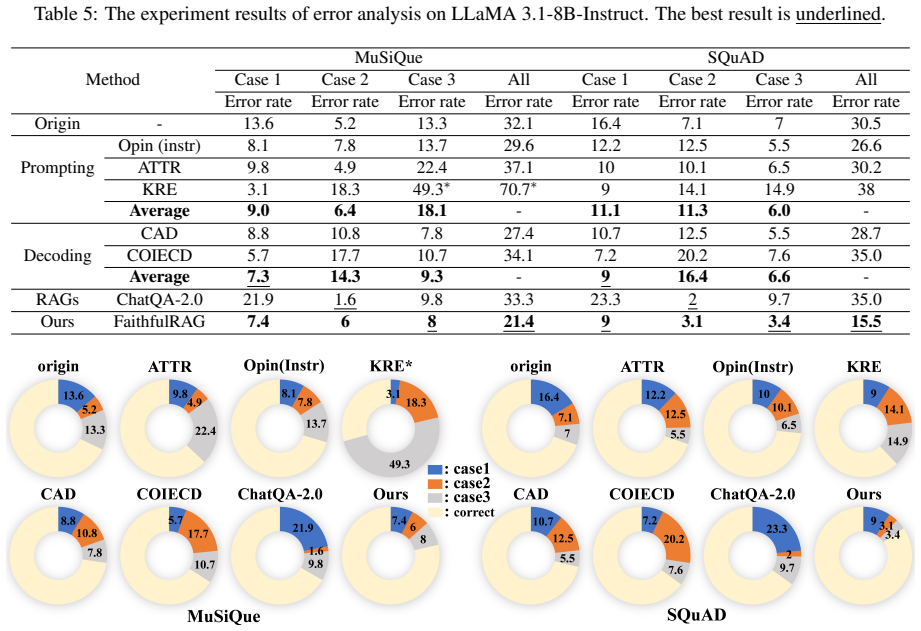
The central claim is that faithfulness and accuracy need not trade off once conflicts are handled at the fact level rather than by global suppression. Concretely, the paper reports that prompting-based and decoding-based faithful methods reduce over-confidence errors (the model sticks to its parametric answer) by about 6 percent on average but raise incorrect-match errors (the model adopts a wrong contextual claim) by a similar amount; FaithfulRAG is claimed to reduce over-confidence errors by 6.8 percent and incorrect-match errors by 1.6 percent on average, and to outperform the strongest baselines by 8.5 to 9.3 points on FaithEval and SQuAD. The method also reports gains in non-conflict settings, where suppression-based baselines often lose accuracy. The authors frame this as evidence that an LLM can act as a critical reasoner that keeps its parametric knowledge and the retrieved context in view at once.
Load-bearing premise
The method's conflict detection assumes that cosine similarity between embeddings of the model's own facts and chunks of the retrieved context reliably surfaces the spans where the conflict actually lies; if the embedding model misses those spans, the self-think step starts from the wrong evidence and the whole reconciliation collapses.
Editorial extensions
If this is right
- Faithfulness methods should stop treating the model's parametric knowledge as noise to be suppressed; keeping it active is what allows conflicting context to be evaluated rather than rubber-stamped.
- Because the method is prompt-level and does not retrain, it can be applied to any instruction-following LLM, and the paper demonstrates gains on 3B, 7B, 8B, 13B, and 16B backbones.
- Fact-level conflict modeling should produce balanced error reduction: the reported error analysis shows both over-confidence and incorrect-match errors falling together, unlike prompting or decoding baselines.
- Non-conflict performance need not suffer: the paper reports accuracy gains on golden-context versions of MuSiQue and SQuAD, where suppression-based methods often drop.
Reading between the lines
- A direct test of the core mechanism is to measure whether the cosine-similarity top-$k$ chunks actually contain the sentences that contradict the model's own facts; if recall of conflict-bearing chunks is no better than chance, the reported gains would have to come from the self-think prompt rather than the alignment step.
- The same self-fact, alignment, and self-think recipe could be ported to multimodal RAG, where conflicts between text and image or audio evidence are common; the paper itself notes this as a limitation.
- One could ablate more finely by replacing the embedding model with a deliberately poor retriever; the paper's own small embedding-model comparison suggests the results are fairly stable, which indicates the alignment step is not brittle within the tested range.
Editorial analysis
A structured set of objections, weighed in public.
Referee Report
Summary. The paper studies knowledge conflicts in retrieval-augmented generation (RAG), where retrieved context contradicts the LLM's parametric knowledge. It argues that existing context-faithful methods improve faithfulness by suppressing parametric knowledge, which increases 'incorrect-match' errors. The proposed FaithfulRAG framework externalizes the model's parametric knowledge into self-facts, aligns these self-facts with retrieved context chunks using cosine similarity, and applies a Self-Think module that reasons over the aligned chunks and the original context before generating an answer. Experiments on the Counterfactual subset of FaithEval, RealtimeQA, MuSiQue, and SQuAD with three backbone LLMs report accuracy improvements over several prompting- and decoding-based baselines, along with an error analysis showing simultaneous reduction of over-confidence and incorrect-match errors.
Significance. If the mechanism is as claimed, the paper offers a useful alternative to suppression-based faithfulness methods: instead of weakening parametric knowledge, it attempts to localize and reason about conflicts at the fact level. The empirical scope is a strength: four datasets, three backbone models, additional model-size experiments, MR-based faithfulness evaluation, and an informative ablation study. The authors also release code and use deterministic decoding, which aids reproducibility. However, the central mechanism — that cosine-similarity-based chunk selection identifies the actual conflict-bearing spans — is not validated, and some headline claims are overbroad given the reported numbers. These issues are fixable with additional analysis, but they currently prevent the paper's central contribution from being fully supported.
major comments (4)
- [Section 4.2, Eq. (6), Algorithm 1] The paper's core claim is that FaithfulRAG resolves knowledge conflicts at the fact level. That claim rests on the Contextual Knowledge Alignment module selecting chunks Caligned that contain the conflicting facts. However, the paper never verifies that the top-k chunks selected by cosine similarity are actually the conflict-bearing spans. Equation (6) measures topical similarity between self-facts and context chunks, not contradiction or conflict. Table 8 only shows that final accuracy is insensitive to the choice of embedding model, and the 'w/o whole Module' ablation in Table 3 shows that prepending self-aligned context matters, but it does not show that the selected chunks are the conflicting ones. The authors should report, for example, recall@k of the selected chunks against the gold or substituted spans in KRE, or a human-annotated evaluation on FaithEval, and should compare against random chunk selection. Without this evidence, the improvement could come from reordering or emphasizing any topically related context rather than from fact-level conflict localization.
- [Section 5.2, Obs. 1, Table 1] The observation that 'FaithfulRAG consistently outperforms baseline models on four benchmark datasets' is contradicted by the reported numbers. On RealtimeQA with Qwen2.5-7B, KRE achieves 86.7 while FaithfulRAG achieves 84.1. The sentence in Obs. 1 stating that FaithfulRAG 'dominates RealtimeQA with scores of 79.9% and 84.1%' is therefore inaccurate for at least one backbone. The authors should either qualify the claim (e.g., by reporting average rank across backbones or noting per-backbone exceptions) or explain why the RealtimeQA result is not considered a counterexample. This is a load-bearing claim because the abstract and introduction describe the method as outperforming state-of-the-art methods across the board.
- [Section 3, Figure 2, Section 5.3] The causal claim that existing faithful methods 'forcibly suppress the model's parametric knowledge' is inferred from error distributions but is not directly measured. The observed increase in Case 2 (incorrect-match) errors is consistent with that explanation, but it is also consistent with other mechanisms, such as instruction-following biases or decoding-level shifts that do not explicitly modulate parametric knowledge. Since this causal story motivates the entire framework, the authors should provide direct evidence, for instance by measuring the model's confidence in or probability assigned to the parametric answer under each method, or by performing an intervention where the context is removed and comparing how each method behaves. Without such evidence, the 'suppression' narrative remains an assumption rather than a measured effect.
- [Section 5.2, Table 1, Section C.1] The paper reports no measures of variance or statistical significance, and the RealtimeQA test set appears to contain only six questions. Some of the accuracy differences that support the state-of-the-art claim are small (e.g., 77.0 vs. 78.0 on one RealtimeQA row), and the FaithEval results are only for the Counterfactual subset even though the tables and abstract label the dataset as 'FaithEval'. The authors should report the subset size, state explicitly in the main text that only the Counterfactual subset is used, and ideally provide paired significance tests or bootstrap confidence intervals across questions. This would strengthen the reliability of the empirical comparisons, especially where margins are small.
minor comments (7)
- [Abstract and Section 5.1] The abstract and Table 1 refer to 'FaithEval' without noting that only the Counterfactual subset is used; this should be clarified at the first mention in the main text.
- [Section C.1] The RealtimeQA-22 test set is described as selecting six questions; this very small test size should be reported near Table 1, because it affects how the RealtimeQA numbers should be interpreted.
- [Section 4.2 and Algorithm 1] It is not clear whether top-k chunks are selected per self-fact or globally across all self-facts, nor how ties are broken; the selection procedure should be specified precisely.
- [Section 5.4] The heading 'Alation Study' contains a typo and should read 'Ablation Study'.
- [Section 2] The phrase 'Knowldge Retrieval' contains a typo and should read 'Knowledge Retrieval'.
- [Appendix B.2] Case 3 is defined only as 'all other scenarios beyond these two cases'; providing one or two concrete examples would make the error taxonomy clearer.
- [Section 5.2, Obs. 2] The claim that KRE and CAD exhibit 'severe instability' is based on a small number of backbones; the refusal cases marked with an asterisk should be discussed separately from accuracy numbers, since a refusal is not the same as an incorrect answer.
Circularity Check
No significant circularity: FaithfulRAG is an empirical pipeline whose components are neither fitted to nor defined by the target benchmark results, and no load-bearing self-citation chain is present.
full rationale
FaithfulRAG is an empirical pipeline rather than a formal derivation, and I find no step in which a claimed output is equivalent by construction to an input. The three modules—self-fact mining (Eqs. 2-4), contextual knowledge alignment (Eqs. 5-6), and self-think (Eqs. 7-8)—are compositions of prompting, embedding similarity, and fixed top-k selection; chunk size (20) and k (5) are fixed hyperparameters, not fitted to the test sets. The central claims are evaluated by ACC and MR on FaithEval, RealtimeQA, MuSiQue, and SQuAD against external baselines, so the headline result is not a renamed or refitted input. The preliminary error analysis in Section 3 and Figure 2 defines Case 1 and Case 2 by comparing parametric and contextual predictions, but this is an evaluation taxonomy, not a fitted quantity later renamed as a prediction. Citations to the authors' own prior work (e.g., KnowGPT and the retrieval-augmented generation survey) appear as background context and are not load-bearing for the paper's claimed novelty or effectiveness. The skeptic's concern—that cosine similarity may not select the truly conflict-bearing spans—is a genuine correctness and robustness risk, but it is not circularity: selecting top-k chunks neither guarantees nor presupposes the final answer, and the Self-Think module retains the original context as a fallback. No uniqueness theorem, self-citation chain, or definitional identification forces the method's choice. The paper is therefore self-contained with respect to its empirical claims, and the appropriate circularity score is 0.
Assumptions & free parameters
free parameters (3)
- chunk_size =
20
- top_k =
5
- embedding_model =
all-MiniLM-L6-v2
assumptions (3)
- domain assumption Self-facts extracted from the LLM's own parametric knowledge are reliable anchors for identifying conflicting context.
- domain assumption Cosine similarity between sentence embeddings of facts and context chunks measures factual alignment.
- domain assumption The LLM can accurately externalize its knowledge through the three-stage self-fact mining prompts.
Cite this review
Pith. "Pith review of FaithfulRAG: Fact-Level Conflict Modeling for Context-Faithful Retrieval-Augmented Generation." pith.science (2026). https://pith.science/paper/7DNNKX67
@misc{pith2026250608938,
  author       = {Pith},
  title        = {Pith review of: FaithfulRAG: Fact-Level Conflict Modeling for Context-Faithful Retrieval-Augmented Generation},
  year         = {2026},
  howpublished = {\url{https://pith.science/paper/7DNNKX67}},
  note         = {Machine review of arXiv:2506.08938}
}
read the original abstract
Large language models (LLMs) augmented with retrieval systems have demonstrated significant potential in handling knowledge-intensive tasks. However, these models often struggle with unfaithfulness issues, generating outputs that either ignore the retrieved context or inconsistently blend it with the LLM`s parametric knowledge. This issue is particularly severe in cases of knowledge conflict, where the retrieved context conflicts with the model`s parametric knowledge. While existing faithful RAG approaches enforce strict context adherence through well-designed prompts or modified decoding strategies, our analysis reveals a critical limitation: they achieve faithfulness by forcibly suppressing the model`s parametric knowledge, which undermines the model`s internal knowledge structure and increases the risk of misinterpreting the context. To this end, this paper proposes FaithfulRAG, a novel framework that resolves knowledge conflicts by explicitly modeling discrepancies between the model`s parametric knowledge and retrieved context. Specifically, FaithfulRAG identifies conflicting knowledge at the fact level and designs a self-thinking process, allowing LLMs to reason about and integrate conflicting facts before generating responses. Extensive experiments demonstrate that our method outperforms state-of-the-art methods. The code is available at https://github.com/DeepLearnXMU/Faithful-RAG
Figures


Figures from the paper (3 more)


Forward citations
Cited by 2 Pith papers
-
Where Facts Go Missing: A Layerwise Taxonomy and Per-Layer Attribution of Information Omission in Air-Gapped LLMAgent Pipelines
In a controlled 75,476-trial stress test, about 73% of omitted-fact failures in LLM agent pipelines are traced to deterministic middleware (redaction, pagination, truncation) rather than model behavior.
-
Enhancing Large Language Models with Reliable Knowledge Graphs
A thesis composed of four published papers proposes contrastive KG error detection, attribute-aware error-aware embedding, inductive graph completion, and KG prompting, but adds no new result beyond those papers.
Reference graph
Works this paper leans on
-
[1]
AI Anthropic. 2024. The claude 3 model family: Opus, sonnet, haiku. Claude-3 Model Card
2024
-
[2]
Akari Asai, Zeqiu Wu, Yizhong Wang, Avirup Sil, and Hannaneh Hajishirzi. 2023. https://arxiv.org/abs/2310.11511 Self-rag: Learning to retrieve, generate, and critique through self-reflection . Preprint, arXiv:2310.11511
arXiv 2023
-
[3]
Baolong Bi, Shaohan Huang, Yiwei Wang, Tianchi Yang, Zihan Zhang, Haizhen Huang, Lingrui Mei, Junfeng Fang, Zehao Li, Furu Wei, et al. 2024 a . Context-dpo: Aligning language models for context-faithfulness. arXiv preprint arXiv:2412.15280
arXiv 2024
-
[4]
Baolong Bi, Shenghua Liu, Yiwei Wang, Lingrui Mei, Junfeng Fang, Hongcheng Gao, Shiyu Ni, and Xueqi Cheng. 2024 b . Is factuality enhancement a free lunch for llms? better factuality can lead to worse context-faithfulness. arXiv preprint arXiv:2404.00216
work page Pith review arXiv 2024
-
[5]
Zhiwei Cao, Qian Cao, Yu Lu, Ningxin Peng, Luyang Huang, Shanbo Cheng, and Jinsong Su. 2024. https://arxiv.org/abs/2406.02376 Retaining key information under high compression ratios: Query-guided compressor for llms . Preprint, arXiv:2406.02376
work page Pith review arXiv 2024
-
[6]
Shengyuan Chen, Qinggang Zhang, Junnan Dong, Wen Hua, Qing Li, and Xiao Huang. 2024. Entity alignment with noisy annotations from large language models. arXiv preprint arXiv:2405.16806
work page Pith review arXiv 2024
-
[7]
Junfeng Fang, Houcheng Jiang, Kun Wang, Yunshan Ma, Shi Jie, Xiang Wang, Xiangnan He, and Tat-Seng Chua. 2025. Alphaedit: Null-space constrained knowledge editing for language models. ICLR
work page 2025
-
[8]
Yunfan Gao, Yun Xiong, Xinyu Gao, Kangxiang Jia, Jinliu Pan, Yuxi Bi, Yi Dai, Jiawei Sun, and Haofen Wang. 2023. Retrieval-augmented generation for large language models: A survey. arXiv preprint arXiv:2312.10997
arXiv 2023
Show all 45 references
-
[9]
Zijin Hong, Zheng Yuan, Hao Chen, Qinggang Zhang, Feiran Huang, and Xiao Huang. 2024. Knowledge-to-sql: Enhancing sql generation with data expert llm. arXiv preprint arXiv:2402.11517
2024 arXiv
-
[10]
Cheng-Yu Hsieh, Yung-Sung Chuang, Chun-Liang Li, Zifeng Wang, Long T Le, Abhishek Kumar, James Glass, Alexander Ratner, Chen-Yu Lee, Ranjay Krishna, et al. 2024. Found in the middle: Calibrating positional attention bias improves long context utilization. arXiv preprint arXiv:...
2024 arXiv
-
[11]
Lei Huang, Weijiang Yu, Weitao Ma, Weihong Zhong, Zhangyin Feng, Haotian Wang, Qianglong Chen, Weihua Peng, Xiaocheng Feng, Bing Qin, et al. 2023. A survey on hallucination in large language models: Principles, taxonomy, challenges, and open questions. arXiv preprint arXiv:2311.05232
2023 arXiv
-
[12]
Houcheng Jiang, Junfeng Fang, Ningyu Zhang, Guojun Ma, Mingyang Wan, Xiang Wang, Xiangnan He, and Tat-seng Chua. 2025. Anyedit: Edit any knowledge encoded in language models. ICML
2025
-
[13]
Jungo Kasai, Keisuke Sakaguchi, Ronan Le Bras, Akari Asai, Xinyan Yu, Dragomir Radev, Noah A Smith, Yejin Choi, Kentaro Inui, et al. 2024. Realtime qa: what's the answer right now? Advances in Neural Information Processing Systems, 36
2024
-
[14]
Woosuk Kwon, Zhuohan Li, Siyuan Zhuang, Ying Sheng, Lianmin Zheng, Cody Hao Yu, Joseph Gonzalez, Hao Zhang, and Ion Stoica. 2023. Efficient memory management for large language model serving with pagedattention. In Proceedings of the 29th Symposium on Operating Systems Princip...
2023
-
[15]
u ttler, Mike Lewis, Wen-tau Yih, Tim Rockt\
Patrick Lewis, Ethan Perez, Aleksandra Piktus, Fabio Petroni, Vladimir Karpukhin, Naman Goyal, Heinrich K\" u ttler, Mike Lewis, Wen-tau Yih, Tim Rockt\" a schel, Sebastian Riedel, and Douwe Kiela. 2020. https://proceedings.neurips.cc/paper_files/paper/2020/file/6b493230205f78...
2020
-
[16]
Daliang Li, Ankit Singh Rawat, Manzil Zaheer, Xin Wang, Michal Lukasik, Andreas Veit, Felix Yu, and Sanjiv Kumar. 2023. https://doi.org/10.18653/v1/2023.findings-acl.112 Large language models with controllable working memory . In Findings of the Association for Computational L...
2023 doi
-
[17]
Aixin Liu, Bei Feng, Bing Xue, Bingxuan Wang, Bochao Wu, Chengda Lu, Chenggang Zhao, Chengqi Deng, Chenyu Zhang, Chong Ruan, et al. 2024 a . Deepseek-v3 technical report. arXiv preprint arXiv:2412.19437
2024 arXiv
-
[18]
Bingshuai Liu, Chenyang Lyu, Zijun Min, Zhanyu Wang, Jinsong Su, and Longyue Wang. 2024 b . https://arxiv.org/abs/2312.01714 Retrieval-augmented multi-modal chain-of-thoughts reasoning for large language models . Preprint, arXiv:2312.01714
2024 arXiv
-
[19]
Liu, Kevin Lin, John Hewitt, Ashwin Paranjape, Michele Bevilacqua, Fabio Petroni, and Percy Liang
Nelson F. Liu, Kevin Lin, John Hewitt, Ashwin Paranjape, Michele Bevilacqua, Fabio Petroni, and Percy Liang. 2024 c . https://doi.org/10.1162/tacl_a_00638 Lost in the middle: How language models use long contexts . Transactions of the Association for Computational Linguistics,...
2024 doi
-
[20]
Zihan Liu, Wei Ping, Rajarshi Roy, Peng Xu, Chankyu Lee, Mohammad Shoeybi, and Bryan Catanzaro. 2024 d . Chatqa: Surpassing gpt-4 on conversational qa and rag. In The Thirty-eighth Annual Conference on Neural Information Processing Systems
2024
-
[21]
Shayne Longpre, Kartik Perisetla, Anthony Chen, Nikhil Ramesh, Chris DuBois, and Sameer Singh. 2021. https://doi.org/10.18653/v1/2021.emnlp-main.565 Entity-based knowledge conflicts in question answering . In Proceedings of the 2021 Conference on Empirical Methods in Natural L...
2021 doi
-
[22]
Yifei Ming, Senthil Purushwalkam, Shrey Pandit, Zixuan Ke, Xuan-Phi Nguyen, Caiming Xiong, and Shafiq Joty. 2025. https://openreview.net/forum?id=UeVx6L59fg Faitheval: Can your language model stay faithful to context, even if ''the moon is made of marshmallows'' . In The Thirt...
2025
-
[23]
Xuan-Phi Nguyen, Shrey Pandit, Senthil Purushwalkam, Austin Xu, Hailin Chen, Yifei Ming, Zixuan Ke, Silvio Savarese, Caiming Xong, and Shafiq Joty. 2024. Sfr-rag: Towards contextually faithful llms. arXiv preprint arXiv:2409.09916
2024 arXiv
-
[24]
OpenAI. 2023. https://arxiv.org/abs/2303.08774 Gpt-4 technical report . Preprint, arXiv:2303.08774
2023 arXiv
-
[25]
Pranav Rajpurkar, Jian Zhang, Konstantin Lopyrev, and Percy Liang. 2016. https://arxiv.org/abs/1606.05250 Squad: 100,000+ questions for machine comprehension of text . Preprint, arXiv:1606.05250
2016 arXiv
-
[26]
Weijia Shi, Xiaochuang Han, Mike Lewis, Yulia Tsvetkov, Luke Zettlemoyer, and Scott Wen-tau Yih. 2023. Trusting your evidence: Hallucinate less with context-aware decoding. arXiv preprint arXiv:2305.14739
2023 arXiv
-
[27]
Hexiang Tan, Fei Sun, Wanli Yang, Yuanzhuo Wang, Qi Cao, and Xueqi Cheng. 2024. Blinded by generated contexts: How language models merge generated and retrieved contexts when knowledge conflicts? In Proceedings of the 62nd Annual Meeting of the Association for Computational Li...
2024
-
[28]
Harsh Trivedi, Niranjan Balasubramanian, Tushar Khot, and Ashish Sabharwal. 2022. https://arxiv.org/abs/2108.00573 Musique: Multihop questions via single-hop question composition . Preprint, arXiv:2108.00573
2022 arXiv
-
[29]
Song Wang, Yaochen Zhu, Haochen Liu, Zaiyi Zheng, Chen Chen, and Jundong Li. 2024. Knowledge editing for large language models: A survey. ACM Computing Surveys, 57(3):1--37
2024
-
[30]
Kevin Wu, Eric Wu, and James Zou. 2024. How faithful are rag models? quantifying the tug-of-war between rag and llms' internal prior. arXiv e-prints, pages arXiv--2404
2024
-
[31]
Jian Xie, Kai Zhang, Jiangjie Chen, Renze Lou, and Yu Su. 2024. https://openreview.net/forum?id=auKAUJZMO6 Adaptive chameleon or stubborn sloth: Revealing the behavior of large language models in knowledge conflicts . In The Twelfth International Conference on Learning Representations
2024
-
[32]
Peng Xu, Wei Ping, Xianchao Wu, Chejian Xu, Zihan Liu, Mohammad Shoeybi, and Bryan Catanzaro. 2024 a . Chatqa 2: Bridging the gap to proprietary llms in long context and rag capabilities. arXiv preprint arXiv:2407.14482
2024 arXiv
-
[33]
Rongwu Xu, Zehan Qi, Zhijiang Guo, Cunxiang Wang, Hongru Wang, Yue Zhang, and Wei Xu. 2024 b . https://doi.org/10.18653/v1/2024.emnlp-main.486 Knowledge conflicts for LLM s: A survey . In Proceedings of the 2024 Conference on Empirical Methods in Natural Language Processing, p...
2024 doi
-
[34]
Jiahao Ying, Yixin Cao, Kai Xiong, Long Cui, Yidong He, and Yongbin Liu. 2024. https://doi.org/10.18653/v1/2024.acl-long.232 Intuitive or dependent? investigating LLM s' behavior style to conflicting prompts . In Proceedings of the 62nd Annual Meeting of the Association for Co...
2024 doi
-
[35]
Wenhao Yu, Dan Iter, Shuohang Wang, Yichong Xu, Mingxuan Ju, Soumya Sanyal, Chenguang Zhu, Michael Zeng, and Meng Jiang. 2023. https://openreview.net/forum?id=fB0hRu9GZUS Generate rather than retrieve: Large language models are strong context generators . In The Eleventh Inter...
2023
-
[36]
Xiaowei Yuan, Zhao Yang, Yequan Wang, Shengping Liu, Jun Zhao, and Kang Liu. 2024. https://doi.org/10.18653/v1/2024.findings-acl.234 Discerning and resolving knowledge conflicts through adaptive decoding with contextual information-entropy constraint . In Findings of the Assoc...
2024 doi
-
[37]
Zheng Yuan, Hao Chen, Zijin Hong, Qinggang Zhang, Feiran Huang, and Xiao Huang. 2025. Knapsack optimization-based schema linking for llm-based text-to-sql generation. arXiv preprint arXiv:2502.12911
2025 arXiv
-
[38]
Qinggang Zhang, Shengyuan Chen, Yuanchen Bei, Zheng Yuan, Huachi Zhou, Zijin Hong, Junnan Dong, Hao Chen, Yi Chang, and Xiao Huang. 2025. A survey of graph retrieval-augmented generation for customized large language models. arXiv preprint arXiv:2501.13958
2025
-
[39]
Qinggang Zhang, Junnan Dong, Hao Chen, Daochen Zha, Zailiang Yu, and Xiao Huang. 2024. Knowgpt: Knowledge graph based prompting for large language models. Advances in Neural Information Processing Systems, 37:6052--6080
2024
-
[40]
Shengyu Zhang, Linfeng Dong, Xiaoya Li, Sen Zhang, Xiaofei Sun, Shuhe Wang, Jiwei Li, Runyi Hu, Tianwei Zhang, Fei Wu, et al. 2023. Instruction tuning for large language models: A survey. arXiv preprint arXiv:2308.10792
2023
-
[41]
Chuang Zhou, Jiahe Du, Huachi Zhou, Hao Chen, Feiran Huang, and Xiao Huang. 2025. Text-attributed graph learning with coupled augmentations. In Proceedings of the 31st International Conference on Computational Linguistics, pages 10865--10876
2025
-
[42]
Huachi Zhou, Shuang Zhou, Hao Chen, Ninghao Liu, Fan Yang, and Xiao Huang. 2024. Enhancing explainable rating prediction through annotated macro concepts. In Proceedings of the 62nd Annual Meeting of the Association for Computational Linguistics (Volume 1: Long Papers), pages ...
2024
-
[43]
Wenxuan Zhou, Sheng Zhang, Hoifung Poon, and Muhao Chen. 2023. https://doi.org/10.18653/v1/2023.findings-emnlp.968 Context-faithful prompting for large language models . In Findings of the Association for Computational Linguistics: EMNLP 2023, pages 14544--14556, Singapore. As...
2023 doi
-
[44]
online" 'onlinestring :=
ENTRY address archivePrefix author booktitle chapter edition editor eid eprint eprinttype howpublished institution journal key month note number organization pages publisher school series title type volume year doi pubmed url lastchecked label extra.label sort.label short.list...
-
[45]
write newline
" write newline "" before.all 'output.state := FUNCTION n.dashify 't := "" t empty not t #1 #1 substring "-" = t #1 #2 substring "--" = not "--" * t #2 global.max substring 't := t #1 #1 substring "-" = "-" * t #2 global.max substring 't := while if t #1 #1 substring * t #2 gl...
Reviewed August 7, 2026 · model on record in the stance chip above.
Discussion (0). Sign in to comment.