REVIEW 3 major objections 5 minor 53 references
Self-consistent thermodynamical treatment for quark matter in quasi-particle model at finite temperature
T0 review · 3 major / 5 minor · reviewed 2026-08-12 · deepseek-v4-flash
Pith's one-line read A quasi-particle model of strange quark matter can be made thermodynamically self-consistent without any counterterm when the medium dependence enters through a chemical potential–dependent quark mass, and the resulting quark star M-R and…
desk verdict Useful quasiparticle EoS for proto-quark stars, but the 'no counterterm' result is a redefinition of ρ, not a derivation from a fixed Hamiltonian. read the letter →
The pith
A machine-rendered reading of the paper's core claim, the machinery that carries it, and where it could break.
The reading
What carries the argument
The central object is the grand canonical partition function of a free Fermi gas with the quasiparticle mass $m_i^*(\mu_i)$ substituted into the dispersion relation, plus a constant bag pressure $B_0$. The thermodynamic potential is computed directly from the partition function, and the key identity that carries the argument is the density relation $\rho_i = -\partial\Omega_i/\partial\mu_i = \frac{\gamma_i}{2\pi^2}\int k^2[f_i^+ - f_i^-]\,dk - m_i^*\frac{\partial m_i^*}{\partial\mu_i}\frac{\gamma_i}{2\pi^2}\int \frac{k^2}{\sqrt{k^2+m_i^{*2}}}[f_i^+ + f_i^-]\,dk$. The second, mass-derivative term is what keeps the Euler relation intact without a counterterm. For the vector-interaction extension, the potential is augmented by a vector meson term $-\frac{1}{2}m_V^2 V_0^2$ with mean-field equation $m_V^2 V_0 = \sum_f g_V \rho_f$, which shifts the chemical potential and stiffens the equation of state.
What would settle it
Compute the vector-interaction equation of state with the effective mass $m_i^*$ evaluated at the shifted chemical potential $\mu_i^*$ rather than at $\mu_i$; if the minimum of $\varepsilon/\rho$ no longer occurs at zero pressure, or if the GW170817 tidal deformability bound is violated, then the paper's self-consistency claim depends on an unstated convention for which chemical potential enters the mass. Equally, an independent scan over the parameter space $g_0$ and $\alpha_\mu$ that finds a point where the Euler relation fails would falsify the claim that consistency is automatic.
Extended reading notes
Core claim
The paper's central claim is that in the quasi-particle model, thermodynamic self-consistency is automatic when the medium effect enters through a chemical potential–dependent quark mass $m_i^*(\mu_i)$ of the form $m_i^* = m_{i0}/2 + \sqrt{m_{i0}^2/4 + g_i^2\mu_i^2/(6\pi^2)}$ with running coupling $g_i = g_0 \exp(-\alpha_\mu \mu_i/\mu_0)$. In this setup, the number density acquires an extra term proportional to $m_i^*\,\partial m_i^*/\partial\mu_i$, which does not need to be cancelled by an external counterterm. The same construction works at zero and finite temperature, in isothermal and isentropic processes, and with a vector mean field that shifts $\mu_i$ to $\mu_i^* = \mu_i - g_V V_0$; the resulting equations of state satisfy the Euler relation and have energy per baryon minimized at zero pressure. With the vector interaction, the calculated mass–radius and mass–tidal-deformability relations for quark stars pass the current observational bounds.
Load-bearing premise
The load-bearing premise is the phenomenological ansatz for the chemical potential–dependent quark mass in Eq. (9) together with the running-coupling form in Eq. (10) and the hand-set parameters $g_0=1.0$, $\alpha_\mu=20$, $B_0=50$–$58$ MeV fm$^{-3}$, and $G_V=0.2$ fm$^{-2}$; if these are changed, the claimed self-consistency may still hold mathematically, but the agreement with neutron star observations would not.
Editorial extensions
If this is right
- Quark matter equations of state from quasi-particle models can be used in the grand canonical ensemble without adding counterterms, simplifying the formalism.
- The vector interaction is essential: without it, the model fails the PSR J0030+0451 and GW170817 tidal deformability constraints; with it, the M-R and M-Λ curves satisfy them.
- Finite temperature and neutrino trapping have only a modest effect on the mass–radius relation in the isothermal and isentropic cases studied.
- For the isentropic path, the equation of state is nearly insensitive to whether neutrinos are trapped or free, though temperature profiles depend on entropy density.
- The quasiparticle model with vector interaction yields quark star configurations that satisfy the 70 ≤ Λ1.4 ≤ 580 GW170817 tidal deformability bound.
Reading between the lines
- The method's success suggests that the counterterm used in earlier quasi-particle models was fixing a problem created by an inconsistent choice of variables, not by the medium dependence itself; the same partition-function route might yield a canonical-ensemble analogue without extra terms.
- The paper does not specify whether $m_i^*$ is evaluated at the unshifted chemical potential $\mu_i$ or at the vector-shifted $\mu_i^*$ in the vector-interaction section; a reader should verify that the self-consistency conditions and M-R curves are insensitive to this choice, since a change could shift the equation of state.
- Because the stability and astrophysical constraints pin the parameters ($B_0$, $G_V$, $\alpha_\mu$), the predictive content of the model is concentrated in the functional form of $m_i^*(\mu)$; extracting this from a QCD-based calculation would turn the model from a fitting tool into a testable prediction.
- The isentropic temperature profiles could be used as input for proto-quark star cooling simulations, connecting the equation of state to neutrino-emission timescales.
Signed reviews
Editorial analysis
A structured set of objections, weighed in public.
Referee Report
Summary. The paper develops a quasi-particle model for strange quark matter in which the medium effect is encoded through a chemical-potential-dependent quark mass and the analysis is carried out in the grand-canonical ensemble. The authors derive the thermodynamic potential from the free-fermion partition function, define the quark number density as the derivative of the potential with respect to the chemical potential, and construct the energy density through the Euler relation, claiming that no counterterm is required for thermodynamic consistency. Vector repulsion is added through a mean-field shift of the chemical potential. Zero-temperature and finite-temperature (isothermal and isentropic) equations of state are applied to quark-star structure, and the resulting mass-radius and mass-tidal-deformability curves are compared with astrophysical constraints.
Significance. If the construction is accepted, the paper offers a simplified quasi-particle framework that avoids an explicit external counterterm and satisfies standard thermodynamic identities by construction. The numerical checks that the minima of f/rho and epsilon/rho occur at zero pressure are useful consistency verifications, and the comparison of the resulting M-R and M-Lambda curves with NICER and GW170817 constraints is a concrete phenomenological application. At the same time, the model is phenomenological: the effective-mass ansatz, the running-coupling form, and the parameters g0, alpha_mu, B0, and GV are inputs rather than predictions, and the astrophysical agreement depends on adjusting the bag constant when the vector interaction is included.
major comments (3)
- [Sec. II, Eqs. (14) and (16)] The central claim that no counterterm is needed rests on identifying the quark number density with rho_i = -dOmega/dmu_i. Since the single-particle energy E_i(k)=sqrt(k^2+(m*_i)^2) depends on mu_i through m*_i, the standard grand-canonical identity is -dOmega/dmu_i = <N_i>/V - <dH/dmu_i>/V, not <N_i>/V. Equation (14) is therefore a redefinition of the density, not a derivation of the conserving particle density. The paper subsequently uses rho_i in the charge-neutrality and baryon-density conditions of Sec. III and in the vector-field equation of motion, Eq. (23). The authors should clarify whether rho_i is intended to be the physical quark density and, if so, justify the omission of the <dH/dmu_i> term; otherwise, the no-counterterm claim establishes thermodynamic consistency only at the level of the chosen definitions and does not guarantee that the equation of state is consistent with particle-number conservation.
- [Sec. 'Medium effect with vector interactions', Eqs. (20)-(23)] The paper does not state whether the effective mass m*_i entering E_i(k) and the derivative dm*_i/dmu_i in the density, Eq. (14), is evaluated at the original chemical potential mu_i or at the shifted value mu*_i = mu_i - g_V V0. This ambiguity propagates into the vector-field equation of motion, Eq. (23), the thermodynamic potential, and the resulting equation of state. Since the claimed agreement with the astrophysical constraints in Figs. 4 and 7 depends on the vector-interaction case, the authors must specify the choice and demonstrate its impact on the M-R and M-Lambda curves.
- [Sec. II, Eq. (13)] The sign of the lepton contribution appears inconsistent with the zero-temperature expression in Eq. (17). For a free Fermi gas the thermodynamic potential is negative, so the lepton term in Eq. (13) should carry a minus sign rather than a plus sign. If the implementation follows Eq. (13) literally, the lepton pressure would be negative and unphysical. Please correct the sign and confirm that the figures were produced with the correct expression.
minor comments (5)
- [Eq. (18)] The zero-temperature density formula uses mu*_i and dm*_i/dmu*_i, but the shifted chemical potential mu* is only introduced later in Eq. (20). Please clarify whether mu* here is the vector-shifted chemical potential or a typo for mu_i, and ensure that the notation is consistent throughout Sec. II.
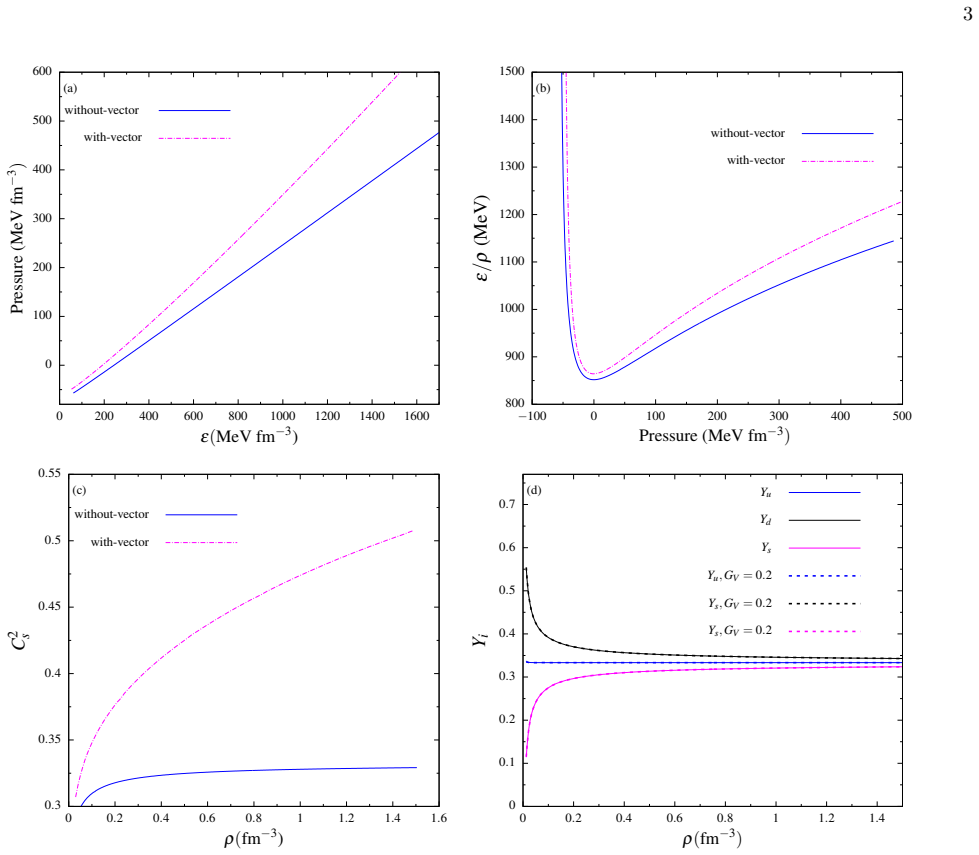
- [Sec. III B] The sentence 'the value of free energy density must vanish at zero pressure' is imprecise; Eq. (1) implies that the derivative of f/rho with respect to rho vanishes at zero pressure, not that f/rho itself vanishes. Please rephrase.
- [Fig. 1(d) and Fig. 3] The legends in the particle-fraction plots appear to repeat some entries (e.g., 'Ys, GV = 0.2' appears twice in Fig. 1(d)), which makes the figure difficult to read. Please correct the legends.
- [Abstract and Sec. III B] The statement that the M-R and M-Lambda diagrams are 'consistent with the observational constraints' should specify that this holds when vector interactions are included; the no-vector case does not satisfy all constraints, as noted in the text.
- [Throughout] There are numerous typographical errors and misspellings, such as 'desnity', 'wich', 'extremly', 'reprents', 'modifed', and 'tempearture'. A careful proofreading pass is needed.
Circularity Check
The 'no counterterm' self-consistency claim is built into the definition of ρ; astrophysical constraints remain an independent (though phenomenological) check.
-
self definitional
[Sec. II, Eqs. (14)-(16), with the consistency checks reported in Figs. 1(b), 2(b)/(f), 5(b)/(f)]
"The quark number densities are given by ρi = −∂Ωi/∂μi = γi/2π²∫k²[f+i − f−i]dk − m∗i ∂m∗i/∂μi γi/2π²∫k²/√(k²+(m∗i)²)[f+i + f−i]dk. The density of each flavor is modified due to the chemical potential-dependent quark mass."
Eq. (14) defines the number density as −∂Ω/∂μ, so the m*∂m*/∂μ contribution that earlier quasiparticle treatments canceled with a counterterm is absorbed into ρ. The pressure is set to P = −Ω (Eq. 15) and the energy density is built from Euler's relation (Eq. 7) as ε = −P + Σρiμi + Ts, giving Eq. (16). The 'thermodynamic consistency' checks displayed in the figures—minimum of ε/ρ or f/ρ at zero pressure—are algebraic identities of these definitions via P = ρ²∂(f/ρ)/∂ρ, so the no-counterterm conclusion is enforced by construction rather than tested. The M-R and tidal-deformability comparisons are independent external checks, but the central formal claim reduces to the chosen definition of density.
full rationale
The paper's main formal result, that no counterterm is needed for thermodynamic consistency when m* depends on μ, is achieved in Eq. (14) by taking ρi = −∂Ωi/∂μi. This automatically includes the mass-derivative term, so the counterterm is unnecessary by construction; the subsequent stability plots (ε/ρ or f/ρ minima at P=0) follow from Euler's relation and P=−Ω and are therefore tautological checks. I therefore flag one self-definitional step. The astrophysical M-R and M-Λ results are not circular in the same way: the parameters g0, αμ, B0, GV are chosen from stability criteria and prior phenomenological practice, not fitted to the PSR J0740+6620 or GW170817 data, and the agreement is an external comparison. The self-citation to Ref. [33] provides the grand-canonical framework but is not the sole support, since the density relation is re-derived in the text. The effective mass and running-coupling ansatze (Eqs. 9-10) are adopted model inputs, not derived outputs, which weakens the first-principles status but does not constitute logical circularity. Overall, partial circularity centered on the no-counterterm claim: 6/10.
Assumptions & free parameters
free parameters (4)
- Bag constant B0 =
58 MeV fm^-3 without vector; 50 MeV fm^-3 with vector
- Effective coupling g0 =
1.0
- Coupling exponent alpha_mu =
20.0
- Vector coupling GV =
0.2 fm^-2
assumptions (6)
- domain assumption A free Fermi gas partition function with a chemical potential-dependent quark mass is a valid starting point for quasiparticle thermodynamics.
- domain assumption The hard dense loop effective mass formula m*_i = m_i0/2 + sqrt(m_i0^2/4 + g_i^2 mu_i^2/(6 pi^2)) describes medium effects.
- domain assumption The running coupling ansatz g_i = g0 exp(-alpha_mu mu_i/mu0) is valid.
- standard math The vacuum contribution to the thermodynamic potential can be dropped.
- domain assumption The Bodmer-Witten stability criterion is the correct condition for fixing model parameters.
- domain assumption The vector meson mean-field approximation with mu*_i = mu_i - gV V0 and equation of motion m_V^2 V0 = sum gV rho_f is valid.
Cite this review
Pith. "Pith review of Self-consistent thermodynamical treatment for quark matter in quasi-particle model at finite temperature." pith.science (2026). https://pith.science/paper/7ELKJRS6
@misc{pith2026241110735,
  author       = {Pith},
  title        = {Pith review of: Self-consistent thermodynamical treatment for quark matter in quasi-particle model at finite temperature},
  year         = {2026},
  howpublished = {\url{https://pith.science/paper/7ELKJRS6}},
  note         = {Machine review of arXiv:2411.10735}
}
abstract
In this work, we have studied the medium effects in strange quark matter in the framework of a grand-canonical ensemble using the phenomenological quasi-particle model. This model is studied with proper self-consistent thermodynamical treatment by incorporating chemical potential-dependent quark mass. We have also included the vector interaction in a self-consistent way. The main aim of this work is to explore the proper thermodynamic treatment in addressing the medium effects at both zero and finite temperatures. In the case of the finite temperature, we explore the study of self-consistent thermodynamics in the isothermal as well as the isentropic processes. The effect of finite temperature and lepton fraction have been studied on the equation of state, speed of sound, and particle fraction. The $M-R$ and $M-\Lambda$ diagrams are found to be consistent with the observational constraints.
Figures


Figures from the paper (4 more)


Reference graph
Works this paper leans on
-
[1]
J. Antoniadis et al. , Science 340, 6131 (2013), arXiv:1304.6875 [astro-ph.HE]
arXiv 2013
-
[2]
E. Fonseca et al., Astrophys. J. Lett. 915, L12 (2021), arXiv:2104.00880 [astro-ph.HE]
arXiv 2021
-
[3]
T. E. Riley et al., Astrophys. J. Lett. 918, L27 (2021), arXiv:2105.06980 [astro-ph.HE]
arXiv 2021
-
[4]
M. C. Miller et al., Astrophys. J. Lett. 918, L28 (2021), arXiv:2105.06979 [astro-ph.HE]
arXiv 2021
-
[5]
T. E. Riley et al., Astrophys. J. Lett. 887, L21 (2019), arXiv:1912.05702 [astro-ph.HE]
arXiv 2019
-
[6]
B. P. Abbott et al. (LIGO Scientific, Virgo), Phys. Rev. Lett. 119, 161101 (2017), arXiv:1710.05832 [gr-qc]
arXiv 2017
- [7]
-
[8]
G. Baym, T. Hatsuda, T. Kojo, P. D. Powell, Y. Song, and T. Takatsuka, Rept. Prog. Phys. 81, 056902 (2018), arXiv:1707.04966 [astro-ph.HE]
arXiv 2018
Show all 53 references
-
[9]
Lovato et al., (2022), arXiv:2211.02224 [nucl-th]
A. Lovato et al., (2022), arXiv:2211.02224 [nucl-th]
2022 arXiv
-
[10]
Annala, T
E. Annala, T. Gorda, A. Kurkela, J. N¨ attil¨ a, and A. Vuorinen, Nature Phys. 16, 907 (2020), 10 0.5 1 1.5 2 2.5 8 9 10 11 12 13 14 15 16 (a) PSR J0740+6620 GW170817 M1 GW170817 M2 PSR J0030+0451 HESS J1731-347 GV = 0.2 fm−2 B0 = 50 MeV fm −3 50 100 150 200 250 300 350 400 1 ...
2020 arXiv
-
[11]
de Forcrand, PoS LA T2009, 010 (2009), arXiv:1005.0539 [hep-lat]
P. de Forcrand, PoS LA T2009, 010 (2009), arXiv:1005.0539 [hep-lat]
2009 arXiv
-
[12]
Kurkela, P
A. Kurkela, P. Romatschke, and A. Vuorinen, Phys. Rev. D 81, 105021 (2010), arXiv:0912.1856 [hep-ph]
2010 arXiv
-
[13]
Farhi and R
E. Farhi and R. L. Jaffe, Phys. Rev. D 30, 2379 (1984)
1984
-
[14]
Torres and D
J. Torres and D. Menezes, Europhysics Letters 101, 42003 (2013)
2013
-
[15]
E. J. Ferrer, V. de la Incera, and L. Paulucci, Phys. Rev. D 92, 043010 (2015)
2015
-
[16]
Bhattacharyya, I
A. Bhattacharyya, I. N. Mishustin, and W. Greiner, J. Phys. G 37, 025201 (2010), arXiv:0905.0352 [nucl-th]
2010 arXiv
-
[17]
S. Han, M. A. A. Mamun, S. Lalit, C. Constantinou, and M. Prakash, Phys. Rev. D 100, 103022 (2019), arXiv:1906.04095 [astro-ph.HE]
2019 arXiv
-
[18]
Ferreira, R
M. Ferreira, R. Cˆ amara Pereira, and C. Providˆ encia, Phys. Rev. D 101, 123030 (2020), arXiv:2005.10543 [nucl-th]
2020 arXiv
-
[19]
D. Sen, N. Alam, and G. Chaudhuri, Phys. Rev. D 106, 083008 (2022), arXiv:2209.13890 [nucl-th]
2022 arXiv
-
[20]
S. Pal, S. Podder, D. Sen, and G. Chaudhuri, Phys. Rev. D 107, 063019 (2023)
2023
-
[21]
Chodos, R
A. Chodos, R. L. Jaffe, K. Johnson, C. B. Thorn, and V. F. Weisskopf, Phys. Rev. D 9, 3471 (1974)
1974
-
[22]
Glendenning, Compact Stars: Nuclear Physics, Par- ticle Physics and General Relativity, Astronomy and As- trophysics Library (Springer New York, 2012)
N. Glendenning, Compact Stars: Nuclear Physics, Par- ticle Physics and General Relativity, Astronomy and As- trophysics Library (Springer New York, 2012)
2012
-
[23]
D. Sen, N. Alam, and G. Chaudhuri, J. Phys. G 48, 105201 (2021), arXiv:2107.08971 [nucl-th]
2021 arXiv
-
[24]
Podder, S
S. Podder, S. Pal, D. Sen, and G. Chaudhuri, Nucl. Phys. A 1042, 122796 (2024), arXiv:2311.08962 [nucl-th]
2024 arXiv
-
[25]
Zhang, P.-C
Z. Zhang, P.-C. Chu, X.-H. Li, H. Liu, and X.-M. Zhang, Phys. Rev. D 103, 103021 (2021)
2021
-
[26]
Chu, X.-H
P.-C. Chu, X.-H. Li, H. Liu, M. Ju, and Y. Zhou, Phys. Rev. C 108, 025808 (2023)
2023
-
[27]
Ma, Z.-Y
Z.-J. Ma, Z.-Y. Lu, J.-F. Xu, G.-X. Peng, X. Fu, and J. Wang, Phys. Rev. D 108, 054017 (2023)
2023
-
[28]
G. X. Peng, H. C. Chiang, J. J. Yang, L. Li, and B. Liu, Phys. Rev. C 61, 015201 (1999)
1999
-
[29]
X. J. Wen, X. H. Zhong, G. X. Peng, P. N. Shen, and P. Z. Ning, Phys. Rev. C 72, 015204 (2005)
2005
-
[30]
Chu and L.-W
P.-C. Chu and L.-W. Chen, The Astrophysical Journal 780, 135 (2013)
2013
-
[31]
O. G. Benvenuto and G. Lugones, Phys. Rev. D 51, 1989 (1995)
1995
-
[32]
Lugones and A
G. Lugones and A. G. Grunfeld, Phys. Rev. D 107, 043025 (2023)
2023
-
[33]
Pal and G
S. Pal and G. Chaudhuri, Phys. Rev. D 108, 103028 (2023)
2023
-
[34]
Chu, Y.-Y
P.-C. Chu, Y.-Y. Jiang, H. Liu, Z. Zhang, X.-M. Zhang, and X.-H. Li, Eur. Phys. J. C 81, 569 (2021)
2021
-
[35]
Schertler, C
K. Schertler, C. Greiner, and M. H. Thoma, Nucl. Phys. A 616, 659 (1997), arXiv:hep-ph/9611305
1997 arXiv
-
[36]
Chu, Y.-N
P.-C. Chu, Y.-N. Wang, X.-H. Li, H. Liu, and J.-W. Zhang, Phys. Rev. C 105, 045806 (2022)
2022
-
[37]
P.-C. Chu, Y. Zhou, X.-H. Li, and Z. Zhang, Phys. Rev. D 100, 103012 (2019)
2019
-
[38]
J. I. Kapusta and C. Gale, Finite-Temperature Field The- ory, Cambridge Monographs on Mathematical Physics (Cambridge University Press, 2023)
2023
-
[39]
Dexheimer, J
V. Dexheimer, J. R. Torres, and D. P. Menezes, Eur. Phys. J. C 73, 2569 (2013), arXiv:1303.5102 [astro- ph.HE]
2013 arXiv
-
[40]
J. W. Negele and E. Vogt, eds., Advances in nuclear physics. Vol. 16(1986). 11
1986
-
[41]
M. Ju, J. Hu, and H. Shen, The Astrophysical Journal 923, 250 (2021)
2021
-
[42]
P. D. Group, Progress of Theoretical and Experimental Physics 2020, 083C01 (2020), https://academic.oup.com/ptep/article- pdf/2020/8/083C01/34673722/ptaa104.pdf
2020
-
[43]
Prakash, I
M. Prakash, I. Bombaci, M. Prakash, P. J. Ellis, J. M. Lattimer, and R. Knorren, Phys. Rept. 280, 1 (1997), arXiv:nucl-th/9603042
1997 arXiv
- [44]
-
[45]
A. W. Steiner, M. Prakash, and J. M. Lattimer, Phys. Lett. B 509, 10 (2001), arXiv:astro-ph/0101566
2001 arXiv
-
[46]
L. L. Lopes, C. Biesdorf, K. D. Marquez, and D. P. Menezes, Phys. Scripta 96, 065302 (2021), arXiv:2009.13552 [hep-ph]
2021 arXiv
-
[47]
Goussard, P
J.-O. Goussard, P. Haensel, and J. L. Zdunik, Astron. Astrophys. 321, 822 (1997), arXiv:astro-ph/9610265
1997 arXiv
-
[48]
Sandin and D
F. Sandin and D. Blaschke, Phys. Rev. D 75, 125013 (2007), arXiv:astro-ph/0701772
2007 arXiv
-
[49]
Chu and L.-W
P.-C. Chu and L.-W. Chen, Phys. Rev. D 96, 103001 (2017), arXiv:1708.03428 [nucl-th]
2017 arXiv
-
[50]
Chu, X.-H
P.-C. Chu, X.-H. Li, H.-Y. Ma, B. Wang, Y.-M. Dong, and X.-M. Zhang, Phys. Lett. B 778, 447 (2018)
2018
-
[51]
M. C. Miller et al., Astrophys. J. Lett. 887, L24 (2019), arXiv:1912.05705 [astro-ph.HE]
2019 arXiv
-
[52]
Doroshenko, V
V. Doroshenko, V. Suleimanov, G. P¨ uhlhofer, and A. Santangelo, Nature Astronomy 6, 1444 (2022)
2022
-
[53]
B. P. Abbott et al. (LIGO Scientific, Virgo), Phys. Rev. Lett. 121, 161101 (2018), arXiv:1805.11581 [gr-qc]
2018 arXiv
Reviewed August 12, 2026 · model on record in the stance chip above.
Discussion (0). Continue with ORCID to comment.