REVIEW 4 major objections 4 minor 44 references
Charmonium hybrids, built from a charm-anticharm pair plus a transverse-electric gluon, are predicted to form a four-state multiplet at 4.19–4.32 GeV with measurably distinct decay signatures.
Reviewed by Pith at T0; open to challenge. T0 means a machine referee read the full paper against a public rubric. the ladder, T0–T4 →
T0 review · deepseek-v4-flash
2026-08-02 23:05 UTC pith:7ETUAUPL
load-bearing objection A useful decay analysis sitting on a mass calculation that uses a different gluon wave function than the decays—needs a consistent recalculation before the search targets can be trusted. the 4 major comments →
Revisiting charmonium hybrid spectroscopy
The pith
A machine-rendered reading of the paper's core claim, the machinery that carries it, and where it could break.
Core claim
The paper's central claim is that the four lowest charmonium hybrid states form a well-separated multiplet in a narrow window around 4.2–4.3 GeV, and that their decay modes are controlled by one robust selection rule rather than by the details of the potential. Treating the hybrid as a c cbar g three-body system with the gluon in the transverse-electric (TE) mode, the authors obtain masses m(0^-+)=4.189 GeV, m(1^-+)=4.231 GeV, m(1^--)=4.276 GeV, and m(2^-+)=4.316 GeV. For decays, the TE gluon imposes that the transition amplitude contains a p-wave factor Y_{1,m}(k-hat) that is odd under k -> -k; two mesons with identical spatial wave functions give an even integrand, so the amplitude vanishe
What carries the argument
The central object is the constituent gluon as a transverse-electric (TE) mode with total gluon angular momentum j_g = 1. In the spectrum calculation, the hybrid is a nonrelativistic three-body system with flux-tube linear confinement between the gluon and each heavy quark plus one-gluon exchange between the charm pair; the ground state is solved variationally with a Gaussian trial wave function in Jacobi coordinates, with the gluon orbital restricted to l_lambda = 0. Spin-dependent terms split the four J^PC states. For decays, the same TE gluon is described by the angular wave function of Eq. (1), and the quark-gluon interaction generates the factor Y_{1,m_l}(k-hat) in the decay amplitude,
Load-bearing premise
The spectrum is computed with the gluon in an s-wave orbital (l_lambda = 0), but the decay amplitudes put the gluon in a p-wave (l_lambda = 1); if the gluon's orbital is consistently p-wave, the variational masses shift and the near-threshold width predictions change.
What would settle it
Compute the 1^-- hybrid mass with a p-wave gluon trial state (l_lambda = 1) and the same Hamiltonian; if the mass moves above the D D1 threshold by more than about 25 MeV, the width becomes several tens of MeV even at the nominal mass and the predicted threshold-sensitive decay pattern fails. Alternatively, a confirmed D Dbar signal from a resonance near 4.23 GeV in e+e- collisions would directly contradict the paper's claim that a TE-gluon 1^-- hybrid cannot decay to D Dbar.
If this is right
- The 0^-+ and 1^-+ charmonium hybrids should appear as narrow resonances in the 4.19–4.24 GeV range; the 1^-+ has exotic quantum numbers, so its observation would be unambiguous evidence of a gluonic excitation.
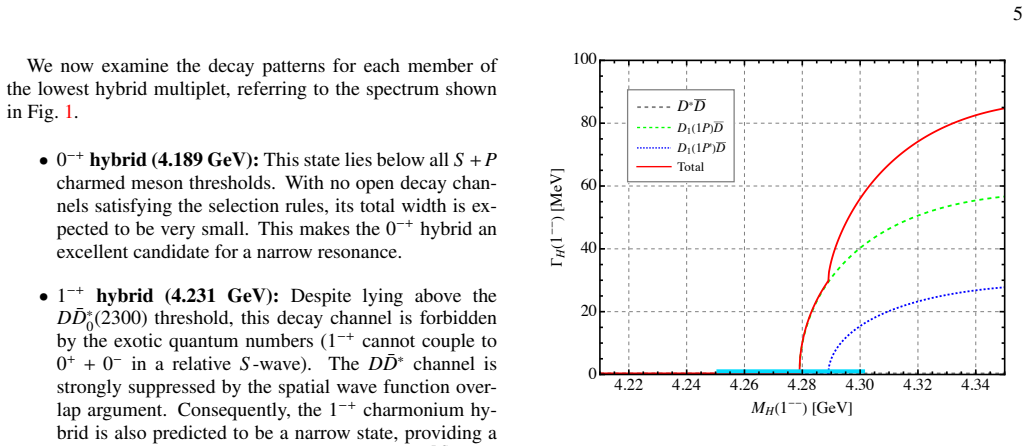
- The 1^-- hybrid, once above the D D1(2420) threshold, should decay dominantly to D D1 with a width of tens of MeV that rises steeply with mass; below threshold, an off-shell D D1 -> D D* pi chain is the expected signature.
- The 2^-+ hybrid should be seen in D D2*(2460) and in rescattering channels such as J/psi omega and J/psi phi, with a strong threshold sensitivity near 4.32 GeV.
- C=+1 hybrids ((0,1,2)^-+) are produced in quarkonium annihilation (e.g., Upsilon -> gamma + hybrid), while the 1^-- hybrid can be searched for in e+e- annihilation; the predicted suppression of D Dbar decays provides a discriminating test against conventional charmonium.
- Y(4230) cannot be a pure 1^-- TE hybrid because the data show D Dbar decays and h_c pi pi rates that violate the predicted selection rules and heavy-quark spin symmetry; mixing with conventional charmonium is the natural repair.
Where Pith is reading between the lines
- Editorial inference: the same selection rule used for open-charm decays should suppress hidden-charm decays into identical S-wave charmed meson pairs as well; a visible e+e- -> D* Dbar* rate near 4.28 GeV would point to a non-TE component.
- Editorial inference: the model's parameters are fixed by conventional charmonium, so an independent lattice QCD calculation of this multiplet would either confirm or displace the 4.19–4.32 GeV window without relying on the variational l_lambda = 0 assumption.
- Editorial inference: if the gluon's p-wave orbital is used consistently in both spectrum and decay, the masses likely shift upward by the p-wave kinetic energy; the qualitative selection rule survives, but the threshold alignments for the 1^-- and 2^-+ states are the most fragile part of the phenomenology.
- Editorial inference: the predicted narrowness of the exotic 1^-+ makes it a high-priority discovery channel, and a search for a narrow 1^-+ resonance in hidden-charm final states at high-luminosity colliders could confirm or exclude the model with modest data.
Editorial analysis
A structured set of objections, weighed in public.
Referee Report
Summary. The paper constructs a constituent-gluon model of charmonium hybrids, treating the hybrid as a c-cbar-g three-body system with a transverse electric (TE) gluon. Using a variational Gaussian wave function, it predicts the lightest hybrid multiplet masses as 4.189 GeV (0^-+), 4.231 GeV (1^-+), 4.276 GeV (1^--), and 4.316 GeV (2^-+), all inside 4.19-4.32 GeV. It then derives a selection rule forbidding decays into two mesons with identical spatial wave functions, computes open-charm widths, and identifies dominant decay modes: 1^-- -> D D1(2420) and 2^-+ -> D D2*(2460), with 0^-+ and 1^-+ narrow. It also discusses production in e+e- annihilation and Upsilon decays, and candidly notes tensions between a pure hybrid interpretation of Y(4230) and recent BESIII data.
Significance. If the results hold, the paper provides a useful, phenomenologically concrete map of charmonium hybrids in the 4.2-4.3 GeV region, with explicit decay signatures that could guide searches at BESIII, Belle II, and future facilities. The analytic derivation of the selection rule and the honest treatment of Y(4230) tensions are strengths. However, the central mass predictions and the decay amplitudes rely on different angular-momentum assignments for the same lambda-mode, so the quantitative conclusions are not yet reliable.
major comments (4)
- [Sec. II B, Eq. (9) vs. Sec. III B, Eq. (25) and wave function] The mass spectrum is computed with a trial wave function restricted to l_lambda=0 (Eq. (9)), explicitly 'to preserve the constituent gluon's 1^+- assignment.' The decay calculation, however, uses a hybrid wave function proportional to p_lambda Y_{1,m_lg}(p_hat_lambda) and a decay amplitude containing Y_{1,m_lg}(k_hat) (Eq. (25) and Sec. III B). These are mutually inconsistent descriptions of the same lambda-mode. If the physical state has l_lambda=1, the Hamiltonian (8) should contain the corresponding centrifugal term, and the kinetic energy is larger by approximately beta_lambda^2/(2 m_lambda) ~ 0.25 GeV for the quoted beta_lambda=0.625 GeV and m_lambda=0.78 GeV. This is more than half the spread of the predicted multiplet and is comparable to the mass differences from the D D1 and D D2* thresholds on which Figs. 2 and 3 and the 'threshold-sensitive width' predictions rest. Please eith
- [Sec. II B, variational bound] Eq. (9) is a variational trial function for l_lambda=0; if the state used in decays has l_lambda=1, the quoted masses are not variational upper bounds for that state. The paper gives no error bars or variational sensitivity study. Since the 1^-- and 2^-+ widths change by tens of MeV when the mass moves by a few tens of MeV (Figs. 2 and 3), the unquantified uncertainty in the mass calculation is load-bearing. A recomputation with l_lambda=1 and an explicit uncertainty estimate is required before the threshold-proximity claims can be assessed.
- [Figs. 2 and 3 and Sec. III B] The papers states 'the shaded band indicates ±25 MeV theoretical uncertainty around our nominal value,' but no derivation or error propagation from the parameters in Table II is provided. The widths plotted vary from near zero to tens of MeV over this band, so the band is not a cosmetic addition. Please explain the origin of ±25 MeV (e.g., parameter variations, wave-function uncertainties) and show how the central masses and widths shift under a consistent l_lambda choice.
- [Table I and Sec. II A] The quantum-number assignments in Table I assume l_cbar c=0, S_cbar c=1, and an unexcited lambda-mode. If the decay analysis requires l_lambda=1, the total J^PC content of the multiplet must be rederived; the states listed may be different or additional states may appear. The paper should present the full angular-momentum coupling for both l_lambda=0 and l_lambda=1 and show explicitly which states are being computed and which are being decayed.
minor comments (4)
- [Sec. III B, wave function] The displayed expression for the hybrid momentum-space wave function has unclear exponents ('beta^{2/3}_rho pi^{1/4}' versus the normalization in Eq. (20)); please check and clarify the notation.
- [Appendix A, Eq. (A3)] In the TM gluon expression, the second term appears to contain 'epsilon(-1,n)' twice; one factor should likely be 'epsilon(1,n)'. Please correct the typo.
- [Eq. (10)-(13)] The spin-dependent shifts use the same wave function psi_H from Eq. (9). If the lambda-mode angular momentum is changed, the matrix elements epsilon and zeta (Eqs. (14) and (15)) must be re-evaluated; a brief statement to this effect would help avoid confusion.
- [Acknowledgments] The acknowledgment of the National Natural Science Foundation contains a typo: 'Nation Natural Science Foundation.' Also, Ref. [17] appears to have an incomplete page/volume field; please check the bibliography.
Circularity Check
No significant circularity: masses and decay signatures follow from a Hamiltonian calibrated to conventional charmonium [19], are not fitted to Y(4230) (whose contradictions the paper reports honestly), and the only self-citation (Ref. [32]) is provenance, not load-bearing; the flagged l_λ=0 vs l_λ=1 issue is a correctness risk, not a circular reduction.
full rationale
The derivation chain is self-contained apart from one minor self-citation, and no prediction reduces to its inputs by construction. The model parameters (Table II) are 'standard values in the literature for heavy quark systems, chosen to reproduce the known charmonium spectrum [19]' — an external calibration, not a fit to the hybrid multiplet being predicted. The masses 4.189–4.316 GeV are obtained by variational solution of the displayed Hamiltonian (Eqs. 5–15), and the paper does not tune them to an experimental state: Sec. IV.A reports BESIII's e+e-→DDbar observation as 'contradict(ing) the predicted vanishing width for a TE hybrid decaying into DDbar' and cites Eq. (28) as challenging the pure Y(4230)-hybrid assignment, which is non-circular, honest reporting. The decay selection rule is derived in-text from Eqs. (23)–(25) and cross-anchored to external Refs. [25,26]; αs=0.5 is an acknowledged free parameter that scales overall widths without setting the qualitative branching pattern, and the ±25 MeV bands in Figs. 2–3 are acknowledged ad hoc uncertainty rather than propagated model error. The only overlapping-author citation in the chain is Ref. [32] (B. Chen and X. Liu, present authors), used for the three-body Hamiltonian ('Following our previous work [32], the non-relativistic Hamiltonian...') and the Salpeter meson β parameters (Table III). Because the Hamiltonian is reproduced in full in the text and is anchored externally (flux tube [19,27], constituent gluon [30,31], TE J^PC=1^+- gluon from bag model [33] and lattice [34,35]), the self-citation is provenance, not a load-bearing justification — the 'one minor self-citation' band (score 2). The skeptic's flagged defect is genuine but is an internal-consistency flaw, not circularity: Eq. (9) restricts the λ-mode to 'the ground state ... (lλ=0)' 'to preserve the constituent gluon's 1^+- assignment', while Eq. (25) (Y_{1,m_lg}(k̂), 'the angular distribution of the constituent gluon') and the decay wave function ψ ∝ pλY_{1,m_lg}(p̂λ) require lλ=1; the resulting inconsistent treatment of the p-wave centrifugal term could shift the mass window on which the threshold-sensitive 1^-- and 2^-+ width predictions (Figs. 2–3) rest. Per the reviewing rules, this missing-support/internal-consistency concern is weighed as correctness risk, not circularity, so it does not raise the circularity score beyond the minor-self-citation value.
Axiom & Free-Parameter Ledger
free parameters (12)
- mc (constituent charm mass) =
1.52 GeV
- mg (constituent gluon mass) =
1.05 GeV
- alpha_s (spectrum) =
0.28
- b (string tension) =
0.132 GeV^2
- c_H (zero-point energy) =
0.58 GeV
- sigma (smearing width) =
1.30 GeV
- alpha_s (decay) =
0.5
- beta_rho (hybrid oscillator parameter) =
0.432 GeV
- beta_lambda (hybrid oscillator parameter) =
0.625 GeV
- beta_D =
0.574 GeV
- beta_D* =
0.496 GeV
- beta_D(1P) =
0.385 GeV
axioms (6)
- domain assumption A hybrid meson is a ccbar-g three-body system; the gluonic excitation is a single massive bead (single-bead flux-tube limit equals constituent gluon).
- domain assumption The lowest gluonic excitation is a transverse-electric (TE) mode with jg=1, J^PC=1^+-; parity/charge-conjugation rules follow Eqs. (3)-(4).
- domain assumption The non-relativistic Hamiltonian of Eq. (5) with a linear flux-tube potential (Eq. 6), smeared one-gluon exchange (Eq. 7), and perturbative spin-spin terms describes the hybrid.
- ad hoc to paper The trial wave function, a product of two Gaussians in rho and lambda (Eq. 9) with the lambda-mode restricted to l_lambda=0, adequately represents the hybrid ground state.
- domain assumption A jg=1 TE hybrid cannot decay into two mesons with identical spatial wave functions; D and D* are similar enough that DD* is strongly suppressed.
- domain assumption Heavy-quark spin symmetry: in hidden-charm decays the ccbar pair must keep S_cc=1 and the final charmonium must have the same C-parity as the hybrid.
invented entities (1)
-
Constituent gluon (massive, spin-1, color-octet quasi-particle with mg=1.05 GeV)
independent evidence
read the original abstract
Hadrons with explicit gluonic degrees of freedom, such as charmonium hybrids, are key to understanding nonperturbative behavior of strong interaction, yet they remain experimentally elusive. Within a constituent gluon model treating the hybrid as a $c\bar{c}g$ three-body system with a transverse electric gluon, we predict the masses of the lightest hybrid multiplet ($J^{PC}=1^{--}, 0^{-+}, 1^{-+}, 2^{-+}$) to lie in the range $4.19$--$4.32$ GeV. By analyzing their decay patterns, we provide specific, experimentally testable signatures to guide the search for these exotic states at current and future facilities.
Figures



Reference graph
Works this paper leans on
-
[1]
Aoyagiet al., Study of theηπ − system in theπ− preaction at 6.3 GeV/c, Phys
H. Aoyagiet al., Study of theηπ − system in theπ− preaction at 6.3 GeV/c, Phys. Lett. B314, 246 (1993)
1993
-
[2]
D. R. Thompsonet al.(E852), Evidence for exotic meson pro- duction in the reactionπ − p→ηπ − pat 18 GeV/c, Phys. Rev. Lett.79, 1630 (1997), arXiv:hep-ex/9705011
Pith/arXiv arXiv 1997
-
[3]
G. S. Adamset al.(E852), Observation of a newJ PC =1 −+ exotic state in the reactionπ− p→π +π−π− pat 18 GeV/c, Phys. Rev. Lett.81, 5760 (1998)
1998
-
[4]
Abeleet al.(Crystal Barrel), Exoticηπstate in ¯pdanni- hilation at rest intoπ −π0ηp(spectator), Phys
A. Abeleet al.(Crystal Barrel), Exoticηπstate in ¯pdanni- hilation at rest intoπ −π0ηp(spectator), Phys. Lett. B423, 175 (1998)
1998
-
[5]
Aldeet al.(IHEP-IISN-LANL-LAPP), Evidence for a 1 −+ Exotic Meson, Phys
D. Aldeet al.(IHEP-IISN-LANL-LAPP), Evidence for a 1 −+ Exotic Meson, Phys. Lett. B205, 397 (1988)
1988
-
[6]
Y . A. Khokhlov (VES), Study ofX(1600) 1 −+ hybrid, Nucl. Phys. A663, 596 (2000)
2000
-
[7]
Dorofeevet al.(VES), TheJ PC =1 −+ hunting season at VES, AIP Conf
V . Dorofeevet al.(VES), TheJ PC =1 −+ hunting season at VES, AIP Conf. Proc.619, 143 (2002), arXiv:hep-ex/0110075
Pith/arXiv arXiv 2002
-
[8]
C. A. Bakeret al., Confirmation ofa 0(1450) andπ 1(1600) in ¯pp→ωπ +π−π0 at rest, Phys. Lett. B563, 140 (2003)
2003
-
[9]
M. Alekseevet al.(COMPASS), Observation of aJ PC = 1−+ exotic resonance in diffractive dissociation of 190 GeV/c π− intoπ −π−π+, Phys. Rev. Lett.104, 241803 (2010), arXiv:0910.5842 [hep-ex]
Pith/arXiv arXiv 2010
-
[10]
G. S. Adamset al.(CLEO), Amplitude analyses of the decays χc1 →ηπ +π− andχ c1 →η ′π+π−, Phys. Rev. D84, 112009 (2011), arXiv:1109.5843 [hep-ex]
Pith/arXiv arXiv 2011
-
[11]
Rodaset al.(JPAC), Determination of the pole position of the lightest hybrid meson candidate, Phys
A. Rodaset al.(JPAC), Determination of the pole position of the lightest hybrid meson candidate, Phys. Rev. Lett.122, 042002 (2019), arXiv:1810.04171 [hep-ph]
Pith/arXiv arXiv 2019
-
[12]
M. Albrechtet al.(Crystal Barrel), Coupled channel anal- ysis of ¯pp→π 0π0η,π 0ηηandK +K−π0 at 900 MeV/c and ofππ-scattering data, Eur. Phys. J. C80, 453 (2020), arXiv:1909.07091 [hep-ex]
Pith/arXiv arXiv 2020
-
[13]
J. Kuhnet al.(E852), Exotic meson production in the f1(1285)π− system observed in the reactionπ − p→ηπ +π−π− p at 18 GeV/c, Phys. Lett. B595, 109 (2004), arXiv:hep- ex/0401004
arXiv 2004
-
[14]
Luet al.(E852), Exotic meson decay toωπ 0π−, Phys
M. Luet al.(E852), Exotic meson decay toωπ 0π−, Phys. Rev. Lett.94, 032002 (2005), arXiv:hep-ex/0405044
Pith/arXiv arXiv 2005
-
[15]
Ablikimet al.(BESIII), Partial wave analysis ofJ/ψ→ γηη′, Phys
M. Ablikimet al.(BESIII), Partial wave analysis ofJ/ψ→ γηη′, Phys. Rev. D106, 072012 (2022), [Erratum: Phys.Rev.D 107, 079901 (2023)], arXiv:2202.00623 [hep-ex]
arXiv 2022
-
[16]
M. Ablikimet al.(BESIII), Observation of an Isoscalar Resonance with ExoticJ PC =1 −+ Quantum Numbers in J/ψ→γηη ′, Phys. Rev. Lett.129, 192002 (2022), [Erratum: Phys.Rev.Lett. 130, 159901 (2023)], arXiv:2202.00621 [hep- ex]
arXiv 2022
-
[17]
F.-Y . Zhang, Q. Huang, and L.-M. Wang, Spectral analysis and decay mechanisms of 1−+ hybrid states in light meson sector, Phys. Rev. D113, 014002 (2026), arXiv:2503.01443 [hep-ph]
Pith/arXiv arXiv 2026
-
[18]
Z.-X. Ma, Q. Huang, R. Chen, L.-M. Wang, Y . Tan, X.-H. Hu, J. He, and H.-X. Huang, Proper constituent gluon mass as the final piece to construct hybrid mesons, Phys. Rev. D112, L111503 (2025), arXiv:2504.05818 [hep-ph]
Pith/arXiv arXiv 2025
-
[19]
T. Barnes, F. E. Close, and E. S. Swanson, Hybrid and conven- tional mesons in the flux tube model: Numerical studies and their phenomenological implications, Phys. Rev. D52, 5242 (1995), arXiv:hep-ph/9501405
Pith/arXiv arXiv 1995
-
[20]
Zhu, Masses and decay widths of heavy hybrid mesons, Phys
S.-L. Zhu, Masses and decay widths of heavy hybrid mesons, Phys. Rev. D60, 014008 (1999), arXiv:hep-ph/9812405. 10
Pith/arXiv arXiv 1999
-
[21]
Y . S. Kalashnikova and A. V . Nefediev, Spectra and de- cays of hybrid charmonia, Phys. Rev. D77, 054025 (2008), arXiv:0801.2036 [hep-ph]
Pith/arXiv arXiv 2008
-
[22]
W. Chen, R. T. Kleiv, T. G. Steele, B. Bulthuis, D. Harnett, J. Ho, T. Richards, and S.-L. Zhu, Mass Spectrum of Heavy Quarkonium Hybrids, JHEP09, 019, arXiv:1304.4522 [hep- ph]
-
[23]
Y . S. Kalashnikova and A. V . Nefediev, QCD string in excited heavy-light mesons and heavy-quark hybrids, Phys. Rev. D94, 114007 (2016), arXiv:1611.10066 [hep-ph]
Pith/arXiv arXiv 2016
-
[24]
R. Oncala and J. Soto, Heavy Quarkonium Hybrids: Spec- trum, Decay and Mixing, Phys. Rev. D96, 014004 (2017), arXiv:1702.03900 [hep-ph]
Pith/arXiv arXiv 2017
-
[25]
C. Farina, H. Garcia Tecocoatzi, A. Giachino, E. Santopinto, and E. S. Swanson, Heavy hybrid decays in a constituent gluon model, Phys. Rev. D102, 014023 (2020), arXiv:2005.10850 [hep-ph]
Pith/arXiv arXiv 2020
-
[26]
P. R. Page, Why hybrid meson coupling to twoS-wave mesons is suppressed, Phys. Lett. B402, 183 (1997), arXiv:hep- ph/9611375
arXiv 1997
-
[27]
Isgur and J
N. Isgur and J. E. Paton, A Flux Tube Model for Hadrons in QCD, Phys. Rev. D31, 2910 (1985)
1985
-
[28]
F. E. Close and P. R. Page, The Production and decay of hybrid mesons by flux tube breaking, Nucl. Phys. B443, 233 (1995), arXiv:hep-ph/9411301
Pith/arXiv arXiv 1995
-
[29]
Y . S. Kalashnikova and D. S. Kuzmenko, Hybrid adiabatic po- tentials in the QCD string model, Phys. Atom. Nucl.66, 955 (2003), arXiv:hep-ph/0203128
Pith/arXiv arXiv 2003
-
[30]
Horn and J
D. Horn and J. Mandula, A Model of Mesons with Constituent Gluons, Phys. Rev. D17, 898 (1978)
1978
-
[31]
E. S. Swanson and A. P. Szczepaniak, Heavy hybrids with con- stituent gluons, Phys. Rev. D59, 014035 (1999), arXiv:hep- ph/9804219
arXiv 1999
-
[32]
B. Chen and X. Liu, Investigating hybrid mesons with 0 +− and 2+− exotic quantum numbers, Eur. Phys. J. C85, 788 (2025), arXiv:2503.06116 [hep-ph]
Pith/arXiv arXiv 2025
-
[33]
Barnes, F
T. Barnes, F. E. Close, and F. de Viron, Q ¯QG Hermaphrodite Mesons in the MIT Bag Model, Nucl. Phys. B224, 241 (1983)
1983
-
[34]
L. Liu, G. Moir, M. Peardon, S. M. Ryan, C. E. Thomas, P. Vi- laseca, J. J. Dudek, R. G. Edwards, B. Joo, and D. G. Richards (Hadron Spectrum), Excited and exotic charmonium spec- troscopy from lattice QCD, JHEP07, 126, arXiv:1204.5425 [hep-ph]
-
[35]
G. K. C. Cheung, C. O’Hara, G. Moir, M. Peardon, S. M. Ryan, C. E. Thomas, and D. Tims (Hadron Spectrum), Excited and ex- otic charmonium,D s andDmeson spectra for two light quark masses from lattice QCD, JHEP12, 089, arXiv:1610.01073 [hep-lat]
-
[36]
K. J. Juge, J. Kuti, and C. Morningstar, Fine structure of the QCD string spectrum, Phys. Rev. Lett.90, 161601 (2003), arXiv:hep-lat/0207004
Pith/arXiv arXiv 2003
-
[37]
F. E. Close and S. Godfrey, Charmonium hybrid production in exclusive B meson decays, Phys. Lett. B574, 210 (2003), arXiv:hep-ph/0305285
Pith/arXiv arXiv 2003
-
[38]
Zhu, The Possible interpretations ofY(4260), Phys
S.-L. Zhu, The Possible interpretations ofY(4260), Phys. Lett. B625, 212 (2005), arXiv:hep-ph/0507025
Pith/arXiv arXiv 2005
-
[39]
F. E. Close and P. R. Page, Gluonic charmonium resonances at BaBar and BELLE?, Phys. Lett. B628, 215 (2005), arXiv:hep- ph/0507199
arXiv 2005
-
[40]
Navaset al.(Particle Data Group), Review of particle physics, Phys
S. Navaset al.(Particle Data Group), Review of particle physics, Phys. Rev. D110, 030001 (2024)
2024
-
[41]
M. Ablikimet al.(BESIII), Precise Measurement of Born Cross Sections fore +e−→D ¯Dat √s=3.80−4.95 GeV, Phys. Rev. Lett.133, 081901 (2024), arXiv:2402.03829 [hep-ex]
arXiv 2024
-
[42]
Abeleet al.(Crystal Barrel), Evidence for aπηP wave in ¯pp annihilations at rest intoπ 0π0η, Phys
A. Abeleet al.(Crystal Barrel), Evidence for aπηP wave in ¯pp annihilations at rest intoπ 0π0η, Phys. Lett. B446, 349 (1999)
1999
-
[43]
D. A. Varshalovich, A. N. Moskalev, and V . K. Khersonskii,Quantum Theory of Angu- lar Momentum(WORLD SCIENTIFIC, 1988) https://www.worldscientific.com/doi/pdf/10.1142/0270
doi:10.1142/0270 1988
-
[44]
M. E. Peskin and D. V . Schroeder,An Introduction to quantum field theory(Addison-Wesley, Reading, USA, 1995)
1995
discussion (0)
Sign in with ORCID, Apple, or X to comment. Anyone can read and Pith papers without signing in.