Superradiant Interactions for Relic Detection with Entangled Nuclear Spins
Pith reviewed 2026-05-18 21:12 UTC · model grok-4.3
The pith
Macroscopic nuclear spin ensembles in coherent states enhance interaction rates with cosmic relics by a factor of N squared through collective superradiant effects.
A machine-rendered reading of the paper's core claim, the machinery that carries it, and where it could break.
Core claim
Macroscopic nuclear spin ensembles prepared in coherent spin states can dramatically enhance the interaction rates of weakly interacting cosmic relics such as dark matter and the cosmic neutrino background through collective quantum effects analogous to Dicke superradiance, where the de-excitation and excitation rates scale as the square of the number of spins, N squared. The protocol initializes the spins with a pi over 2 Rabi pulse and then uses a detuned spin-circuit interaction to implement a squeezing Hamiltonian that reduces standard quantum variance by up to 4.8 orders of magnitude for circuits with quality factors around 10 to the 8 or 9. The imprinted signal can be further magnified
What carries the argument
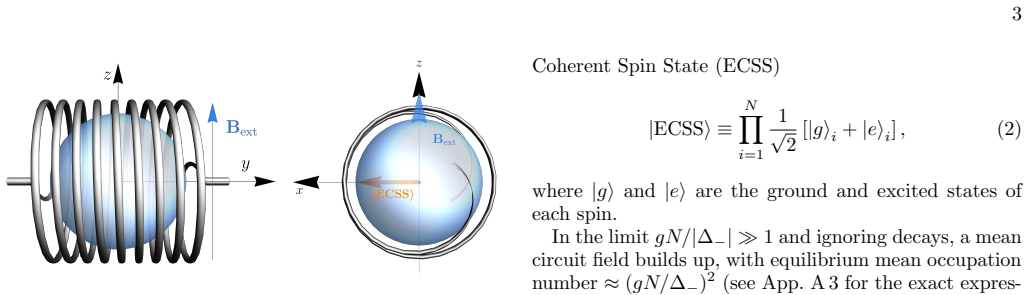
Superradiant interactions realized by initializing nuclear spins into a coherent spin state and then applying a detuned squeezing Hamiltonian through coupling to a superconducting circuit.
If this is right
- The protocol accelerates searches for axion and dark photon dark matter by increasing sensitivity.
- It extends the reach of existing axion experiments to probe QCD axion-nuclear spin couplings.
- It enables detection of coherent inelastic interactions from the cosmic neutrino background.
- It positions nuclear-spin-based systems as a new class of quantum ultra-low-threshold detectors.
Where Pith is reading between the lines
- Similar squeezing protocols could be tested first in smaller spin systems to verify the N-squared scaling before scaling to macroscopic ensembles.
- The approach may connect to other quantum sensing platforms that already use superconducting circuits for noise reduction.
- Success would imply that relic detection thresholds can be lowered further by combining multiple such ensembles in arrays.
Load-bearing premise
Squeezing must occur faster than spin relaxation and dephasing in the ensemble.
What would settle it
An experiment that measures interaction rates scaling quadratically rather than linearly with spin number N, or that achieves 48 dB of squeezing in the spin variance for quality factors near 10^9.
Figures
read the original abstract
We recently showed that macroscopic nuclear spin ensembles prepared in coherent spin states can dramatically enhance the interaction rates of weakly interacting cosmic relics-such as dark matter and the cosmic neutrino background-through collective quantum effects analogous to Dicke superradiance, where the de-excitation and excitation rates scale as the square of the number of spins, $N^2$. We thus coined these processes superradiant interactions. In this paper, we propose a protocol to realize this enhancement and boost the discovery potential for such relics. We show how concepts from quantum optics can be adapted to nuclear spins coupled to superconducting circuits, enabling high-sensitivity systems. The spins are first initialized into a coherent spin state via a $\pi/2$ Rabi pulse from the ground state. When the circuit is sufficiently detuned from resonance, the spin-circuit interaction implements a squeezing Hamiltonian. Because squeezing must outpace spin relaxation and dephasing, the protocol favors macroscopic ensembles and high-quality superconducting circuits. During this squeezing phase, the standard quantum variance is reduced by up to 4.8 orders of magnitude-equivalent to 48 dB of squeezing-for circuits with quality factors $Q \sim 10^8$-$10^9$. The signal imprinted on the spins during the squeezing protocol can be magnified by further utilizing the squeezing interactions, easing the requirement for shot-noise-limited readout. This protocol has the potential to significantly accelerate axion and dark photon dark matter searches and extend the reach of existing axion experiments to probe QCD axion-nuclear spin couplings. More broadly, it paves the way for detecting coherent inelastic interactions from other cosmic relics-most notably the cosmic neutrino background-and establishes nuclear-spin-based systems as a new class of quantum, ultra-low-threshold detectors.
Editorial analysis
A structured set of objections, weighed in public.
Referee Report
Summary. The manuscript proposes a protocol to enhance detection of weakly interacting cosmic relics (dark matter axions, dark photons, cosmic neutrino background) via superradiant interactions in macroscopic nuclear spin ensembles coupled to superconducting circuits. Building on prior N² scaling of interaction rates in coherent spin states, the spins are initialized with a π/2 pulse and then subjected to a detuned spin-circuit interaction that implements a squeezing Hamiltonian; for Q ∼ 10^8–10^9 the protocol is claimed to deliver up to 48 dB of squeezing, after which the reduced variance and collective enhancement can be used to magnify the relic-induced signal and relax readout requirements.
Significance. If the protocol is experimentally viable, it would constitute a novel quantum-optics-inspired route to lowering detection thresholds for relic searches by combining collective superradiance with spin squeezing. The approach could meaningfully extend the reach of existing axion haloscopes toward QCD axion-nuclear couplings and open a new experimental window on coherent inelastic processes from the cosmic neutrino background, establishing nuclear-spin systems as a distinct class of ultra-low-threshold quantum detectors.
major comments (2)
- [Protocol description (squeezing phase)] The central feasibility claim—that the dispersive squeezing rate outpaces relaxation and dephasing long enough to reach ∼48 dB variance reduction—rests on an unquantified comparison. The abstract and protocol description state the requirement but supply no scaling relation between the collective squeezing rate (set by the small nuclear gyromagnetic ratio and circuit Q) and the N-dependent dephasing channels (dipolar interactions or inhomogeneous broadening) that grow with density or ensemble size in the macroscopic regime N ≫ 10^10 favored by the protocol.
- [Abstract and quantitative estimates] The 4.8-order squeezing estimate for Q ∼ 10^8–10^9 is presented as an order-of-magnitude result without an explicit derivation, error budget, or dependence on spin coherence time T2. Because this number directly determines whether the subsequent N²-enhanced readout is accessible, the absence of the supporting calculation is load-bearing for the discovery-potential claims.
minor comments (1)
- [Introduction] A short recap of the N² scaling derived in the authors’ prior work would help readers who have not yet consulted that reference.
Simulated Author's Rebuttal
We thank the referee for their careful reading of the manuscript and for highlighting the need for more explicit quantification of the squeezing protocol. We address each major comment below and have revised the manuscript to incorporate the requested scaling relations, derivations, and error budgets.
read point-by-point responses
-
Referee: The central feasibility claim—that the dispersive squeezing rate outpaces relaxation and dephasing long enough to reach ∼48 dB variance reduction—rests on an unquantified comparison. The abstract and protocol description state the requirement but supply no scaling relation between the collective squeezing rate (set by the small nuclear gyromagnetic ratio and circuit Q) and the N-dependent dephasing channels (dipolar interactions or inhomogeneous broadening) that grow with density or ensemble size in the macroscopic regime N ≫ 10^10 favored by the protocol.
Authors: We agree that the initial submission did not provide a sufficiently explicit scaling comparison. In the revised manuscript we have added a dedicated subsection deriving the relevant rates. The collective squeezing rate scales as χ√N / Δ (with χ set by the nuclear gyromagnetic ratio and circuit parameters), while dipolar dephasing grows linearly with density and inhomogeneous broadening is largely N-independent for fixed volume. For the macroscopic ensembles (N > 10^10) and Q ∼ 10^8–10^9 considered, the analysis shows a temporal window in which the squeezing Hamiltonian dominates long enough to reach the quoted variance reduction before dephasing limits further improvement. Numerical estimates using representative nuclear-spin coherence times are now included. revision: yes
-
Referee: The 4.8-order squeezing estimate for Q ∼ 10^8–10^9 is presented as an order-of-magnitude result without an explicit derivation, error budget, or dependence on spin coherence time T2. Because this number directly determines whether the subsequent N²-enhanced readout is accessible, the absence of the supporting calculation is load-bearing for the discovery-potential claims.
Authors: We acknowledge that the 48 dB figure was stated without a self-contained derivation in the original text. The estimate follows from the squeezing parameter ξ = exp(−χ t), where the rate χ is proportional to the dispersive spin-circuit coupling and circuit Q, and the available time t is bounded by the spin coherence time T2. We have now inserted the full analytic derivation together with an error budget that varies T2 over the range reported for nuclear spins in similar environments (0.1–10 s). The revised text shows that the 48 dB target remains accessible for Q in the stated range provided T2 exceeds a few seconds, which is consistent with existing literature on nuclear-spin systems. revision: yes
Circularity Check
Minor self-citation to prior demonstration of superradiant interactions; new squeezing protocol derived independently from standard quantum optics without reduction to fitted parameters or self-referential definitions.
specific steps
-
self citation load bearing
[Abstract, paragraph 1]
"We recently showed that macroscopic nuclear spin ensembles prepared in coherent spin states can dramatically enhance the interaction rates of weakly interacting cosmic relics... We thus coined these processes superradiant interactions. In this paper, we propose a protocol to realize this enhancement"
The load-bearing premise of N²-enhanced relic interactions is justified solely by the authors' overlapping prior work rather than an independent derivation or external verification within this manuscript; the protocol then assumes this enhancement can be realized without providing a scaling comparison that would falsify the assumption independently.
full rationale
The paper builds on a recent self-citation for the N² enhancement concept but introduces a distinct protocol using detuned spin-circuit interactions to implement squeezing, drawn from established quantum optics. No equations reduce by construction to prior fits, no ansatz is smuggled via citation, and the central feasibility condition (squeezing outpacing dephasing) is stated as an assumption rather than derived from self-referential inputs. The derivation chain remains self-contained against external quantum optics benchmarks.
Axiom & Free-Parameter Ledger
free parameters (1)
- Circuit quality factor Q
axioms (2)
- domain assumption Detuned spin-circuit interaction implements a squeezing Hamiltonian
- domain assumption Nuclear spins can be prepared in a coherent spin state via a pi/2 Rabi pulse from the ground state
Lean theorems connected to this paper
-
IndisputableMonolith/Cost/FunctionalEquation.leanwashburn_uniqueness_aczel unclear?
unclearRelation between the paper passage and the cited Recognition theorem.
When the circuit is sufficiently detuned from resonance, the spin-circuit interaction implements a squeezing Hamiltonian... Heff/ℏ ≈ χ(−J²_z + 2a†a Jz + Jz)
-
IndisputableMonolith/Foundation/AlphaCoordinateFixation.leanJ_uniquely_calibrated_via_higher_derivative unclear?
unclearRelation between the paper passage and the cited Recognition theorem.
the maximum achievable reduction... ξ² ≈ 22/3/3 [χ / (η(2n̄+1) + 2/(3N T1))]²/3
What do these tags mean?
- matches
- The paper's claim is directly supported by a theorem in the formal canon.
- supports
- The theorem supports part of the paper's argument, but the paper may add assumptions or extra steps.
- extends
- The paper goes beyond the formal theorem; the theorem is a base layer rather than the whole result.
- uses
- The paper appears to rely on the theorem as machinery.
- contradicts
- The paper's claim conflicts with a theorem or certificate in the canon.
- unclear
- Pith found a possible connection, but the passage is too broad, indirect, or ambiguous to say the theorem truly supports the claim.
Forward citations
Cited by 2 Pith papers
-
Entanglement Requirements for Coherent Enhancement in Detectors
Coherent enhancement in detectors is quantitatively constrained by single-mode entanglement entropy, with general bounds on scaling with system size that interpolate between incoherent and fully coherent regimes.
-
Gradient-Produced Neutrinos
Steep matter-density gradients in neutron stars can produce neutrino-antineutrino pairs analogous to the Schwinger effect.
Reference graph
Works this paper leans on
-
[1]
A. Arvanitaki, S. Dimopoulos, and M. Galanis, Super- radiant interactions of the cosmic neutrino background, axions, dark matter, and reactor neutrinos, Phys. Rev. D 111, 055015 (2025), arXiv:2408.04021 [hep-ph]
- [2]
-
[3]
K. C. Cox, G. P. Greve, J. M. Weiner, and J. K. Thomp- son, Deterministic squeezed states with collective mea- surements and feedback, Phys. Rev. Lett. 116, 093602 (2016)
work page 2016
-
[4]
L. Pezz` e, A. Smerzi, M. K. Oberthaler, R. Schmied, and P. Treutlein, Quantum metrology with nonclassical states of atomic ensembles, Rev. Mod. Phys. 90, 035005 (2018)
work page 2018
-
[5]
S. S. Szigeti, O. Hosten, and S. A. Haine, Improving cold- atom sensors with quantum entanglement: Prospects and challenges, Applied Physics Letters 118 (2021)
work page 2021
-
[6]
Cosmic Axion Spin Precession Experiment (CASPEr)
D. Budker, P. W. Graham, M. Ledbetter, S. Rajendran, and A. Sushkov, Proposal for a Cosmic Axion Spin Pre- cession Experiment (CASPEr), Phys. Rev. X 4, 021030 (2014), arXiv:1306.6089 [hep-ph]
work page internal anchor Pith review Pith/arXiv arXiv 2014
-
[7]
Resonant detection of axion mediated forces with Nuclear Magnetic Resonance
A. Arvanitaki and A. A. Geraci, Resonantly De- tecting Axion-Mediated Forces with Nuclear Mag- netic Resonance, Phys. Rev. Lett. 113, 161801 (2014), arXiv:1403.1290 [hep-ph]
work page internal anchor Pith review Pith/arXiv arXiv 2014
-
[8]
V. Rollano, M. C. de Ory, C. D. Buch, M. Rub´ ın-Osanz, D. Zueco, C. S´ anchez-Azqueta, A. Chiesa, D. Grana- dos, S. Carretta, A. Gomez, et al. , High cooperativity coupling to nuclear spins on a circuit quantum electro- dynamics architecture, Communications Physics 5, 246 (2022)
work page 2022
-
[9]
M. Kitagawa and M. Ueda, Squeezed spin states, Phys. Rev. A 47, 5138 (1993)
work page 1993
-
[10]
M. A. Norcia, R. J. Lewis-Swan, J. R. Cline, B. Zhu, A. M. Rey, and J. K. Thompson, Cavity-mediated col- lective spin-exchange interactions in a strontium super- radiant laser, Science 361, 259 (2018)
work page 2018
-
[11]
I. D. Leroux, M. H. Schleier-Smith, and V. Vuleti´ c, Im- plementation of cavity squeezing of a collective atomic spin, Physical Review Letters 104, 073602 (2010)
work page 2010
- [12]
-
[13]
Z. Li, S. Colombo, C. Shu, G. Velez, S. Pilatowsky- Cameo, R. Schmied, S. Choi, M. Lukin, E. Pedrozo- Pe˜ nafiel, and V. Vuleti´ c, Improving metrology with quan- tum scrambling, Science 380, 1381 (2023)
work page 2023
-
[14]
H. Strobel, W. Muessel, D. Linnemann, T. Zibold, D. B. Hume, L. Pezz` e, A. Smerzi, and M. K. Oberthaler, Fisher information and entanglement of non-gaussian spin states, Science 345, 424 (2014)
work page 2014
-
[15]
T. Berrada, S. Van Frank, R. B¨ ucker, T. Schumm, J.-F. Schaff, and J. Schmiedmayer, Integrated mach– zehnder interferometer for bose–einstein condensates, Nature communications 4, 2077 (2013)
work page 2077
- [16]
-
[17]
M. Aker et al. (KATRIN), New Constraint on the Lo- cal Relic Neutrino Background Overdensity with the First KATRIN Data Runs, Phys. Rev. Lett. 129, 011806 (2022), arXiv:2202.04587 [nucl-ex]
-
[18]
H. Nagaoka, The inductance coefficients of solenoids, The journal of the College of Science, Imperial University of Tokyo, Japan 27, 1 (1909)
work page 1909
-
[19]
J. Hu, W. Chen, Z. Vendeiro, A. Urvoy, B. Braverman, and V. Vuleti´ c, Vacuum spin squeezing, Physical Review A 96, 050301 (2017)
work page 2017
-
[20]
S. Colombo, E. Pedrozo-Pe˜ nafiel, A. F. Adiyatullin, Z. Li, E. Mendez, C. Shu, and V. Vuleti´ c, Time-reversal-based quantum metrology with many-body entangled states, Nature Physics 18, 925 (2022)
work page 2022
-
[21]
N. R. Newbury, A. S. Barton, G. D. Cates, W. Happer, and H. Middleton, Gaseous 3−3he magnetic dipolar spin relaxation, Phys. Rev. A 48, 4411 (1993)
work page 1993
-
[22]
W. Muessel, H. Strobel, D. Linnemann, T. Zibold, B. Juli´ a-D´ ıaz, and M. Oberthaler, Twist-and-turn spin squeezing in bose-einstein condensates, Physical Review A 92, 023603 (2015)
work page 2015
-
[23]
Z. Niu, V. M. Sch¨ afer, H. Zhang, C. Wagner, N. R. Tay- lor, D. J. Young, E. Y. Song, A. Chu, A. M. Rey, and J. K. Thompson, Many-body gap protection against mo- tional dephasing of an optical clock transition, Physical Review Letters 134, 113403 (2025)
work page 2025
-
[24]
Enabling the discovery of QCD axion Dark Matter at the GUT scale
A. Sushkov, Quantum-limited magnetic resonance detec- tion for the casper axion dark matter search, Talk pre- sented at the workshop “Enabling the discovery of QCD axion Dark Matter at the GUT scale” (2025), Lawrence Berkeley National Laboratory (LBNL), May 7–9, 2025
work page 2025
-
[25]
A. AlShirawi et al. (DMRadio), Electromagnetic mod- eling and science reach of DMRadio-m 3, arXiv (2023), arXiv:2302.14084 [hep-ex]
-
[26]
Weinberg, A New Light Boson?, Phys
S. Weinberg, A New Light Boson?, Phys. Rev. Lett. 40, 223 (1978)
work page 1978
-
[27]
Wilczek, Problem of Strong P and T Invariance in the Presence of Instantons, Phys
F. Wilczek, Problem of Strong P and T Invariance in the Presence of Instantons, Phys. Rev. Lett. 40, 279 (1978)
work page 1978
-
[28]
M. Dine and W. Fischler, The Not So Harmless Axion, Phys. Lett. B 120, 137 (1983)
work page 1983
-
[29]
J. Preskill, M. B. Wise, and F. Wilczek, Cosmology of the Invisible Axion, Phys. Lett. B 120, 127 (1983)
work page 1983
-
[30]
M. S. Turner, Axions from sn1987a, Phys. Rev. Lett. 60, 1797 (1988)
work page 1988
-
[31]
G. Raffelt and D. Seckel, Bounds on exotic-particle inter- actions from sn1987a, Phys. Rev. Lett. 60, 1793 (1988)
work page 1988
- [32]
- [33]
-
[34]
M. Baryakhtar, M. Galanis, R. Lasenby, and O. Simon, Black hole superradiance of self-interacting scalar fields, Phys. Rev. D103, 095019 (2021), arXiv:2011.11646 [hep- ph]
- [35]
-
[36]
J. E. Moody and F. Wilczek, New macroscopic forces?, Phys. Rev. D 30, 130 (1984)
work page 1984
-
[37]
Dark photon limits: A handbook,
A. Caputo, C. A. J. O’Hare, A. J. Millar, and E. Vitagliano, Dark photon limits: a cookbook, arXiv (2021), arXiv:2105.04565 [hep-ph]
-
[38]
A Radio for Hidden-Photon Dark Matter Detection
S. Chaudhuri, P. W. Graham, K. Irwin, J. Mardon, S. Rajendran, and Y. Zhao, Radio for hidden-photon dark matter detection, Phys. Rev. D 92, 075012 (2015), arXiv:1411.7382 [hep-ph]
work page internal anchor Pith review Pith/arXiv arXiv 2015
-
[39]
A. Grassellino, R. Harnik, Z. Liu, and A. Romanenko, First results of Dark SRF: a dark photon search with SRF cavities, Presentation at Aspen Center for Physics (Aspen 2) (2020), https://indico.physics.lbl.gov/ event/939/contributions/4371/attachments/2162/ 2915/DarkSRF-Aspen-2.pdf
work page 2020
-
[40]
F. D. Colegrove, L. D. Schearer, and G. K. Walters, Po- larization of he3 gas by optical pumping, Phys. Rev.132, 2561 (1963)
work page 1963
- [41]
-
[42]
J. Hu, W. Chen, Z. Vendeiro, H. Zhang, and V. Vuleti´ c, Entangled collective-spin states of atomic ensembles un- der nonuniform atom-light interaction, Physical Review A 92, 063816 (2015)
work page 2015
-
[43]
Y. Wu, R. Krishnakumar, J. Mart´ ınez-Rinc´ on, B. K. Malia, O. Hosten, and M. A. Kasevich, Retrieval of cavity-generated atomic spin squeezing after free-space release, Physical Review A 102, 012224 (2020)
work page 2020
-
[44]
S. A. Diddams, K. Vahala, and T. Udem, Optical fre- quency combs: Coherently uniting the electromagnetic spectrum, Science 369, eaay3676 (2020)
work page 2020
-
[45]
X. Xie, R. Bouchand, D. Nicolodi, M. Giunta, W. H¨ ansel, M. Lezius, A. Joshi, S. Datta, C. Alexandre, M. Lours, et al., Photonic microwave signals with zeptosecond-level absolute timing noise, nature photonics 11, 44 (2017)
work page 2017
-
[46]
Marki microwave phase noise calculator, https: //markimicrowave.com/technical-resources/tools/ phase-noise-jitter-calculator/ (2009)
work page 2009
-
[47]
S. Yamamoto, K. Konii, H. Tanabe, S. Yokoyama, T. Matsuda, and T. Yamada, Super-stable superconduct- ing mri magnet operating for 25 years, IEEE Transac- tions on Applied Superconductivity 24, 1 (2014)
work page 2014
-
[48]
Y. Takeda, H. Maeda, K. Ohki, and Y. Yanagisawa, Re- view of the temporal stability of the magnetic field for ultra-high field superconducting magnets with a particu- lar focus on superconducting joints between hts conduc- tors, Superconductor Science and Technology 35, 043002 (2022)
work page 2022
-
[49]
L. Brouwer, T. Shen, R. Norris, A. Hafalia, R. Schlueter, L. Wang, J. Ciston, P. Ercius, Q. Ji, M. Mankos, C. Ophus, A. Stibor, A. Schmid, A. M. Minor, and P. Denes, Stabilization and control of persistent current magnets using variable inductance, Superconductor Sci- ence and Technology 35, 045011 (2022)
work page 2022
- [50]
-
[51]
K. Uhlig and W. Hehn, 3he4he dilution refrigerator pre- cooled by gifford-mcmahon refrigerator, Cryogenics 37, 279 (1997)
work page 1997
-
[52]
A. Serafin, M. Fadel, P. Treutlein, and A. Sinatra, Nu- clear spin squeezing in helium-3 by continuous quantum nondemolition measurement, Physical review letters127, 013601 (2021)
work page 2021
- [53]
-
[54]
Boyers, Prospects for spin squeezing in nuclear mag- netic resonance dark matter searches , Ph.D
E. Boyers, Prospects for spin squeezing in nuclear mag- netic resonance dark matter searches , Ph.D. thesis, Boston U. (2022)
work page 2022
-
[55]
B. Yurke and J. S. Denker, Quantum network theory, Phys. Rev. A 29, 1419 (1984)
work page 1984
-
[56]
Reviews of Modern Physics , volume =
A. Blais, A. L. Grimsmo, S. Girvin, and A. Wallraff, Circuit quantum electrodynamics, Reviews of Modern Physics 93, 10.1103/revmodphys.93.025005 (2021)
-
[57]
M. H. Schleier-Smith, Cavity-enabled spin squeezing for a quantum-enhanced atomic clock (2011), PhD Thesis
work page 2011
-
[58]
M. H. Schleier-Smith, I. D. Leroux, and V. Vuleti´ c, States of an ensemble of two-level atoms with reduced quantum uncertainty, Phys. Rev. Lett. 104, 073604 (2010)
work page 2010
- [59]
-
[60]
R. H. Dicke, The effect of collisions upon the doppler width of spectral lines, Phys. Rev. 89, 472 (1953). 16 A. Unitary Evolution In this appendix we derive the Dicke Hamiltonian describing our system, App. A 1, and from that we derive the OAT Hamiltonian, App. A 2, in the RWA, for simplicity. Finally, we derive exact expressions of the squeezing Hamilto...
work page 1953
-
[61]
The Dicke Hamiltonian Here we derive the spin-circuit Hamiltonian Eq. (1). The classical Hamiltonian of an LC circuit is HLC = LI2 2 + q2 2C , where L is the inductance, C the capacitance, I the current and q the charge in the circuit. The resonance frequency is ωLC = 1/ √ LC. Standard quantization of the charge and the flux, such that ϕ = LI → i q ωLCL 2...
-
[62]
(3) in the RWA, which makes the computation more tractable
Squeezing Hamiltonian Here we derive the squeezing Hamiltonian, Eq. (3) in the RWA, which makes the computation more tractable. The full non-RWA result is presented in the next section. First, we polarize the spins in their ground state, Q |g⟩ and apply a slow Rabi oscillation of frequency Ω ≪ ∆ to bring them to the |ECSS⟩, where ∆ ≡ ∆− in the RWA. The Ha...
-
[63]
Beyond the rotating wave approximation In the protocol described in the main paper, the large squeezing factor at low frequencies depends on large-detunings where the system does not obey the RWA: ω0 ≪ ωLC. Here we briefly derive the OAT Hamiltonian without the RWA, omitting the details that can be easily adapted from the formalism developed in the two pr...
-
[64]
Bloch sphere curvature The squeezing Hamiltonian Heff = −χJ2 z leads to the following dynamics of the collective spin operators: ˙Jz = 0 (B1) ˙J− = −2iχJzJ− − iχJ−, (B2) whose formal solution is Jz(t) = Jz(0) and J−(t) = e2iχt(Jz(0)+1/2)J−(0). For a system initially in the |ECSS⟩, the evolution of operator expectation values is well-known [9]: ⟨Jz⟩ = ⟨Jy⟩...
-
[65]
Decoherence Squeezing is limited by any interaction of the spins or the circuit with environmental degrees of freedom. Some of these are fundamental, in that they occur because of the nature of nuclear spins and LC circuits. These include decay to thermal circuit modes, App. B 2 a, which is dominated by collective effects for nuclear spins, and relaxation...
-
[66]
Finite polarization A finite sample polarization p means that the initial state is not described by the pure state matrix Q i |g⟩i, but rather by the density matrix 2 −NQ i[(1 + p) |g⟩ ⟨g| + (1 − p) |e⟩ ⟨e|]i, which is a mixed state. Under a coherent Rabi π/2 pulse, this state evolves to ρp = 2−NY i [(1 + p) |+⟩ ⟨+| + (1 − p) |−⟩ ⟨−|]i , (E1) where |±⟩i a...
-
[67]
Static inhomogeneity In a realistic experimental setup, the cavity coupling would vary from spin to spin because of inhomogeneities in the vacuum mode. For solid samples, these are static, while the Brownian motion exhibited by the spins in a gaseous or liquid sample makes those time-dependent as well (addressed in the next section). The effects inhomogen...
-
[68]
Time-dependent inhomogeneity In a liquid or gaseous system, the spins are free to move, so that they explore different regions of the vacuum magnetic field during the duration of the experiment. In this case each spin couples with gi = ¯gi + δgi(t) to the circuit, where ¯ gi is the coupling at the beginning of the experiment, which depends on the location...
-
[69]
Coupling fluctuations Coupling fluctuations can affect this protocol on several levels, from limiting squeezing and magnification, to inducing confusion with respect to a signal. They depend on mechanical fluctuations of the coil and the cavity, changes in the quality factor Q of the circuit and frequency instabilities or pick-up of noise from electronics...
-
[70]
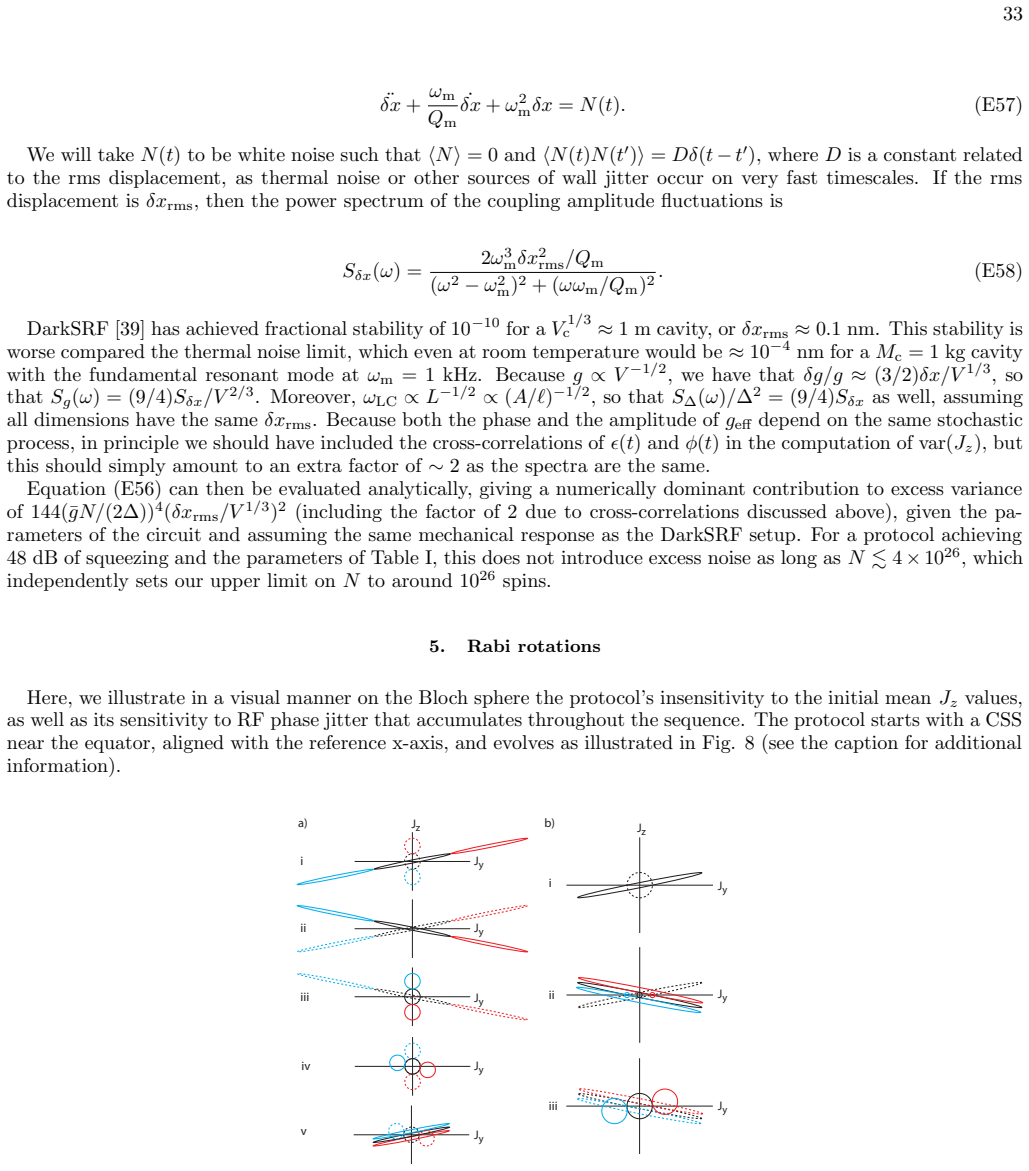
Rabi rotations Here, we illustrate in a visual manner on the Bloch sphere the protocol’s insensitivity to the initial mean Jz values, as well as its sensitivity to RF phase jitter that accumulates throughout the sequence. The protocol starts with a CSS near the equator, aligned with the reference x-axis, and evolves as illustrated in Fig. 8 (see the capti...
discussion (0)
Sign in with ORCID, Apple, or X to comment. Anyone can read and Pith papers without signing in.