REVIEW 5 major objections 4 minor 1 cited by
Fast Distributed Nash Equilibrium Seeking in Monotone Games
T0 review · 5 major / 4 minor · reviewed 2026-08-06 · deepseek-v4-flash
Pith's one-line read A distributed gradient-extrapolation method reaches Nash equilibria at rate $O(\exp\{-k/(\gamma^2 n^2)\})$ and provides the first rate guarantee for merely monotone games.
desk verdict The claimed merely-monotone rate is unproven as written — the stated λ_t violates the telescoping identity in Proposition 1 — but the restricted strongly monotone part and the algorithmic idea are solid enough to deserve peer review after a repair. read the letter →
The pith
A machine-rendered reading of the paper's core claim, the machinery that carries it, and where it could break.
The reading
What carries the argument
The machinery is an extrapolated pseudo-gradient step combined with a consensus step: each player mixes neighbor estimates via the mixing matrix $W$, forming $\hat{x}^k$, and then projects onto its own action set with the gradient extrapolation $\nabla_i J_i(\hat{x}_{(i)}^k) + \lambda_k[\nabla_i J_i(x_{(i)}^k) - \nabla_i J_i(\hat{x}_{(i)}^{k-1})]$. The proof decomposes every estimation matrix into its consensus part $x_{\|}$ and disagreement part $x_{\perp}$, and uses a weighted-energy inequality (Proposition 1) in which the mixing matrix's contraction constant $\sigma$ controls the disagreement while a parameter-dependent potential controls the distance of the consensus to the equilibrium. In the strongly monotone case, choosing the weights $\theta_t = c^t$ with $c>1$ yields a Lyapunov inequality that telescopes to the geometric rate; in the monotone case, time-varying weights and the gap function $g(y) = \max_{x\in\Omega}\langle F(x), y-x\rangle$ give the sublinear rate on averaged iterates.
What would settle it
Construct a two-player game with $\Omega=[0,1]^2$ whose pseudo-gradient is strongly monotone on $\Omega$ but not on all of $\mathbb{R}^2$, initialize ADM with estimates outside $\Omega$, and check whether the geometric rate of Corollary 2 still holds; a counterexample where the iterates stall or diverge would show that the whole-space assumption in Lemma 4 is essential.
Extended reading notes
Core claim
The central claim is that the centralized operator extrapolation idea can be carried into a distributed setting without sacrificing its acceleration. Concretely, ADM's update $x_i^{k+1} = P_{\Omega_i}\{\hat{x}_i^k - \alpha_k[\nabla_i J_i(\hat{x}_{(i)}^k) + \lambda_k(\nabla_i J_i(x_{(i)}^k) - \nabla_i J_i(\hat{x}_{(i)}^{k-1}))]\}$, with $\hat{x}^k = W x^k$ the consensus mixing step, yields the geometric rate $\|x_k - x^*\|^2 = O(\exp\{-k/(\gamma^2 n^2)\})$ under restricted strong monotonicity, and the gap-function rate $g(\bar{x}_k) = O(1/k^{1/2-\varepsilon})$ under mere monotonicity. The authors compare the geometric rate favorably with GRANE's $O(\exp\{-k/(\gamma^6 n^6)\})$ and the direct distributed procedure's $O(\exp\{-k/(\gamma^4 n^3)\})$, and they note that their monotone result is the first distributed rate for that class. They also flag that, unlike the centralized case, both monotonicity assumptions are made over the whole space $\mathbb{R}^n$ because players' estimates of joint actions need not lie in $\Omega$.
Load-bearing premise
The proofs assume the players' payoff map's monotonicity holds everywhere in $\mathbb{R}^n$, not only on the joint action set, because players' estimates of others' actions can leave that set; if monotonicity holds only on the action set, the stated rates are not established.
Editorial extensions
If this is right
- In restricted strongly monotone games, ADM's squared error decays as $O(\exp\{-k/(\gamma^2 n^2)\})$, which improves on GRANE's $O(\exp\{-k/(\gamma^6 n^6)\})$ and the direct distributed procedure's $O(\exp\{-k/(\gamma^4 n^3)\})$ in both iteration count and dimension dependence.
- In merely monotone games, the gap function at the averaged iterates decays as $O(1/k^{1/2-\varepsilon})$ for any $\varepsilon \in (0,1/2)$, giving the first distributed convergence-rate guarantee for this class.
- In merely monotone games, any limit point of the averaged iterates is a Nash equilibrium; in restricted strongly monotone games, the whole estimation matrix converges to the consensus matrix whose rows are the unique Nash equilibrium.
- The acceleration does not come from extra oracle calls: each player performs one pseudo-gradient evaluation, one projection, and one round of neighbor communication per iteration.
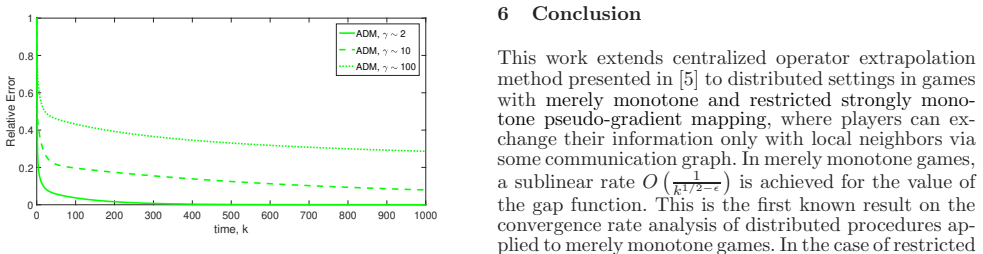
- The rates degrade as the condition number $\gamma = L/\mu$ grows, which the numerical experiments confirm.
Reading between the lines
- If the whole-space monotonicity assumption is the bottleneck, adding a projection or clipping step that keeps estimates in a region where monotonicity is known could relax it, at the cost of some bias; the authors do not analyze this variant.
- Because the exponential rate depends on $n^2$ and on $\sigma$ through the mixing matrix, choosing a better-connected graph or a mixing matrix with smaller second-largest singular value should improve the constant; the paper does not explore this trade-off.
- The $O(1/k^{1/2-\varepsilon})$ gap-function rate leaves open whether matching lower bounds exist for distributed monotone games; if such lower bounds match, the method would be order-optimal.
- The extrapolation step suggests a direct route to stochastic or asynchronous variants, since each player only needs its own gradient and neighbors' estimates; this is not studied in the paper.
Editorial analysis
A structured set of objections, weighed in public.
Referee Report
Summary. The paper proposes a distributed algorithm for Nash equilibrium seeking in convex games with merely monotone and restricted strongly monotone pseudo-gradients. The algorithm is an operator-extrapolation method with local communications over a fixed undirected graph. The central claims are a geometric rate O(exp{-k/(gamma^2 n^2)}) for restricted strongly monotone games and a sublinear rate O(1/k^{1/2-epsilon}) for the gap function in merely monotone games, both presented as improvements over prior distributed methods. The analysis is built on a telescoping-sum inequality in Proposition 1, with separate treatments for the two monotonicity cases.
Significance. If the results are correct, the monotone-rate guarantee would be the first distributed convergence-rate result for merely monotone games, and the geometric rate would improve the known dependence on the condition number and network size. The paper is also careful to state its assumptions and to provide full proofs, including the technical proposition omitted from the conference version. However, the correctness of the monotone-rate result currently rests on a parameter inversion in the telescoping identity, and the geometric-rate proof contains an undefined constant and a false displayed equality. These issues are fixable, but until they are resolved the main claims are not established as stated.
major comments (5)
- [Proposition 1 and Theorem 1 (Eq. (16), parameter choices)] The stated parameter choice in Theorem 1, namely lambda_t = (t/(t+1))^{a+b}, does not satisfy the telescoping identity used in Proposition 1. The proof of Proposition 1 uses theta_{t+1} alpha_{t+1} lambda_{t+1} = theta_t alpha_t, and with theta_t = (t+1)^{-b}, alpha_t = A(t+1)^{-a}, lambda_t = (t/(t+1))^{a+b} one obtains theta_{t+1} alpha_{t+1} lambda_{t+1} = A(t+1)^{a+b}/(t+2)^{2(a+b)}, while theta_t alpha_t = A(t+1)^{-(a+b)}. The correct relation requires lambda_t = ((t+1)/t)^{a+b}, the reciprocal of the stated value. Since Eq. (16) and the subsequent telescoping argument in Proposition 1, Lemma 3, and Theorem 1 all depend on this identity, the claimed O(1/k^{1/2-epsilon}) gap-rate result is not proven for the algorithm as specified. This is a load-bearing error, though it appears correctable.
- [Corollary 1 (parameter choice and rate)] The parameter choices in Corollary 1 are internally inconsistent with the claimed rate. With alpha_k = A/(k+1)^{1/2+eps/2} and theta_t = 1/(t+1)^eps, the exponents are a = 1/2 + eps/2 and b = eps, so 1-a-b = 1/2 - 3eps/2, not 1/2 - eps as stated. To obtain the claimed exponent 1/2 - eps, one needs b = eps/2, i.e., theta_t = 1/(t+1)^{eps/2}. The stated theta_t gives a slower rate for any eps in (0,1/2), so the rate in the corollary does not follow from the stated parameters.
- [Proof of Proposition 1, Eq. (17) (completion of squares)] The displayed equality after '=' in the chain around Eq. (17) is incorrect: it writes the sum of squares as sum (||x_t - hat(x)_{t-1}|| - ||x_{t+1} - x_t||)^2, omitting the coefficients sqrt(theta_t L^2 alpha_t^2 lambda_t^2/(2 eta_t)) and sqrt(theta_t eta_t/2) that appear in the preceding expression. As printed, the equality is false. The subsequent lower bound only needs the sum to be nonnegative, so the proof can be repaired by inserting the missing coefficients, but the displayed line must be corrected.
- [Proof of Theorem 2 (undefined constant g5)] The proof of Theorem 2 refers to the condition 'alpha <= min{g4, g5}' but the constant g5 is never defined. From the surrounding text, the needed bound appears to be alpha <= sqrt(7)/(8L), which is used to conclude L^2 alpha^2/(2(1-eta)) <= 1/16. The proof is incomplete without a definition of g5 (or an explicit statement of this bound).
- [Assumption (4) and Lemma 4 (full-space monotonicity)] The result for the 'restricted strongly monotone' case assumes inequality (4) over the whole space R^n, not only over the joint action set Omega. This is explicitly acknowledged after Lemma 4, but it is a substantive limitation: the algorithm's estimates can leave Omega, so the proof genuinely needs the full-space condition. The paper should state this limitation in the abstract and in the comparison with prior distributed methods, since those methods may only require strong monotonicity on Omega; as presented, the claimed improvement over GRANE/DDP may not apply to games that are not monotone outside Omega.
minor comments (4)
- [Section 4.1, proof of Theorem 1] The definition of eta_t in the proof is ambiguous: 'eta_t = 1/2 (t+1)^{2a-2eps}' should read eta_t = 1/(2(t+1)^{2a-2eps}) to be consistent with the text.
- [Appendix A] Appendix A states 'given that lambda_t = theta_{t-1} alpha_{t-1} / (theta_t alpha_t)', which contradicts the definition lambda_t = (t/(t+1))^{a+b} used in Theorem 1; the former is the reciprocal of the latter. This inconsistency is part of the parameter-inversion issue noted above and should be resolved.
- [Corollary 1] The condition on A in Corollary 1, written as 'A <= 1/(2L) 1/sqrt(2)', is typeset ambiguously; the intended bound appears to be A <= 1/(2L sqrt(2)). Please clarify the notation.
- [General notation] The paper defines L in (2) as a Lipschitz constant for the pseudo-gradient on the relevant domain, but later uses the same L for the Lipschitz constant of the augmented mapping in Lemma 1. This is consistent, but it would help to state explicitly that the same constant serves both purposes.
Circularity Check
No significant circularity: rates follow from explicitly proved telescoping inequalities (Proposition 1) with analytically chosen step sizes, and no fitted constants appear. Self-citations (GRANE [22], DDP [3,19], uniqueness via [22]) serve only as comparison baselines or standard facts and are not load-bearing.
full rationale
The derivation chain is self-contained and non-circular. Algorithm 1 adapts the external operator-extrapolation method of [5] (Kotsalis-Lan-Li), not the authors' own work, and the convergence proofs rest on Proposition 1, an explicitly proved telescoping inequality whose two conditions are theta_{t-1}*eta_t*(1-eta_{t-1}) >= theta_t*L^2*alpha_t^2*lambda_t^2 and theta_{t+1}*alpha_{t+1}*lambda_{t+1} = theta_t*alpha_t; Lemma 3 and Lemma 4 then inject monotonicity (5) or restricted strong monotonicity (4), and Theorems 1-2 with Corollaries 1-2 evaluate the resulting sums with analytically chosen sequences. No parameter is fitted to the predicted quantity: the geometric rate exp{-k/(gamma^2 n^2)} is computed from the contraction factor 1+epsilon(alpha) in the proof of Theorem 2, and the gap rate O(k^{-1/2+epsilon}) from sum theta_t*alpha_t ~ k^{1-a-b}. Self-citations occur only as comparison baselines: Remark 4 cites GRANE [22] and DDP [3,19] (the authors' earlier algorithms) for the rates being improved upon, and uniqueness of the Nash equilibrium cites Theorem 9 in [22], a standard consequence of strong monotonicity that is not load-bearing. The strengthened monotonicity assumptions over all of R^n (inequalities (4)-(5)) rather than only over Omega are explicit and acknowledged after Lemma 4; they narrow applicability but do not smuggle in the conclusion. Correctness flag, not circularity: with Theorem 1's choice lambda_k = (k/(k+1))^{a+b}, Proposition 1's identity theta_t*alpha_t*lambda_t = theta_{t-1}*alpha_{t-1} fails, since theta_t*alpha_t*lambda_t = A*t^{a+b}/(t+1)^{2(a+b)} while theta_{t-1}*alpha_{t-1} = A/t^{a+b}; the identity requires the reciprocal lambda_k = ((k+1)/k)^{a+b} > 1. Appendix A's verification ('Since alpha_t = A/(t+1)^a, lambda_t = (t/(t+1))^{a+b}, theta_t = 1/(t+1)^b, we get theta_{t+1}*alpha_{t+1}*lambda_{t+1} = theta_t*alpha_t for all t >= 0') is therefore false, so Theorem 1 and Corollary 1 are unproven as stated, while Theorem 2 (constant lambda = 1/c) is unaffected. This is a serious correctness issue for the referee, but it is an error rather than a circular reduction.
Assumptions & free parameters
free parameters (3)
- Constant step size alpha =
alpha = min{g1, g2, g3, g4} with g_i functions of mu, L, n, sigma, ||I - W||; see (30)
- Sequence parameters a, b, A, epsilon =
a > 1/2, a + b < 1, A < 1/(2L), epsilon small; alpha_k = A/(k+1)^a, lambda_k = (k/(k+1))^{a+b}, theta_t = 1/(t+1)^b
- Auxiliary sequences eta_t, zeta_t =
eta_t = 1/(2(t+1)^{2a - 2 epsilon}), zeta_t = 1/(t+1)^{a - 2 epsilon}
assumptions (5)
- standard math Nash equilibria of convex games coincide with solutions of the variational inequality <F(x*), x - x*> >= 0 (Facchinei and Pang).
- standard math Projection inequality (Lemma 2): for y = P_Y[z - alpha g], alpha <g, y - x> + (1/2)||z - y||^2 <= (1/2)||x - z||^2 - (1/2)||x - y||^2.
- domain assumption Spectral contraction of mixing matrix: ||W x - 1 xbar|| <= sigma ||x - 1 xbar|| with sigma in (0,1) under Assumption 4.
- domain assumption Restricted strong monotonicity of the pseudo-gradient over the whole R^n, not just Omega (inequality (4)).
- domain assumption Assumption 3: each partial derivative nabla_i J_i is Lipschitz in own and others' variables; implies F is Lipschitz with constant L (Lemma 1).
Cite this review
Pith. "Pith review of Fast Distributed Nash Equilibrium Seeking in Monotone Games." pith.science (2026). https://pith.science/paper/7F4CMR75
@misc{pith2026250711703,
  author       = {Pith},
  title        = {Pith review of: Fast Distributed Nash Equilibrium Seeking in Monotone Games},
  year         = {2026},
  howpublished = {\url{https://pith.science/paper/7F4CMR75}},
  note         = {Machine review of arXiv:2507.11703}
}
read the original abstract
This work proposes a novel distributed approach for computing a Nash equilibrium in convex games with merely monotone and restricted strongly monotone pseudo-gradients. By leveraging the idea of the centralized operator extrapolation method presented in [5] to solve variational inequalities, we develop the algorithm converging to Nash equilibria in games, where players have no access to the full information but are able to communicate with neighbors over some communication graph. The convergence rate is demonstrated to be geometric and improves the rates obtained by the previously presented procedures seeking Nash equilibria in the class of games under consideration.
Figures


Forward citations
Cited by 1 Pith paper
-
Solving Monotone Linear-Quadratic Generalized Nash Equilibrium Problems via Quadratic Programming
A merely monotone linear-quadratic generalized Nash equilibrium problem reduces to one convex quadratic program, and two accelerated QP schemes reach quadratically decaying approximate equilibria.
Reference graph
Works this paper leans on
-
[5]
G. Kotsalis, G. Lan, and T. Li. Simple and optimal methods for stochastic variational inequalities, i: Opera tor extrapolation. SIAM Journal on Optimization , 32(3):2041– 2073, 2022
work page 2022
-
[1]
T. Alpcan and T. Ba¸ sar. Distributed Algorithms for Nash Equilibria of Flow Control Games. In Advances in Dynamic Games, pages 473–498. Springer, 2005
work page 2005
-
[2]
M. Bianchi, G. Belgioioso, and S. Grammatico. A distribu ted proximal-point algorithm for nash equilibrium seeking und er partial-decision information with geometric convergence . arXiv preprint arXiv:1910.11613 , 2019
work page Pith review arXiv 1910
-
[3]
M. Bianchi, G. Belgioioso, and S. Grammatico. A fully- distributed proximal-point algorithm for nash equilibriu m seeking with linear convergence rate. In 2020 59th IEEE Conference on Decision and Control (CDC) , pages 2303– 2308, 2020
work page 2020
-
[4]
M. Bianchi and S. Grammatico. Fully distributed nash equilibrium seeking over time-varying communication networks with linear convergence rate. IEEE Control Systems Letters, 5(2):499–504, 2021
work page 2021
-
[6]
G. Lan. First-order and stochastic optimization method s for machine learning. Springer, 2020
work page 2020
- [7]
-
[8]
N. Li, Y. Yao, I. Kolmanovsky, E. Atkins, and A. R. Girard. Game-theoretic modeling of multi-vehicle interactions at uncontrolled intersections. IEEE Transactions on Intelligent Transportation Systems, 23(2):1428–1442, 2022
work page 2022
Show all 24 references
-
[9]
Nemirovski
A. Nemirovski. Prox-method with rate of convergence o(1/t) for variational inequalities with lipschitz contin uous monotone operators and smooth convex-concave saddle point problems. SIAM Journal on Optimization , 15(1):229–251, 2004
2004
-
[10]
Nesterov and L
Yu. Nesterov and L. Scrimali. Solving strongly monoton e variational and quasi-variational inequalities. Discrete and Continuous Dynamical Systems - A , 31(4):1383–1396, 2011
2011
-
[11]
Nguyen, D.T
D.T.A. Nguyen, D.T. Nguyen, and A. Nedi´ c. Distributed nash equilibrium seeking over time-varying directed communication networks. IEEE Transactions on Control of Network Systems , pages 1–12, 2025
2025
-
[12]
Olshevsky and J
A. Olshevsky and J. Tsitsiklis. Convergence speed in distributed consensus and averaging. SIAM Journal on Control and Optimization , 48(1):33–55, 2009
2009
-
[13]
Pang and F
J.-S. Pang and F. Facchinei. Finite-dimensional variational inequalities and complementarity problems : vol. 1 . Springer series in operations research. Springer, New York, Berlin, Heidelberg, 2003. 12
2003
-
[14]
Qu and N
G. Qu and N. Li. Accelerated distributed Nesterov gradient descent. IEEE Transactions on Automatic Control , 65(6):2566–2581, 2020
2020
-
[15]
W. Saad, H. Zhu, H. V. Poor, and T. Ba¸ sar. Game- theoretic methods for the smart grid: An overview of microgrid systems, demand-side management, and smart grid communications. IEEE Signal Processing Magazine , 29(5):86–105, 2012
2012
-
[16]
Scutari, S
G. Scutari, S. Barbarossa, and D. P. Palomar. Potential games: A framework for vector power control problems with coupled constraints. In 2006 IEEE International Conference on Acoustics Speech and Signal Processing Proceedings , volume 4, pages 241–244, May 2006
2006
-
[17]
Sedlmayer, D.-K
M. Sedlmayer, D.-K. Nguyen, and R. I. Bot. A fast optimistic method for monotone variational inequalities. In Andreas Krause, Emma Brunskill, Kyunghyun Cho, Barbara Engelhardt, Sivan Sabato, and Jonathan Scarlett, editors, Proceedings of the 40th International Conference on Ma...
2023
-
[18]
W. Shi, Q. Ling, G. W u, and W. Yin. EXTRA: An Exact First-Order Algorithm for Decentralized Consensus Optimization. SIAM Journal on Optimization , 25(2):944– 966, 2015
2015
-
[19]
Tatarenko and A
T. Tatarenko and A. Nedi´ c. Geometric convergence of distributed gradient play in games with unconstrained acti on sets. IF AC-PapersOnLine, 53(2):3367–3372, 2020. 21st IF AC W orld Congress
2020
-
[20]
Tatarenko and A
T. Tatarenko and A. Nedi´ c. Accelerating distributed n ash equilibrium seeking. In 2024 European Control Conference (ECC), pages 323–328, 2024
2024
-
[21]
Tatarenko, W
T. Tatarenko, W. Shi, and A. Nedi´ c. Accelerated gradie nt play algorithm for distributed nash equilibrium seeking. I n 2018 IEEE Conference on Decision and Control (CDC) , pages 3561–3566, 2018
2018
-
[22]
Tatarenko, W
T. Tatarenko, W. Shi, and A. Nedi´ c. Geometric converge nce of gradient play algorithms for distributed nash equilibri um seeking. IEEE Transactions on Automatic Control , 66(11):5342–5353, 2021
2021
-
[23]
Ye, Q.-L
M. Ye, Q.-L. Han, L. Ding, and S. Xu. Distributed nash equilibrium seeking in games with partial decision information: A survey. Proceedings of the IEEE , 111(2):140– 157, 2023. A More details on proof of Theorem 1. Since αt = A (t+1)a , λt = ( t t+1 ) a+b , θt = 1 (t+1)b , we...
2023
-
[24]
More details on the inequality a2 = 1−ηt 2 −( L + 2nL2 µ ) αt ≥ 1/8 under the conditions αt ≤ µ 4(Lµ+2nL2) and αt ≤ √ 3 4L . As ηt = 1− √ 1−4L2α2 t 2 , 1−ηt 2 − ( L + 2nL2 µ ) αt ≥ 1/8 if and only if 2 + 2 √ 1 − 4L2α2 t − 8 ( L + 2nL2 µ ) αt ≥ 1 ⇕ 2 − 8 ( L + 2nL2 µ ) αt ≥ 1 −...
Reviewed August 6, 2026 · model on record in the stance chip above.
Discussion (0). Continue with ORCID to comment.