REVIEW 3 major objections 6 minor 66 references
A one-step, draft-free video object removal model can match or surpass multi-step diffusion and flow-based baselines by distilling from a teacher that sees the ground truth.
Reviewed by Pith at T0; open to challenge. T0 means a machine referee read the full paper against a public rubric. the ladder, T0–T4 →
T0 review · deepseek-v4-flash
2026-08-02 00:31 UTC pith:7F4MDSEY
load-bearing objection A practical one-step video object removal system with a clever distillation idea, but the core mechanism is under-verified and the headline SOTA claim is stronger than the evidence. the 3 major comments →
From Draft to Draft-Free: One-Step Video Object Removal via Privileged Distillation and Fast Planting
The pith
A machine-rendered reading of the paper's core claim, the machinery that carries it, and where it could break.
Core claim
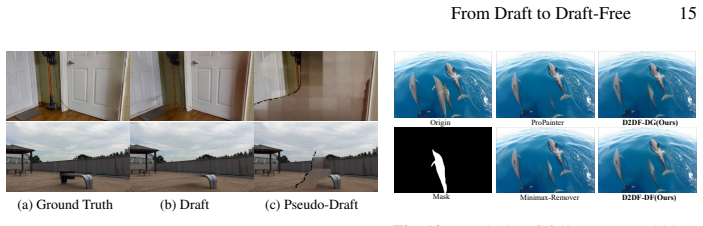
The paper's central claim is that a one-step student can match or surpass multi-step diffusion and flow-based methods for video object removal if it is distilled from a teacher that is conditioned on the ground truth rather than on the imperfect draft. The authors call this 'truth-injected' distillation (PPCD) and show that it stabilizes the consistency training, giving the student a consistent target path even though the student never sees the ground truth at inference. With the SGFP module generating latent pseudo-drafts, the final D2DF-DF model requires no external prior and still leads prior methods in PSNR on RORD, ROVI, and VPLM while using a single denoising step. The implied discover
What carries the argument
Prior-Privileged Consistency Distillation (PPCD): a consistency-distillation loss in which the teacher's condition is the masked video plus the ground-truth latent during training (Eq. 6), producing a golden target; the student is trained with that target plus a direct ground-truth loss (Eq. 9). Self-Guided Fast Planting (SGFP): a lightweight Temporal Masked Transformer that tokenizes video latents into patches and allows only unmasked patches as keys/values, reconstructing masked regions to form a latent pseudo-draft in 0.02s. The two mechanisms together convert a multi-step draft-refinement process into a one-step, draft-free generative model.
Load-bearing premise
The method rests on the assumption that the teacher's ground-truth-conditioned path is a target the student can actually reach from a blurry draft; if a draft is too far from the true background, the student has no way to follow the golden trajectory and will blur or fail.
What would settle it
Take a fixed set of RORD videos and run D2DF-DG with drafts artificially corrupted to varying degrees (random noise, heavy blur, larger masks) and compare one-step student output against the 50-step teacher's output; if the PSNR gap between student and teacher grows sharply as draft quality drops, then the privileged trajectory is not reachable and the central claim fails in that regime.
If this is right
- Denoising for a single 25-frame 480x720 video drops to about 1.03 s, making near-real-time video object removal feasible on an A100; total inference including encode/decode stays under 10 s.
- The draft-free model removes the need for optical-flow or ProPainter-style pre-processing at inference, eliminating a whole class of flow-related failure modes and extra latency.
- Performance on large-mask videos improves more than existing methods as mask ratio grows, so the method is suited to removing large or slowly moving objects where propagation fails.
- The draft-guided variant can refine drafts from unseen sources (FuseFormer, DiffuEraser) even though it was trained with ProPainter drafts, indicating the distillation teaches a general refinement capability rather than overfitting to one draft distribution.
- The three-stage decomposition is modular: trained teachers can be re-used to distill faster students, suggesting the framework can be applied to other conditional video editing tasks.
Where Pith is reading between the lines
- The truth-injected distillation idea may transfer beyond object removal: any conditional generation task with a cheap imperfect prior (e.g., super-resolution from low-res, deblurring, frame interpolation) could train its teacher on the clean target to stabilize distillation, as long as the student's input remains the imperfect prior. This is an extension, not something the paper tests.
- Because SGFP builds pseudo-drafts entirely in latent space, one could in principle train the whole D2DF-DF end-to-end from a smaller backbone or even a video autoencoder, potentially shrinking the 5B-parameter footprint; the paper does not explore scaling.
- The paper's failure cases (complex occlusions between multiple objects) suggest the one-step student inherits the teacher's ambiguity rather than adding its own errors; a natural test is to combine SGFP with explicit motion/occlusion reasoning to see whether the pseudo-draft can resolve some of that ambiguity before the one-step generator runs.
- No human perceptual study is reported; the metric gains on VFID/LPIPS do not directly tell whether the one-step output is visually indistinguishable from a 50-step teacher in a blind comparison, so that comparison is a concrete open question.
Editorial analysis
A structured set of objections, weighed in public.
Referee Report
Summary. This paper proposes D2DF, a three-stage framework for video object removal. Stage I trains a draft-guided diffusion teacher (D-LDM) conditioned on the masked video and an external draft (ProPainter). Stage II distills this multi-step teacher into a one-step draft-guided refiner (D2DF-DG) using Prior-Privileged Consistency Distillation (PPCD), in which the teacher is conditioned on the ground-truth video during distillation. Stage III introduces Self-Guided Fast Planting (SGFP), a latent-space pseudo-draft generator, and distills D2DF-DG into D2DF-DF, a draft-free one-step model. The paper reports state-of-the-art results on RORD, ROVI, and VPLM, with a zero-shot evaluation on Camera-Bench, and a denoising time of about 1 second per video.
Significance. If the claims hold, this is a practically valuable contribution: it directly addresses the latency and hallucination problems of diffusion-based video object removal through progressive distillation. The paper contains extensive experiments, multiple ablations, and a public code repository, which are strengths. The privileged-distillation idea and the latent pseudo-draft generator are creative. However, the current evidence does not fully support either the proposed mechanism or the state-of-the-art claim. The comparison is weakened by training-protocol ambiguity, the PPCD ablation is confounded by an unattributed direct regression term, and the Stage III distillation with a one-step teacher is not formally specified. These issues are addressable but require additional experiments and exposition.
major comments (3)
- [Section 4.1 (Datasets) and Table 1] The proposed models are trained on the training splits of RORD and ROVI (approximately 30k samples) and evaluated on their test splits plus VPLM. The comparison methods in Table 1 are not stated to be trained or fine-tuned on the same training splits. If the baselines are used off-the-shelf, the comparison conflates algorithmic quality with an in-domain training advantage. To support the state-of-the-art claim, the paper must state the training data for each baseline and either retrain/fine-tune all methods on the same training splits or include a zero-shot/cross-dataset evaluation where all methods are trained on the same external data.
- [Section 3.3, Eq. (9), and Table 4] The claim that PPCD's privileged trajectory is responsible for the reported improvement is not established. The PPCD loss is L_ppcd = d(x_pred^0, x_hat^phi_0) + alpha * d(x_pred^0, x_0), with alpha = 1 (Section 4.1). Thus PPCD differs from the preceding CD baseline in two ways at once: the teacher condition (draft vs. ground truth) and the additional direct L2 term. Table 4 does not ablate these two factors. With alpha = 1, the direct L2 term alone is a regression to ground truth, so the gain over CD may stem entirely from that term rather than from the 'golden trajectory.' Additionally, the teacher at distillation time receives I_pp(x_t) = Cat(x_t, x_0^M + x_0) (Eq. 6), a conditioning input that was never used in Stage I training (Eq. 5); the paper provides no evidence that this out-of-distribution teacher produces stable or accurate trajectories. An ablation such as 'CD + direct L2 wit
- [Section 3.4, Eqs. (6)-(9), and Table 6] The paper states that Stage III 'employs the PPCD framework again' with D2DF-DG as the teacher (Section 3.4). However, PPCD as defined in Section 3.3 requires a multi-step diffusion teacher and an ODE solver Phi to produce the trajectory point x_hat^phi_tn from x_{tn+1} (Eqs. 6-8). D2DF-DG is a one-step student, not a diffusion model with an ODE solver. No equations are provided for how a trajectory is generated from D2DF-DG, nor what the EMA target becomes in this setting. Without this, the D2DF-DF results in Tables 1-2 and the Stage III ablations in Table 6 are not reproducible, and the draft-free half of the headline claim is unsupported. The authors should formally specify the Stage III distillation objective and trajectory construction.
minor comments (6)
- [Table 1] There are formatting errors in the table: numbers run together, e.g., ProPainter's ROVI row '0.026341.15' and D2DF-DG's ROVI row '42.410.98880.062 0.0227'. The table should be reformatted so each metric is a distinct cell.
- [Table 3] The table has similar spacing issues and the symbols in the 'Draft' and 'Flow' columns (e.g., '–%' and '–!') are unexplained. Please define them in the caption or use clear check/cross marks.
- [Section 4.1 (Implementation Details)] The phrase 'We train only the DiT component with full-parameter SFT' is unclear. Please define SFT (supervised fine-tuning?) and specify which parameters are updated in each stage.
- [Section 3.3, Eq. (7)] The notation x_hat^phi_0 in Eq. (7) is confusing because the quantity is produced by the student's EMA target f_{theta^-}, not by the teacher phi. Renaming this variable would avoid implying that the teacher generated it.
- [Section 4.2 (Efficiency) and Table 2] Table 2 reports D2DF-DF total time as 1.05 s (prior 0.02 s + denoising 1.03 s), but the text says 'including the time for encoding and decoding latents, our complete processing time is within 10 seconds.' Please clarify whether the 1-second claim is only for the denoising process and what the end-to-end latency actually is.
- [Section 4.5 (Analysis of Failure Cases)] The failure analysis is brief and mostly qualitative. A quantitative breakdown of failure modes (e.g., by number of objects, mask ratio, or occlusion complexity) would help readers understand the limitations of one-step inference.
Circularity Check
No significant circularity: the framework is a supervised distillation pipeline and its claims are external benchmark measurements.
full rationale
The paper's derivation chain is not circular. Stage I trains a draft-conditioned diffusion teacher D-LDM with a standard LDM objective (Eq. 5). Stage II's PPCD replaces the draft condition with the ground-truth latent for the teacher only (Eq. 6), while the student still conditions on the draft at inference (Eqs. 7–8). The objective Eq. 9 contains both a consistency term toward the teacher's output and a direct regression term to x0; this is supervised training with privileged information, not a prediction derived from fitted parameters. There is no quantity that is defined in terms of the target and then reported as a predicted result. The SOTA claims in Tables 1–3 are empirical evaluations on held-out datasets, including a zero-shot benchmark, and thus are externally grounded. No load-bearing self-citation chain is present: references to CogVideoX, consistency distillation, and baselines such as ProPainter are standard components or comparisons, not cited to force the framework's conclusion. The under-specification of Stage III, where PPCD is said to be applied again with the one-step D2DF-DG as teacher without providing the required ODE-trajectory equations, is a completeness/correctness concern, not a circularity. Likewise, the acknowledged failure cases (Section 4.5 and Conclusion) limit the method but do not make the pipeline circular. No circular step can be exhibited by reduction of an equation or fitted parameter to the claimed output.
Axiom & Free-Parameter Ledger
free parameters (6)
- PPCD loss weight α =
1
- SGFP mask threshold τ =
0.7
- SGFP patch size P =
10
- SGFP spatial radius R =
2
- SGFP layers L =
4
- Draft loss ratio L_draft:L_ppcd =
1:5
axioms (5)
- domain assumption Pretrained CogVideoX-5B-I2V provides a sufficiently strong video prior for the teacher and student.
- domain assumption The flow-based output of ProPainter is a useful draft prior that simplifies the mapping to clean video.
- ad hoc to paper Conditioning the teacher on ground truth during distillation yields a stable 'golden trajectory' that the student can approximate.
- standard math Consistency distillation (Eq. 3) transfers to video latents with the chosen ODE solver.
- domain assumption The latent space of the pretrained autoencoder preserves enough spatial-temporal structure for SGFP to reconstruct meaningful pseudo-drafts.
read the original abstract
Video object removal is a fundamental yet challenging task in video editing. Despite recent progress, existing methods typically fall into two categories. Traditional approaches based on optical flow or attention mechanisms often introduce noticeable artifacts and yield unnatural results. In contrast, diffusion-based methods improve visual realism but demand multiple denoising steps, limiting their practicality. To address these issues, we propose From-Draft-to-Draft-Free (D2DF), a framework that distills the ability of transforming coarse drafts into refined videos into a one-step video generation model. Within D2DF, a teacher model is trained to refine low-quality removal results ("drafts") into high-fidelity videos by multiple steps. Then, through Prior-Privileged Consistency Distillation (PPCD), we distill this capability into a student model that performs one-step removal conditioned on the draft. To eliminate draft dependency, we introduce a Self-Guided Fast Planting (SGFP) module based on our Temporal Masked Transformer that autonomously generates scene-consistent pseudo-drafts in latent space, enabling a fully draft-free one-step model. Extensive experiments show that both draft-conditioned and draft-free versions achieve state-of-the-art performance on multiple metrics, surpassing traditional and multi-step generative methods in both quality and efficiency. The denoising process for a single video takes only about 1 second.
Figures


Reference graph
Works this paper leans on
-
[1]
In: Proceedings of the 2001 IEEE Computer Society Conference on Com- puter Vision and Pattern Recognition
Bertalmio, M., Bertozzi, A.L., Sapiro, G.: Navier-stokes, fluid dynamics, and image and video inpainting. In: Proceedings of the 2001 IEEE Computer Society Conference on Com- puter Vision and Pattern Recognition. CVPR 2001. vol. 1, pp. I–I. IEEE (2001)
2001
-
[2]
In: Proceedings of the Spe- cial Interest Group on Computer Graphics and Interactive Techniques Conference Confer- ence Papers
Bian, Y ., Zhang, Z., Ju, X., Cao, M., Xie, L., Shan, Y ., Xu, Q.: Videopainter: Any-length video inpainting and editing with plug-and-play context control. In: Proceedings of the Spe- cial Interest Group on Computer Graphics and Interactive Techniques Conference Confer- ence Papers. pp. 1–12 (2025)
2025
-
[3]
arXiv preprint arXiv:2311.15127 (2023)
Blattmann, A., Dockhorn, T., Kulal, S., Mendelevitch, D., Kilian, M., Lorenz, D., Levi, Y ., English, Z., V oleti, V ., Letts, A., et al.: Stable video diffusion: Scaling latent video diffusion models to large datasets. arXiv preprint arXiv:2311.15127 (2023)
Pith/arXiv arXiv 2023
-
[4]
In: Proceedings of the IEEE/CVF conference on computer vision and pattern recognition
Blattmann, A., Rombach, R., Ling, H., Dockhorn, T., Kim, S.W., Fidler, S., Kreis, K.: Align your latents: High-resolution video synthesis with latent diffusion models. In: Proceedings of the IEEE/CVF conference on computer vision and pattern recognition. pp. 22563–22575 (2023)
2023
-
[5]
OpenAI Blog 1(8), 1 (2024)
Brooks, T., Peebles, B., Holmes, C., DePue, W., Guo, Y ., Jing, L., Schnurr, D., Taylor, J., Luhman, T., Luhman, E., et al.: Video generation models as world simulators. OpenAI Blog 1(8), 1 (2024)
2024
-
[6]
Advances in neural information processing systems34, 8780–8794 (2021)
Dhariwal, P., Nichol, A.: Diffusion models beat gans on image synthesis. Advances in neural information processing systems34, 8780–8794 (2021)
2021
-
[7]
In: Proceedings of the Computer Vision and Pattern Recognition Conference
Ding, D., Pan, Y ., Feng, R., Dai, Q., Qiu, K., Bao, J., Luo, C., Chen, Z.: Homogen: Enhanced video inpainting via homography propagation and diffusion. In: Proceedings of the Computer Vision and Pattern Recognition Conference. pp. 22953–22962 (2025)
2025
-
[8]
IEEE Transactions on Image Processing 24(10), 3034–3047 (2015)
Ebdelli, M., Le Meur, O., Guillemot, C.: Video inpainting with short-term windows: appli- cation to object removal and error concealment. IEEE Transactions on Image Processing 24(10), 3034–3047 (2015)
2015
-
[9]
In: European Conference on Computer Vision
Gao, C., Saraf, A., Huang, J.B., Kopf, J.: Flow-edge guided video completion. In: European Conference on Computer Vision. pp. 713–729. Springer (2020)
2020
-
[10]
arXiv preprint arXiv:2406.14548 (2024)
Geng, Z., Pokle, A., Luo, W., Lin, J., Kolter, J.Z.: Consistency models made easy. arXiv preprint arXiv:2406.14548 (2024)
Pith/arXiv arXiv 2024
-
[11]
arXiv e-prints pp
Gu, B., Luo, H., Guo, S., Dong, P.: Advanced video inpainting using optical flow-guided efficient diffusion. arXiv e-prints pp. arXiv–2412 (2024)
2024
-
[12]
arXiv preprint arXiv:2412.00857 (2024)
Gu, B., Luo, H., Guo, S., Dong, P., Zhou, Q.: Coherent video inpainting using optical flow- guided efficient diffusion. arXiv preprint arXiv:2412.00857 (2024)
Pith/arXiv arXiv 2024
-
[13]
arXiv preprint arXiv:2210.02303 (2022)
Ho, J., Chan, W., Saharia, C., Whang, J., Gao, R., Gritsenko, A., Kingma, D.P., Poole, B., Norouzi, M., Fleet, D.J., et al.: Imagen video: High definition video generation with diffusion models. arXiv preprint arXiv:2210.02303 (2022)
Pith/arXiv arXiv 2022
-
[14]
Hore, A., Ziou, D.: Image quality metrics: Psnr vs. ssim. In: 2010 20th international confer- ence on pattern recognition. pp. 2366–2369. IEEE (2010)
2010
-
[15]
In: Proceedings of the Computer Vision and Pattern Recognition Conference
Jin, W., Dai, Q., Luo, C., Baek, S.H., Cho, S.: Flovd: Optical flow meets video diffusion model for enhanced camera-controlled video synthesis. In: Proceedings of the Computer Vision and Pattern Recognition Conference. pp. 2040–2049 (2025)
2040
-
[16]
In: Proceedings of the IEEE/CVF conference on computer vision and pattern recognition
Kim, D., Woo, S., Lee, J.Y ., Kweon, I.S.: Deep video inpainting. In: Proceedings of the IEEE/CVF conference on computer vision and pattern recognition. pp. 5792–5801 (2019)
2019
-
[17]
In: Proceedings of the European conference on computer vision (ECCV)
Lai, W.S., Huang, J.B., Wang, O., Shechtman, E., Yumer, E., Yang, M.H.: Learning blind video temporal consistency. In: Proceedings of the European conference on computer vision (ECCV). pp. 170–185 (2018)
2018
-
[18]
In: Proceedings of the AAAI Conference on Artificial Intelligence
Lee, M., Cho, S., Shin, C., Lee, J., Yang, S., Lee, S.: Video diffusion models are strong video inpainter. In: Proceedings of the AAAI Conference on Artificial Intelligence. vol. 39, pp. 4526–4533 (2025) From Draft to Draft-Free 17
2025
-
[19]
In: Proceedings of the IEEE/CVF international conference on computer vision
Lee, S., Oh, S.W., Won, D., Kim, S.J.: Copy-and-paste networks for deep video inpainting. In: Proceedings of the IEEE/CVF international conference on computer vision. pp. 4413– 4421 (2019)
2019
-
[20]
arXiv preprint arXiv:2501.10018 (2025)
Li, X., Xue, H., Ren, P., Bo, L.: Diffueraser: A diffusion model for video inpainting. arXiv preprint arXiv:2501.10018 (2025)
Pith/arXiv arXiv 2025
-
[21]
In: Proceedings of the IEEE/CVF conference on computer vision and pattern recognition
Li, Z., Lu, C.Z., Qin, J., Guo, C.L., Cheng, M.M.: Towards an end-to-end framework for flow-guided video inpainting. In: Proceedings of the IEEE/CVF conference on computer vision and pattern recognition. pp. 17562–17571 (2022)
2022
-
[22]
arXiv preprint arXiv:2604.01693 (2026)
Liu, D., Wang, W., Li, C., Lyu, J.: From understanding to erasing: Towards complete and stable video object removal. arXiv preprint arXiv:2604.01693 (2026)
arXiv 2026
-
[23]
In: Proceedings of the IEEE/CVF international conference on computer vision
Liu, R., Deng, H., Huang, Y ., Shi, X., Lu, L., Sun, W., Wang, X., Dai, J., Li, H.: Fuseformer: Fusing fine-grained information in transformers for video inpainting. In: Proceedings of the IEEE/CVF international conference on computer vision. pp. 14040–14049 (2021)
2021
-
[24]
arXiv preprint arXiv:2410.11081 (2024)
Lu, C., Song, Y .: Simplifying, stabilizing and scaling continuous-time consistency models. arXiv preprint arXiv:2410.11081 (2024)
Pith/arXiv arXiv 2024
-
[25]
Advances in neural information processing systems35, 5775–5787 (2022)
Lu, C., Zhou, Y ., Bao, F., Chen, J., Li, C., Zhu, J.: Dpm-solver: A fast ode solver for diffusion probabilistic model sampling in around 10 steps. Advances in neural information processing systems35, 5775–5787 (2022)
2022
-
[26]
arXiv preprint arXiv:2310.04378 (2023)
Luo, S., Tan, Y ., Huang, L., Li, J., Zhao, H.: Latent consistency models: Synthesizing high- resolution images with few-step inference. arXiv preprint arXiv:2310.04378 (2023)
Pith/arXiv arXiv 2023
-
[27]
arXiv preprint arXiv:2311.05556 (2023)
Luo, S., Tan, Y ., Patil, S., Gu, D., von Platen, P., Passos, A., Huang, L., Li, J., Zhao, H.: Lcm- lora: A universal stable-diffusion acceleration module. arXiv preprint arXiv:2311.05556 (2023)
Pith/arXiv arXiv 2023
-
[28]
In: Proceedings of the IEEE/CVF conference on computer vision and pattern recognition
Meng, C., Rombach, R., Gao, R., Kingma, D., Ermon, S., Ho, J., Salimans, T.: On distillation of guided diffusion models. In: Proceedings of the IEEE/CVF conference on computer vision and pattern recognition. pp. 14297–14306 (2023)
2023
-
[29]
arXiv preprint arXiv:2508.18633 (2025)
Miao, C., Feng, Y ., Zeng, J., Gao, Z., Liu, H., Yan, Y ., Qi, D., Chen, X., Wang, B., Zhao, H.: Rose: Remove objects with side effects in videos. arXiv preprint arXiv:2508.18633 (2025)
Pith/arXiv arXiv 2025
-
[30]
In: Proceedings of the IEEE/CVF international conference on computer vision
Peebles, W., Xie, S.: Scalable diffusion models with transformers. In: Proceedings of the IEEE/CVF international conference on computer vision. pp. 4195–4205 (2023)
2023
-
[31]
In: Pro- ceedings of the IEEE conference on computer vision and pattern recognition
Perazzi, F., Pont-Tuset, J., McWilliams, B., Van Gool, L., Gross, M., Sorkine-Hornung, A.: A benchmark dataset and evaluation methodology for video object segmentation. In: Pro- ceedings of the IEEE conference on computer vision and pattern recognition. pp. 724–732 (2016)
2016
-
[32]
arXiv preprint arXiv:2307.01952 (2023)
Podell, D., English, Z., Lacey, K., Blattmann, A., Dockhorn, T., Müller, J., Penna, J., Rom- bach, R.: Sdxl: Improving latent diffusion models for high-resolution image synthesis. arXiv preprint arXiv:2307.01952 (2023)
Pith/arXiv arXiv 2023
-
[33]
In: Proceedings of the IEEE/CVF conference on com- puter vision and pattern recognition
Rombach, R., Blattmann, A., Lorenz, D., Esser, P., Ommer, B.: High-resolution image syn- thesis with latent diffusion models. In: Proceedings of the IEEE/CVF conference on com- puter vision and pattern recognition. pp. 10684–10695 (2022)
2022
-
[34]
In: BMVC
Sagong, M.C., Yeo, Y .J., Jung, S.W., Ko, S.J.: Rord: A real-world object removal dataset. In: BMVC. p. 542 (2022)
2022
-
[35]
arXiv preprint arXiv:2202.00512 (2022)
Salimans, T., Ho, J.: Progressive distillation for fast sampling of diffusion models. arXiv preprint arXiv:2202.00512 (2022)
Pith/arXiv arXiv 2022
-
[36]
In: European Conference on Computer Vision
Sauer, A., Lorenz, D., Blattmann, A., Rombach, R.: Adversarial diffusion distillation. In: European Conference on Computer Vision. pp. 87–103. Springer (2024)
2024
-
[37]
arXiv preprint arXiv:2010.02502 (2020)
Song, J., Meng, C., Ermon, S.: Denoising diffusion implicit models. arXiv preprint arXiv:2010.02502 (2020)
Pith/arXiv arXiv 2010
-
[38]
arXiv preprint arXiv:2310.14189 (2023) 18 Z
Song, Y ., Dhariwal, P.: Improved techniques for training consistency models. arXiv preprint arXiv:2310.14189 (2023) 18 Z. Chen et al
Pith/arXiv arXiv 2023
-
[39]
In: Proceedings of the 40th International Conference on Machine Learning
Song, Y ., Dhariwal, P., Chen, M., Sutskever, I.: Consistency models. In: Proceedings of the 40th International Conference on Machine Learning. pp. 32211–32252 (2023)
2023
-
[40]
arXiv preprint arXiv:2011.13456 (2020)
Song, Y ., Sohl-Dickstein, J., Kingma, D.P., Kumar, A., Ermon, S., Poole, B.: Score- based generative modeling through stochastic differential equations. arXiv preprint arXiv:2011.13456 (2020)
Pith/arXiv arXiv 2011
-
[41]
IEEE Transactions on Multimedia 13(4), 602–614 (2011)
Tang, N.C., Hsu, C.T., Su, C.W., Shih, T.K., Liao, H.Y .M.: Video inpainting on digitized vintage films via maintaining spatiotemporal continuity. IEEE Transactions on Multimedia 13(4), 602–614 (2011)
2011
-
[42]
In: Proceedings of the AAAI conference on artificial intelligence
Wang, C., Huang, H., Han, X., Wang, J.: Video inpainting by jointly learning temporal struc- ture and spatial details. In: Proceedings of the AAAI conference on artificial intelligence. vol. 33, pp. 5232–5239 (2019)
2019
-
[43]
arXiv preprint arXiv:1808.06601 (2018)
Wang, T.C., Liu, M.Y ., Zhu, J.Y ., Liu, G., Tao, A., Kautz, J., Catanzaro, B.: Video-to-video synthesis. arXiv preprint arXiv:1808.06601 (2018)
Pith/arXiv arXiv 2018
-
[44]
Advances in Neural Information Processing Systems36, 7594–7611 (2023)
Wang, X., Yuan, H., Zhang, S., Chen, D., Wang, J., Zhang, Y ., Shen, Y ., Zhao, D., Zhou, J.: Videocomposer: Compositional video synthesis with motion controllability. Advances in Neural Information Processing Systems36, 7594–7611 (2023)
2023
-
[45]
In: Proceedings of the IEEE/CVF Conference on Computer Vision and Pattern Recognition
Wang, Y ., Bao, J., Weng, W., Feng, R., Yin, D., Yang, T., Zhang, J., Dai, Q., Zhao, Z., Wang, C., et al.: Microcinema: A divide-and-conquer approach for text-to-video generation. In: Proceedings of the IEEE/CVF Conference on Computer Vision and Pattern Recognition. pp. 8414–8424 (2024)
2024
-
[46]
IEEE Transactions on Image Processing (2023)
Wang, Z., Wang, J., Li, X., Li, Y .L., Lu, Y ., Wang, S.: Unsupervised temporal correspondence learning for unified video object removal. IEEE Transactions on Image Processing (2023)
2023
-
[47]
IEEE transactions on image processing13(4), 600–612 (2004)
Wang, Z., Bovik, A.C., Sheikh, H.R., Simoncelli, E.P.: Image quality assessment: from er- ror visibility to structural similarity. IEEE transactions on image processing13(4), 600–612 (2004)
2004
-
[48]
In: Pro- ceedings of the IEEE/CVF Conference on Computer Vision and Pattern Recognition
Wei, Y ., Zhang, S., Qing, Z., Yuan, H., Liu, Z., Liu, Y ., Zhang, Y ., Zhou, J., Shan, H.: Dreamvideo: Composing your dream videos with customized subject and motion. In: Pro- ceedings of the IEEE/CVF Conference on Computer Vision and Pattern Recognition. pp. 6537–6549 (2024)
2024
-
[49]
In: Proceedings of the IEEE/CVF Conference on Computer Vision and Pattern Recognition
Weng, W., Feng, R., Wang, Y ., Dai, Q., Wang, C., Yin, D., Zhao, Z., Qiu, K., Bao, J., Yuan, Y ., et al.: Art-v: Auto-regressive text-to-video generation with diffusion models. In: Proceedings of the IEEE/CVF Conference on Computer Vision and Pattern Recognition. pp. 7395–7405 (2024)
2024
-
[50]
In: Proceedings of the IEEE/CVF international conference on computer vision
Wu, J.Z., Ge, Y ., Wang, X., Lei, S.W., Gu, Y ., Shi, Y ., Hsu, W., Shan, Y ., Qie, X., Shou, M.Z.: Tune-a-video: One-shot tuning of image diffusion models for text-to-video generation. In: Proceedings of the IEEE/CVF international conference on computer vision. pp. 7623–7633 (2023)
2023
-
[51]
In: Proceedings of the IEEE/CVF Conference on Computer Vision and Pattern Recognition
Wu, J., Li, X., Si, C., Zhou, S., Yang, J., Zhang, J., Li, Y ., Chen, K., Tong, Y ., Liu, Z., et al.: Towards language-driven video inpainting via multimodal large language models. In: Proceedings of the IEEE/CVF Conference on Computer Vision and Pattern Recognition. pp. 12501–12511 (2024)
2024
-
[52]
In: Euro- pean Conference on Computer Vision
Xing, J., Xia, M., Zhang, Y ., Chen, H., Yu, W., Liu, H., Liu, G., Wang, X., Shan, Y ., Wong, T.T.: Dynamicrafter: Animating open-domain images with video diffusion priors. In: Euro- pean Conference on Computer Vision. pp. 399–417. Springer (2024)
2024
-
[53]
In: Proceedings of the IEEE/CVF conference on computer vision and pat- tern recognition
Xing, Z., Dai, Q., Hu, H., Wu, Z., Jiang, Y .G.: Simda: Simple diffusion adapter for efficient video generation. In: Proceedings of the IEEE/CVF conference on computer vision and pat- tern recognition. pp. 7827–7839 (2024)
2024
-
[54]
In: Proceedings of the Eu- ropean conference on computer vision (ECCV)
Xu, N., Yang, L., Fan, Y ., Yang, J., Yue, D., Liang, Y ., Price, B., Cohen, S., Huang, T.: Youtube-vos: Sequence-to-sequence video object segmentation. In: Proceedings of the Eu- ropean conference on computer vision (ECCV). pp. 585–601 (2018) From Draft to Draft-Free 19
2018
-
[55]
In: Proceedings of the IEEE/CVF conference on computer vision and pattern recognition
Xu, R., Li, X., Zhou, B., Loy, C.C.: Deep flow-guided video inpainting. In: Proceedings of the IEEE/CVF conference on computer vision and pattern recognition. pp. 3723–3732 (2019)
2019
-
[56]
arXiv preprint arXiv:2408.06072 (2024)
Yang, Z., Teng, J., Zheng, W., Ding, M., Huang, S., Xu, J., Yang, Y ., Hong, W., Zhang, X., Feng, G., et al.: Cogvideox: Text-to-video diffusion models with an expert transformer. arXiv preprint arXiv:2408.06072 (2024)
Pith/arXiv arXiv 2024
-
[57]
In: Proceedings of the 2025 Conference on Empirical Methods in Natural Language Processing
Yoon, J., Yu, S., Bansal, M.: RACCooN: Versatile instructional video editing with auto- generated narratives. In: Proceedings of the 2025 Conference on Empirical Methods in Natural Language Processing. pp. 27960–27996. Association for Computational Linguistics (2025)
2025
-
[58]
In: Proceedings of the IEEE/CVF Conference on Computer Vi- sion and Pattern Recognition
Zeng, Y ., Wei, G., Zheng, J., Zou, J., Wei, Y ., Zhang, Y ., Li, H.: Make pixels dance: High- dynamic video generation. In: Proceedings of the IEEE/CVF Conference on Computer Vi- sion and Pattern Recognition. pp. 8850–8860 (2024)
2024
-
[59]
In: European conference on computer vision
Zeng, Y ., Fu, J., Chao, H.: Learning joint spatial-temporal transformations for video inpaint- ing. In: European conference on computer vision. pp. 528–543. Springer (2020)
2020
-
[60]
In: European con- ference on computer vision
Zhang, K., Fu, J., Liu, D.: Flow-guided transformer for video inpainting. In: European con- ference on computer vision. pp. 74–90. Springer (2022)
2022
-
[61]
In: Proceedings of the IEEE/CVF conference on computer vision and pattern recogni- tion
Zhang, K., Fu, J., Liu, D.: Inertia-guided flow completion and style fusion for video inpaint- ing. In: Proceedings of the IEEE/CVF conference on computer vision and pattern recogni- tion. pp. 5982–5991 (2022)
2022
-
[62]
In: Proceedings of the IEEE conference on computer vision and pattern recognition
Zhang, R., Isola, P., Efros, A.A., Shechtman, E., Wang, O.: The unreasonable effectiveness of deep features as a perceptual metric. In: Proceedings of the IEEE conference on computer vision and pattern recognition. pp. 586–595 (2018)
2018
-
[63]
In: Proceedings of the AAAI Conference on Artificial Intelligence
Zhang, R., Li, W., Wang, P., Guan, C., Fang, J., Song, Y ., Yu, J., Chen, B., Xu, W., Yang, R.: Autoremover: Automatic object removal for autonomous driving videos. In: Proceedings of the AAAI Conference on Artificial Intelligence. vol. 34, pp. 12853–12861 (2020)
2020
-
[64]
In: International conference on machine learning
Zheng, H., Nie, W., Vahdat, A., Azizzadenesheli, K., Anandkumar, A.: Fast sampling of diffusion models via operator learning. In: International conference on machine learning. pp. 42390–42402. PMLR (2023)
2023
-
[65]
In: Proceedings of the IEEE/CVF international conference on computer vision
Zhou, S., Li, C., Chan, K.C., Loy, C.C.: Propainter: Improving propagation and transformer for video inpainting. In: Proceedings of the IEEE/CVF international conference on computer vision. pp. 10477–10486 (2023)
2023
-
[66]
arXiv preprint arXiv:2505.24873 (2025)
Zi, B., Peng, W., Qi, X., Wang, J., Zhao, S., Xiao, R., Wong, K.F.: Minimax-remover: Taming bad noise helps video object removal. arXiv preprint arXiv:2505.24873 (2025)
Pith/arXiv arXiv 2025
discussion (0)
Sign in with ORCID, Apple, or X to comment. Anyone can read and Pith papers without signing in.