REVIEW 3 major objections 6 minor 105 references
Towards Autonomous Micromobility through Scalable Urban Simulation
T0 review · 3 major / 6 minor · reviewed 2026-08-16 · deepseek-v4-flash
Pith's one-line read This paper introduces URBAN-SIM, a simulation platform that generates infinite diverse interactive urban scenes and trains embodied agents at over 1,800 frames per second on one GPU, together with URBAN-BENCH, eight tasks revealing how…
desk verdict URBAN-SIM/URBAN-BENCH is a genuinely useful integrated platform and benchmark for micromobility robot learning, but the headline scalability claims are under-supported by the current experimental design and need tightening before they can be taken at face value. read the letter →
The pith
A machine-rendered reading of the paper's core claim, the machinery that carries it, and where it could break.
The reading
What carries the argument
The load-bearing mechanism is asynchronous scene sampling, supported by a hierarchical urban generation pipeline and GPU-based interactive dynamics. In contrast to synchronous sampling used by existing GPU platforms, where every environment in a batch is identical, URBAN-SIM caches all assets and randomly samples unique configurations per environment, fully vectorizing observations, rewards, and actions on the GPU. This is what lets the platform run 256 non-uniform environments in parallel, reach 1,800–2,600 fps with RGBD sensors, and gain a 26.3% relative improvement over synchronous approaches at the same training steps. The Wave Function Collapse terrain generator, a constraint-based procedural generation algorithm, and the ORCA reciprocal collision-avoidance algorithm, ported to run on GPUs, supply the variety and interactivity that make the large-scale sampling meaningful.
What would settle it
Deploy the trained navigation and locomotion policies on a physical quadruped and wheeled robot over sidewalks with stairs, slopes, pedestrians, and static obstacles, and compare success rate, collision count, and route completion against the same metrics in URBAN-SIM; a large drop in success rate or a rise in collisions under comparable conditions would show the simulator's training signal does not carry to the target application.
Extended reading notes
Core claim
The central claim is that scale and performance are not mutually exclusive for urban robot learning if scene diversity is generated procedurally and scene sampling is asynchronous. URBAN-SIM's hierarchical pipeline connects street blocks, plans functional ground zones, applies Wave Function Collapse to create flat, stair, slope, and rough terrains, and places objects from a 15,000-asset repository, producing an effectively infinite range of static scenes. Its interactive dynamics strategy runs a GPU port of ORCA so pedestrians and cyclists respond to the robot in real time, and its asynchronous sampling lets each of 256 parallel environments be unique rather than identical copies. Across the eight URBAN-BENCH tasks the paper reports that the four robots show distinct strengths: the quadruped is smoothest, the wheeled-legged robot is most versatile, the humanoid handles static and dynamic obstacles best, and the wheeled robot excels on clear pathways. The paper also reports that scaling the number of unique training scenes from 1 to 1,024 raises success rate on the static-obstacle navigation task from 5.1% to 83.2%, which it presents as evidence that large-scale diversity is itself a training signal.
Load-bearing premise
The load-bearing premise is that skills learned and metrics measured inside this simulator transfer to real sidewalks, since the paper reports no real-world experiments and only a one-sentence note of preliminary sim-to-real results.
Editorial extensions
If this is right
- If URBAN-SIM works as described, a single GPU can support large-scale training across hundreds of unique urban scenes at near-real-time speed, removing the need for uniform, repetitive environments in micromobility research.
- URBAN-BENCH's eight tasks provide a common yardstick: four heterogeneous robots can be trained and compared on locomotion, navigation, and kilometer-scale traverse, with metrics for completeness, efficiency, and safety.
- Training on more diverse scenes measurably improves navigation performance, from 5.1% to 83.2% success rate as the scene count grows from 1 to 1,024, implying that scene diversity is a scaling axis of its own.
- The human-AI shared autonomy modes for the urban traverse task demonstrate a middle path where human labor falls from 1,189 seconds to about 189 seconds while collision counts remain below the fully AI mode.
Reading between the lines
- Editorial inference: The paper's own foundational-task results suggest a testable extension: a modular policy that chains small-scene navigation and terrain-specific locomotion models should outperform an end-to-end policy trained on the full kilometer-scale task, which is exactly the design of their shared autonomy modes.
- Editorial inference: Because the paper reports no real-world experiments, the most consequential open question is whether the qualitative skills it observes, sidestepping, detouring, and stair climbing, transfer to physical sidewalks; a natural next experiment is deploying the trained depth-map policies on real robots with domain randomization and measuring the success-rate drop.
- Editorial inference: The platform's open architecture invites other task definitions beyond the eight, such as curb-ramp finding or intersection crossing, which the paper itself lists as user-defined possibilities.
Signed reviews
Editorial analysis
A structured set of objections, weighed in public.
Referee Report
Summary. The paper presents URBAN-SIM, a GPU-accelerated urban simulation and robot-learning platform built on Nvidia Omniverse/PhysX, together with URBAN-BENCH, a suite of eight micromobility tasks (four locomotion, three navigation, one kilometer-scale traverse) evaluated on four heterogeneous robots. The platform's three claimed contributions are hierarchical procedural urban generation, GPU-based interactive dynamics via a JAX implementation of ORCA, and asynchronous scene sampling that permits training on many unique scenes in parallel. The central quantitative claims are a training throughput above 1,800 FPS on a single L40S GPU and a relative improvement of more than 26.3% from asynchronous sampling over synchronous approaches. The main empirical evidence is the scalability study in Section 6 (Figure 7), the benchmark tables (Tables 1, 2, and 7), and the performance benchmarks in Appendix C.
Significance. If the scalability and throughput claims hold, URBAN-SIM addresses a real gap: existing platforms tend to offer either fast training in uniform environments (IsaacGym, IsaacLab) or visually rich but slow urban scenes (CARLA, EmbodiedCity). The hierarchical generation pipeline, the GPU ORCA dynamics, and the asynchronous sampling design are plausible and useful engineering contributions. URBAN-BENCH is also a potentially valuable community asset: it covers a wider range of embodiments and longer-horizon tasks than most existing micromobility benchmarks, and the human-AI shared-autonomy study for urban traverse is a welcome addition. The paper is unusually complete in its appendix, with a datasheet, hyperparameters, asset descriptions, and a commitment to open-source the code and scene data. However, the headline numerical claims—the 26.3% improvement and the 1,800 FPS training throughput—are not yet backed by the reported experimental protocol, which is load-bearing for the paper's central thesis.
major comments (3)
- [Section 6, Figure 7; Section 1] The paper's headline scalability claim—'more than 26.3% relative improvement compared to synchronous approaches with the same training steps' (Section 1)—is never tied to any reported number, curve, or derivation. In Section 6, the synchronous/asynchronous comparison varies the number of training scenes from 1 to 1,024, but the text does not state whether the total number of parallel environments, per-step sample counts, batch sizes, GPU resources, or random seeds are held fixed. If scene count and environment count are increased together, the success-rate increase from 5.1% to 83.2% could result from more on-policy samples per gradient step rather than from asynchronous sampling per se. In addition, Figure 7 (Left) reports no seeds or error bars, and the synchronous baseline is described only as 'all scenes in a batch are identical'; a baseline that periodically resets to fresh unique scenes would be needed to separate scene diversity from the asynchrony mechanism. Please report the full protocol, per-condition seeds, error bars, and the exact calculation of the 26.3% figure.
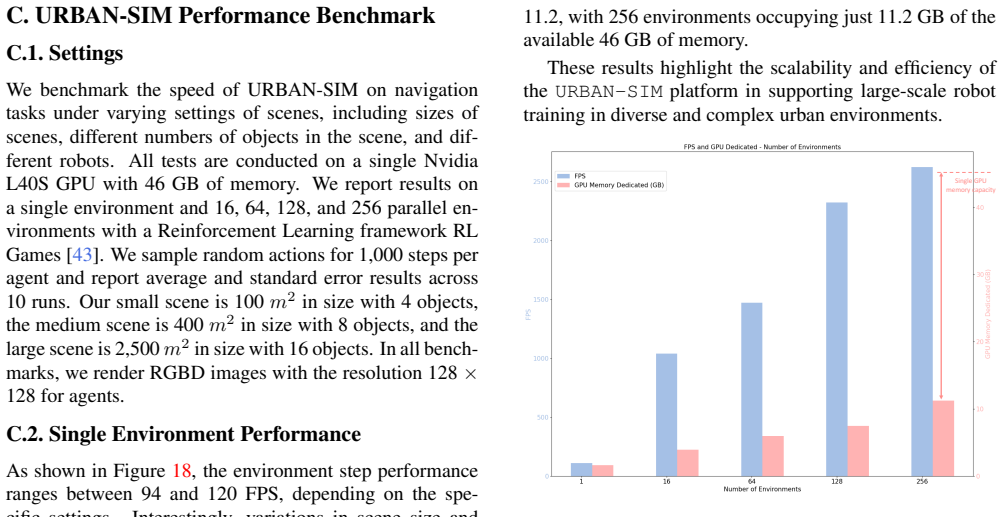
- [Section 3.3 and Appendix C] The abstract and Section 3 state that URBAN-SIM provides 'more than 1,800 fps high training performance' on a single L40S GPU, but Appendix C measures environment-step FPS under random actions ('We sample random actions for 1,000 steps per agent'), not end-to-end training throughput. The curves in Figure 19 include an 'Environment Step, Inference, and Train FPS' condition, but the text never reports those numerical values, so the reader cannot determine the actual training speed. Please report the end-to-end training FPS (including policy inference, PPO updates, and data transfer) for the same configurations, or explicitly re-label the 1,800–2,600 fps claim as simulator stepping speed only.
- [Appendix G] The manuscript's motivation is autonomous micromobility in real urban spaces, but Appendix G states that 'the current version focuses solely on simulation and does not include real-world experimentation.' The only reported sim-to-real evidence is the sentence 'preliminary experiments ... have already achieved good transferability to real-world environments,' with no results, metrics, or protocol. Given that URBAN-BENCH is presented as revealing each robot's strengths and limitations for autonomous micromobility, the absence of quantitative real-world validation makes those conclusions simulation-only; the transferability sentence should either be substantiated or removed, and the benchmark claims should be framed accordingly.
minor comments (6)
- [Figure 7 caption] The caption reads 'Comparison between synchronous and synchronous scene sampling'; the second instance should be 'asynchronous'.
- [Equation (4)] The tracking reward uses the notation 'ds−2−d' without a clear definition; please define this distance variable consistently.
- [Appendix E.5] The locomotion section repeats the navigation training times ('It took about 8, 18, and 24 hours ... for NavClear, NavStatic, and NavDynamic'); the locomotion training times should be reported separately.
- [Appendix C.3] The sentence on GPU memory reads 'from 1.6 to 11.2' without units; Figure 17 should label units on both axes and state that the memory values are in GB.
- [Table 3] The rows are labeled 'Urban-Loc-2 (Stair)' and 'Urban-Loc-3 (Slope)', which is inconsistent with the order of LocoSlope and LocoStair in Section A.1; please align the naming.
- [Appendix F (Datasheet)] The datasheet states that the dataset is 'self-contained,' while Section B.1 says assets come from external sources such as Objaverse-XL and SynBody; please clarify what 'self-contained' means in this context.
Circularity Check
No significant circularity: URBAN-SIM and URBAN-BENCH are measured systems and benchmark contributions, not derivations that reduce to their inputs.
full rationale
This is a systems and empirical benchmark paper, not a derivation chain. The central claims are that URBAN-SIM generates diverse urban scenes and achieves high training throughput, and that URBAN-BENCH tasks expose measurable robot capabilities. These claims are supported by measured benchmark scores, FPS figures, and qualitative behavioral observations; no equation in the paper turns an input constant into a predicted result, and no fitted parameter is renamed as a prediction. The scalability evaluation in Section 6 is empirical: it compares asynchronous and synchronous sampling and varies the number of training scenes, reporting success-rate changes. The 26.3% relative improvement mentioned in Section 1 and the details of Figure 7 are under-supported, and the comparison could be confounded by uncontrolled factors, but that is a correctness or experimental-validity concern, not circularity, because the claimed advantage is not defined as the measured outcome. The only notable self-citation is reference [83], MetaUrban, cited in the introduction as an example of low training performance without GPU parallelization; it is contextual related work rather than a load-bearing premise, and the paper's results do not reduce to that citation. Section G explicitly acknowledges the simulator 'focuses solely on simulation and does not include real-world experimentation' and offers only preliminary sim-to-real remarks, which is a limitation rather than a circular step. No uniqueness theorem or ansatz is imported from the authors' prior work to force the conclusions, and the task definitions are grounded in external reports on urban mobility needs. Overall, the paper is self-contained as an empirical platform and benchmark contribution, so no circularity is found.
Assumptions & free parameters
free parameters (2)
- Navigation and locomotion reward weights (c1, c2, c3) =
Nav: (2.0, 0.5, 1.0); Loco: (1.0, 2.0, 0.01)
- Terrain parameter sampling ranges =
e.g., stair height U(0.05,0.23) train, U(0.10,0.30) test
assumptions (3)
- domain assumption PhysX 5 physics and ORCA-style crowd dynamics are realistic enough that policies trained in simulation will transfer to real micromobility devices
- domain assumption Procedurally generated scenes approximate the real urban data distribution relevant to micromobility
- domain assumption ORCA (JAX version) is a sufficient model of interactive pedestrians, cyclists, and scooters
Cite this review
Pith. "Pith review of Towards Autonomous Micromobility through Scalable Urban Simulation." pith.science (2026). https://pith.science/paper/7FERLGSV
@misc{pith2026250500690,
  author       = {Pith},
  title        = {Pith review of: Towards Autonomous Micromobility through Scalable Urban Simulation},
  year         = {2026},
  howpublished = {\url{https://pith.science/paper/7FERLGSV}},
  note         = {Machine review of arXiv:2505.00690}
}
read the original abstract
Micromobility, which utilizes lightweight mobile machines moving in urban public spaces, such as delivery robots and mobility scooters, emerges as a promising alternative to vehicular mobility. Current micromobility depends mostly on human manual operation (in-person or remote control), which raises safety and efficiency concerns when navigating busy urban environments full of unpredictable obstacles and pedestrians. Assisting humans with AI agents in maneuvering micromobility devices presents a viable solution for enhancing safety and efficiency. In this work, we present a scalable urban simulation solution to advance autonomous micromobility. First, we build URBAN-SIM - a high-performance robot learning platform for large-scale training of embodied agents in interactive urban scenes. URBAN-SIM contains three critical modules: Hierarchical Urban Generation pipeline, Interactive Dynamics Generation strategy, and Asynchronous Scene Sampling scheme, to improve the diversity, realism, and efficiency of robot learning in simulation. Then, we propose URBAN-BENCH - a suite of essential tasks and benchmarks to gauge various capabilities of the AI agents in achieving autonomous micromobility. URBAN-BENCH includes eight tasks based on three core skills of the agents: Urban Locomotion, Urban Navigation, and Urban Traverse. We evaluate four robots with heterogeneous embodiments, such as the wheeled and legged robots, across these tasks. Experiments on diverse terrains and urban structures reveal each robot's strengths and limitations.
Figures


Figures from the paper (18 more)




Reference graph
Works this paper leans on
-
[1]
https://renderpeople.com/
Renderpeople. https://renderpeople.com/ . Ac- cessed: 2024-11-19. 19
2024
-
[2]
https://assetstore.unity
Unity asset store. https://assetstore.unity. com/. Accessed: 2024-11. 19
2024
-
[3]
https : / / www
Unreal engine marketplace. https : / / www . unrealengine . com / marketplace/. Accessed: 2024-11. 19
2024
-
[4]
https://www.cocodelivery.com/
Coco robotics. https://www.cocodelivery.com/. 2
-
[5]
https://www.kiwibot.com/
Kiwibot. https://www.kiwibot.com/. 2
-
[6]
The role of micro-mobility in shaping sustainable cities: A systematic literature review.Transportation research part D: transport and environment, 2021
Rusul L Abduljabbar, Sohani Liyanage, and Hussein Dia. The role of micro-mobility in shaping sustainable cities: A systematic literature review.Transportation research part D: transport and environment, 2021. 2, 3
2021
-
[7]
Josh Achiam, Steven Adler, Sandhini Agarwal, Lama Ah- mad, Ilge Akkaya, Florencia Leoni Aleman, Diogo Almeida, Janko Altenschmidt, Sam Altman, Shyamal Anadkat, et al. Gpt-4 technical report. arXiv preprint arXiv:2303.08774 ,
-
[8]
Legged locomotion in challenging terrains using egocentric vision
Ananye Agarwal, Ashish Kumar, Jitendra Malik, and Deepak Pathak. Legged locomotion in challenging terrains using egocentric vision. In CoRL, 2023. 4
2023
Show all 105 references
-
[9]
Chang, Devendra Singh Chaplot, Alexey Dosovitskiy, Saurabh Gupta, Vladlen Koltun, Jana Kosecka, Jitendra Malik, Roozbeh Mottaghi, Manolis Savva, and Amir R
Peter Anderson, Angel X. Chang, Devendra Singh Chaplot, Alexey Dosovitskiy, Saurabh Gupta, Vladlen Koltun, Jana Kosecka, Jitendra Malik, Roozbeh Mottaghi, Manolis Savva, and Amir R. Zamir. On evaluation of embodied navigation agents. arXiv preprint arXiv:1807.06757, 2018. 4
2018 arXiv
-
[10]
The sustainable mobility paradigm
David Banister. The sustainable mobility paradigm. Trans- port policy, 2008. 3
2008
-
[11]
Jax: composable transformations of python+ numpy programs
James Bradbury, Roy Frostig, Peter Hawkins, Matthew James Johnson, Chris Leary, Dougal Maclau- rin, George Necula, Adam Paszke, Jake VanderPlas, Skye Wanderman-Milne, et al. Jax: composable transformations of python+ numpy programs. 2018. 5
2018
-
[12]
nuplan: A closed-loop ml-based plan- ning benchmark for autonomous vehicles
Holger Caesar, Juraj Kabzan, Kok Seang Tan, Whye Kit Fong, Eric Wolff, Alex Lang, Luke Fletcher, Oscar Beijbom, and Sammy Omari. nuplan: A closed-loop ml-based plan- ning benchmark for autonomous vehicles. arXiv preprint arXiv:2106.11810, 2021. 3
2021 arXiv
-
[13]
Extreme parkour with legged robots
Xuxin Cheng, Kexin Shi, Ananye Agarwal, and Deepak Pathak. Extreme parkour with legged robots. In ICRA, 2024. 2, 4
2024
-
[14]
Mul- tilegged matter transport: A framework for locomotion on noisy landscapes
Baxi Chong, Juntao He, Daniel Soto, Tianyu Wang, Daniel Irvine, Grigoriy Blekherman, and Daniel I Goldman. Mul- tilegged matter transport: A framework for locomotion on noisy landscapes. Science, 2023. 4
2023
-
[15]
The micro-mobility revolution: the intro- duction and adoption of electric scooters in the united states
Regina R Clewlow. The micro-mobility revolution: the intro- duction and adoption of electric scooters in the united states. Technical report, 2019. 2
2019
-
[16]
Robothor: An open simulation-to-real embodied AI platform
Matt Deitke, Winson Han, Alvaro Herrasti, Aniruddha Kembhavi, Eric Kolve, Roozbeh Mottaghi, Jordi Salvador, Dustin Schwenk, Eli VanderBilt, Matthew Wallingford, Luca Weihs, Mark Yatskar, and Ali Farhadi. Robothor: An open simulation-to-real embodied AI platform. In CVPR, 2020. 3
2020
-
[17]
Proc- thor: Large-scale embodied ai using procedural generation
Matt Deitke, Eli VanderBilt, Alvaro Herrasti, Luca Weihs, Kiana Ehsani, Jordi Salvador, Winson Han, Eric Kolve, Aniruddha Kembhavi, and Roozbeh Mottaghi. Proc- thor: Large-scale embodied ai using procedural generation. NeuIPS, 2022. 3, 33
2022
-
[18]
Objaverse-xl: A universe of 10m+ 3d objects
Matt Deitke, Ruoshi Liu, Matthew Wallingford, Huong Ngo, Oscar Michel, Aditya Kusupati, Alan Fan, Christian Laforte, Vikram V oleti, Samir Yitzhak Gadre, et al. Objaverse-xl: A universe of 10m+ 3d objects. NeuIPS, 2024. 19
2024
-
[19]
Bike-sharing: History, impacts, models of provision, and future.Journal of public transportation, 2009
Paul DeMaio. Bike-sharing: History, impacts, models of provision, and future.Journal of public transportation, 2009. 3
2009
-
[20]
Vision for mo- bile robot navigation: A survey
Guilherme N DeSouza and Avinash C Kak. Vision for mo- bile robot navigation: A survey. TPAMI, 2002. 3
2002
-
[21]
Carla: An open urban driving simulator
Alexey Dosovitskiy, German Ros, Felipe Codevilla, Antonio Lopez, and Vladlen Koltun. Carla: An open urban driving simulator. In CoRL, 2017. 2, 3, 19
2017
-
[22]
Feigelis, Daniel Bear, Dan Gutfreund, David D
Chuang Gan, Jeremy Schwartz, Seth Alter, Damian Mrowca, Martin Schrimpf, James Traer, Julian De Freitas, Jonas Ku- bilius, Abhishek Bhandwaldar, Nick Haber, Megumi Sano, Kuno Kim, Elias Wang, Michael Lingelbach, Aidan Curtis, Kevin T. Feigelis, Daniel Bear, Dan Gutfreund, Davi...
2021
-
[23]
Embodiedc- ity: A benchmark platform for embodied agent in real-world city environment
Chen Gao, Baining Zhao, Weichen Zhang, Jinzhu Mao, Jun Zhang, Zhiheng Zheng, Fanhang Man, Jianjie Fang, Zile Zhou, Jinqiang Cui, Xinlei Chen, and Yong Li. Embodiedc- ity: A benchmark platform for embodied agent in real-world city environment. arXiv preprint arXiv:2410.09604, 2024. 3
-
[24]
Morgenstern, Briana Vecchione, Jennifer Wortman Vaughan, Hanna M
Timnit Gebru, Jamie H. Morgenstern, Briana Vecchione, Jennifer Wortman Vaughan, Hanna M. Wallach, Hal Daumé, and Kate Crawford. Datasheets for datasets. Comm. of the ACM, 2021. 29, 32
2021
-
[25]
Life between buildings
Jan Gehl. Life between buildings. 2011. 2
2011
-
[26]
Waymax: An accelerated, data- driven simulator for large-scale autonomous driving re- search
Cole Gulino, Justin Fu, Wenjie Luo, George Tucker, Eli Bronstein, Yiren Lu, Jean Harb, Xinlei Pan, Yan Wang, Xiangyu Chen, et al. Waymax: An accelerated, data- driven simulator for large-scale autonomous driving re- search. NeurIPS, 2024. 5
2024
-
[27]
Wave function collapse algorithm
Maxim Gumin. Wave function collapse algorithm. https: //github.com/mxgmn/, 2016. 5
2016
-
[28]
Dynamic flow distribution pre- diction for urban dockless e-scooter sharing reconfiguration
Suining He and Kang G Shin. Dynamic flow distribution pre- diction for urban dockless e-scooter sharing reconfiguration. In Proceedings of the web conference, 2020. 3
2020
-
[29]
The assault on culture: utopian currents from lettrisme to class war
Stewart Home. The assault on culture: utopian currents from lettrisme to class war. 1991. 3
1991
-
[30]
Gpudrive: Data- driven, multi-agent driving simulation at 1 million fps.arXiv preprint arXiv:2408.01584, 2024
Saman Kazemkhani, Aarav Pandya, Daphne Cornelisse, Brennan Shacklett, and Eugene Vinitsky. Gpudrive: Data- driven, multi-agent driving simulation at 1 million fps.arXiv preprint arXiv:2408.01584, 2024. 3
2024 arXiv
-
[31]
Ai2-thor: An interactive 3d environ- ment for visual ai
Eric Kolve, Roozbeh Mottaghi, Winson Han, Eli VanderBilt, Luca Weihs, Alvaro Herrasti, Matt Deitke, Kiana Ehsani, Daniel Gordon, Yuke Zhu, Kembhavi Aniruddha, Gupta Ab- hinav, and Farhadi Ali. Ai2-thor: An interactive 3d environ- ment for visual ai. arXiv preprint arXiv:1712.0...
2017 arXiv
-
[32]
Next generation legged robot locomotion: A review on control techniques
Swapnil Saha Kotha, Nipa Akter, Sarafat Hussain Abhi, Sajal Kumar Das, Md Robiul Islam, Md Firoj Ali, 10 Md Hafiz Ahamed, Md Manirul Islam, Subrata Kumar Sarker, Md Faisal Rahman Badal, et al. Next generation legged robot locomotion: A review on control techniques. Heliyon, 2024. 3
2024
-
[33]
Drivergym: Democratising rein- forcement learning for autonomous driving
Parth Kothari, Christian Perone, Luca Bergamini, Alexandre Alahi, and Peter Ondruska. Drivergym: Democratising rein- forcement learning for autonomous driving. arXiv preprint arXiv:2111.06889, 2021. 3
2021 arXiv
-
[34]
Sumo (simulation of urban mobility)-an open- source traffic simulation
Daniel Krajzewicz, Georg Hertkorn, Christian Rössel, and Peter Wagner. Sumo (simulation of urban mobility)-an open- source traffic simulation. In MESM, 2002. 3
2002
-
[35]
Learning robust autonomous navigation and locomotion for wheeled- legged robots
Joonho Lee, Marko Bjelonic, Alexander Reske, Lorenz Wellhausen, Takahiro Miki, and Marco Hutter. Learning robust autonomous navigation and locomotion for wheeled- legged robots. Science Robotics, 2024. 4
2024
-
[36]
Karen Liu, Hyowon Gweon, Jiajun Wu, Li Fei- Fei, and Silvio Savarese
Chengshu Li, Fei Xia, Roberto Martín-Martín, Michael Lingelbach, Sanjana Srivastava, Bokui Shen, Kent Elliott Vainio, Cem Gokmen, Gokul Dharan, Tanish Jain, Andrey Kurenkov, C. Karen Liu, Hyowon Gweon, Jiajun Wu, Li Fei- Fei, and Silvio Savarese. igibson 2.0: Object-centric si...
-
[37]
Matthews, Ivan Villa- Renteria, Jerry Huayang Tang, Claire Tang, Fei Xia, Yunzhu Li, Silvio Savarese, Hyowon Gweon, C
Chengshu Li, Ruohan Zhang, Josiah Wong, Cem Gokmen, Sanjana Srivastava, Roberto Martín-Martín, Chen Wang, Gabrael Levine, Wensi Ai, Benjamin Martinez, Hang Yin, Michael Lingelbach, Minjune Hwang, Ayano Hiranaka, Su- jay Garlanka, Arman Aydin, Sharon Lee, Jiankai Sun, Mona Anva...
2024
-
[38]
Metadrive: Composing diverse driving scenarios for generalizable reinforcement learning
Quanyi Li, Zhenghao Peng, Lan Feng, Qihang Zhang, Zhenghai Xue, and Bolei Zhou. Metadrive: Composing diverse driving scenarios for generalizable reinforcement learning. TPAMI, 2022. 2, 3
2022
-
[39]
Robust and versatile bipedal jumping control through reinforcement learning
Zhongyu Li, Xue Bin Peng, Pieter Abbeel, Sergey Levine, Glen Berseth, and Koushil Sreenath. Robust and versatile bipedal jumping control through reinforcement learning. In RSS, 2023. 4
2023
-
[40]
Visual instruction tuning
Haotian Liu, Chunyuan Li, Qingyang Wu, and Yong Jae Lee. Visual instruction tuning. NeuIPS, 2023. 34
2023
-
[41]
Visual whole- body control for legged loco-manipulation
Minghuan Liu, Zixuan Chen, Xuxin Cheng, Yandong Ji, Ri- Zhao Qiu, Ruihan Yang, and Xiaolong Wang. Visual whole- body control for legged loco-manipulation. In CoRL, 2024. 4
2024
-
[42]
Flexible mobility on-demand: An en- vironmental scan
Sohani Liyanage, Hussein Dia, Rusul Abduljabbar, and Saeed Asadi Bagloee. Flexible mobility on-demand: An en- vironmental scan. Sustainability, 2019. 3
2019
-
[43]
rl-games: A high-performance framework for reinforcement learning
Denys Makoviichuk and Viktor Makoviychuk. rl-games: A high-performance framework for reinforcement learning. https://github.com/Denys88/rl_games , 2021. 22
2021
-
[44]
Isaac gym: High performance gpu based physics simulation for robot learning
Viktor Makoviychuk, Lukasz Wawrzyniak, Yunrong Guo, Michelle Lu, Kier Storey, Miles Macklin, David Hoeller, Nikita Rudin, Arthur Allshire, Ankur Handa, et al. Isaac gym: High performance gpu based physics simulation for robot learning. In NeurIPS Datasets and Benchmarks. 2, 3, 5
-
[45]
Be- yond grand theft auto v for training, testing and enhanc- ing deep learning in self driving cars
Mark Martinez, Chawin Sitawarin, Kevin Finch, Lennart Meincke, Alex Yablonski, and Alain Kornhauser. Be- yond grand theft auto v for training, testing and enhanc- ing deep learning in self driving cars. arXiv preprint arXiv:1712.01397, 2017. 3
2017 arXiv
-
[46]
Heuristic approaches to solve e-scooter as- signment problem
Mahmoud Masoud, Mohammed Elhenawy, Mohammed H Almannaa, Shi Qiang Liu, Sebastien Glaser, and Andry Rakotonirainy. Heuristic approaches to solve e-scooter as- signment problem. IEEE access, 2019. 3
2019
-
[47]
Report by the international trans- port forum oecd/itf
ITF Safe Micromobility. Report by the international trans- port forum oecd/itf. In International Transport Forum: Paris, France, 2020. 2
2020
-
[48]
Shared smart bicycle schemes in european cities
P Midgley. Shared smart bicycle schemes in european cities. Global Transport Knowledge Partnership, 2009. 3
2009
-
[49]
Learning robust perceptive locomotion for quadrupedal robots in the wild
Takahiro Miki, Joonho Lee, Jemin Hwangbo, Lorenz Well- hausen, Vladlen Koltun, and Marco Hutter. Learning robust perceptive locomotion for quadrupedal robots in the wild. Science robotics, 2022. 4
2022
-
[50]
Is micro-mobility sustainable? an overview of implications for accessibility, air pollution, safety, physical activity and subjective wellbeing
Dimitris Milakis, Laura Gedhardt, Daniel Ehebrecht, and Barbara Lenz. Is micro-mobility sustainable? an overview of implications for accessibility, air pollution, safety, physical activity and subjective wellbeing. Handbook of sustainable transport, 2020. 2
2020
-
[51]
Orbit: A unified simulation framework for interactive robot learning environments.RAL,
Mayank Mittal, Calvin Yu, Qinxi Yu, Jingzhou Liu, Nikita Rudin, David Hoeller, Jia Lin Yuan, Ritvik Singh, Yunrong Guo, Hammad Mazhar, et al. Orbit: A unified simulation framework for interactive robot learning environments.RAL,
-
[52]
Isaac sim
Nvidia Corp. Isaac sim. https : / / developer . nvidia.com/isaac/sim , 2024. Accessed: 2024-11. 3
2024
-
[53]
Nvidia omniverse
Nvidia Corp. Nvidia omniverse. https://developer. nvidia.com/omniverse, 2024. Accessed: 2024-11. 2, 5, 15
2024
-
[54]
Nvidia Corp. Physx. https://developer.nvidia. com/physx-sdk, 2024. Accessed: 2024-11. 2
2024
-
[55]
Micro- mobility and public transport integration: The current state of knowledge
Giulia Oeschger, Páraic Carroll, and Brian Caulfield. Micro- mobility and public transport integration: The current state of knowledge. Transportation Research Part D: Transport and Environment, 2020. 2, 3
2020
-
[56]
Generative agents: Interactive simulacra of human behavior
Joon Sung Park, Joseph O’Brien, Carrie Jun Cai, Mered- ith Ringel Morris, Percy Liang, and Michael S Bernstein. Generative agents: Interactive simulacra of human behavior. In UIST, 2023. 34
2023
-
[57]
Virtualhome: Simulating household activities via programs
Xavier Puig, Kevin Ra, Marko Boben, Jiaman Li, Tingwu Wang, Sanja Fidler, and Antonio Torralba. Virtualhome: Simulating household activities via programs. In CVPR,
-
[58]
Nopa: Neurally-guided online probabilistic assistance for building socially intelligent home assistants
Xavier Puig, Tianmin Shu, Joshua B Tenenbaum, and An- tonio Torralba. Nopa: Neurally-guided online probabilistic assistance for building socially intelligent home assistants. In ICRA, 2023. 34
2023
-
[59]
Turner, Oleksandr Maksymets, Zsolt Kira, Mrinal Kalakrishnan, Jitendra Malik, Devendra Singh Chaplot, Un- nat Jain, Dhruv Batra, Akshara Rai, and Roozbeh Mottaghi
Xavier Puig, Eric Undersander, Andrew Szot, Mikael Dal- laire Cote, Tsung-Yen Yang, Ruslan Partsey, Ruta Desai, Alexander William Clegg, Michal Hlavac, So Yeon Min, 11 Vladimir V ondrus, Théophile Gervet, Vincent-Pierre Berges, John M. Turner, Oleksandr Maksymets, Zsolt Kira, ...
2023
-
[60]
Markov decision processes
Martin L Puterman. Markov decision processes. Handbooks in operations research and management science, 1990. 7, 27
1990
-
[61]
Jaxmarl: Multi-agent rl environments in jax
Alexander Rutherford, Benjamin Ellis, Matteo Gallici, Jonathan Cook, Andrei Lupu, Gardar Ingvarsson, Timon Willi, Akbir Khan, Christian Schroeder de Witt, Alexandra Souly, et al. Jaxmarl: Multi-agent rl environments in jax. arXiv preprint arXiv:2311.10090, 2023. 5
2023 arXiv
-
[62]
Habitat: A platform for embodied AI research
Manolis Savva, Jitendra Malik, Devi Parikh, Dhruv Batra, Abhishek Kadian, Oleksandr Maksymets, Yili Zhao, Erik Wijmans, Bhavana Jain, Julian Straub, Jia Liu, and Vladlen Koltun. Habitat: A platform for embodied AI research. In ICCV, 2019. 3, 33
2019
-
[63]
Proximal policy optimization algo- rithms
John Schulman, Filip Wolski, Prafulla Dhariwal, Alec Rad- ford, and Oleg Klimov. Proximal policy optimization algo- rithms. arXiv preprint arXiv:1707.06347, 2017. 7, 26, 27, 28
2017 arXiv
-
[64]
Viking: Vision-based kilometer-scale navigation with geographic hints
Dhruv Shah and Sergey Levine. Viking: Vision-based kilometer-scale navigation with geographic hints. In RSS,
-
[65]
Public bikesharing and modal shift behavior: a comparative study of early bikesharing systems in north america
Susan Shaheen, Elliot Martin, and Adam Cohen. Public bikesharing and modal shift behavior: a comparative study of early bikesharing systems in north america. 2013. 2, 3
2013
-
[66]
Bike- sharing in europe, the americas, and asia: past, present, and future
Susan A Shaheen, Stacey Guzman, and Hua Zhang. Bike- sharing in europe, the americas, and asia: past, present, and future. Transportation research record, 2010. 3
2010
-
[67]
igibson 1.0: a simulation environment for interactive tasks in large realistic scenes
Bokui Shen, Fei Xia, Chengshu Li, Roberto Martín-Martín, Linxi Fan, Guanzhi Wang, Claudia Pérez-D’Arpino, Shya- mal Buch, Sanjana Srivastava, Lyne Tchapmi, Tchapmi Mi- cael, Vainio Kent, Wong Josiah, Fei-Fei Li, and Savarese Sil- vio. igibson 1.0: a simulation environment for ...
2021
-
[68]
Procedural generation in game design
Tanya Short and Tarn Adams. Procedural generation in game design. CRC Press, 2017. 5
2017
-
[69]
Smith, J
Laura M. Smith, J. Chase Kew, Tianyu Li, Linda Luu, Xue Bin Peng, Sehoon Ha, Jie Tan, and Sergey Levine. Learning and adapting agile locomotion skills by transfer- ring experience. In RSS, 2023. 4
2023
-
[70]
Learn- ing to navigate sidewalks in outdoor environments
Maks Sorokin, Jie Tan, C Karen Liu, and Sehoon Ha. Learn- ing to navigate sidewalks in outdoor environments. RAL,
-
[71]
Turner, Noah Maestre, Mustafa Mukadam, Devendra Singh Chaplot, Oleksandr Maksymets, Aaron Gokaslan, Vladimir V ondrus, Sameer Dharur, Franziska Meier, Wojciech Galuba, Angel X
Andrew Szot, Alexander Clegg, Eric Undersander, Erik Wijmans, Yili Zhao, John M. Turner, Noah Maestre, Mustafa Mukadam, Devendra Singh Chaplot, Oleksandr Maksymets, Aaron Gokaslan, Vladimir V ondrus, Sameer Dharur, Franziska Meier, Wojciech Galuba, Angel X. Chang, Zsolt Kira, ...
2021
-
[72]
Micro-mobility: the next wave of urban trans- portation in india
A Tiwari. Micro-mobility: the next wave of urban trans- portation in india. YS Journal, January, 2019. 2
2019
-
[73]
Modeling bike sharing system using built environ- ment factors
Tien Dung Tran, Nicolas Ovtracht, and Bruno Faivre d’Arcier. Modeling bike sharing system using built environ- ment factors. Procedia Cirp, 2015. 3
2015
-
[74]
Con- gested traffic states in empirical observations and micro- scopic simulations
Martin Treiber, Ansgar Hennecke, and Dirk Helbing. Con- gested traffic states in empirical observations and micro- scopic simulations. Physical review E , 62(2):1805, 2000. 25
2000
-
[75]
Sean 2.0: Formalizing and generating social situations for robot navi- gation
Nathan Tsoi, Alec Xiang, Peter Yu, Samuel S Sohn, Greg Schwartz, Subashri Ramesh, Mohamed Hussein, Anjali W Gupta, Mubbasir Kapadia, and Marynel Vázquez. Sean 2.0: Formalizing and generating social situations for robot navi- gation. RAL, 2022. 4
2022
-
[76]
Department of Transportation
U.S. Department of Transportation. Fatality analysis reporting system (fars). https : / / www . nhtsa . gov / research - data / fatality - analysis - reporting-system-fars. 2
-
[77]
Department of Transportation
U.S. Department of Transportation. Transportation reports and publications. https://www.transportation. gov/, 2024. Accessed: 2024-11. 6
2024
-
[78]
Federal Highway Administration
U.S. Federal Highway Administration. National household travel survey (nhts). https://nhts.ornl.gov/, 2017. Accessed: 2024-11. 6
2017
-
[79]
Reciprocal n-body collision avoidance
Jur Van Den Berg, Stephen J Guy, Ming Lin, and Dinesh Manocha. Reciprocal n-body collision avoidance. In ISRR,
-
[80]
Grutopia: Dream general robots in a city at scale
Hanqing Wang, Jiahe Chen, Wensi Huang, Qingwei Ben, Tai Wang, Boyu Mi, Tao Huang, Siheng Zhao, Yilun Chen, Sizhe Yang, et al. Grutopia: Dream general robots in a city at scale. arXiv preprint arXiv:2407.10943, 2024. 3
2024 arXiv
-
[81]
Urban intelligence with deep edges
Gary White and Siobhan Clarke. Urban intelligence with deep edges. IEEE Access, 2020. 3
2020
-
[82]
Omniobject3d: Large-vocabulary 3d object dataset for realistic perception, reconstruction and generation
Tong Wu, Jiarui Zhang, Xiao Fu, Yuxin Wang, Jiawei Ren, Liang Pan, Wayne Wu, Lei Yang, Jiaqi Wang, Chen Qian, Dahua Lin, and Ziwei Liu. Omniobject3d: Large-vocabulary 3d object dataset for realistic perception, reconstruction and generation. In CVPR, 2023. 19, 31
2023
-
[83]
Metaur- ban: An embodied ai simulation platform for urban micro- mobility
Wayne Wu, Honglin He, Jack He, Yiran Wang, Chenda Duan, Zhizheng Liu, Quanyi Li, and Bolei Zhou. Metaur- ban: An embodied ai simulation platform for urban micro- mobility. arXiv preprint arXiv:2407.08725, 2024. 2
2024 arXiv
-
[84]
Citydreamer: Compositional generative model of unbounded 3d cities
Haozhe Xie, Zhaoxi Chen, Fangzhou Hong, and Ziwei Liu. Citydreamer: Compositional generative model of unbounded 3d cities. In CVPR, 2024. 3
2024
-
[85]
Safety of micro-mobility: Analysis of e- scooter crashes by mining news reports
Hong Yang, Qingyu Ma, Zhenyu Wang, Qing Cai, Kun Xie, and Di Yang. Safety of micro-mobility: Analysis of e- scooter crashes by mining news reports. Accident Analysis & Prevention, 2020. 3
2020
-
[86]
Synbody: Synthetic dataset with layered human models for 3d human perception and modeling
Zhitao Yang, Zhongang Cai, Haiyi Mei, Shuai Liu, Zhaoxi Chen, Weiye Xiao, Yukun Wei, Zhongfei Qing, Chen Wei, Bo Dai, Wayne Wu, Chen Qian, Dahua Lin, Ziwei Liu, and Lei Yang. Synbody: Synthetic dataset with layered human models for 3d human perception and modeling. In ICCV,
-
[87]
Hm3d-ovon: A dataset and bench- mark for open-vocabulary object goal navigation
Naoki Yokoyama, Ram Ramrakhya, Abhishek Das, Dhruv Batra, and Sehoon Ha. Hm3d-ovon: A dataset and bench- mark for open-vocabulary object goal navigation. arXiv preprint arXiv:2409.14296, 2024. 4
2024 arXiv
-
[88]
climb high steps
Shougao Zhang, Mengqi Zhou, Yuxi Wang, Chuanchen Luo, Rongyu Wang, Yiwei Li, Xucheng Yin, Zhaoxiang Zhang, and Junran Peng. Cityx: Controllable procedural con- tent generation for unbounded 3d cities. arXiv preprint arXiv:2407.17572, 2024. 3 12 Abstract In the appendix, we pre...
2024 arXiv
-
[89]
To benchmark the urban navigation tasks, we generate 3 subsets with different environmental con- ditions
Urban-Nav. To benchmark the urban navigation tasks, we generate 3 subsets with different environmental con- ditions. 1) Urban-Nav-1: scenes with the ground sepa- rated into traversable (such as trails or sidewalks) and un- traversable (such as shrubs or roadways) areas. 2) Urb...
-
[90]
To benchmark the urban locomotion tasks, we generate 4 subsets of terrain conditions based on the URBAN-SIM
Urban-Loc. To benchmark the urban locomotion tasks, we generate 4 subsets of terrain conditions based on the URBAN-SIM. 1) Urban-Loc-1: flat ground. 2) Urban-Loc- 2: slope terrains with different sampled dip angles and lengths. 3) Urban-Loc-3: stair terrains with different sam...
-
[91]
Urban-Tra-Standard. To quantitatively benchmark the kilometer-scale urban traverse task, we build a complex running-track testing environment with an unseen combi- nation of layouts, obstacles, terrains, and dynamics. The running track is 120 m in length and 10 m in width. It ...
-
[92]
Urban-Tra-City. To qualitatively evaluate robot behav- iors on the urban traverse task, we further construct a city- scale testing environment with an area of 1,440,000 m2 (1,200 m width× 1,200 m length). This scene features vivid and realistic urban scenarios, including diver...
-
[93]
A fully human control mode
Human. A fully human control mode. Humans control a robot’s navigation to make waypoint following. The robot uses a general locomotion model trained on mixed terrain
-
[94]
A fully AI control model
AI. A fully AI control model. The robot uses a general navigation model to make waypoint following and a general locomotion model to traverse terrains
-
[95]
A human AI shared control mode
Human-AI-Mode-1. A human AI shared control mode. Humans dispatch foundational navigation models and loco- motion models based on scene conditions at every decision point or call humans for takeover
-
[96]
Slope”, “Stair
Human-AI-Mode-2. A human AI shared control mode. Humans dispatch foundational navigation models and the general locomotion model based on scene conditions at ev- ery decision point or call humans for takeover. E.4. Navigation Benchmark In this section, we will describe the exp...
2024
-
[97]
Embodied AI. The proposed platform and benchmarks push forward research in autonomous micromobility by ad- dressing key challenges such as urban navigation, locomo- tion, and long-horizon planning. By providing realistic, scalable, and diverse environments, our work could acce...
-
[98]
The simulation tools introduced in this work could revolutionize urban planning and infrastruc- ture design
Urban development. The simulation tools introduced in this work could revolutionize urban planning and infrastruc- ture design. By simulating various traffic patterns, pedes- trian flows, and robot interactions, urban spaces could be optimized for accessibility, safety, and ef...
-
[99]
Society. This work fosters the safe and inclusive inte- gration of autonomous robots into public spaces, supporting accessibility for mobility-impaired individuals and enabling technologies such as assistive wheelchairs and parcel deliv- ery robots. By enhancing the capabiliti...
-
[100]
The deployment of AI and robots in urban spaces, while promising, introduces risks
Potential negative impacts. The deployment of AI and robots in urban spaces, while promising, introduces risks. Increased automation may lead to job displacement and economic inequality, while privacy concerns arise with the presence of robots and sensors in public areas. More...
-
[101]
Our benchmarks primar- ily evaluate urban navigation, locomotion, and traverse, which are three essential skills for urban micromobility
Extension of robot capability. Our benchmarks primar- ily evaluate urban navigation, locomotion, and traverse, which are three essential skills for urban micromobility. However, additional capabilities, such as manipulation and multi-modal perception, are critical for enabling...
-
[102]
While the procedurally generated scenes in URBAN-SIM offer extensive diversity, they do not fully reflect real-world data distributions
Real-world data distribution. While the procedurally generated scenes in URBAN-SIM offer extensive diversity, they do not fully reflect real-world data distributions. Ex- tending URBAN-SIM to incorporate data from real-world sources, such as OpenStreetMap, could significantly ...
-
[103]
To foster collabora- tion and maximize the impact of our platform, we plan to actively develop an open-source ecosystem
Building an open-source ecosystem. To foster collabora- tion and maximize the impact of our platform, we plan to actively develop an open-source ecosystem. We will begin by conducting surveys to understand user demands and re- fine our development roadmap accordingly. The plat...
-
[104]
Enabling open-world learning. Our platform aims to support cutting-edge research in open-world learning, leveraging Vision-Language Models (VLMs) and Large- Language Models (LLMs) as heterogeneous agents in vir- tual urban environments. A promising direction is to endow agents...
-
[105]
Addressing Current Limitations. We will continue to ad- dress the challenges identified in the sim-to-real gap and other limitations, such as extending the platform to incor- porate additional robot capabilities and real-world data dis- tributions. In summary, our scalable urb...
Reviewed August 16, 2026 · model on record in the stance chip above.
Discussion (0). Continue with ORCID to comment.