REVIEW 4 major objections 4 minor 56 references
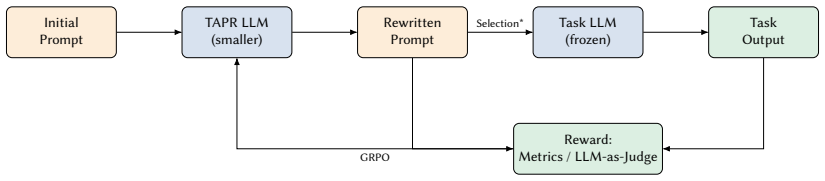
TAPR, a small model trained with reinforcement learning, rewrites prompts so that a frozen larger model answers them more accurately, demonstrated on question answering and arithmetic benchmarks.
Reviewed by Pith at T0; open to challenge. T0 means a machine referee read the full paper against a public rubric. the ladder, T0–T4 →
A small LLM trained with GRPO and LLM-judge rewards rewrites simple prompts into more effective ones, improving question-answering and arithmetic accuracy over base prompts while giving mixed, often negligible gains on summarization.
T0 review reviewed 2026-08-03 challenge →
load-bearing objection GRPO-driven prompt rewriting is worth a look, but the paper oversells consistency and the judge setup needs work. the 4 major comments →
TAPR: Enhancing LLM Performance with a Task-Aware Prompt Rewriter
The pith
A machine-rendered reading of the paper's core claim, the machinery that carries it, and where it could break.
The reading
Core claim
The central claim is that a smaller model can be trained through reinforcement learning to consistently improve the outputs of a frozen, larger model purely by editing the text of the prompt. TAPR is trained with GRPO, where each candidate rewrite is scored by an LLM judge twice: once for the quality of the prompt itself and once for the correctness of the frozen model's response, and the two scores are combined with equal weight. The authors report that this training yields stable learning and that the resulting rewriter beats both the original prompt and the untrained base model on question answering (Natural Questions and HotpotQA) and arithmetic reasoning (GSM8K), while summarization gai
What carries the argument
The load-bearing mechanism is the pairing of Group Relative Policy Optimization (GRPO) with an LLM-as-a-judge reward. GRPO updates the rewriter's policy using relative advantages across sampled rewrites for the same prompt, avoiding a separate value model; the reward combines a 0–5 prompt-quality score from one judge with a correctness score of the frozen model's answer from another judge. The prompt-quality term is what keeps training from drifting into degenerate rewrites, and the paper's ablation shows that removing it stalls learning.
Load-bearing premise
The claim rests on the judge's scores being a faithful measure of answer quality: if GPT-4o-mini's judgments are biased or can be gamed, the accuracy improvements may not reflect genuine task performance.
What would settle it
Compare TAPR-rewritten outputs on the same 1,000-sample NQ and GSM8K splits using human annotators instead of GPT-4o-mini; if the human-verified accuracy is not higher than the baseline prompt's, the central claim fails. Alternatively, flip the order of the two judged options in the comparison prompt and see whether the win-rates reverse, which would indicate the judge, not the prompt, is responsible.
If this is right
- If correct, everyday users can obtain stronger LLM performance without learning prompt engineering.
- A small, cheap rewriter model could be inserted in front of a frozen larger model, cutting cost while preserving quality.
- LLM-as-a-judge rewards become a viable training signal for open-ended tasks where exact-match metrics are unreliable.
- The same training recipe could be applied to other frozen models and new tasks with little modification.
Where Pith is reading between the lines
- Because the evaluation oracle (GPT-4o-mini) is also one of the training judges and exhibits a documented second-position bias, the reported gains may shrink or reverse under human evaluation; a human-annotated evaluation would settle this.
- The 'clarity' improvements in rewritten prompts may be partly an artifact of the prompt-quality reward, which rewards adherence to prompt-engineering heuristics rather than end-task correctness; the paper's own discussion notes that reward gains do not always transfer.
- A testable extension: apply TAPR to open-ended generation (dialogue, instruction following) where human evaluation is used as the gold standard, to see whether the judge-based gains generalize beyond benchmarks.
Editorial analysis
A structured set of objections, weighed in public.
Referee Report
Summary. The paper introduces TAPR, a small LLM (Phi-4-mini-instruct or LLaMA-3.2-3B-Instruct) trained with GRPO to rewrite a one-line task prompt for a frozen Task LLM (LLaMA-3.1-8B-Instruct). Training rewards combine an LLM-as-a-judge score of the Task LLM's answer and an LLM-judge 'prompt quality' score. Final evaluations use GPT-4o-mini on 1,000 samples per dataset across question answering (Natural Questions, HotpotQA), summarization (CNN/Daily Mail, SciTLDR), and arithmetic reasoning (GSM8K). The paper reports gains over baseline-prompt and base-model rewriting for several settings, plus ablations with PPO, SFT, prompt-quality reward, selection mechanism, full-prompt rewriting, alternative Task LLMs, and cross-task generalization. The abstract and conclusion claim 'consistent gains,' but Section 6.1 and several tables qualify or directly contradict this claim.
Significance. The topic is timely and the paper ships code, detailed hyperparameters, multiple ablations, and an explicit discussion of LLM-judge limitations, which is commendable. The central research question is meaningful: can a small model trained with RL improve a frozen larger model by rewriting prompt text? However, the current evidence does not establish the headline claim. The main positive results on NQ and HotpotQA are measured by GPT-4o-mini, which is also one of the two reward judges used during training, and the paper documents a strong second-position bias for this judge. The only verifiable result (GSM8K last-integer accuracy) shows modest gains, while summarization results show trained LLaMA TAPR below its own base model and Phi TAPR below its base model on SciTLDR. As presented, the paper is better described as a well-documented partial/negative result than as a demonstration of consistently improved downstream performance. The authors themselves state in §6.4 that gains are not yet consistent enough to offset additional training and inference costs.
major comments (4)
- [§3.2, §4, §6.3] The evaluation is not independent of training. GPT-4o-mini is one of the two reward judges during GRPO training (Section 3.2) and the sole final evaluator (Section 4). The NQ and HotpotQA gains in Tables 2 and 3 may therefore reflect the rewriter learning to exploit surface features favored by this judge, rather than genuinely improving answer quality. The paper documents a strong second-position bias for GPT-4o-mini (Table 7 note, Section 6.3) and validates the judge on only 1/100 NQ cases (footnote 1), which does not rule out condition-dependent leniency toward TAPR outputs. Please provide human evaluation or an independent judge on the final outputs, or restrict the headline claim to verifiable metrics such as GSM8K last-integer accuracy.
- [Abstract and Conclusion vs §5–§6] The claim of 'consistent gains' is directly contradicted by the paper's own tables. In Table 5, LLaMA-3.2 TAPR scores 3.435 vs 3.794 for the untrained base model on CNN/DM; in Table 6, LLaMA TAPR scores 3.107 vs 3.749, and Phi TAPR scores 3.710 vs 3.802, on SciTLDR. Appendix Table 15 shows full-prompt TAPR below the baseline prompt for all models on NQ, and Table 17 shows multi-task TAPR below baseline on both summarization datasets. Section 6.1 itself states that gains are 'not always consistent.' Please revise the abstract and conclusion to match the evidence.
- [§4, Tables 2–9] No repeated runs or error bars are reported; Section 4 explicitly states that 'each training and evaluation is conducted only once.' Differences of 1–3 percentage points over 1,000 samples (e.g., Phi TAPR 59.20 vs baseline 56.30 on NQ; LLaMA TAPR 56.00 vs baseline 53.20 on HotpotQA) may be within sampling noise. Add multiple seeds, or at least bootstrap confidence intervals over the 1,000 evaluation samples, to support quantitative claims.
- [§3.2, §5.4, §6.1] The prompt-quality reward is defined by an LLM judge checking adherence to prompt-engineering principles, so the observed 'clearer, more instructive' rewriting (Abstract, §7) is substantially the training objective itself. Section 6.1 concedes that 'much of the reward improvement may reflect the model’s ability to satisfy prompt quality criteria rather than the end-task metrics.' This circularity should be acknowledged in the abstract and conclusion, and the qualitative claims tempered accordingly.
minor comments (4)
- [Footnote 1, §3.2] The 'internal test' that found only 1/100 incorrect judgments is not described in enough detail to be reproduced. Please include the evaluation protocol, sample size, model version, and how human labels were obtained.
- [Table 11] The PPO variant labels 'Con.', 'Mod.', 'Agg.' are defined in the caption, but the table format would be clearer if the hyperparameter values (learning rate, KL coefficient) were listed in a separate column or expanded caption.
- [Figures 2 and 3] The figures show raw and moving-average training rewards, but the axis labels and units are not fully specified in the captions. Please state what the y-axis represents and the window size for the moving average.
- [§6.2] The claim that 'training only improves performance with a specific prompt' is clear, but the example of the Phi-4-mini CNN/DM run producing a joke prompt suggests a degenerate failure mode that should be reported in the main results or a dedicated error-analysis section, not only in the discussion.
Circularity Check
Partial circularity: the NQ/HotpotQA evaluation judge was also a training reward judge, and the 'clearer prompts' finding restates the prompt-quality reward; GSM8K and other external metrics retain independent content.
specific steps
-
fitted input called prediction
[Section 3.2 (Rewards) and Section 4 (Evaluation Protocol); Tables 2–3]
"To reduce bias and stabilize the reward signal, we average the LLM-as-a-judge scores from two different judge models (LLaMA-3.1-8B-Instruct and GPT-4o-mini). ... During evaluation, we use GPT-4o-mini as the sole judge model to score answers."
GPT-4o-mini is one of the two reward judges used during GRPO training, and it is also the sole final evaluator. The reported NQ gains (56.30 to 59.20/62.20) and HotpotQA gains (53.20 to 56.70/56.00) are therefore measured by an oracle that the policy was directly optimized to satisfy. This is not an independent check of answer quality; it is partly a re-measurement of the training objective. The paper itself documents the same judge's strong second-position bias (Table 7 note, Section 6.3), making the overlap consequential. The reduction is partial because training averaged two judges and evaluation used held-out samples, and the GSM8K results use an external last-integer metric.
-
self definitional
[Section 3.2 (prompt quality reward) and Section 6.4 (Future Work)]
"The prompt quality reward is a score on a scale of 0 to 5 coming from an LLM judge based on whether the rewritten prompt matches the meaning of the initial instruction and improves it according to common prompt engineering principles. ... This is partially supported by our finding that rewritten prompts tended to be clearer, more detailed, and more consistent with prompt engineering best practices than the baseline instructions."
The qualitative claim that TAPR produces 'clearer, more detailed' prompts 'consistent with prompt engineering best practices' is the exact criterion encoded in the prompt-quality reward Q(p̃). The observed property is therefore a restatement of the training objective, not an independent finding about prompt quality. Example prompts and win-rates provide some non-circular illustration, but the general 'clarity/instructiveness' conclusion is defined by the reward itself.
full rationale
The core RL formulation is not mathematically circular: TAPR maximizes a combined reward, and the GSM8K evaluation uses a verifiable last-integer accuracy signal that is external to the judge. The paper also reports results with alternative task LLMs and win-rate comparisons, which provide independent content. However, two evaluation-design choices create partial circularity. First, GPT-4o-mini is used both as one of the two training reward judges and as the sole final evaluation judge for NQ and HotpotQA, so the headline QA improvements are partly optimized against the evaluation oracle rather than independently verified. Second, the prompt-quality reward defines 'good' prompts as those an LLM judge rates as following prompt-engineering principles, and the paper then presents the observation that TAPR prompts are 'clearer' and 'more consistent with prompt engineering principles' as a finding; this is self-referential. I found no load-bearing self-citation chain: references to PRewrite, GRPO, and related work are external baselines or methods. Because the central claim is only partially reduced to its own evaluation and reward definitions, a moderate score is appropriate rather than a full circularity finding.
Axiom & Free-Parameter Ledger
free parameters (8)
- Reward weights alpha, beta =
1 (equal weights)
- GRPO learning rate =
1e-5
- GRPO sampling configuration =
4 completions per prompt, T=1.0, top_k=40, p=0.95
- GRPO clipping bounds and iterations =
epsilon_low=0.2, epsilon_high=0.28, 2 iterations
- Selection mechanism configuration =
5 candidates at T=0.5 (3 for full-prompt rewriting)
- Stopping criterion =
no improvement in 25-step moving average for 100 steps
- Evaluation subset size =
1000 validation/test samples per dataset
- Judge model choice =
LLaMA-3.1-8B-Instruct + GPT-4o-mini averaged in training; GPT-4o-mini alone at evaluation
axioms (6)
- domain assumption LLM-as-a-judge scores are valid measures of downstream answer quality.
- domain assumption Averaging two judge models removes enough bias for the reward signal to be useful.
- ad hoc to paper The prompt-quality reward from an LLM judge reflects genuine prompt-engineering quality.
- domain assumption GRPO optimizes the stochastic composite reward without reward hacking or degenerate outputs.
- domain assumption The chosen baseline prompts ('Answer the question', 'Summarize the text', 'SOLUTION') are fair initial prompts for evaluating rewriting gains.
- domain assumption Single-run results with no seeds support the generalization claims.
Cite this review
Pith. "Pith review of TAPR: Enhancing LLM Performance with a Task-Aware Prompt Rewriter." pith.science (2026). https://pith.science/paper/7G2KCMHD
@misc{pith2026260728657,
  author       = {Pith},
  title        = {Pith review of: TAPR: Enhancing LLM Performance with a Task-Aware Prompt Rewriter},
  year         = {2026},
  howpublished = {\url{https://pith.science/paper/7G2KCMHD}},
  note         = {Machine review of arXiv:2607.28657}
}
read the original abstract
Large Language Models (LLMs) often require carefully crafted prompts to unlock their full potential, which can be a barrier for non-expert users. This work addresses the challenge by introducing a Task-Aware Prompt Rewriter (TAPR), a model that reformulates user prompts into task-optimized prompts with the explicit goal of improving downstream LLM performance. We train TAPR using reinforcement learning with Group Relative Policy Optimization (GRPO), where rewards are derived from LLM-as-judge evaluations of both the reformulated prompt and the corresponding task output. Experimental results on diverse tasks, such as question answering, summarization, and arithmetic reasoning, show that our method yields consistent gains over base models in prompt rewriting ability. Fine-tuning Phi-4-mini-instruct (as the base model for TAPR) produces prompts that contain clearer and more instructive language, leading to higher accuracy on established benchmarks such as Natural Questions and GSM8K. Our code is available at: https://github.com/OliverSavolainen/task-specific-prompt-rewriter
Figures


Reference graph
Works this paper leans on
-
[1]
Brown, B
T. Brown, B. Mann, N. Ryder, M. Subbiah, J. Kaplan, P. Dhariwal, A. Neelakantan, P. Shyam, G. Sastry, A. Askell, et al., Language models are few-shot learners, Advances in Neural Information Processing Systems 33 (2020)
2020
-
[2]
J. Wei, Y. Tay, R. Bommasani,et al., Emergent abilities of large language models, arXiv preprint arXiv:2206.07682 (2022). URL: https://arxiv.org/abs/2206.07682.arXiv:2206.07682
Pith/arXiv arXiv 2022
-
[3]
A. Srivastava, A. Rastogi, A. Rao, A. A. M. Shoeb, A. Abid, A. Fisch, A. R. Brown, A. San- toro, A. Gupta, A. Garriga-Alonso, A. Kluska, A. Lewkowycz,et al., Beyond the imitation game: Quantifying and extrapolating the capabilities of language models, 2022. URL: https: //arxiv.org/abs/2206.04615.arXiv:2206.04615
Pith/arXiv arXiv 2022
-
[4]
T. Shin, Y. Razeghi, R. L. L. IV, E. Wallace, S. Singh, Autoprompt: Eliciting knowledge from language models with automatically generated prompts, 2020. URL: https://arxiv.org/abs/2010. 15980.arXiv:2010.15980
Pith/arXiv arXiv 2020
-
[5]
W. Kong, S. A. Hombaiah, M. Zhang, Q. Mei, M. Bendersky, Prewrite: Prompt rewriting with reinforcement learning, 2024. URL: https://arxiv.org/abs/2401.08189.arXiv:2401.08189
Pith/arXiv arXiv 2024
-
[6]
Schulman, F
J. Schulman, F. Wolski, P. Dhariwal, A. Radford, O. Klimov, Proximal policy optimization algorithms,
-
[7]
Z. Shao, P. Wang, Q. Zhu, R. Xu, J. Song, X. Bi, H. Zhang, M. Zhang, Y. K. Li, Y. Wu, D. Guo, Deepseekmath: Pushing the limits of mathematical reasoning in open language models, 2024. URL: https://arxiv.org/abs/2402.03300.arXiv:2402.03300
Pith/arXiv arXiv 2024
-
[8]
J. Wei, M. Bosma, V. Y. Zhao, K. Guu, A. W. Yu, B. Lester, N. Du, A. M. Dai, Q. V. Le, Finetuned language models are zero-shot learners, in: Proceedings of the 10th International Conference on Learning Representations (ICLR), 2022
2022
-
[9]
Christiano, J
P. Christiano, J. Leike, T. B. Brown, M. Martic, S. Legg, D. Amodei, Deep reinforcement learning from human preferences, in: Advances in Neural Information Processing Systems 30 (NIPS 2017), 2017, pp. 4299–4307
2017
-
[10]
Ouyang, J
L. Ouyang, J. Wu, X. Jiang, D. Almeida, C. L. Wainwright, P. Mishkin, C. Zhang, S. Agarwal, K. Slama, A. Ray, J. Schulman, J. Hilton, F. Kelton, L. Miller, M. Simens, A. Askell, P. Welinder, P. Christiano, J. Leike, R. Lowe, Training language models to follow instructions with human feedback, in: Advances in Neural Information Processing Systems 35 (NeurI...
2022
-
[11]
DeepSeek-AI, Deepseek-r1: Incentivizing reasoning capability in llms via reinforcement learning,
-
[12]
B. Jin, H. Zeng, Z. Yue, J. Yoon, S. Arik, D. Wang, H. Zamani, J. Han, Search-r1: Training llms to reason and leverage search engines with reinforcement learning, 2025. URL: https://arxiv.org/abs/ 2503.09516.arXiv:2503.09516
Pith/arXiv arXiv 2025
-
[13]
Boonstra, Prompt engineering, Google 5-Day GenAI Intensive Whitepapers-to-Text, Kaggle, 2025
L. Boonstra, Prompt engineering, Google 5-Day GenAI Intensive Whitepapers-to-Text, Kaggle, 2025. https://www.kaggle.com/code/toddgardiner/google-5-day-genai-intensive-whitepapers-to-text/ output
2025
-
[14]
Kojima, S
T. Kojima, S. S. Gu, M. Reid, Y. Matsuo, Y. Iwasawa, Large language models are zero-shot reasoners,
-
[15]
J. Wei, et al., Chain-of-thought prompting elicits reasoning in large language models, arXiv preprint arXiv:2201.11903 (2022)
Pith/arXiv arXiv 2022
-
[16]
T. Shen, T. Lei, R. Barzilay, T. Jaakkola, Style transfer from non-parallel text by cross-alignment, in: Advances in Neural Information Processing Systems, 2017
2017
-
[17]
Z. Hu, Z. Yang, X. Liang, R. Salakhutdinov, E. P. Xing, Toward controlled generation of text, in: Proceedings of the 34th International Conference on Machine Learning (ICML), 2017
2017
-
[18]
D. X. Long, H. N. Ngoc, T. Sim, H. Dao, S. Joty, K. Kawaguchi, N. F. Chen, M.-Y. Kan, Llms are biased towards output formats! systematically evaluating and mitigating output format bias of llms, 2024. URL: https://arxiv.org/abs/2408.08656.arXiv:2408.08656
Pith/arXiv arXiv 2024
-
[19]
Fernando, D
C. Fernando, D. S. Banarse, H. Michalewski, S. Osindero, T. Rocktäschel, Promptbreeder: Self- referential self-improvement via prompt evolution, in: Proceedings of the 41st International Conference on Machine Learning (ICML), 2024, pp. 13481–13544
2024
-
[20]
M. Deng, J. Wang, C.-P. Hsieh, Y. Wang, H. Guo, T. Shu, M. Song, E. P. Xing, Z. Hu, Rlprompt: Optimizing discrete text prompts with reinforcement learning, in: Proceedings of the 2022 Conference on Empirical Methods in Natural Language Processing (EMNLP), 2022, pp. 3369–3391
2022
-
[21]
T. Zhang, X. Wang, D. Zhou, D. Schuurmans, J. E. Gonzalez, Tempera: Test-time prompting via reinforcement learning, 2022. URL: https://arxiv.org/abs/2211.11890.arXiv:2211.11890
Pith/arXiv arXiv 2022
-
[22]
URL: https://doi.org/10.48550/ arXiv.2305.10403, arXiv preprint arXiv:2305.10403
Google, Palm 2 technical report, PaLM 2 Technical Report, 2023. URL: https://doi.org/10.48550/ arXiv.2305.10403, arXiv preprint arXiv:2305.10403
-
[23]
Papineni, S
K. Papineni, S. Roukos, T. Ward, W.-J. Zhu, Bleu: a method for automatic evaluation of machine translation, in: Proceedings of the 40th Annual Meeting on Association for Computational Linguistics, Association for Computational Linguistics, 2002
2002
-
[24]
Lin, Rouge: A package for automatic evaluation of summaries, in: Text Summarization Branches Out, ACL Workshop, 2004, pp
C.-Y. Lin, Rouge: A package for automatic evaluation of summaries, in: Text Summarization Branches Out, ACL Workshop, 2004, pp. 74–81. URL: https://aclanthology.org/W04-1013/
2004
-
[25]
Banerjee, A
S. Banerjee, A. Lavie, Meteor: An automatic metric for mt evaluation with improved correlation with human judgments, in: Proceedings of the ACL Workshop on Intrinsic and Extrinsic Evaluation Measures for Machine Translation and/or Summarization, Ann Arbor, Michigan, 2005, pp. 65–72
2005
-
[26]
T. Zhang, V. Kishore, F. Wu, K. Q. Weinberger, Y. Artzi, Bertscore: Evaluating text generation with bert, 2020. URL: https://arxiv.org/abs/1904.09675.arXiv:1904.09675
Pith/arXiv arXiv 2020
-
[27]
H. Saadany, C. Orăsan, Bleu, meteor, bertscore: Evaluation of metrics performance in assess- ing critical translation errors in sentiment-oriented text, in: Proceedings of the Translation and Interpreting Technology Online Conference TRITON 2021, TRITON 2021, INCOMA Ltd. Shoumen, BULGARIA, 2021, p. 48–56. URL: http://dx.doi.org/10.26615/978-954-452-071-7_...
-
[28]
Zheng, W.-L
L. Zheng, W.-L. Chiang, Y. Sheng, et al., Judging llm-as-a-judge with mt-bench and chatbot arena, in: NeurIPS, 2023
2023
-
[29]
J. Gu, X. Jiang, Z. Shi, H. Tan, X. Zhai, C. Xu, W. Li, Y. Shen, S. Ma, H. Liu, S. Wang, K. Zhang, Y. Wang, W. Gao, L. Ni, J. Guo, A survey on llm-as-a-judge, arXiv preprint arXiv:2411.15594 (2024)
Pith/arXiv arXiv 2024
-
[30]
H. Lee, S. Phatale, H. Mansoor, T. Mesnard, J. Ferret, K. Lu, C. Bishop, E. Hall, V. Carbune, A. Rastogi, S. Prakash, Rlaif vs. rlhf: Scaling reinforcement learning from human feedback with ai feedback,
-
[31]
Y. Bai, S. Kadavath, S. Kundu, A. Askell, J. Kernion, A. Jones, A. Chen, et al., Constitutional ai: Harmlessness from ai feedback, arXiv preprint arXiv:2212.08073 (2022)
Pith/arXiv arXiv 2022
-
[32]
T. Kwiatkowski, J. Palomaki, O. Redfield, M. Collins, A. Parikh, C. Alberti, D. Epstein, I. Polosukhin, J. Devlin, K. Lee, K. Toutanova, L. Jones, M. Kelcey, M.-W. Chang, A. M. Dai, J. Uszkoreit, Q. Le, S. Petrov, Natural questions: A benchmark for question answering research, Transactions of the Association for Computational Linguistics 7 (2019) 452–466....
-
[33]
Z. Yang, P. Qi, S. Zhang, Y. Bengio, W. Cohen, R. Salakhutdinov, C. D. Manning, HotpotQA: A dataset for diverse, explainable multi-hop question answering, in: E. Riloff, D. Chiang, J. Hockenmaier, J. Tsujii (Eds.), Proceedings of the 2018 Conference on Empirical Methods in Natural Language Processing, Association for Computational Linguistics, Brussels, B...
-
[34]
K. M. Hermann, T. Kočiský, E. Grefenstette, L. Espeholt, W. Kay, M. Suleyman, P. Blun- som, Teaching machines to read and comprehend, 2015. URL: https://arxiv.org/abs/1506.03340. arXiv:1506.03340
Pith/arXiv arXiv 2015
-
[35]
I. Cachola, K. Lo, A. Cohan, D. Weld, TLDR: Extreme summarization of scientific documents, in: T. Cohn, Y. He, Y. Liu (Eds.), Findings of the Association for Computational Linguistics: EMNLP 2020, Association for Computational Linguistics, Online, 2020, pp. 4766–4777. URL: https: //aclanthology.org/2020.findings-emnlp.428/. doi:10.18653/v1/2020.findings-emnlp.428
-
[36]
K. Cobbe, V. Kosaraju, M. Bavarian, M. Chen, H. Jun, L. Kaiser, M. Plappert, J. Tworek, J. Hilton, R. Nakano, C. Hesse, J. Schulman, Training verifiers to solve math word problems, 2021. URL: https://arxiv.org/abs/2110.14168. doi:10.48550/arXiv.2110.14168.arXiv:2110.14168
-
[37]
W. Li, X. Wang, W. Li, B. Jin, A survey of automatic prompt engineering: An optimization perspective, arXiv preprint arXiv:2502.11560 (2025). URL: https://arxiv.org/abs/2502.11560
Pith/arXiv arXiv 2025
-
[38]
R. Rafailov, A. Sharma, E. Mitchell, S. Ermon, C. D. Manning, C. Finn, Direct preference optimization: Your language model is secretly a reward model, 2024. URL: https://arxiv.org/abs/2305.18290. arXiv:2305.18290
Pith/arXiv arXiv 2024
-
[39]
AI, The llama 3 herd of models, 2024
M. AI, The llama 3 herd of models, 2024. URL: https://arxiv.org/abs/2407.21783. arXiv:2407.21783
Pith/arXiv arXiv 2024
-
[40]
Microsoft Azure AI Services Blog, Introducing phi-4: Microsoft’s newest small language model specializing in complex reasoning, 2025. URL: https:// techcommunity.microsoft.com/blog/aiplatformblog/introducing-phi-4-microsoft%E2%80% 99s-newest-small-language-model-specializing-in-comple/4357090, microsoft Tech Community Blog
arXiv 2025
-
[41]
URL: https://ai.meta.com/blog/llama-3-2-connect-2024-vision-edge-mobile-devices/, meta AI Blog
Meta AI, Llama 3.2: Revolutionizing edge ai and vision with open, customizable models, 2024. URL: https://ai.meta.com/blog/llama-3-2-connect-2024-vision-edge-mobile-devices/, meta AI Blog
2024
-
[42]
Team, Qwen3 technical report, 2025
Q. Team, Qwen3 technical report, 2025. URL: https://arxiv.org/abs/2505.09388. arXiv:2505.09388
Pith/arXiv arXiv 2025
-
[43]
URL: https://huggingface.co/ datasets/data-is-better-together/10k_prompts_ranked, accessed: 2025-06-19
Data-is-Better-Together Collective, 10k prompts ranked, 2024. URL: https://huggingface.co/ datasets/data-is-better-together/10k_prompts_ranked, accessed: 2025-06-19
2024
-
[44]
Kundu, Prompt optimization dataset, 2025
R. Kundu, Prompt optimization dataset, 2025. URL: https://huggingface.co/datasets/rishavkundu/ prompt_optimization_dataset, accessed: 2025-06-19
2025
-
[45]
Accessed: 2025-06-19
OpenAI, GPT-4o mini: advancing cost-efficient intelligence, https://openai.com/index/ gpt-4o-mini-advancing-cost-efficient-intelligence/, 2024. Accessed: 2025-06-19
2024
-
[46]
Hugging Face, Trl: Transformer reinforcement learning, https://huggingface.co/docs/trl/en/index,
-
[47]
Z. Liu, C. Chen, W. Li, P. Qi, T. Pang, C. Du, W. S. Lee, M. Lin, Understanding r1-zero-like training: A critical perspective, 2025. URL: https://arxiv.org/abs/2503.20783.arXiv:2503.20783. Acknowledgments Thanks to the developers of ACM consolidated LaTeX styles https://github.com/borisveytsman/acmart and to the developers of Elsevier updated LATEX templa...
Pith/arXiv arXiv 2025
-
[51]
Published January 28, 2025; Accessed: 2025-06-19
2025
-
[53]
explanation
Original instruction: The old instruction New Instruction: {"explanation": "Explanation of why this kind of rewriting was done", " final_rewritten_query": "The rewritten instruction."} Now write the new instruction. Respond only with valid JSON. Do not write an introduction or summary. Original instruction: "Answer the question" New Instruction: { A.2. LL...
-
[54]
Match at least one reference answer exactly or via an unambiguous synonym
-
[55]
Ignore extra, irrelevant detail; focus on whether the core answer is present
-
[56]
explanation
Output 1 for correct, 0 for incorrect. Return a JSON object: { "explanation": "...short justification...", "score": 1 | 0 } Examples [QUERY] : Who wrote "Pride and Prejudice"? [RESPONSE] : Jane Austen wrote "Pride and Prejudice" in 1813. [REFERENCE] : ["Jane Austen"] { "explanation": "Mentions Jane Austen, which matches the reference exactly.", "score": 1...
-
[2017]
URL: https://arxiv.org/abs/1707.06347.arXiv:1707.06347
-
[2023]
URL: https://arxiv.org/abs/2205.11916.arXiv:2205.11916
-
[2024]
URL: https://arxiv.org/abs/2309.00267.arXiv:2309.00267
-
[2025]
URL: https://arxiv.org/abs/2501.12948.arXiv:2501.12948
This paper was first reviewed by deepseek-v4-flash on August 3, 2026.
discussion (0)
Sign in with ORCID, Apple, or X to comment. Anyone can read and Pith papers without signing in.