REVIEW 3 major objections 5 minor 68 references
The paper claims that benign clients' training hyperparameters—learning rate, batch size, local epochs, and weight decay—strongly modulate backdoor attack success in horizontal federated learning, and that a well-chosen configuration reduce
Reviewed by Pith at T0; open to challenge. T0 means a machine referee read the full paper against a public rubric. the ladder, T0–T4 →
Benign clients' training hyperparameters act as a backdoor-defense lever: choosing higher learning rates, more local epochs, and smaller batch sizes substantially reduces backdoor attack success in horizontal federated learning.
T0 review reviewed 2026-08-05 challenge →
load-bearing objection Benign hyperparameters matter — the qualitative finding holds; the quantitative no-sacrifice/universality claims are in-sample and too strong. the 3 major comments →
On Hyperparameters and Backdoor-Resistance in Horizontal Federated Learning
The pith
A machine-rendered reading of the paper's core claim, the machinery that carries it, and where it could break.
The reading
Core claim
The paper's central claim is that the choice of training hyperparameters by benign clients—learning rate, momentum, weight decay, number of local epochs, and batch size—materially changes the success and persistence of backdoor attacks in horizontal federated learning, and that a careful choice can suppress attack effectiveness regardless of the malicious clients' hyperparameters. The paper demonstrates this both analytically, through a recursion for the malicious loss under FedAvg with a two-group benign/malicious abstraction, and empirically across the A3FL, Chameleon, DarkFed, and FCBA attacks under several defenses and adaptive adversaries. The recommended benign configuration (η_b=0.15,
What carries the argument
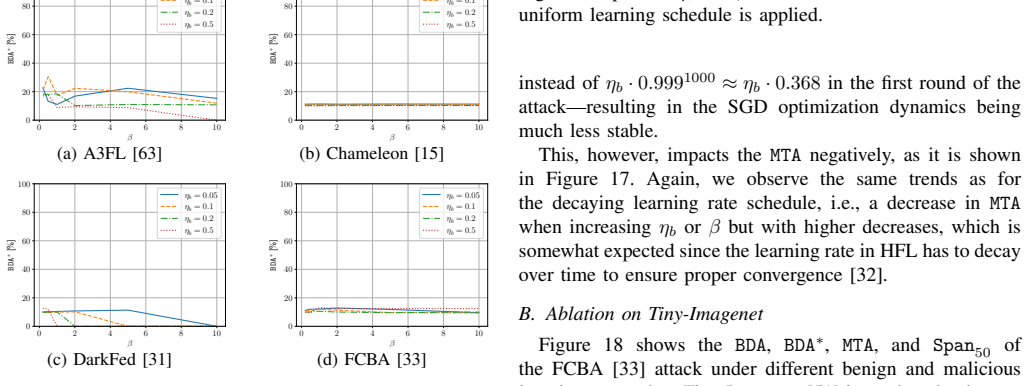
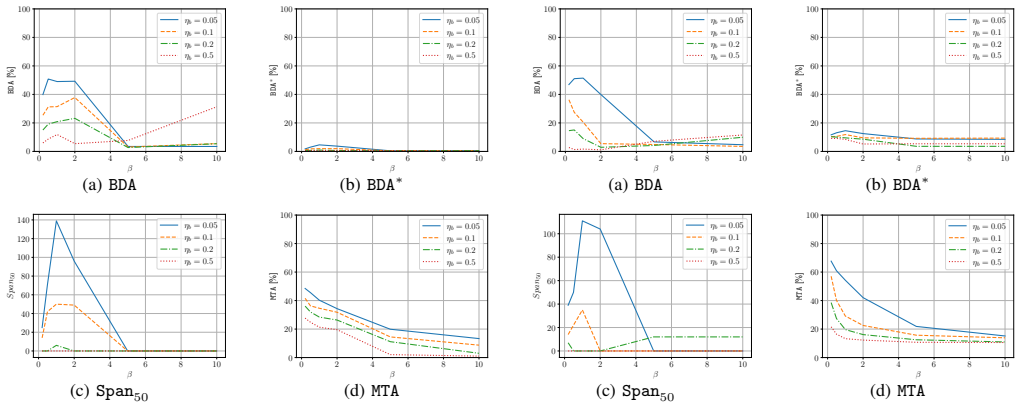
The load-bearing object is a recursive equation for the malicious loss under the standard FedAvg aggregation rule: F_m(θ^t)=F_m(θ^{t-1} − (1−α)Δ_b^t − αΔ_m^t), in which Δ_b and Δ_m are the benign and malicious model updates, each determined by learning rate, momentum, local epochs, batch size, and weight decay. The paper instantiates the two loss functions F_b and F_m with small diagonal linear networks on a toy classification problem plus a backdoor task, which lets it derive the qualitative behavior: raising the benign learning rate or the number of benign gradient steps raises the malicious loss (that is, lowers backdoor accuracy), and the effect saturates as the malicious learning rate g
Load-bearing premise
The recommendation assumes that the simplified model of training as two client groups—benign and malicious—plus the four tested attacks captures how backdoor resistance responds to benign hyperparameters in real deployments and future attacks.
What would settle it
Evaluate a held-out backdoor attack (e.g., a semantic-trigger attack on CIFAR-100) under the recommended benign configuration with the same attack budget; if peak backdoor accuracy or lifespan is not substantially lower than under the paper's default benign settings, the claim that benign tuning caps attack success regardless of attack is falsified.
If this is right
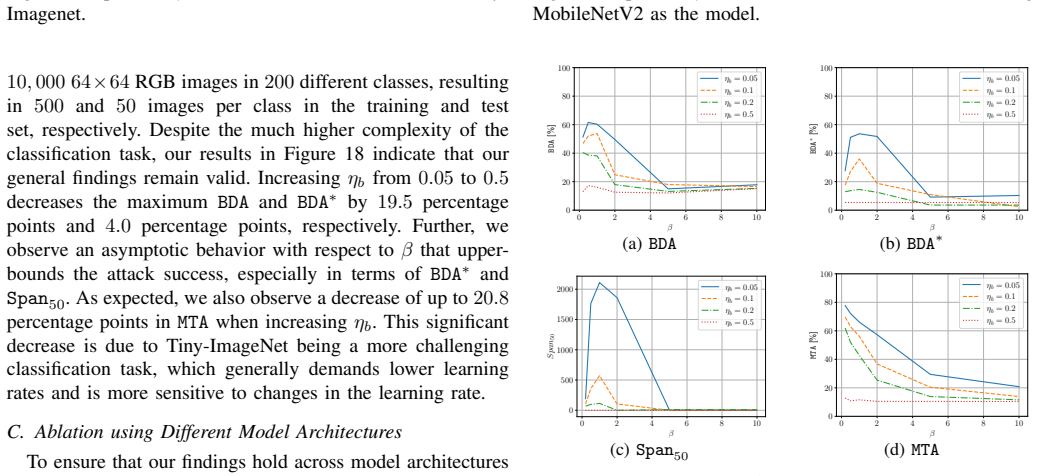
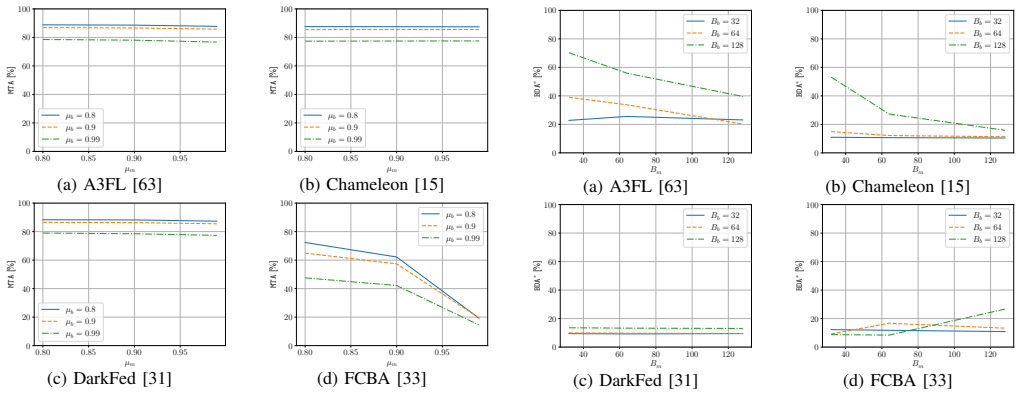
- Reported backdoor success rates in HFL are inflated when benign clients use the ad-hoc settings common in the literature; under the recommended benign configuration, backdoor accuracy and lifespan drop across all four tested attacks, in several cases to near-zero.
- A proactive, zero-overhead defense exists: choosing benign hyperparameters before deployment requires no runtime computation and can outperform at least one commonly used defense (Krum) when used alone.
- Adaptive adversaries—including those that greedily or stochastically tune malicious hyperparameters in response—are capped by well-chosen benign settings; against the stochastic adversary, average backdoor accuracy and post-attack backdoor accuracy fall by about 31 and 30 percentage points even without a defense.
- The effects hold across several model architectures (ResNet20, MobileNetV2, VGG17) and Tiny-ImageNet, so the qualitative guidance is not an artifact of one setup.
- Defenses such as FoolsGold combine usefully with tuned benign hyperparameters, while some defenses show less benefit than originally reported once benign settings are fixed.
Where Pith is reading between the lines
- Beyond the paper, if the asymptotic-cap result holds, future HFL security evaluations should publish and control benign hyperparameter choices; attack-defense comparisons without a tuned benign baseline would be hard to interpret.
- Beyond the paper, the mechanism suggests a deployment-time optimization loop: since the server already selects hyperparameters, it could run a small search (cheap proxy tasks) before deployment to find a config for its specific model, granting even stronger robustness than the paper's one-size-fits-all recommendation.
- Beyond the paper, the same reasoning predicts that heterogeneity in benign hyperparameters across clients destabilizes training and should be avoided—the paper validates this in four of six tested combinations; a natural extension is to quantify how much heterogeneity is tolerable before robustness degrades.
- Beyond the paper, the observed trend that model capacity increases backdoor persistence (VGG17) suggests larger models may need even more aggressive benign regularization, a testable prediction for transformer-scale federated models.
Editorial analysis
A structured set of objections, weighed in public.
Referee Report
Summary. The paper studies how the hyperparameters of benign clients in horizontal federated learning (HFL) affect the success of backdoor attacks and the effectiveness of defenses. It provides an analytical recursion on a toy diagonal-linear-network model (Eqs. (3)–(6)), an empirical ablation across five benign hyperparameters (learning rate, momentum, weight decay, local epochs, batch size) under four state-of-the-art attacks (A3FL, Chameleon, DarkFed, FCBA), four defenses, multiple architectures and datasets, and two adaptive adversary models. Based on a Pareto/NSGA-II search over a discrete grid, it recommends a single benign configuration (η_b=0.15, λ_b=0.0005, E_b=10, B_b=32) and claims that this configuration curbs backdoor effectiveness 'regardless of the malicious clients' settings' and 'without sacrificing main task accuracy,' e.g., reducing the A3FL 50%-lifespan by 98.6%.
Significance. If the central quantitative claims held, this would be an important result: benign hyperparameters would be a first-order, defender-controlled variable in HFL security evaluations, and many published attack/defense comparisons would need to be revisited. The paper has notable strengths: a systematic survey of 15 prior attacks, a unified evaluation framework, reproducible public code with fixed seeds, consistent qualitative trends across four attacks, multiple architectures, and multiple datasets, and an analytical recursion that is non-circular (it is a FedAvg update identity rather than an assumption smuggled into the conclusion). The direction of the effect — higher benign learning rate, more local epochs, smaller batch size, and higher weight decay reduce backdoor accuracy and lifespan — is consistently supported by the measurements. However, the stress-test concern lands: the recommended configuration is selected on the same attack/defense grid on which the headline numbers are reported, and Table V shows a concrete counterexample to the 'no sacrifice' claim. The strength of the paper is in the qualitative finding and the evaluation methodology; the current overclaims and the l
major comments (3)
- The abstract claims the recommended benign configuration yields 'across-the-board improvements in robustness without sacrificing main task accuracy' and works 'regardless of the malicious clients' settings.' This is not established. The configuration (η_b=0.15, λ_b=0.0005, E_b=10, B_b=32) is selected via grid search/NSGA-II on the same attack/defense combinations that are later reported as results, so the headline figures are in-sample selections. Table V, DarkFed/None row, shows the recommended configuration under the unconstrained greedy BDA-maximizing adversary yields MTA=11.4% versus 84.2% with the original parameters — a 72.8 percentage-point collapse. The MTA-constrained adversary (MTA_c) is listed as N.A. for this combination, so it does not rescue the claim. The 'regardless of malicious settings' claim fails for the unconstrained adversary. The revision should either restrict the
- The OLS regressions report R²=0.191 for BDA, 0.163 for BDA*, and 0.166 for Span50. These fits explain only a small fraction of the variance, so the benign hyperparameters are statistically significant but not dominant. The Pareto/NSGA-II selection over a 24-point grid then picks a single configuration; with such low explanatory power, the selected point is likely one of many near-equivalent solutions and is at risk of overfitting to the specific four attacks and four defenses evaluated. The paper needs cross-validation or a held-out evaluation to support the stability of the recommended configuration, and the quantitative claims (e.g., the 98.6% lifespan reduction) should be reported with error bars or across multiple seeds rather than as point estimates from the selection grid.
- The analytical recursion is a FedAvg update identity and is not circular, which I acknowledge as a strength. However, the paper uses a 2D classification task on a diagonal linear network as a 'faithful surrogate' for F_b and F_m, and then uses the asymptotic behavior of the toy model to argue that benign hyperparameters can lower-bound malicious loss 'irrespective of the malicious learning rate' and, by extension, 'regardless of the malicious clients' settings.' This is a strong conclusion drawn from a model with a hand-designed backdoor, full-batch gradient descent, no defenses, and no adaptive adversary. The empirical results support a qualitative direction, but the analytic model does not by itself establish the across-the-board, attacker-agnostic claim. I recommend reframing the analytical part as an illustrative mechanism and relying on the empirical evaluation for the quantitative
minor comments (5)
- [Abstract] The phrase 'reduced by 98.6%, respectively' contains a stray 'respectively' and should be reworded.
- [§IV-A] The notation 'Fm(θt)−Fm(θ*_m)∼Fm(θt)' is ambiguous; the '∼' is not defined. Please clarify what quantity is plotted in Figure 3.
- [§VI-C] The search space Ω is very small (η_b∈{0.1,0.15,0.2}, λ_b∈{0.0005,0.001}, E_b∈{10,20}, B_b∈{16,32}). The word 'Pareto frontier' is used for a frontier over a discrete grid; this is fine, but the recommended configuration's optimality is only within this grid. The paper should state this limitation explicitly in the main text, not only in the limitations section.
- [§VI-C] The paper states that grid search gave 'nearly identical' results to NSGA-II but reports only the NSGA-II outcome. Please provide the grid-search results or a direct comparison, since the reproducibility of the recommended configuration depends on this claim.
- [§III-B] The threat model states that malicious clients 'do observe the benign clients' training hyperparameters' and can estimate the impact of their choices. The adaptive adversary is then evaluated only on the same hyperparameter grid as the benign clients. This is a reasonable design, but the relation between the greedy/stochastic adversaries and the real-world 'informed manner' assumption should be discussed more carefully, especially since the stochastic adversary is much more computationally expensive than the greedy one.
Circularity Check
No circular derivation found: the recursion equations are FedAvg update identities, and the headline results are measurements, not quantities defined by the fitted hyperparameters. The recommended configuration is selected on the same evaluation grid, which is a generalization/overfitting concern rather than a circularity.
full rationale
The paper's analytical section (Eqs. 3-6) recursively states how the global model is updated under FedAvg with benign and malicious client updates; these are identities describing the update rule, not definitions that smuggle in the conclusion that higher benign learning rates reduce backdoor accuracy. The subsequent claims about BDA, BDA*, and lifespan are supported by direct measurements on the selected attacks and defenses, so the attack-success metrics are not defined by the hyperparameters being varied. The recommended benign configuration is found by Pareto/grid/NSGA-II search over the same attack-defense combinations later reported in Tables IV and V, so the headline improvement numbers are in-sample and may not generalize; Table V even shows DarkFed/None MTA collapsing to 11.4% under the unconstrained greedy adversary, contradicting the blanket 'without sacrificing main task accuracy' phrasing. However, this is a statistical selection/generalization caveat, not a case where the prediction reduces to its own input by construction. No self-citation chain or uniqueness theorem is load-bearing, and no equation is defined in terms of the quantity it is supposed to predict. The paper is therefore not significantly circular, though the strength of the quantitative claims should be tempered by the lack of out-of-sample validation.
Axiom & Free-Parameter Ledger
free parameters (5)
- Recommended benign learning rate eta_b =
0.15
- Recommended benign local epochs E_b =
10
- Recommended benign batch size B_b =
32
- Recommended benign weight decay lambda_b =
0.0005
- Learning-rate decay factor gamma =
0.999
axioms (6)
- domain assumption All honest clients use one shared hyperparameter configuration broadcast by the server.
- domain assumption The two-group abstraction: a single loss F_b and F_m represents all benign and malicious clients, respectively.
- domain assumption Adversaries observe the benign hyperparameters and may adapt malicious ones via greedy or stochastic (NSGA-II) search.
- ad hoc to paper A diagonal linear network on a 2D classification task with a designed backdoor is a faithful surrogate for F_b and F_m.
- ad hoc to paper The search grid Omega covers the practically relevant benign hyperparameter space.
- standard math FedAvg update recursion and SGD update rules in Equations 3 to 6.
Cite this review
Pith. "Pith review of On Hyperparameters and Backdoor-Resistance in Horizontal Federated Learning." pith.science (2026). https://pith.science/paper/7G55RVGC
@misc{pith2026250905192,
  author       = {Pith},
  title        = {Pith review of: On Hyperparameters and Backdoor-Resistance in Horizontal Federated Learning},
  year         = {2026},
  howpublished = {\url{https://pith.science/paper/7G55RVGC}},
  note         = {Machine review of arXiv:2509.05192}
}
abstract
Horizontal Federated Learning (HFL) is particularly vulnerable to backdoor attacks as adversaries can easily manipulate both the training data and processes to execute sophisticated attacks. In this work, we study the impact of training hyperparameters on the effectiveness of backdoor attacks and defenses in HFL. More specifically, we show both analytically and by means of measurements that the choice of hyperparameters by benign clients does not only influence model accuracy but also significantly impacts backdoor attack success. This stands in sharp contrast with the multitude of contributions in the area of HFL security, which often rely on custom ad-hoc hyperparameter choices for benign clients$\unicode{x2013}$leading to more pronounced backdoor attack strength and diminished impact of defenses. Our results indicate that properly tuning benign clients' hyperparameters$\unicode{x2013}$such as learning rate, batch size, and number of local epochs$\unicode{x2013}$can significantly curb the effectiveness of backdoor attacks, regardless of the malicious clients' settings. We support this claim with an extensive robustness evaluation of state-of-the-art attack-defense combinations, showing that carefully chosen hyperparameters yield across-the-board improvements in robustness without sacrificing main task accuracy. For example, we show that the 50%-lifespan of the strong A3FL attack can be reduced by 98.6%, respectively$\unicode{x2013}$all without using any defense and while incurring only a 2.9 percentage points drop in clean task accuracy.
Figures






Reference graph
Works this paper leans on
-
[1]
Maksym Andriushchenko, Aditya Vardhan Varre, Loucas Pillaud- Vivien, and Nicolas Flammarion. 2023. SGD with Large Step Sizes Learns Sparse Features. InICML
work page 2023
-
[2]
Apple. 2019. Designing for Privacy - WWDC19 - Videos. (2019). htt ps://developer.apple.com/videos/play/wwdc2019/708
work page 2019
- [3]
-
[4]
Eugene Bagdasaryan and Vitaly Shmatikov. 2021. Blind backdoors in deep learning models. InUSENIX Security
work page 2021
-
[5]
Eugene Bagdasaryan, Andreas Veit, Yiqing Hua, Deborah Estrin, and Vitaly Shmatikov. 2020. How To Backdoor Federated Learning. In AISTATS
work page 2020
-
[6]
Gilad Baruch, Moran Baruch, and Yoav Goldberg. 2019. A Little Is Enough: Circumventing Defenses For Distributed Learning. In NeurIPS
work page 2019
-
[7]
Daniel J. Beutel et al. 2022. Flower: A Friendly Federated Learning Research Framework. (2022). doi:10.48550/arXiv.2007.14390
-
[8]
Arjun Nitin Bhagoji, Supriyo Chakraborty, Prateek Mittal, and Seraphin Calo. 2019. Analyzing Federated Learning through an Ad- versarial Lens. InICML
work page 2019
-
[9]
Peva Blanchard, El Mahdi El Mhamdi, Rachid Guerraoui, and Julien Stainer. 2017. Machine Learning with Adversaries: Byzantine Tolerant Gradient Descent. InNeurIPS
work page 2017
-
[10]
Xiaoyu Cao, Jinyuan Jia, Zaixi Zhang, and Neil Zhenqiang Gong
-
[11]
1998.Statistical Power Analysis for the Behavioral Sciences
Jacob Cohen. 1998.Statistical Power Analysis for the Behavioral Sciences. (2nd Edition ed.)
work page 1998
-
[12]
Zico Kolter, and Ameet Talwalkar
Jeremy Cohen, Simran Kaur, Yuanzhi Li, J. Zico Kolter, and Ameet Talwalkar. 2021. Gradient descent on neural networks typically occurs at the edge of stability. InICLR
work page 2021
-
[13]
Francesco Croce and Matthias Hein. 2020. Reliable evaluation of adversarial robustness with an ensemble of diverse parameter-free attacks. InICML
work page 2020
-
[14]
Francesco D’Angelo, Maksym Andriushchenko, Aditya Vardhan Varre, and Nicolas Flammarion. 2024. Why do we need weight decay in modern deep learning? InNeurIPS
work page 2024
-
[15]
Yanbo Dai and Songze Li. 2023. Chameleon: Adapting to Peer Images for Planting Durable Backdoors in Federated Learning. InICML
work page 2023
-
[16]
Federated Learning in Practice: Reflections and Projections
Katharine Daly, Hubert Eichner, Peter Kairouz, H. Brendan McMahan, Daniel Ramage, and Zheng Xu. 2024. Federated Learning in Practice: Reflections and Projections. (2024). http://arxiv.org/abs/2410.08892
work page internal anchor Pith review Pith/arXiv arXiv 2024
- [17]
-
[18]
Pei Fang and Jinghui Chen. 2023. On the vulnerability of backdoor defenses for federated learning. InAAAI. doi:10.1609/aaai.v37i10.263 93
-
[19]
Sadegh Farhadkhani, Rachid Guerraoui, Nirupam Gupta, Rafael Pinot, and John Stephan. 2022. Byzantine machine learning made easy by resilient averaging of momentums. InICML
work page 2022
- [20]
-
[21]
Clement Fung, Chris J. M. Yoon, and Ivan Beschastnikh. 2020. The Limitations of Federated Learning in Sybil Settings. InRAID
work page 2020
-
[22]
Ian Goodfellow, Yoshua Bengio, and Aaron Courville. 2016.Deep Learning. https://www.deeplearningbook.org/
work page 2016
-
[23]
Tianyu Gu, Brendan Dolan-Gavitt, and S. Garg. 2017. BadNets: Identifying Vulnerabilities in the Machine Learning Model Supply Chain.CoRR. http://arxiv.org/abs/1708.06733
Pith/arXiv arXiv 2017
-
[24]
Andrew Hard, Kanishka Rao, Rajiv Mathews, Swaroop Ramaswamy, Franc ¸oise Beaufays, Sean Augenstein, Hubert Eichner, Chlo´e Kiddon, and Daniel Ramage. 2019. Federated Learning for Mobile Keyboard Prediction. (2019). doi:10.48550/arXiv.1811.03604
-
[25]
Fengxiang He, Tongliang Liu, and Dacheng Tao. 2019. Control batch size and learning rate to generalize well: Theoretical and empirical evidence. InNeurIPS
work page 2019
-
[26]
Kaiming He, Xiangyu Zhang, Shaoqing Ren, and Jian Sun. 2016. Deep Residual Learning for Image Recognition. InCVPR. doi:10.1109/CV PR.2016.90
doi:10.1109/cv 2016
-
[27]
James Kirkpatrick et al. 2017. Overcoming catastrophic forgetting in neural networks.Proceedings of the National Academy of Sciences. doi:10.1073/pnas.1611835114
-
[28]
A. Krizhevsky. 2009. Learning Multiple Layers of Features from Tiny Images. Tech. rep. https://www.semanticscholar.org/paper/Learning- Multiple-Layers-of-Features-from-Tiny-Krizhevsky/5d90f06bb70a0a 3dced62413346235c02b1aa086
work page 2009
-
[29]
Anders Krogh and John A. Hertz. 1991. A simple weight decay can improve generalization. InNeurIPS
work page 1991
-
[30]
Haoyang Li, Qingqing Ye, Haibo Hu, Jin Li, Leixia Wang, Chengfang Fang, and Jie Shi. 2023. 3DFed: Adaptive and Extensible Framework for Covert Backdoor Attack in Federated Learning. InIEEE S&P. doi:10.1109/SP46215.2023.10179401
arXiv 2023
-
[31]
Minghui Li, Wei Wan, Yuxuan Ning, Shengshan Hu, Lulu Xue, Leo Yu Zhang, and Yichen Wang. 2024. DarkFed: A data-free backdoor attack in federated learning. InIJCAI
work page 2024
-
[32]
Xiang Li, Kaixuan Huang, Wenhao Yang, Shusen Wang, and Zhihua Zhang. 2020. On the Convergence of FedAvg on Non-IID Data. In ICLR
work page 2020
-
[33]
Tao Liu, Yuhang Zhang, Zhu Feng, Zhiqin Yang, Chen Xu, Dapeng Man, and Wu Yang. 2024. Beyond traditional threats: A persistent backdoor attack on federated learning. InAAAI. doi:10.1609/AAAI.V3 8I19.30131
doi:10.1609/aaai.v3 2024
-
[34]
Yingqi Liu, Shiqing Ma, Yousra Aafer, Wen-Chuan Lee, Juan Zhai, Weihang Wang, and Xiangyu Zhang. 2018. Trojaning Attack on Neural Networks. InNDSS
work page 2018
-
[35]
Bing Luo, Wenli Xiao, Shiqiang Wang, Jianwei Huang, and Leandros Tassiulas. 2022. Tackling system and statistical heterogeneity for federated learning with adaptive client sampling. InINFOCOM. doi:1 0.1109/INFOCOM48880.2022.9796935
arXiv 2022
-
[36]
Xiaoting Lyu, Yufei Han, Wei Wang, Jingkai Liu, Bin Wang, Jiqiang Liu, and Xiangliang Zhang. 2023. Poisoning with cerberus: stealthy and colluded backdoor attack against federated learning. InAAAI. doi:1 0.1609/aaai.v37i7.26083
work page 2023
-
[37]
Brendan McMahan, Eider Moore, Daniel Ramage, Seth Hampson, and Blaise Aguera y Arcas. 2017. Communication-Efficient Learning of Deep Networks from Decentralized Data. InAISTATS
work page 2017
-
[38]
Brendan McMahan, Eider Moore, Daniel Ramage, Seth Hampson, and Blaise Ag ¨uera y Arcas
H. Brendan McMahan, Eider Moore, Daniel Ramage, Seth Hampson, and Blaise Ag ¨uera y Arcas. 2023. Communication-Efficient Learning of Deep Networks from Decentralized Data. (2023). doi:10.48550/ar Xiv.1602.05629
-
[39]
El Mahdi El Mhamdi, Rachid Guerraoui, and S ´ebastien Rouault. 2018. The Hidden Vulnerability of Distributed Learning in Byzantium. In ICML
work page 2018
-
[40]
Philipp Moritz et al. 2018. Ray: A distributed framework for emerging AI applications. InOSDI
work page 2018
-
[41]
Dung Thuy Nguyen, Tuan Minh Nguyen, Anh Tuan Tran, Khoa D. Doan, and Kok Seng Wong. 2023. IBA: Towards Irreversible Backdoor Attacks in Federated Learning. InNeurIPS
work page 2023
-
[42]
Mustafa Safa Ozdayi, Murat Kantarcioglu, and Yulia R. Gel. 2021. Defending against Backdoors in Federated Learning with Robust Learning Rate. InAAAI. doi:10.1609/aaai.v35i10.17118
-
[43]
Matthias Paulik et al. 2021. Federated Evaluation and Tuning for On- Device Personalization: System Design & Applications. (2021). doi:1 0.48550/arXiv.2102.08503
-
[44]
Phillip Rieger, Torsten Krauß, Markus Miettinen, Alexandra Dmitrienko, and Ahmad-Reza Sadeghi. 2024. CrowdGuard: Federated Backdoor Detection in Federated Learning. InNDSS Symposium
work page 2024
-
[45]
Dazhong Rong, Qinming He, and Jianhai Chen. 2022. Poisoning deep learning based recommender model in federated learning scenarios. In IJCAI. doi:10.24963/IJCAI.2022/306
-
[46]
Dazhong Rong, Shuai Ye, Ruoyan Zhao, Hon Ning Yuen, Jianhai Chen, and Qinming He. 2022. FedRecAttack: Model poisoning attack to federated recommendation. InICDE. doi:10.1109/ICDE53745.2022 .00243
arXiv 2022
-
[47]
Howard, Menglong Zhu, Andrey Zhmogi- nov, and Liang-Chieh Chen
Mark Sandler, Andrew G. Howard, Menglong Zhu, Andrey Zhmogi- nov, and Liang-Chieh Chen. 2018. MobileNetV2: Inverted residuals and linear bottlenecks. InCVPR. doi:10.1109/CVPR.2018.00474
arXiv 2018
-
[48]
Virat Shejwalkar, Amir Houmansadr, Peter Kairouz, and Daniel Ra- mage. 2022. Back to the Drawing Board: A Critical Evaluation of Poisoning Attacks on Production Federated Learning. InIEEE S&P. doi:10.1109/SP46214.2022.9833647
arXiv 2022
-
[49]
Eli Sherman and Ilya Shpitser. 2018. Identification and Estimation of Causal Effects from Dependent Data. InNeurIPS
work page 2018
-
[50]
Karen Simonyan and Andrew Zisserman. 2015. Very deep convolu- tional networks for large-scale image recognition. InICLR
work page 2015
-
[51]
Stanford. 2015. Tiny ImageNet Visual Recognition Challenge. (2015). https://cs231n.stanford.edu/2015/project.html
work page 2015
- [52]
-
[53]
Ziteng Sun, Peter Kairouz, Ananda Theertha Suresh, and H. Brendan McMahan. 2019. Can You Really Backdoor Federated Learning? (2019). doi:10.48550/arXiv.1911.07963
-
[54]
Ilya Sutskever, James Martens, George E. Dahl, and Geoffrey E. Hinton. 2013. On the importance of initialization and momentum in deep learning. InICML
work page 2013
-
[55]
Christian Szegedy, Wojciech Zaremba, Ilya Sutskever, Joan Bruna, Dumitru Erhan, Ian Goodfellow, and Rob Fergus. 2014. Intriguing properties of neural networks. InICLR. doi:10.48550/arXiv.1312.6199
-
[56]
Bolun Wang, Yuanshun Yao, Shawn Shan, Huiying Li, Bimal Viswanath, Haitao Zheng, and Ben Y . Zhao. 2019. Neural Cleanse: Identifying and Mitigating Backdoor Attacks in Neural Networks. In IEEE S&P. doi:10.1109/SP.2019.00031
arXiv 2019
-
[57]
Hongyi Wang, Kartik Sreenivasan, Shashank Rajput, Harit Vish- wakarma, Saurabh Agarwal, Jy-yong Sohn, Kangwook Lee, and Dim- itris Papailiopoulos. 2020. Attack of the tails: yes, you really can backdoor federated learning. InNeurIPS
work page 2020
- [58]
-
[59]
Chulin Xie, Keli Huang, Pin-Yu Chen, and Bo Li. 2020. DBA: Distributed Backdoor Attacks against Federated Learning. InICLR
work page 2020
-
[60]
Gonzalez, Kannan Ramchandran, and Michael W
Yaoqing Yang, Rajiv Khanna, Yaodong Yu, Amir Gholami, Kurt Keutzer, Joseph E. Gonzalez, Kannan Ramchandran, and Michael W. Mahoney. 2020. Boundary thickness and robustness in learning models. InNeurIPS. Optim [61] FCBA [33] DarkFed [31] IBA [41] A3FL [63] Chameleon [15] 3DFed [30] CerP [36] F3BA [18] Neurotoxin [65] Tails [57] Model Replacement [5] DBA [5...
work page 2020
-
[61]
Yuxin Yang, Qiang Li, Chenfei Nie, Yuan Hong, and Binghui Wang
-
[62]
Ki Yoon Yoo and Nojun Kwak. 2022. Backdoor Attacks in Federated Learning by Rare Embeddings and Gradient Ensembling. InEMNLP. doi:10.18653/v1/2022.emnlp-main.6
-
[63]
Hangfan Zhang, Jinyuan Jia, Jinghui Chen, Lu Lin, and Di Wu
-
[64]
Shijie Zhang, Hongzhi Yin, Tong Chen, Zi Huang, Quoc Viet Hung Nguyen, and Lizhen Cui. 2022. PipAttack: Poisoning federated rec- ommender systems for manipulating item promotion. InWSDM. doi:1 0.1145/3488560.3498386
arXiv 2022
-
[65]
Zhengming Zhang, Ashwinee Panda, Linyue Song, Yaoqing Yang, Michael Mahoney, Prateek Mittal, Ramchandran Kannan, and Joseph Gonzalez. 2022. Neurotoxin: Durable Backdoors in Federated Learn- ing. InICML. APPENDIXA SELECTION OFREPRESENTATIVEBACKDOORATTACKS We visually sorted all initially-selected 15 backdoor attacks (cf. Section III-C) in Figure 11. Here, ...
work page 2022
- [67]
-
[2002]
IEEE Transactions on Evolutionary Computation
A fast and elitist multiobjective genetic algorithm: NSGA-II. IEEE Transactions on Evolutionary Computation. doi:10.1109/4235.9 96017
-
[2024]
Breaking state-of-the-art poisoning defenses to federated learn- ing: An optimization-based attack framework. InCIKM. doi:10.1145 /3627673.3679566
This paper was first reviewed by deepseek-v4-flash on August 5, 2026.
discussion (0)
Sign in with ORCID, Apple, or X to comment. Anyone can read and Pith papers without signing in.