REVIEW 3 major objections 5 minor 78 references
Out of Time Order Correlations in the Quasi-Periodic Aubry-Andr\'e model
T0 review · 3 major / 5 minor · reviewed 2026-08-14 · deepseek-v4-flash
Pith's one-line read The paper claims a finite-time bound, Eq. (32), proving that out-of-time-ordered correlators equilibrate in any extended quadratic model.
desk verdict Eq. (27) invalidates the claimed equilibration bound, but the numerics are solid enough to warrant referee time. read the letter →
The pith
A machine-rendered reading of the paper's core claim, the machinery that carries it, and where it could break.
The reading
What carries the argument
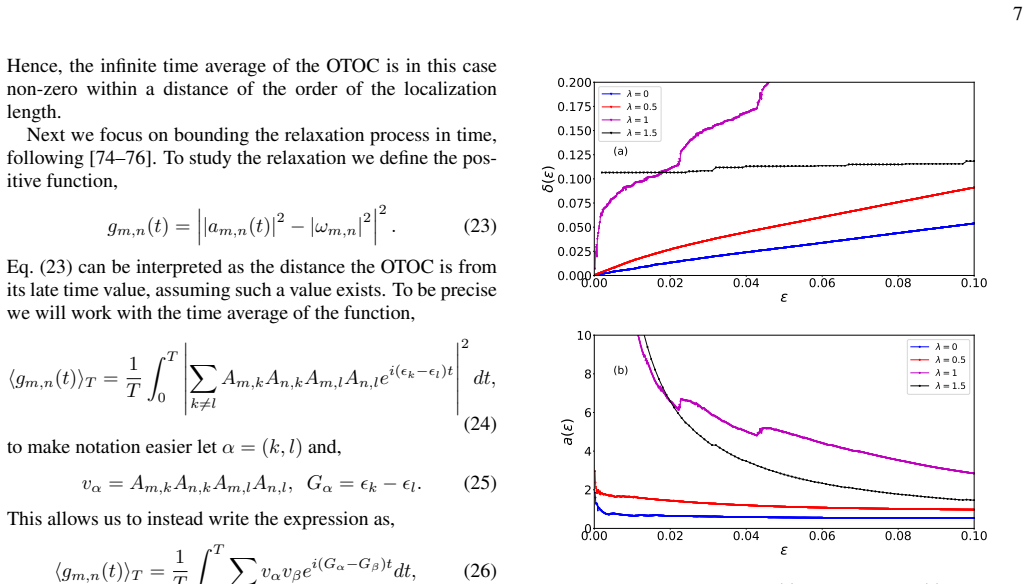
The central object is $g_{m,n}(t)=\big||a_{m,n}(t)|^2-|\omega_{m,n}|^2\big|^2$, where $a_{m,n}(t)=\sum_k A_{m,k}A_{n,k}e^{i\epsilon_k t}$ is the time-dependent anticommutator of the fermion operators and $|\omega_{m,n}|^2$ is its infinite-time average. The mechanism that carries the argument is the concentration function $\xi_p(x)=\max_\beta \sum_{\alpha: G_\beta \le G_\alpha \le G_\beta+x} p_\alpha$ for the distribution of frequency gaps $G_\alpha=\epsilon_k-\epsilon_l$ weighted by $p_\alpha=|v_\alpha|/Q$, combined with a Gaussian-profile bound on uniform time averages. This yields Eq. (32), whose $1/T$ term vanishes as $T\to\infty$ when $\delta(\epsilon)\approx 0$, which the numerics show for the extended phase.
What would settle it
Evaluate the exact time average $\langle g_{m,n}(t)\rangle_T$ for a finite Aubry-André chain (for example, $\lambda=0.5$, $L=1600$, $m=L/2$, $n=L/2+6$) by summing $v_\alpha v_\beta e^{i(G_\alpha-G_\beta)t}$ directly with signed coefficients, and compare with the right-hand side of Eq. (32) computed from $|v_\alpha|$. If the right-hand side is smaller than the exact average at any $T$ where $\delta(\epsilon)$ is claimed negligible, the bound as stated is false.
Extended reading notes
Core claim
The paper's central claim is that real-space OTOCs in the Aubry-André model equilibrate in the extended phase, and that the same argument works for any quadratic model in an extended regime. Concretely, it proves the bound $\langle g_{m,n}(t)\rangle_T \le \kappa\pi Q^2\big(a(\epsilon)/(\sigma_G T)+\delta(\epsilon)\big)$, where $\langle g_{m,n}(t)\rangle_T$ is the time average of the squared distance between $|a_{m,n}(t)|^2$ and its infinite-time average. Because extended-phase eigenvector amplitudes scale as $1/\sqrt{L}$, the infinite-time value vanishes in the thermodynamic limit, and with numerically small $\delta(\epsilon)$ the bound decays with $T$, establishing equilibration. The paper also claims that the infinite-time OTOC is zero in the extended phase (no persistent scrambling) and stays nonzero only within a localization length in the localized phase.
Load-bearing premise
The proof of Eq. (32) relies on replacing the signed coefficients $v_\alpha$ (products of eigenvector components, which can be negative) by their absolute values while keeping the oscillating phases $e^{i(G_\alpha-G_\beta)t}$; this step is only guaranteed to give an upper bound if all $v_\alpha$ have the same sign, and eigenvector products of opposite signs break it.
Editorial extensions
If this is right
- In the extended phase of the Aubry-André model ($\lambda<1$), the time-averaged OTOC deviation $\langle g_{m,n}(t)\rangle_T$ decays at least as $O(1/T)$, so the correlator equilibrates to its infinite-time value.
- Because $A_{m,k}\sim 1/\sqrt{L}$ in the extended phase, the infinite-time value itself vanishes in the thermodynamic limit, meaning the real-space OTOC equilibrates to zero (no persistent scrambling).
- The same bound applies to any quadratic model in an extended regime, so the result is not specific to the quasi-periodic potential.
- At the critical point and in the localized phase, $\delta(\epsilon)$ is not small, so the proof does not guarantee equilibration there, consistent with the observed lack of equilibration.
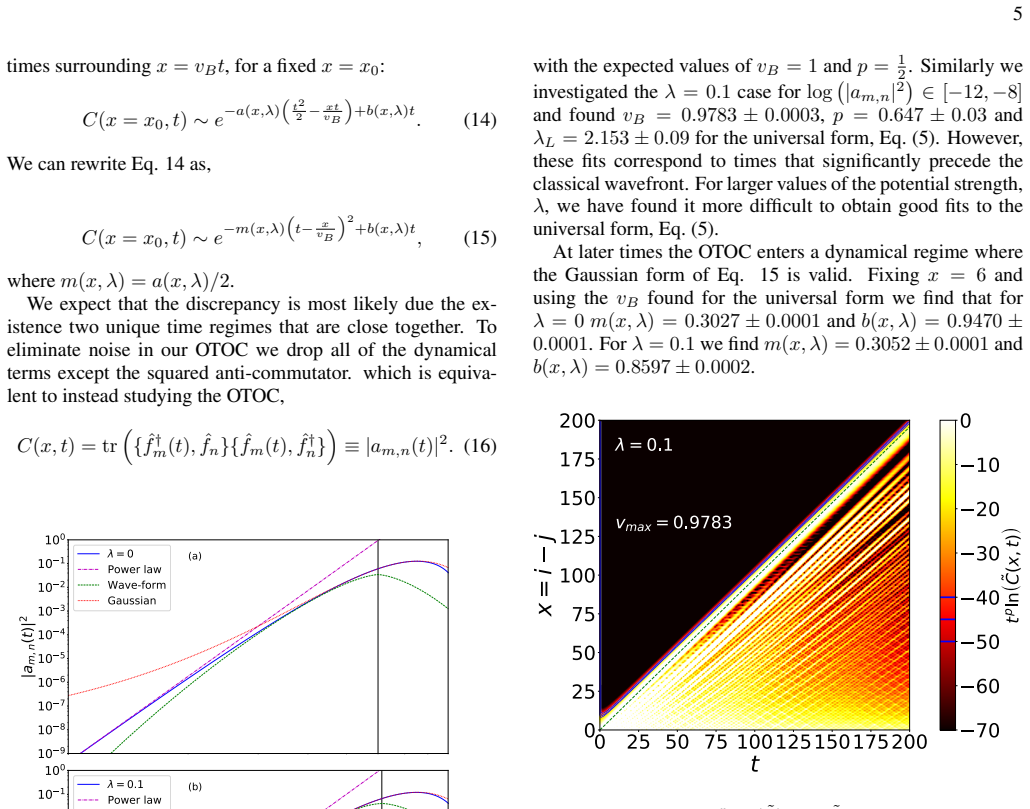
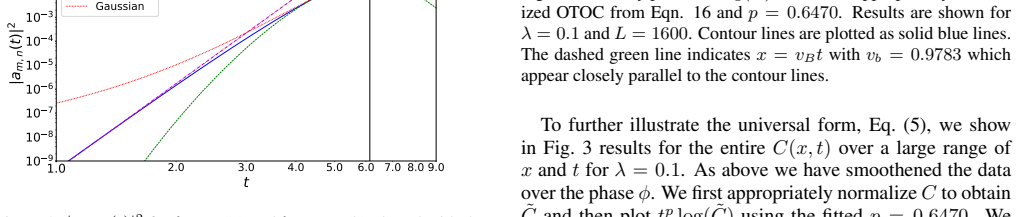
- The Gaussian wavefront near $x=v_B t$ and the universal form ahead of it become the main finite-time signatures of operator spreading, with fitted velocities matching the maximal group velocity.
Reading between the lines
- Editorial extension: the same concentration-function machinery could bound equilibration of higher-order OTOCs or other local observables in models whose single-particle spectrum is known, without requiring chaos.
- Editorial extension: if the bound survives the sign issue at Eq. (27), it suggests a general route from single-particle spectral statistics to rigorous statements about operator spreading.
- Editorial extension: a direct numerical test comparing the exact signed-coefficient time average with the absolute-coefficient right-hand side of Eq. (32) would show whether the extended-phase claim is robust or an artifact of the triangle inequality.
Signed reviews
Editorial analysis
A structured set of objections, weighed in public.
Referee Report
Summary. The manuscript studies out-of-time-ordered correlators (OTOCs) in the quasi-periodic Aubry-André model, a free-fermion model with a localization transition. After introducing a quench protocol and deriving the anticommutator amplitude a_{m,n}(t), the authors report five time-regime results: early-time power-law growth, a wavefront described by the universal form of Eq. (5) and by a Gaussian form, a late-time equilibration bound for the squared anticommutator (Eq. (32)), and momentum-space OTOCs fitted to an ad-hoc form. The central claim is that the late-time bound proves equilibration of the OTOC in the extended phase and generalizes to all quadratic models.
Significance. If the late-time bound were correct, it would be a notable rigorous result: a finite-time equilibration bound for (a variant of) an OTOC in free-fermion systems, extending the equilibration machinery of Refs. [74-76]. The numerical study of the AA model provides useful exact-diagonalization data for wavefronts and momentum OTOCs. However, the proof contains a load-bearing error at Eq. (27), and the quantity being bounded is not the full OTOC of Eq. (1). The wavefront and momentum results are empirical fits with fitted parameters, so they are phenomenological rather than predictive. The strengths are the large-scale exact numerics and the transparent presentation of the attempted derivation; no machine-checked proofs or reproducible code are provided. On balance, the central claim is not established.
major comments (3)
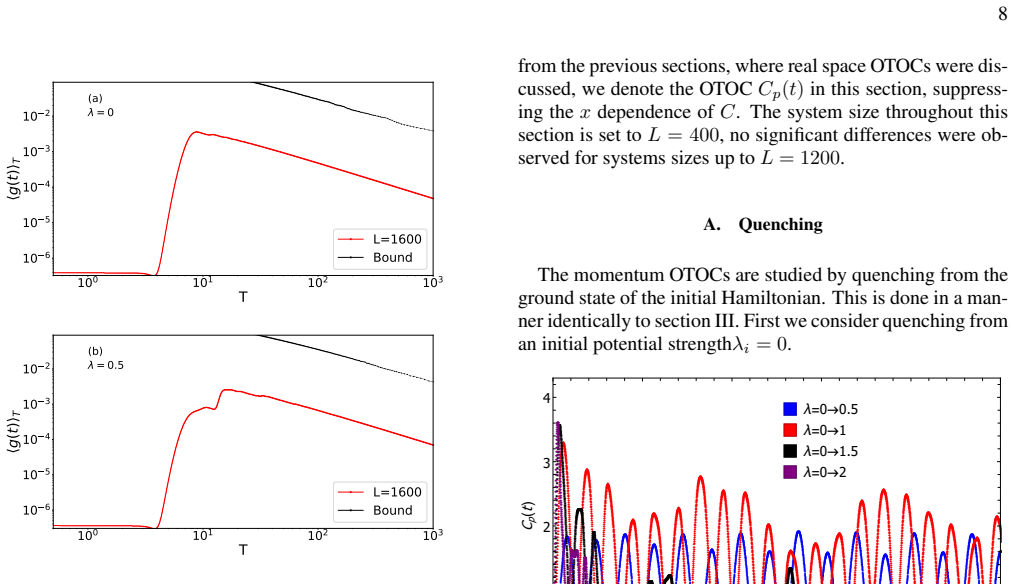
- [Section III C, Eq. (27)] The step from Eq. (26) to Eq. (27) is not a consequence of the triangle inequality. Replacing the signed coefficients v_α by |v_α| while retaining the phases e^{iG_α t} does not yield an upper bound: for v_1=1, v_2=-1, G_1=0, G_2=π, the time average of |1-e^{iπt}|^2 over T=3/2 is 2+4/(3π), while the proposed bound with |v_α| gives 2-4/(3π), violating the inequality. Thus Eq. (29) and Eq. (32) bound the wrong object, and the claimed equilibration of the OTOC in any quadratic model is unproven. The numerical check in Fig. 7 only demonstrates the inequality for two specific parameter sets; it cannot cover the failure modes introduced by mixed-sign v_α.
- [Section III C, Eq. (16)] The proof applies to the squared anti-commutator |a_{m,n}(t)|^2 defined in Eq. (16), not to the full OTOC C(x,t)=⟨[A(t),B]^†[A(t),B]⟩ of Eq. (1). The full OTOC contains additional correlation terms (Appendix C, Eq. C33). Equilibration of |a_{m,n}|^2 does not imply equilibration of C(x,t). The abstract and conclusion state the result as 'equilibration of the OTOC' and as valid for 'any quadratic model', which overstates what is shown. The authors should at minimum restrict the claim to the truncated correlator.
- [Section III B] The universal wavefront form Eq. (5) is 'confirmed' using values of v_B, p, λ_L obtained by fitting the same data; this is circular and does not constitute an independent verification. Similarly, the Gaussian form Eq. (17) is an empirical fit with fitted parameters m and b, and the momentum OTOC form Eq. (36) is explicitly ad hoc. These results are phenomenology, not derived predictions, and the text should be reframed accordingly.
minor comments (5)
- [Abstract; Section II; Appendix A; Section IV] There are several typos: the abstract's 'ans' should be 'and'; Section II's statement that the model is identical to the Aubry-André model is redundant with the introduction; Appendix A's 'diagonilized' should be 'diagonalized'; Section IV's 'quecnhing' should be 'quenching'.
- [Fig. 2 caption] The caption says 'Results are for a fixed x=6 with L=1600 and λ=0' but panel (b) is λ=0.1; the parameters for each panel should be specified separately.
- [Fig. 7] The vertical axis label 'g(t) T' should be '⟨g⟩_T' and the caption should define the time average explicitly.
- [Eq. (30)] The formula for σ_G is written as sqrt(Σ p_α G_α^2 - (p_α G_α)^2); this should be sqrt(Σ_α p_α G_α^2 - (Σ_α p_α G_α)^2) to be unambiguous.
- [Eq. (34)] The bound c^4/L^2 is plausible but the derivation is compressed; the authors should show the number of terms in the sum over k≠l and the justification for treating c as system-size independent.
Circularity Check
No circularity: the main equilibration bound is derived from standard external equilibration machinery plus a self-contained appendix, and the wavefront/momentum fits are empirical calibrations of externally proposed forms, not predictions forced by the paper's own definitions.
full rationale
The paper's central finite-time bound, Eq. (32), is obtained by applying the equilibration framework of Refs. [74]–[76] to the explicitly written anti-commutator correlator |a_{m,n}(t)|^2. The Gaussian-averaging argument is reproduced in Appendix D, and the key structural lemma used at Eq. (31) is attributed to proposition 5 of Ref. [75], whose authors do not overlap with the present paper. Although Eq. (27) is described as following from the triangle inequality, and this step is mathematically questionable when the coefficients v_alpha have mixed signs, that is a correctness defect rather than a circular reduction: the paper does not define the target quantity in terms of the bound or fit the bound to the target. The wavefront analysis fits the external universal form Eq. (5), proposed by Refs. [29,30], to numerical data and then compares the fitted parameters with expected values; extracting v_B, p, and lambda_L from data and presenting agreement as confirmation is calibration, not a claim that the functional form is derived from the fit. The Gaussian form around x = v_B t and the momentum-space form Eq. (36) are explicitly empirical or ad hoc, so presenting them as observed fits is not circular. Self-citations appear (Ref. [11] for the Hadamard-formula argument and Ref. [76] as a similar proof reference), but they are not load-bearing: the early-time argument is also supported by the physical statement that the first dynamical contribution comes from hopping only, and the late-time proof is self-contained and cites the non-overlapping Ref. [75] for the proposition that controls xi_p(x). No step reduces to its own input by definition, no fitted parameter is renamed as a prediction of the central bound, and no uniqueness or existence claim is imported from the authors' own prior work. The honest finding is that the derivation chain is self-contained with respect to circularity, regardless of whether every inequality is valid.
Assumptions & free parameters
free parameters (5)
- butterfly velocity v_B =
0.9950 ± 0.0002 (λ=0), 0.9783 ± 0.0003 (λ=0.1)
- wavefront exponent p =
0.50 ± 0.08 (λ=0), 0.647 ± 0.03 (λ=0.1)
- Lyapunov exponent λ_L =
1.78 ± 0.03 (λ=0), 2.153 ± 0.09 (λ=0.1)
- Gaussian wavefront parameters m(x,λ), b(x,λ) =
m=0.3027, b=0.9470 (λ=0, x=6); m=0.3052, b=0.8597 (λ=0.1, x=6); asymptotic values m≈0.01, b≈0.2 (λ=0)
- momentum OTOC fit parameters C, a, b, c, d =
not reported
assumptions (4)
- domain assumption The Aubry-André model has a localization transition at λ_c=J for golden-mean σ.
- domain assumption Extended eigenvector components scale as |A_{m,k}| ~ 1/√L.
- ad hoc to paper Replacing signed coefficients v_α by |v_α| while retaining e^{i(G_α-G_β)t} yields an upper bound in Eq. (27).
- standard math Proposition 5 of Ref. [75] bounds ξ_p(x) by a(ε)x/σ_G + δ(ε).
Cite this review
Pith. "Pith review of Out of Time Order Correlations in the Quasi-Periodic Aubry-Andr\'e model." pith.science (2026). https://pith.science/paper/7GZBHXWB
@misc{pith2026190803292,
  author       = {Pith},
  title        = {Pith review of: Out of Time Order Correlations in the Quasi-Periodic Aubry-Andr\'e model},
  year         = {2026},
  howpublished = {\url{https://pith.science/paper/7GZBHXWB}},
  note         = {Machine review of arXiv:1908.03292}
}
abstract
We study out of time ordered correlators (OTOC) in a free fermionic model with a quasi-periodic potential. This model is equivalent to the Aubry-Andr\'e model and features a phase transition from an extended phase to a localized phase at a non-zero value of the strength of the quasi-periodic potential. We investigate five different time-regimes of interest for out of time ordered correlators; early, wavefront, $x=v_Bt$, late time equilibration and infinite time. For the early time regime we observe a power law for all potential strengths. For the time regime preceding the wavefront we confirm a recently proposed universal form and use it to extract the characteristic velocity of the wavefront for the present model. A Gaussian waveform is observed to work well in the time regime surrounding $x=v_Bt$. Our main result is for the late time equilibration regime where we derive a finite time equilibration bound for the OTOC, bounding the correlator's distance from its late time value. The bound impose strict limits on equilibration of the OTOC in the extended regime ans is valid not only for the Aubry-Andr\'e model but for any quadratic model model. Finally, momentum out of time ordered correlators for the Aubry-Andr\'e model are studied where large values of the OTOC are observed at late times at the critical point.
Figures

Figures from the paper (6 more)




Reference graph
Works this paper leans on
-
[1]
Maldacena, S
J. Maldacena, S. H. Shenker, and D. Stanford, Journal of High Energy Physics 2016, 106 (2016)
2016
-
[2]
The universal form, Eq. (5), cannot be re-expressed in a form equivalent to the ’Gaussian’ form characterized by two spatial and disorder de- pendent functions a(x,λ ), b(x,λ ) proposed in Ref. 11, for 5 times surroundingx =vBt, for a fixedx =x0: C(x =x0,t )∼e −a(x,λ) ( t2 2− xt vB ) +b(x,λ)t . (14) We can rewrite Eq. 14 as, C(x =x0,t )∼e −m(x,λ) ( t− x vB...
-
[3]
Similarly we investigated theλ = 0.1 case for log ( |am,n|2) ∈ [−12,−8] and found vB = 0.9783± 0.0003, p = 0.647± 0.03 and λL = 2.153± 0.09 for the universal form, Eq. (5). However, these fits correspond to times that significantly precede the classical wavefront. For larger values of the potential strength, λ, we have found it more difficult to obtain good ...
- [4]
- [5]
-
[6]
J. R. Gonz ´alez Alonso, N. Yunger Halpern, and J. Dressel, Phys. Rev. Lett. 122, 040404 (2019)
work page 2019
-
[7]
B. Yan, L. Cincio, and W. H. Zurek, (2019), arXiv:1903.02651
arXiv 2019
- [8]
Show all 78 references
-
[9]
D. Mao, D. Chowdhury, and T. Senthil, (2019), arXiv:1903.10499
2019 arXiv
-
[10]
R. J. Lewis-Swan, A. Safavi-Naini, J. J. Bollinger, and A. M. Rey, Nature Communications 10, 1581 (2019)
2019
-
[11]
Uni- versal scrambling in gapless quantum spin chains,
S. Nakamura, E. Iyoda, T. Deguchi, and T. Sagawa, “Uni- versal scrambling in gapless quantum spin chains,” (2019), arXiv:1904.09778
2019 arXiv
-
[12]
Bohrdt, C
A. Bohrdt, C. B. Mendl, M. Endres, and M. Knap, New Journal of Physics 19, 063001 (2017)
2017
-
[13]
Riddell and E
J. Riddell and E. S. Sørensen, Phys. Rev. B 99, 054205 (2019)
2019
-
[14]
R. Fan, P. Zhang, H. Shen, and H. Zhai, Science Bulletin 62, 707 (2017)
2017
- [15]
-
[16]
J. Lee, D. Kim, and D. H. Kim, (2018), arXiv:1812.00357
2018 arXiv
-
[17]
X. Chen, T. Zhou, D. A. Huse, and E. Fradkin, Annalen der Physik 529, 1600332 (2017)
2017
-
[18]
Swingle, G
B. Swingle, G. Bentsen, M. Schleier-Smith, and P. Hayden, Phys. Rev. A 94, 040302 (2016)
2016
-
[19]
G. Zhu, M. Hafezi, and T. Grover, Phys. Rev. A 94, 062329 (2016)
2016
-
[20]
N. Y . Yao, F. Grusdt, B. Swingle, M. D. Lukin, D. M. Stamper-Kurn, J. E. Moore, and E. A. Demler, (2016), arXiv:1607.01801
2016 arXiv
-
[21]
Danshita, M
I. Danshita, M. Hanada, and M. Tezuka, Progress of Theoretical and Experimental Physics 2017 (2017), 10.1093/ptep/ptx108, http://oup.prod.sis.lan/ptep/article- pdf/2017/8/083I01/19650704/ptx108.pdf
2017 doi
-
[22]
G ¨arttner, J
M. G ¨arttner, J. G. Bohnet, A. Safavi-Naini, M. L. Wall, J. J. Bollinger, and A. M. Rey, Nature Physics 13, 781 (2017)
2017
-
[23]
J. Li, R. Fan, H. Wang, B. Ye, B. Zeng, H. Zhai, X. Peng, and J. Du, Phys. Rev. X 7, 031011 (2017)
2017
-
[24]
K. A. Landsman, C. Figgatt, T. Schuster, N. M. Linke, B. Yoshida, N. Y . Yao, and C. Monroe, Nature Publishing Group 567, 1 (2019)
2019
-
[25]
Miller, Symmetry Groups and Their Applications, Computer Science and Applied Mathematics (Academic Press, 1972)
W. Miller, Symmetry Groups and Their Applications, Computer Science and Applied Mathematics (Academic Press, 1972)
1972
-
[26]
D ´ora and R
B. D ´ora and R. Moessner, Phys. Rev. Lett.119, 026802 (2017)
2017
-
[27]
D. A. Roberts and B. Swingle, Phys. Rev. Lett. 117, 091602 (2016)
2016
-
[28]
X. Chen, T. Zhou, and C. Xu, Journal of Statistical Mechanics: Theory and Experiment 2018, 073101 (2018). 16
2018
-
[29]
Lin and O
C.-J. Lin and O. I. Motrunich, Phys. Rev. B 97, 144304 (2018)
2018
- [30]
- [31]
-
[32]
Khemani, D
V . Khemani, D. A. Huse, and A. Nahum, Phys. Rev. B 98, 144304 (2018)
2018
-
[33]
Nahum, S
A. Nahum, S. Vijay, and J. Haah, Phys. Rev. X 8, 021014 (2018)
2018
-
[34]
C. W. von Keyserlingk, T. Rakovszky, F. Pollmann, and S. L. Sondhi, Phys. Rev. X 8, 021013 (2018)
2018
- [35]
-
[36]
Gu, X.-L
Y . Gu, X.-L. Qi, and D. Stanford, Journal of High Energy Physics 2017, 125 (2017)
2017
- [37]
-
[38]
S. Sahu, S. Xu, and B. Swingle, arXiv cond-mat.str-el (2018), 1807.06086
2018 arXiv
-
[39]
Rakovszky, F
T. Rakovszky, F. Pollmann, and C. W. von Keyserlingk, Phys. Rev. X 8, 031058 (2018)
2018
-
[40]
S. H. Shenker and D. Stanford, Journal of High Energy Physics 2014, 67 (2014)
2014
-
[41]
A. A. Patel, D. Chowdhury, S. Sachdev, and B. Swingle, Phys. Rev. X 7, 031047 (2017)
2017
-
[42]
Chowdhury and B
D. Chowdhury and B. Swingle, Phys. Rev. D 96, 065005 (2017)
2017
-
[43]
Huang, Y .-L
Y . Huang, Y .-L. Zhang, and X. Chen, Annalen der Physik529, 1600318 (2017)
2017
-
[45]
He and Z.-Y
R.-Q. He and Z.-Y . Lu, Phys. Rev. B95, 054201 (2017)
2017
-
[46]
D. A. Roberts and B. Yoshida, Journal of High Energy Physics 2017, 121 (2017)
2017
- [47]
- [48]
-
[49]
J. K. Max McGinley, Andreas Nunnenkamp, arXiv.org (2018), 1807.06039
2018 arXiv
-
[50]
B.-B. Wei, G. Sun, and M.-J. Hwang, (2019), 1906.00533
2019 arXiv
-
[51]
Aubry and G
S. Aubry and G. Andr, Proceedings, VIII International Collo- quium on Group-Theoretical Methods in Physics 3 (1980)
1980
-
[52]
Hiramoto and M
H. Hiramoto and M. Kohmoto, Physical Review B 40, 8225 (1989)
1989
-
[53]
Aulbach, A
C. Aulbach, A. Wobst, G.-L. Ingold, P. H ¨anggi, and I. Varga, New Journal Of Physics 6, 70 (2004)
2004
-
[54]
D. J. Boers, B. Goedeke, D. Hinrichs, and M. Holthaus, Phys. Rev. A 75, 063404 (2007)
2007
-
[55]
Modugno, New Journal Of Physics 11, 033023 (2009)
M. Modugno, New Journal Of Physics 11, 033023 (2009)
2009
-
[56]
Albert and P
M. Albert and P. Leboeuf, Phys. Rev. A 81, 013614 (2010)
2010
-
[57]
Ribeiro, M
P. Ribeiro, M. Haque, and A. Lazarides, Phys. Rev. A 87, 043635 (2013)
2013
-
[58]
Danieli, K
C. Danieli, K. Rayanov, B. Pavlov, G. Martin, and S. Flach, International Journal of Modern Physics B29, 1550036 (2015)
2015
-
[59]
Wang and P
X. Wang and P. Tong, Journal of Statistical Mechanics: Theory and Experiment 2017, 113107 (2017)
2017
-
[60]
X. Li, X. Li, and S. Das Sarma, Phys. Rev. B 96, 085119 (2017)
2017
-
[61]
A. J. Mart ´ınez, M. A. Porter, and P. G. Kevrekidis, Philosoph- ical Transactions of the Royal Society A: Mathematical, Physi- cal and Engineering Sciences 376, 20170139 (2018)
2018
-
[62]
G. A. D. Castro and R. Paredes, European Journal of Physics (2019)
2019
-
[63]
Gramsch and M
C. Gramsch and M. Rigol, Phys. Rev. A 86, 053615 (2012)
2012
-
[64]
Roati, C
G. Roati, C. D’Errico, L. Fallani, M. Fattori, C. Fort, M. Za- ccanti, G. Modugno, M. Modugno, and M. Inguscio, Nature 453, 895 (2008)
2008
-
[65]
Deissler, M
B. Deissler, M. Zaccanti, G. Roati, C. D’Errico, M. Fattori, M. Modugno, G. Modugno, and M. Inguscio, Nature Physics 6, 354 (2010)
2010
-
[66]
Lucioni, B
E. Lucioni, B. Deissler, L. Tanzi, G. Roati, M. Zaccanti, M. Modugno, M. Larcher, F. Dalfovo, M. Inguscio, and G. Modugno, Physical Review Letters 106, 133 (2011)
2011
-
[67]
Fallani, J
L. Fallani, J. E. Lye, V . Guarrera, C. Fort, and M. Inguscio, Physical Review Letters 98, 39 (2007)
2007
-
[68]
Schreiber, S
M. Schreiber, S. S. Hodgman, P. Bordia, H. P. L ¨uschen, M. H. Fischer, R. V osk, E. Altman, U. Schneider, and I. Bloch, Sci- ence 349, 842 (2015)
2015
-
[69]
H. P. L ¨uschen, P. Bordia, S. S. Hodgman, M. Schreiber, S. Sarkar, A. J. Daley, M. H. Fischer, E. Altman, I. Bloch, and U. Schneider, Physical Review X 7, 37 (2017)
2017
-
[70]
H. P. L ¨uschen, P. Bordia, S. Scherg, F. Alet, E. Altman, U. Schneider, and I. Bloch, Physical Review Letters 119, 18 (2017)
2017
-
[71]
S. Iyer, V . Oganesyan, G. Refael, and D. A. Huse, Phys. Rev. B 87, 134202 (2013)
2013
-
[72]
S. Xu, X. Li, B. Swingle, and S. Das Sarma, arXiv.org (2019), 1902.07199
2019 arXiv
-
[73]
Coleman, Introduction to Many-Body Physics (Cambridge University Press, 2015)
P. Coleman, Introduction to Many-Body Physics (Cambridge University Press, 2015)
2015
-
[74]
Muralidharan, K
S. Muralidharan, K. Lochan, and S. Shankaranarayanan, Phys. Rev. E 97, 012142 (2018)
2018
-
[75]
Abdul-Rahman, B
H. Abdul-Rahman, B. Nachtergaele, R. Sims, and G. Stolz, Annalen der Physik 529, 1600280 (2017)
2017
-
[76]
A. S. L. Malabarba, L. P. Garc ´ıa-Pintos, N. Linden, T. C. Far- relly, and A. J. Short, Phys. Rev. E 90, 012121 (2014)
2014
-
[77]
L. P. Garc´ıa-Pintos, N. Linden, A. S. L. Malabarba, A. J. Short, and A. Winter, Phys. Rev. X7, 031027 (2017)
2017
-
[78]
Alhambra, J
´Alvaro M. Alhambra, J. Riddell, and L. P. Garc ´ıa-Pintos, arXiv:1906.11280 (2019)
2019 arXiv
-
[79]
Perarnau-Llobet, A
M. Perarnau-Llobet, A. Riera, R. Gallego, H. Wilming, and J. Eisert, New Journal of Physics 18, 123035 (2016)
2016
Reviewed August 14, 2026 · model on record in the stance chip above.
Discussion (0). Continue with ORCID to comment.