REVIEW 3 major objections 5 minor 130 references
Squeeze3D: Your 3D Generation Model is Secretly an Extreme Neural Compressor
T0 review · 3 major / 5 minor · reviewed 2026-08-07 · deepseek-v4-flash
Pith's one-line read The paper claims that a frozen pre-trained 3D generator, bridged to a pre-trained encoder by two small mapping networks trained only on synthetic outputs, acts as an extreme lossy codec, squeezing meshes, point clouds, and radiance fields…
desk verdict Squeeze3D has a genuinely new mechanism and plausible mesh results, but the evaluation oversells the extreme-compression story and dodges the hard off-manifold test. read the letter →
The pith
A machine-rendered reading of the paper's core claim, the machinery that carries it, and where it could break.
The reading
What carries the argument
The load-bearing mechanism is the pair of trainable mappings $F^E_\theta$ and $F^D_\theta$ between two frozen latent spaces, one belonging to the encoder $E$ and one to the generator $\mathcal G$. A Gram-loss term, $\lambda_{\text{gram}}\|F^E_\theta(z_E)F^E_\theta(z_E)^\top - I\|_F^2$, drives the compressed codes toward orthonormality, which the authors show is needed because unregularized codes concentrate information along a few dominant singular directions and waste most of their dimensions. The compressed latent dimension then acts as the rate knob of the codec: the ablation on point clouds shows quality rises with code size up to a point, then saturates.
What would settle it
Encode a curated set of objects from categories the generator has never seen (for example, mechanical CAD parts or indoor room scans), store only the compressed codes, and reconstruct; if the reconstructions are no closer to the inputs than random samples from the generator by standard metrics such as LPIPS or Chamfer distance, the claim that Squeeze3D acts as a general 3D compressor fails for out-of-prior inputs.
Extended reading notes
Core claim
Squeeze3D's central claim is that disparate latent spaces can be bridged by learned maps, making an existing encoder-generator pair into a codec without retraining either model. For an object $G$, the encoder yields $z_E=E(G)$; the forward mapping $F^E_\theta$ compresses it to $z_{\text{comp}}$; the reverse mapping $F^D_\theta$ lifts that code to a generator latent $z_G$; and the frozen generator $\mathcal{G}(z_G,c)$ redraws the object. The authors report compression ratios up to 2187x for textured meshes, about 58x for point clouds, and about 619x for radiance fields, with reconstruction quality close to that of methods that compress far less aggressively. Because the mapping networks are trained exclusively on synthetic generator outputs, the pipeline is format-agnostic and can be re-targeted to a new encoder or generator by retraining only the two small networks.
Load-bearing premise
The load-bearing premise is that any object fed to the codec lies close enough to the generator's output distribution that the encoder's latent can be inverted into a generator latent whose output resembles that object; if the object is outside the generator's prior, the stored code contains no genuine object identity and decompression becomes a hallucination.
Editorial extensions
If this is right
- A textured mesh can be stored and transmitted as about 3 KB, a point cloud as about 2 KB, and a radiance field as about 90 KB, without per-object training.
- Compression and decompression are single forward passes through small networks plus the frozen generator, so the method avoids the long per-scene optimizations of many neural compression methods; the paper reports roughly 270 ms to compress and 1.5 s to decompress a mesh.
- The same recipe applies to any encoder-generator pair, so supporting a new 3D format or a stronger generator only requires retraining the two mapping networks.
- Reconstruction quality is capped by the generator's representational power, which means Squeeze3D inherits future generator improvements for free.
- Compressed codes form a continuous, interpolable space, so linearly interpolating two codes yields an intermediate mesh.
Reading between the lines
- The same latent-bridging recipe could be lifted to 2D or video: a frozen image or video diffusion model would act as the decoder, mapping networks would be trained only on synthetic outputs, and the achievable ratios would be determined by how well the generator covers the test distribution.
- The rate-distortion frontier of this approach is set by the generator's prior, not by the codec, so a meaningful benchmark would measure reconstruction fidelity as a function of how far test objects fall from that prior; the paper's appendix already shows a 4.22 dB PSNR drop on out-of-distribution radiance fields.
- The Gram-loss finding suggests a general design rule for neural latent codecs: without an orthonormality regularizer, the effective rank of the compressed code is far below its nominal dimension, so any learned bottleneck should include such a term.
- A hybrid system could detect when the input is out of the generator's support and fall back to a classical codec; the paper flags the need for such a fallback, and a concrete test would be a decision rule based on reconstruction likelihood or latent density.
Editorial analysis
A structured set of objections, weighed in public.
Referee Report
Summary. The paper proposes Squeeze3D, a compression framework that uses a pre-trained 3D encoder to map a mesh, point cloud, or radiance field to a compact latent, then two small mapping networks (forward and reverse) to translate that latent into the latent space of a pre-trained 3D generator, which reconstructs the object. The mapping networks are trained exclusively on synthetic generator outputs using a reconstruction loss on generator latents plus a Gram orthogonality loss. The paper reports extreme compression ratios (up to 2187x for textured meshes, 58.5x for point clouds, and 619x for radiance fields) and claims visual quality comparable to many existing methods across the three formats.
Significance. If the method works as claimed, the contribution is significant: it demonstrates that a frozen generative prior can serve as an extreme lossy codec, eliminating per-object optimization and supporting flexible encoder/generator swaps. The paper is clearly written, the training procedure is reproducible from the description, and the ablation on compressed size is useful. However, the evaluation currently supports the extreme-ratio claim better than the quality-comparability claim, and the load-bearing distribution-coverage assumption is never tested with genuinely off-manifold data.
major comments (3)
- [§4.3, Table 3] The claim that Squeeze3D maintains visual quality 'comparable to many existing methods' is not supported for point clouds. Squeeze3D achieves PointSSIM 0.4484 versus 0.9722 for Draco‡ and 0.9535 for Draco§, and PCQM 1.8437 versus 3.2875 for Draco‡. A PointSSIM drop of more than half is not 'comparable' in the usual sense, even at a higher compression ratio. The paper should either revise the wording, add a rate-distortion analysis that makes the trade-off explicit, or include a quality-matched comparison at similar bitrates.
- [§3.2, §5, §B.2, §C.1] The load-bearing distribution-coverage assumption is never tested. The training set consists only of pairs (E(G(z,c)), z) sampled from the frozen generator's own outputs, so the mapping networks only learn to invert the encoder on the generator's output manifold. The out-of-distribution evaluation in §B.2 is composed of outputs of other 3D generative models (OpenLRM, InstantMesh, Hunyuan3D-2, TRELLIS, SPAR3D, SORA-3D), and the radiance-field OOD set in §C.2 is the 'ai' subset of NeRF-MAE, the same model family used as encoder and generator. The main test sets (Objaverse, ShapeNet, NeRF-MAE) lie within the generator's training prior. No real scanned, LiDAR, or CAD object is compressed. For an off-manifold object, zcomp may contain no identity information and decompression becomes hallucination. The limitation section concedes this qualitatively, but the paper never quantifies the degradation as a function of distance from the generator manifold, which is needed to support the claim that Squeeze3D is a general 3D codec.
- [§4.1, Tables 4 and 8] The radiance-field experiment uses NeRF-MAE as both the encoder and the generator, and the OOD test is the 'ai' subset of the same dataset. This conflates the generative prior with the encoder and does not exercise the claimed cross-model bridging. The compressed size for this leg is 24,000 dimensions (Table 5), far larger than the mesh and point-cloud codes, so the headline 619x ratio is achieved on a very large original representation with a relatively large code. The paper should clarify what the radiance-field experiment demonstrates beyond a single autoencoder with a trained bottleneck, and, if possible, include a second generator for this format.
minor comments (5)
- [§4.3] The text states the point-cloud compression ratio is '117 (117 / 1.00)', while Table 3 reports CR 58.5 (117 / 2.00) and the abstract says 55x; these numbers should be reconciled.
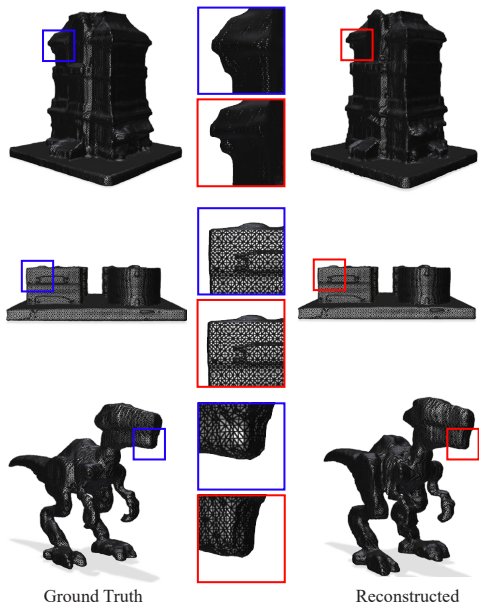
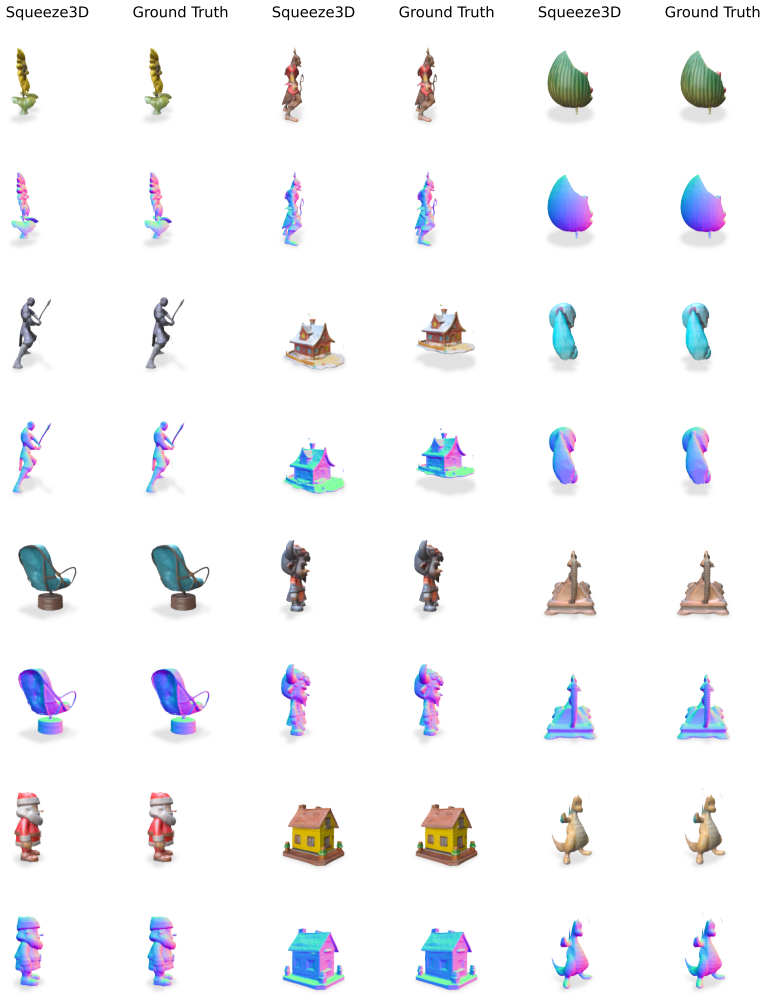
- [Figures 4 and 5] The captions contain the placeholder text 'Lorem ipsum', which should be replaced with actual descriptions.
- [Equation (4)] The Gram loss is written for a single sample; since the Frobenius norm of a vector outer product is simply the vector norm squared, the intended batch-wise orthogonality should be stated explicitly.
- [§C.2] There are typos ('seprately', 'datsets', 'and ae') that should be corrected.
- [Table 2] The reported compression ratio 2187.0748 does not match the displayed sizes 6.43 MB / 0.003 MB ≈ 2143; please verify the arithmetic.
Circularity Check
No significant circularity: Squeeze3D's training target is the generator's own latent, but the paper's claims are empirical and the dependence on generator coverage is openly stated as a limitation, not hidden in the derivation.
full rationale
The mapping networks in Squeeze3D are trained, per Eq. (4), to map encoder latents of synthetic generator outputs back to the generator latents that produced them, with the Gram loss encouraging orthonormality of the compressed code. This design honestly recognizes the generator as both the prior and the quality ceiling, as explicitly conceded in Section 5: 'the decompressed outputs from Squeeze3D fundamentally cannot exceed the quality of what the generator can produce.' The main compression results, however, are measured on held-out datasets (Objaverse, ShapeNet, and NeRF-MAE) using frozen pre-trained encoders and generators; they are reported empirical measurements rather than predictions derived from the training loss. The 'out-of-distribution' mesh collection in Section B.2 draws from other 3D generative model demos, which limits external validity for real off-manifold data but does not make the method's own equations circular. No load-bearing self-citations or author-imported uniqueness theorems appear, and the distribution-coverage assumption is stated as a limitation rather than disguised as a result. Consequently, the central pipeline does not reduce to its inputs by construction; the main risk is correctness/generalization, not circularity.
Assumptions & free parameters
free parameters (4)
- Compressed latent dimension dC =
770 (InstantMesh), 1024 (OpenLRM, Shap-E, LION), 1024 to 8192 (LION ablations), 24000 (radiance fields)
- Loss weights λgram and λgen =
Not reported
- LLaMA3 prompt distribution for mesh training data =
2500 prompts repeated 4 times = 10000 objects
- Generator-target representation per pair =
Triplanes (InstantMesh, OpenLRM); implicit MLP (Shap-E); global and local latents (LION)
assumptions (4)
- domain assumption The pre-trained encoder E maps each 3D object to a latent vector that preserves the object's identity.
- domain assumption Objects seen at test time lie near the output distribution of the frozen generator G.
- ad hoc to paper NeRF-MAE's decoder can serve as the generative model for the radiance-field experiment.
- domain assumption The Gram semi-orthogonality constraint does not discard information needed for reconstruction.
Cite this review
Pith. "Pith review of Squeeze3D: Your 3D Generation Model is Secretly an Extreme Neural Compressor." pith.science (2026). https://pith.science/paper/7H4OFCOF
@misc{pith2026250607932,
  author       = {Pith},
  title        = {Pith review of: Squeeze3D: Your 3D Generation Model is Secretly an Extreme Neural Compressor},
  year         = {2026},
  howpublished = {\url{https://pith.science/paper/7H4OFCOF}},
  note         = {Machine review of arXiv:2506.07932}
}
read the original abstract
We propose Squeeze3D, a novel framework that leverages implicit prior knowledge learnt by existing pre-trained 3D generative models to compress 3D data at extremely high compression ratios. Our approach bridges the latent spaces between a pre-trained encoder and a pre-trained generation model through trainable mapping networks. Any 3D model represented as a mesh, point cloud, or a radiance field is first encoded by the pre-trained encoder and then transformed (i.e. compressed) into a highly compact latent code. This latent code can effectively be used as an extremely compressed representation of the mesh or point cloud. A mapping network transforms the compressed latent code into the latent space of a powerful generative model, which is then conditioned to recreate the original 3D model (i.e. decompression). Squeeze3D is trained entirely on generated synthetic data and does not require any 3D datasets. The Squeeze3D architecture can be flexibly used with existing pre-trained 3D encoders and existing generative models. It can flexibly support different formats, including meshes, point clouds, and radiance fields. Our experiments demonstrate that Squeeze3D achieves compression ratios of up to 2187x for textured meshes, 55x for point clouds, and 619x for radiance fields while maintaining visual quality comparable to many existing methods. Squeeze3D only incurs a small compression and decompression latency since it does not involve training object-specific networks to compress an object.
Figures


Figures from the paper (21 more)






Reference graph
Works this paper leans on
-
[1]
Towards a point cloud structural similarity metric
Evangelos Alexiou and Touradj Ebrahimi. Towards a point cloud structural similarity metric. In2020 IEEE International Conference on Multimedia & Expo Workshops (ICMEW), pages 1–6, 2020
2020
-
[2]
Diff-PCC: Diffusion-based neural compression for 3d point clouds, 2024
Anonymous. Diff-PCC: Diffusion-based neural compression for 3d point clouds, 2024
2024
-
[3]
Sal: Sign agnostic learning of shapes from raw data
Matan Atzmon and Yaron Lipman. Sal: Sign agnostic learning of shapes from raw data. InProceedings of the IEEE/CVF conference on computer vision and pattern recognition, pages 2565–2574, 2020
2020
-
[4]
Jimmy Lei Ba, Jamie Ryan Kiros, and Geoffrey E. Hinton. Layer normalization, 2016
2016
-
[5]
Andrew Brock, Theodore Lim, J. M. Ritchie, and Nick Weston. Generative and discriminative voxel modeling with convolutional neural networks, 2016
2016
-
[6]
Recursively generated b-spline surfaces on arbitrary topological meshes
Edwin Catmull and James Clark. Recursively generated b-spline surfaces on arbitrary topological meshes. InSeminal graphics: pioneering efforts that shaped the field, pages 183–188. 1998
1998
-
[7]
Chang, Thomas Funkhouser, Leonidas Guibas, Pat Hanrahan, Qixing Huang, Zimo Li, Silvio Savarese, Manolis Savva, Shuran Song, Hao Su, Jianxiong Xiao, Li Yi, and Fisher Yu
Angel X. Chang, Thomas Funkhouser, Leonidas Guibas, Pat Hanrahan, Qixing Huang, Zimo Li, Silvio Savarese, Manolis Savva, Shuran Song, Hao Su, Jianxiong Xiao, Li Yi, and Fisher Yu. Shapenet: An information-rich 3d model repository, 2015
2015
-
[8]
3d shape tokenization via latent flow matching, 2025
Jen-Hao Rick Chang, Yuyang Wang, Miguel Angel Bautista Martin, Jiatao Gu, Xiaoming Zhao, Josh Susskind, and Oncel Tuzel. 3d shape tokenization via latent flow matching, 2025
2025
Show all 130 references
-
[9]
Tensorf: Tensorial radiance fields
Anpei Chen, Zexiang Xu, Andreas Geiger, Jingyi Yu, and Hao Su. Tensorf: Tensorial radiance fields. In European conference on computer vision, pages 333–350. Springer, 2022
2022
-
[10]
Deep compression autoencoder for efficient high-resolution diffusion models, 2025
Junyu Chen, Han Cai, Junsong Chen, Enze Xie, Shang Yang, Haotian Tang, Muyang Li, Yao Lu, and Song Han. Deep compression autoencoder for efficient high-resolution diffusion models, 2025
2025
-
[11]
How far can we compress instant-ngp-based nerf? InProceedings of the IEEE/CVF Conference on Computer Vision and Pattern Recognition (CVPR), pages 20321–20330, June 2024
Yihang Chen, Qianyi Wu, Mehrtash Harandi, and Jianfei Cai. How far can we compress instant-ngp-based nerf? InProceedings of the IEEE/CVF Conference on Computer Vision and Pattern Recognition (CVPR), pages 20321–20330, June 2024
2024
-
[12]
Meshanything: Artist-created mesh generation with autoregressive transformers, 2024
Yiwen Chen, Tong He, Di Huang, Weicai Ye, Sijin Chen, Jiaxiang Tang, Xin Chen, Zhongang Cai, Lei Yang, Gang Yu, Guosheng Lin, and Chi Zhang. Meshanything: Artist-created mesh generation with autoregressive transformers, 2024
2024
-
[13]
3dtopia-xl: Scaling high-quality 3d asset generation via primitive diffusion.arXiv preprint arXiv:2409.12957, 2024
Zhaoxi Chen, Jiaxiang Tang, Yuhao Dong, Ziang Cao, Fangzhou Hong, Yushi Lan, Tengfei Wang, Haozhe Xie, Tong Wu, Shunsuke Saito, et al. 3dtopia-xl: Scaling high-quality 3d asset generation via primitive diffusion.arXiv preprint arXiv:2409.12957, 2024
2024 arXiv
-
[14]
Learning implicit fields for generative shape modeling
Zhiqin Chen and Hao Zhang. Learning implicit fields for generative shape modeling. InProceedings of the IEEE/CVF conference on computer vision and pattern recognition, pages 5939–5948, 2019
2019
-
[15]
Appearance-preserving simplification
Jonathan Cohen, Marc Olano, and Dinesh Manocha. Appearance-preserving simplification. InProceed- ings of the 25th annual conference on Computer graphics and interactive techniques, pages 115–122, 1998
1998
-
[16]
Octformer: Efficient octree-based transformer for point cloud compression with local enhancement.Proceedings of the AAAI Conference on Artificial Intelligence, 37(1):470–478, Jun
Mingyue Cui, Junhua Long, Mingjian Feng, Boyang Li, and Huang Kai. Octformer: Efficient octree-based transformer for point cloud compression with local enhancement.Proceedings of the AAAI Conference on Artificial Intelligence, 37(1):470–478, Jun. 2023
2023
-
[17]
Neusdfusion: A spatial-aware generative model for 3d shape completion, reconstruction, and generation, 2024
Ruikai Cui, Weizhe Liu, Weixuan Sun, Senbo Wang, Taizhang Shang, Yang Li, Xibin Song, Han Yan, Zhennan Wu, Shenzhou Chen, Hongdong Li, and Pan Ji. Neusdfusion: A spatial-aware generative model for 3d shape completion, reconstruction, and generation, 2024
2024
-
[18]
On the effectiveness of weight-encoded neural implicit 3d shapes, 2021
Thomas Davies, Derek Nowrouzezahrai, and Alec Jacobson. On the effectiveness of weight-encoded neural implicit 3d shapes, 2021
2021
-
[19]
Geometry compression
Michael Deering. Geometry compression. InProceedings of the 22nd Annual Conference on Com- puter Graphics and Interactive Techniques, SIGGRAPH ’95, page 13–20, New York, NY , USA, 1995. Association for Computing Machinery
1995
-
[20]
Objaverse-xl: A universe of 10m+ 3d objects, 2023
Matt Deitke, Ruoshi Liu, Matthew Wallingford, Huong Ngo, Oscar Michel, Aditya Kusupati, Alan Fan, Christian Laforte, Vikram V oleti, Samir Yitzhak Gadre, Eli VanderBilt, Aniruddha Kembhavi, Carl V ondrick, Georgia Gkioxari, Kiana Ehsani, Ludwig Schmidt, and Ali Farhadi. Objave...
2023
-
[21]
An image is worth 16x16 words: Transformers for image recognition at scale
Alexey Dosovitskiy, Lucas Beyer, Alexander Kolesnikov, Dirk Weissenborn, Xiaohua Zhai, Thomas Unterthiner, Mostafa Dehghani, Matthias Minderer, Georg Heigold, Sylvain Gelly, Jakob Uszkoreit, and Neil Houlsby. An image is worth 16x16 words: Transformers for image recognition at...
2021
-
[22]
Neural geometry fields for meshes
Venkataram Edavamadathil Sivaram, Tzu-Mao Li, and Ravi Ramamoorthi. Neural geometry fields for meshes. InACM SIGGRAPH 2024 Conference Papers, SIGGRAPH ’24, New York, NY , USA, 2024. Association for Computing Machinery
2024
-
[23]
Lightgaussian: Unbounded 3d gaussian compression with 15x reduction and 200+ fps, 2024
Zhiwen Fan, Kevin Wang, Kairun Wen, Zehao Zhu, Dejia Xu, and Zhangyang Wang. Lightgaussian: Unbounded 3d gaussian compression with 15x reduction and 200+ fps, 2024
2024
-
[24]
Google/draco: a library for compressing and decompressing 3d geometric meshes and point clouds, 2018
Frank Galligan, Michael Hemmer, Ondrej Stava, Fan Zhang, and Jamieson Brettle. Google/draco: a library for compressing and decompressing 3d geometric meshes and point clouds, 2018
2018
-
[25]
Galvis, Xingxing Zuo, Simon Schaefer, and Stefan Leutengger
Juan D. Galvis, Xingxing Zuo, Simon Schaefer, and Stefan Leutengger. Sc-diff: 3d shape completion with latent diffusion models, 2024
2024
-
[26]
Strivec: Sparse tri-vector radiance fields, 2023
Quankai Gao, Qiangeng Xu, Hao Su, Ulrich Neumann, and Zexiang Xu. Strivec: Sparse tri-vector radiance fields, 2023
2023
-
[27]
Rui Gao and Rajeev K. Jaiman. H-siren: Improving implicit neural representations with hyperbolic periodic functions, 2024
2024
-
[28]
Heckbert
Michael Garland and Paul S. Heckbert. Surface simplification using quadric error metrics. InProceedings of the 24th Annual Conference on Computer Graphics and Interactive Techniques, SIGGRAPH ’97, page 209–216, USA, 1997. ACM Press/Addison-Wesley Publishing Co
1997
-
[29]
On quantizing implicit neural representations
Cameron Gordon, Shin-Fang Chng, Lachlan MacDonald, and Simon Lucey. On quantizing implicit neural representations. InProceedings of the IEEE/CVF Winter Conference on Applications of Computer Vision, pages 341–350, 2023
2023
-
[30]
Mesh convolutional autoencoder for semi-regular meshes of different sizes
Sara Hahner and Jochen Garcke. Mesh convolutional autoencoder for semi-regular meshes of different sizes. InProceedings of the IEEE/CVF Winter Conference on Applications of Computer Vision (WACV), pages 885–894, January 2022
2022
-
[31]
Identity mappings in deep residual networks
Kaiming He, Xiangyu Zhang, Shaoqing Ren, and Jian Sun. Identity mappings in deep residual networks. In Bastian Leibe, Jiri Matas, Nicu Sebe, and Max Welling, editors,Computer Vision – ECCV 2016, pages 630–645, Cham, 2016. Springer International Publishing
2016
-
[32]
Openlrm: Open-source large reconstruction models
Zexin He and Tengfei Wang. Openlrm: Open-source large reconstruction models. https://github. com/3DTopia/OpenLRM, 2023
2023
-
[33]
Gaussian error linear units (gelus), 2023
Dan Hendrycks and Kevin Gimpel. Gaussian error linear units (gelus), 2023
2023
-
[34]
Deep geometric texture synthesis.arXiv preprint arXiv:2007.00074, 2020
Amir Hertz, Rana Hanocka, Raja Giryes, and Daniel Cohen-Or. Deep geometric texture synthesis.arXiv preprint arXiv:2007.00074, 2020
2007 arXiv
-
[35]
Masked autoencoder for self-supervised pre-training on lidar point clouds
Georg Hess, Johan Jaxing, Elias Svensson, David Hagerman, Christoffer Petersson, and Lennart Svensson. Masked autoencoder for self-supervised pre-training on lidar point clouds. In2023 IEEE/CVF Winter Conference on Applications of Computer Vision Workshops (WACVW), page 350–35...
2023
-
[36]
Lrm: Large reconstruction model for single image to 3d, 2024
Yicong Hong, Kai Zhang, Jiuxiang Gu, Sai Bi, Yang Zhou, Difan Liu, Feng Liu, Kalyan Sunkavalli, Trung Bui, and Hao Tan. Lrm: Large reconstruction model for single image to 3d, 2024
2024
-
[37]
Piecewise smooth surface reconstruction
Hugues Hoppe, Tony DeRose, Tom Duchamp, Mark Halstead, Hubert Jin, John McDonald, Jean Schweitzer, and Werner Stuetzle. Piecewise smooth surface reconstruction. InProceedings of the 21st annual conference on Computer graphics and interactive techniques, pages 295–302, 1994
1994
-
[38]
Rendering-oriented 3d point cloud attribute compression using sparse tensor-based transformer, 2025
Xiao Huo, Junhui Hou, Shuai Wan, and Fuzheng Yang. Rendering-oriented 3d point cloud attribute compression using sparse tensor-based transformer, 2025
2025
-
[39]
Nerf-mae: Masked autoencoders for self-supervised 3d representation learning for neural radiance fields
Muhammad Zubair Irshad, Sergey Zakharov, Vitor Guizilini, Adrien Gaidon, Zsolt Kira, and Rares Ambrus. Nerf-mae: Masked autoencoders for self-supervised 3d representation learning for neural radiance fields. InEuropean Conference on Computer Vision, pages 434–453. Springer, 2024
2024
-
[40]
Neural 3d scene compression via model compression.arXiv preprint arXiv:2105.03120, 2021
Berivan Isik. Neural 3d scene compression via model compression.arXiv preprint arXiv:2105.03120, 2021. 12
2021 arXiv
-
[41]
Efficient learning with sine-activated low-rank matrices, 2025
Yiping Ji, Hemanth Saratchandran, Cameron Gordon, Zeyu Zhang, and Simon Lucey. Efficient learning with sine-activated low-rank matrices, 2025
2025
-
[42]
Generative latent coding for ultra-low bitrate image compression
Zhaoyang Jia, Jiahao Li, Bin Li, Houqiang Li, and Yan Lu. Generative latent coding for ultra-low bitrate image compression. In2024 IEEE/CVF Conference on Computer Vision and Pattern Recognition (CVPR), pages 26088–26098, 2024
2024
-
[43]
Local implicit grid representations for 3d scenes
Chiyu Jiang, Avneesh Sud, Ameesh Makadia, Jingwei Huang, Matthias Nießner, Thomas Funkhouser, et al. Local implicit grid representations for 3d scenes. InProceedings of the IEEE/CVF Conference on Computer Vision and Pattern Recognition, pages 6001–6010, 2020
2020
-
[44]
Shap-e: Generating conditional 3d implicit functions, 2023
Heewoo Jun and Alex Nichol. Shap-e: Generating conditional 3d implicit functions, 2023
2023
-
[45]
Prunerf: Segment- centric dataset pruning via 3d spatial consistency.arXiv preprint arXiv:2406.00798, 2024
Yeonsung Jung, Heecheol Yun, Joonhyung Park, Jin-Hwa Kim, and Eunho Yang. Prunerf: Segment- centric dataset pruning via 3d spatial consistency.arXiv preprint arXiv:2406.00798, 2024
2024 arXiv
-
[46]
3d gaussian splatting for real-time radiance field rendering.ACM Transactions on Graphics, 42(4), July 2023
Bernhard Kerbl, Georgios Kopanas, Thomas Leimkühler, and George Drettakis. 3d gaussian splatting for real-time radiance field rendering.ACM Transactions on Graphics, 42(4), July 2023
2023
-
[47]
Auto-encoding variational bayes, 2013
Diederik P Kingma, Max Welling, et al. Auto-encoding variational bayes, 2013
2013
-
[48]
Nerf-vae: A geometry aware 3d scene generative model
Adam R Kosiorek, Heiko Strathmann, Daniel Zoran, Pol Moreno, Rosalia Schneider, Sona Mokrá, and Danilo Jimenez Rezende. Nerf-vae: A geometry aware 3d scene generative model. InInternational Conference on Machine Learning, pages 5742–5752. PMLR, 2021
2021
-
[49]
Corto: Mesh compression library
Visual Computing Lab. Corto: Mesh compression library. https://github.com/cnr-isti-vclab/ corto, 2025. Accessed: March 03, 2025
2025
-
[50]
Ln3diff: Scalable latent neural fields diffusion for speedy 3d generation
Yushi Lan, Fangzhou Hong, Shuai Yang, Shangchen Zhou, Xuyi Meng, Bo Dai, Xingang Pan, and Chen Change Loy. Ln3diff: Scalable latent neural fields diffusion for speedy 3d generation. InEuropean Conference on Computer Vision, pages 112–130. Springer, 2024
2024
-
[51]
Compact 3d gaussian representation for radiance field
Joo Chan Lee, Daniel Rho, Xiangyu Sun, Jong Hwan Ko, and Eunbyung Park. Compact 3d gaussian representation for radiance field. InProceedings of the IEEE/CVF Conference on Computer Vision and Pattern Recognition (CVPR), pages 21719–21728, June 2024
2024
-
[52]
Spectral mesh simplification.Computer Graphics Forum, 39(2):315–324, 2020
Thibault Lescoat, Hsueh-Ti Derek Liu, Jean-Marc Thiery, Alec Jacobson, Tamy Boubekeur, and Maks Ovsjanikov. Spectral mesh simplification.Computer Graphics Forum, 39(2):315–324, 2020
2020
-
[53]
Compressing volumetric radiance fields to 1 mb
Lingzhi Li, Zhen Shen, Zhongshu Wang, Li Shen, and Liefeng Bo. Compressing volumetric radiance fields to 1 mb. InProceedings of the IEEE/CVF Conference on Computer Vision and Pattern Recognition, pages 4222–4231, 2023
2023
-
[54]
Compressing volumetric radiance fields to 1 mb
Lingzhi Li, Zhen Shen, Zhongshu Wang, Li Shen, and Liefeng Bo. Compressing volumetric radiance fields to 1 mb. In2023 IEEE/CVF Conference on Computer Vision and Pattern Recognition (CVPR), pages 4222–4231, 2023
2023
-
[55]
Compact real-time radiance fields with neural codebook
Lingzhi Li, Zhongshu Wang, Zhen Shen, Li Shen, and Ping Tan. Compact real-time radiance fields with neural codebook. In2023 IEEE International Conference on Multimedia and Expo (ICME), pages 2189–2194. IEEE, 2023
2023
-
[56]
NeRFCodec: Neural Feature Compression Meets Neural Radiance Fields for Memory-Efficient Scene Representation
Sicheng Li, Hao Li, Yiyi Liao, and Lu Yu. NeRFCodec: Neural Feature Compression Meets Neural Radiance Fields for Memory-Efficient Scene Representation . In2024 IEEE/CVF Conference on Computer Vision and Pattern Recognition (CVPR), pages 21274–21283, Los Alamitos, CA, USA, June...
2024
-
[57]
Nerfcodec: Neural feature compression meets neural radiance fields for memory-efficient scene representation, 2024
Sicheng Li, Hao Li, Yiyi Liao, and Lu Yu. Nerfcodec: Neural feature compression meets neural radiance fields for memory-efficient scene representation, 2024
2024
-
[58]
An improved decimation of triangle meshes based on curvature
Wei Li, Yufei Chen, Zhicheng Wang, Weidong Zhao, and Lin Chen. An improved decimation of triangle meshes based on curvature. In Duoqian Miao, Witold Pedrycz, Dominik ´Slezak, Georg Peters, Qinghua Hu, and Ruizhi Wang, editors,Rough Sets and Knowledge Technology, pages 260–271,...
2014
-
[59]
Alvarez, Sanja Fidler, Chen Feng, and Anima Anandkumar
Yiming Li, Zhiding Yu, Christopher Choy, Chaowei Xiao, Jose M. Alvarez, Sanja Fidler, Chen Feng, and Anima Anandkumar. V oxformer: Sparse voxel transformer for camera-based 3d semantic scene completion, 2023. 13
2023
-
[60]
Transpcc: Towards deep point cloud compression via transformers
Zujie Liang and Fan Liang. Transpcc: Towards deep point cloud compression via transformers. In Proceedings of the 2022 International Conference on Multimedia Retrieval, ICMR ’22, page 1–5, New York, NY , USA, 2022. Association for Computing Machinery
2022
-
[61]
A comprehensive study and comparison of core technologies for mpeg 3-d point cloud compression.IEEE Transactions on Broadcasting, 66(3):701–717, 2019
Hao Liu, Hui Yuan, Qi Liu, Junhui Hou, and Ju Liu. A comprehensive study and comparison of core technologies for mpeg 3-d point cloud compression.IEEE Transactions on Broadcasting, 66(3):701–717, 2019
2019
-
[62]
Neural subdivision.arXiv preprint arXiv:2005.01819, 2020
Hsueh-Ti Derek Liu, Vladimir G Kim, Siddhartha Chaudhuri, Noam Aigerman, and Alec Jacobson. Neural subdivision.arXiv preprint arXiv:2005.01819, 2020
2005 arXiv
-
[63]
Variational autoencoder for 3d voxel compression
Juncheng Liu, Steven Mills, and Brendan McCane. Variational autoencoder for 3d voxel compression. In 2020 35th International Conference on Image and Vision Computing New Zealand (IVCNZ), pages 1–6, 2020
2020
-
[64]
Smooth subdivision surfaces based on triangles
Charles Loop. Smooth subdivision surfaces based on triangles. 1987
1987
-
[65]
Zhe Luo, Wenjing Jia, and Stuart W. Perry. Transformer-based geometric point cloud compression with local neighbor aggregation. InDICTA, pages 223–228, 2023
2023
-
[66]
Shapesplat: A large-scale dataset of gaussian splats and their self-supervised pretraining.arXiv preprint arXiv:2408.10906, 2024
Qi Ma, Yue Li, Bin Ren, Nicu Sebe, Ender Konukoglu, Theo Gevers, Luc Van Gool, and Danda Pani Paudel. Shapesplat: A large-scale dataset of gaussian splats and their self-supervised pretraining.arXiv preprint arXiv:2408.10906, 2024
2024 arXiv
-
[67]
Da Silva Cruz
Miguel Marques and Luís A. Da Silva Cruz. Explorations on 3d point clouds coding using transformers and patches. In2022 10th European Workshop on Visual Information Processing (EUVIP), pages 1–6, 2022
2022
-
[68]
Julien N. P. Martel, David B. Lindell, Connor Z. Lin, Eric R. Chan, Marco Monteiro, and Gordon Wetzstein. Acorn: Adaptive coordinate networks for neural scene representation, 2021
2021
-
[69]
Oc- cupancy networks: Learning 3d reconstruction in function space
Lars Mescheder, Michael Oechsle, Michael Niemeyer, Sebastian Nowozin, and Andreas Geiger. Oc- cupancy networks: Learning 3d reconstruction in function space. InProceedings of the IEEE/CVF conference on computer vision and pattern recognition, pages 4460–4470, 2019
2019
-
[70]
Pcqm: A full-reference quality metric for colored 3d point clouds
Gabriel Meynet, Yana Nehmé, Julie Digne, and Guillaume Lavoué. Pcqm: A full-reference quality metric for colored 3d point clouds. In2020 Twelfth International Conference on Quality of Multimedia Experience (QoMEX), pages 1–6, 2020
2020
-
[71]
Implicit surface representations as layers in neural networks
Mateusz Michalkiewicz, Jhony K Pontes, Dominic Jack, Mahsa Baktashmotlagh, and Anders Eriks- son. Implicit surface representations as layers in neural networks. InProceedings of the IEEE/CVF International Conference on Computer Vision, pages 4743–4752, 2019
2019
-
[72]
Srinivasan, Matthew Tancik, Jonathan T
Ben Mildenhall, Pratul P. Srinivasan, Matthew Tancik, Jonathan T. Barron, Ravi Ramamoorthi, and Ren Ng. Nerf: representing scenes as neural radiance fields for view synthesis.Commun. ACM, 65(1):99–106, December 2021
2021
-
[73]
Variational autoencoders for 3d data processing.Artificial Intelligence Review, 57(2):42, 2024
Szilárd Molnár and Levente Tamás. Variational autoencoders for 3d data processing.Artificial Intelligence Review, 57(2):42, 2024
2024
-
[74]
Instant neural graphics primitives with a multiresolution hash encoding.ACM Transactions on Graphics, 41(4):1–15, July 2022
Thomas Müller, Alex Evans, Christoph Schied, and Alexander Keller. Instant neural graphics primitives with a multiresolution hash encoding.ACM Transactions on Graphics, 41(4):1–15, July 2022
2022
-
[75]
TT-NF: Tensor train neural fields, 2023
Anton Obukhov, Mikhail Usvyatsov, Christos Sakaridis, Konrad Schindler, and Luc Van Gool. TT-NF: Tensor train neural fields, 2023
2023
-
[76]
Deepsdf: Learning continuous signed distance functions for shape representation
Jeong Joon Park, Peter Florence, Julian Straub, Richard Newcombe, and Steven Lovegrove. Deepsdf: Learning continuous signed distance functions for shape representation. InProceedings of the IEEE/CVF conference on computer vision and pattern recognition, pages 165–174, 2019
2019
-
[77]
Convolutional occupancy networks
Songyou Peng, Michael Niemeyer, Lars Mescheder, Marc Pollefeys, and Andreas Geiger. Convolutional occupancy networks. InComputer Vision–ECCV 2020: 16th European Conference, Glasgow, UK, August 23–28, 2020, Proceedings, Part III 16, pages 523–540. Springer, 2020
2020
-
[78]
Neural nerf compression.arXiv preprint arXiv:2406.08943, 2024
Tuan Pham and Stephan Mandt. Neural nerf compression.arXiv preprint arXiv:2406.08943, 2024
2024 arXiv
-
[79]
Neural mesh simplification
Rolandos Alexandros Potamias, Stylianos Ploumpis, and Stefanos Zafeiriou. Neural mesh simplification. InProceedings of the IEEE/CVF Conference on Computer Vision and Pattern Recognition, pages 18583– 18592, 2022. 14
2022
-
[80]
Pointnet++: Deep hierarchical feature learning on point sets in a metric space
Charles Ruizhongtai Qi, Li Yi, Hao Su, and Leonidas J Guibas. Pointnet++: Deep hierarchical feature learning on point sets in a metric space. In I. Guyon, U. V on Luxburg, S. Bengio, H. Wallach, R. Fergus, S. Vishwanathan, and R. Garnett, editors,Advances in Neural Information...
2017
-
[81]
Nerfmeshing: Distilling neural radiance fields into geometrically-accurate 3d meshes, 2023
Marie-Julie Rakotosaona, Fabian Manhardt, Diego Martin Arroyo, Michael Niemeyer, Abhijit Kundu, and Federico Tombari. Nerfmeshing: Distilling neural radiance fields into geometrically-accurate 3d meshes, 2023
2023
-
[82]
Arce, Nestor Porras-Diaz, Oleg Ieremeiev, Andrii Rubel, Vladimir Lukin, Mateusz Kopytek, Piotr Lech, Jarosław Fastowicz, and Krzysztof Okarma
Andres Ramirez-Jaime, Gonzalo R. Arce, Nestor Porras-Diaz, Oleg Ieremeiev, Andrii Rubel, Vladimir Lukin, Mateusz Kopytek, Piotr Lech, Jarosław Fastowicz, and Krzysztof Okarma. Generative diffusion models for compressed sensing of satellite lidar data: Evaluating image quality ...
2025
-
[83]
Xcube: Large-scale 3d generative modeling using sparse voxel hierarchies
Xuanchi Ren, Jiahui Huang, Xiaohui Zeng, Ken Museth, Sanja Fidler, and Francis Williams. Xcube: Large-scale 3d generative modeling using sparse voxel hierarchies. InProceedings of the IEEE/CVF Conference on Computer Vision and Pattern Recognition, 2024
2024
-
[84]
L3dg: Latent 3d gaussian diffusion
Barbara Roessle, Norman Müller, Lorenzo Porzi, Samuel Rota Bulò, Peter Kontschieder, Angela Dai, and Matthias Nießner. L3dg: Latent 3d gaussian diffusion. InSIGGRAPH Asia 2024 Conference Papers, December 2024
2024
-
[85]
U-net: Convolutional networks for biomedical image segmentation
Olaf Ronneberger, Philipp Fischer, and Thomas Brox. U-net: Convolutional networks for biomedical image segmentation. In Nassir Navab, Joachim Hornegger, William M. Wells, and Alejandro F. Frangi, editors,Medical Image Computing and Computer-Assisted Intervention – MICCAI 2015,...
2015
-
[86]
Rossignac
J. Rossignac. Edgebreaker: connectivity compression for triangle meshes.IEEE Transactions on Visualization and Computer Graphics, 5(1):47–61, 1999
1999
-
[87]
Schroeder, Jonathan A
William J. Schroeder, Jonathan A. Zarge, and William E. Lorensen. Decimation of triangle meshes. SIGGRAPH Comput. Graph., 26(2):65–70, July 1992
1992
-
[88]
Emerging mpeg standards for point cloud compression.IEEE Journal on Emerging and Selected Topics in Circuits and Systems, 9(1):133–148, 2018
Sebastian Schwarz, Marius Preda, Vittorio Baroncini, Madhukar Budagavi, Pablo Cesar, Philip A Chou, Robert A Cohen, Maja Krivoku ´ca, Sébastien Lasserre, Zhu Li, et al. Emerging mpeg standards for point cloud compression.IEEE Journal on Emerging and Selected Topics in Circuits...
2018
-
[89]
3d point cloud attribute compression using diffusion-based texture-aware intra prediction.IEEE Transactions on Circuits and Systems for Video Technology, 34(10):9633–9646, 2024
Yiting Shao, Xiaodong Yang, Wei Gao, Shan Liu, and Ge Li. 3d point cloud attribute compression using diffusion-based texture-aware intra prediction.IEEE Transactions on Circuits and Systems for Video Technology, 34(10):9633–9646, 2024
2024
-
[90]
Polyscope, 2019
Nicholas Sharp et al. Polyscope, 2019. www.polyscope.run
2019
-
[91]
Accelerating nerfs: Optimizing neural radiance fields with special- ized hardware architectures
William Shen and Willie McClinton. Accelerating nerfs: Optimizing neural radiance fields with special- ized hardware architectures
-
[92]
Distilled low rank neural radiance field with quantization for light field compression.arXiv preprint arXiv:2208.00164, 2022
Jinglei Shi and Christine Guillemot. Distilled low rank neural radiance field with quantization for light field compression.arXiv preprint arXiv:2208.00164, 2022
2022 arXiv
-
[93]
Binary radiance fields.Advances in neural information processing systems, 36, 2024
Seungjoo Shin and Jaesik Park. Binary radiance fields.Advances in neural information processing systems, 36, 2024
2024
-
[94]
Meshgpt: Generating triangle meshes with decoder-only transformers
Yawar Siddiqui, Antonio Alliegro, Alexey Artemov, Tatiana Tommasi, Daniele Sirigatti, Vladislav Rosov, Angela Dai, and Matthias Nießner. Meshgpt: Generating triangle meshes with decoder-only transformers. InProceedings of the IEEE/CVF Conference on Computer Vision and Pattern ...
2024
-
[95]
Implicit neural representations with periodic activation functions
Vincent Sitzmann, Julien Martel, Alexander Bergman, David Lindell, and Gordon Wetzstein. Implicit neural representations with periodic activation functions. In H. Larochelle, M. Ranzato, R. Hadsell, M.F. Balcan, and H. Lin, editors,Advances in Neural Information Processing Sys...
2020
-
[96]
Scene representation networks: Continuous 3d-structure-aware neural scene representations.Advances in Neural Information Processing Systems, 32, 2019
Vincent Sitzmann, Michael Zollhöfer, and Gordon Wetzstein. Scene representation networks: Continuous 3d-structure-aware neural scene representations.Advances in Neural Information Processing Systems, 32, 2019. 15
2019
-
[97]
Dropout: A simple way to prevent neural networks from overfitting.Journal of Machine Learning Research, 15(56):1929–1958, 2014
Nitish Srivastava, Geoffrey Hinton, Alex Krizhevsky, Ilya Sutskever, and Ruslan Salakhutdinov. Dropout: A simple way to prevent neural networks from overfitting.Journal of Machine Learning Research, 15(56):1929–1958, 2014
1929
-
[98]
Explicit surface remeshing
Vitaly Surazhsky and Craig Gotsman. Explicit surface remeshing. InProceedings of the 2003 Eurograph- ics/ACM SIGGRAPH symposium on Geometry processing, pages 20–30, 2003
2003
-
[99]
Piecewise regular meshes: Construction and compression.Graphical Models, 64(3-4):183–198, 2002
Andrzej Szymczak, Jarek Rossignac, and Davis King. Piecewise regular meshes: Construction and compression.Graphical Models, 64(3-4):183–198, 2002
2002
-
[100]
Variable bitrate neural fields
Towaki Takikawa, Alex Evans, Jonathan Tremblay, Thomas Müller, Morgan McGuire, Alec Jacobson, and Sanja Fidler. Variable bitrate neural fields. InACM SIGGRAPH 2022 Conference Proceedings, SIGGRAPH ’22, New York, NY , USA, 2022. Association for Computing Machinery
2022
-
[101]
Neural geometric level of detail: Real-time rendering with implicit 3D shapes
Towaki Takikawa, Joey Litalien, Kangxue Yin, Karsten Kreis, Charles Loop, Derek Nowrouzezahrai, Alec Jacobson, Morgan McGuire, and Sanja Fidler. Neural geometric level of detail: Real-time rendering with implicit 3D shapes. 2021
2021
-
[102]
Fourier features let networks learn high frequency functions in low dimensional domains
Matthew Tancik, Pratul Srinivasan, Ben Mildenhall, Sara Fridovich-Keil, Nithin Raghavan, Utkarsh Singhal, Ravi Ramamoorthi, Jonathan Barron, and Ren Ng. Fourier features let networks learn high frequency functions in low dimensional domains. In H. Larochelle, M. Ranzato, R. Ha...
2020
-
[103]
Compressible-composable nerf via rank-residual decomposition
Jiaxiang Tang, Xiaokang Chen, Jingbo Wang, and Gang Zeng. Compressible-composable nerf via rank-residual decomposition. In S. Koyejo, S. Mohamed, A. Agarwal, D. Belgrave, K. Cho, and A. Oh, editors,Advances in Neural Information Processing Systems, volume 35, pages 14798–14809...
2022
-
[104]
Del- icate textured mesh recovery from nerf via adaptive surface refinement.arXiv preprint arXiv:2303.02091, 2022
Jiaxiang Tang, Hang Zhou, Xiaokang Chen, Tianshu Hu, Errui Ding, Jingdong Wang, and Gang Zeng. Del- icate textured mesh recovery from nerf via adaptive surface refinement.arXiv preprint arXiv:2303.02091, 2022
2022 arXiv
-
[105]
Geometric compression through topological surgery.ACM Trans
Gabriel Taubin and Jarek Rossignac. Geometric compression through topological surgery.ACM Trans. Graph., 17(2):84–115, April 1998
1998
-
[106]
Triangle mesh compression.Proceedings - Graphics Interface, pages 26–34, 1998
Costa Touma and Craig Gotsman. Triangle mesh compression.Proceedings - Graphics Interface, pages 26–34, 1998. Graphics Interface ’98 ; Conference date: 18-06-1998 Through 20-06-1998
1998
-
[107]
Neural discrete representation learning
Aaron van den Oord, Oriol Vinyals, and koray kavukcuoglu. Neural discrete representation learning. In I. Guyon, U. V on Luxburg, S. Bengio, H. Wallach, R. Fergus, S. Vishwanathan, and R. Garnett, editors, Advances in Neural Information Processing Systems, volume 30. Curran Ass...
2017
-
[108]
Sparse tensor-based multiscale representation for point cloud geometry compression.IEEE Transactions on Pattern Analysis and Machine Intelligence, 45(7):9055–9071, 2023
Jianqiang Wang, Dandan Ding, Zhu Li, Xiaoxing Feng, Chuntong Cao, and Zhan Ma. Sparse tensor-based multiscale representation for point cloud geometry compression.IEEE Transactions on Pattern Analysis and Machine Intelligence, 45(7):9055–9071, 2023
2023
-
[109]
Neural radiance fields with hash-low-rank decomposition.Applied Sciences, 14(23), 2024
Jiaxin Wang, Weichen Dai, Kangcheng Ma, and Wanzeng Kong. Neural radiance fields with hash-low-rank decomposition.Applied Sciences, 14(23), 2024
2024
-
[110]
latentsplat: Autoencoding variational gaussians for fast generalizable 3d reconstruction
Christopher Wewer, Kevin Raj, Eddy Ilg, Bernt Schiele, and Jan Eric Lenssen. latentsplat: Autoencoding variational gaussians for fast generalizable 3d reconstruction. InEuropean Conference on Computer Vision, pages 456–473. Springer, 2024
2024
-
[111]
Direct3d: Scalable image-to-3d generation via 3d latent diffusion transformer.arXiv preprint arXiv:2405.14832, 2024
Shuang Wu, Youtian Lin, Feihu Zhang, Yifei Zeng, Jingxi Xu, Philip Torr, Xun Cao, and Yao Yao. Direct3d: Scalable image-to-3d generation via 3d latent diffusion transformer.arXiv preprint arXiv:2405.14832, 2024
2024 arXiv
-
[112]
Structured 3d latents for scalable and versatile 3d generation.arXiv preprint arXiv:2412.01506, 2024
Jianfeng Xiang, Zelong Lv, Sicheng Xu, Yu Deng, Ruicheng Wang, Bowen Zhang, Dong Chen, Xin Tong, and Jiaolong Yang. Structured 3d latents for scalable and versatile 3d generation.arXiv preprint arXiv:2412.01506, 2024
2024 arXiv
-
[113]
Hollownerf: Pruning hashgrid-based nerfs with trainable collision mitigation
Xiufeng Xie, Riccardo Gherardi, Zhihong Pan, and Stephen Huang. Hollownerf: Pruning hashgrid-based nerfs with trainable collision mitigation. InProceedings of the IEEE/CVF International Conference on Computer Vision, pages 3480–3490, 2023
2023
-
[114]
Neural fields in visual computing and beyond
Yiheng Xie, Towaki Takikawa, Shunsuke Saito, Or Litany, Shiqin Yan, Numair Khan, Federico Tombari, James Tompkin, Vincent sitzmann, and Srinath Sridhar. Neural fields in visual computing and beyond. Computer Graphics Forum, 41(2):641–676, 2022. 16
2022
-
[115]
Instantmesh: Efficient 3d mesh generation from a single image with sparse-view large reconstruction models.arXiv preprint arXiv:2404.07191, 2024
Jiale Xu, Weihao Cheng, Yiming Gao, Xintao Wang, Shenghua Gao, and Ying Shan. Instantmesh: Efficient 3d mesh generation from a single image with sparse-view large reconstruction models.arXiv preprint arXiv:2404.07191, 2024
2024 arXiv
-
[116]
Coarse-to-fine transformer for lossless 3d medical image compression
Xiaoxuan Yang, Guo Lu, Donghui Feng, Zhengxue Cheng, Guosheng Yu, and Li Song. Coarse-to-fine transformer for lossless 3d medical image compression. In2024 IEEE International Conference on Visual Communications and Image Processing (VCIP), pages 1–5, 2024
2024
-
[117]
Vq-nerf: Vector quantization enhances implicit neural representations.arXiv preprint arXiv:2310.14487, 2023
Yiying Yang, Wen Liu, Fukun Yin, Xin Chen, Gang Yu, Jiayuan Fan, and Tao Chen. Vq-nerf: Vector quantization enhances implicit neural representations.arXiv preprint arXiv:2310.14487, 2023
2023 arXiv
-
[118]
Adversarial autoencoders for compact representations of 3d point clouds.Computer Vision and Image Understanding, 193:102921, 2020
Maciej Zamorski, Maciej Zi˛ eba, Piotr Klukowski, Rafał Nowak, Karol Kurach, Wojciech Stokowiec, and Tomasz Trzci´nski. Adversarial autoencoders for compact representations of 3d point clouds.Computer Vision and Image Understanding, 193:102921, 2020
2020
-
[119]
Lion: Latent point diffusion models for 3d shape generation
Xiaohui Zeng, Arash Vahdat, Francis Williams, Zan Gojcic, Or Litany, Sanja Fidler, and Karsten Kreis. Lion: Latent point diffusion models for 3d shape generation. InAdvances in Neural Information Processing Systems (NeurIPS), 2022
2022
-
[120]
3dshape2vecset: A 3d shape repre- sentation for neural fields and generative diffusion models.ACM Transactions On Graphics (TOG), 42(4):1–16, 2023
Biao Zhang, Jiapeng Tang, Matthias Niessner, and Peter Wonka. 3dshape2vecset: A 3d shape repre- sentation for neural fields and generative diffusion models.ACM Transactions On Graphics (TOG), 42(4):1–16, 2023
2023
-
[121]
Compress3d: A compressed latent space for 3d generation from a single image
Bowen Zhang, Tianyu Yang, Yu Li, Lei Zhang, and Xi Zhao. Compress3d: A compressed latent space for 3d generation from a single image. In Aleš Leonardis, Elisa Ricci, Stefan Roth, Olga Russakovsky, Torsten Sattler, and Gül Varol, editors,Computer Vision – ECCV 2024, pages 276–2...
2024
-
[122]
3d representation in 512-byte:variational tokenizer is the key for autoregressive 3d generation, 2024
Jinzhi Zhang, Feng Xiong, and Mu Xu. 3d representation in 512-byte:variational tokenizer is the key for autoregressive 3d generation, 2024
2024
-
[123]
G3pt: Unleash the power of autoregressive modeling in 3d generation via cross-scale querying transformer.arXiv preprint arXiv:2409.06322, 2024
Jinzhi Zhang, Feng Xiong, and Mu Xu. G3pt: Unleash the power of autoregressive modeling in 3d generation via cross-scale querying transformer.arXiv preprint arXiv:2409.06322, 2024
2024 arXiv
-
[124]
Transformer and upsampling-based point cloud compression
Junteng Zhang, Gexin Liu, Dandan Ding, and Zhan Ma. Transformer and upsampling-based point cloud compression. InProceedings of the 1st International Workshop on Advances in Point Cloud Compression, Processing and Analysis, APCCPA ’22, page 33–39, New York, NY , USA, 2022. Asso...
2022
-
[125]
Efros, Eli Shechtman, and Oliver Wang
Richard Zhang, Phillip Isola, Alexei A. Efros, Eli Shechtman, and Oliver Wang. The unreasonable effectiveness of deep features as a perceptual metric. In2018 IEEE/CVF Conference on Computer Vision and Pattern Recognition, pages 586–595, 2018
2018
-
[126]
Rate-aware compression for nerf-based volumetric video
Zhiyu Zhang, Guo Lu, Huanxiong Liang, Zhengxue Cheng, Anni Tang, and Li Song. Rate-aware compression for nerf-based volumetric video. InProceedings of the 32nd ACM International Conference on Multimedia, pages 3974–3983, 2024
2024
-
[127]
Michelangelo: Conditional 3d shape generation based on shape-image-text aligned latent representation.Advances in neural information processing systems, 36:73969–73982, 2023
Zibo Zhao, Wen Liu, Xin Chen, Xianfang Zeng, Rui Wang, Pei Cheng, Bin Fu, Tao Chen, Gang Yu, and Shenghua Gao. Michelangelo: Conditional 3d shape generation based on shape-image-text aligned latent representation.Advances in neural information processing systems, 36:73969–73982, 2023
2023
-
[128]
Vq-nerf: Neural reflectance decomposition and editing with vector quantization.IEEE Transactions on Visualization and Computer Graphics, 30(9):6247–6260, 2023
Hongliang Zhong, Jingbo Zhang, and Jing Liao. Vq-nerf: Neural reflectance decomposition and editing with vector quantization.IEEE Transactions on Visualization and Computer Graphics, 30(9):6247–6260, 2023
2023
-
[129]
Fully convolutional mesh autoencoder using efficient spatially varying kernels
Yi Zhou, Chenglei Wu, Zimo Li, Chen Cao, Yuting Ye, Jason Saragih, Hao Li, and Yaser Sheikh. Fully convolutional mesh autoencoder using efficient spatially varying kernels. In H. Larochelle, M. Ranzato, R. Hadsell, M.F. Balcan, and H. Lin, editors,Advances in Neural Informatio...
2020
-
[130]
within-block
Denis Zorin, Peter Schröder, and Wim Sweldens. Interpolating subdivision for meshes with arbitrary topology. InProceedings of the 23rd annual conference on Computer graphics and interactive techniques, pages 189–192, 1996. 17 Appendix Contents A Additional Implementation Detai...
1996
Reviewed August 7, 2026 · model on record in the stance chip above.
Discussion (0). Sign in to comment.