REVIEW 3 major objections 6 minor 17 cited by
Are VLMs Ready for Autonomous Driving? An Empirical Study from the Reliability, Data, and Metric Perspectives
T0 review · 3 major / 6 minor · reviewed 2026-08-10 · deepseek-v4-flash
Pith's one-line read DriveBench shows that vision-language models for driving can produce plausible answers with no image at all, so current benchmark scores overstate their visual grounding.
desk verdict DriveBench is a useful, reusable warning about VLM overreliance on text and priors, but the curated subset and GPT-rubric scoring leave the magnitude of the problem less settled than the title implies. read the letter →
The pith
A machine-rendered reading of the paper's core claim, the machinery that carries it, and where it could break.
The reading
What carries the argument
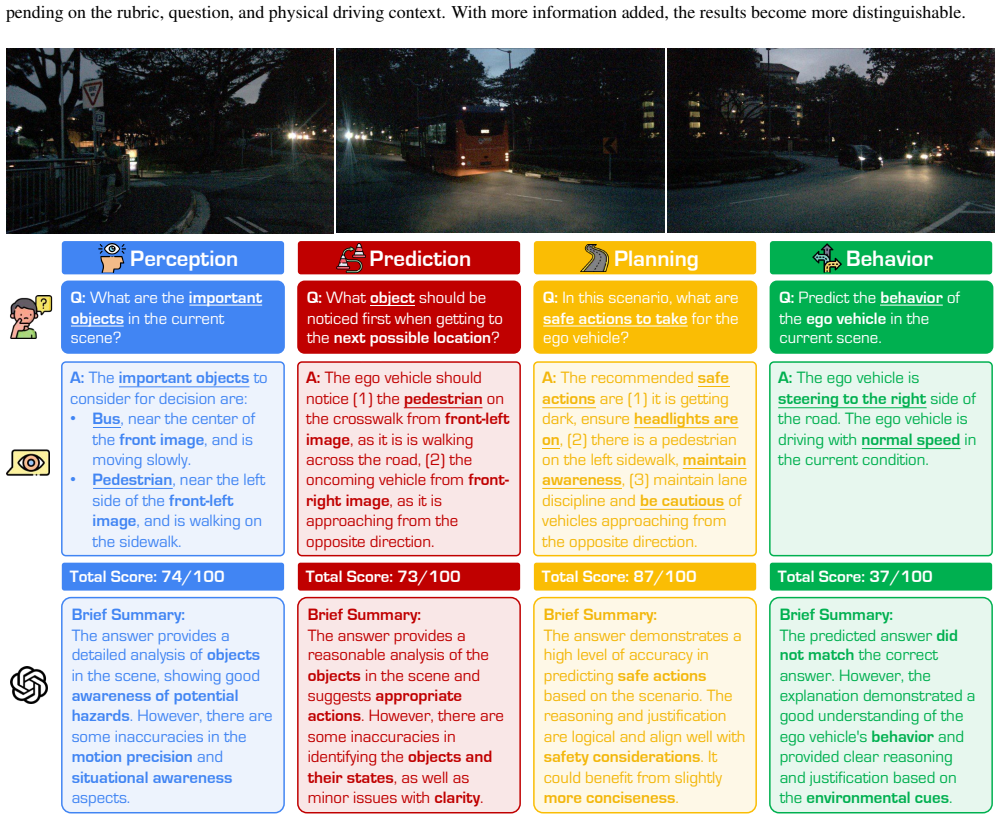
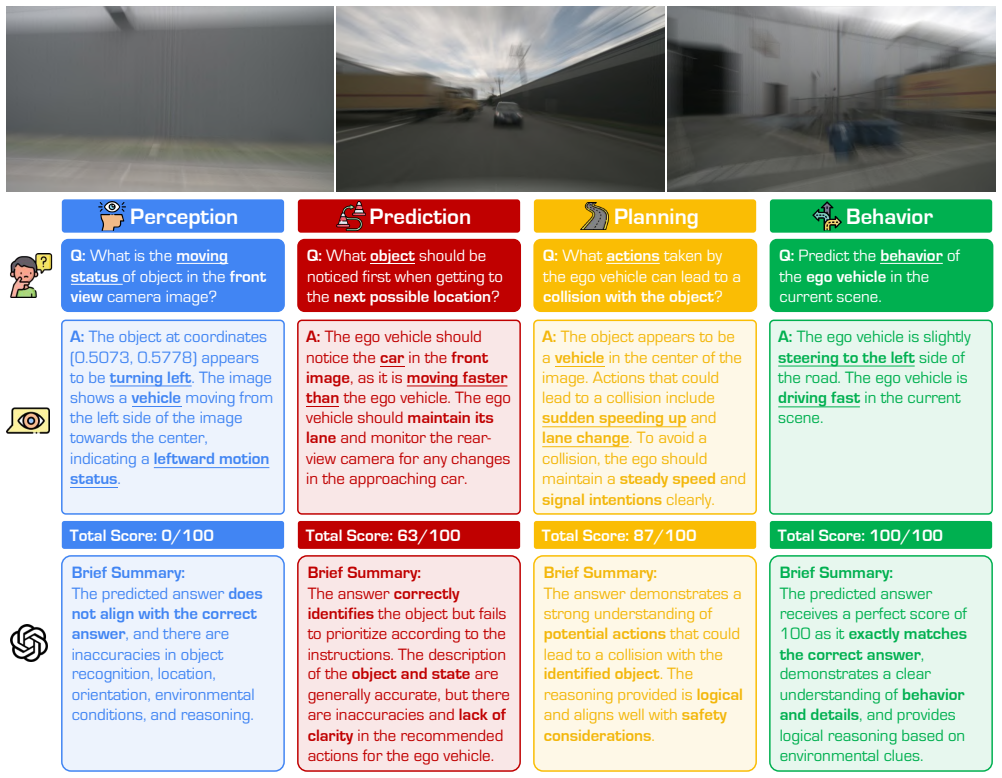
The load-bearing object is DriveBench, a benchmark built by re-sampling DriveLM's nuScenes-based QA pairs to balance answer distributions and by filtering to instances GPT-4o can answer from a single frame, then testing every model under clean images, 15 synthesized corruptions (weather, sensor failures, blurs, transmission errors), and fully black text-only inputs. The critical mechanism is the text-only condition: comparing a model's answers with no visual input against its clean-image answers exposes how much of the apparent performance comes from language priors rather than vision. A second mechanism is the rubric-aware GPT evaluation, which the paper shows yields more discriminating scores when the prompt includes the question, task rubrics, and scene context rather than the answer and ground truth alone.
What would settle it
Take the DriveBench perception questions and replace the text-only condition with images whose pixels are randomly permuted or inverted, so no scene information remains but the question text is unchanged; if VLM accuracy stays at the clean-image level on these inputs, the claim that models lean on language priors is supported, whereas a drop to chance would falsify it. Alternatively, compute the always-'Going Ahead' accuracy on the balanced DriveBench behavior MCQs: if that baseline is near chance rather than above 70%, the dataset-imbalance explanation would need revision.
Extended reading notes
Core claim
DriveBench's central finding is that VLMs do not reliably ground driving answers in visual input: removing the image entirely leaves GPT scores nearly unchanged across tasks, with some models even scoring higher on text-only prompts, and accuracy on perception multiple-choice questions frequently stays at the same level with black images as with clean ones. The paper attributes this to learned priors, common-sense defaults such as 'Going Ahead', and textual cues embedded in the questions themselves, such as camera names and coordinates. Because existing datasets are imbalanced and current metrics reward fluent, template-like explanations over correct visual reasoning, these fabricated answers pass evaluation. The paper also finds that models are partly aware of corruptions when explicitly told about them, but do not volunteer that awareness or downgrade their confidence, and that driving-specific fine-tuning largely improves answer formatting rather than visual grounding.
Load-bearing premise
The benchmark selects test instances by keeping only those GPT-4o can answer correctly from a single frame, assuming that GPT-4o's success marks an instance where one frame carries enough visual information; if that filter inherits GPT-4o's own biases, then the measured differences between clean, corrupted, and text-only inputs do not cleanly measure visual grounding.
Editorial extensions
If this is right
- VLM driving assistants that score well on existing benchmarks may be answering from language priors, so a high benchmark score alone is not evidence of visual understanding.
- Robustness to corruption cannot be read from stable scores under corrupted images, because the same stability appears under text-only inputs, indicating the scores may not involve the image at all.
- Evaluation protocols for driving VLMs should include text-only and black-image controls, balanced answer distributions, and task-specific rubrics with scene context.
- Models' awareness of corruptions, when explicitly prompted, could be used to make them abstain or hedge in degraded conditions, improving reliability.
- Fine-tuned driving VLMs can show inflated gains from answer-format matching, so the choice of metric changes conclusions about which model is best.
Reading between the lines
- My inference: the same blindfold test — comparing text-only against full-input performance — could be applied to any VLM claim in robotics, medical imaging, or other safety-critical domains, not just driving.
- My inference: the paper's results imply a cheap diagnostic for future models: report the gap between clean, corrupted, and text-only accuracy, since a small gap means the model's answers are likely prior-driven.
- My inference: because questions embed camera names and normalized coordinates, even 'text-only' inputs contain geometric cues; removing those cues by scrambling camera labels would isolate how much of the text-only performance comes from pure language priors versus coordinate heuristics.
- My inference: a testable extension is to compute the majority-answer baseline ('always Going Ahead') on each balanced task; models near that baseline under corruption are best explained as prior-following rather than vision-based.
Signed reviews
Editorial analysis
A structured set of objections, weighed in public.
Referee Report
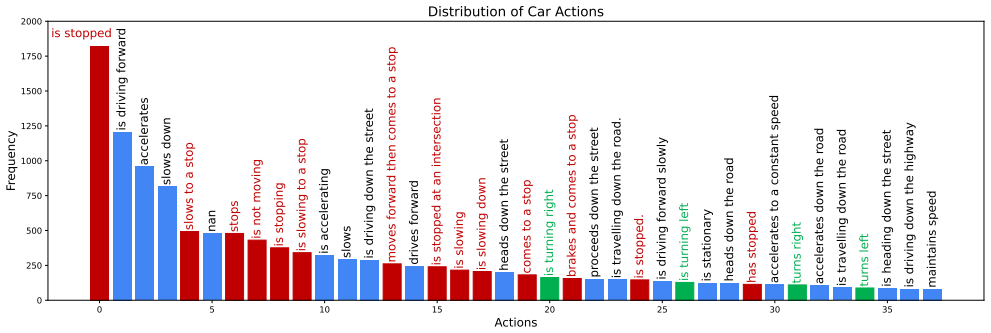
Summary. DriveBench is an empirical benchmark study that evaluates 12 vision-language models (VLMs) on four driving-language tasks under clean, corrupted, and text-only inputs. The benchmark is built from DriveLM, rebalanced to counter the 78.6% 'Going Straight' bias, and supplemented with 15 corruption types. The paper reports three main findings: (1) VLMs often maintain comparable accuracy and GPT-scores under heavy corruption and even with no image at all, suggesting they rely on general knowledge and textual priors rather than visual grounding; (2) VLMs exhibit corruption awareness only when explicitly prompted; and (3) standard metrics (ROUGE/BLEU, and even naive GPT scores) are insensitive to fabrication, while rubric- and context-augmented GPT evaluation is more discriminative. The authors release the benchmark toolkit and dataset publicly.
Significance. If the findings hold, this is a valuable and timely empirical contribution: it provides a concrete, publicly available testbed with 17 input settings, introduces a text-only control that exposes a failure mode common to driving VLMs, and offers a transparent analysis of dataset imbalance (the 78.6% 'Going Straight' statistic) and metric pathologies. The paper's strengths include a large model sweep, a clear corruption taxonomy, a falsifiable text-only experimental design, and the public release of code and data. However, the central claim that 'VLMs can pass driving benchmarks without seeing the road' rests on the curated subset of DriveBench, and the curation procedure plus the evaluation methodology introduce load-bearing concerns that currently prevent the quantitative results from fully supporting the broad conclusions.
major comments (3)
- [Sec. 3.1 (Dataset curation)] The curation filter keeps only instances that 'GPT-4o can correctly interpret,' on the assumption that GPT-4o's success indicates sufficient single-frame visual information. This assumption is load-bearing for the central claim, but the paper's own Fig. 10 shows that models can answer questions from camera names and coordinates without any visual input. If GPT-4o's successes are partly driven by the same textual priors, the filter may preferentially retain textually guessable cases and remove the cases that genuinely require visual grounding. The comparable clean vs. text-only results in Tabs. 2 and 3 could then partly measure the guessability of the filtered subset rather than a general VLM property. Please provide a concrete test: evaluate the models on the filtered-out instances (where GPT-4o fails) and show whether text-only performance drops, or quantify the distribution of answer priors in the kept versus removed sets.
- [Tabs. 2 and 3] The main quantitative evidence for the 'comparable performance' claim is presented as single point estimates without error bars, confidence intervals, or significance tests. Several of the decisive differences are small (e.g., GPT-4o perception GPT score 35.37 clean vs. 36.48 text-only; accuracy 59.0 vs. 59.5 in Tab. 3). With roughly 200 perception MCQs and 200 behavior MCQs, these differences are plausibly within sampling noise. Please report bootstrap confidence intervals or per-keyframe variance and state which clean/text-only/corrupted comparisons are statistically distinguishable.
- [Appendix C.4 and Fig. 8 (Human evaluation)] The human evaluation is based on only 15 keyframes. The large human accuracy drops under corruption (e.g., perception 93.3 clean vs. 33.3 fog) are used to argue that the corruptions are genuinely impactful and that VLMs' lack of degradation is abnormal. With n=15, the standard error is large and the reported accuracy differences are fragile. Please either increase the human sample or report confidence intervals; without this, the human-vs-VLM contrast in Sec. 4.2.1 is not quantitatively supported.
minor comments (6)
- [A.3 and Tab. 6] The text in A.3 states that the curated dataset contains 1,461 questions, but Tab. 6 sums to 1,261 (400+61+600+200). The abstract reports 20,498 total QA pairs, which matches 19,237 robustness pairs plus 1,261, not 1,461. Please reconcile these numbers.
- [Tab. 3 caption] Tab. 3 reports only 8 of the 12 evaluated models; the selection criterion is stated only in the main text. Please add the criterion to the table caption for clarity.
- [Fig. 8] The y-axis label 'Performance Change' is ambiguous; please specify whether it is absolute accuracy change, relative change, or another quantity.
- [Tab. 14] There is a typo in the table title ('Predicion'), and the Qwen2VL7B and Qwen2VL72B rows are duplicated verbatim for the 7B model entries.
- [Abstract and Sec. 5] The abstract claims 'we propose refined evaluation metrics,' but the paper does not introduce a new metric; it advocates rubric- and context-augmented GPT scoring. Consider wording such as 'refined evaluation protocols' to avoid overclaiming.
- [Fig. 12] The caption of Fig. 12 should state the task and condition (prediction task, clean inputs) so the reader can interpret the correlation plots without consulting the main text.
Circularity Check
No circularity found: DriveBench's central comparison is an empirical measurement, not a derivation from fitted parameters or self-citation.
full rationale
The paper's main claim—that VLMs answer driving questions from textual or general-knowledge cues even without usable visual input—is supported by direct experimental contrasts between clean, corrupted, and text-only conditions across 12 models. No parameter is fitted to a subset and then renamed as a prediction; no equation is defined in terms of the target conclusion. The GPT-4o-based curation filter in Sec. 3.1 is a benchmark-construction choice aimed at removing temporal-context-dependent cases, and the paper's own Appendix E.2 acknowledges the resulting DriveLM-only scope, so the conclusion is not forced by an imported uniqueness claim or by a self-citation chain. Self-citations to DriveLM and to the authors' corruption-generation work supply datasets and tools, but the reliability conclusion is measured, not assumed. Hence no circular step can be exhibited with a specific reduction.
Assumptions & free parameters
free parameters (1)
- Dataset curation filter based on GPT-4o correctness
assumptions (4)
- domain assumption DriveLM-nuScenes is representative of driving-with-language benchmarks
- domain assumption The 15 corruption simulation algorithms approximate real-world sensor and weather degradations
- ad hoc to paper GPT-4o correctness indicates sufficient single-frame visual information
- domain assumption GPT-3.5-turbo rubric-based scores reflect human-preferred explanation quality
Cite this review
Pith. "Pith review of Are VLMs Ready for Autonomous Driving? An Empirical Study from the Reliability, Data, and Metric Perspectives." pith.science (2026). https://pith.science/paper/7HFMFSIR
@misc{pith2026250104003,
  author       = {Pith},
  title        = {Pith review of: Are VLMs Ready for Autonomous Driving? An Empirical Study from the Reliability, Data, and Metric Perspectives},
  year         = {2026},
  howpublished = {\url{https://pith.science/paper/7HFMFSIR}},
  note         = {Machine review of arXiv:2501.04003}
}
read the original abstract
Recent advancements in Vision-Language Models (VLMs) have sparked interest in their use for autonomous driving, particularly in generating interpretable driving decisions through natural language. However, the assumption that VLMs inherently provide visually grounded, reliable, and interpretable explanations for driving remains largely unexamined. To address this gap, we introduce DriveBench, a benchmark dataset designed to evaluate VLM reliability across 17 settings (clean, corrupted, and text-only inputs), encompassing 19,200 frames, 20,498 question-answer pairs, three question types, four mainstream driving tasks, and a total of 12 popular VLMs. Our findings reveal that VLMs often generate plausible responses derived from general knowledge or textual cues rather than true visual grounding, especially under degraded or missing visual inputs. This behavior, concealed by dataset imbalances and insufficient evaluation metrics, poses significant risks in safety-critical scenarios like autonomous driving. We further observe that VLMs struggle with multi-modal reasoning and display heightened sensitivity to input corruptions, leading to inconsistencies in performance. To address these challenges, we propose refined evaluation metrics that prioritize robust visual grounding and multi-modal understanding. Additionally, we highlight the potential of leveraging VLMs' awareness of corruptions to enhance their reliability, offering a roadmap for developing more trustworthy and interpretable decision-making systems in real-world autonomous driving contexts. The benchmark toolkit is publicly accessible.
Figures


Figures from the paper (27 more)






Forward citations
Cited by 17 Pith papers
-
Steadily moving semi-infinite fracture in plane poroelasticity
XEmbodied achieves SOTA on 18 embodied VQA benchmarks by fusing 3D geometric tokens and distilled physical cues into a 30B VLM with progressive curriculum training.
-
STSBench: A Spatio-temporal Scenario Benchmark for Multi-modal Large Language Models in Autonomous Driving
A new benchmark, STSnu, uses 971 verified multiple-choice questions from NuScenes to test driving vision-language models' spatio-temporal reasoning, and shows they lag far behind text-only LLMs given perfect trajectories.
-
MapTab: A Diagnostic Benchmark for Long-Horizon Multi-Criteria Multimodal Reasoning on Heterogeneous Topological Graphs
MapTab is a new multimodal benchmark with 328 images and nearly 200k queries that shows current MLLMs have substantial difficulty with multi-criteria route planning when visual and tabular information must be combined.
-
DriveQA: Passing the Driving Knowledge Test
DriveQA is a new multimodal driving-knowledge benchmark showing that LLMs and MLLMs struggle with right-of-way, numerical traffic rules, and sign variations, with modest transfer gains to nuScenes and BDD.
-
Monocular Semantic Scene Completion via Masked Recurrent Networks
Decomposing monocular semantic scene completion into a coarse stage plus a masked recurrent refinement network improves NYUv2 and SemanticKITTI completion and semantic IoU over prior monocular methods.
-
Beyond One Shot, Beyond One Perspective: Cross-View and Long-Horizon Distillation for Better LiDAR Representations
LiMA distills long-term multi-camera image features into LiDAR backbones and reports consistent gains on segmentation and detection benchmarks.
-
AD^2-Bench: A Hierarchical CoT Benchmark for MLLM in Autonomous Driving under Adverse Conditions
AD^2-Bench is a new adverse-weather driving benchmark with hierarchical chain-of-thought annotations and LLM-based quality metrics; 12 MLLMs all scored below 60%.
-
Impromptu VLA: Open Weights and Open Data for Driving Vision-Language-Action Models
A new 80K-clip dataset of unstructured driving scenarios with Q&A annotations improves VLA performance on NeuroNCAP and nuScenes benchmarks.
-
PixelThink: Towards Efficient Chain-of-Pixel Reasoning
A soft token-budget penalty driven by task difficulty and model confidence roughly halves the reasoning tokens used by segmentation MLLMs while slightly improving mask accuracy on ReasonSeg-derived benchmarks.
-
Extending Large Vision-Language Model for Diverse Interactive Tasks in Autonomous Driving
DriveMonkey, which bridges a vision-language model to a pre-trained 3D detector with learnable queries, improves 3D visual grounding mAP by 9.86 percentage points over general LVLMs on the new NuInteract benchmark.
-
Are Vision LLMs Road-Ready? A Comprehensive Benchmark for Safety-Critical Driving Video Understanding
DVBench introduces 10,000 expert-annotated questions on crash and near-crash driving videos and reports that no tested vision LLM exceeds 40 percent accuracy under its strict GroupEval scoring.
-
Benchmarking the Robustness of Autonomous Driving to Environmental Illusions: A Lane Perception Perspective
Environmental illusions cause 5-7% accuracy drops in lane detection models and can trigger collisions in closed-loop simulation, with a proposed defense (MIDA) recovering ~4% robustness.
-
RoadBench: Benchmarking MLLMs on Fine-Grained Spatial Understanding and Reasoning under Urban Road Scenarios
A new 9,121-case benchmark of road-marking tasks shows most multimodal LLMs perform near or below simple rule-based baselines in fine-grained urban spatial reasoning.
-
RoboTron-Drive: All-in-One Large Multimodal Model for Autonomous Driving
One 8B multimodal model trained jointly on six driving datasets outperforms individual specialists on average and transfers zero-shot to three unseen driving benchmarks.
-
A Survey on Vision-Language-Action Models for Autonomous Driving
A survey organizes vision-language-action models for autonomous driving into four stages, compares over 20 systems, and catalogs datasets, benchmarks, and open challenges.
-
Chain-of-Thought for Autonomous Driving: A Comprehensive Survey and Future Prospects
A survey that classifies chain-of-thought methods for autonomous driving into modular, logical, and reflective pipelines, and proposes three evolutionary stages from direct prompting to reinforcement learning.
-
Generative AI for Autonomous Driving: Frontiers and Opportunities
A comprehensive, structured survey of generative AI for autonomous driving, covering model families, sensor modalities, real-world applications, and open research challenges.
Reference graph
Works this paper leans on
-
[1]
Phi-3 technical report: A highly capable language model locally on your phone
Marah Abdin, Sam Ade Jacobs, Ammar Ahmad Awan, Jyoti Aneja, Ahmed Awadallah, Hany Awadalla, Nguyen Bach, Amit Bahree, Arash Bakhtiari, Harkirat Behl, et al. Phi-3 technical report: A highly capable language model locally on your phone. arXiv preprint arXiv:2404.14219, 2024. 2, 3, 7, 9, 10, 18, 20
arXiv 2024
-
[2]
Josh Achiam, Steven Adler, Sandhini Agarwal, Lama Ah- mad, Ilge Akkaya, Florencia Leoni Aleman, Diogo Almeida, Janko Altenschmidt, Sam Altman, Shyamal Anadkat, et al. Gpt-4 technical report. arXiv preprint arXiv:2303.08774 ,
-
[3]
Mousumi Akter, Naman Bansal, and Shubhra Kanti Kar- maker. Revisiting automatic evaluation of extractive summa- rization task: Can we do better than rouge? In Findings of the Association for Computational Linguistics, pages 1547– 1560, 2022. 3
work page 2022
-
[4]
Spice: Semantic propositional image cap- tion evaluation
Peter Anderson, Basura Fernando, Mark Johnson, and Stephen Gould. Spice: Semantic propositional image cap- tion evaluation. In European Conference on Computer Vi- sion, pages 382–398, 2016. 3
work page 2016
-
[5]
Jinze Bai, Shuai Bai, Yunfei Chu, Zeyu Cui, Kai Dang, Xi- aodong Deng, Yang Fan, Wenbin Ge, Yu Han, Fei Huang, Binyuan Hui, Luo Ji, Mei Li, Junyang Lin, Runji Lin, Day- iheng Liu, Gao Liu, Chengqiang Lu, Keming Lu, Jianxin Ma, Rui Men, Xingzhang Ren, Xuancheng Ren, Chuanqi Tan, Sinan Tan, Jianhong Tu, Peng Wang, Shijie Wang, Wei Wang, Shengguang Wu, Benfe...
arXiv 2023
-
[6]
Rt-2: Vision-language-action models transfer web knowledge to robotic control
Anthony Brohan, Noah Brown, Justice Carbajal, Yevgen Chebotar, Xi Chen, Krzysztof Choromanski, Tianli Ding, Danny Driess, Avinava Dubey, Chelsea Finn, et al. Rt-2: Vision-language-action models transfer web knowledge to robotic control. arXiv preprint arXiv:2307.15818, 2023. 3
arXiv 2023
-
[7]
nuscenes: A multi- modal dataset for autonomous driving
Holger Caesar, Varun Bankiti, Alex H Lang, Sourabh V ora, Venice Erin Liong, Qiang Xu, Anush Krishnan, Yu Pan, Gi- ancarlo Baldan, and Oscar Beijbom. nuscenes: A multi- modal dataset for autonomous driving. In IEEE/CVF Con- ference on Computer Vision and Pattern Recognition, pages 11621–11631, 2020. 4
work page 2020
-
[8]
Spatialvlm: Endow- ing vision-language models with spatial reasoning capabili- ties
Boyuan Chen, Zhuo Xu, Sean Kirmani, Brain Ichter, Dorsa Sadigh, Leonidas Guibas, and Fei Xia. Spatialvlm: Endow- ing vision-language models with spatial reasoning capabili- ties. In IEEE/CVF Conference on Computer Vision and Pat- tern Recognition, pages 14455–14465, 2024. 3
work page 2024
Show all 80 references
-
[9]
Automated evaluation of large vision-language models on self-driving corner cases
Kai Chen, Yanze Li, Wenhua Zhang, Yanxin Liu, Pengxi- ang Li, Ruiyuan Gao, Lanqing Hong, Meng Tian, Xinhai Zhao, Zhenguo Li, Dit-Yan Yeung, Huchuan Lu, and Xu Jia. Automated evaluation of large vision-language models on self-driving corner cases. arXiv preprint arXiv:2404.10595,
-
[10]
Driving with llms: Fusing object-level vector modality for explainable autonomous driving
Long Chen, Oleg Sinavski, Jan H ¨unermann, Alice Karnsund, Andrew James Willmott, Danny Birch, Daniel Maund, and Jamie Shotton. Driving with llms: Fusing object-level vector modality for explainable autonomous driving. In IEEE In- ternational Conference on Robotics and Automat...
2024
-
[11]
Driving- gpt: Unifying driving world modeling and planning with multi-modal autoregressive transformers
Yuntao Chen, Yuqi Wang, and Zhaoxiang Zhang. Driving- gpt: Unifying driving world modeling and planning with multi-modal autoregressive transformers. arXiv preprint arXiv:2412.18607, 2024. 3
2024 arXiv
-
[12]
Internvl: Scaling up vision foundation models and aligning for generic visual-linguistic tasks
Zhe Chen, Jiannan Wu, Wenhai Wang, Weijie Su, Guo Chen, Sen Xing, Muyan Zhong, Qinglong Zhang, Xizhou Zhu, Lewei Lu, Bin Li, Ping Luo, Tong Lu, Yu Qiao, and Jifeng Dai. Internvl: Scaling up vision foundation models and aligning for generic visual-linguistic tasks. arXiv prepri...
2023 arXiv
-
[13]
How far are we to gpt-4v? closing the gap to commercial multimodal models with open-source suites
Zhe Chen, Weiyun Wang, Hao Tian, Shenglong Ye, Zhang- wei Gao, Erfei Cui, Wenwen Tong, Kongzhi Hu, Jiapeng Luo, Zheng Ma, et al. How far are we to gpt-4v? closing the gap to commercial multimodal models with open-source suites. arXiv preprint arXiv:2404.16821, 2024. 2
2024 arXiv
-
[14]
Drivelm: Driving with graph vi- sual question answering
DriveLM contributors. Drivelm: Driving with graph vi- sual question answering. https : / / github . com / OpenDriveLab/DriveLM, 2023. 4, 7
2023
-
[15]
Drive as you speak: Enabling human-like interac- tion with large language models in autonomous vehicles
Can Cui, Yunsheng Ma, Xu Cao, Wenqian Ye, and Ziran Wang. Drive as you speak: Enabling human-like interac- tion with large language models in autonomous vehicles. In Proceedings of the IEEE/CVF Winter Conference on Appli- cations of Computer Vision, pages 902–909, 2024. 3
2024
-
[16]
Talk2car: Taking control of your self-driving car
Thierry Deruyttere, Simon Vandenhende, Dusan Grujicic, Luc Van Gool, and Marie-Francine Moens. Talk2car: Taking control of your self-driving car. In Conference on Empirical Methods in Natural Language Processing, pages 2088–2098,
-
[17]
Insight-v: Ex- ploring long-chain visual reasoning with multimodal large language models
Yuhao Dong, Zuyan Liu, Hai-Long Sun, Jingkang Yang, Winston Hu, Yongming Rao, and Ziwei Liu. Insight-v: Ex- ploring long-chain visual reasoning with multimodal large language models. arXiv preprint arXiv:2411.14432 , 2024. 3, 18
2024 arXiv
-
[18]
Out of the bleu: how should we assess quality of the code generation models? Journal of Systems and Software, 203:111741, 2023
Mikhail Evtikhiev, Egor Bogomolov, Yaroslav Sokolov, and Timofey Bryksin. Out of the bleu: how should we assess quality of the code generation models? Journal of Systems and Software, 203:111741, 2023. 3
2023
-
[19]
Data determines distributional robustness in contrastive language image pre-training (clip)
Alex Fang, Gabriel Ilharco, Mitchell Wortsman, Yuhao Wan, Vaishaal Shankar, Achal Dave, and Ludwig Schmidt. Data determines distributional robustness in contrastive language image pre-training (clip). In International Conference on Machine Learning, pages 6216–6234. PMLR, 2022...
2022
-
[20]
Drive like a human: Rethink- ing autonomous driving with large language models
Daocheng Fu, Xin Li, Licheng Wen, Min Dou, Pinlong Cai, Botian Shi, and Yu Qiao. Drive like a human: Rethink- ing autonomous driving with large language models. In IEEE/CVF Winter Conference on Applications of Computer Vision, pages 910–919, 2024. 2, 3
2024
-
[21]
Llama-adapter v2: Parameter-efficient vi- sual instruction model
Peng Gao, Jiaming Han, Renrui Zhang, Ziyi Lin, Shijie Geng, Aojun Zhou, Wei Zhang, Pan Lu, Conghui He, Xi- angyu Yue, et al. Llama-adapter v2: Parameter-efficient vi- sual instruction model. arXiv preprint arXiv:2304.15010 ,
-
[22]
Frontiers: Can large lan- guage models capture human preferences? Marketing Sci- ence, 2024
Ali Goli and Amandeep Singh. Frontiers: Can large lan- guage models capture human preferences? Marketing Sci- ence, 2024. 3
2024
-
[23]
Drivemllm: A benchmark for spatial understanding with multimodal large language models in autonomous driving
Xianda Guo, Ruijun Zhang, Yiqun Duan, Yuhang He, Chen- ming Zhang, Shuai Liu, and Long Chen. Drivemllm: A benchmark for spatial understanding with multimodal large language models in autonomous driving. arXiv preprint arXiv:2411.13112, 2024. 5
2024 arXiv
-
[24]
Is your hd map constructor reliable under sensor corruptions? In Advances in Neural Informa- tion Processing Systems, 2024
Xiaoshuai Hao, Mengchuan Wei, Yifan Yang, Haimei Zhao, Hui Zhang, Yi Zhou, Qiang Wang, Weiming Li, Lingdong Kong, and Jing Zhang. Is your hd map constructor reliable under sensor corruptions? In Advances in Neural Informa- tion Processing Systems, 2024. 5
2024
-
[25]
Cogagent: A visual language model for gui agents
Wenyi Hong, Weihan Wang, Qingsong Lv, Jiazheng Xu, Wenmeng Yu, Junhui Ji, Yan Wang, Zihan Wang, Yuxiao Dong, Ming Ding, et al. Cogagent: A visual language model for gui agents. InIEEE/CVF Conference on Computer Vision and Pattern Recognition, pages 14281–14290, 2024. 3
2024
-
[26]
Planning-oriented autonomous driving
Yihan Hu, Jiazhi Yang, Li Chen, Keyu Li, Chonghao Sima, Xizhou Zhu, Siqi Chai, Senyao Du, Tianwei Lin, Wen- hai Wang, et al. Planning-oriented autonomous driving. In IEEE/CVF Conference on Computer Vision and Pattern Recognition, pages 17853–17862, 2023. 2, 7
2023
-
[27]
Survey of hallucination in natural language generation
Ziwei Ji, Nayeon Lee, Rita Frieske, Tiezheng Yu, Dan Su, Yan Xu, Etsuko Ishii, Ye Jin Bang, Andrea Madotto, and Pascale Fung. Survey of hallucination in natural language generation. ACM Computing Surveys, 55(12):1–38, 2023. 6, 10
2023
-
[28]
Senna: Bridging large vision-language mod- els and end-to-end autonomous driving
Bo Jiang, Shaoyu Chen, Bencheng Liao, Xingyu Zhang, Wei Yin, Qian Zhang, Chang Huang, Wenyu Liu, and Xing- gang Wang. Senna: Bridging large vision-language mod- els and end-to-end autonomous driving. arXiv preprint arXiv:2410.22313, 2024. 2, 6
-
[29]
Textual explanations for self-driving ve- hicles
Jinkyu Kim, Anna Rohrbach, Trevor Darrell, John Canny, and Zeynep Akata. Textual explanations for self-driving ve- hicles. In European Conference on Computer Vision, pages 563–578, 2018. 2, 3, 5, 14, 17, 18
2018
-
[30]
Robo3d: Towards robust and reliable 3d perception against corruptions
Lingdong Kong, Youquan Liu, Xin Li, Runnan Chen, Wen- wei Zhang, Jiawei Ren, Liang Pan, Kai Chen, and Ziwei Liu. Robo3d: Towards robust and reliable 3d perception against corruptions. In IEEE/CVF International Conference on Computer Vision, pages 19994–20006, 2023. 3, 5, 16
2023
-
[31]
Robodepth: Robust out-of-distribution depth estimation under corruptions
Lingdong Kong, Shaoyuan Xie, Hanjiang Hu, Lai Xing Ng, Benoit Cottereau, and Wei Tsang Ooi. Robodepth: Robust out-of-distribution depth estimation under corruptions. Ad- vances in Neural Information Processing Systems, 36, 2024. 3, 16
2024
-
[32]
Lingdong Kong, Shaoyuan Xie, Hanjiang Hu, Yaru Niu, Wei Tsang Ooi, Benoit R. Cottereau, Lai Xing Ng, Yuexin Ma, Wenwei Zhang, Liang Pan, Kai Chen, Ziwei Liu, We- ichao Qiu, Wei Zhang, Xu Cao, Hao Lu, Ying-Cong Chen, Caixin Kang, Xinning Zhou, Chengyang Ying, Wentao Shang, Xing...
2024 arXiv
-
[33]
Gonzalez, Hao Zhang, and Ion Stoica
Woosuk Kwon, Zhuohan Li, Siyuan Zhuang, Ying Sheng, Lianmin Zheng, Cody Hao Yu, Joseph E. Gonzalez, Hao Zhang, and Ion Stoica. Efficient memory management for large language model serving with pagedattention. In Pro- ceedings of the ACM SIGOPS 29th Symposium on Operating Syste...
2023
-
[34]
An environment for autonomous driving decision-making
Edouard Leurent. An environment for autonomous driving decision-making. https://github.com/eleurent/ highway-env, 2018. 3
2018
-
[35]
R-bench: Are your large multimodal model robust to real-world corruptions? arXiv preprint arXiv:2410.05474, 2024
Chunyi Li, Jianbo Zhang, Zicheng Zhang, Haoning Wu, Yuan Tian, Wei Sun, Guo Lu, Xiaohong Liu, Xiongkuo Min, Weisi Lin, et al. R-bench: Are your large multimodal model robust to real-world corruptions? arXiv preprint arXiv:2410.05474, 2024. 4
-
[36]
Evaluating object hallucination in large vision-language models
Yifan Li, Yifan Du, Kun Zhou, Jinpeng Wang, Wayne Xin Zhao, and Ji-Rong Wen. Evaluating object hallucination in large vision-language models. In Conference on Empirical Methods in Natural Language Processing , pages 292–305,
-
[37]
Is your lidar placement optimized for 3d scene understanding? In Advances in Neural Information Process- ing Systems, 2024
Ye Li, Lingdong Kong, Hanjiang Hu, Xiaohao Xu, and Xi- aonan Huang. Is your lidar placement optimized for 3d scene understanding? In Advances in Neural Information Process- ing Systems, 2024. 5
2024
-
[38]
Bevformer: Learning bird’s-eye-view representation from multi-camera images via spatiotemporal transformers
Zhiqi Li, Wenhai Wang, Hongyang Li, Enze Xie, Chong- hao Sima, Tong Lu, Yu Qiao, and Jifeng Dai. Bevformer: Learning bird’s-eye-view representation from multi-camera images via spatiotemporal transformers. In European Con- ference on Computer Vision, pages 1–18, 2022. 7
2022
-
[39]
Is ego status all you need for open- loop end-to-end autonomous driving? In IEEE/CVF Con- ference on Computer Vision and Pattern Recognition, pages 14864–14873, 2024
Zhiqi Li, Zhiding Yu, Shiyi Lan, Jiahan Li, Jan Kautz, Tong Lu, and Jose M Alvarez. Is ego status all you need for open- loop end-to-end autonomous driving? In IEEE/CVF Con- ference on Computer Vision and Pattern Recognition, pages 14864–14873, 2024. 2, 4, 17
2024
-
[40]
Rouge: A package for automatic evaluation of summaries
Chin-Yew Lin. Rouge: A package for automatic evaluation of summaries. In Text Summarization Branches Out, pages 74–81, 2004. 3, 7, 9, 10, 14, 17, 19
2004
-
[41]
Coarse corre- spondences elicit 3d spacetime understanding in multimodal language model
Benlin Liu, Yuhao Dong, Yiqin Wang, Yongming Rao, Yan- song Tang, Wei-Chiu Ma, and Ranjay Krishna. Coarse corre- spondences elicit 3d spacetime understanding in multimodal language model. arXiv preprint arXiv:2408.00754, 2024. 3
2024 arXiv
-
[42]
Visual instruction tuning
Haotian Liu, Chunyuan Li, Qingyang Wu, and Yong Jae Lee. Visual instruction tuning. InAdvances in Neural Information Processing Systems, pages 34892–34916, 2023. 2, 3
2023
-
[43]
Improved baselines with visual instruction tuning
Haotian Liu, Chunyuan Li, Yuheng Li, and Yong Jae Lee. Improved baselines with visual instruction tuning. 39 In IEEE/CVF Conference on Computer Vision and Pattern Recognition, pages 26296–26306, 2024. 7, 9, 10, 18, 20
2024
-
[44]
Llava-next: Im- proved reasoning, ocr, and world knowledge, 2024
Haotian Liu, Chunyuan Li, Yuheng Li, Bo Li, Yuanhan Zhang, Sheng Shen, and Yong Jae Lee. Llava-next: Im- proved reasoning, ocr, and world knowledge, 2024. 2, 3, 7, 9, 10, 13, 18
2024
-
[45]
Aligning with hu- man judgement: The role of pairwise preference in large lan- guage model evaluators
Yinhong Liu, Han Zhou, Zhijiang Guo, Ehsan Shareghi, Ivan Vuli´c, Anna Korhonen, and Nigel Collier. Aligning with hu- man judgement: The role of pairwise preference in large lan- guage model evaluators. arXiv preprint arXiv:2403.16950,
-
[46]
Oryx mllm: On-demand spatial-temporal understanding at arbitrary resolution
Zuyan Liu, Yuhao Dong, Ziwei Liu, Winston Hu, Ji- wen Lu, and Yongming Rao. Oryx mllm: On-demand spatial-temporal understanding at arbitrary resolution. arXiv preprint arXiv:2409.12961, 2024. 7, 10
2024 arXiv
-
[47]
Chain-of-spot: Interactive reasoning improves large vision-language models
Zuyan Liu, Yuhao Dong, Yongming Rao, Jie Zhou, and Ji- wen Lu. Chain-of-spot: Interactive reasoning improves large vision-language models. arXiv preprint arXiv:2403.12966,
-
[48]
Dolphins: Multimodal language model for driving
Yingzi Ma, Yulong Cao, Jiachen Sun, Marco Pavone, and Chaowei Xiao. Dolphins: Multimodal language model for driving. arXiv preprint arXiv:2312.00438, 2023. 2, 3, 6, 7, 10, 12, 18
2023 arXiv
-
[49]
Drama: Joint risk localization and captioning in driving
Srikanth Malla, Chiho Choi, Isht Dwivedi, Joon Hee Choi, and Jiachen Li. Drama: Joint risk localization and captioning in driving. In IEEE/CVF Winter Conference on Applications of Computer Vision, pages 1043–1052, 2023. 5
2023
-
[50]
Gpt-driver: Learning to drive with gpt.arXiv preprint arXiv:2310.01415, 2023
Jiageng Mao, Yuxi Qian, Junjie Ye, Hang Zhao, and Yue Wang. Gpt-driver: Learning to drive with gpt.arXiv preprint arXiv:2310.01415, 2023. 2, 6
2023 arXiv
-
[51]
Quality not quantity: On the interaction between dataset design and robustness of clip
Thao Nguyen, Gabriel Ilharco, Mitchell Wortsman, Se- woong Oh, and Ludwig Schmidt. Quality not quantity: On the interaction between dataset design and robustness of clip. Advances in Neural Information Processing Systems , 35:21455–21469, 2022. 4, 5
2022
-
[52]
Foundation models for autonomous systems,
OpenDriveLab. Foundation models for autonomous systems,
-
[53]
Vlp: Vision language planning for autonomous driving
Chenbin Pan, Burhaneddin Yaman, Tommaso Nesti, Abhirup Mallik, Alessandro G Allievi, Senem Velipasalar, and Liu Ren. Vlp: Vision language planning for autonomous driving. In IEEE/CVF Conference on Computer Vision and Pattern Recognition, pages 14760–14769, 2024. 2
2024
-
[54]
Bleu: a method for automatic evaluation of machine translation
Kishore Papineni, Salim Roukos, Todd Ward, and Wei-Jing Zhu. Bleu: a method for automatic evaluation of machine translation. In Annual Meeting of the Association for Com- putational Linguistics, pages 311–318, 2002. 3, 7, 9, 14, 17
2002
-
[55]
Nuscenes-qa: A multi-modal visual ques- tion answering benchmark for autonomous driving scenario
Tianwen Qian, Jingjing Chen, Linhai Zhuo, Yang Jiao, and Yu-Gang Jiang. Nuscenes-qa: A multi-modal visual ques- tion answering benchmark for autonomous driving scenario. In AAAI Conference on Artificial Intelligence , pages 4542– 4550, 2024. 2, 3, 5, 12
2024
-
[56]
Learning transferable visual models from natural language supervision
Alec Radford, Jong Wook Kim, Chris Hallacy, Aditya Ramesh, Gabriel Goh, Sandhini Agarwal, Girish Sastry, Amanda Askell, Pamela Mishkin, Jack Clark, Gretchen Krueger, and Ilya Sutskever. Learning transferable visual models from natural language supervision. In International Con...
-
[57]
Rank2tell: A multimodal driving dataset for joint importance ranking and reasoning
Enna Sachdeva, Nakul Agarwal, Suhas Chundi, Sean Roelofs, Jiachen Li, Mykel Kochenderfer, Chiho Choi, and Behzad Dariush. Rank2tell: A multimodal driving dataset for joint importance ranking and reasoning. In IEEE/CVF Winter Conference on Applications of Computer Vision , page...
2024
-
[58]
Lmdrive: Closed-loop end-to-end driving with large language models
Hao Shao, Yuxuan Hu, Letian Wang, Guanglu Song, Steven L Waslander, Yu Liu, and Hongsheng Li. Lmdrive: Closed-loop end-to-end driving with large language models. In IEEE/CVF Conference on Computer Vision and Pattern Recognition, pages 15120–15130, 2024. 2, 6
2024
-
[59]
Drivelm: Driving with graph visual question answering
Chonghao Sima, Katrin Renz, Kashyap Chitta, Li Chen, Hanxue Zhang, Chengen Xie, Jens Beißwenger, Ping Luo, Andreas Geiger, and Hongyang Li. Drivelm: Driving with graph visual question answering. In European Conference on Computer Vision, pages 256–274, 2024. 2, 3, 4, 5, 6, 7, ...
2024
-
[60]
Open-world ob- ject manipulation using pre-trained vision-language models
Austin Stone, Ted Xiao, Yao Lu, Keerthana Gopalakrish- nan, Kuang-Huei Lee, Quan Vuong, Paul Wohlhart, Sean Kirmani, Brianna Zitkovich, Fei Xia, et al. Open-world ob- ject manipulation using pre-trained vision-language models. arXiv preprint arXiv:2303.00905, 2023. 3
2023 arXiv
-
[61]
Scalability in perception for autonomous driving: Waymo open dataset
Pei Sun, Henrik Kretzschmar, Xerxes Dotiwalla, Aurelien Chouard, Vijaysai Patnaik, Paul Tsui, James Guo, Yin Zhou, Yuning Chai, Benjamin Caine, et al. Scalability in perception for autonomous driving: Waymo open dataset. InIEEE/CVF Conference on Computer Vision and Pattern Rec...
2020
-
[62]
Drivevlm: The convergence of autonomous driving and large vision-language models
Xiaoyu Tian, Junru Gu, Bailin Li, Yicheng Liu, Yang Wang, Zhiyong Zhao, Kun Zhan, Peng Jia, Xianpeng Lang, and Hang Zhao. Drivevlm: The convergence of autonomous driving and large vision-language models. arXiv preprint arXiv:2402.12289, 2024. 2, 3, 5, 6, 12
2024 arXiv
-
[63]
Does bleu score work for code migration? In IEEE/ACM International Conference on Program Compre- hension, pages 165–176, 2019
Ngoc Tran, Hieu Tran, Son Nguyen, Hoan Nguyen, and Tien Nguyen. Does bleu score work for code migration? In IEEE/ACM International Conference on Program Compre- hension, pages 165–176, 2019. 3
2019
-
[64]
How many unicorns are in this im- age? a safety evaluation benchmark for vision llms
Haoqin Tu, Chenhang Cui, Zijun Wang, Yiyang Zhou, Bingchen Zhao, Junlin Han, Wangchunshu Zhou, Huaxiu Yao, and Cihang Xie. How many unicorns are in this im- age? a safety evaluation benchmark for vision llms. arXiv preprint arXiv:2311.16101, 2023. 6
2023 arXiv
-
[65]
Cider: Consensus-based image description evalu- ation
Ramakrishna Vedantam, C Lawrence Zitnick, and Devi Parikh. Cider: Consensus-based image description evalu- ation. In IEEE/CVF Conference on Computer Vision and Pattern Recognition, pages 4566–4575, 2015. 3
2015
-
[66]
Evaluation and analysis of hal- lucination in large vision-language models
Junyang Wang, Yiyang Zhou, Guohai Xu, Pengcheng Shi, Chenlin Zhao, Haiyang Xu, Qinghao Ye, Ming Yan, Ji Zhang, Jihua Zhu, et al. Evaluation and analysis of hal- lucination in large vision-language models. arXiv preprint arXiv:2308.15126, 2023. 6
2023 arXiv
-
[67]
Qwen2-vl: Enhancing vision-language model’s perception of the world at any resolution
Peng Wang, Shuai Bai, Sinan Tan, Shijie Wang, Zhihao Fan, Jinze Bai, Keqin Chen, Xuejing Liu, Jialin Wang, Wenbin Ge, et al. Qwen2-vl: Enhancing vision-language model’s perception of the world at any resolution. arXiv preprint arXiv:2409.12191, 2024. 2, 3, 7, 9, 10, 15, 18, 20
2024 arXiv
-
[68]
40 Omnidrive: A holistic llm-agent framework for autonomous driving with 3d perception, reasoning and planning
Shihao Wang, Zhiding Yu, Xiaohui Jiang, Shiyi Lan, Min Shi, Nadine Chang, Jan Kautz, Ying Li, and Jose M Alvarez. 40 Omnidrive: A holistic llm-agent framework for autonomous driving with 3d perception, reasoning and planning. arXiv preprint arXiv:2405.01533, 2024. 2, 6
2024 arXiv
-
[69]
Dilu: A knowledge-driven approach to autonomous driving with large language models
Licheng Wen, Daocheng Fu, Xin Li, Xinyu Cai, Tao Ma, Pinlong Cai, Min Dou, Botian Shi, Liang He, and Yu Qiao. Dilu: A knowledge-driven approach to autonomous driving with large language models. In International Conference on Learning Representations, 2024. 2, 3
2024
-
[70]
Language prompt for autonomous driving
Dongming Wu, Wencheng Han, Tiancai Wang, Yingfei Liu, Xiangyu Zhang, and Jianbing Shen. Language prompt for autonomous driving. arXiv preprint arXiv:2309.04379,
-
[71]
Benchmarking and im- proving bird’s eye view perception robustness in autonomous driving
Shaoyuan Xie, Lingdong Kong, Wenwei Zhang, Jiawei Ren, Liang Pan, Kai Chen, and Ziwei Liu. Benchmarking and im- proving bird’s eye view perception robustness in autonomous driving. arXiv preprint arXiv:2405.17426, 2024. 3, 5, 10, 16
2024 arXiv
-
[72]
Explain- able object-induced action decision for autonomous vehicles
Yiran Xu, Xiaoyin Yang, Lihang Gong, Hsuan-Chu Lin, Tz- Ying Wu, Yunsheng Li, and Nuno Vasconcelos. Explain- able object-induced action decision for autonomous vehicles. In IEEE/CVF Conference on Computer Vision and Pattern Recognition, pages 9523–9532, 2020. 2, 3, 5
2020
-
[73]
Vlm-ad: End-to-end autonomous driving through vision-language model supervision
Yi Xu, Yuxin Hu, Zaiwei Zhang, Gregory P Meyer, Siva Karthik Mustikovela, Siddhartha Srinivasa, Eric M Wolff, and Xin Huang. Vlm-ad: End-to-end autonomous driving through vision-language model supervision. arXiv preprint arXiv:2412.14446, 2024. 3
2024 arXiv
-
[74]
Drivegpt4: Interpretable end-to-end autonomous driving via large language model
Zhenhua Xu, Yujia Zhang, Enze Xie, Zhen Zhao, Yong Guo, Kwan-Yee K Wong, Zhenguo Li, and Hengshuang Zhao. Drivegpt4: Interpretable end-to-end autonomous driving via large language model. IEEE Robotics and Automation Let- ters, 9(10):8186–8193, 2024. 2, 3, 6
2024
-
[75]
Octopus: Embodied vision-language programmer from environmental feedback
Jingkang Yang, Yuhao Dong, Shuai Liu, Bo Li, Ziyue Wang, Haoran Tan, Chencheng Jiang, Jiamu Kang, Yuanhan Zhang, Kaiyang Zhou, et al. Octopus: Embodied vision-language programmer from environmental feedback. In European Conference on Computer Vision , pages 20–38. Springer,
-
[76]
A survey of large language models for autonomous driving
Zhenjie Yang, Xiaosong Jia, Hongyang Li, and Junchi Yan. A survey of large language models for autonomous driving. arXiv preprint arXiv:2311.01043, 2023. 2, 3, 4
2023 arXiv
-
[77]
Benchmarking the robustness of spatial-temporal models against corruptions
Chenyu Yi, Siyuan Yang, Haoliang Li, Yap-peng Tan, and Alex Kot. Benchmarking the robustness of spatial-temporal models against corruptions. In Advances in Neural Informa- tion Processing Systems, 2021. 16
2021
-
[78]
Bdd100k: A diverse driving dataset for heterogeneous multitask learning
Fisher Yu, Haofeng Chen, Xin Wang, Wenqi Xian, Yingying Chen, Fangchen Liu, Vashisht Madhavan, and Trevor Dar- rell. Bdd100k: A diverse driving dataset for heterogeneous multitask learning. In IEEE/CVF Conference on Computer Vision and Pattern Recognition, pages 2636–2645, 202...
2020
-
[2023]
4, 5, 7, 8, 9, 10, 11, 12, 13, 15, 17, 19, 20
-
[2024]
Accessed: 2024-11-11. 4
2024
Reviewed August 10, 2026 · model on record in the stance chip above.
Discussion (0). Continue with ORCID to comment.