REVIEW 5 major objections 6 minor 53 references
The paper claims G-Skin can automatically rig 3D Gaussian Splatting assets to arbitrary skeletons without 3D rigging data, by distilling motion priors from a fine-tuned 2D image-editing diffusion model into skeleton-controllable pseudo-guid
Reviewed by Pith at T0; open to challenge. T0 means a machine referee read the full paper against a public rubric. the ladder, T0–T4 →
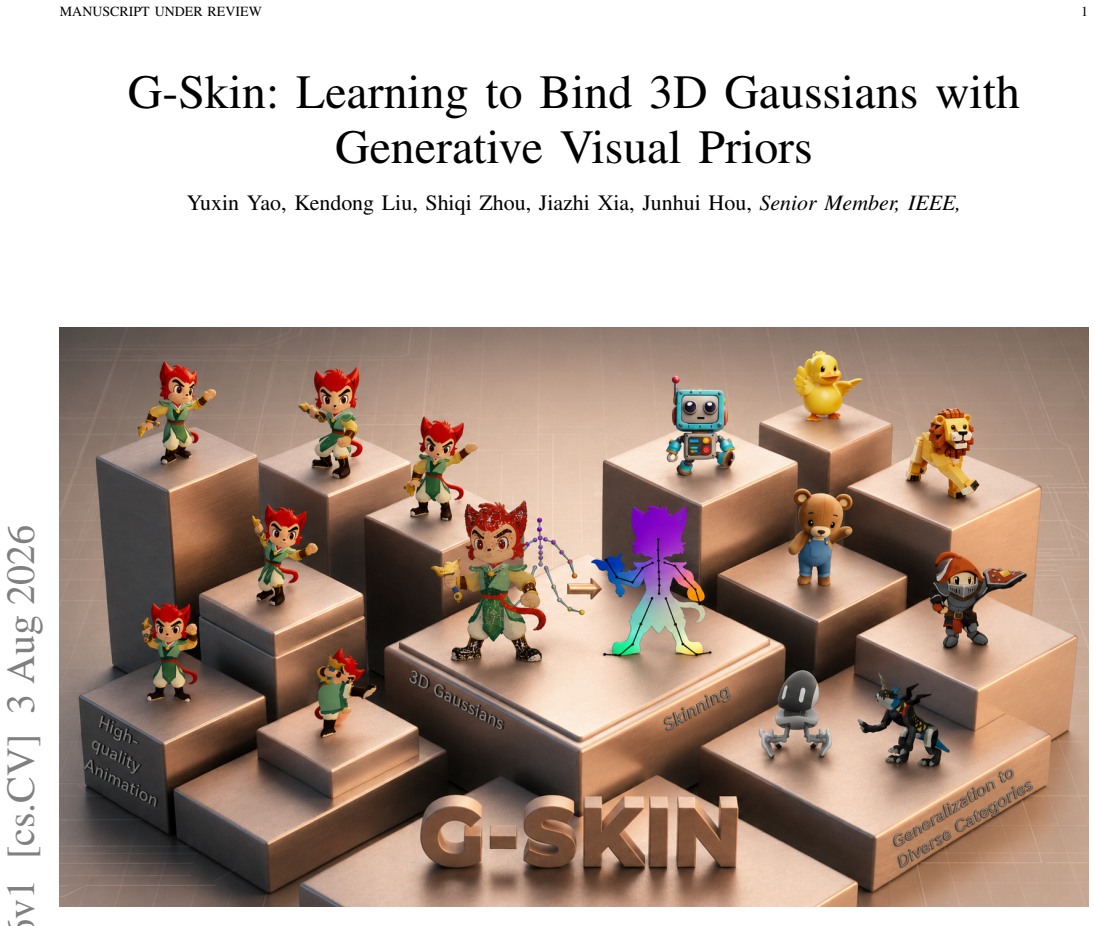
G-Skin learns 3D Gaussian skinning weights for arbitrary skeletons by optimizing them against skeleton-controlled images generated by a fine-tuned diffusion model.
T0 review reviewed 2026-08-04 challenge →
load-bearing objection A novel but not fully proven pipeline for skinning 3D Gaussians via generated images; the evidence for 'clear advantages' is thinner than claimed, but the direction and ablations are solid enough to warrant peer review. the 5 major comments →
G-Skin: Learning to Bind 3D Gaussians with Generative Visual Priors
The pith
A machine-rendered reading of the paper's core claim, the machinery that carries it, and where it could break.
The reading
Core claim
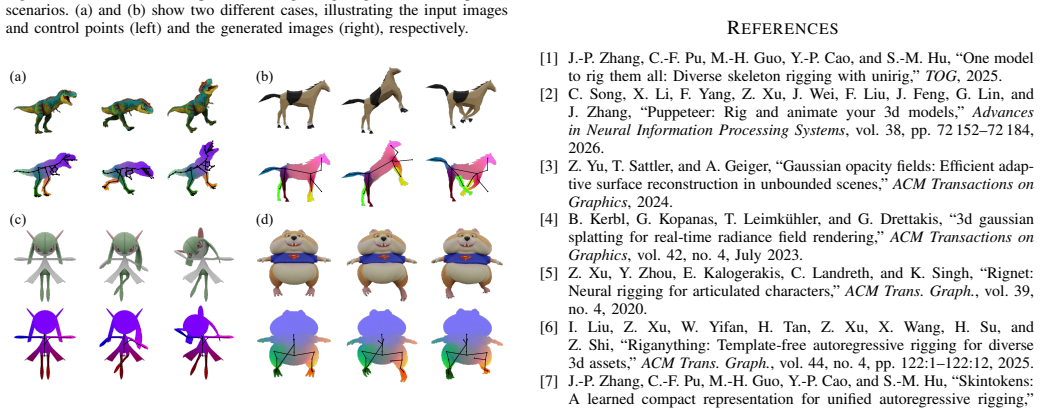
The central claim is that a skeleton-controllable 2D image generator can supply the supervision that 3D Gaussian rigging lacks. G-Skin renders the rest-pose object, randomly rotates a subset of joints, projects the joint displacements into handle and target points, and builds a dynamic mask from an initial linear-blend-skinning deformation. A fine-tuned drag-based image-editing diffusion model then outputs an image of the object in that pose. Using these images as pseudo-ground truth, G-Skin optimizes a CNN volumetric skinning field initialized from visibility-corrected geodesic voxel binding weights. The objective combines a rendering loss against the generated image with an as-rigid-as-pos
What carries the argument
The load-bearing mechanism is the skeleton-controllable guidance generation module: an image-editing diffusion model, fine-tuned so that dense skeleton control points and a dynamic mask are respected, synthesizes pose-aligned images of the object. These images replace the 3D rigging data that would otherwise be required. The second component is the optimization objective over a volumetric CNN skinning field—rendering loss against the generated image plus an as-rigid-as-possible term and a bone-to-surface coupling term—which keeps the skinning weights smooth and structurally coherent when the generator output is imperfect.
Load-bearing premise
The load-bearing premise is that the fine-tuned 2D generator, conditioned on projected skeleton points and a dynamic mask, produces images whose pose-dependent shape changes are accurate enough to supervise 3D skinning weights; if it fails—for instance on geometrically fused parts—the rigidity and coupling losses cannot repair a wrong supervision signal.
What would settle it
Take objects with two parts that touch but are not connected—a character holding a prop, crossed limbs, or glued-feet cases—and run G-Skin with a skeleton that treats the parts as separate bones, then compare rendered animations against ground-truth frames. If the optimized weights bind the touching parts together, or if LPIPS on these cases is no better than using the initial geometric weights, the claim of structurally coherent skinning is disproved; the paper's own Fig. 13 already shows such a failure, so a systematic run over fused-geometry assets would settle the boundary.
If this is right
- Automated rigging becomes available for 3D Gaussian Splatting assets directly, without converting them to meshes and without paired 3D rigging datasets.
- The same pipeline applies to mesh-anchored Gaussian representations, so it can be paired with deformations designed to suppress animation artifacts.
- Because supervision comes from 2D generative priors, the method should transfer to unseen object categories with only a short per-object optimization.
- The reported comparisons imply that, on the evaluated benchmark, learned weights beat mesh-based rigging transfer and point-cloud baselines in both automated video metrics and human ratings.
Where Pith is reading between the lines
- The fine-tuning ablation—generated-image quality jumps after aligning the base editor to skeleton controls—suggests that downstream skinning accuracy is gated by generator pose fidelity, so stronger pose-conditioned diffusion models should translate directly into better skinning.
- The dynamic-mask and handle/target conditioning scheme is a general way to turn a 2D image editor into a 3D supervision engine; the same recipe could estimate deformation fields, contact points, or part segmentation where 3D ground truth is scarce.
- The stated failure on geometrically glued or topologically fused parts implies the method assumes locally separable geometry; an extension would need explicit contact or part-separation priors, not just stronger image guidance.
- A natural next step, implicit in the paper, is to turn the generated pseudo-guidance into a large synthetic rigging dataset that trains a feed-forward skinning network, removing test-time optimization.
Editorial analysis
A structured set of objections, weighed in public.
Referee Report
Summary. The paper proposes G-Skin, a framework for automatically skinning 3D Gaussian Splatting assets to arbitrary skeletons. The method first computes initial geometric skinning weights via a geodesic-voxel binding with a visibility penalty, then uses a fine-tuned skeleton-controllable image generation model to synthesize pose-aligned guidance images. These images, together with two geometric regularizers (ARAP and coupling losses), supervise the optimization of a volumetric skinning field. The authors evaluate on Articulation-XL 2.0 and on newly generated 3D assets, comparing against mesh-based baselines (UniRig, Puppeteer, BBW) and a Gaussian-based baseline (MIA), and report advantages in PSNR, SSIM, LPIPS, VBench metrics, and user studies.
Significance. If validated, the core idea—distilling 2D generative motion priors into 3D skinning weights—is novel and practically relevant, as it sidesteps the scarcity of high-quality 3D rigging datasets. The framework is flexible (supports both vanilla and mesh-anchored 3DGS) and the regularization design is reasonable. The paper also provides a clear component ablation. However, the current evidence is insufficient to support the strong claims of 'clear advantages' and 'superior generalization' because the evaluation protocol is confounded by circularity: the guidance generator is fine-tuned on the same dataset family used for the main quantitative evaluation, and the dynamic mask used for generation depends on the method's own initial skinning. These concerns substantially weaken the persuasiveness of the empirical results.
major comments (5)
- [Sec. IV-A and Table II] The guidance generator is fine-tuned on 351 objects from Articulation-XL 2.0, and Table II reports the main quantitative comparison on 40 objects from the test set of the same dataset. Because the generator has been trained on this asset distribution, the generated 'pseudo-guidance' images may reproduce deformations seen during fine-tuning rather than provide independent supervision. The text acknowledges that Articulation-XL 2.0 test objects overlap with UniRig/Puppeteer training sets, but it does not address the analogous overlap for the proposed generator. This makes the reported margins (e.g., 26.37 vs 26.19 PSNR) hard to interpret as evidence of generalization. Please add evaluation on a dataset not used for generator fine-tuning, or retrain the generator without Articulation-XL 2.0 and verify that the advantage persists.
- [Sec. III-C and Eq. (8)] The dynamic mask used to condition the guidance generator is computed from the initial skinning weights (Eq. (7)) applied via LBS and rendered. Those same initial weights are used to initialize the network through L_init (Eq. (8)). Thus the generated images—and therefore the rendering loss—depend on the method's own initialization. Errors in the initial skinning can propagate: a wrongly marked region may not be regenerated, leaving the optimization with no incentive to correct it. To support the claim that the generative prior improves over geometric initialization, please ablate the source of the mask (e.g., ground-truth mask, mask from a different initialization, or no mask) and report the effect on final skinning quality.
- [Table II and Table III] The quantitative advantages over the strongest baselines are small: PSNR 26.37 vs 26.19, SSIM 0.964 vs 0.963, LPIPS 0.0447 vs 0.0475. No standard deviations, confidence intervals, or significance tests are reported, and the comparison set is favorable to the method for the reasons above. The abstract's claim of 'clear advantages' is not supported by these numbers. Please report variability over objects/views and perform a statistical test, or soften the claim.
- [Sec. IV-D and Table V] The ablation of fine-tuning (Table V) only measures image generation quality against ground-truth renders; it does not measure how generator errors affect the final skinning weights. To separate the contributions of the generator and the skinning optimizer, an oracle experiment is needed: optimize skinning from ground-truth rendered images of the target pose and compare with optimization from generated images. This would quantify how often and how much the generated guidance is wrong, and whether the ARAP and coupling losses (Eqs. (10)-(11)) can absorb those errors. Without this, the paper's central assumption that the generated images are reliable guidance remains untested.
- [Sec. V] The paper acknowledges that the method fails on geometrically glued or topologically fused regions (Fig. 13). This is precisely the regime where the generator's output is most likely to be wrong, and it is also a common case in practice. The current evaluation does not quantify the frequency or severity of such failures, nor does it test whether the two regularizers mitigate them. Please add a failure analysis with a measure of how often the optimization produces visibly incorrect deformations, and discuss the boundary of the method's applicability.
minor comments (6)
- [Sec. IV-A] Dataset naming is inconsistent: 'Articulation XL 2.0' vs 'Articulation-XL 2.0' throughout.
- [Sec. IV-C] BBW is reported only on the remaining 'successful trials' after excluding 15 failed cases. Please report the number of remaining cases and the exclusion criterion, as this makes the baseline comparison non-standard.
- [Table V and Fig. 10] The 'Ground Truth' in Table V and Fig. 10 is not defined. Specify whether these are ground-truth renders from Articulation-XL 2.0, from the generated assets, or from a separate set.
- [Sec. IV-D] The phrase 'by benchmark configurations across 1 view...' is awkward and likely a typo; consider 'by benchmarking configurations across 1 view...'.
- [References] Reference [49] has an incomplete author list ('Diederik, P.' only). Please correct to 'Kingma, D.P. and Ba, J.'.
- [Fig. 2] The acronym 'GOF' is used in the caption without expansion. Please expand on first use.
Circularity Check
No significant circularity; the supervision signal is not equivalent to the method's own inputs by construction.
full rationale
G-Skin's derivation chain is not circular. The skinning weights are optimized by a render loss against images synthesized by a diffusion model that was fine-tuned on 351 Articulation-XL 2.0 objects, while the main quantitative benchmark uses 40 held-out test objects from the same dataset and a separate set of 85 Trellis-generated assets; the generator is not fine-tuned per test asset, so this is a standard train/test split rather than a fitted-input-called-prediction. The dynamic mask (Sec. III-C) is computed from the initial skinning weights of Eq. (7), but it enters only as a binary control signal for the inpainting model; it is not the optimization target, and the ablation in Table IV shows that the optimized weights differ substantially from the initial weights (PSNR 23.83 vs 26.37), so the final prediction is not forced to equal the input by construction. The self-citation [21] is used only as a general reference for LBS and as a related-work example; it is not load-bearing. The acknowledged failure on geometrically glued parts and the reliance on test-time optimization are limitations about generalization and robustness, not evidence that the output is equivalent to the input. No equation in the paper reduces the claimed prediction to a fitted parameter or to a self-citation chain.
Axiom & Free-Parameter Ledger
free parameters (7)
- visibility penalty delta =
10% of bounding box diagonal
- binding smoothness gamma =
0.5
- ARAP neighbor count K1 =
30
- coupling loss neighbor count K2 =
not specified
- loss weights w_a and w_c =
not reported
- canonical voxel resolution =
128
- mesh-anchored offset beta =
learned in [-0.5, 0.5]
axioms (6)
- domain assumption Linear Blend Skinning is a valid deformation model for 3D Gaussian primitives
- ad hoc to paper The fine-tuned 2D diffusion model provides reliable pose-aligned guidance images from skeleton control points and dynamic masks
- ad hoc to paper Fine-tuning on 351 Articulation-XL 2.0 objects does not degrade the pre-trained 2D foundation model's priors
- domain assumption Initial geometric skinning weights from Eq. (7) are accurate enough to define dynamic masks and serve as initialization
- ad hoc to paper Rendering loss against single-view generated images can determine correct 3D skinning weights
- standard math 3D Gaussian Splatting provides a differentiable rendering model
Cite this review
Pith. "Pith review of G-Skin: Learning to Bind 3D Gaussians with Generative Visual Priors." pith.science (2026). https://pith.science/paper/7HIQHBJ4
@misc{pith2026260801726,
  author       = {Pith},
  title        = {Pith review of: G-Skin: Learning to Bind 3D Gaussians with Generative Visual Priors},
  year         = {2026},
  howpublished = {\url{https://pith.science/paper/7HIQHBJ4}},
  note         = {Machine review of arXiv:2608.01726}
}
read the original abstract
3D Gaussian Splatting has achieved remarkable success in photorealistic and efficient rendering, leading to a rapid increase in 3D assets represented by 3D Gaussian primitives. Directly rigging these assets with arbitrary skeleton topologies is highly desirable. However, training a feed-forward skinning framework is infeasible due to the lack of high-quality 3D Gaussian rigging datasets. An alternative solution is to transfer mesh-based techniques to 3D Gaussian-based representation, but 3D Gaussian primitives are not restricted to the surface and lack explicit topological connectivity. Moreover, this kind of method suffers from poor generalization to unseen data due to its strong dependence on training data, while acquiring high-quality rigging data is prohibitively expensive. To address this challenging problem, we propose G-Skin, a novel generative skinning framework designed for expressive and high-fidelity animation with 3D Gaussian representation. To overcome this 3D data scarcity, we introduce a skeleton-controllable image generation model leveraging 2D vision foundation models to distill powerful motion priors into pseudo-guidance. Guided by these priors, we formulate an optimization pipeline incorporating geometry-aware regularizations, which stabilizes the learning process and ensures smooth, structurally coherent skinning weights. G-Skin also generalizes flexibly to the augmented variants of 3D Gaussian representation designed to mitigate animation-induced rendering artifacts. Extensive experiments validate the effectiveness of our approach, demonstrating clear advantages over state-of-the-art methods. Project page: https://yaoyx689.github.io/GSkin.html.
Figures



Reference graph
Works this paper leans on
-
[1]
One model to rig them all: Diverse skeleton rigging with unirig,
J.-P. Zhang, C.-F. Pu, M.-H. Guo, Y .-P. Cao, and S.-M. Hu, “One model to rig them all: Diverse skeleton rigging with unirig,”TOG, 2025
work page 2025
-
[2]
Puppeteer: Rig and animate your 3d models,
C. Song, X. Li, F. Yang, Z. Xu, J. Wei, F. Liu, J. Feng, G. Lin, and J. Zhang, “Puppeteer: Rig and animate your 3d models,”Advances in Neural Information Processing Systems, vol. 38, pp. 72 152–72 184, 2026
work page 2026
-
[3]
Gaussian opacity fields: Efficient adap- tive surface reconstruction in unbounded scenes,
Z. Yu, T. Sattler, and A. Geiger, “Gaussian opacity fields: Efficient adap- tive surface reconstruction in unbounded scenes,”ACM Transactions on Graphics, 2024
work page 2024
-
[4]
3d gaussian splatting for real-time radiance field rendering,
B. Kerbl, G. Kopanas, T. Leimk ¨uhler, and G. Drettakis, “3d gaussian splatting for real-time radiance field rendering,”ACM Transactions on Graphics, vol. 42, no. 4, July 2023
2023
-
[5]
Rignet: Neural rigging for articulated characters,
Z. Xu, Y . Zhou, E. Kalogerakis, C. Landreth, and K. Singh, “Rignet: Neural rigging for articulated characters,”ACM Trans. Graph., vol. 39, no. 4, 2020
work page 2020
-
[6]
Riganything: Template-free autoregressive rigging for diverse 3d assets,
I. Liu, Z. Xu, W. Yifan, H. Tan, Z. Xu, X. Wang, H. Su, and Z. Shi, “Riganything: Template-free autoregressive rigging for diverse 3d assets,”ACM Trans. Graph., vol. 44, no. 4, pp. 122:1–122:12, 2025
work page 2025
-
[7]
Skintokens: A learned compact representation for unified autoregressive rigging,
J.-P. Zhang, C.-F. Pu, M.-H. Guo, Y .-P. Cao, and S.-M. Hu, “Skintokens: A learned compact representation for unified autoregressive rigging,” arXiv preprint arXiv:2602.04805, 2026
arXiv 2026
-
[8]
Objaverse: A universe of annotated 3d objects,
M. Deitke, D. Schwenk, J. Salvador, L. Weihs, O. Michel, E. VanderBilt, L. Schmidt, K. Ehsani, A. Kembhavi, and A. Farhadi, “Objaverse: A universe of annotated 3d objects,” inProceedings of the IEEE/CVF conference on computer vision and pattern recognition, 2023, pp. 13 142–13 153
2023
-
[9]
Objaverse-xl: A uni- verse of 10m+ 3d objects,
M. Deitke, R. Liu, M. Wallingford, H. Ngo, O. Michel, A. Kusupati, A. Fan, C. Laforte, V . V oleti, S. Y . Gadreet al., “Objaverse-xl: A uni- verse of 10m+ 3d objects,”Advances in Neural Information Processing Systems, vol. 36, pp. 35 799–35 813, 2023
work page 2023
-
[10]
Nerf: Representing scenes as neural radiance fields for view synthesis,
B. Mildenhall, P. P. Srinivasan, M. Tancik, J. T. Barron, R. Ramamoorthi, and R. Ng, “Nerf: Representing scenes as neural radiance fields for view synthesis,” inEur . Conf. Comput. Vis., 2020
work page 2020
-
[11]
Template-free articulated neural point clouds for reposable view synthesis,
L. Uzolas, E. Eisemann, and P. Kellnhofer, “Template-free articulated neural point clouds for reposable view synthesis,”Advances in Neural Information Processing Systems, vol. 36, pp. 31 621–31 637, 2023
work page 2023
-
[12]
Humannerf: Efficiently generated human radiance field from sparse inputs,
F. Zhao, W. Yang, J. Zhang, P. Lin, Y . Zhang, J. Yu, and L. Xu, “Humannerf: Efficiently generated human radiance field from sparse inputs,” inProceedings of the IEEE/CVF Conference on Computer Vision and Pattern Recognition, 2022, pp. 7743–7753
2022
-
[13]
Real-time large-scale deformation of gaussian splatting,
L. Gao, J. Yang, B.-T. Zhang, J.-M. Sun, Y .-J. Yuan, H. Fu, and Y .- K. Lai, “Real-time large-scale deformation of gaussian splatting,”ACM Transactions on Graphics (TOG), vol. 43, no. 6, pp. 1–17, 2024
work page 2024
-
[14]
Splattingavatar: Realistic real-time human avatars with mesh-embedded gaussian splatting,
Z. Shao, Z. Wang, Z. Li, D. Wang, X. Lin, Y . Zhang, M. Fan, and Z. Wang, “Splattingavatar: Realistic real-time human avatars with mesh-embedded gaussian splatting,” inProceedings of the IEEE/CVF Conference on Computer Vision and Pattern Recognition, 2024, pp. 1606–1616
work page 2024
-
[15]
Gaussianavatars: Photorealistic head avatars with rigged 3d gaussians,
S. Qian, T. Kirschstein, L. Schoneveld, D. Davoli, S. Giebenhain, and M. Nießner, “Gaussianavatars: Photorealistic head avatars with rigged 3d gaussians,” inProceedings of the IEEE/CVF Conference on Computer Vision and Pattern Recognition, 2024, pp. 20 299–20 309
2024
-
[16]
Vr-gs: A physical dynamics-aware interactive gaussian splatting system in virtual reality,
Y . Jiang, C. Yu, T. Xie, X. Li, Y . Feng, H. Wang, M. Li, H. Lau, F. Gao, Y . Yanget al., “Vr-gs: A physical dynamics-aware interactive gaussian splatting system in virtual reality,” inACM SIGGRAPH 2024 Conference Papers, 2024, pp. 1–1
2024
-
[17]
Arap- gs: Drag-driven as-rigid-as-possible 3d gaussian splatting editing with diffusion prior,
X. Han, R. Tian, Y . Tong, F. Yu, D. Liu, and Y . Zhang, “Arap- gs: Drag-driven as-rigid-as-possible 3d gaussian splatting editing with diffusion prior,” inICASSP 2026-2026 IEEE International Conference on Acoustics, Speech and Signal Processing (ICASSP). IEEE, 2026, pp. 12 807–12 811
work page 2026
-
[18]
Template-free articulated gaus- sian splatting for real-time reposable dynamic view synthesis,
D. Wan, Y . Wang, R. Lu, and G. Zeng, “Template-free articulated gaus- sian splatting for real-time reposable dynamic view synthesis,”Advances in Neural Information Processing Systems, vol. 37, pp. 62 000–62 023, 2024. MANUSCRIPT UNDER REVIEW 14
work page 2024
-
[19]
Human gaussian splatting: Real-time rendering of animatable avatars,
A. Moreau, J. Song, H. Dhamo, R. Shaw, Y . Zhou, and E. P ´erez- Pellitero, “Human gaussian splatting: Real-time rendering of animatable avatars,” inProceedings of the IEEE/CVF conference on computer vision and pattern recognition, 2024, pp. 788–798
work page 2024
-
[20]
L. Hu, H. Zhang, Y . Zhang, B. Zhou, B. Liu, S. Zhang, and L. Nie, “Gaussianavatar: Towards realistic human avatar modeling from a single video via animatable 3d gaussians,” inProceedings of the IEEE/CVF conference on computer vision and pattern recognition, 2024, pp. 634– 644
work page 2024
-
[21]
Riggs: Rigging of 3d gaussians for modeling articulated objects in videos,
Y . Yao, Z. Deng, and J. Hou, “Riggs: Rigging of 3d gaussians for modeling articulated objects in videos,” inThe IEEE/CVF Conference on Computer Vision and Pattern Recognition, 2025
work page 2025
-
[22]
Gaussianimate: Reconstruct and rig animatable categories with level of dynamics,
J. Wang, D. Lyu, Z. Cai, Z. Dou, C. Lin, A. Chen, and Y . Xiu, “Gaussianimate: Reconstruct and rig animatable categories with level of dynamics,” inSIGGRAPH Asia 2026 conference papers, 2026
work page 2026
-
[23]
Smpl: A skinned multi-person linear model,
M. Loper, N. Mahmood, J. Romero, G. Pons-Moll, and M. J. Black, “Smpl: A skinned multi-person linear model,”ACM transactions on graphics (TOG), vol. 34, no. 6, pp. 1–16, 2015
work page 2015
-
[24]
3D menagerie: Modeling the 3D shape and pose of animals,
S. Zuffi, A. Kanazawa, D. Jacobs, and M. J. Black, “3D menagerie: Modeling the 3D shape and pose of animals,” inIEEE Conf. Comput. Vis. Pattern Recog., Jul. 2017
work page 2017
-
[25]
Predicting animation skeletons for 3d articulated models via volumetric nets,
Z. Xu, Y . Zhou, E. Kalogerakis, and K. Singh, “Predicting animation skeletons for 3d articulated models via volumetric nets,” in2019 international conference on 3D vision (3DV). IEEE, 2019, pp. 298–307
work page 2019
-
[26]
Drive: Diffusion-based rigging empowers gener- ation of versatile and expressive characters,
M. Sun, J. Chen, J. Dong, Y . Chen, X. Jiang, S. Mao, P. Jiang, J. Wang, B. Dai, and R. Huang, “Drive: Diffusion-based rigging empowers gener- ation of versatile and expressive characters,” inIEEE/CVF Conference on Computer Vision and Pattern Recognition, CVPR 2025, Nashville, TN, USA, June 11-15, 2025. Computer Vision Foundation / IEEE, 2025, pp. 21 170–21 180
work page 2025
-
[27]
Anymate: A dataset and baselines for learning 3d object rigging,
Y . Deng, Y . Zhang, C. Geng, S. Wu, and J. Wu, “Anymate: A dataset and baselines for learning 3d object rigging,” inSpecial Interest Group on Computer Graphics and Interactive Techniques Conference Conference Papers (SIGGRAPH Conference Papers ’25). Vancouver, BC, Canada: Association for Computing Machinery, Aug. 2025, august 10–14, 2025
work page 2025
-
[28]
Armo: Autoregressive rigging for multi-category objects,
M. Sun, S. Mao, K. Chen, Y . Chen, S. Lu, J. Wang, J. Dong, and R. Huang, “Armo: Autoregressive rigging for multi-category objects,” arXiv preprint arXiv:2503.20663, 2025
Pith/arXiv arXiv 2025
-
[29]
Magicarticulate: Make your 3d models articulation-ready,
C. Song, J. Zhang, X. Li, F. Yang, Y . Chen, Z. Xu, J. H. Liew, X. Guo, F. Liu, J. Feng, and G. Lin, “Magicarticulate: Make your 3d models articulation-ready,” inProceedings of the Computer Vision and Pattern Recognition Conference (CVPR), June 2025, pp. 15 998–16 007
work page 2025
-
[30]
Automatic rigging and animation of 3d characters,
I. Baran and J. Popovic, “Automatic rigging and animation of 3d characters,”ACM Trans. Graph., vol. 26, no. 3, p. 72, 2007
work page 2007
-
[31]
Geodesic voxel binding for pro- duction character meshes,
O. Dionne and M. de Lasa, “Geodesic voxel binding for pro- duction character meshes,” inProceedings of the 12th ACM SIG- GRAPH/Eurographics Symposium on Computer Animation, 2013, pp. 173–180
work page 2013
-
[32]
Neuroskin- ning: automatic skin binding for production characters with deep graph networks,
L. Liu, Y . Zheng, D. Tang, Y . Yuan, C. Fan, and K. Zhou, “Neuroskin- ning: automatic skin binding for production characters with deep graph networks,”ACM Trans. Graph., vol. 38, no. 4, pp. 114:1–114:12, 2019
work page 2019
-
[33]
A. Mosella-Montoro and J. Ruiz-Hidalgo, “Skinningnet: Two-stream graph convolutional neural network for skinning prediction of synthetic characters,” inProceedings of the IEEE/CVF conference on computer vision and pattern recognition, 2022, pp. 18 593–18 602
work page 2022
-
[34]
Humanrig: Learning automatic rigging for humanoid character in a large scale dataset,
Z. Chu, F. Xiong, M. Liu, J. Zhang, M. Shao, Z. Sun, D. Wang, and M. Xu, “Humanrig: Learning automatic rigging for humanoid character in a large scale dataset,” inProceedings of the IEEE/CVF Conference on Computer Vision and Pattern Recognition, 2025, pp. 304–313
work page 2025
-
[35]
Make- it-animatable: An efficient framework for authoring animation-ready 3d characters,
Z. Guo, J. Xiang, K. Ma, W. Zhou, H. Li, and R. Zhang, “Make- it-animatable: An efficient framework for authoring animation-ready 3d characters,” inProceedings of the Computer Vision and Pattern Recognition Conference, 2025, pp. 10 783–10 792
work page 2025
-
[36]
Articulated kinematics distillation from video diffusion models,
X. Li, Q. Ma, T. Lin, Y . Chen, C. Jiang, M. Liu, and D. Xiang, “Articulated kinematics distillation from video diffusion models,” in IEEE/CVF Conference on Computer Vision and Pattern Recognition, CVPR 2025, Nashville, TN, USA, June 11-15, 2025. Computer Vision Foundation / IEEE, 2025, pp. 17 571–17 581
work page 2025
-
[37]
Cogvideox: Text-to-video diffusion models with an expert transformer,
Z. Yang, J. Teng, W. Zheng, M. Ding, S. Huang, J. Xu, Y . Yang, W. Hong, X. Zhang, G. Fenget al., “Cogvideox: Text-to-video diffusion models with an expert transformer,”arXiv preprint arXiv:2408.06072, 2024
Pith/arXiv arXiv 2024
-
[38]
Animax: Animating the inanimate in 3d with joint video-pose diffusion models,
Z. Huang, H. Feng, Y .-T. Sun, Y .-C. Guo, Y .-P. Cao, and L. Sheng, “Animax: Animating the inanimate in 3d with joint video-pose diffusion models,” inProceedings of the SIGGRAPH Asia 2025 Conference Papers, 2025, pp. 1–13
work page 2025
-
[39]
Articulate3d: Zero-shot text-driven 3d object posing,
O. Deb, A. Hu, A. Khakzar, P. Torr, and C. Rupprecht, “Articulate3d: Zero-shot text-driven 3d object posing,” 2025
work page 2025
-
[40]
Magicpony: Learning articulated 3d animals in the wild,
S. Wu, R. Li, T. Jakab, C. Rupprecht, and A. Vedaldi, “Magicpony: Learning articulated 3d animals in the wild,” inIEEE Conf. Comput. Vis. Pattern Recog., 2023, pp. 8792–8802
work page 2023
-
[41]
Pose space deformation: a unified approach to shape interpolation and skeleton-driven deforma- tion,
J. P. Lewis, M. Cordner, and N. Fong, “Pose space deformation: a unified approach to shape interpolation and skeleton-driven deforma- tion,” inProceedings of the 27th Annual Conference on Computer Graphics and Interactive Techniques, ser. SIGGRAPH ’00. USA: ACM Press/Addison-Wesley Publishing Co., 2000, p. 165–172
work page 2000
-
[42]
Games: Mesh-based adapting and modification of gaussian splatting,
J. Waczy ´nska, P. Borycki, S. Tadeja, J. Tabor, and P. Spurek, “Games: Mesh-based adapting and modification of gaussian splatting,”arXiv preprint arXiv:2402.01459, 2024
Pith/arXiv arXiv 2024
- [43]
-
[44]
JiMeng AI, “Jimeng ai,” 2025. [Online]. Available: https://jimeng. jianying.com
work page 2025
-
[45]
Lightningdrag: Lightning fast and accurate drag-based image editing emerging from videos,
Y . Shi, J. H. Liew, H. Yan, V . Tan, and J. Feng, “Lightningdrag: Lightning fast and accurate drag-based image editing emerging from videos,” inInternational Conference on Machine Learning. PMLR, 2025, pp. 54 981–54 993
work page 2025
-
[46]
Flux.1 kontext: Flow matching for in-context image generation and editing in latent space,
B. F. Labs, S. Batifol, A. Blattmann, F. Boesel, S. Consul, C. Diagne, T. Dockhorn, J. English, Z. English, P. Esser, S. Kulal, K. Lacey, Y . Levi, C. Li, D. Lorenz, J. M ¨uller, D. Podell, R. Rombach, H. Saini, A. Sauer, and L. Smith, “Flux.1 kontext: Flow matching for in-context image generation and editing in latent space,” 2025. [Online]. Available: h...
Pith/arXiv arXiv 2025
-
[47]
Doubao: A large language model by ByteDance,
ByteDance, “Doubao: A large language model by ByteDance,” https: //www.doubao.com, 2024, accessed: 2024-05-20
work page 2024
-
[48]
Structured 3d latents for scalable and versatile 3d generation,
J. Xiang, Z. Lv, S. Xu, Y . Deng, R. Wang, B. Zhang, D. Chen, X. Tong, and J. Yang, “Structured 3d latents for scalable and versatile 3d generation,” inProceedings of the Computer Vision and Pattern Recognition Conference, 2025, pp. 21 469–21 480
2025
-
[49]
Adam: A method for stochastic optimization,
P. K. Diederik, “Adam: A method for stochastic optimization,”(No Title), 2014
work page 2014
-
[50]
Adobe Systems Inc., “Mixamo,” https://www.mixamo.com, 2024, ac- cessed: 2024-05-20
work page 2024
-
[51]
VBench: Comprehensive benchmark suite for video generative models,
Z. Huang, Y . He, J. Yu, F. Zhang, C. Si, Y . Jiang, Y . Zhang, T. Wu, Q. Jin, N. Chanpaisit, Y . Wang, X. Chen, L. Wang, D. Lin, Y . Qiao, and Z. Liu, “VBench: Comprehensive benchmark suite for video generative models,” inProceedings of the IEEE/CVF Conference on Computer Vision and Pattern Recognition, 2024
2024
-
[52]
Bounded biharmonic weights for real-time deformation
A. Jacobson, I. Baran, J. Popovic, and O. Sorkine, “Bounded biharmonic weights for real-time deformation.”ACM Trans. Graph., vol. 30, no. 4, p. 78, 2011
work page 2011
-
[53]
libigl: A simple C++ geometry processing library,
A. Jacobson, D. Panozzoet al., “libigl: A simple C++ geometry processing library,” 2018, https://libigl.github.io/. Yuxin Yaois currently a postdoctoral researcher with the Department of Computer Science, City University of Hong Kong. She received the BE degree from the University of Electronic Science and Technology of China, Chengdu, China, in 2018, and...
work page 2018
This paper was first reviewed by deepseek-v4-flash on August 4, 2026.
discussion (0)
Sign in with ORCID, Apple, or X to comment. Anyone can read and Pith papers without signing in.