REVIEW 5 major objections 5 minor 46 references
Age of Information Minimization in UAV-Enabled Integrated Sensing and Communication Systems
T0 review · 5 major / 5 minor · reviewed 2026-08-06 · deepseek-v4-flash
Pith's one-line read This paper claims that one learned policy can jointly steer a UAV and shape its beams to keep target-status information fresher at ground users than three baseline approaches, across varying SINR thresholds, sensing accuracy requirements…
desk verdict Solid simulation-driven AoI-UAV-ISAC paper with a genuinely new joint trajectory-beamforming angle; worth refereeing, but the sensing model and baseline choices need tightening. read the letter →
The pith
A machine-rendered reading of the paper's core claim, the machinery that carries it, and where it could break.
The reading
What carries the argument
The load-bearing mechanism is the AoI update rule in Eqs. (28)-(29), where the freshness of the target status at each user depends on two gates: the radar SNR $\mathrm{SNR}_p[n]$ against the threshold $\mathrm{SNR}_{\mathrm{th}}$ for generating an update, and the communication SINR $\Gamma_k[n]$ against $\Gamma_{\mathrm{th}}$ for receiving it. The radar SNR is obtained from an array-factor-extended radar equation with coherent pulse integration, and the measurement covariance that feeds the Kalman filter is taken as the CRLB expression $R[n]=\sigma_0^2/(\mathrm{SNR}_p[n]+\varepsilon)I_2$. The optimization machinery is a finite-horizon Markov Decision Process whose state packs UAV position, user geometry, SINRs, per-user AoIs, Kalman-filter estimate and covariance, radar SNR, and mission progress; whose action is the continuous triple of UAV displacement, priority scores, and an adaptive threshold; and whose post-processing maps that triple to feasible powers and beam directions. Soft Actor-Critic training with twin critics, automatic entropy temperature, and a replay buffer is what keeps this continuous-action policy stable enough to learn the coupled behavior.
What would settle it
In a high-fidelity channel emulator or field trial, measure the actual covariance of the radar position measurements at the SNRs the UAV experiences, and re-run the same SAC policy and baselines with the empirical $R[n]$ substituted for Eq. (15). If the average-AoI ordering between the SAC controller and the baselines reverses, or if the policy's adaptive threshold ceases to track $\mathrm{SNR}_{\mathrm{th}}$, the CRLB-driven update rule is the part of the model that failed.
Extended reading notes
Core claim
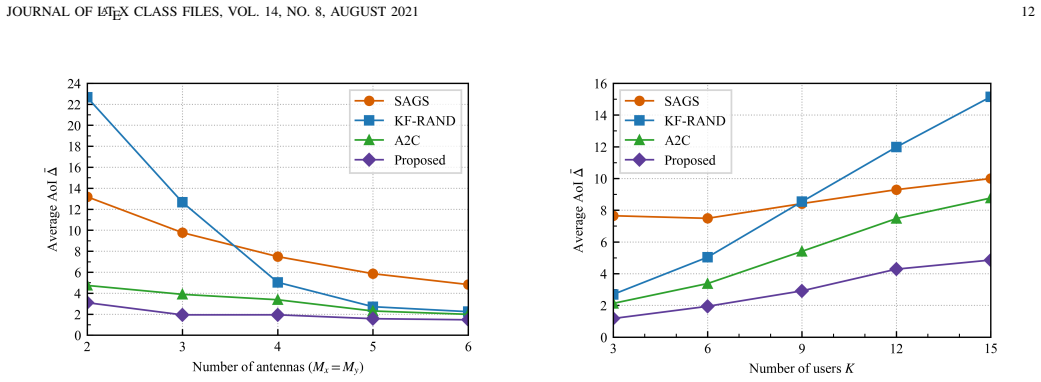
The central discovery, stated on the paper's own terms, is that the AoI recursion couples the radar and communication gates, and that a deep reinforcement learning policy can be trained to navigate that coupling. An update is generated only when the post-detection sensing SNR passes $\mathrm{SNR}_{\mathrm{th}}$, and it is received by user $k$ only when the downlink SINR $\Gamma_k[n]$ passes $\Gamma_{\mathrm{th}}$; otherwise the user's age increments. By letting the agent output a two-dimensional displacement, a set of per-beam priority scores, and an adaptive threshold, and then mapping these outputs through a softmax power split, regularized zero-forcing beam directions, and a Kalman-filter-steered sensing beam, the policy learns where to fly and which beams to energize. In the simulations, the resulting SAC controller holds the lowest average AoI for every tested value of the SINR threshold $\Gamma_{\mathrm{th}} \in \{0,5,10,15,20\}$ dB, the sensing accuracy requirement $\sigma_{\mathrm{req}} \in \{0.1,0.5,1,2,4\}$ m, the UPA size from $2\times2$ to $6\times6$, and the user count from 3 to 15, and its learned trajectories visibly bend away from the target toward distant users as the sensing requirement is relaxed.
Load-bearing premise
The entire AoI ordering rests on the simulated radar measurement noise being exactly the CRLB expression $R[n]=\sigma_0^2/(\mathrm{SNR}_p[n]+\varepsilon)I_2$ and on the reliability test that turns high radar SNR into a fresh status update; if real radar errors differ because of multipath, beam shape, or imperfect pulse integration, the simulated AoI ordering between schemes may not transfer.
Editorial extensions
If this is right
- If the central claim is right, a single trained SAC policy can act as a real-time UAV-ISAC controller, since the same agent generalizes across different SINR thresholds, sensing accuracy requirements, array sizes, and user counts in the simulations.
- The learned trajectories make the sensing-communication trade-off explicit: tightening $\sigma_{\mathrm{req}}$ pulls the UAV close to the target and raises radar SNR, while loosening it lets the UAV drift toward users and improves their SINR.
- Larger antenna arrays reduce average AoI for every scheme, and the SAC policy uses the extra spatial degrees of freedom to satisfy all users while sustaining the sensing beam.
- Increasing the number of users raises average AoI for all policies, but the SAC controller keeps the lowest age even when 15 users contend for the same power budget.
- The SAC controller converges faster and more stably than the on-policy A2C baseline, suggesting that off-policy entropy-regularized updates are better matched to this continuous-action problem.
Reading between the lines
- The threshold-plus-priority action representation suggests an implicit schedulability rule: a user is served only when its learned score exceeds the adaptive threshold, so the policy could be distilled into a lightweight channel-aware scheduler for hardware-constrained deployments.
- Because the state already tracks per-user AoI, radar SNR, and Kalman uncertainty, the same MDP could be retargeted to peak-AoI or AoI-violation constraints by swapping the reward function, which the paper does not explore.
- The free-space Friis channel and perfect Doppler compensation are part of the model; in multipath or interference-rich environments the policy would need channel-state information in its state vector, and the observed performance ordering may not persist.
- The reported per-slot inference cost of $O(F_\pi + K + M^3)$ indicates the learned policy is computationally light enough for onboard execution, but the paper does not test real-time inference on actual UAV hardware.
Editorial analysis
A structured set of objections, weighed in public.
Referee Report
Summary. The manuscript studies a single-UAV ISAC system in which the UAV simultaneously tracks a moving target and serves K ground users, and proposes minimizing the long-term average AoI at the users by jointly optimizing UAV trajectory, per-slot power allocation, and beam directions. The transmit waveform superimposes communication and sensing beams; the sensing measurement is modeled by a CRLB-based isotropic covariance with an SNR reliability gate, a Kalman filter estimates the target state, and regularized zero-forcing forms user beams. The joint problem is cast as a finite-horizon MDP and solved with Soft Actor-Critic, with a state containing UAV/users/target/KF uncertainty and reward equal to negative average AoI. Simulations compare SAC against A2C, an AoI-greedy scheduler, and a random KF-based scheme, reporting lower average AoI for SAC over varying SINR thresholds, sensing accuracy requirements, array sizes, and user counts.
Significance. If the results hold, the paper makes a useful contribution by demonstrating that a single DRL policy can coordinate trajectory, sensing power, and multiuser beamforming for freshness-critical ISAC, going beyond prior AoI-UAV studies that ignore spatial beamforming. The MDP formulation, state/action design, and complexity analysis are clear, and the use of fixed user-layout seeds across methods is a good reproducibility practice. The central claim, however, is supported only by simulation under a heavily stylized sensing model and without statistical uncertainty, and several formulation and implementation issues need to be resolved before the results can be taken as conclusive.
major comments (5)
- [IV-B, Figs. 5, 6, 10, 11] The central comparative claim that SAC consistently achieves the lowest average AoI is made without error bars or confidence intervals, although the text states that results are averaged over 100 Monte Carlo episodes. For curves where the SAC/A2C gap is small, the reported ordering could be within sampling noise; please report standard errors or confidence intervals and, where useful, paired differences per user layout.
- [III-B5, Eq. (37) vs II-E, Eq. (33)] The training objective is the discounted return sum_{n=1}^N gamma^{n-1} r[n] with gamma=0.99 and N=60, while P1 minimizes the undiscounted time-averaged AoI. With gamma^{59} approximately 0.55, later slots are substantially down-weighted, so the learned policy optimizes a different objective than the one stated. Please either use an average-reward formulation (or gamma=1 with appropriate variance control) or provide evidence that the relative ranking is insensitive to gamma.
- [II-C2, Eq. (22)] The KF prediction equation is written as \hat{s}_T^-[n] = F \hat{s}_T^-[n-1]; given the paper's notation (superscript '-' denotes a predicted value before new measurements), this makes the filter base each prediction on the previous prediction rather than the previous posterior \hat{s}_T[n-1], so measurement updates are effectively discarded. Since the KF output steers the sensing beam in (41), this is not a purely cosmetic issue; please correct the equation and confirm that the implementation matches the corrected filter.
- [II-C1, Eqs. (15) and (17)] The reliability test (16)-(17) and the AoI update rule (28) reduce the sensing process to a scalar SNR threshold derived from the isotropic CRLB covariance R[n]=sigma_0^2/(SNR_p[n]+epsilon) I_2. For a UPA, the Fisher information for delay/angle estimation is range- and angle-dependent and generally yields an anisotropic, non-diagonal error covariance, so the simulation's measurement generation (14), the KF update (25)-(27), and the gating all share the same simplified model. The AoI ordering across schemes may change under a more realistic sensing model; please add a sensitivity study (e.g., an FIM-based covariance with range/angle dependence, or at least anisotropic perturbations of R) to show the SAC advantage persists.
- [Eq. (15) and Table I] There is a numerical inconsistency in the default parameters: with c=3e8 m/s and B=100 MHz, Eq. (15) gives sigma_0 approximately 0.60 m, whereas Table I lists sigma_0=0.338 m. This changes SNR_th=(sigma_0/sigma_req)^2 by about 5 dB and therefore directly shifts the gating event in (28) and all AoI numbers. Please correct the equation, the table, or the simulation parameters and re-run the affected figures.
minor comments (5)
- [Algorithm 1, line 15] Algorithm 1 sets r[n] = -sum_k Delta_k[n], while Eq. (37) defines r[n] = -\bar{\Delta}[n]; for fixed K these differ by a constant factor, but the two forms should be made consistent.
- [IV-A, target trajectory paragraph] The text says the construction guarantees the terminal constraint p_T^h[N-1] = p_N; with the slot indexing used elsewhere, this should probably be p_T^h[N] = p_N, or the indexing convention should be stated explicitly.
- [III-D1 and II-D] There are typos: 'is is well-suited' in Section III-D1 and 'we define the the long-term' near Eq. (31); please proofread the manuscript.
- [Fig. 10 caption and main text] Figure 10 varies the UPA size but the surrounding text lists '4 x 4 UPA' among fixed parameters; this should be rephrased to avoid confusion.
- [IV-A, compared algorithms] The baselines SAGS and KF-RAND are quite weak (single-user greedy and random allocation); adding a conventional myopic optimization baseline (e.g., trajectory-only or beam-only optimization) would make the DRL gains more informative.
Circularity Check
No significant circularity: the AoI results are direct simulation outcomes, and the few self-citations are not load-bearing.
full rationale
The paper's central claim is an empirical simulation comparison: a Soft Actor-Critic policy trained to minimize average AoI is evaluated against baselines in the same simulator and reported to achieve lower average AoI. The AoI update rule (Eqs. (28)-(29)), the measurement model (Eqs. (14)-(15)), and the Kalman filter (Eqs. (22)-(27)) are stated modeling assumptions, not parameters fitted to the reported AoI curves. The reward in Eq. (37) is the negative of the average AoI in Eq. (31); aligning the training objective with the evaluation metric is a normal design property, not a circular derivation, because the evaluation measures the same simulated quantity rather than recovering an input fit. All simulation constants are listed in Table I, and no fitted parameter is renamed as a prediction. The self-citations [5] and [33] support background statements about UAV deployment and reinforcement learning and are not load-bearing for the AoI comparison; no uniqueness theorem or ansatz from the authors' prior work is imported to force the chosen approach. The dependence of the results on the CRLB covariance model in Eq. (15) is a model-risk or correctness concern, not a circularity, because the paper does not claim to derive that model from its own output. Overall, the derivation and evaluation chain is self-contained apart from minor non-load-bearing self-citations.
Assumptions & free parameters
free parameters (2)
- q0^2 (process noise variance) =
0.25
- epsilon (CRLB regularization) =
tiny constant
assumptions (5)
- domain assumption Free-space line-of-sight channel with Friis path loss and perfect Doppler compensation
- domain assumption Sensing waveform is orthogonal to user despreading codes and does not interfere
- domain assumption Measurement covariance equals the CRLB expression in Eq. (15)
- domain assumption Target follows a nearly-constant-velocity model with known process noise Q = q0^2 I4
- domain assumption AoI evolves only through the gating rules in Eqs. (28)-(29)
Cite this review
Pith. "Pith review of Age of Information Minimization in UAV-Enabled Integrated Sensing and Communication Systems." pith.science (2026). https://pith.science/paper/7HNGG7J6
@misc{pith2026250714299,
  author       = {Pith},
  title        = {Pith review of: Age of Information Minimization in UAV-Enabled Integrated Sensing and Communication Systems},
  year         = {2026},
  howpublished = {\url{https://pith.science/paper/7HNGG7J6}},
  note         = {Machine review of arXiv:2507.14299}
}
read the original abstract
Unmanned aerial vehicles (UAVs) equipped with integrated sensing and communication (ISAC) capabilities are envisioned to play a pivotal role in future wireless networks due to their enhanced flexibility and efficiency. However, jointly optimizing UAV trajectory planning, multi-user communication, and target sensing under stringent resource constraints and time-critical conditions remains a significant challenge. To address this, we propose an Age of Information (AoI)-centric UAV-ISAC system that simultaneously performs target sensing and serves multiple ground users, emphasizing information freshness as the core performance metric. We formulate a long-term average AoI minimization problem that jointly optimizes the UAV's flight trajectory and beamforming. To tackle the high-dimensional, non-convexity of this problem, we develop a deep reinforcement learning (DRL)-based algorithm capable of providing real-time decisions on UAV movement and beamforming for both radar sensing and multi-user communication. Specifically, a Kalman filter is employed for accurate target state prediction, regularized zero-forcing is utilized to mitigate inter-user interference, and the Soft Actor-Critic algorithm is applied for training the DRL agent on continuous actions. The proposed framework adaptively balances the trade-offs between sensing accuracy and communication quality. Extensive simulation results demonstrate that our proposed method consistently achieves lower average AoI compared to baseline approaches.
Figures


Figures from the paper (5 more)


Reference graph
Works this paper leans on
-
[1]
What will the future of UA V cellular communications be? A flight from 5G to 6G,
G. Geraci, A. Garcia-Rodriguez, M. M. Azari, A. Lozano, M. Mezzav- illa, S. Chatzinotas, Y . Chen, S. Rangan, and M. Di Renzo, “What will the future of UA V cellular communications be? A flight from 5G to 6G,” IEEE Commun. Surv. Tutor ., vol. 24, no. 3, pp. 1304–1335, May 2022
work page 2022
-
[2]
Disaster relief wireless networks: Challenges and solutions,
Y . Wang, Z. Su, N. Zhang, and D. Fang, “Disaster relief wireless networks: Challenges and solutions,” IEEE Wireless Commun. , vol. 28, no. 5, pp. 148–155, Oct. 2021
work page 2021
-
[3]
A compilation of uav applications for precision agriculture,
P. Radoglou-Grammatikis, P. Sarigiannidis, T. Lagkas, and I. Moscho- lios, “A compilation of uav applications for precision agriculture,” Comput. Netw., vol. 172, p. 107148, May 2020. JOURNAL OF LATEX CLASS FILES, VOL. 14, NO. 8, AUGUST 2021 13
work page 2020
-
[4]
Border surveillance monitoring using quadcopter UA V- aided wireless sensor networks,
S. Berrahal, J.-H. Kim, S. Rekhis, N. Boudriga, D. Wilkins, and J. Acevedo, “Border surveillance monitoring using quadcopter UA V- aided wireless sensor networks,” J. Commun. Softw. Syst. , vol. 12, no. 1, pp. 67–82, Mar. 2016
work page 2016
-
[5]
Y . Bai, B. Xie, Y . Liu, Z. Chang, and R. J ¨antti, “Dynamic uav deployment in multi-uav wireless networks: A multi-modal feature- based deep reinforcement learning approach,” IEEE Internet Things J. , early access, Apr. 2025
work page 2025
-
[6]
Q. Wu, J. Xu, Y . Zeng, D. W. K. Ng, N. Al-Dhahir, R. Schober, and A. L. Swindlehurst, “A comprehensive overview on 5G-and-beyond networks with UA Vs: From communications to sensing and intelligence,” IEEE J. Sel. Areas Commun. , vol. 39, no. 10, pp. 2912–2945, Jun. 2021
work page 2021
-
[7]
A. Wilson, A. Kumar, A. Jha, and L. R. Cenkeramaddi, “Embedded sensors, communication technologies, computing platforms and machine learning for UA Vs: A review,” IEEE Sens. J. , vol. 22, no. 3, pp. 1807– 1826, Dec. 2021
work page 2021
-
[8]
Integrated sensing and communications: Toward dual-functional wire- less networks for 6G and beyond,
F. Liu, Y . Cui, C. Masouros, J. Xu, T. X. Han, Y . C. Eldar, and S. Buzzi, “Integrated sensing and communications: Toward dual-functional wire- less networks for 6G and beyond,” IEEE J. Sel. Areas Commun. , vol. 40, no. 6, pp. 1728–1767, Mar. 2022
work page 2022
Show all 46 references
-
[9]
UA V meets integrated sensing and communication: Challenges and future directions,
J. Mu, R. Zhang, Y . Cui, N. Gao, and X. Jing, “UA V meets integrated sensing and communication: Challenges and future directions,” IEEE Commun. Mag. , vol. 61, no. 5, pp. 62–67, Jan. 2023
2023
-
[10]
Integrated sensing and communications: Recent advances and ten open challenges,
S. Lu, F. Liu, Y . Li, K. Zhang, H. Huang, J. Zou, X. Li, Y . Dong, F. Dong, J. Zhu et al., “Integrated sensing and communications: Recent advances and ten open challenges,” IEEE Internet Things J. , vol. 11, no. 11, pp. 19 094–19 120, Feb. 2024
2024
-
[11]
UA V-enabled integrated sensing and communication: Opportunities and challenges,
K. Meng, Q. Wu, J. Xu, W. Chen, Z. Feng, R. Schober, and A. L. Swindlehurst, “UA V-enabled integrated sensing and communication: Opportunities and challenges,” IEEE Wireless Commun. , vol. 31, no. 2, pp. 97–104, Apr. 2024
2024
-
[12]
Age of information: An introduction and survey,
R. D. Yates, Y . Sun, D. R. Brown, S. K. Kaul, E. Modiano, and S. Ulukus, “Age of information: An introduction and survey,” IEEE J. Sel. Areas Commun. , vol. 39, no. 5, pp. 1183–1210, Mar. 2021
2021
-
[13]
Peak age of information distribution for edge computing with wireless links,
F. Chiariotti, O. Vikhrova, B. Soret, and P. Popovski, “Peak age of information distribution for edge computing with wireless links,” IEEE Trans. Commun., vol. 69, no. 5, pp. 3176–3191, Jan. 2021
2021
-
[14]
Throughput maximization for UA V-enabled integrated periodic sensing and commu- nication,
K. Meng, Q. Wu, S. Ma, W. Chen, K. Wang, and J. Li, “Throughput maximization for UA V-enabled integrated periodic sensing and commu- nication,” IEEE Trans. Wireless Commun. , vol. 22, no. 1, pp. 671–687, Aug. 2022
2022
-
[15]
Joint maneuver and beamforming design for UA V-enabled integrated sensing and communication,
Z. Lyu, G. Zhu, and J. Xu, “Joint maneuver and beamforming design for UA V-enabled integrated sensing and communication,” IEEE Trans. Wireless Commun., vol. 22, no. 4, pp. 2424–2440, Oct. 2022
2022
-
[16]
Resource allocation for adaptive beam alignment in UA V-assisted integrated sensing and communication networks,
J. Liu, C. Zhou, M. Sheng, H. Yang, X. Huang, and J. Li, “Resource allocation for adaptive beam alignment in UA V-assisted integrated sensing and communication networks,” IEEE J. Sel. Areas Commun. , vol. 43, no. 1, pp. 350–363, Jan. 2025
2025
-
[17]
A joint UA V trajectory, user association, and beamforming design strategy for multi-UA V-assisted ISAC systems,
R. Zhang, Y . Zhang, R. Tang, H. Zhao, Q. Xiao, and C. Wang, “A joint UA V trajectory, user association, and beamforming design strategy for multi-UA V-assisted ISAC systems,” IEEE Internet Things J. , vol. 11, no. 18, pp. 29 360–29 374, Sep. 2024
2024
-
[18]
Beamforming design and trajectory optimization for UA V-empowered adaptable integrated sensing and communication,
C. Deng, X. Fang, and X. Wang, “Beamforming design and trajectory optimization for UA V-empowered adaptable integrated sensing and communication,” IEEE Trans. Wireless Commun. , vol. 22, no. 11, pp. 8512–8526, Nov. 2023
2023
-
[19]
Integrated sensing, communication, and computation with adaptive DNN splitting in multi-UA V networks,
C. Deng, X. Fang, and X. Wang, “Integrated sensing, communication, and computation with adaptive DNN splitting in multi-UA V networks,” IEEE Trans. Wireless Commun., vol. 23, no. 11, pp. 17 429–17 445, Nov. 2024
2024
-
[20]
Efficient UA V hovering, resource allocation, and trajectory design for ISAC with limited backhaul capacity,
A. Khalili, A. Rezaei, D. Xu, F. Dressler, and R. Schober, “Efficient UA V hovering, resource allocation, and trajectory design for ISAC with limited backhaul capacity,” IEEE Trans. Wireless Commun. , vol. 23, no. 11, pp. 17 635–17 650, Nov. 2024
2024
-
[21]
Joint beamforming and UA V trajectory optimization for covert communications in ISAC networks,
D. Deng, W. Zhou, X. Li, D. B. da Costa, D. W. K. Ng, and A. Nallanathan, “Joint beamforming and UA V trajectory optimization for covert communications in ISAC networks,” IEEE Trans. Wireless Commun., vol. 24, no. 2, pp. 1016–1030, Feb. 2025
2025
-
[22]
Integrated sensing and com- munication in UA V swarms for cooperative multiple targets tracking,
L. Zhou, S. Leng, Q. Wang, and Q. Liu, “Integrated sensing and com- munication in UA V swarms for cooperative multiple targets tracking,” IEEE Trans. Mob. Comput. , vol. 22, no. 11, pp. 6526–6542, Nov. 2022
2022
-
[23]
UA V-enabled integrated sensing and communication: Tracking design and optimization,
Y . Jiang, Q. Wu, W. Chen, and K. Meng, “UA V-enabled integrated sensing and communication: Tracking design and optimization,” IEEE Commun. Lett. , vol. 28, no. 5, pp. 1024–1028, May 2024
2024
-
[24]
ISAC from the sky: UA V trajectory design for joint communication and target localization,
X. Jing, F. Liu, C. Masouros, and Y . Zeng, “ISAC from the sky: UA V trajectory design for joint communication and target localization,” IEEE Trans. Wireless Commun., vol. 23, no. 10, pp. 12 857–12 872, Oct. 2024
2024
-
[25]
Radar probing optimization for joint beamforming and UA V trajectory design in UA V-enabled integrated sensing and communication,
Y . Liu, W. Mao, B. He, W. Huangfu, T. Huang, H. Zhang, and K. Long, “Radar probing optimization for joint beamforming and UA V trajectory design in UA V-enabled integrated sensing and communication,” IEEE Trans. Commun., early access, Nov. 2024
2024
-
[26]
UA V assisted in- tegrated sensing and communications for internet of things: 3D trajectory optimization and resource allocation,
Z. Liu, X. Liu, Y . Liu, V . C. Leung, and T. S. Durrani, “UA V assisted in- tegrated sensing and communications for internet of things: 3D trajectory optimization and resource allocation,” IEEE Trans. Wireless Commun. , vol. 23, no. 8, pp. 8654–8667, Aug. 2024
2024
-
[27]
Integrated sensing and communi- cations for UA V assisted internet of things based on deep reinforcement learning,
X. Liu, J. Wu, C. Zhao, and Z. Liu, “Integrated sensing and communi- cations for UA V assisted internet of things based on deep reinforcement learning,” IEEE Trans. V eh. Technol., early access, Feb. 2025
2025
-
[28]
Reinforcement-learning-based UA V 3-D target tracking and digital- twin-assisted collision avoidance with integrated sensing and commu- nication,
M. Chen, F. Shu, M. Zhu, D. Wu, Y . Yao, and Q. Zhang, “Reinforcement-learning-based UA V 3-D target tracking and digital- twin-assisted collision avoidance with integrated sensing and commu- nication,” IEEE Internet Things J. , early access, Apr. 2025
2025
-
[29]
AoI-optimal trajectory planning in UA V-assisted ISAC networks,
Q. Zhu, R. Liu, X. Lv, Q. Meng, and Y . Wang, “AoI-optimal trajectory planning in UA V-assisted ISAC networks,” inIEEE Int. Conf. Commun. Technol. (ICCT), Wuxi, China, Oct. 2023, pp. 428–433
2023
-
[30]
Optimizing multi-UA V multi-user system through integrated sensing and communi- cation for age of information (AoI) analysis,
Y . Zhou, A. A. Khuwaja, X. Li, N. Zhao, and Y . Chen, “Optimizing multi-UA V multi-user system through integrated sensing and communi- cation for age of information (AoI) analysis,” IEEE Open J. Commun. Soc., vol. 5, no. 11, pp. 6918–6931, Nov. 2024
2024
-
[31]
AoI minimization for air- ground integrated sensing and communication networks with jamming attack,
H. Mei, H. Zhang, X. Zhou, and J. Wang, “AoI minimization for air- ground integrated sensing and communication networks with jamming attack,” IEEE Trans. V eh. Technol., early access, Apr. 2025
2025
-
[32]
Joint sensing and age of information optimization for energy constrained UA V-assisted integrated sensing, calculation, and communication,
Z. Liu, X. Liu, W. Yang, and X. Zhang, “Joint sensing and age of information optimization for energy constrained UA V-assisted integrated sensing, calculation, and communication,” IEEE Trans. Wireless Com- mun., vol. 24, no. 5, pp. 4440–4453, May 2025
2025
-
[33]
Toward autonomous multi-UA V wireless network: A survey of reinforcement learning-based approaches,
Y . Bai, H. Zhao, X. Zhang, Z. Chang, R. J ¨antti, and K. Yang, “Toward autonomous multi-UA V wireless network: A survey of reinforcement learning-based approaches,” IEEE Commun. Surv. Tutor ., vol. 25, no. 4, pp. 3038–3067, Oct. 2023
2023
-
[34]
Deep rein- forcement learning based resource allocation and trajectory planning in integrated sensing and communications UA V network,
Y . Qin, Z. Zhang, X. Li, W. Huangfu, and H. Zhang, “Deep rein- forcement learning based resource allocation and trajectory planning in integrated sensing and communications UA V network,” IEEE Trans. Wireless Commun., vol. 22, no. 11, pp. 8158–8169, Nov. 2023
2023
-
[35]
MARL-based UA V trajectory and beamforming optimization for ISAC system,
Q. Gao, R. Zhong, H. Shin, and Y . Liu, “MARL-based UA V trajectory and beamforming optimization for ISAC system,” IEEE Internet Things J., vol. 11, no. 24, pp. 40 492–40 505, Dec. 2024
2024
-
[36]
MU-MIMO commu- nications with MIMO radar: From co-existence to joint transmission,
F. Liu, C. Masouros, A. Li, H. Sun, and L. Hanzo, “MU-MIMO commu- nications with MIMO radar: From co-existence to joint transmission,” IEEE Trans. Wireless Commun. , vol. 17, no. 4, pp. 2755–2770, Apr. 2018
2018
-
[37]
Waveform design and signal processing aspects for fusion of wireless communications and radar sensing,
C. Sturm and W. Wiesbeck, “Waveform design and signal processing aspects for fusion of wireless communications and radar sensing,” Proc. IEEE, vol. 99, no. 7, pp. 1236–1259, Jul. 2011
2011
-
[38]
Optimum co-design for spectrum sharing between matrix completion based MIMO radars and a MIMO communication system,
B. Li, A. P. Petropulu, and W. Trappe, “Optimum co-design for spectrum sharing between matrix completion based MIMO radars and a MIMO communication system,” IEEE Trans. Signal Process. , vol. 64, no. 17, pp. 4562–4575, Sep. 2016
2016
-
[39]
Motion compensation for UA V SAR based on raw radar data,
M. Xing, X. Jiang, R. Wu, F. Zhou, and Z. Bao, “Motion compensation for UA V SAR based on raw radar data,” IEEE Trans. Geosci. Remote Sens., vol. 47, no. 8, pp. 2870–2883, Aug. 2009
2009
-
[40]
Next- generation multiple access for integrated sensing and communications,
Y . Liu, T. Huang, F. Liu, D. Ma, W. Huangfu, and Y . C. Eldar, “Next- generation multiple access for integrated sensing and communications,” Proc. IEEE, vol. 112, no. 9, pp. 1467–1496, Sep. 2024
2024
-
[41]
Levanon and E
N. Levanon and E. Mozeson, Radar Signals , ser. IEEE Press. Wiley, 2004. [Online]. Available: https://books.google.fi/books?id=l 2lHI9fVHUC
2004
-
[42]
Tracking and data association,
Y . Bar-Shalom, T. E. Fortmann, and P. G. Cable, “Tracking and data association,” J. Acoust. Soc. Am. , vol. 87, no. 2, pp. 918–919, Feb. 1990
1990
-
[43]
S. S. Blackman and R. Popoli, Design and analysis of modern tracking systems, ser. The Artech House radar library. Artech House, 1999. [Online]. Available: https://cir.nii.ac.jp/crid/1130000795827809408
1999
-
[44]
Puterman, Markov Decision Processes: Discrete Stochastic Dynamic Programming, ser
M. Puterman, Markov Decision Processes: Discrete Stochastic Dynamic Programming, ser. Wiley Series in Probability and Statistics. Wiley, 2014. [Online]. Available: https://books.google.fi/books?id= VvBjBAAAQBAJ
2014
-
[45]
Soft actor-critic: Off- policy maximum entropy deep reinforcement learning with a stochastic actor,
T. Haarnoja, A. Zhou, P. Abbeel, and S. Levine, “Soft actor-critic: Off- policy maximum entropy deep reinforcement learning with a stochastic actor,” in Int. Conf. Mach. Learn. (ICML) , Stockholm, Sweden, Jul. 2018, pp. 1861–1870
2018
-
[46]
Asynchronous methods for deep reinforcement learning,
V . Mnih, A. P. Badia, M. Mirza, A. Graves, T. Lillicrap, T. Harley, D. Silver, and K. Kavukcuoglu, “Asynchronous methods for deep reinforcement learning,” in Int. Conf. Mach. Learn. (ICML) , New York, USA, Jun. 2016, pp. 1928–1937
2016
Reviewed August 6, 2026 · model on record in the stance chip above.
Discussion (0). Continue with ORCID to comment.