Governance-Aware Software Architecture for Multi-Stakeholder Platforms
Pith reviewed 2026-06-28 21:28 UTC · model grok-4.3
The pith
A governance-architecture correspondence framework maps five MSP principles to specific software design decisions and their technically convenient defaults.
A machine-rendered reading of the paper's core claim, the machinery that carries it, and where it could break.
Core claim
The central claim is that a governance-architecture correspondence framework can translate five MSP governance principles into the architectural decision spaces where they must be resolved. For each principle the framework specifies both the governance-aware design choice and the technically convenient default it overrides, thereby surfacing decisions that would otherwise remain hidden in standard software patterns for tenant isolation and access control.
What carries the argument
The governance-architecture correspondence framework, which links each MSP governance principle to the precise architectural decision spaces where it must be addressed.
If this is right
- Data visibility and access decisions become places where equity and transparency principles must be actively chosen instead of defaulting to isolation.
- Service decomposition decisions must weigh stakeholder autonomy against coordination requirements rather than following modularity alone.
- Algorithm design choices incorporate fairness and accountability constraints instead of optimizing only for performance or simplicity.
- Stakeholder requirement conflicts are addressed during architecture definition rather than after deployment.
- Platform builders gain an explicit list of governance overrides to apply when standard technical patterns would otherwise dominate.
Where Pith is reading between the lines
- The framework could serve as a review checklist for any multi-stakeholder system even without a full empirical study.
- Similar mappings might be developed for domains such as healthcare or civic platforms that also involve structurally opposed stakeholder groups.
- Quantitative metrics attached to each decision space could allow automated detection of default choices during code reviews.
Load-bearing premise
Governance principles drawn from MSP literature can be translated into concrete architectural decision spaces without loss of meaning or introduction of new conflicts.
What would settle it
A pre/post judgment study with users across all stakeholder types that finds no measurable difference in governance outcome perceptions between platforms built with and without the framework would falsify the prediction of improved outcomes.
Figures
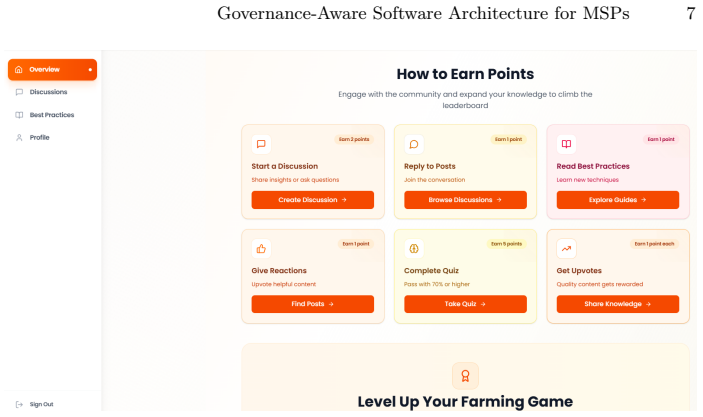
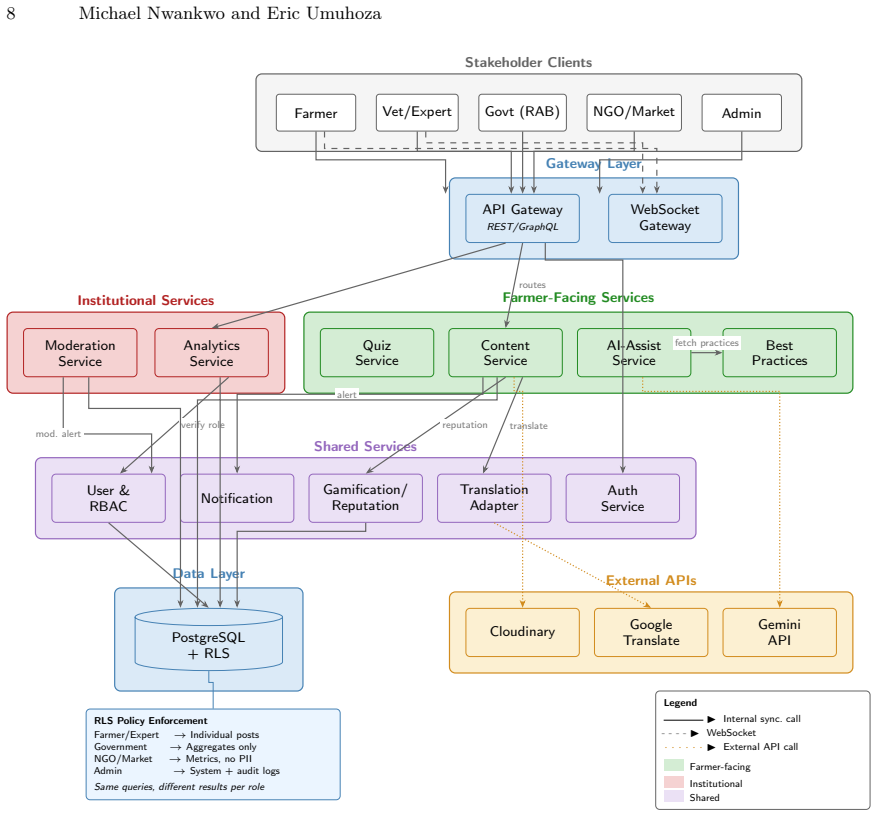
read the original abstract
Multi-stakeholder platforms (MSPs) coordinate diverse stakeholder groups, often with competing or conflicting requirements. As these platforms increasingly take digital form, engineers building them make architectural decisions about data visibility, service decomposition, and algorithm design that directly determine which stakeholder requirements are prioritized when conflicts arise. Software architecture literature provides patterns for data isolation and access control among tenants but does not address how architectural decisions resolve conflicts among stakeholders with structurally divergent interests. MSP governance literature identifies the principles at stake but treats technology as neutral infrastructure. Neither addresses the translation between governance principles and architectural decision spaces. This paper proposes a governance-architecture correspondence framework that surfaces implicit governance decisions, making them explicit and debatable before deployment. The framework maps five MSP governance principles to the architectural decision spaces where they must be addressed, identifying for each the governance-aware design choice and the technically convenient default it overrides. We illustrate the framework in a constructed knowledge platform for pig farming in Rwanda, where five stakeholder types present structurally conflicting requirements. As work in progress, the framework is proposed but not yet empirically validated; a planned pre/post judgment study with platform users across all stakeholder types will test falsifiable predictions about governance outcomes.
Editorial analysis
A structured set of objections, weighed in public.
Referee Report
Summary. The paper proposes a governance-architecture correspondence framework that maps five MSP governance principles to architectural decision spaces (data visibility, service decomposition, algorithm design) in multi-stakeholder platforms. For each mapping it identifies a governance-aware design choice that overrides a technically convenient default. The framework is illustrated via a single constructed example of a pig-farming knowledge platform in Rwanda involving five stakeholder types with structurally conflicting requirements. The work is explicitly presented as in progress and not yet empirically validated, with a planned pre/post judgment study to test predictions about governance outcomes.
Significance. If the mappings can be shown to preserve principle intent without distortion, the framework would usefully bridge MSP governance literature (which treats technology as neutral) and software architecture literature (which provides isolation patterns but ignores structurally divergent stakeholder interests). The proposal is novel in surfacing implicit governance decisions as explicit architectural choices. Credit is due for clearly stating the gap and the work-in-progress status; however, the absence of derivation, cross-case validation, or falsifiable evidence in the current manuscript limits immediate significance to the conceptual level.
major comments (2)
- [Illustration] Illustration section: the single author-constructed pig-farming example cannot test the central claim that the five principle-to-decision mappings preserve original intent and conflict structure. Because the example is built to fit the framework, it provides no independent check on whether the translation introduces new inconsistencies or dilutes meaning when stakeholder interests diverge.
- [Framework proposal] Framework proposal (abstract and §3): the claim that the framework 'surfaces implicit governance decisions' rests on the unargued assumption that governance principles from the MSP literature translate directly into architectural decision spaces without loss or conflict. No derivation, cross-check against independent MSP cases, or argument for fidelity is supplied.
minor comments (2)
- [Abstract] Abstract: the five MSP governance principles are referenced but not enumerated; listing them explicitly would improve readability before the mappings are presented.
- [Conclusion] The planned pre/post study is mentioned only in the abstract; a brief description of the falsifiable predictions and study design in the main text would strengthen the forward-looking claims.
Simulated Author's Rebuttal
We thank the referee for the constructive comments, which help clarify the scope of this work-in-progress submission. We address each major comment below, emphasizing that the manuscript already states its conceptual and illustrative nature along with the planned empirical validation.
read point-by-point responses
-
Referee: Illustration section: the single author-constructed pig-farming example cannot test the central claim that the five principle-to-decision mappings preserve original intent and conflict structure. Because the example is built to fit the framework, it provides no independent check on whether the translation introduces new inconsistencies or dilutes meaning when stakeholder interests diverge.
Authors: We agree that the constructed example is not positioned as a test or validation of the mappings' fidelity. Its purpose, as described in the manuscript, is solely to illustrate how the five governance principles map onto the three architectural decision spaces in a scenario with structurally conflicting stakeholder requirements. The manuscript explicitly notes that the work remains unvalidated and that a planned pre/post judgment study will provide the first falsifiable evidence. No revision to the example's role is planned, as altering it would not address the need for independent empirical testing. revision: no
-
Referee: Framework proposal (abstract and §3): the claim that the framework 'surfaces implicit governance decisions' rests on the unargued assumption that governance principles from the MSP literature translate directly into architectural decision spaces without loss or conflict. No derivation, cross-check against independent MSP cases, or argument for fidelity is supplied.
Authors: The framework is advanced as a conceptual proposal that identifies correspondences between established MSP governance principles and the architectural decision spaces where they must be operationalized. The mappings are motivated by the gap articulated in the introduction, but we acknowledge that the current manuscript supplies neither a formal derivation of the mappings nor cross-case checks against independent MSP instances. This limitation is consistent with the work-in-progress framing and the planned empirical study intended to examine preservation of intent. No additional derivation will be added at this stage. revision: no
Circularity Check
No circularity: conceptual mapping proposal with explicit constructed illustration
full rationale
The paper advances a governance-architecture correspondence framework as a proposal that maps five MSP principles to decision spaces, using a single author-constructed example (pig-farming platform) explicitly labeled as illustration rather than validation. No equations, fitted parameters, or self-citations appear in the provided text. The central claim does not reduce to a self-definition, renamed result, or load-bearing prior work by the same authors; the translation step is presented as the novel contribution itself, not derived from or equivalent to its inputs by construction. This matches the default expectation of a non-circular conceptual paper.
Axiom & Free-Parameter Ledger
axioms (1)
- domain assumption MSP governance principles can be mapped to specific architectural decision spaces without loss of meaning
invented entities (1)
-
governance-architecture correspondence framework
no independent evidence
Reference graph
Works this paper leans on
-
[1]
In: Proceedings of the IEEE International Conference on Software Maintenance (ICSM), pp
Bezemer, C.-P., Zaidman, A., Platzbeecker, B., Hurkmans, T., ’t Hart, A.: En- abling multi-tenancy: An industrial experience report. In: Proceedings of the IEEE International Conference on Software Maintenance (ICSM), pp. 1–8. IEEE (2010)
2010
-
[2]
In: Proceedings of the 15th National Computer Security Conference, pp
Ferraiolo, D.F., Kuhn, D.R.: Role-based access controls. In: Proceedings of the 15th National Computer Security Conference, pp. 554–563 (1992)
1992
-
[3]
In: Zhang, P., Galletta, D
Friedman, B., Kahn, P.H., Jr., Borning, A.: Value sensitive design and information systems. In: Zhang, P., Galletta, D. (eds.) Human-Computer Interaction in Man- agement Information Systems: Foundations, pp. 348–372. M.E. Sharpe, Armonk, NY (2006)
2006
-
[4]
PLOS ONE12(2), e0169634 (2017).https://doi.org/10.1371/journal.pone.0169634
Hermans, F., Sartas, M., van Schagen, B., van Asten, P., Schut, M.: Social network analysis of multi-stakeholder platforms in agricultural research for development: Op- portunities and constraints for innovation and scaling. PLOS ONE12(2), e0169634 (2017).https://doi.org/10.1371/journal.pone.0169634
-
[5]
https://martinfowler.com/articles/microservices.html (2014)
Lewis, J., Fowler, M.: Microservices: A definition of this new architectural term. https://martinfowler.com/articles/microservices.html (2014). Accessed 25 October 2023
2014
-
[6]
Tropical Animal Health and Production54(5), 305 (2022).https://doi.org/10.1007/s11250-022-03289-2
Hirwa, C.d., Mutabazi, J., Nsabimana, J.D., Dusengemungu, L., Kayitesi, A., Sema- horo, F., Uwimana, G., Nyabinwa, P., Kugonza, D.R.: Challenges and opportunities of smallholder pig production systems in Rwanda. Tropical Animal Health and Production54(5), 305 (2022).https://doi.org/10.1007/s11250-022-03289-2
-
[7]
O’Reilly Media, Sebastopol, CA (2021)
Newman, S.: Building Microservices: Designing Fine-Grained Systems, 2nd edn. O’Reilly Media, Sebastopol, CA (2021)
2021
-
[8]
Experimental Agriculture52(4), 537–561 (2016).https://doi.org/10.1017/S001447971500023X
Schut, M., et al.: Innovation platforms: Experiences with their institutional em- bedding in agricultural research for development. Experimental Agriculture52(4), 537–561 (2016).https://doi.org/10.1017/S001447971500023X
-
[9]
Journal of the Knowledge Economy15(4), 17077–17107 (2024).https://doi.org/10.1007/s13132-023-01661-7
van Ewijk, E., et al.: Farmer-centred multi-stakeholder platforms: From iterative approach to conceptual embedding. Journal of the Knowledge Economy15(4), 17077–17107 (2024).https://doi.org/10.1007/s13132-023-01661-7
-
[10]
Winner, L.: Do artifacts have politics? Daedalus109(1), 121–136 (1980)
1980
discussion (0)
Sign in with ORCID, Apple, or X to comment. Anyone can read and Pith papers without signing in.