Traffic-CBM: A Structurally Interpretable Multimodal Framework for Encrypted Traffic Classification
Pith reviewed 2026-06-30 06:17 UTC · model grok-4.3
The pith
Traffic-CBM organizes encrypted traffic signals into explicit concept summaries drawn from predefined evidence groups.
A machine-rendered reading of the paper's core claim, the machinery that carries it, and where it could break.
Core claim
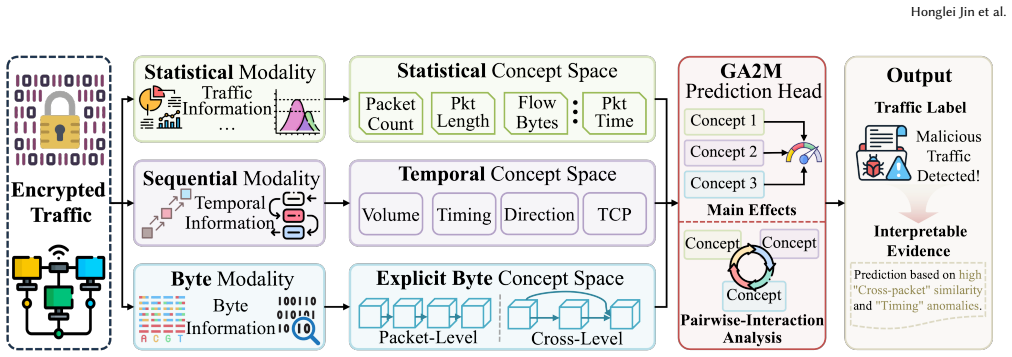
Traffic-CBM maps grouped flow statistics to statistical concepts, applies dedicated temporal encoders to disjoint subspaces for temporal concepts, and decomposes byte-level evidence into packet-level and cross-packet concepts, forming a unified hierarchical concept space that supports structural analysis of multimodal traffic evidence.
What carries the argument
The hierarchical concept space, where each concept is a scalar evidence summary constrained by a predefined traffic evidence group.
If this is right
- The model reaches competitive and balanced accuracy on multiple encrypted traffic benchmarks.
- The concept space is actively used by the classifier rather than ignored.
- Different levels of traffic evidence become directly comparable through their concept activations.
- Structural explanations of predictions become available without post-hoc attribution methods.
Where Pith is reading between the lines
- The same grouping approach could be tested on other multimodal classification tasks where data sources differ in granularity.
- Concept-level interventions, such as clamping a statistical concept, might allow controlled tests of decision sensitivity.
- If the predefined groups prove insufficient for new traffic types, the framework would require an automatic group-discovery step.
Load-bearing premise
Predefined traffic evidence groups can produce scalar concept summaries that capture the relevant multimodal signals without requiring manual semantic annotations.
What would settle it
If randomizing the values of the learned concepts leaves the model's predictions on the encrypted traffic benchmarks unchanged, the claim that the concept space drives classification would be falsified.
Figures
read the original abstract
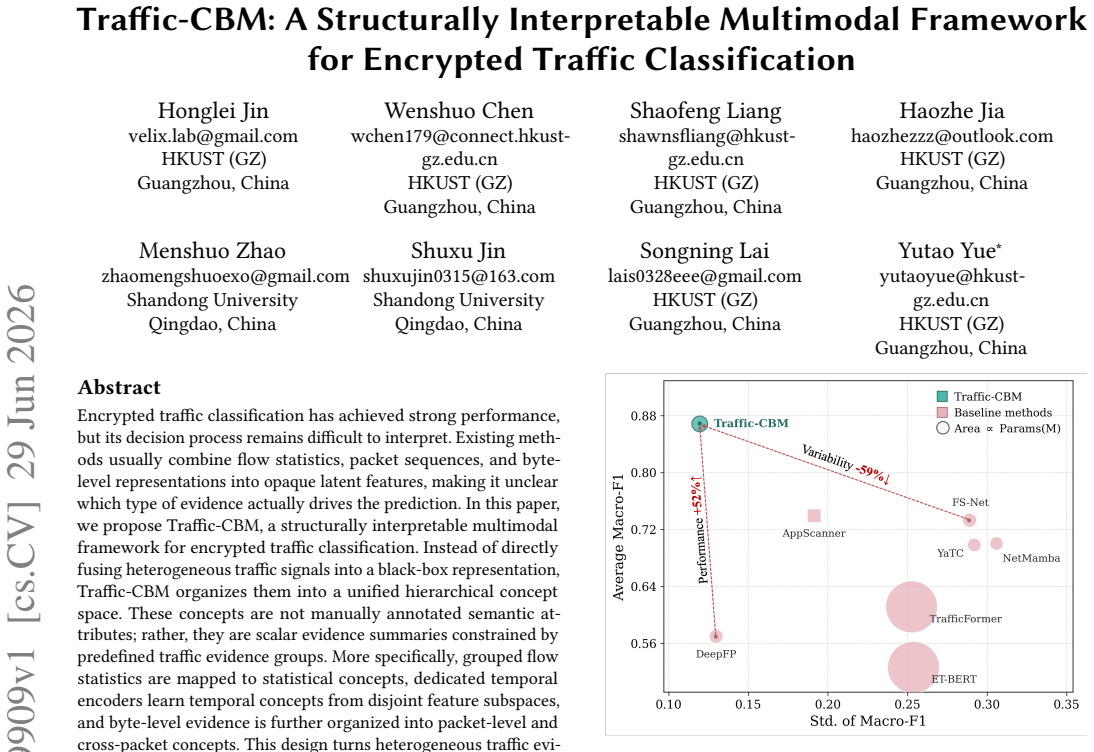
Encrypted traffic classification has achieved strong performance, but its decision process remains difficult to interpret. Existing methods usually combine flow statistics, packet sequences, and byte-level representations into opaque latent features, making it unclear which type of evidence actually drives the prediction. In this paper, we propose Traffic-CBM, a structurally interpretable multimodal framework for encrypted traffic classification. Instead of directly fusing heterogeneous traffic signals into a black-box representation, Traffic-CBM organizes them into a unified hierarchical concept space. These concepts are not manually annotated semantic attributes; rather, they are scalar evidence summaries constrained by predefined traffic evidence groups. More specifically, grouped flow statistics are mapped to statistical concepts, dedicated temporal encoders learn temporal concepts from disjoint feature subspaces, and byte-level evidence is further organized into packet-level and cross-packet concepts. This design turns heterogeneous traffic evidence into an explicit concept representation and makes different levels of traffic evidence easier to analyze. We evaluate Traffic-CBM on multiple encrypted traffic benchmarks. Results show that it achieves competitive and balanced classification performance while providing a clearer structural interpretation interface than conventional end-to-end fusion models. Further analyses suggest that the learned concept space is actively used in the prediction process and provides a clearer structural explanation of multimodal traffic evidence.
Editorial analysis
A structured set of objections, weighed in public.
Referee Report
Summary. The paper proposes Traffic-CBM, a structurally interpretable multimodal framework for encrypted traffic classification. It organizes heterogeneous traffic signals (flow statistics, temporal sequences, byte-level data) into a unified hierarchical concept space using predefined evidence groups: statistical concepts from grouped flow statistics, temporal concepts from disjoint subspaces via dedicated encoders, and packet-level/cross-packet concepts from byte-level evidence. The framework claims competitive and balanced classification performance on multiple encrypted traffic benchmarks while providing clearer structural interpretation than conventional end-to-end fusion models, with further analyses indicating the concept space is actively used in predictions.
Significance. If the experimental claims hold with proper baselines and ablations, the work could advance interpretable multimodal learning in network security by replacing opaque latent fusion with explicit, analyzable concept representations derived without manual semantic annotations. This addresses a key limitation in encrypted traffic classification where decision processes are hard to interpret.
major comments (2)
- [Abstract] Abstract: the claim of 'competitive and balanced classification performance' is asserted without any quantitative results, baselines, error bars, ablation studies, or dataset details, so the central performance claim cannot be evaluated.
- [Abstract] Abstract: the construction of scalar concept summaries from 'predefined traffic evidence groups' is described at a high level but no procedure, validation, or constraints are provided to confirm these groups capture relevant multimodal signals without introducing bias or requiring manual tuning.
minor comments (1)
- [Abstract] Abstract: the phrase 'hierarchical concept space' is used without a reference to a figure, equation, or formal definition of the hierarchy levels.
Simulated Author's Rebuttal
We thank the referee for the constructive comments on the abstract. We address each major comment point by point below.
read point-by-point responses
-
Referee: [Abstract] Abstract: the claim of 'competitive and balanced classification performance' is asserted without any quantitative results, baselines, error bars, ablation studies, or dataset details, so the central performance claim cannot be evaluated.
Authors: We agree that the abstract would be strengthened by including key quantitative results to support the performance claim. In the revised version, we will add specific metrics such as accuracy and macro-F1 scores on the primary benchmarks, along with references to the main baselines and datasets used. The full experimental details, including error bars, ablation studies, and dataset descriptions, are already provided in Sections 4 and 5 of the manuscript. revision: yes
-
Referee: [Abstract] Abstract: the construction of scalar concept summaries from 'predefined traffic evidence groups' is described at a high level but no procedure, validation, or constraints are provided to confirm these groups capture relevant multimodal signals without introducing bias or requiring manual tuning.
Authors: The abstract is intentionally concise. The full procedure for constructing the scalar concept summaries from predefined traffic evidence groups—using standard groupings of flow statistics, dedicated encoders on disjoint temporal subspaces, and byte-level packet features—is detailed in Section 3, along with the rationale that these groups derive from conventional traffic feature categories without manual semantic annotations. This design inherently avoids per-sample manual tuning. We will revise the abstract to include a brief clause referencing that the groups follow established multimodal traffic partitioning practices. revision: partial
Circularity Check
No significant circularity detected
full rationale
The abstract and provided context describe a multimodal framework that organizes traffic signals into hierarchical concepts via predefined groups and encoders, but contain no equations, fitting procedures, self-citations, or derivation steps that reduce predictions or concepts to their own inputs by construction. No load-bearing claims are shown to be equivalent to fitted parameters or prior self-referential results. The evaluation claims competitive performance without detailing any circular reduction in the concept construction or prediction process. This is the expected outcome for a high-level architectural description lacking mathematical derivations.
Axiom & Free-Parameter Ledger
axioms (1)
- domain assumption Predefined traffic evidence groups produce scalar summaries that capture relevant heterogeneous signals
invented entities (4)
-
hierarchical concept space
no independent evidence
-
statistical concepts
no independent evidence
-
temporal concepts
no independent evidence
-
packet-level and cross-packet concepts
no independent evidence
Reference graph
Works this paper leans on
-
[1]
Rishabh Agarwal, Levi Melnick, Nicholas Frosst, Xuezhou Zhang, Ben Lengerich, Rich Caruana, and Geoffrey Hinton. 2021. Neural Additive Models: Interpretable Machine Learning with Neural Nets. InAdvances in Neural Information Processing Systems (NeurIPS)
2021
-
[2]
Khaled Al-Naami, Swarup Chandra, Ahmad Mustafa, Latifur Khan, Zhiqiang Lin, Kevin Hamlen, and Bhavani Thuraisingham. 2016. Adaptive Encrypted Traffic Fingerprinting with Bi-Directional Dependence. InProceedings of the Annual Computer Security Applications Conference (ACSAC). 177–188
2016
-
[3]
Motaharul Islam, and Mohammad Nurul Huda
Zahedi Azam, Md. Motaharul Islam, and Mohammad Nurul Huda. 2023. Com- parative Analysis of Intrusion Detection Systems and Machine Learning-Based Model Analysis Through Decision Tree.IEEE Access11 (2023), 80348–80391. doi:10.1109/ACCESS.2023.3296444
-
[4]
Asmaa Benchama and Khalid Zebbara. 2023. Novel Approach to Intrusion Detection: Introducing GAN-MSCNN-BILSTM with LIME Predictions.Data and Metadata2 (2023). doi:10.56294/dm2023202
-
[5]
Rich Caruana, Yin Lou, Johannes Gehrke, Paul Koch, Marc Sturm, and Noemie Elhadad. 2015. Intelligible Models for HealthCare: Predicting Pneumonia Risk and Hospital 30-day Readmission. InProceedings of the ACM SIGKDD International Conference on Knowledge Discovery and Data Mining (KDD). 1721–1730. doi:10. 1145/2783258.2788613
-
[6]
Jacob Devlin, Ming-Wei Chang, Kenton Lee, and Kristina Toutanova. 2019. BERT: Pre-training of Deep Bidirectional Transformers for Language Understanding. In Proceedings of the North American Chapter of the Association for Computational Linguistics (NAACL)
2019
-
[7]
Jay DeYoung, Sarthak Jain, Nazneen Fatema Rajani, Eric Lehman, Caiming Xiong, Richard Socher, and Byron C. Wallace. 2020. ERASER: A Benchmark to Evaluate Rationalized NLP Models. InProceedings of the Annual Meeting of the Association for Computational Linguistics (ACL). 4443–4458. doi:10.18653/v1/2020.acl-main. 408
-
[8]
Wenqi Dong, Jing Yu, Xinjie Lin, Gaopeng Gou, and Gang Xiong. 2025. Deep learning and pre-training technology for encrypted traffic classification: A com- prehensive review.Neurocomputing617 (2025), 128444. doi:10.1016/j.neucom. 2024.128444
-
[9]
Ghorbani
Gerard Draper-Gil, Arash Habibi Lashkari, Mohammad Saiful Islam Mamun, and Ali A. Ghorbani. 2016. Characterization of Encrypted and VPN Traffic Using Time-Related Features. InProceedings of the International Conference on Information Systems Security and Privacy (ICISSP)
2016
-
[10]
Viet Duong, Qiong Wu, Zhengyi Zhou, Hongjue Zhao, Chenxiang Luo, Eric Zavesky, Huaxiu Yao, and Huajie Shao. 2024. CAT: Interpretable Concept-based Taylor Additive Models. InProceedings of the 30th ACM SIGKDD Conference on Knowledge Discovery and Data Mining (KDD). 723–734. doi:10.1145/3637528. 3672020
-
[11]
Zijun Hang, Yuliang Lu, Yongjie Wang, and Yi Xie. 2023. Flow-MAE: Leveraging Masked AutoEncoder for Accurate, Efficient and Robust Malicious Traffic Classi- fication. InProceedings of the International Symposium on Research in Attacks, Intrusions and Defenses (RAID). 297–314. doi:10.1145/3607199.3607206
-
[12]
Jamie Hayes and George Danezis. 2016. k-fingerprinting: a robust scalable web- site fingerprinting technique. InProceedings of the USENIX Security Symposium. 1187–1203
2016
- [13]
-
[14]
Kaiming He, Xinlei Chen, Saining Xie, Yanghao Li, Piotr Dollár, and Ross Girshick
-
[15]
Masked Autoencoders Are Scalable Vision Learners. InProceedings of the IEEE/CVF Conference on Computer Vision and Pattern Recognition (CVPR). 15979– 15988. doi:10.1109/CVPR52688.2022.01553
-
[16]
Pamela Hermosilla, Sebastián Berríos, and Héctor Allende-Cid. 2025. Explainable AI for Forensic Analysis: A Comparative Study of SHAP and LIME in Intrusion Detection Models.Applied Sciences15, 13 (2025). doi:10.3390/app15137329
-
[17]
Yang Ji, Ying Sun, Yuting Zhang, Zhigaoyuan Wang, Yuanxin Zhuang, Zheng Gong, Dazhong Shen, Chuan Qin, Hengshu Zhu, and Hui Xiong. 2025. A Com- prehensive Survey on Self-Interpretable Neural Networks.Proc. IEEE113 (2025), 783–813. doi:10.1109/JPROC.2025.3635153
-
[18]
Haozhe Jia, Wenshuo Chen, Zhihui Huang, Lei Wang, Hongru Xiao, Nanqian Jia, Keming Wu, Songning Lai, Bowen Tian, and Yutao Yue. 2025. Physics-Informed Representation Alignment for Sparse Radio-Map Reconstruction. InProceedings of the ACM International Conference on Multimedia (ACM MM). 12352–12360. doi:10.1145/3746027.3758161
-
[19]
Pang Wei Koh, Thao Nguyen, Yew Siang Tang, Stephen Mussmann, Emma Pierson, Been Kim, and Percy Liang. 2020. Concept Bottleneck Models. In Proceedings of the International Conference on Machine Learning (ICML). 5338– 5348
2020
-
[20]
Kunda Lin, Xiaolong Xu, and Honghao Gao. 2021. TSCRNN: A Novel Clas- sification Scheme of Encrypted Traffic Based on Flow Spatiotemporal Fea- tures for Efficient Management of IIoT.Computer Networks190 (2021), 107974. doi:10.1016/j.comnet.2021.107974
-
[21]
Xinjie Lin, Gang Xiong, Gaopeng Gou, Zhen Li, Junzheng Shi, and Jing Yu
-
[22]
InProceedings of the ACM Web Conference (WWW)
ET-BERT: A Contextualized Datagram Representation with Pre-training Transformers for Encrypted Traffic Classification. InProceedings of the ACM Web Conference (WWW). 633–642. doi:10.1145/3485447.3512217
-
[23]
Chang Liu, Longtao He, Gang Xiong, Zigang Cao, and Zhen Li. 2019. FS-Net: A Flow Sequence Network for Encrypted Traffic Classification. InProceedings of the IEEE Conference on Computer Communications (INFOCOM). 1171–1179. doi:10.1109/INFOCOM.2019.8737507
-
[24]
Yang Liu, Tianwei Zhang, and Shi Gu. 2025. Hybrid Concept Bottleneck Mod- els. InProceedings of the IEEE/CVF Conference on Computer Vision and Pattern Recognition (CVPR). 20179–20189. doi:10.1109/CVPR52734.2025.01879
-
[25]
Ilya Loshchilov and Frank Hutter. 2019. Decoupled Weight Decay Regularization. InInternational Conference on Learning Representations (ICLR)
2019
-
[26]
Mohammad Lotfollahi, Mahdi Jafari Siavoshani, Ramin Shirali Hossein Zade, and Mohammdsadegh Saberian. 2020. Deep Packet: A Novel Approach for Encrypted Traffic Classification Using Deep Learning.Soft Computing24, 3 (2020), 1999–2012. doi:10.1007/s00500-019-04030-2
-
[27]
Yin Lou, Rich Caruana, Johannes Gehrke, and Giles Hooker. 2013. Accurate Intelligible Models with Pairwise Interactions. InProceedings of the 19th ACM SIGKDD International Conference on Knowledge Discovery and Data Mining (KDD). 623–631. doi:10.1145/2487575.2487579
-
[28]
Lundberg and Su-In Lee
Scott M. Lundberg and Su-In Lee. 2017. A Unified Approach to Interpreting Model Predictions. InAdvances in Neural Information Processing Systems (NeurIPS). 4768– 4777
2017
-
[29]
Alfredo Nascita, Francesco Cerasuolo, Giuseppe Aceto, Domenico Ciuonzo, Va- lerio Persico, and Antonio Pescapé. 2023. Explainable Mobile Traffic Classifi- cation: The Case of Incremental Learning. InProceedings of the 2023 Workshop on Explainable and Safety Bounded Machine Learning for Networking. 25–31. doi:10.1145/3630050.3630178
-
[30]
Alfredo Nascita, Antonio Montieri, Giuseppe Aceto, Domenico Ciuonzo, Va- lerio Persico, and Antonio Pescapé. 2023. Improving Performance, Reliabil- ity, and Feasibility in Multimodal Multitask Traffic Classification with XAI. IEEE Transactions on Network and Service Management20 (2023), 1267–1289. doi:10.1109/TNSM.2023.3246794
-
[31]
Alfredo Nascita, Antonio Montieri, Giuseppe Aceto, Domenico Ciuonzo, Valerio Persico, and Antonio Pescapé. 2021. XAI Meets Mobile Traffic Classification: Understanding and Improving Multimodal Deep Learning Architectures.IEEE Transactions on Network and Service Management18, 4 (2021), 4225–4246. doi:10. 1109/TNSM.2021.3098157
-
[32]
Nguyen, and Tsui-Wei Weng
Tuomas Oikarinen, Subhro Das, Lam M. Nguyen, and Tsui-Wei Weng. 2023. Label-free Concept Bottleneck Models. InThe Eleventh International Conference on Learning Representations
2023
-
[33]
Eleonora Poeta, Gabriele Ciravegna, Eliana Pastor, Tania Cerquitelli, and Elena Baralis. 2025. Concept-based Explainable Artificial Intelligence: A Survey.Com- put. Surveys(2025). doi:10.1145/3774643
-
[34]
Marco Tulio Ribeiro, Sameer Singh, and Carlos Guestrin. 2016. "Why Should I Trust You?": Explaining the Predictions of Any Classifier. InProceedings of the ACM SIGKDD International Conference on Knowledge Discovery and Data Mining (KDD). 1135–1144. doi:10.1145/2939672.2939778
-
[35]
Ghorbani
Iman Sharafaldin, Arash Habibi Lashkari, and Ali A. Ghorbani. 2018. Toward Generating a New Intrusion Detection Dataset and Intrusion Traffic Character- ization. InProceedings of the International Conference on Information Systems Security and Privacy (ICISSP)
2018
-
[36]
Adit Sharma and Arash Habibi Lashkari. 2025. A Survey on Encrypted Network Traffic: Identification and Classification Techniques, Challenges, and Future Directions.Computer Networks257 (2025), 110984. doi:10.1016/j.comnet.2024. 110984
-
[37]
Meng Shen, Jinpeng Zhang, Liehuang Zhu, Ke Xu, and Xiaojiang Du. 2021. Accurate Decentralized Application Identification via Encrypted Traffic Analysis Using Graph Neural Networks.IEEE Transactions on Information Forensics and Security16 (2021), 2367–2380. doi:10.1109/TIFS.2021.3050608
-
[38]
Payap Sirinam, Mohsen Imani, Marc Juarez, and Matthew Wright. 2018. Deep Fin- gerprinting: Undermining Website Fingerprinting Defenses with Deep Learning. InProceedings of the ACM SIGSAC Conference on Computer and Communications Security (CCS). 1928–1943. doi:10.1145/3243734.3243768
-
[39]
Jiwon Suh, Juwon Hong, Mose Gu, and Jaehoon Paul Jeong. 2025. Interpretable Detection of Encrypted Traffic Using SHAP-Based Feature Attribution. InProceed- ings of the International Conference on Information and Communication Technology Convergence (ICTC). 190–195. doi:10.1109/ICTC66702.2025.11388509
-
[40]
Taylor, Riccardo Spolaor, Mauro Conti, and Ivan Martinovic
Vincent F. Taylor, Riccardo Spolaor, Mauro Conti, and Ivan Martinovic. 2018. Robust Smartphone App Identification via Encrypted Network Traffic Analysis. IEEE Transactions on Information Forensics and Security13, 1 (2018), 63–78. doi:10. 1109/TIFS.2017.2737970
-
[41]
Bowen Tian, Wenshuo Chen, Zexi Li, Songning Lai, Jiemin Wu, and Yutao Yue
-
[42]
InProceedings of the ACM International Conference on Multimedia (ACM MM)
Text2Weight: Bridging Natural Language and Neural Network Weight Spaces. InProceedings of the ACM International Conference on Multimedia (ACM MM). 10152–10160. doi:10.1145/3746027.3755441 Traffic-CBM: A Structurally Interpretable Multimodal Framework for Encrypted Traffic Classification
-
[43]
Dubois, Martina Lindorfer, David Choffnes, Maarten van Steen, and Andreas Peter
Thijs Sebastiaan van Ede, Riccardo Bortolameotti, Andrea Continella, Jingjing Ren, Daniel J. Dubois, Martina Lindorfer, David Choffnes, Maarten van Steen, and Andreas Peter. 2020. FlowPrint: Semi-Supervised Mobile-App Fingerprint- ing on Encrypted Network Traffic. InNetwork and Distributed System Security Symposium (NDSS). doi:10.14722/ndss.2020.24412
-
[44]
Gomez, Łukasz Kaiser, and Illia Polosukhin
Ashish Vaswani, Noam Shazeer, Niki Parmar, Jakob Uszkoreit, Llion Jones, Aidan N. Gomez, Łukasz Kaiser, and Illia Polosukhin. 2017. Attention Is All You Need. InAdvances in Neural Information Processing Systems (NeurIPS). 6000– 6010
2017
-
[45]
Tongze Wang, Xiaohui Xie, Wenduo Wang, Chuyi Wang, Youjian Zhao, and Yong Cui. 2024. NetMamba: Efficient Network Traffic Classification via Pre-Training Unidirectional Mamba. InProceedings of the IEEE International Conference on Network Protocols (ICNP). 1–11. doi:10.1109/ICNP61940.2024.10858569
-
[46]
Wei Wang, Ming Zhu, Xuewen Zeng, Xiaozhou Ye, and Yiqiang Sheng. 2017. Malware Traffic Classification Using Convolutional Neural Network for Repre- sentation Learning. InProceedings of the International Conference on Information Networking (ICOIN). 712–717. doi:10.1109/ICOIN.2017.7899588
-
[47]
Nimesha Wickramasinghe, Arash Shaghaghi, Gene Tsudik, and Sanjay Jha
-
[48]
InProceedings of the IEEE Symposium on Security and Privacy (SP)
SoK: Decoding the Enigma of Encrypted Network Traffic Classifiers. InProceedings of the IEEE Symposium on Security and Privacy (SP). 1825–1843. doi:10.1109/SP61157.2025.00165
-
[49]
Tieqi Xi, Qiuhua Zheng, Chuanhui Cheng, Ting Wu, Guojie Xie, Xuebiao Qian, Haochen Ye, and Zhenyu Sun. 2025. SwiftSession: A Novel Incremental and Adaptive Approach to Rapid Traffic Classification by Leveraging Local Features. Future Internet17, 3 (2025), 114. doi:10.3390/fi17030114
-
[50]
Luming Yang, Lin Liu, JunJie Huang, Zhuotao Liu, Shiyu Liang, Shaojing Fu, and Yongjun Wang. 2025. MM4flow: A Pre-trained Multi-modal Model for Versatile Network Traffic Analysis. InProceedings of the ACM SIGSAC Conference on Computer and Communications Security (CCS). 1664–1678. doi:10.1145/3719027. 3744804
-
[51]
Mateo Espinosa Zarlenga, Zohreh Shams, Michael Edward Nelson, Been Kim, and Mateja Jamnik. 2023. TabCBM: Concept-based Interpretable Neural Networks for Tabular Data.Transactions on Machine Learning Research(2023)
2023
-
[52]
Ruijie Zhao, Mingwei Zhan, Xianwen Deng, Yanhao Wang, Yijun Wang, Guan Gui, and Zhi Xue. 2023. Yet Another Traffic Classifier: A Masked Autoencoder Based Traffic Transformer with Multi-Level Flow Representation.Proceedings of the AAAI Conference on Artificial Intelligence37, 4 (2023), 5420–5427. doi:10. 1609/aaai.v37i4.25674
2023
-
[53]
Wenbo Zheng, Chao Gou, Lan Yan, and Shaocong Mo. 2020. Learning to Classify: A Flow-Based Relation Network for Encrypted Traffic Classification. InProceed- ings of the ACM Web Conference (WWW). 13–22. doi:10.1145/3366423.3380090
-
[54]
Guangmeng Zhou, Xiongwen Guo, Zhuotao Liu, Tong Li, Qi Li, and Ke Xu. 2025. TrafficFormer: An Efficient Pre-trained Model for Traffic Data. InProceedings of the IEEE Symposium on Security and Privacy (SP). 1844–1860. doi:10.1109/ SP61157.2025.00102 Honglei Jin et al. A Dataset Details We use six public encrypted traffic benchmarks in this work: Cipher- Sp...
discussion (0)
Sign in with ORCID, Apple, or X to comment. Anyone can read and Pith papers without signing in.