Crystal Dislocations as Atomic Scale Ratchets
Pith reviewed 2026-06-28 22:09 UTC · model grok-4.3
The pith
Dislocations containing atomic-scale jogs exhibit asymmetric mobility under opposite applied stresses due to coupling between displacement vectors and eigenstrain.
A machine-rendered reading of the paper's core claim, the machinery that carries it, and where it could break.
Core claim
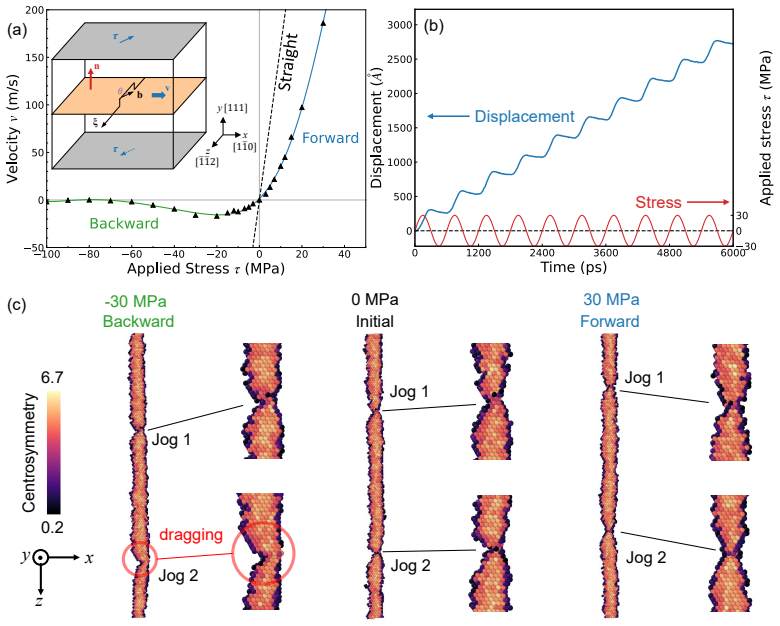
Molecular dynamics simulations of face-centered cubic nickel reveal that dislocations containing atomic-scale jogs exhibit asymmetric mobility under opposite applied stresses, reversing the loading direction triggers significantly higher drag. This asymmetry arises from an unconventional coupling between an atomic displacement vector and the second-order tensorial eigenstrain of the jog motion mechanism. Because jogs are ubiquitous structures in plastic deformation, this discovery challenges classical descriptions of plastic deformation mechanisms, with direct implications to cyclic creep, and opens new pathways for defect engineering to enhance fatigue resistance.
What carries the argument
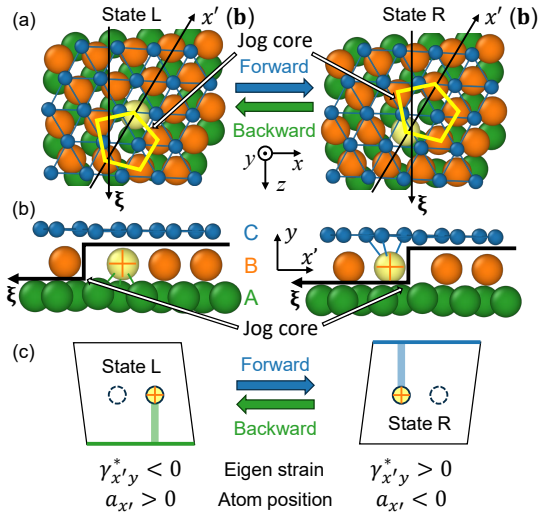
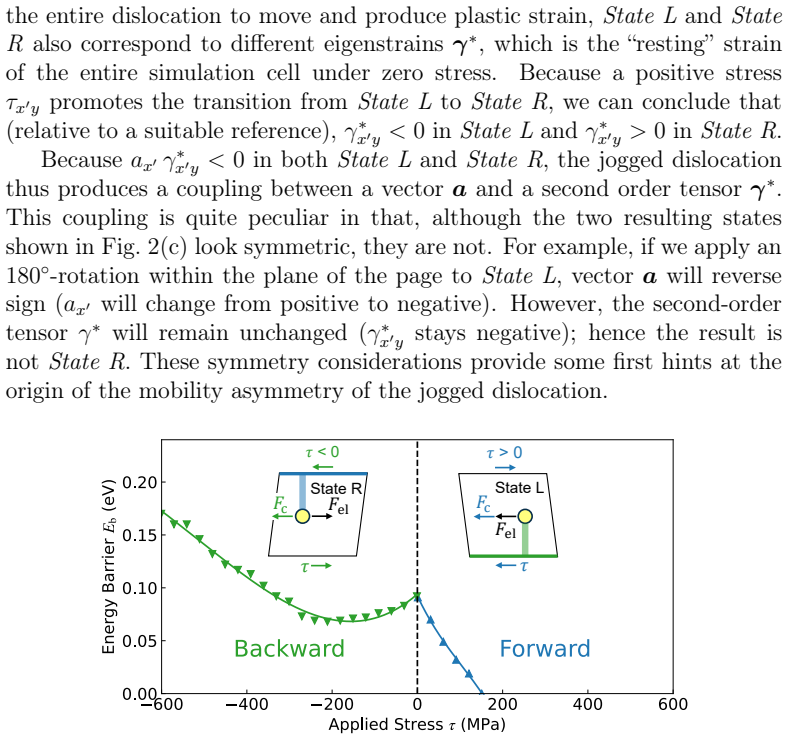
The unconventional coupling between an atomic displacement vector and the second-order tensorial eigenstrain of the jog motion mechanism.
If this is right
- Challenges classical micromechanics models that assume symmetric response where reversing load inverts velocity without changing its magnitude.
- Carries direct implications for cyclic creep under repeated loading.
- Opens pathways for defect engineering to enhance fatigue resistance by controlling jog structures.
Where Pith is reading between the lines
- The same coupling could appear in other crystal structures or with different point defects, altering mobility predictions in those cases.
- Dislocation dynamics codes would need direction-dependent drag terms to match observations under cyclic conditions.
- Materials processing that controls jog density might produce directionally biased plastic flow for specific loading histories.
Load-bearing premise
The molecular dynamics simulations of face-centered cubic nickel accurately capture the real atomic-scale behavior of jogged dislocations without artifacts from interatomic potential choice, system size, or boundary conditions.
What would settle it
Experimental measurement of dislocation velocity under reversed shear in nickel crystals showing identical speeds in both directions, or simulations with alternate potentials reproducing fully symmetric mobility.
Figures
read the original abstract
The symmetry of a system's response to external stimuli is a fundamental concept in physics and materials science. At the microscopic scale, breaking this symmetry to achieve a rectified response is exceptionally difficult to engineer and remains rare in nature. Conventional micromechanics models of crystalline solids assume a symmetric response to applied stress, where reversing the load simply inverts the direction of defect velocity without altering its magnitude. In this work, we report an atomic-scale, geometry-rooted mechanism that breaks this symmetry. Molecular dynamics simulations of face-centered cubic nickel reveal that dislocations containing atomic-scale jogs exhibit asymmetric mobility under opposite applied stresses, reversing the loading direction triggers significantly higher drag. This asymmetry arises from an unconventional coupling between an atomic displacement vector and the second-order tensorial eigenstrain of the jog motion mechanism. Because jogs are ubiquitous structures in plastic deformation, this discovery challenges classical descriptions of plastic deformation mechanisms, with direct implications to cyclic creep, and opens new pathways for defect engineering to enhance fatigue resistance.
Editorial analysis
A structured set of objections, weighed in public.
Referee Report
Summary. The manuscript claims that molecular dynamics simulations of face-centered cubic nickel reveal an atomic-scale ratchet mechanism in which jogged dislocations exhibit asymmetric mobility under opposite applied stresses: reversing the loading direction produces significantly higher drag. This asymmetry is attributed to an unconventional coupling between an atomic displacement vector and the second-order tensorial eigenstrain of the jog motion mechanism, breaking the symmetric response assumed in classical micromechanics models of crystalline solids. The authors argue that because jogs are ubiquitous in plastic deformation, the finding has implications for cyclic creep and fatigue resistance.
Significance. If the reported asymmetry is shown to be a robust geometric consequence rather than a simulation artifact, the result would challenge conventional assumptions of symmetric defect response to load reversal and suggest new routes for defect engineering to improve fatigue life. The use of MD to identify a specific eigenstrain-displacement coupling provides a concrete, falsifiable mechanism that could be tested experimentally.
major comments (2)
- [Methods / simulation description] Simulation methods (presumably §2 or equivalent): the asymmetry is demonstrated using only a single EAM potential for Ni. Different EAM potentials are known to produce different core energies, stacking-fault widths, and Peierls stresses; without explicit checks that the ratchet effect persists (or at least does not change sign) under an alternative potential or in larger periodic cells, it remains possible that the reported drag asymmetry is potential-specific rather than a general geometric feature of the jog eigenstrain coupling.
- [Results / mechanism] Results section describing the mechanism: the claim that the asymmetry 'arises from an unconventional coupling between an atomic displacement vector and the second-order tensorial eigenstrain' is presented as the explanation, yet no quantitative decomposition (e.g., separate contributions of the displacement vector versus the eigenstrain tensor under forward versus reverse shear) is shown to isolate this coupling from other possible sources of asymmetry such as core reconstruction or boundary-condition effects.
minor comments (2)
- [Abstract] Abstract: the phrase 'significantly higher drag' is used without a numerical factor or comparison to the forward direction; a quantitative statement (e.g., ratio of velocities or drag coefficients) would strengthen the claim.
- [Methods] The manuscript would benefit from an explicit statement of the interatomic potential identifier (e.g., 'Mishin et al. 1999 EAM') and the precise system size and boundary conditions used for the shear simulations.
Simulated Author's Rebuttal
We thank the referee for the detailed and constructive report. The comments highlight important aspects of robustness and mechanistic clarity. We address each major comment below and indicate the revisions we will make.
read point-by-point responses
-
Referee: [Methods / simulation description] Simulation methods (presumably §2 or equivalent): the asymmetry is demonstrated using only a single EAM potential for Ni. Different EAM potentials are known to produce different core energies, stacking-fault widths, and Peierls stresses; without explicit checks that the ratchet effect persists (or at least does not change sign) under an alternative potential or in larger periodic cells, it remains possible that the reported drag asymmetry is potential-specific rather than a general geometric feature of the jog eigenstrain coupling.
Authors: We agree that explicit verification with an alternative potential would strengthen the claim that the asymmetry is a general geometric consequence of the jog eigenstrain coupling rather than potential-specific. Although the underlying mechanism is derived from the geometry of the displacement vector and second-order eigenstrain (independent of potential details such as core energy), we will add simulations using a second EAM potential for Ni, confirming that the sign and presence of the drag asymmetry are preserved. These results will be included in the revised manuscript. revision: yes
-
Referee: [Results / mechanism] Results section describing the mechanism: the claim that the asymmetry 'arises from an unconventional coupling between an atomic displacement vector and the second-order tensorial eigenstrain' is presented as the explanation, yet no quantitative decomposition (e.g., separate contributions of the displacement vector versus the eigenstrain tensor under forward versus reverse shear) is shown to isolate this coupling from other possible sources of asymmetry such as core reconstruction or boundary-condition effects.
Authors: We acknowledge that an explicit quantitative decomposition would more rigorously isolate the proposed coupling from other possible sources of asymmetry. In the revised manuscript we will add a dedicated analysis that decomposes the contributions of the atomic displacement vector and the second-order eigenstrain tensor under forward versus reverse shear, thereby clarifying the origin of the asymmetry and ruling out dominant influences from core reconstruction or boundary conditions. revision: yes
Circularity Check
No circularity; asymmetry is reported as direct MD observation without self-referential reduction
full rationale
The paper presents its central finding as an observation from molecular dynamics simulations of jogged dislocations in FCC nickel, where asymmetric mobility under reversed stress is attributed to geometric coupling between displacement vector and jog eigenstrain. No equations, fitted parameters, predictions derived from subsets of the same data, or load-bearing self-citations are invoked that would reduce the claim to its inputs by construction. The derivation chain consists of simulation setup followed by reported results, which is self-contained and externally falsifiable via independent simulations or experiments.
Axiom & Free-Parameter Ledger
Reference graph
Works this paper leans on
-
[1]
J. E. Angelo, N. R. Moody, M. I. Baskes, Trapping of hydrogen to lattice defects in nickel, Model. Simul. Mater. Sci. Eng. 3 (1995)
1995
-
[2]
S. Rao, T. A. Parthasarathy, C. Woodward, Atomistic simulation of cross-slip processes in model fcc structures, Philos. Mag. A 79 (1999) 1167–1192. W. Cai, W. D. Nix, Imperfections in Crystalline Solids, Cambridge University Press,
1999
discussion (0)
Sign in with ORCID, Apple, or X to comment. Anyone can read and Pith papers without signing in.