REVIEW 5 major objections 6 minor 20 references
DragStream shows that drag-based editing of autoregressively generated video can run on the fly with no training, by repairing latent drift and filtering context interference.
Reviewed by Pith at T0; open to challenge. T0 means a machine referee read the full paper against a public rubric. the ladder, T0–T4 →
T0 review · deepseek-v4-flash
2026-08-04 11:37 UTC pith:7JK3BSUU
load-bearing objection A genuinely new streaming-drag task with a plausible training-free method, but the quantitative evidence is too weak to fully trust the headline claims. the 5 major comments →
Streaming Drag-Oriented Interactive Video Manipulation: Drag Anything, Anytime!
The pith
A machine-rendered reading of the paper's core claim, the machinery that carries it, and where it could break.
Core claim
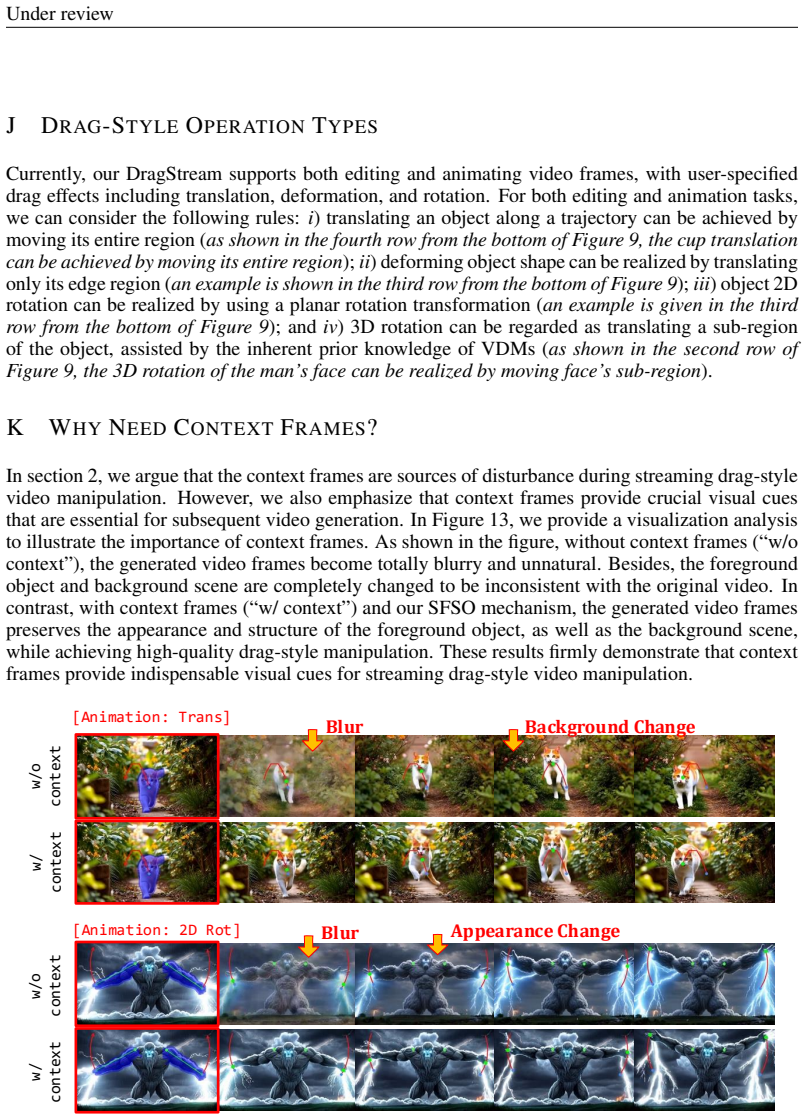
The central claim is that streaming drag control over autoregressive video diffusion models is achievable at inference time alone, with no training, as long as two failure modes are addressed. DragStream first identifies that each drag optimization step perturbs the latent distribution; over iterations this drift breaks the denoiser, so it rectifies the latent after every step by renormalizing to the mean and standard deviation of the preceding neighboring latents at the same timestep (ADSR). It also observes that context frames, while essential for visual consistency, carry high-frequency details that dominate the optimization and create artifacts, so it filters the cached keys and values i
What carries the argument
ADSR (adaptive distribution self-rectification) is a moment-matching step that, after each latent optimization iteration, rescales the dragged latent so that its mean and standard deviation equal those of the preceding neighboring latents at the same denoising timestep, preventing cumulative drift. SFSO (spatial-frequency selective optimization) is a two-part mechanism: switchable frequency-domain selection, which applies a Butterworth filter with a randomly chosen cutoff frequency to the cached self-attention keys and values so that each iteration mixes low-frequency robustness with high-frequency detail, and criticality-driven spatial-domain selection, a Gaussian filtering map that suppres
Load-bearing premise
ADSR assumes that the mean and standard deviation of a few neighboring latents are a safe reference distribution and that rescaling the optimized latent to those statistics does not erase the drag signal.
What would settle it
A sustained stress test: run a long stream in which a user applies many successive drags to different objects, and measure the KL divergence between the optimized latent distribution and the neighbor distribution after each drag; if the divergence grows without bound, or object attributes change and the drag halts, the central claim fails. A simpler check is whether a drag on an object far outside the training distribution still succeeds with ADSR applied.
If this is right
- Users could correct a frame mid-generation without regenerating the video, because the edit propagates through the context window to subsequent frames.
- The method is model-agnostic: demonstrated on two different autoregressive video diffusion models, it could become a standard inference-time control layer.
- Because it is training-free, adding drag control costs only inference-time optimization, making interactive video manipulation feasible on a single GPU.
- The unified operation format (editing and animation, each with translation, deformation, and rotation) provides a common interface for future drag-style video manipulation systems.
Where Pith is reading between the lines
- If ADSR generalizes beyond short clips, local moment matching could become a general recipe for any optimization-based latent editing in autoregressive diffusion, not just drag operations.
- The switchable-frequency idea may transfer to other context-conditioned generation tasks where high-frequency leakage from reference frames causes artifacts, such as long-context text-to-video or image-to-video.
- A natural testable extension is to apply ADSR to other perturbation sources (text prompts, camera controls, pose edits) to see whether the same drift-repair mechanism holds.
- The 'anytime, anything' claim is only established for the tested regime: 204 short Self-Forcing clips; longer streams or out-of-distribution content could break the neighboring-latent reference assumption.
Editorial analysis
A structured set of objections, weighed in public.
Referee Report
Summary. The paper introduces REVEL, a streaming drag-oriented interactive video manipulation task, and proposes DragStream, a training-free plug-in for autoregressive video diffusion models. DragStream combines an Adaptive Distribution Self-Rectification (ADSR) strategy, which normalizes the optimized latent to the mean/standard deviation of neighboring context latents, with a Spatial-Frequency Selective Optimization (SFSO) mechanism, which filters keys/values in the frequency domain and gates gradients spatially during iterative latent optimization. The authors claim that this enables both editing and animation operations (translation, deformation, 2D/3D rotation) at any frame during autoregressive generation, and that it integrates seamlessly with existing autoregressive VDMs such as Self-Forcing and CausVid. Experiments are reported on a newly annotated benchmark of 204 Self-Forcing-generated clips, with FVD, FID, ObjMC, and DAI metrics, plus qualitative visualizations and ablations.
Significance. If the claims hold, the paper would make a useful practical contribution: a training-free, model-agnostic mechanism for interactive drag control of autoregressive video diffusion models, with a unified treatment of editing and animation. The REVEL task definition is clear and the qualitative demonstration of drag-induced effects (including rotation and deformation) is compelling. The paper also merits credit for attempting to identify latent drift and context interference as distinct failure modes and for providing component-level ablations. However, the current evidence is not sufficient to establish the central claim: the main quantitative figures are unreadable in the provided PDF, the benchmark is small and self-generated, no code or data are released, and the headline metrics (ObjMC and DAI) are closely aligned with the very objective the method optimizes. The ADSR mechanism also raises a specific correctness risk that is not addressed by any long-horizon or repeated-drag test.
major comments (5)
- [Section 5.1, Figures 5-7] The quantitative results that carry the central claim are not legible in the provided manuscript. Figure 5 (and similarly Figures 6 and 7) renders as a sequence of broken substitution glyphs (e.g., "/uni00000016/...") rather than visible bars or numbers, so none of the FVD/FID/ObjMC/DAI values can be read. This is not a cosmetic issue: the main text's assertion of consistent quantitative superiority cannot be verified. The only legible numeric table is Appendix H (Table 2). The authors should provide readable figures, or equivalently tabulate all reported numbers, for every experiment that is used to support the performance claims.
- [Appendix C.2, Eq. (11) vs. Eq. (3)] The DAI and ObjMC metrics are not independent of the DragStream optimization objective. DAI (Eq. 11) measures the latent-feature difference between the original handle region and the target region, which is exactly what the reconstruction loss L_Rec (Eq. 3) minimizes by transplanting source-handle features to the target position. ObjMC similarly measures adherence to the user-specified trajectory that defines the optimization target in Eq. (1). Thus the headline 'better ObjMC/DAI' partially reports the method's own objective. Since the adapted baselines also use latent optimization, the comparison is not wholly meaningless, but the paper should acknowledge this circularity and supplement the evaluation with independent metrics: e.g., user studies, point tracking on held-out points, appearance/identity preservation, or measurements of the actual physical displacement achieved.
- [Proposition 2, Eq. (4)] ADSR is load-bearing, but its key assumption is unverified. The method rescales the optimized latent z_{T'}^{k'} to the mean and standard deviation of neighboring latents after every iteration. Figure 2(a) shows that drag operations shift precisely these first-order moments (mean, variance, min, max); Eq. (4) then removes that shift. The paper gives no decomposition of how much of the handle-point displacement is carried by the global moments versus the residual spatial structure, and no long-horizon or repeated-drag test that would rule out partial cancellation of the user's intended motion. The evaluation uses only 204 short Self-Forcing clips, which cannot establish that the mechanism is safe under streaming sessions with multiple or long drags. Please add a direct stress test that measures handle-point displacement with and without ADSR, and report whether the method remains stable w
- [Propositions 2-4] The paper labels the three components as 'Propositions,' but no proofs or derivations are supplied. Proposition 2 states a heuristic normalization; Proposition 3 states a frequency-domain filtering choice; Proposition 4 states a spatial gradient mask. Each is plausible, and the ablation plots (once readable) may support them empirically, but calling them propositions without formal statements or assumptions overstates their status. Please either provide rigorous statements (with conditions under which the normalization preserves the drag signal, or the filter choice is optimal) or rename them as design choices/heuristics.
- [Appendix C.1] The benchmark is small and self-contained: 204 clips generated by Self-Forcing, annotated by the authors, with no external data, no code, and no data release. No confidence intervals, per-category breakdown, or statistical significance tests are reported. The claim that DragStream is 'seamlessly integrated into existing autoregressive VDMs' is supported only by qualitative results on CausVid in Appendix I. For a new task definition and a proposed method, the evaluation should include: (i) release of code and benchmark annotations; (ii) numerical tables with error bars; and (iii) at least one experiment on a longer stream or a repeated-drag scenario to substantiate the streaming claim.
minor comments (6)
- [Section 3, REMARK 2] Typo: 'achievninbg' should be 'achieving'.
- [Section 3 and Section 4.2.1] There are two remarks labeled 'REMARK 2': one after Proposition 1 and one after Eq. (3). Renumber to avoid confusion.
- [Appendix B, Table 1] 'Notions' should be 'Notations'.
- [Section 4.1] The notation definitions contain repeated typos: 'indictor' should be 'indicator' (two occurrences).
- [Proposition 3, Eq. (7)] The cutoff frequency set {0.2, 0.4, 0.6, 1} is given without units (normalized frequency?). Clarify how the Butterworth filter is applied to 2D feature maps and what value of N and the omega_i correspond to.
- [Section 5.1] The quantitative figures are not only unreadable but also appear to omit the actual numbers in the text. Even after fixing the rendering, please include the numeric values in the caption or body so that the results are accessible to all readers.
Circularity Check
No significant circularity: DragStream's training-free latent optimization is evaluated with independent FVD/FID and task-level drag metrics; no load-bearing step reduces to its own inputs.
full rationale
The derivation chain is self-contained. DragStream is a training-free latent-region optimizer (Eqs. 2-3) with ADSR (Eq. 4) and SFSO/CSS (Eqs. 5-10); none of these equations is defined in terms of the quantities they are claimed to predict. The main quantitative claims rest on FVD/FID, which are standard distribution-quality metrics independent of the optimization, plus ObjMC/DAI, which are task-defined drag-fidelity metrics. Although DAI (Eq. 11) is conceptually similar to L_Rec (Eq. 3), it is not algebraically the same quantity: L_Rec operates on intermediate multi-layer DiT features F(z_T'^{k'}) at timestep T'=3 with a mask Y_i^{k'}, while DAI is computed on the final decoded latents z_0 around radius-r trajectory neighborhoods; the paper never fits or predicts DAI from L_Rec. ObjMC uses an external tracker (Co-Tracker 3) against user trajectories, so it is not the loss. The only self-citation is DragNeXt for the r=20 setting in DAI, which is a metric hyperparameter, not a load-bearing premise; no uniqueness theorem or ansatz is imported from author-only prior work. The ADSR moment-matching step is a plausible correctness risk (it may partially erase drag-induced moment shifts), but that is a robustness concern, not circularity.
Axiom & Free-Parameter Ledger
free parameters (4)
- Butterworth cutoff frequency set =
{0.2, 0.4, 0.6, 1}
- Gaussian focus scale alpha =
1
- Latent optimization settings =
T'=3, I=4, layers 12-15, lr=4e-2
- ADSR neighbor window L_n =
not specified
axioms (5)
- domain assumption Autoregressive VDM chain-rule decomposition and KV-cache streaming
- domain assumption Features from DiT layers 12-15 encode enough semantic structure for drag points
- ad hoc to paper Moment normalization by neighboring latents does not erase the drag signal
- ad hoc to paper Butterworth-filtered keys/values retain semantics while suppressing artifacts
- ad hoc to paper Gaussian gradient masking prevents background over-optimization
Cite this review
Pith. "Pith review of Streaming Drag-Oriented Interactive Video Manipulation: Drag Anything, Anytime!." pith.science (2026). https://pith.science/paper/7JK3BSUU
@misc{pith2026251003550,
  author       = {Pith},
  title        = {Pith review of: Streaming Drag-Oriented Interactive Video Manipulation: Drag Anything, Anytime!},
  year         = {2026},
  howpublished = {\url{https://pith.science/paper/7JK3BSUU}},
  note         = {Machine review of arXiv:2510.03550}
}
read the original abstract
Achieving streaming, fine-grained control over the outputs of autoregressive video diffusion models remains challenging, making it difficult to ensure that they consistently align with user expectations. To bridge this gap, we propose \textbf{stReaming drag-oriEnted interactiVe vidEo manipuLation (REVEL)}, a new task that enables users to modify generated videos \emph{anytime} on \emph{anything} via fine-grained, interactive drag. Beyond DragVideo and SG-I2V, REVEL unifies drag-style video manipulation as editing and animating video frames with both supporting user-specified translation, deformation, and rotation effects, making drag operations versatile. In resolving REVEL, we observe: \emph{i}) drag-induced perturbations accumulate in latent space, causing severe latent distribution drift that halts the drag process; \emph{ii}) streaming drag is easily disturbed by context frames, thereby yielding visually unnatural outcomes. We thus propose a training-free approach, \textbf{DragStream}, comprising: \emph{i}) an adaptive distribution self-rectification strategy that leverages neighboring frames' statistics to effectively constrain the drift of latent embeddings; \emph{ii}) a spatial-frequency selective optimization mechanism, allowing the model to fully exploit contextual information while mitigating its interference via selectively propagating visual cues along generation. Our method can be seamlessly integrated into existing autoregressive video diffusion models, and extensive experiments firmly demonstrate the effectiveness of our DragStream.
Figures


Reference graph
Works this paper leans on
-
[1]
Jianhong Bai, Menghan Xia, Xiao Fu, Xintao Wang, Lianrui Mu, Jinwen Cao, Zuozhu Liu, Haoji Hu, Xiang Bai, Pengfei Wan, et al. Recammaster: Camera-controlled generative rendering from a single video.arXiv preprint arXiv:2503.11647,
-
[4]
Following Deng et al
We follow SG-I2V to use the AdamW Loshchilov & Hutter (2017) optimizer during latent optimization, with the learning rate set as4×10 −2. Following Deng et al. (2024), we perform latent region optimization at the denoising timestepT ′ = 3, where the features of latent code are extracted from the12−15layers of the DiT denoiser, the number of iterations is s...
2017
-
[5]
Cotracker3: Simpler and better point tracking by pseudo-labelling real videos
10 Under review Nikita Karaev, Iurii Makarov, Jianyuan Wang, Natalia Neverova, Andrea Vedaldi, and Christian Rupprecht. Cotracker3: Simpler and better point tracking by pseudo-labelling real videos. In Proc. arXiv:2410.11831,
-
[6]
Akio Kodaira, Chenfeng Xu, Toshiki Hazama, Takanori Yoshimoto, Kohei Ohno, Shogo Mitsuhori, Soichi Sugano, Hanying Cho, Zhijian Liu, and Kurt Keutzer. Streamdiffusion: A pipeline-level solution for real-time interactive generation.arXiv preprint arXiv:2312.12491,
-
[7]
Streamdit: Real-time streaming text-to-video generation.arXiv preprint arXiv:2507.03745,
Akio Kodaira, Tingbo Hou, Ji Hou, Masayoshi Tomizuka, and Yue Zhao. Streamdit: Real-time streaming text-to-video generation.arXiv preprint arXiv:2507.03745,
-
[9]
Shanchuan Lin, Ceyuan Yang, Hao He, Jianwen Jiang, Yuxi Ren, Xin Xia, Yang Zhao, Xuefeng Xiao, and Lu Jiang. Autoregressive adversarial post-training for real-time interactive video gen- eration.arXiv preprint arXiv:2506.09350,
-
[10]
Decoupled weight decay regularization.arXiv preprint arXiv:1711.05101,
Ilya Loshchilov and Frank Hutter. Decoupled weight decay regularization.arXiv preprint arXiv:1711.05101,
-
[12]
Freetraj: Tuning-free trajectory control in video diffusion models.arXiv preprint arXiv:2406.16863,
Haonan Qiu, Zhaoxi Chen, Zhouxia Wang, Yingqing He, Menghan Xia, and Ziwei Liu. Freetraj: Tuning-free trajectory control in video diffusion models.arXiv preprint arXiv:2406.16863,
-
[13]
Towards accurate generative models of video: A new metric & challenges
Thomas Unterthiner, Sjoerd Van Steenkiste, Karol Kurach, Raphael Marinier, Marcin Michalski, and Sylvain Gelly. Towards accurate generative models of video: A new metric & challenges. arXiv preprint arXiv:1812.01717,
-
[15]
Zewei Zhang, Huan Liu, Jun Chen, and Xiangyu Xu. Gooddrag: Towards good practices for drag editing with diffusion models.arXiv preprint arXiv:2404.07206,
-
[16]
Tora: Trajectory-oriented diffusion transformer for video generation
11 Under review Zhenghao Zhang, Junchao Liao, Menghao Li, Zuozhuo Dai, Bingxue Qiu, Siyu Zhu, Long Qin, and Weizhi Wang. Tora: Trajectory-oriented diffusion transformer for video generation. InProceed- ings of the Computer Vision and Pattern Recognition Conference, pp. 2063–2073, 2025a. Zhongwei Zhang, Fuchen Long, Zhaofan Qiu, Yingwei Pan, Wu Liu, Ting Y...
Pith/arXiv arXiv 2063
-
[17]
Dragnext: Rethinking drag-based image editing.arXiv preprint arXiv:2506.07611,
Yuan Zhou, Junbao Zhou, Qingshan Xu, Kesen Zhao, Yuxuan Wang, Hao Fei, Richang Hong, and Hanwang Zhang. Dragnext: Rethinking drag-based image editing.arXiv preprint arXiv:2506.07611,
-
[18]
5 4.2 DragStream: Drag Anything, Anytime in a Training-Free Paradigm
12 Under review CONTENTS 1 Introduction 2 2 Related Work 3 3 Streaming Drag-Oriented Interactive Video Manipulation 3 4 Methodology 5 4.1 Preliminaries . . . . . . . . . . . . . . . . . . . . . . . . . . . . . . . . . . . . . 5 4.2 DragStream: Drag Anything, Anytime in a Training-Free Paradigm . . . . . . . . 6 4.2.1 Overall Pipeline . . . . . . . . . . ....
2025
-
[20]
Trans”), deformation (“Defor
A fundamental distinction lies in the different type of used VDMs. In streaming drag-style video manipulation, video frames are generated autoregressively; thus, when an unsatisfactory video frame is observed, users can directly feed drag-style operations to models and modify videos on the fly. In contrast, non-streaming drag-style video manipulation reli...
2025
-
[2017]
Sg-i2v: Self-guided trajectory control in image-to-video generation.arXiv preprint arXiv:2411.04989,
Koichi Namekata, Sherwin Bahmani, Ziyi Wu, Yash Kant, Igor Gilitschenski, and David B Lin- dell. Sg-i2v: Self-guided trajectory control in image-to-video generation.arXiv preprint arXiv:2411.04989,
-
[2018]
Motionctrl: A unified and flexible motion controller for video generation
Zhouxia Wang, Ziyang Yuan, Xintao Wang, Yaowei Li, Tianshui Chen, Menghan Xia, Ping Luo, and Ying Shan. Motionctrl: A unified and flexible motion controller for video generation. In ACM SIGGRAPH 2024 Conference Papers, pp. 1–11,
2024
-
[2020]
Feng Liang, Akio Kodaira, Chenfeng Xu, Masayoshi Tomizuka, Kurt Keutzer, and Diana Mar- culescu. Looking backward: Streaming video-to-video translation with feature banks.arXiv preprint arXiv:2405.15757,
-
[2023]
Feng Chen, Zhen Yang, Bohan Zhuang, and Qi Wu. Streaming video diffusion: Online video editing with diffusion models.arXiv preprint arXiv:2405.19726,
-
[2024]
Xun Huang, Zhengqi Li, Guande He, Mingyuan Zhou, and Eli Shechtman. Self forcing: Bridging the train-test gap in autoregressive video diffusion.arXiv preprint arXiv:2506.08009,
-
[2025]
Cameractrl: Enabling camera control for text-to-video generation.arXiv preprint arXiv:2404.02101,
Hao He, Yinghao Xu, Yuwei Guo, Gordon Wetzstein, Bo Dai, Hongsheng Li, and Ceyuan Yang. Cameractrl: Enabling camera control for text-to-video generation.arXiv preprint arXiv:2404.02101,
discussion (0)
Sign in with ORCID, Apple, or X to comment. Anyone can read and Pith papers without signing in.