REVIEW 2 major objections 4 minor 1 cited by
The paper claims that cosmic-ray acceleration spectra can act as probes of quantum spacetime, predicting spectral index transitions, including a −2 to −3 steepening when energy-momentum composition is deformed but the dispersion relation is
Reviewed by Pith at T0; open to challenge. T0 means a machine referee read the full paper against a public rubric. the ladder, T0–T4 →
T0 review · deepseek-v4-flash
2026-08-03 11:52 UTC pith:7L2MRSA5
load-bearing objection Interesting and mostly sound first-order framework, but the classical-basis headline result is unsupported as printed due to an antipode error. the 2 major comments →
Fermi Acceleration Mechanisms Beyond Lorentz Symmetry
The pith
A machine-rendered reading of the paper's core claim, the machinery that carries it, and where it could break.
Core claim
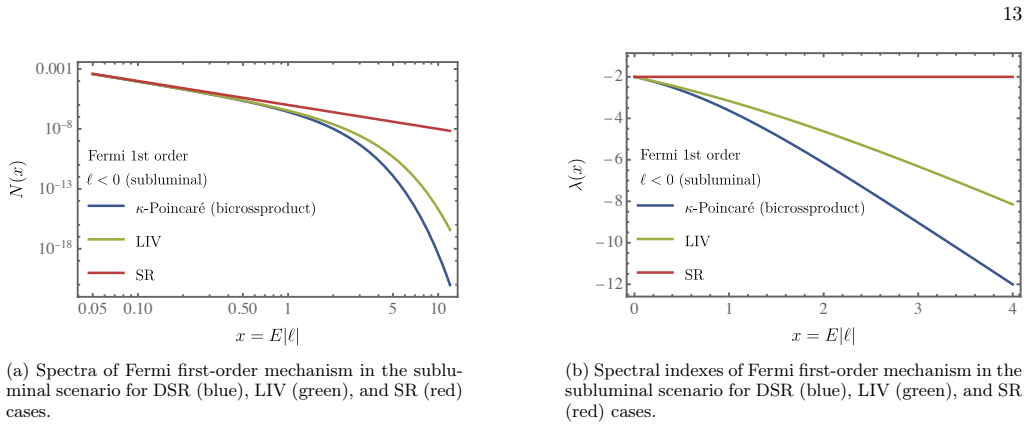
On its own terms, the paper establishes that Fermi acceleration is sensitive to which sector of Lorentz symmetry is modified. In the first-order mechanism, analytically solvable spectra are derived: for the bicrossproduct basis the spectrum is N(x) ∝ csch⁴(x)[coth(x) ± 1] depending on the sign of the deformation parameter ℓ, and for the LIV case N(x) ∝ e^{2x}/(e^x−1)² or 1/(e^x−1)²; both deviate from the special-relativistic power law E^{−2}. In the classical basis, where the dispersion relation is unchanged, the first-order spectrum is N(x) ∝ (x+1)/[x²(x+2)²], giving a spectral index that transitions from −2 to −3. The second-order mechanism is treated numerically; its effects appear at ene
What carries the argument
The carrying mechanism is Bell's shock-acceleration argument turned into a diffusion-loss equation, with the escape probability now set by the energy-dependent speed of light c_ℓ(E). For the bicrossproduct basis, c_ℓ(E) = c e^{ℓE}; this enters the escape probability P_esc = (4/3)U/c_ℓ(E), making the spectral equation energy-dependent. For the classical basis, the key ingredient is the deformed antipode ⊖p = −p(ℓE + √(1+ℓ²c⁴m²)) that replaces ordinary momentum reversal in the elastic collision, while c_ℓ = c stays constant. The spectra then follow from solving the resulting first- or second-order differential equations for N(E).
Load-bearing premise
The load-bearing premise is that the escape probability in the shock argument is inversely proportional to the energy-dependent speed c_ℓ(E); if the escape probability is actually energy-independent (as in the standard argument), the predicted spectral transitions reduce to tiny corrections.
What would settle it
Measure the cosmic-ray spectral index in a clean Fermi-type accelerator (e.g., supernova remnant shocks) across a wide energy range: if the index remains a constant power law, or if a steepening appears in a scenario with a modified dispersion relation but no classical-basis transition, the central claim fails. More narrowly, the classical-basis prediction N(x) ∝ (x+1)/[x²(x+2)²] is rejected if the observed spectrum around the supposed transition energy is inconsistent with a smooth −2-to−3 run at any deformation scale.
If this is right
- If the first-order Fermi spectrum is observed to steepen from index −2 to −3 at high energies without any accompanying time-of-flight or threshold anomalies, that would point specifically to a deformed momentum composition law rather than a modified dispersion.
- The energy dependence of the spectral index provides a new observable for cosmic ray observatories: the transition energy would directly encode the deformation scale ℓ^{−1}.
- In the bicrossproduct and LIV scenarios, superluminal vs subluminal signatures are distinguishable: LIV superluminal stabilizes the index to 0 at high energies, while DSR subluminal drops below −2.
- The second-order mechanism shows deviations starting around 10^{−3}ℓ^{−1}, extending the probe to lower energies relative to the Planck scale.
- Since the classical basis evades the usual photon time-of-flight and threshold bounds, the deformation scale could be below the Planck scale and still have escaped detection—making cosmic ray spectra a unique probe for this sector.
Where Pith is reading between the lines
- The energy dependence of the predicted spectra is largely carried by the assumption that the escape probability scales as 1/c_ℓ(E) in Bell's argument; if that prescription is modified, the same deformed kinematics would produce much weaker signatures. Testing this modeling choice against a more complete transport treatment would sharpen the predictions.
- A direct statistical fit of the classical-basis spectrum to the Pierre Auger energy spectrum could place a lower bound on ℓ^{−1}; the paper demonstrates the spectral shapes but does not perform such inference.
- The framework could be transferred to other shock environments, such as supernova remnants with different compression ratios, and to other deformed-relativity settings; the same diffusion equation would translate those into new spectral predictions.
- If second-order effects indeed appear at 10^{−3}ℓ^{−1}, then for ℓ^{−1} near 10^{15} eV the deviation would occur around 10^{12} eV, which is within reach of current balloon and space-borne cosmic-ray experiments—an opportunity the paper only gestures at.
Editorial analysis
A structured set of objections, weighed in public.
Referee Report
Summary. The paper constructs a general framework for first- and second-order Fermi acceleration in which frame transformations, energy-momentum conservation laws, and dispersion relations can be deformed. It is applied to the κ-Poincaré algebra in the bicrossproduct basis, to a Lorentz-violating limit with only a modified dispersion relation, and to the classical basis with an undeformed dispersion relation but a deformed composition law. The central analytic result is the first-order spectral index in the classical basis, which runs from -2 at low energy to -3 at high energy (Eqs. 75-76). The bicrossproduct and LIV cases produce energy-dependent escape probabilities and modified spectra, solved analytically in first order and numerically in second order.
Significance. If the derivation is correct, the paper offers a new phenomenological window: Fermi acceleration spectra could become a quantum-gravity probe, particularly via the classical basis, which avoids the strong bounds on modified dispersion relations. The first-order equations are solved in closed form, and the predictions are parameterized by the deformation scale ℓ rather than fitted to data. However, the printed derivation contains a central algebraic inconsistency that must be fixed before the results can be used.
major comments (2)
- [Sec. V.B, Eqs. (59), (71)] The antipode for the classical basis is printed as ⊖p′ = -p(ℓE + sqrt(1+ℓ^2 c^4 m^2)), which for massless particles gives ⊖p′ = -p(1+ℓE). Substituting this into Eq. (7) with the standard Lorentz transformation does not yield the energy gain Eq. (71); instead one obtains a term proportional to -ℓE times the SR gain, which would not produce the -2→-3 transition. Solving p⊕q = 0 using the composition law (56)-(57) gives q_E = -E/(1+ℓE), q_i = -p_i/(1+ℓE) for massless on-shell particles, which does reproduce Eq. (71). Thus Eq. (59) is internally inconsistent with the stated composition law and with the subsequent derivation. This is load-bearing because the central claim in Sec. V.B rests on Eq. (71). The authors must correct Eq. (59) or explicitly derive the antipode they actually use.
- [Abstract and Sec. VII] The abstract states: 'We compare our results with Pierre Auger data.' However, no quantitative comparison with Auger data appears anywhere in the manuscript. Section VII explicitly says 'We do not aim in this paper to explain transitions in cosmic ray spectra,' and the only related figure (Fig. 4) shows theoretical curves for different ℓ without data points. Either the claimed comparison should be added, or the abstract should be revised to describe the actual content.
minor comments (4)
- [Eq. (62)] In the LIV average energy gain, ⟨ΔE⟩_LIV, the factor (1 - e^{ℓE}) appears; the subsequent ODE (64) and solution (67) are consistent with (1 - e^{-ℓE}). Please correct the sign/argument typo, including in Eq. (63) if it propagates.
- [Notation throughout, esp. Eqs. (15), (17), (52), (60)-(62)] The symbol 'cℓ' is used both for the energy-dependent speed c_ℓ(E) (e.g., Eq. (15)) and for the product cℓ (c times the deformation scale, e.g., Eq. (60)). This ambiguity makes the derivation difficult to follow and may have caused the inconsistencies noted in the major comments. Use distinct notation, e.g., c_ℓ(E) for the speed and cℓ for the product.
- [Eq. (27) and Eq. (82)] The collision probability P(θ) is written as P(θ) ∝ 1 + U/c_ℓ cosθ in Eq. (27), but in the second-order bicrossproduct derivation the same symbol P(θ) appears with an e^{-ℓE} factor. This is consistent with c_ℓ = c e^{ℓE}, but the two expressions should be connected explicitly to avoid confusion.
- [Sec. II.B.2] The substitution of the differential flux for the integral flux in the escape probability is a modeling choice. It would be helpful to state more explicitly that this is an assumption, since the standard Bell argument uses the integral flux and the difference can affect the bicrossproduct spectra.
Circularity Check
No circularity (score 0); central classical-basis transition is internally consistent with the composition law, but Eq. (59) as printed is inconsistent with Eq. (71).
full rationale
No circular reduction is present. The deformation scale ℓ is scanned (Fig. 4) rather than fitted to Pierre Auger data, and the spectra are obtained by solving the diffusion equation (20) from stated inputs (frame transformations, composition law/antipode, dispersion relation, escape probability). The energy-dependent escape probability in the bicrossproduct case is an explicit modeling step (Eqs. (15)-(18)), not a hidden reuse of the output. Self-citations ([46],[47]) support standard κ-Poincaré technical facts that are also in external references ([22],[23],[45]) and are not load-bearing uniqueness claims. There is, however, a serious non-circular defect: as printed, Eq. (59) with m=0 gives ⊖p = -p(1+ℓE); substituted into Eq. (7) this yields ΔE ∝ (U/c)E cosθ(2+ℓE), whose diffusion equation gives N ∝ E^{-2}, not the claimed transition. Eq. (71) follows instead from the inverse antipode ⊖p = -p/(1+ℓE), which is the antipode implied by the classical-basis composition law (56)-(57). So Eq. (59) appears to be a typesetting error (division instead of multiplication); the -2 to -3 result is internally consistent with the composition law and is not a circular construction.
Axiom & Free-Parameter Ledger
free parameters (3)
- ℓ (κ-Poincaré deformation scale, ℓ = κ⁻¹) =
not fitted; scanned (e.g., 10¹⁵–10¹⁹ eV in Fig. 4)
- ε (DSR/LIV selector) =
fixed at 0 or 1
- τ_esc = α⁻¹ normalization (second order) =
τ_esc = α⁻¹
axioms (8)
- domain assumption κ-Poincaré bicrossproduct Poisson algebra, mass Casimir, boosts, and antipode (Eqs. 34–45, 53–55), from Majid–Ruegg [22] and Gubitosi–Mercati [45]
- domain assumption Classical-basis composition law and antipode (Eqs. 56–59), from Borowiec–Pachol [23], Pachol [25], Carmona et al. [26]
- ad hoc to paper Elastic collision maps p′ → ⊖p′ using the single-particle antipode; boost-parameter backreaction is omitted
- ad hoc to paper Escape probability from differential-flux ratio with energy-dependent speed: P_esc = (4/3)U/c_ℓ(E)
- domain assumption Non-relativistic monatomic shock thermodynamics: U = 3v_s/4, downstream speed v_s/4
- domain assumption Steady-state diffusion-loss equation with D∇²N = Q = 0 (Bell's argument)
- domain assumption Encounter probability P(θ) ∝ 1 + (U/c_ℓ)cos θ
- domain assumption Ultrarelativistic limit m ≈ 0 used throughout
read the original abstract
We construct models for first- and second-order Fermi acceleration of particles, incorporating generic frame transformations, dispersion relations, and conservation laws. Within this framework, we study deformations of Lorentz symmetry via the $\kappa$-Poincar\'e algebra in the bicrossproduct and classical bases, which respectively deform and preserve the relativistic dispersion relation. We also examine explicit Lorentz symmetry violation and compare the results with deformed relativity and special relativity. The energy spectra present different shapes when one considers deformation or violation of Lorentz symmetry in superluminal or subluminal scenarios. One of the possible outcomes is an intense decay of the spectrum for higher energies. We compare our results with Pierre Auger data.
Figures



Forward citations
Cited by 1 Pith paper
-
Bicovariant Codifferential Calculi
Bicovariant codifferential calculi on Hopf algebras reduce to classifying Yetter-Drinfeld submodules, providing a dual to existing differential calculi constructions.
Reference graph
Works this paper leans on
-
[1]
Momentum as a function of velocity and the speed of light 9
-
[2]
The escape probability 5
-
[3]
Second order F ermi acceleration mechanism6 IV
The spectral index 6 III. Second order F ermi acceleration mechanism6 IV. Deformation and Violation of Lorentz Symmetry8 A. Bicrossproduct basis 8
-
[4]
Classical basis 10 V
Modeling Lorentz Violation 10 B. Classical basis 10 V. First order F ermi Mechanism beyond Lorentz symmetry10 A. The bicrossproduct basis ofκ-Poincaré algebra and LIV scenarios 11
-
[5]
Classical basis 13 VI
Particle spectrum (super and subluminal cases) 11 B. Classical basis 13 VI. Second order F ermi Mechanism beyond Lorentz symmetry14 A. The bicrossproduct basis ofκ-Poincaré algebra and LIV scenarios 14
-
[6]
Particle spectrum (super and subluminal cases) 16 B. Classical basis 17 VII. Discussion 18 Acknowledgments 19 References 19 ∗Electronic address: erick.leite@academico.ufpb.br †Electronic address: dilto@fisica.ufc.br ‡Electronic address: valdir@fisica.ufpb.br §Electronic address: gilson.alves@estudante.ufcg.edu.br ¶Electronic address: lobofisica@gmail.com,...
Pith/arXiv arXiv 2026
-
[7]
the infinitesimal transformationsf0 and ⃗fthat act on energy and momentum from (3) and (4),
-
[8]
the opposite momentum⊖⃗ pfrom (5),
-
[9]
Any of these ingredients can produce a deformed energy gain and modify the acceleration process
the deformed velocity of particlesvi from (8). Any of these ingredients can produce a deformed energy gain and modify the acceleration process. 5
-
[10]
Particle spectrum From Bell’s argument [39, 40], we can derive the particle spectrum using a diffusion-loss equation. The number of particlesNat a given timetwithin an energy range(E, E+dE)is given by: dN dt =D∇ 2N+Q− N τesc + ∂(b·N) ∂E ,(11) whereDis a diffusion coefficient,Qis the rate of particle injection per unit volume,bis the energy loss rate, andτ...
-
[11]
detector
The escape probability In this section, we follow the discussion by Spurio (see section 6.5.1 of [42]). The flux is the same in either direction of particle passage, meaning that at each pass, the particle gains energy. In the downstream region, due to the random velocity of the particles, described by the isotropic nature of the velocity distribution in ...
-
[12]
magnetic mirrors,
The spectral index Since the velocity of the shock front is given byv s = 4U/3, whereUis the velocity of the perturbed gas in the downstream region in the rest frame of the unperturbed gas in the upstream region, we derive that the escape probability is related to the residence probabilityPas: 1−P=P esc = 4 3 U cℓ .(18) Using these expressions in (12), we...
1949
-
[13]
Momentum as a function of velocity and the speed of light To conclude the brief review of the main results of the bicrossproduct basis of theκ-Poincaré algebra, we also derive the speed of particles from the modified dispersion relation defined by the mass Casimir. From (38), we can find the energy and its first derivative: E=ℓ −1 log 2 2 +c 4m2ℓ2 −cℓ p c...
-
[14]
Without any of these ingredients, we are in a Lorentz-violating scenario
Modeling Lorentz Violation The set of conditions that describe a deformed relativistic scenario is given by the deformed algebra of generators (which defines the mass shell) and the composition law. Without any of these ingredients, we are in a Lorentz-violating scenario. The quantum gravity community usually assumes such a scenario as one produced by a m...
-
[15]
In Special Relativity, we havecℓ =cand⟨∆E⟩= 4U/3c, which gives: E dNSR dE + 2NSR = 0⇒N SR(E)∝E −2,(65) with a spectral index of−2
Particle spectrum (super and subluminal cases) In the case ofκ-Poincaré and LIV, we use (20) to find: N (1) κ,b ′(E) +ℓ e2ℓE + 3 e2ℓE −1 N (1) κ,b (E) = 0, N (1) LIV ′(E) + 2ℓ eℓE −1 N (1) LIV (E) = 0,(64) where prime ′ denotes differentiation with respect to energy, and we use the superscript(1)to denote the first-order mechanism. In Special Relativity, ...
-
[16]
Particle spectrum (super and subluminal cases) As in the first-order mechanism, we can define a dimensionless quantityx=ℓEto describe the spectrumN(x)and the spectral index, given by (22), in a simpler form: (ex −1) 2 (ex + 1)2 N (2) b,κ,+ ′′(x) + 6ex + 7e2x + 1 N (2) b,κ,+ ′(x) + 2 −8ex −e 2x −8e 3x + 6e4x −1 N (2) b,κ,+(x) = 0(87) and (ex −1) 2 −N (2) L...
-
[17]
0.0010 0.0015 0.0020 0.0025 0.0030 - 3.2 - 3.0 - 2.8 - 2.6 - 2.4 - 2.2 - 2.0 (b) Spectral indexes of Fermi second-order mechanism for DSR (blue) and SR (red) cases
× 10-4 0.001 0.005 0.010 (a) Spectra of Fermi second-order mechanism for DSR (blue) and SR (red) cases. 0.0010 0.0015 0.0020 0.0025 0.0030 - 3.2 - 3.0 - 2.8 - 2.6 - 2.4 - 2.2 - 2.0 (b) Spectral indexes of Fermi second-order mechanism for DSR (blue) and SR (red) cases. Figure 7: Second-order Fermi mechanism considering Lorentz preservation and deformation ...
2023
-
[18]
Polchinski,String Theory
J. Polchinski,String Theory. Vol. 1: An Introduction to the Bosonic String. Cambridge Monographs on Mathematical Physics. Cambridge University Press, 1998
1998
-
[19]
Lorentz Invariance Violation from String Theory,
N. E. Mavromatos, “Lorentz Invariance Violation from String Theory,”PoSQG-PH(2007) 027,arXiv:0708.2250 [hep-th]
Pith/arXiv arXiv 2007
-
[20]
A Short Review of Loop Quantum Gravity,
A. Ashtekar and E. Bianchi, “A Short Review of Loop Quantum Gravity,”Rept. Prog. Phys.84(2021) no. 4, 042001, arXiv:2104.04394 [gr-qc]
Pith/arXiv arXiv 2021
-
[21]
Spacetime-noncommutativity regime of Loop Quantum Gravity,
G. Amelino-Camelia, M. M. da Silva, M. Ronco, L. Cesarini, and O. M. Lecian, “Spacetime-noncommutativity regime of Loop Quantum Gravity,”Phys. Rev. D95(2017) no. 2, 024028,arXiv:1605.00497 [gr-qc]
Pith/arXiv arXiv 2017
-
[22]
Quantum Gravity from Causal Dynamical Triangulations: A Review,
R. Loll, “Quantum Gravity from Causal Dynamical Triangulations: A Review,”Class. Quant. Grav.37(2020) no. 1, 013002,arXiv:1905.08669 [hep-th]
Pith/arXiv arXiv 2020
-
[23]
Spectral Dimension of the Universe in Quantum Gravity at a Lifshitz Point,
P. Horava, “Spectral Dimension of the Universe in Quantum Gravity at a Lifshitz Point,”Phys. Rev. Lett.102(2009) 161301,arXiv:0902.3657 [hep-th]
Pith/arXiv arXiv 2009
-
[24]
3D Quantum Gravity and Effective Noncommutative Quantum Field Theory,
L. Freidel and E. R. Livine, “3D Quantum Gravity and Effective Noncommutative Quantum Field Theory,”Phys. Rev. Lett.96(2006) 221301,arXiv:hep-th/0512113
Pith/arXiv arXiv 2006
-
[25]
Modern tests of Lorentz invariance,
D. Mattingly, “Modern tests of Lorentz invariance,”Living Rev. Rel.8(2005) 5,arXiv:gr-qc/0502097
Pith/arXiv arXiv 2005
-
[26]
G. Amelino-Camelia, “Relativity in space-times with short distance structure governed by an observer independent (Planckian) length scale,”Int. J. Mod. Phys. D11(2002) 35–60,arXiv:gr-qc/0012051
Pith/arXiv arXiv 2002
-
[27]
Lorentz invariance with an invariant energy scale,
J. Magueijo and L. Smolin, “Lorentz invariance with an invariant energy scale,”Phys. Rev. Lett.88(2002) 190403, arXiv:hep-th/0112090
Pith/arXiv arXiv 2002
-
[28]
Planck-scale modified dispersion relations and Finsler geometry,
F. Girelli, S. Liberati, and L. Sindoni, “Planck-scale modified dispersion relations and Finsler geometry,”Phys. Rev. D 75(2007) 064015,arXiv:gr-qc/0611024
Pith/arXiv arXiv 2007
-
[29]
Realization of doubly special relativistic symmetries in Finsler geometries,
G. Amelino-Camelia, L. Barcaroli, G. Gubitosi, S. Liberati, and N. Loret, “Realization of doubly special relativistic symmetries in Finsler geometries,”Phys. Rev. D90(2014) no. 12, 125030,arXiv:1407.8143 [gr-qc]
Pith/arXiv arXiv 2014
-
[30]
I. P. Lobo, N. Loret, and F. Nettel, “Investigation of Finsler geometry as a generalization to curved spacetime of Planck-scale-deformed relativity in the de Sitter case,”Phys. Rev. D95(2017) no. 4, 046015,arXiv:1611.04995 [gr-qc]
Pith/arXiv arXiv 2017
-
[31]
Finsler spacetime geometry in Physics,
C. Pfeifer, “Finsler spacetime geometry in Physics,”Int. J. Geom. Meth. Mod. Phys.16(2019) no. supp02, 1941004, arXiv:1903.10185 [gr-qc]
Pith/arXiv arXiv 2019
-
[32]
Reaching the Planck scale with muon lifetime measurements,
I. P. Lobo and C. Pfeifer, “Reaching the Planck scale with muon lifetime measurements,”Phys. Rev. D103(2021) no. 10, 106025,arXiv:2011.10069 [hep-ph]
Pith/arXiv arXiv 2021
-
[33]
DSR-relativistic spacetime picture and the phenomenology of Planck-scale-modified time dilation,
G. Amelino-Camelia, G. Gubitosi, P. Pellecchia, M. Refuto, and G. Rosati, “DSR-relativistic spacetime picture and the phenomenology of Planck-scale-modified time dilation,”arXiv:2506.08111 [gr-qc]. 20
-
[34]
Hamilton geometry: Phase space geometry from modified dispersion relations,
L. Barcaroli, L. K. Brunkhorst, G. Gubitosi, N. Loret, and C. Pfeifer, “Hamilton geometry: Phase space geometry from modified dispersion relations,”Phys. Rev. D92(2015) no. 8, 084053,arXiv:1507.00922 [gr-qc]
Pith/arXiv arXiv 2015
-
[35]
Curved spacetimes with localκ-Poincaré dispersion relation,
L. Barcaroli, L. K. Brunkhorst, G. Gubitosi, N. Loret, and C. Pfeifer, “Curved spacetimes with localκ-Poincaré dispersion relation,”Phys. Rev. D96(2017) no. 8, 084010,arXiv:1703.02058 [gr-qc]
Pith/arXiv arXiv 2017
-
[36]
Quantum Configuration and Phase Spaces: Finsler and Hamilton Geometries,
S. Albuquerque, V. B. Bezerra, I. P. Lobo, G. Macedo, P. H. Morais, E. Rodrigues, L. C. N. Santos, and G. Varão, “Quantum Configuration and Phase Spaces: Finsler and Hamilton Geometries,”Physics5(2023) 90–115, arXiv:2301.09448 [gr-qc]
Pith/arXiv arXiv 2023
-
[37]
Q deformation of Poincare algebra,
J. Lukierski, H. Ruegg, A. Nowicki, and V. N. Tolstoi, “Q deformation of Poincare algebra,”Phys. Lett. B264(1991) 331–338
1991
-
[38]
Quantum kappa Poincare in any dimension,
J. Lukierski and H. Ruegg, “Quantum kappa Poincare in any dimension,”Phys. Lett. B329(1994) 189–194, arXiv:hep-th/9310117
Pith/arXiv arXiv 1994
-
[39]
Bicrossproduct structure of kappa Poincare group and noncommutative geometry,
S. Majid and H. Ruegg, “Bicrossproduct structure of kappa Poincare group and noncommutative geometry,”Phys. Lett. B334(1994) 348–354,arXiv:hep-th/9405107
Pith/arXiv arXiv 1994
-
[40]
Classical basis for kappa-Poincare algebra and doubly special relativity theories,
A. Borowiec and A. Pachol, “Classical basis for kappa-Poincare algebra and doubly special relativity theories,”J. Phys. A 43(2010) 045203,arXiv:0903.5251 [hep-th]
Pith/arXiv arXiv 2010
-
[41]
Arzano and J
M. Arzano and J. Kowalski-Glikman,Deformations of Spacetime Symmetries: Gravity, Group-Valued Momenta, and Non-Commutative Fields, vol. 986 ofLecture Notes in Physics. 6, 2021
2021
-
[42]
Pachol,κ-Minkowski spacetime: Mathematical formalism and applications in Planck scale physics
A. Pachol,κ-Minkowski spacetime: Mathematical formalism and applications in Planck scale physics. PhD thesis, Wroclaw U., 2011.arXiv:1112.5366 [math-ph]
Pith/arXiv arXiv 2011
-
[43]
J. M. Carmona, J. L. Cortés, F. Rescic, M. A. Reyes, and T. Terzić, “Photon absorption in a doubly special relativity model with undeformed free propagation and total momentum conservation,”JCAP07(2025) 066,arXiv:2503.15203 [hep-ph]
arXiv 2025
-
[44]
Quantum gravity phenomenology at the dawn of the multi-messenger era—A review,
A. Addaziet al., “Quantum gravity phenomenology at the dawn of the multi-messenger era—A review,”Prog. Part. Nucl. Phys.125(2022) 103948,arXiv:2111.05659 [hep-ph]
Pith/arXiv arXiv 2022
-
[45]
White paper and roadmap for quantum gravity phenomenology in the multi-messenger era,
R. Alves Batistaet al., “White paper and roadmap for quantum gravity phenomenology in the multi-messenger era,” Class. Quant. Grav.42(2025) no. 3, 032001,arXiv:2312.00409 [gr-qc]
Pith/arXiv arXiv 2025
-
[46]
Quantum-Spacetime Phenomenology,
G. Amelino-Camelia, “Quantum-Spacetime Phenomenology,”Living Rev. Rel.16(2013) 5,arXiv:0806.0339 [gr-qc]
Pith/arXiv arXiv 2013
-
[47]
Space-time quantum solves three experimental paradoxes,
G. Amelino-Camelia, “Space-time quantum solves three experimental paradoxes,”Phys. Lett. B528(2002) 181–187, arXiv:gr-qc/0107086. [31]Pierre AugerCollaboration, A. Aabet al., “Combined fit of spectrum and composition data as measured by the Pierre Auger Observatory,”JCAP04(2017) 038,arXiv:1612.07155 [astro-ph.HE]. [Erratum: JCAP 03, E02 (2018)]
Pith/arXiv arXiv 2002
-
[48]
Ultra-high-energy cosmic-ray bounds on nonbirefringent modified-Maxwell theory,
F. R. Klinkhamer and M. Risse, “Ultra-high-energy cosmic-ray bounds on nonbirefringent modified-Maxwell theory,” Phys. Rev. D77(2008) 016002,arXiv:0709.2502 [hep-ph]
Pith/arXiv arXiv 2008
-
[49]
T. Jacobson, S. Liberati, and D. Mattingly, “Threshold effects and Planck scale Lorentz violation: Combined constraints from high-energy astrophysics,”Phys. Rev. D67(2003) 124011,arXiv:hep-ph/0209264
Pith/arXiv arXiv 2003
-
[50]
Future prospects of testing Lorentz invariance with UHECRs,
D. Boncioli, A. di Matteo, F. Salamida, R. Aloisio, P. Blasi, P. L. Ghia, A. Grillo, S. Petrera, and T. Pierog, “Future prospects of testing Lorentz invariance with UHECRs,”PoSICRC2015(2016) 521,arXiv:1509.01046 [astro-ph.HE]
Pith/arXiv arXiv 2016
-
[51]
Changes in extensive air showers from isotropic Lorentz violation in the photon sector,
J. S. Diaz, F. R. Klinkhamer, and M. Risse, “Changes in extensive air showers from isotropic Lorentz violation in the photon sector,”Phys. Rev. D94(2016) no. 8, 085025,arXiv:1607.02099 [hep-ph]. [36]Pierre AugerCollaboration, P. Abreuet al., “Constraining Lorentz Invariance Violation using the muon content of extensive air showers measured at the Pierre A...
Pith/arXiv arXiv 2016
-
[52]
Lorentz Invariance Violation Tests in Astroparticle Physics,
H. Martínez-Huerta, R. G. Lang, and V. de Souza, “Lorentz Invariance Violation Tests in Astroparticle Physics,” Symmetry12(2020) no. 8, 1232
2020
-
[53]
On the Origin of the Cosmic Radiation,
E. Fermi, “On the Origin of the Cosmic Radiation,”Phys. Rev.75(1949) 1169–1174
1949
-
[54]
The Acceleration of cosmic rays in shock fronts. I,
A. R. Bell, “The Acceleration of cosmic rays in shock fronts. I,”Mon. Not. Roy. Astron. Soc.182(1978) 147–156
1978
-
[55]
The acceleration of cosmic rays in shock fronts. II.,
A. R. Bell, “The acceleration of cosmic rays in shock fronts. II.,”Mon. Not. Roy. Astron. Soc.182(1978) 443–455
1978
-
[56]
Longair,High Energy Astrophysics
M. Longair,High Energy Astrophysics. Cambridge University Press, 2011
2011
-
[57]
Spurio,Probes of Multimessenger Astrophysics
M. Spurio,Probes of Multimessenger Astrophysics. Charged cosmic rays, neutrinos,γ-rays and gravitational waves. Astronomy and Astrophysics Library. Springer, 2018
2018
-
[58]
Fermi acceleration under Lorentz invariance violation,
M. Duarte and V. de Souza, “Fermi acceleration under Lorentz invariance violation,”JCAP10(2024) 029, arXiv:2407.17254 [astro-ph.HE]
Pith/arXiv arXiv 2024
-
[59]
M. Duarte and V. de Souza, “Effects of Lorentz invariance violation on charged particles and photon production in astrophysical sources,”arXiv:2507.06766 [astro-ph.HE]
-
[60]
Relative Locality inκ-Poincaré,
G. Gubitosi and F. Mercati, “Relative Locality inκ-Poincaré,”Class. Quant. Grav.30(2013) 145002,arXiv:1106.5710 [gr-qc]
Pith/arXiv arXiv 2013
-
[61]
Two-body decays in deformed relativity,
I. P. Lobo, C. Pfeifer, P. H. Morais, R. A. Batista, and V. B. Bezerra, “Two-body decays in deformed relativity,”JHEP 09(2022) 003,arXiv:2112.12172 [hep-ph]
Pith/arXiv arXiv 2022
-
[62]
Anti-de Sitter momentum space in 3D and 4D quantum gravity,
G. Amelino-Camelia, I. P. Lobo, and G. Palmisano, “Anti-de Sitter momentum space in 3D and 4D quantum gravity,” Class. Quant. Grav.41(2024) no. 8, 085006,arXiv:2403.16721 [gr-qc]
Pith/arXiv arXiv 2024
-
[63]
V. Vasileiou, A. Jacholkowska, F. Piron, J. Bolmont, C. Couturier, J. Granot, F. W. Stecker, J. Cohen-Tanugi, and F. Longo, “Constraints on Lorentz Invariance Violation from Fermi-Large Area Telescope Observations of Gamma-Ray Bursts,”Phys. Rev. D87(2013) no. 12, 122001,arXiv:1305.3463 [astro-ph.HE]. [49]LHAASOCollaboration, Z. Caoet al., “Stringent Tests...
Pith/arXiv arXiv 2013
discussion (0)
Sign in with ORCID, Apple, or X to comment. Anyone can read and Pith papers without signing in.